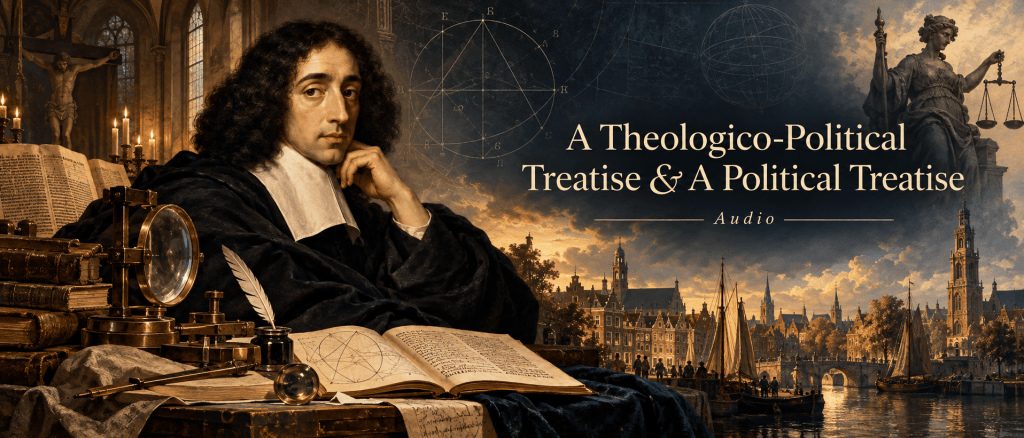
Few works in the history of Western philosophy have challenged established religious and political authority as profoundly as Baruch Spinoza’s A Theologico-Political Treatise and A Political Treatise. Written during an era of intense theological controversy, political instability, and intellectual transformation, these two works represent a decisive turning point in the development of modern philosophy. Combining rigorous historical scholarship, radical biblical criticism, metaphysical inquiry, and systematic political analysis, Spinoza questions the foundations of religious orthodoxy, examines the relationship between faith and reason, and develops an influential defense of freedom of thought, expression, and philosophical investigation. Together, the treatises provide an extraordinary examination of the conditions under which human beings can live rationally, peacefully, and freely within organized society.
First published anonymously in Latin in 1670, A Theologico-Political Treatise (Tractatus Theologico-Politicus) was among the most controversial philosophical publications of the seventeenth century. Appearing in the Dutch Republic, a society renowned for its relative religious tolerance but nevertheless divided by bitter theological and political disputes, the work immediately provoked accusations of atheism, impiety, and subversion. Its arguments were considered so dangerous that the original publication concealed the author’s identity and employed a fictitious publishing address. In 1674, the treatise was formally prohibited by the authorities in Holland, although copies continued to circulate throughout Europe. What contemporary critics condemned as an assault upon religious and political order would subsequently be recognized as a foundational contribution to Enlightenment thought, historical biblical scholarship, and the philosophical defense of intellectual liberty.
At the center of A Theologico-Political Treatise lies Spinoza’s revolutionary approach to the interpretation of Scripture. Rejecting the assumption that the Bible must be understood as a unified, divinely dictated document containing infallible truths about nature and metaphysics, Spinoza argues that it should instead be investigated through the same historical, linguistic, and critical methods employed in the examination of other ancient texts. He studies the circumstances of its composition, the intentions and intellectual limitations of its authors, the transmission of its manuscripts, and the political and cultural environments in which its various books emerged. His analysis leads him to question the traditional attribution of the Pentateuch, the first five books of the Hebrew Bible, to Moses, arguing that these writings contain evidence of later composition, editorial intervention, and historical development. He similarly examines the authorship and compilation of other biblical books, anticipating important elements of the historical-critical methods that would become central to modern biblical studies.
Spinoza’s investigation extends beyond textual authorship to the nature of prophecy, revelation, divine law, and miracles. Rather than treating prophets as privileged philosophers possessing extraordinary knowledge of the ultimate structure of reality, he interprets prophecy primarily in relation to imagination, moral understanding, and the historical circumstances of particular communities. His treatment of miracles is equally radical. Because nature operates according to necessary and universal laws, events cannot constitute genuine violations of the natural order. What human beings describe as miraculous reflects the limitations of their understanding rather than an interruption of nature by a supernatural power. This interpretation challenges traditional conceptions of divine intervention while establishing a fundamentally naturalistic approach to religious experience and historical explanation.
These arguments are closely connected to Spinoza’s broader philosophical understanding of God and nature. Although his most systematic exposition of this relationship appears in his posthumously published Ethics, the theological treatise already challenges the conception of God as a humanlike sovereign who intervenes arbitrarily in worldly affairs. For Spinoza, divine activity cannot be understood independently of the necessary order of nature. The theological significance of Scripture must therefore be distinguished from questions concerning the causal structure of reality, which belong to philosophical and rational investigation. By refusing to subordinate reason to inherited theological authority, Spinoza establishes a radically different understanding of the relationship between knowledge, religion, and human freedom.
One of the treatise’s most enduring contributions is its distinction between philosophy and theology. Spinoza argues that the two disciplines pursue fundamentally different objectives: philosophy seeks truth through reason and demonstration, whereas faith concerns obedience, moral conduct, and the practical cultivation of justice and charity. Scripture, he maintains, does not demand agreement with an elaborate system of speculative doctrines. Its essential ethical teaching is accessible without sophisticated philosophical knowledge and can be expressed through the fundamental obligations to love one’s neighbor, act justly, and practice charity. Religious devotion should consequently be evaluated not by conformity to imposed dogmas but by the conduct it produces. This position permits individuals to maintain different theological convictions without necessarily undermining their shared moral and civic responsibilities.
From this distinction emerges Spinoza’s powerful defense of freedom of conscience and intellectual inquiry. He argues that no political authority can completely control what individuals believe or compel genuine agreement through coercion. Attempts to regulate thought and suppress philosophical disagreement are therefore not merely oppressive but ultimately ineffective and politically dangerous. Far from threatening public stability, freedom of philosophical investigation can contribute to social peace by reducing the destructive influence of religious fanaticism, sectarian conflict, and institutionalized superstition. The suppression of intellectual freedom, by contrast, encourages hypocrisy, resentment, and political instability. Spinoza’s central contention is that the freedom to philosophize is compatible with genuine religious devotion and indispensable to the preservation of a peaceful commonwealth.
The political implications of these arguments are extensive. Spinoza examines the historical organization of the ancient Hebrew state, the relationship between religious authority and civil government, and the ways theological doctrines have been used to legitimize political power. He argues that religious institutions become particularly dangerous when they claim independent coercive authority or seek to impose their interpretations of sacred texts upon the wider population. His proposed solution places the public regulation of religious institutions under civil authority while defending the individual’s freedom of inward belief and rational judgment. Although his conception of liberty does not amount to an unrestricted modern doctrine of free expression, it represents a remarkable intervention in the development of religious toleration, republican political theory, and the philosophical foundations of a society in which competing convictions can coexist.
Spinoza’s political philosophy also rests upon a distinctive understanding of human nature. Rejecting idealized accounts of political life that assume human beings consistently act according to reason or moral virtue, he recognizes that individuals are frequently governed by fear, hope, ambition, resentment, and competing desires. Political institutions must therefore be designed with an understanding of human psychology rather than constructed around unrealistic expectations of universal rationality. This approach connects Spinoza’s political arguments to his wider philosophical investigation of emotions, causality, necessity, and the conditions of human freedom. Political stability emerges not simply from the moral excellence of rulers or citizens but from institutions capable of organizing conflicting interests into a sustainable social order.
These concerns receive a more systematic treatment in A Political Treatise (Tractatus Politicus), Spinoza’s final major work, composed during the last years of his life and left unfinished at his death in 1677. Published posthumously that same year, the treatise moves beyond the immediate theological controversies of the earlier work toward a comprehensive examination of political authority, natural right, sovereignty, institutional design, and the organization of the state. Drawing upon his understanding of human behavior and the relationship between power and right, Spinoza asks how political communities can preserve security, prevent tyranny, and establish the conditions necessary for collective freedom.
Rather than beginning with an idealized vision of how political communities ought to function, Spinoza investigates the actual mechanisms through which authority is acquired, maintained, and exercised. His analysis reflects an engagement with the political realism associated with Niccolò Machiavelli and Thomas Hobbes, while developing an independent account of collective power, rational cooperation, and the common good. Natural right, in Spinoza’s account, is inseparable from the actual power of individuals and communities to exist and act. Political institutions must consequently accommodate the forces shaping human conduct and establish durable arrangements through which private interests can be reconciled with public security.
A Political Treatise examines three principal forms of government: monarchy, aristocracy, and democracy. In his treatment of monarchy, Spinoza considers how royal authority can be constitutionally organized and restrained to prevent arbitrary government and the concentration of unchecked power. His analysis emphasizes the importance of councils, institutional safeguards, and arrangements that make the interests of rulers dependent upon the well-being of the political community. The objective is not merely to identify an enlightened monarch but to establish a political structure capable of maintaining stability even when those exercising authority are motivated by ordinary human passions.
His discussion of aristocracy investigates forms of government in which political authority is concentrated within a comparatively limited governing body. Spinoza distinguishes between centralized and decentralized aristocratic systems, examining their institutional advantages, vulnerabilities, and potential sources of conflict. He considers the distribution of offices, the size and composition of governing councils, and the arrangements necessary to prevent factional domination. Throughout this analysis, he emphasizes that durable government depends upon balancing political interests and limiting opportunities for private ambition to undermine collective security.
The final section turns to democracy, which Spinoza regards as an especially significant form of political organization because of its relationship to collective sovereignty and the distribution of political power. Democracy offers the possibility of bringing political authority into closer alignment with the power of the community as a whole. However, Spinoza died before completing his systematic treatment of democratic government, leaving only the opening portion of the intended discussion. The surviving text also reveals important limitations in his conception of political participation, including the exclusion of women, servants, and certain other groups from his proposed democratic arrangements. These restrictions reflect significant tensions between the universal implications of his philosophical principles and the social assumptions of seventeenth-century political thought.
Despite its unfinished condition, A Political Treatise remains a major contribution to the history of political philosophy. Its account of sovereignty, constitutional organization, collective power, and political stability anticipates questions that would later become central to modern discussions of democracy, institutional accountability, and the relationship between individual liberty and public authority. Particularly important is Spinoza’s insistence that peace cannot be reduced to the mere absence of armed conflict. A genuinely peaceful political community requires a stable civic order in which collective institutions enable individuals to live securely and develop their capacities.
The relationship between the two treatises reveals the remarkable continuity of Spinoza’s philosophical project. Whereas A Theologico-Political Treatise confronts the intellectual and political consequences of religious authority, A Political Treatise examines the institutional arrangements through which freedom and stability might be achieved in practice. Both works reject appeals to unquestionable authority and instead seek to explain religious and political phenomena through their natural, historical, and psychological causes. Both insist that the organization of society must be understood in relation to human nature, collective power, and the conditions of rational coexistence. Together, they present an integrated conception of philosophy as an inquiry into the forces that govern human life and the possibilities for transforming those forces through knowledge and institutional organization.
Spinoza’s intellectual independence was inseparable from his extraordinary personal circumstances. Born in Amsterdam in 1632 into a Portuguese-Sephardic Jewish family whose ancestors had fled religious persecution in the Iberian Peninsula, he received an education grounded in Jewish religious scholarship and Hebrew learning. In 1656, at the age of twenty-three, he was expelled from Amsterdam’s Portuguese-Jewish congregation following accusations of grave religious heterodoxy. He never converted to Christianity and did not subsequently affiliate himself with another established religious denomination. Instead, he pursued an independent philosophical existence, supporting himself in part through optical lens work and maintaining intellectual relationships with a circle of scholars, scientists, and religious dissenters. His philosophical writings challenged many of the fundamental assumptions shared by the religious and intellectual establishments of his time, and his major systematic work, Ethics, was published only after his death in 1677.
The influence of Spinoza’s political and theological writings extends far beyond their immediate seventeenth-century context. His treatment of Scripture helped establish the foundations of modern historical biblical criticism, while his defense of intellectual independence contributed to the development of Enlightenment debates about toleration, secular government, freedom of expression, and the legitimate limits of political authority. His thought would become a major point of reference for subsequent generations of philosophers and historians, including important figures associated with German idealism, modern theories of democracy, and contemporary interpretations of the relationship between reason and political power.
More than three centuries after their composition, A Theologico-Political Treatise and A Political Treatise remain essential works for understanding the origins of modern philosophical and political thought. Their central questions retain considerable relevance: How should religious authority relate to civil government? Can freedom of thought coexist with political stability? What distinguishes rational faith from superstition? How can political institutions accommodate the competing interests and passions of individuals? What makes a state genuinely free, and what conditions allow human beings to live together without coercion, persecution, or fear?
This unabridged audiobook edition brings together two of Spinoza’s most important contributions to the philosophy of religion and politics, offering an extensive exploration of the intellectual foundations of religious criticism, political sovereignty, constitutional government, and human liberty. Combining historical investigation with systematic philosophical reasoning, these treatises reveal Spinoza not only as one of the foremost metaphysicians of the early modern period but also as an exceptionally original theorist of political life. Their arguments continue to challenge conventional assumptions about authority, belief, and freedom, making them indispensable listening for students of philosophy, theology, political theory, intellectual history, and the Enlightenment.
A Theologico-Political Treatise is presented in the English translation by Robert Harvey Monro Elwes, and A Political Treatise in the translation by A. H. Gosset.


Leave a Reply