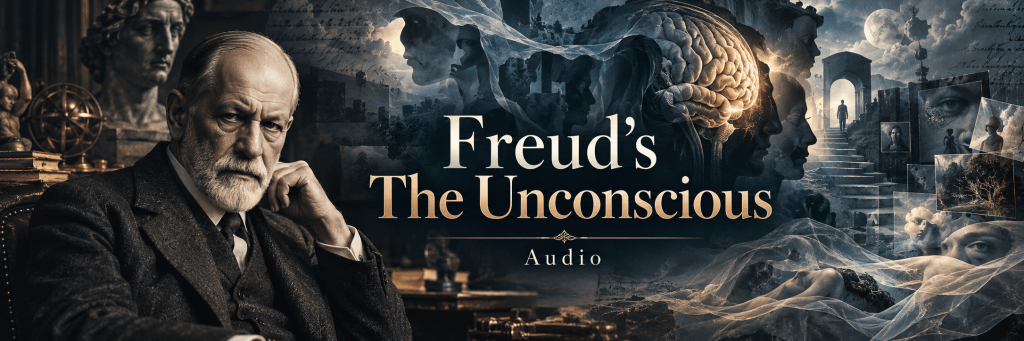
Sigmund Freud’s The Unconscious is one of the foundational works of modern psychoanalysis and a landmark in the history of psychological and philosophical thought. Bringing together some of Freud’s most influential essays on the hidden mechanisms of mental life, this collection offers a systematic exploration of the forces that shape human thoughts, emotions, desires, and behaviour beyond the boundaries of conscious awareness. Through his investigations of repression, instinctual drives, sexuality, psychological conflict, and the relationship between consciousness and unconscious mental activity, Freud challenges the traditional assumption that human beings possess transparent knowledge of their own minds. Instead, he presents a profoundly different conception of the psyche: one in which conscious experience constitutes only a portion of mental existence, while unconscious processes continually influence perception, memory, judgment, and action.
At the centre of Freud’s revolutionary approach is the proposition that thoughts, impulses, wishes, and memories can remain psychologically active even when they are inaccessible to consciousness. The unconscious, in this account, is not simply a repository of forgotten experiences or information temporarily outside awareness. It is an organised domain of mental activity governed by principles that differ fundamentally from those regulating ordinary conscious thought. Freud argues that disturbing or unacceptable wishes may be excluded from consciousness through repression, yet their psychological force does not disappear. Instead, they continue to find indirect expression through dreams, fantasies, neurotic symptoms, slips of the tongue, and seemingly irrational patterns of behaviour. This understanding of unconscious motivation became one of the defining principles of psychoanalysis and transformed subsequent discussions of human subjectivity, personal identity, and psychological conflict.
The collection opens with Formulations on the Two Principles of Psychic Functioning (1911), an important statement of Freud’s distinction between the pleasure principle and the reality principle. According to Freud, psychic life initially seeks the immediate reduction of tension and the satisfaction of desire. As individuals encounter the constraints of the external world, however, they gradually develop the capacity to postpone gratification, tolerate frustration, and adjust their behaviour to circumstances. The resulting relationship between pleasure and reality is not a simple opposition between irrationality and reason. Rather, Freud describes an ongoing process of negotiation in which immediate satisfaction is redirected, deferred, or transformed in accordance with the demands of practical existence. His analysis raises fundamental questions about psychological development, self-control, adaptation, and the tensions that accompany participation in social life.
In Drives and Their Fates (1915), Freud turns to the instinctual foundations of mental activity, examining the nature of the drives that generate psychological tension and motivate human behaviour. He distinguishes their sources, aims, objects, and the transformations they may undergo, developing an account of how desire can change direction without necessarily losing its underlying force. Particularly significant are his investigations of sadism and masochism, voyeurism and exhibitionism, through which he explores the transformation of active impulses into passive ones and the redirection of drives toward the self. These analyses form part of his broader attempt to understand human sexuality not as a fixed biological mechanism but as a complex field of psychological processes shaped by development, fantasy, conflict, and changing relations to objects of desire. Freud’s distinction between a drive and an instinct also becomes essential here, suggesting that human motivation cannot be reduced to predetermined patterns of behaviour.
The essay Repression (1915) develops one of the most consequential concepts in psychoanalytic theory. Freud investigates the psychological mechanisms through which disturbing ideas and impulses are prevented from entering consciousness, and the circumstances under which their derivatives return in altered or disguised forms. Repression, he argues, is not equivalent to forgetting, nor does it eliminate the mental contents against which it operates. Instead, it maintains a dynamic separation between conflicting psychological tendencies, often requiring continuing defensive activity. The repressed material may consequently reappear through substitute ideas, symptoms, anxieties, or forms of behaviour whose origins remain obscure to the individual. Freud’s analysis provides an important theoretical foundation for his understanding of neurosis and for the psychoanalytic practice of interpreting apparently disconnected mental experiences as expressions of underlying psychological conflicts.
The collection’s central essay, The Unconscious (1915), provides Freud’s most systematic early formulation of unconscious mental functioning. Here he considers the evidence for unconscious processes, the relationship between conscious and unconscious ideas, and the limitations of introspection as a means of understanding the mind. He distinguishes between descriptive, dynamic, and systematic meanings of the unconscious, while developing a model of mental activity involving unconscious, preconscious, and conscious systems. Particularly influential is his account of the distinctive characteristics of unconscious processes, including their relative independence from ordinary chronological time, their capacity to accommodate contradictory impulses, and their operation through mechanisms of displacement and condensation. Freud also examines the relationship between unconscious representations and language, considering how mental contents become available to consciousness and why certain ideas remain inaccessible despite their continuing psychological activity.
These investigations illuminate Freud’s broader distinction between primary and secondary processes. Primary processes, associated especially with unconscious mental functioning, permit the movement and redistribution of psychological intensity between ideas and representations. Secondary processes, more closely associated with deliberate thinking and the demands of reality, organise mental activity through logical connections, temporal relationships, and practical considerations. Freud’s account thereby challenges the assumption that all mental processes operate according to the same principles. The apparently illogical character of dreams, symptoms, and fantasies becomes intelligible within a theory that attributes to unconscious activity its own distinctive organisation.
In Negation (1925), Freud examines the revealing relationship between denial and unconscious recognition. He observes that individuals may introduce a disturbing thought into conscious discourse precisely by declaring that it does not apply to them. Such statements suggest that the intellectual acknowledgment of an idea does not necessarily entail its emotional acceptance. The essay explores how judgment, affirmation, and negation develop from more elementary psychological processes, extending psychoanalytic theory into fundamental questions concerning cognition and the formation of conscious thought. Freud’s analysis is especially significant for its demonstration of how an apparently straightforward act of denial may disclose a more complicated relationship between conscious reasoning and repressed material.
The later essay Fetishism (1927) develops these questions through Freud’s investigation of sexual desire, anxiety, and the defence mechanism he describes as disavowal. He proposes that fetishistic attachments may emerge through a psychological compromise in which a disturbing perception is simultaneously acknowledged and repudiated. His interpretation, particularly its association with childhood sexual theories and castration anxiety, reflects the assumptions and clinical framework of early twentieth-century psychoanalysis. Nevertheless, the essay occupies an important position in the development of Freud’s theory of psychological defence, demonstrating his increasing interest in the possibility that contradictory attitudes toward reality may coexist within the same individual.
This line of inquiry culminates in The Splitting of the Ego in Defence Processes, written in 1938 and published posthumously in 1940. In this late and unfinished work, Freud returns to the problem of psychological conflict and proposes that the ego may maintain incompatible attitudes rather than resolving their contradiction. The resulting division complicates the notion of a unified, internally consistent self and represents an important development in Freud’s final understanding of defensive mental processes. Read alongside his earlier writings on repression and unconscious motivation, the essay illustrates both the continuity of his central concerns and the substantial changes his theories underwent over several decades.
Taken together, these writings trace a remarkable intellectual development from Freud’s early account of the competing demands of pleasure and reality to his mature investigations of unconscious conflict, disavowal, and psychic division. Although Freud’s specific clinical interpretations and many of his theoretical claims remain subjects of substantial scientific and philosophical debate, their historical influence is difficult to overstate. His concepts have shaped psychiatry, psychotherapy, psychology, literary criticism, cultural theory, and continental philosophy, while informing the work of thinkers such as Jacques Lacan, Paul Ricoeur, Herbert Marcuse, and numerous subsequent theorists of subjectivity and desire. More broadly, Freud’s investigations transformed the vocabulary through which modern culture discusses repression, psychological defence, unconscious motivation, and the instability of personal identity.
Presented in Graham Frankland’s English translation, with an introduction by Mark Cousins, this Penguin Classics edition forms part of a wider publishing project devoted to making Freud’s major writings accessible to contemporary readers. The introduction provides an intellectual framework for approaching the collection, while the translation preserves important distinctions in Freud’s conceptual terminology and argumentative method. The audiobook edition is performed by acclaimed British actor Michael Pennington, co-founder of the English Shakespeare Company, whose extensive theatrical career includes performances with the Royal Shakespeare Company and his portrayal of Carl Jung in the BBC drama Freud. His narration brings a measured and engaging quality to Freud’s frequently intricate discussions, making the collection particularly suitable for sustained listening and reflection.
At once a foundational introduction to psychoanalysis and a concentrated examination of some of its most difficult theoretical problems, The Unconscious offers an indispensable perspective on Freud’s attempt to explain the hidden dimensions of human experience. It confronts questions that remain central to psychological and philosophical inquiry: How much of human behaviour is consciously determined? Why do unwanted thoughts and desires persist despite efforts to suppress them? How can individuals simultaneously acknowledge and deny the same reality? What does it mean to understand oneself when the mind is not fully accessible to its own awareness? Through these enduring problems, Freud invites readers and listeners to reconsider the nature of rationality, freedom, self-knowledge, and the complex relationship between what human beings consciously believe and what may unconsciously influence their lives.


Leave a Reply