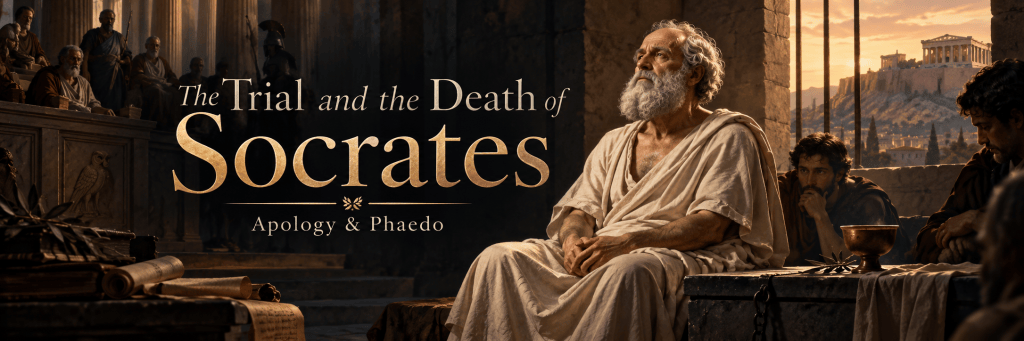
The Trial and the Death of Socrates brings together two of the most influential works of ancient philosophy, Plato’s Apology and Phaedo, which recount the trial, condemnation, final philosophical conversations, and execution of Socrates in Athens in 399 BCE. Combining historical drama with profound reflections on justice, knowledge, morality, the soul, and the meaning of human existence, these writings offer an extraordinary portrait of a philosopher whose commitment to intellectual inquiry transformed the course of Western thought. More than two millennia after their composition, they remain foundational texts in philosophy, political theory, ethics, and the enduring debate over the relationship between individual conscience and the authority of the state.
Socrates (469–399 BCE) occupies a singular position in intellectual history. Although he left no philosophical writings of his own, his methods of questioning, his insistence on rational examination, and his conviction that virtue is inseparable from the pursuit of wisdom profoundly influenced subsequent generations. Much of what is known about his life and thought derives from the works of his students and contemporaries, especially Plato and Xenophon. Among these accounts, Plato’s Apology and Phaedo are particularly significant because they present the philosopher at the decisive moment when his principles were tested against the prospect of death. While these works are rooted in historical events, they are also carefully constructed philosophical and literary compositions rather than verbatim transcripts. Their importance lies in the remarkable combination of historical testimony, philosophical argument, and dramatic characterization through which Plato preserves and interprets the legacy of his teacher.
The events unfold against the turbulent political background of late fifth-century Athens. Following decades of conflict with Sparta, the catastrophic defeat of Athens in the Peloponnesian War in 404 BCE, and the brief but violent oligarchic regime of the Thirty, the restored Athenian democracy remained marked by political instability, social tensions, and widespread anxiety concerning the relationship between traditional values and intellectual innovation. Socrates, whose public questioning of influential citizens had attracted admiration as well as hostility, became an increasingly controversial figure. His associations with prominent individuals, some of whom had participated in anti-democratic politics, added to the atmosphere of suspicion surrounding him. In 399 BCE, at approximately seventy years of age, he was brought before an Athenian court and charged with impiety, introducing or acknowledging unauthorized divine powers, and corrupting the city’s youth. His trial would become one of the most consequential episodes in the history of philosophy.
In Apology, Plato reconstructs Socrates’ defense before the citizens serving as his judges. The Greek term apologia signifies a reasoned defense rather than an expression of regret, and the work presents Socrates not as a penitent defendant seeking forgiveness but as a philosopher determined to justify his way of life. Rejecting the conventional techniques of courtroom persuasion, he refuses to flatter his judges or appeal to their emotions through displays of personal suffering. Instead, he examines the accusations against him, challenges the assumptions of his opponents, and explains why philosophical inquiry constitutes a public service rather than a threat to the community.
Central to his defense is the celebrated account of the Delphic oracle, which reportedly declared that no one was wiser than Socrates. Perplexed by this pronouncement, Socrates began questioning politicians, poets, craftsmen, and other individuals who claimed to possess knowledge. He discovered that many were confident in their wisdom without adequately understanding the subjects on which they spoke. Socrates consequently interpreted his own distinctive wisdom as an awareness of the limitations of his knowledge. This recognition became the foundation of his philosophical practice: a relentless examination of beliefs, values, and assumptions through dialogue and rational argument.
The Apology therefore introduces some of the most enduring themes of Socratic philosophy. Socrates argues that the cultivation of the soul and the pursuit of virtue are more important than wealth, reputation, political advancement, or physical security. He presents philosophical questioning as an indispensable responsibility of human existence, insisting that a life without critical self-examination forfeits something essential to its value. Comparing himself to a gadfly appointed to awaken a large but sluggish horse, he describes his questioning as a necessary stimulus to the moral and intellectual life of Athens. His refusal to abandon philosophy, even under the threat of execution, transforms the defense into a confrontation between the obligations of personal conscience and the demands of political authority.
After the court finds him guilty, Socrates confronts the question of punishment with the same intellectual independence that characterized his defense. Rather than renouncing his convictions, he maintains that his activities have benefited the city and provocatively suggests that he deserves public recognition instead of condemnation. Eventually sentenced to death, he refuses to treat mortality as the greatest possible evil. His reflections on the uncertainty of death, the limits of human knowledge, and the moral importance of avoiding injustice culminate in a powerful affirmation of philosophical integrity. The Apology thus becomes more than an account of a criminal proceeding: it is an investigation of what it means to live according to reason and principle in a society whose judgments may conflict with one’s deepest convictions.
The second work, Phaedo, moves from the public confrontation of the courtroom to the intimate surroundings of Socrates’ prison cell. Set on the final day of his life, it takes the form of a conversation in which Phaedo of Elis, one of the philosopher’s young companions, recounts the events surrounding his teacher’s death to Echecrates. Plato himself is described as absent from the gathering, making the narrative a philosophical reconstruction of a reported eyewitness account. The delay between Socrates’ conviction and execution, explained through the sacred Athenian mission to Delos during which public executions were prohibited, provides the historical setting for the philosopher’s final discussions with his followers.
Where the Apology centers on the ethical demands of the philosophical life, Phaedo explores the metaphysical questions raised by its approaching end. Socrates considers the nature of the soul, its relationship to the body, and the possibility that it survives physical death. He presents philosophy as a preparation for dying, arguing that the pursuit of genuine knowledge requires the intellect to free itself, as far as possible, from the distractions and limitations imposed by bodily desires and sensory experience. Death, understood as the separation of soul and body, consequently becomes the occasion for examining whether the soul possesses an existence independent of the material organism.
A substantial part of the dialogue is devoted to arguments for the immortality of the soul. Socrates begins by considering the cyclical relationship between opposites, including life and death, before developing the theory of recollection, according to which certain forms of knowledge imply the soul’s existence before birth. He subsequently distinguishes the changing, composite, and perceptible world from an intelligible order of enduring realities, suggesting that the soul possesses a greater affinity with the latter. These discussions introduce and develop themes central to Plato’s metaphysics, particularly the distinction between the mutable objects of sensory experience and the unchanging Forms through which knowledge becomes possible.
The arguments are not accepted without resistance. Socrates’ companions, particularly Simmias and Cebes, raise substantial objections concerning the nature and persistence of the soul. One compares the soul to the harmony produced by a musical instrument, questioning whether it might disappear when the body is destroyed. Another suggests that the soul could outlast several bodies yet ultimately perish. Their objections compel Socrates to refine his reasoning, producing a sustained examination of immortality, causation, identity, and the conditions of genuine knowledge. These exchanges demonstrate the essential character of Platonic philosophy: its conclusions emerge through criticism, dialogue, and the systematic examination of competing possibilities rather than through unquestioned assertions.
The concluding sections of Phaedo are among the most affecting passages in ancient literature. After presenting his final reflections on the destiny of the soul and the moral significance of how human beings conduct their lives, Socrates prepares to undergo the sentence imposed upon him. Surrounded by friends who struggle to conceal their grief, he remains composed, attentive, and concerned for their welfare. The narrative describes his final actions, his consumption of the prescribed poison, and the gradual loss of bodily sensation preceding his death. His last request, that a debt of a rooster be paid to Asclepius, the Greek god associated with healing, has inspired centuries of philosophical interpretation concerning the relationship between life, death, liberation, and the restoration of the soul.
Taken together, Apology and Phaedo illuminate complementary dimensions of the Socratic ideal. The first presents philosophy as a moral obligation within civic life, requiring courage, intellectual honesty, and resistance to unjustifiable authority. The second extends the inquiry beyond the political community toward fundamental questions concerning existence, consciousness, mortality, and the possibility of truths independent of the physical world. Both works insist that philosophy is not merely an abstract intellectual discipline but a way of life whose ultimate significance becomes apparent in the choices, actions, and character of the person who practices it.
Their influence extends across the history of Western civilization. Socrates’ example helped shape the philosophical traditions of Plato and Aristotle, while his composure before death became an important model for later Hellenistic thinkers, particularly the Stoics. His defense of intellectual examination and moral independence continues to inform debates concerning freedom of thought, education, civil responsibility, religious belief, political dissent, and the obligations of citizenship. Meanwhile, the metaphysical arguments of Phaedo have exercised a lasting influence on philosophical and theological discussions of the soul, immortality, knowledge, and the distinction between material and immaterial reality. The dialogues remain equally compelling as works of literature, combining rigorous reasoning with memorable characterization and a sustained dramatic confrontation with the universal fact of human mortality.
This unabridged production presents both dialogues in a modern English translation by Tom Griffith, accompanied by introductory material that establishes their historical and philosophical contexts. A distinguished ensemble led by Bruce Alexander in the role of Socrates, with Jamie Glover, Neville Jason, Gordon Griffin, and David Timson, brings Plato’s texts to life through a dramatic performance that preserves their conversational structure, intellectual intensity, and emotional depth. Originally released in 2001, the recording offers approximately four hours and thirty-nine minutes of classical philosophy, making the dialogues accessible both to newcomers seeking an introduction to Socratic thought and to experienced readers wishing to revisit these foundational works.
The Trial and the Death of Socrates endures because it presents philosophical inquiry at its most uncompromising and its most human. In the figure of Socrates, Plato portrays a thinker who regards truth as more valuable than social approval, virtue as more important than material success, and moral integrity as something that must be preserved even at the cost of life itself. The result is both a moving account of an extraordinary death and a lasting meditation on the meaning of wisdom, justice, freedom, and the examined life.


Leave a Reply