Georg Wilhelm Friedrich Hegel’s Aesthetics, also known as Lectures on Fine Art or Philosophy of Fine Art, stands among the most comprehensive and influential philosophical investigations of beauty, artistic creation, and the historical development of art. Building upon the intellectual achievements of eighteenth-century German aesthetics and the traditions established by Johann Joachim Winckelmann, Immanuel Kant, Friedrich Schiller, and Friedrich Wilhelm Joseph Schelling, Hegel develops a systematic philosophy in which art becomes an essential expression of human consciousness, freedom, and cultural development. Rather than regarding beauty merely as a matter of personal taste or sensory pleasure, he examines art as a manifestation of the spiritual and intellectual life of humanity, revealing how different civilizations have understood themselves, their relationship to nature, and their place within the world.
Developed through lectures delivered at Heidelberg and Berlin between 1818 and 1829, Hegel’s philosophy of art was published posthumously in 1835 by his student Heinrich Gustav Hotho, who assembled the material from Hegel’s manuscripts and student lecture notes. The resulting work became one of the foundational texts of modern aesthetic philosophy, bringing together metaphysics, history, religion, literature, and the visual and performing arts within a single philosophical framework. Its extraordinary intellectual scope places it alongside Aristotle’s Poetics and the major aesthetic writings of Kant and Schiller, while its historical approach helped establish the philosophical foundations for subsequent developments in art history, cultural criticism, and the interpretation of artistic expression.
At the center of Hegel’s aesthetics lies the proposition that artistic beauty is the sensuous manifestation of the Idea: the presentation of spiritual truth through material forms accessible to human perception. Art is therefore neither simply an imitation of external reality nor an ornamental activity intended exclusively to produce enjoyment. It represents a distinctive means through which human beings recognize their own freedom, express their deepest convictions, and give concrete form to otherwise abstract ideas. Hegel consequently distinguishes artistic beauty from natural beauty, arguing that works of art possess a particular significance because they arise through conscious human activity and embody the creative powers of spirit. His examination of beauty considers the relationship between form and content, appearance and reality, imagination and understanding, and the individual artist’s creative activity and the wider historical circumstances in which artistic production occurs.
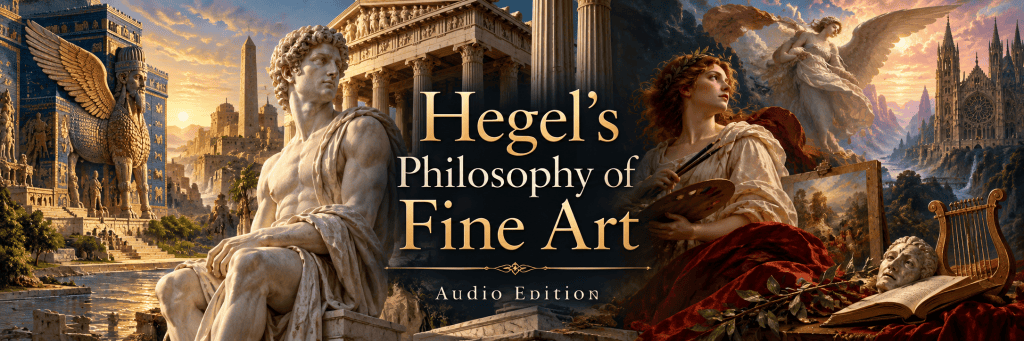
One of the work’s most original contributions is its account of the historical development of art through three fundamental configurations: symbolic, classical, and romantic. In symbolic art, associated particularly with ancient Eastern civilizations and Egypt, spiritual meanings struggle to find adequate expression through material forms. Monumental architecture, religious symbols, and the enigmatic imagery of ancient cultures exemplify this tension between the ideas being expressed and the physical forms employed to represent them. Classical art, reaching its exemplary realization in ancient Greece, achieves a harmonious correspondence between spiritual meaning and bodily appearance. Greek sculpture becomes especially important because the idealized human figure presents divinity and freedom through a unified, intelligible, and sensuously beautiful form. Romantic art, which Hegel associates with Christianity and the subsequent development of European culture, introduces a transformation in artistic expression: inwardness, individual subjectivity, emotional experience, and spiritual freedom increasingly exceed the limitations of external representation. Through this progression, Hegel constructs a philosophical history of artistic forms in which changes in art are inseparable from changes in religion, society, and humanity’s understanding of itself.
The work subsequently examines the five principal arts—architecture, sculpture, painting, music, and poetry—considering their distinctive materials, expressive possibilities, and historical significance. Architecture gives shape to physical space and transforms inorganic matter into structures capable of carrying symbolic and spiritual meaning. Sculpture develops the representation of living individuality through three-dimensional form, achieving its classical ideal in the human body. Painting introduces a greater emphasis on subjective experience, emotional particularity, and the expressive possibilities of color and visual appearance. Music advances artistic inwardness through sound, rhythm, harmony, and temporal development, allowing feeling to acquire a form independent of visible objects. Poetry, which Hegel regards as the most universal of the individual arts, employs language and imagination to express the widest range of human actions, emotions, conflicts, and ideas. His discussions illuminate not only the technical distinctions between these artistic practices but also the philosophical principles connecting them within a unified conception of artistic development.
Hegel’s extensive analyses of literature and drama constitute another of the work’s enduring achievements. Drawing upon Greek mythology, epic poetry, classical theatre, and modern European literature, he investigates the relationship between artistic representation, ethical conflict, human agency, and historical consciousness. His celebrated interpretation of Sophocles’ Antigone understands tragedy as the confrontation of competing ethical obligations, particularly those associated with family and political authority, rather than a simple struggle between good and evil. In his consideration of Shakespearean drama, Hegel explores the increasing importance of individual personality, ambition, passion, and psychological conflict in modern tragedy. His reflections on comedy, dramatic resolution, reconciliation, and the relationship between freedom and necessity remain important contributions to literary criticism and the philosophy of theatre.
Equally significant is Hegel’s exploration of art’s relationship to religion and philosophy. Within his broader philosophical system, art belongs to the sphere of absolute spirit, alongside religion and philosophical thought. These three activities represent different ways in which humanity seeks to understand ultimate reality and its own spiritual freedom. Hegel nevertheless argues that the historical development of modern society transforms the cultural function of artistic creation. His controversial thesis concerning the so-called end of art does not simply predict the disappearance of artistic activity or the cessation of creative achievement. Rather, it proposes that art, although continuing to develop and retain its significance, no longer occupies the supreme position it held in earlier civilizations as the principal means through which humanity apprehends ultimate truth. This argument has generated extensive debate concerning the autonomy of modern art, the relationship between aesthetics and philosophy, and the historical transformation of artistic meaning.
The philosophical consequences of Hegel’s aesthetics extend far beyond nineteenth-century German idealism. His treatment of beauty, historical development, artistic representation, and the cultural significance of creative activity has influenced or provoked critical responses from generations of philosophers, literary theorists, and art historians. Thinkers such as Friedrich Nietzsche, Martin Heidegger, Theodor W. Adorno, Georg Lukács, Hans-Georg Gadamer, and Arthur Danto have engaged with questions central to Hegel’s philosophy of art, particularly those concerning tragedy, historical consciousness, artistic autonomy, and the changing status of art in modern society. Although aspects of Hegel’s historical framework, especially its Eurocentric assumptions and hierarchical classification of artistic traditions, have attracted substantial criticism, his insistence that works of art must be understood in relation to their intellectual, religious, and historical environments continues to inform contemporary aesthetic scholarship.
This 2017 edition of Philosophy of Fine Art supplements its presentation of Hegel’s philosophical work with an extensive explanatory introduction designed to make its challenging concepts, historical references, and theoretical arguments more accessible. The accompanying material provides an overview of Hegel’s life and intellectual development, situating his aesthetics within the broader philosophical movement of German idealism and explaining its relationship to his principal writings on logic, history, religion, and spirit. A structured chapter-by-chapter summary introduces the major themes and arguments, while additional analytical commentary clarifies the work’s conceptual organization, central philosophical propositions, and most important contributions to the history of aesthetic thought.
The supplementary study material also examines the historical conditions surrounding the development of Hegel’s lectures, the work’s subsequent reception, and its enduring influence on philosophy, art history, and literary criticism. Attention is given to the interpretations and controversies associated with Hegel’s classification of artistic forms, his account of the relationship between beauty and truth, and his much-debated understanding of art’s historical destiny. By combining biographical context, philosophical explanation, thematic analysis, and critical discussion, the edition provides listeners with a structured means of approaching one of the most ambitious works in the history of aesthetic theory.
Philosophy of Fine Art remains an indispensable contribution to the study of artistic beauty and cultural history. Its significance lies not only in the extraordinary range of artworks, artistic traditions, and literary forms that Hegel examines, but also in the fundamental questions it raises about the nature and purpose of artistic creation. Why do human beings produce art? How does beauty communicate meaning? In what ways do artistic forms reflect the societies that create them? What distinguishes the aesthetic experience from religious belief or philosophical understanding? And how does the historical transformation of human consciousness alter the possibilities of artistic expression? Through its systematic engagement with these questions, Hegel’s aesthetics offers an exceptionally rich intellectual framework for understanding the relationship between art, freedom, history, and human experience, making it an essential work for students of philosophy, literature, aesthetics, art history, and anyone seeking a deeper understanding of the cultural and philosophical significance of art.


Leave a Reply