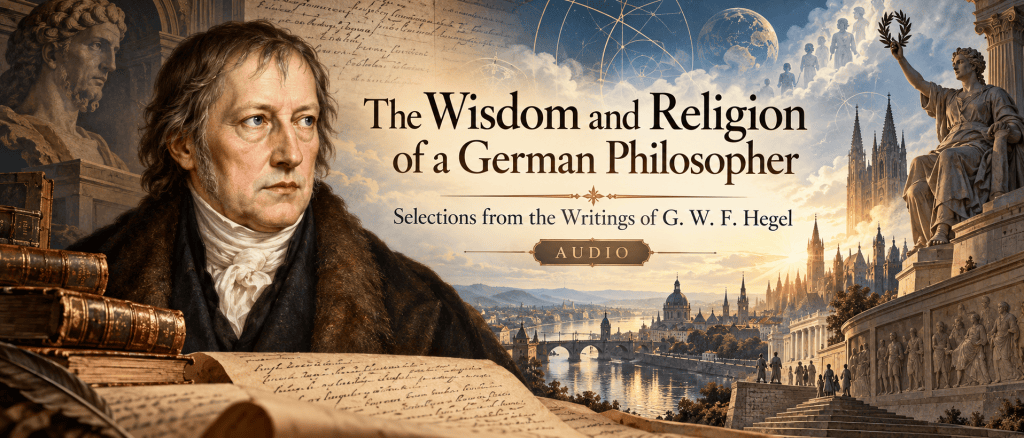
The Wisdom and Religion of a German Philosopher offers an illuminating introduction to the philosophical thought of Georg Wilhelm Friedrich Hegel (1770–1831), one of the most influential and intellectually ambitious thinkers in the history of Western philosophy. Originally published in 1897 and compiled by the Scottish philosopher, translator, and social reformer Elizabeth Sanderson Haldane (1862–1937), this collection brings together carefully selected passages from Hegel’s writings, presenting his ideas in a concise, thematically organized format. Rather than requiring readers to navigate the entirety of his extensive and frequently demanding philosophical system, the anthology provides a series of concentrated reflections on fundamental questions concerning human existence, consciousness, knowledge, freedom, morality, religion, history, and the nature of reality.
Hegel occupies a central position in the development of German idealism, extending and transforming the philosophical achievements of Immanuel Kant, Johann Gottlieb Fichte, and Friedrich Wilhelm Joseph Schelling. His philosophical project seeks to understand reality not as a static collection of independent objects and immutable principles, but as an interconnected and historically developing whole. For Hegel, thought and being, individuality and universality, freedom and necessity, and the finite and infinite cannot be adequately understood through rigid oppositions. Their deeper significance emerges through the relationships, contradictions, and processes of mediation by which apparently separate determinations reveal their underlying connections. This dynamic conception of reality, often associated with dialectical thinking, provides the intellectual foundation for his investigations into logic, nature, human consciousness, ethical life, religion, art, and world history.
The selections assembled in this volume introduce readers to several interconnected dimensions of Hegel’s philosophical vision. Particularly important is his concept of Geist, conventionally translated as either spirit or mind, which encompasses more than the consciousness of an isolated individual. Spirit also manifests itself through language, culture, social institutions, historical development, religious consciousness, and philosophical reflection. Human beings, in Hegel’s understanding, develop self-knowledge and freedom through their participation in an intelligible social and historical world. Consciousness is therefore not an entirely private phenomenon, but an activity shaped by relationships with others and by the accumulated achievements of human civilization.
Closely related to this conception of spirit is Hegel’s understanding of freedom. Rather than identifying freedom exclusively with the absence of external restrictions or the unrestricted exercise of individual choice, Hegel examines the conditions under which human beings can become genuinely self-determining. Freedom requires rational self-understanding and finds concrete expression through ethical relationships, reciprocal recognition, and the institutions of social life. His philosophy consequently raises enduring questions about the relationship between personal autonomy and communal obligation, individual conscience and objective ethical principles, and subjective intentions and their realization in the world. Such questions remain important to contemporary discussions in moral philosophy, political theory, sociology, and the philosophy of law.
Religion occupies a particularly significant place within this collection, reflecting both its title and the distinctive interests of its Victorian editor. Hegel’s philosophy of religion does not treat religious belief merely as an assortment of doctrines, rituals, or supernatural assertions. Instead, he investigates religion as a historically developing form of human self-understanding through which spirit seeks to comprehend its relationship to ultimate reality. Religious representations, symbols, and practices express fundamental conceptions of the divine, humanity, and the world, although their philosophical significance cannot always be exhausted by their immediate or literal meanings. Hegel’s interpretation of Christianity is especially important because he understands its central themes, including incarnation and reconciliation, in relation to the unity of divine and human existence and the overcoming of estrangement.
An essential distinction in Hegel’s thought concerns the relationship between religion and philosophy. While both are concerned with ultimate truth, religion expresses its content primarily through representation, imagery, and historically transmitted forms of consciousness, whereas philosophy seeks to comprehend that content through conceptual thought. This distinction makes Hegel’s work particularly relevant to the philosophy of religion, philosophical theology, and the history of religious ideas. His reflections invite consideration of how faith and reason may be related, how religious consciousness develops historically, and whether apparently conflicting forms of knowledge can be understood within a more comprehensive philosophical framework.
The anthology also illuminates Hegel’s distinctive interpretation of history as a process through which human freedom and self-consciousness become progressively articulated. Historical development, from this perspective, is neither a meaningless succession of events nor simply the accumulation of individual actions. It involves the emergence, transformation, and eventual dissolution of cultural forms and political institutions, each of which expresses a historically specific understanding of freedom and rational life. Hegel’s account is not without controversy, particularly regarding its assumptions about historical progress and the relationship between particular civilizations and universal history. Nevertheless, it remains one of the most influential attempts to interpret the historical process philosophically.
Another recurring concern is the relation between knowledge and reality. Hegel challenges the assumption that truth consists solely in the correspondence between isolated propositions and independently given facts. His philosophical method instead emphasizes the systematic relationships through which concepts acquire their determinate meanings. Contradiction, limitation, and negation are not merely obstacles to understanding; they can disclose the insufficiency of one-sided perspectives and motivate the development of more comprehensive conceptual determinations. This conception of philosophical inquiry helps explain the importance of Hegel’s contributions to logic, metaphysics, epistemology, and the philosophy of science.
The historical circumstances surrounding the compilation contribute substantially to its significance. Elizabeth Sanderson Haldane was an important participant in the intellectual and social movements of late Victorian and early twentieth-century Britain. At a time when women continued to encounter substantial barriers to advanced education and academic recognition, she established herself as a philosophical scholar, translator, biographer, and advocate of social reform. Her intellectual interests extended across German philosophy, the history of ideas, education, public administration, and the improvement of social welfare institutions.
Before publishing this anthology, Haldane had already undertaken one of the major projects involved in introducing Hegel’s philosophy to English-speaking audiences. In collaboration with Frances H. Simson, she produced the three-volume English translation of Hegel’s Lectures on the History of Philosophy, published between 1892 and 1896. Her engagement with European philosophy subsequently extended to René Descartes, whose philosophical writings she translated in collaboration with G. R. T. Ross in two volumes published in 1911 and 1912. She also authored biographical and historical studies and contributed extensively to public and intellectual life. In recognition of her achievements, the University of St Andrews awarded her an honorary Doctor of Laws degree in 1906. She later became the first woman appointed as a justice of the peace in Scotland, reflecting the breadth of her commitment to intellectual advancement and civic participation.
Haldane’s editorial approach is especially valuable for understanding the reception of German idealism in the English-speaking world during the nineteenth century. Her selection and thematic arrangement of Hegelian passages reflect a period in which British philosophers and theologians were increasingly interested in idealism as a means of reconsidering the relationships between science, religion, ethics, individuality, and society. Hegel’s philosophy appealed to thinkers seeking alternatives to narrowly empiricist accounts of knowledge and exclusively individualistic accounts of moral existence. By presenting his ideas in relatively short passages, Haldane helped make a complex and systematic body of thought available to readers who might otherwise have found Hegel’s major treatises inaccessible.
At the same time, the anthology should be understood as a historically situated interpretation rather than an exhaustive representation of Hegel’s system. Extracting passages from larger arguments necessarily changes the context in which they are encountered, while thematic organization can emphasize particular aspects of a philosopher’s work over others. Haldane’s editorial choices reveal both the philosophical concerns of her own period and the enduring adaptability of Hegel’s writings. The collection is consequently valuable in two respects: as an introduction to Hegel’s philosophical ideas and as a document of the intellectual history of their reception, translation, and dissemination.
A particularly useful feature of the compilation is the inclusion of references identifying the original sources of its selections. These references allow interested readers to move beyond individual passages and investigate the larger arguments from which they have been drawn. The book can therefore function both as an accessible introduction and as a starting point for more sustained engagement with Hegel’s principal writings, including his works on logic, spirit, religion, history, and ethical life. Its fragmentary structure also encourages reflective listening, allowing individual statements and conceptual problems to be considered independently before being connected with the wider philosophical system.
This audiobook edition preserves Elizabeth Haldane’s original preface and introduces a new foreword written by Sarah Bacaller, who also serves as narrator. Bacaller’s contribution provides additional historical and intellectual context concerning the collection and its editor, connecting the nineteenth-century publication with contemporary interest in Hegelian philosophy. Her spoken presentation offers another way of approaching material whose conceptual density often rewards attentive and repeated engagement.
With a running time of approximately three hours and fifty-six minutes, The Wisdom and Religion of a German Philosopher presents a concentrated encounter with a thinker whose influence extends across philosophy, theology, political theory, historical scholarship, literary criticism, and the social sciences. Hegel’s ideas profoundly shaped subsequent debates involving figures as diverse as Karl Marx, Søren Kierkegaard, British idealists, phenomenologists, critical theorists, and contemporary philosophers concerned with recognition, rationality, and social freedom.
Ultimately, the enduring value of this anthology lies in its presentation of philosophy as an effort to understand the connections between seemingly separate dimensions of experience. Questions of truth cannot be detached entirely from questions of consciousness; freedom cannot be considered independently of social and historical circumstances; and religion cannot be adequately understood without examining its relationship to reason, culture, and human self-understanding. Through Haldane’s thoughtful selection of passages, Hegel emerges not simply as the architect of an elaborate philosophical system, but as a thinker concerned with the fundamental problem of how humanity comes to understand itself and its place within reality.
For students encountering German idealism for the first time, readers interested in the historical relationship between philosophy and religion, and those seeking a concise introduction to the intellectual foundations of Hegelian thought, this audiobook offers an accessible yet philosophically substantial entry point into one of the great systematic projects of modern philosophy.


Leave a Reply