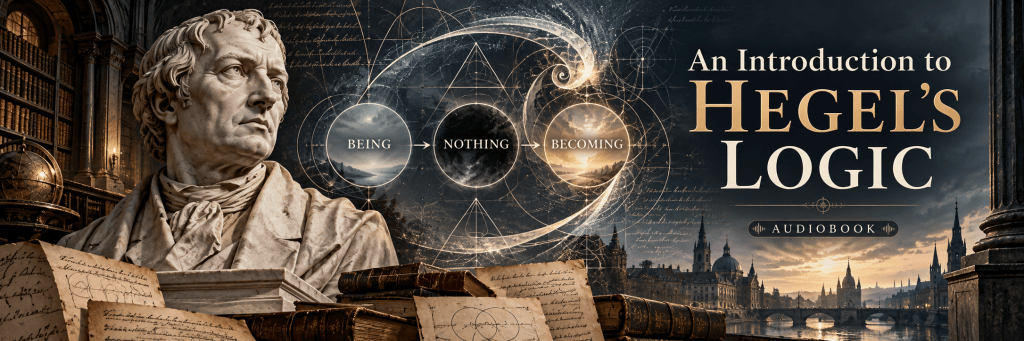
An Introduction to Hegel’s Logic by Andy Blunden offers an extensive yet accessible examination of one of the most influential and demanding achievements in the history of Western philosophy: the dialectical logic of Georg Wilhelm Friedrich Hegel (1770–1831). In approximately five hours, Blunden guides listeners through the philosophical foundations, conceptual structure, historical origins, and contemporary significance of Hegel’s method of dialectical reasoning. Written from a perspective informed by Marxism, cultural-historical psychology, and social theory, the work seeks to make Hegel’s notoriously difficult philosophy intelligible without sacrificing its conceptual depth. It is particularly concerned with demonstrating why a philosophical system developed in early nineteenth-century Germany continues to provide important resources for understanding social relations, political movements, historical transformation, and the development of human consciousness.
Hegel’s Logic occupies a central position within German idealism and the subsequent development of modern philosophy. Its influence extends far beyond academic metaphysics and epistemology, reaching into Marxist theory, critical sociology, political philosophy, psychology, and theories of historical change. Unlike conventional formal logic, which primarily examines the validity of arguments and the relations between propositions, Hegel’s speculative logic investigates the fundamental categories through which reality becomes intelligible. Concepts such as being, nothing, becoming, identity, difference, contradiction, necessity, actuality, and freedom are not presented as isolated definitions but as interconnected moments within a developing system of thought. Hegel maintains that philosophical categories cannot be adequately understood independently of their internal relations and transformations. Blunden’s introduction reconstructs this distinctive approach while examining its implications for the investigation of both individual consciousness and collective human activity.
The book begins by situating Hegel’s intellectual development within the extraordinary political and social circumstances of late eighteenth- and early nineteenth-century Europe. The French Revolution, the Napoleonic Wars, the disintegration of established feudal structures, and the gradual emergence of capitalist modernity provided the historical background against which Hegel developed his philosophical system. Germany remained politically fragmented, while France and Britain experienced profound transformations in political institutions, industrial production, and social organization. Blunden examines how these conditions shaped Hegel’s concern with freedom, historical development, national unity, and the relationship between individuals and the institutions through which they participate in collective life. Hegel’s philosophical project consequently emerges not merely as an abstract attempt to establish a comprehensive system of knowledge, but also as a response to the contradictions of a society undergoing fundamental historical change.
Particular attention is given to Hegel’s engagement with the philosophical traditions that preceded him. The influence of Immanuel Kant, Johann Gottlieb Fichte, and Friedrich Wilhelm Joseph Schelling is explored alongside the problems of subjectivity, objectivity, knowledge, and freedom that characterized post-Kantian German philosophy. Blunden explains how Hegel sought to overcome divisions between thought and reality, subject and object, individual and society, and freedom and necessity. His account connects the development of Hegel’s mature logical categories with the earlier investigations of consciousness, recognition, historical experience, and spirit undertaken in the Phenomenology of Spirit (1807). These connections illuminate the relationship between Hegel’s theory of knowledge and his broader understanding of human beings as historically situated participants in shared social and cultural practices.
At the centre of the discussion stands the threefold architecture of Hegel’s Logic: the Doctrine of Being, the Doctrine of Essence, and the Doctrine of the Concept, also translated as the Doctrine of the Notion. Blunden follows the progression of these interconnected divisions, explaining how each introduces increasingly developed forms of conceptual determination. The Doctrine of Being begins with the most immediate and abstract categories, including pure being, nothing, and becoming, before examining quality, quantity, and measure. The Doctrine of Essence moves beyond immediacy to investigate reflection, mediation, identity, difference, opposition, contradiction, appearance, and actuality. Finally, the Doctrine of the Concept addresses universality, particularity, individuality, judgment, inference, objectivity, and the Idea. Throughout this progression, Blunden seeks to clarify the internal necessity of the transitions between categories and the philosophical significance of their development.
An important theme is Hegel’s understanding of contradiction as something more fundamental than a logical error or a simple inconsistency between propositions. Within dialectical reasoning, contradictions disclose limitations within existing determinations and provide the basis for further conceptual development. Blunden discusses the importance of negation, mediation, and Aufhebung, commonly translated as sublation, through which a determination is simultaneously overcome and preserved within a more comprehensive unity. Rather than reducing dialectics to the familiar but misleading formula of thesis, antithesis, and synthesis, the discussion emphasizes the particular movement of concepts and the need to understand a phenomenon through the relations that constitute it. This approach offers an alternative to methods that treat objects, institutions, or social conditions as fixed entities possessing independently defined characteristics.
What distinguishes Blunden’s interpretation is his sustained effort to establish a relationship between Hegel’s abstract logical categories and the concrete historical activity of human beings. Drawing upon his extensive work in cultural-historical psychology, activity theory, and the philosophy of social movements, Blunden interprets the Logic as a resource for understanding the formation, development, and transformation of socially constituted concepts. Human consciousness is considered inseparable from language, labour, institutions, inherited cultural practices, and the material conditions through which individuals interact with one another. Concepts are therefore not understood exclusively as private mental representations, but as historically developed forms of meaning embedded in collective practices. This perspective provides a connection between Hegel’s speculative philosophy and later traditions of social theory, particularly those associated with Karl Marx and Lev Vygotsky.
The interpretation also addresses the longstanding relationship between Hegelian dialectics and Marxist thought. Hegel’s philosophy exerted a decisive influence on Marx’s intellectual formation and on subsequent efforts to develop a dialectical understanding of capitalist society. Yet the relationship between Hegel’s philosophical idealism and Marx’s historical materialism remains complex and contested. Blunden approaches this relationship critically, examining how elements of Hegel’s logical method can be appropriated for the analysis of material social relations without necessarily accepting the metaphysical commitments of his original philosophical system. The result is an account of dialectics that is concerned not simply with the abstract development of ideas, but with historically changing social practices, forms of organization, institutional contradictions, and possibilities for collective transformation.
Questions concerning the relationship between individual agency and collective life occupy an equally important position. Blunden examines how Hegel’s conception of spirit can be interpreted in relation to the shared cultural and institutional world through which individuals develop their capacities and identities. From this perspective, freedom cannot be reduced to the absence of external restrictions, because the effective exercise of freedom depends upon historically established social relations, forms of cooperation, and institutions. Individual self-determination and collective organization are consequently treated as interdependent rather than mutually exclusive. These themes provide a foundation for considering how political movements develop shared objectives, how institutions acquire authority, and how established forms of social life may be transformed through organized human activity.
Blunden does not present Hegel’s philosophy as a completed or infallible explanation of historical reality. His interpretation also considers the limitations arising from Hegel’s idealism, the historical conditions of his philosophical development, and aspects of his social and political thought that are difficult to reconcile with contemporary understandings of emancipation and equality. The discussion distinguishes the continuing analytical value of dialectical categories from the assumption that Hegel’s particular historical judgments must be accepted. Such a critical approach is important for understanding the subsequent reception of Hegel among thinkers who have drawn upon his philosophical method while rejecting significant elements of his metaphysics or political conclusions.
The significance of An Introduction to Hegel’s Logic ultimately lies in its presentation of dialectics as a method for investigating processes rather than merely classifying finished results. Social institutions, political ideologies, cultural practices, and systems of knowledge can be understood as historically constituted relations whose apparent stability conceals processes of development, conflict, and transformation. By connecting Hegel’s logical categories with questions of contemporary social organization, Blunden demonstrates how dialectical reasoning can contribute to a more comprehensive understanding of social change without reducing complex historical phenomena to mechanical laws or predetermined outcomes.
Originally developed through Blunden’s sustained engagement with Hegelian philosophy and his educational work on dialectics, this introduction offers a concentrated guide to the conceptual problems at the heart of Hegel’s system. It is especially valuable for listeners interested in the philosophical foundations of Marxism, critical theory, political philosophy, cultural psychology, and the historical development of social consciousness. Although Hegel’s Logic remains a demanding work requiring careful study, Blunden provides a framework for approaching its central arguments, clarifying the relationships between its principal categories and demonstrating why its influence has persisted across successive generations of philosophers, social theorists, and political activists. The audiobook is narrated by Sarah Bacaller and runs for approximately four hours and fifty-three minutes.


Leave a Reply