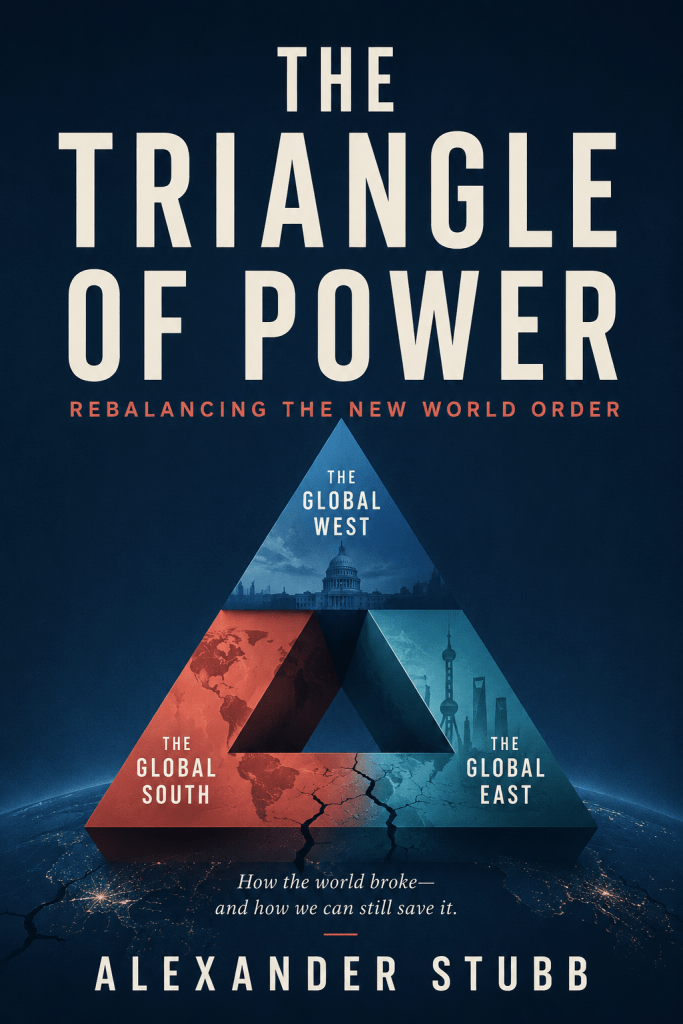
The Triangle of Power: Rebalancing the New World Order poses a single governing question: what form of international order can succeed the post-Cold War liberal settlement now that its assumptions have failed, and by what agency can that succession be steered toward rule-governed cooperation rather than an oligopoly of great powers. Alexander Stubb answers with a triadic morphology of global forces—the Global West, Global East, and Global South—crossed with a triad of dynamics—competition, conflict, cooperation—and issuing in a normative program he names values-based realism and dignified foreign policy. The book’s distinctive value as an object of study lies in its double authorship-position: a sitting head of state writing conceptual analysis from inside the very transition he theorizes, so that the argument records, and partly enacts, the diplomacy it recommends.
The compositional history of the work, disclosed with unusual candor in its acknowledgments and at two points within the main text, belongs to its argument rather than to mere circumstance. Stubb reports that he began writing in early 2020 as a professor at the European University Institute in Florence and finished in the summer of 2025 as the thirteenth president of Finland, and that the world changed so rapidly across those five years that concluding the manuscript resembled tracking a moving target. More consequentially, he reports that an earlier version of the book was organized around a bipolar framing, with China and the United States as the two power centers, and that the sequence of COVID-19, the invasion of Ukraine, and the energy crisis persuaded him that the world was less orderly than he had wished to believe—a cacophony of relationships that the bipolar schema flattened. The Triangle, in other words, is presented as a revised category, one the author arrived at by watching his first category fail against events.
This admission functions as a methodological signature. The book repeatedly warns against the human tendency to over-rationalize the past, overdramatize the present, and underestimate the future, and against the retrospective illusion that history moves in straight lines when in real time it moves in zigzags; by exhibiting its own zigzag—the abandoned bipolar draft—the work applies its epistemology to itself. The reader is thereby instructed how to hold the Triangle: as an instrument calibrated against a particular moment, corrigible in principle, rather than as a timeless ontology of world politics. That instruction acquires additional weight in the acknowledgments, where Stubb explains his deliberate omission of footnotes and bibliography on the ground that he wanted the book to be a journey of how his thinking evolved from student of international relations in 1989 to president amid a changing order, with a curated list of further reading standing in for scholarly apparatus.
The renunciation of the citation economy is itself an interpretive operator: it signals that the book’s warrant is testimonial and synthetic rather than demonstrative, that its claims rest on three decades of first-person diplomatic acquaintance organized by academic training, and that the appropriate standard of assessment is the coherence and fruitfulness of the synthesis rather than the completeness of its documentation. The same paratextual stratum performs a subtle division of intellectual labor: Stubb thanks a research assistant for heavy lifting specifically on chapters three, six, and nine—the chapters on institutional disintegration, the Global South, and cooperation, which are, tellingly, the chapters most dependent on datasets and organizational histories—while reserving to the authorial voice the diary-vignettes, the portraits of leaders, and the doctrinal formulations.
And the acknowledgments close with a disclaimer that the book articulates a personal analysis rather than Finland’s foreign policy doctrine, a distinction that must be read together with the introduction’s claim that values-based realism is precisely the philosophy Finland embraced after Russia’s attack: the author-president writes as a private intelligence whose office nonetheless saturates every scene, and the book never fully stabilizes the boundary between the citizen who theorizes and the head of state who negotiates. That instability is productive rather than accidental, for it mirrors the book’s central wager—that analysis and agency, understanding the world and shaping it, are continuous activities.
The front matter deepens this reading. The praise apparatus assembled before the title page is unusually dense and unusually legible as a performative gesture: endorsements arrive from American public intellectuals, from a former NATO secretary general, from the director of a European think tank, from a British former foreign secretary, and—most pointedly—from the president of South Africa, whose blurb commends the book’s case for inclusive multilateralism founded on the UN Charter and the protection of the vulnerable against the ambitions of the powerful. Read against the book’s argument, the endorsement page enacts in miniature the coalition the text hopes to summon: voices of the Global West and the Global South jointly certifying a proposal for rebalanced order. One endorser even registers, with gentle irony, the book’s own sociological paradox—the scholar-statesman who can analyze the corridors of power because he walks them, and who plays golf with the American president whose transactionalism the book must somehow domesticate.
The map placed before the introduction, credited to a professional cartographer, gives the Triangle a visual body before the text has defined it, and the table of contents discloses the architecture that the introduction will then motivate: three parts—Order, Balance, Dynamics—mapped explicitly onto past, present, and future, each part containing three chapters, so that the triadic figure governs the book’s form as thoroughly as its content. Nine chapters, three parts, three spheres, three dynamics, three scenarios at the end, three concrete proposals, three lenses of values, interests, and power: the numerological consistency is no ornament. It expresses the book’s deepest methodological commitment, which is that a disordered world becomes tractable only through a small set of load-bearing distinctions held steadily across domains, and it quietly claims for the analysis the very quality—order—whose worldly decay the analysis narrates.
Each chapter opens with an italicized vignette, dated and located like a diary entry, and these vignettes constitute a distinct evidentiary genre within the work, a stratum of first-person testimony that the surrounding analysis then conceptualizes. The introduction’s opening scene is the book’s primal scene: three days into the full-scale invasion of Ukraine, the author texts the Russian foreign minister, whom he knows personally from years of negotiation, pleading for the madness to stop; the minister deflects, parries with propaganda, and after six fruitless messages the exchange dies. The scene establishes at a stroke the book’s epistemic warrant—the author is someone whose phone contains the Russian foreign minister’s number and whose judgments about Russian intentions rest on acquaintance rather than punditry—and its emotional register, an anger disciplined into analysis, a felt shifting of tectonic plates converted into the question of what order comes next.
The same introduction then fast-forwards three years to a seven-hour round of golf with the American president, senators, and celebrities in Florida, where the author, representing a small country without illusions of outsized impact, tries to make the case that Putin cannot be trusted, while registering that the American’s world is transactional rather than multilateral and that his presidency will accelerate the transition already underway. The two scenes bracket the book’s problem-space between two figures of the Global West’s crisis: the adversary who breaks the rules from outside, and the ally who disparages them from inside.
Subsequent vignettes extend the genre—the young student at Furman University watching the Berlin Wall fall almost in real time and losing a champagne wager that Russia would become a liberal democracy; the foreign minister brokering a five-day ceasefire in Georgia in 2008 after stumbling upon women and children expelled from their homes in Gori; the midsummer bonfire on a Finnish island the night Brexit defied his confident prediction, followed by a London town-hall heckler whose cry that the GDP growth was the panelist’s rather than his own punctures the author’s naïveté about the self-evidence of integration’s benefits; the Chinese vice president in Helsinki in 2009 explaining, with a smile, that technological protectionism is competitive rationality; the midnight power-plant inauguration in Siberia where the future militia leader serves dinner and airport officials angle for bribes; the Christmas dinner interrupted by news of severed Baltic seabed cables and the seizure of the tanker Eagle S; the Davos roundtable where a Global South minister rises to tell the assembled leaders that the world has changed and they have not; the state visit to Beijing where a quiet smile answers a pointed question about North Korean troops; and finally the private dinner in Helsinki with the Ukrainian presidential couple, jazz and candles against a war of attrition.
Considered as a system, the vignettes perform three functions. They authenticate: nearly every major analytical claim in the book—about Putin’s rationality, about Xi’s patience, about the South’s frustration, about hybrid warfare’s blurring of peace and war—is anchored in a scene where the author witnessed or negotiated the relevant reality. They periodize: the dated scenes, running from 1990 to 2025, plot the author’s education as a synecdoche of the West’s, each disillusionment (the champagne bet, Brexit, the invasion) marking a stage in the passage from values-based idealism to values-based realism. And they exemplify: the Beijing vignette in particular is explicitly glossed as dignified foreign policy in action—hard questions raised within a relationship of mutual respect, moral grandstanding forgone because it would have ended the meeting—so that the book’s normative proposal is shown operating before it is formally defined. The vignettes thereby collapse the distinction between the book’s evidence and its recommendation: the same practice of respectful, interest-aware, values-anchored engagement that the author urges upon the West is the practice by which he acquired the knowledge the book contains.
The introduction performs the work’s principal conceptual staging, and its sequence of moves repays close reconstruction because later chapters will repeatedly return to redetermine what is laid down here. Stubb begins with a diagnosis phrased as a generational analogy: the present is our equivalent of 1918, 1945, or 1989, a hinge at which the power structures, relationships, and foundational principles of world order will be reborn, with the next few years deciding dynamics for decades. He then supplies an autobiographical genealogy of the order now dying—the bipolar Cold War world becoming unipolar overnight in 1989, the intoxicating sense that all two hundred nations would pivot toward liberal democracy and markets, the end-of-history thesis he confesses he believed—and locates the West’s original sin in a failure of humility in victory: the failure to give agency to those who lost, or more precisely to those who had never had a say in global governance.
The term agency enters here almost casually and becomes, across the book, its master concept, the hinge on which diagnosis and prescription alike turn; the reader should track how a word introduced as a description of what the West withheld returns as the name of what the South demands, what UN reform must institutionalize, what small states like Finland exercise against the odds, and what the concluding pages attribute to every citizen. The introduction then erects the book’s governing antithesis through a pair of historical emblems. Yalta in 1945 stands for a settlement made by big powers over the heads of small ones, spheres of influence carved by three men at a table; Helsinki in 1975 stands for a security order built by thirty-five states on rules and norms applicable equally to all, a feat of multilateralism amid tension that helped precipitate the Cold War’s end.
From the emblems Stubb extracts formal definitions: multilateralism is a system of cooperation grounded in international institutions and common rules whose key principles apply equally to all countries irrespective of size; multipolarity is an oligopoly of power, several competing nodes generating ad hoc, opportunistic behavior and shifting alliances of real-time self-interest, a structure that leaves small and medium states out as bigger powers deal over their heads. The definitional pair carries an explicit valence—multilateralism leads toward order, multipolarity leans toward disorder and conflict—and the introduction converts the pair into an imperative: the world faces a choice and must choose Helsinki over Yalta, which obliges Western leaders to convince the countries the old order ignored that Helsinki has something to offer them, and to do so by means other than the ones that failed before. Here a structural tension enters the book that will never be fully discharged and that the work, to its credit, does not pretend to discharge.
Multipolarity functions in the text both as a descriptive tendency—the world is becoming multipolar, power is diffusing to multiple nodes, and the book’s own three-sphere morphology presupposes that diffusion—and as a normative adversary, the Yalta-form to be resisted. The apparent contradiction is managed, though never thematized as such, by an implicit distinction of levels: the distribution of capabilities across West, East, and South is treated as a fact beyond election, while the form of order governing that distribution—rule-based and equal, or deal-based and hierarchical—is treated as elective, the object of the choice the book urges. The Triangle is thus a description of multipolar fact deployed in the service of a multilateral norm, and the whole argumentative burden of the book consists in showing that the passage from the one to the other is possible, that a triangular distribution of power can be housed within a Helsinki-form rather than degenerating into a Yalta-form. It is an inference, though a well-grounded one, to say that the book’s title names exactly this wager: rebalancing is the operation by which brute multipolarity would be converted into reformed multilateralism, and the Triangle is the geometry within which the operation must be performed.
The introduction’s presentation of the three spheres already contains, in compressed form, the categorial heterogeneity that Part Two will elaborate and that constitutes one of the work’s most philosophically interesting features. The Global West—the United States, Europe, and their democratic allies from Japan to Canada, its hard core representing roughly fifteen percent of world population and over half of global economy—is defined axiologically: it is the sphere of democracy, social market economy, fundamental rights and freedoms, the traditional defender of the rules-based liberal order. The Global East—led by China, supported by Russia and a set of smaller autocracies, some twenty percent of population and GDP, the latter mostly China’s—is defined strategically: it is the sphere that challenges the current order, seeks to rewrite rules and institutions, prizes inviolable state sovereignty and non-interference over universal rights, autocracy over democracy.
The Global South—over half the world’s nations and population, less than a quarter of its GDP, spanning Asia, Africa, the Middle East, and Latin America—is defined privatively: its common denominator is underrepresentation in the current order, insufficient agency, and the demand for a redistribution of power in its favor. One vertex is constituted by values, one by an oppositional project, one by a lack. Stubb is explicit that these are spheres rather than traditional blocs or poles, that they overlap—Latin American countries, India, and Turkey see themselves as belonging to West and South at once—and that each is internally diverse; and he concedes in advance what he calls a possible weakness of the Western definition, namely that the rest of the Global West will have to work hard to persuade the American president that the liberal order serves American interests. The concession is remarkable: the sphere defined by commitment to the liberal order contains, at its center of gravity, a government whose commitment is precisely what cannot be assumed.
The book’s handling of this instability is characteristic of its whole procedure. Rather than redefining the West to exclude the anomaly or minimizing the anomaly to save the definition, Stubb holds both terms—the values and interests of the Global West carry more weight, he argues, than the manner in which any administration drives them, and one should resist hasty conclusions about the deterioration of a century-old partnership—while candidly registering that some elements of the Trump presidency may even serve peace and security, with everything depending on how goals are achieved and at what price. The definition of the West is thereby converted from a classification into a task: the West is less a set of countries than a project whose principal member must be continually re-persuaded of it. A parallel operation governs the South’s definition.
Because the sphere is constituted by a lack of agency, its unity is conditional on the persistence of that lack; the book will later name the graduation problem—the risk that economically ascendant members like Brazil or India prioritize relations with the powerful over the common Southern agenda—as the internal solvent of the category. And the East’s definition by strategic opposition entails, as the text will show at length, that its unity is transactional, an alliance of convenience whose members’ goals and methods diverge. None of the three vertices, in short, possesses the ontological solidity that the geometrical figure of a triangle suggests; each is a field of tension provisionally stabilized by the analysis. The book knows this and says so, and the knowledge disciplines its predictions: because the spheres are dynamic fields rather than fixed blocs, the future is genuinely open, flexible alliances rather than binary camps are the expected pattern, and the pendulum—one of the text’s recurring figures—can swing.
The introduction completes its staging with the second triad—competition, conflict, cooperation—and with the doctrinal formulations that Part Three will operationalize. Competition among the spheres is declared a certainty and potentially a healthy one; conflict and cooperation are dependent variables, their emergence hinging on how competition is managed in a world where anything from technology to energy to currency to information can be weaponized. The core East-West axis is specified as the geostrategic contest between the established American power and the rising Chinese one, an ideological rivalry of democracy against autocracy that is nonetheless complicated by both camps’ at least theoretical commitment to trade and globalization; the disagreement concerns the rules and principles of the system, multilateral preservation against multipolar reconstruction.
The South is declared anything except agnostic about the emerging order—it wants agency in the system while declining to take sides—and its new cohort of middle powers is characterized as transactional rather than ideological, making deals where it suits them, refusing the us-versus-them frame, seeking to pick and choose issue by issue in order to maximize autonomy and access to global goods. This characterization explains, in advance, the South’s posture toward the war in Ukraine, and it generates the book’s pivotal strategic claim: whichever superpower wants its paradigm to prevail must find an effective way to bring the South along, and so far the East has done this better. Against this ground the introduction unveils its prescriptions. Values-based realism is defined, in a formulation the author himself calls a mouthful, as a set of universal values grounded in freedom, fundamental rights, and international rules, which takes into account the realities of global diversity and the histories and cultures of the nation-states, regions, and continents composing the international order.
The definition is followed by a gloss whose modesty is doctrinally significant: values-based realism is an instrument rather than a doctrine, adopted for a limited time, and that time is now. Its intellectual genealogy is given as a synthesis of the post-Cold War era’s two contending paradigms—the end-of-history thesis standing for values, the clash-of-civilizations thesis standing for realism—into a paradigm of values and interests, rule of law alongside respect for difference. And its biographical genealogy is Finnish: the Cold War’s pragmatic realism, in which a small country beside an imperial power compromised its Western values to survive, an accommodation that at times went too far and constitutes an era of which Finns cannot be proud; the post-1989 swing to values-based idealism; and the post-2022 correction to values-based realism, with the author’s vehement rejection of any Finlandization prescription for Ukraine—no anticipatory compliance, which amounts to surrendered sovereignty—marking the limit beyond which realism must never carry values.
The paired concept, dignified foreign policy, is introduced as the mode in which values-based realism is conducted: a policy grounded in mutual respect, leading by example rather than exhortation, walking the talk of political freedom and ethical warfare even when inconvenient, engaging in dialogue rather than monologue, and renouncing the dictation of solutions to others. It is worth pausing on the internal strain of the values-based-realism formula, because the book’s philosophical seriousness is nowhere clearer than in its refusal to dissolve that strain verbally. The definition asserts values that are universal and, in the same breath, requires that they take into account global diversity of culture and history. Universality and accommodation pull against each other: a value that bends to every context forfeits universality, while a universality that bends to none forfeits the realism the formula promises.
The book’s resolution, developed across the cooperation chapter and the conclusions, is procedural rather than semantic: the universal core is contracted to a minimum—respect for international law, the keeping of agreements, the human-rights compass of the UN Charter and the Universal Declaration—while everything beyond the minimum is remitted to persuasion, example, and incentive rather than condition and coercion. Shared values remain a goal of collaboration while ceasing to be its precondition. Whether this procedural settlement stabilizes the antinomy or merely administers it is a question the book leaves, deliberately, to practice; its author’s wager is that a smaller universalism honestly kept persuades more than a larger one selectively enforced, and the recurring evidence for the wager is the ledger of Western double standards—Iraq without a mandate, Gaza’s civilian toll set against lectures on territorial integrity, climate finance promised and withheld—that the South keeps and the book repeatedly, unsparingly, reads out against the West itself.
Part One, titled Order, executes the book’s genealogy of the present in three chapters whose titles plot a controlled descent—from order to disorder, from disorder to disruption, from disruption to disintegration—and whose internal procedure exhibits a consistent method: each phase of the descent is explained by a double optic, the view from within the West corrected by the view from beyond it. The first chapter opens with an anthropological premise that quietly governs the entire work: humans seek order within disorder to make sense of a world that often lacks it, and the epochal terms filling our history books—Pax Romana, the dynasties, the empires—are interpretive constructions that nonetheless name something real, structures framing relations among populations and governments and supplying coherence. Order, on this account, is a need before it is a fact; the Westphalian system contributed the grammar of sovereignty and formal equality; and order has never meant the equality of states in power, only the distribution and management of power among them sufficient for stability. The premise does double work.
It licenses the book’s constructivism about eras—the later coinage of the interregnum for the present in-between period is offered explicitly as a provisional naming, since defining an era is as difficult as dating its end—and it plants the seed of the book’s late reflection that order is a mental construct while disorder is often the reality, a reflection that keeps the entire analysis honest about its own status as an ordering act performed upon recalcitrant material. The chapter then narrates the post-1989 sequence with an emphasis falling always on opportunity and its forfeiture.
The bipolar order becomes unipolar almost overnight; the nineties, felt as orderly from the West, are in reality messy—Yugoslav wars, rocky reunification, Russia’s failed decade of democracy and hypercapitalism sowing the seeds of strongman rule—and the institutional adaptations of the era are modest and mostly regional, OSCE renamed and retasked, NATO drifting to crisis management, the EU widening and deepening, while the global institutions that set the rules of economy and trade, the IMF and WTO and the UN’s power structure, remain essentially unchanged, so that the nations sidelined before remain sidelined after. The pivot of the chapter is September 11, 2001, glossed as tragic and symbolic at once, an attack on the twin pillars of capitalism and democracy that inaugurated what Stubb names the West’s double mistake: pivoting on its highest message by elevating security above freedom, and attempting to direct world affairs while granting inadequate agency and power to other nations.
The War on Terror is judged a recipe for instability—democratic change comes from within, rarely from outside, never through force—and the ledger is tallied without euphemism: Afghanistan’s costs in lives and displacement ending in the Taliban’s return, Iraq’s invasion premised on a false assumption and prosecuted without a UN mandate, the victorious superpower no longer looking so super. Interwoven with this Western self-critique runs the counter-narrative of the rest’s rise: the post-American world thesis, the formidable growth of China, India, Brazil and others, the migration of governance energy from formal multilateral institutions to coalitions like the G7 and G20, patchwork cooperation replacing rules-based order, and the decade’s summary verdict—the 2000s as a wasted decade in which the United States, holding all the keys to global influence, failed to stay in the driver’s seat, while from the outside the West looked arrogant, incoherent, and inconsistent, its cooperation fine so long as it followed Western norms, its solidarity necessary so long as it cost nothing at home, its international rules binding until they impeded Western interests.
The chapter’s personal stratum—Nice negotiated through long nights, Lisbon developed at the Commission, the Georgian ceasefire brokered in five days from a Sardinian poolside through bombed Gori to a Moscow endgame—culminates in a lesson explicitly drawn: the rules considered sacrosanct could be broken, disorder was growing and needed containment, and the alarm the author tried to ring across Europe was drowned by the Lehman collapse as the West looked away. The section on the view from beyond the West then generalizes the correction: the critical decades looked entirely different outside the West, whose myopia cost it the chance to consolidate influence while opening that chance to China, whose world was transactional and whose partnership looked less demanding and judgmental than that of former colonial powers; middle powers began striking independent notes; and India’s frustration at its undersized role, set against its demographic and democratic weight, is flagged early as the single most consequential variable in whether Eastern or Western values prevail—the leader, if any, of the Global South.
The chapter closes by fixing February 24, 2022 as the date on which an era ends and an interregnum begins, and by rejecting, in advance, the tempting bipolar forecast of a US-led liberal order facing a China-led authoritarian one: the world of binary alliances no longer exists, and the likelier pattern is flexible alliance, regionalization, decentralization—a push and pull of values, interests, and necessity that the book will explore.
The second chapter, centered on the invasion itself, is methodologically the boldest of the three, because its argumentative burden is to convert an emotional rupture into an analytical instrument. Its opening vignette—waking in Florence at four in the morning to the news, scribbling on the plane that Georgia in 2008 and Crimea in 2014 make this the third Russian invasion in fourteen years, writing that this has to be the tipping point because a power in decline is dangerous—is immediately disciplined by a program: to understand the dominoes, one must cut through emotion and examine why Putin attacked and why states reacted as they did, on the premise that even the reactions that disappointed the West were rational from each state’s perspective, whether the stake was political security, energy and food security, or, for everyone, their place in the world. The premise is the book’s interpretive charity principle, and its first and hardest application is the section arguing that Putin is other than crazy.
Against the psychoanalysis of pundits who never met the man, Stubb sets his own meetings—the composed, prepared, analytical, wryly smiling figure who knew how to take a room—and the counter-thesis that what appears insane through one lens may look rational through another, so that navigating a changing world requires seeing through both. The rationality reconstructed is narrative rationality: Russia’s historical self-understanding as ever threatened, alone, attacked from all directions, custodian of true European Christian ideals abandoned by decadent Westerners, sole conqueror of continental tyrants; the refusal ever to accept the post-Cold War liberal order; foreign relations as zero-sum, ruled by strength, empty of values; the Russkiy Mir doctrine of one language, one religion, one leader as ideological warrant for controlling post-Soviet space; the 2021 essay effectively denying Ukrainian statehood; the ambition, mainstream in Russia rather than marginal, to restore imperial greatness.
Within that narrative the invasion is consistent; only by Western reasoning is it crazy; and the practical corollary is drawn without flinching—one should assume Putin will go all the way, since after the invasion the war became too big for him to fail and keep his position. Yet the same section renders the verdict that the attack will stand among the greatest tactical and strategic blunders of modern history, overestimating Russian capability, underestimating Ukrainian resistance and Western resolve, and achieving the precise opposite of its aims: a more European Ukraine, a more united EU and West, a NATO returned to founding purpose, a doubled Russian border with the alliance.
The chapter’s account of Russian political culture—an order-craving, centuries-authoritarian society for which democracy still connotes the chaos of the nineties, memorialized in the bitter coinage that renders the democratic experiment as dermocracy; a system of organized corruption in which governors and oligarchs hold their portfolios at the leader’s pleasure and elites back the leader until things go sour—grounds the prediction that change would require a people’s or palace revolution, both presently unlikely, while the author expressly declines the determinist conclusion that Russia can never change. The remainder of the chapter distributes the invasion’s consequences across the Triangle, and the distribution is where the framework earns its keep.
The West’s response—never more united, determined, or effective in the author’s thirty-year career except after 9/11, with coordinated condemnation, unprecedented sanctions, military and financial aid, and the overcoming of its two alleged post-Cold War mistakes of counting on American security and depending on Russian energy—is credited fully and then immediately complicated by the contradiction it exposed: fresh proof that a norms-based order beats rogue behavior, and simultaneous proof of those norms’ weakness on the world stage, since global responses to Western sanctions ranged from lukewarm to neutral, forcing the West back to the drawing board with the recognition that most nations will follow no one automatically.
The East’s response is read through China’s discomfort: the no-limits friendship declared at the Beijing Olympics weeks before the war; the war as distraction from the party congress and the zero-COVID showcase, and as opportunity to cement dominance over Russia as the East’s real leader; the three options of leaning to Russia, leaning to the West, or neutrality, resolved into a juggling of all three because the EU’s trade mattered and secondary sanctions threatened; and the author’s own three meetings with Xi yielding the judgment that respectful dialogue outperforms disrespectful monologue and that the friendship without limits means less than feared—transactional for China, necessary for Russia, convenience rather than depth, united by a common enemy and by each leader’s wish that the other remain in power, divided by method, the aggressive disruptor beside the reputation-conscious economic superpower.
The South’s response receives the chapter’s most consequential arithmetic: 141 states condemning at the UN, 35 abstaining—including India, China, and South Africa, together over half of humanity—five supporting, and, decisively, only about forty ultimately willing to sanction, none from Africa or Latin America, condemnation being words and sanctions action. The West’s relieved misreading of the vote as overwhelming support is corrected by the category of dissociation—your war, our inflation—and by the colonial ledger that disqualifies former imperial powers from lecturing on territorial integrity, epitomized in the Indian foreign minister’s admonition that Europe must outgrow the mindset in which its problems are the world’s while the world’s are never Europe’s, a remark the author endorses as essentially correct.
Region by region—India’s successful balancing between the Quad and Russian arms, Latin America’s verbal support and practical non-intervention with both Brazilian candidates blaming NATO expansion, Africa’s at-best neutrality rooted in Soviet memories, economic ties, and non-alignment traditions—the chapter converts the war into a diagnostic instrument: a snapshot, as the introduction had put it, of the new world disorder, revealing interests, flexible alliances, and the South’s refusal to constrain its own ascension. The closing section then performs the book’s most explicit act of self-revision, recounting the abandonment of the bipolar draft and declaring the old order officially dead, the present a fight for a future order whose healthy outcome necessarily runs through international institutions—against the pundits announcing those institutions’ death, whose resilience the author defends and whose reinvention he assigns as the task.
The third chapter shifts register from narrative to institutional analysis, and its opening vignette—the UN General Assembly of September 2008, Lehman freshly collapsed, Lavrov arriving late to lie about Georgia, the whole flurry of formality defended as the foundation on which multilateral order is built, since relationships between countries ultimately rest on relationships between people and a hard conversation beats a chasm of silence—announces its theme: the currency of international relations is trust, and the chapter is an anatomy of its depletion. The quantitative sketch—over fifty thousand international fora, summits, networks, and organizations channeling cooperation—frames the paradox that many countries are rejecting multilateralism at the moment of its greatest necessity, and the chapter’s analytical core is the identification of three trends set in motion by rising multipolarity: multiplication, regionalization, and distrust, the first two challenging yet potentially healthy, the third the biggest obstacle.
Before elaborating the trends, the chapter mounts its defense of the United Nations, and the defense’s structure is instructive: full acknowledgment of the criticisms—inefficiency, though the UN works about as efficiently as one can expect when the world negotiates with itself; encroachment on sovereignty, though its purpose is precisely to solve problems beyond any national government’s remit; perpetuation of power disparities, the criticism the book treats as the serious one, since the Security Council’s 1945 design balanced West and East while leaving the South out then and now—followed by the Churchillian verdict that the UN is the worst form of global governance save all the others, and by the reformist conclusion that the critical step is neither stagnation nor abandonment; the institution must be made to work for all members, beginning with agency and representation.
The historical section, an opportunity lost, replays the post-Cold War decade at the institutional level: the first Gulf War’s Security Council unanimity and the American president’s new-world-order speeches promising new ways of working with other nations; the busy institution-building of the early nineties; and then the devolution, with the second Iraq war, prosecuted without Council authority, read widely including in Europe as Washington’s declaration that it exempted itself from its own rules, after which charges of double standards grew louder and other nations began looking elsewhere for leadership. The three trends are then developed with the book’s characteristic even-handedness.
Multiplication—the kaleidoscopic scattering of power into proliferating organizations, actors, and informal clubs from the G20 to BRICS, driven by proliferating global issues and the awakened claims of businesses, civil society, science, and sub-national governments to a share in governing global public goods—is granted its rationale and its dangers alike, with the East’s promotion of multipolarity as liberation from Western dominance answered by the observation that Beijing’s and Moscow’s neighbors fear the replacement of one dominance by another, and by the maxim that the sustainable solution is fairness rather than fragmentation.
Regionalization—the near-eighty regional organizations since 1945, accelerating after 1990, widening from economics to geopolitics, with China’s Belt-and-Road-leveraged assertiveness inspiring counter-formations from the revived Quad and AUKUS to the EU’s Global Gateway—is judged by a criterion the book states with care: the difference between healthy and unhealthy regionalism lies in whether arrangements are purely transactional or systemically cooperative, whether they feed into a larger system of shared values, whether they are part of something bigger; on that condition regionalization could even serve as a first step toward stronger, more balanced multilateralism, a thought the conclusions will elevate into one of the book’s three final proposals.
Distrust, the third trend, receives the deepest treatment, decomposed into three sources requiring three rectifications: disillusionment, as globalization’s genuinely rising tide—quadrupled GDP, sextupled trade, a billion lifted from extreme poverty—coexists with rising inequality and with the Southern experience of bearing an unduly high share of burdens for an unduly low share of benefits, the Sudanese bearing climate change more profoundly than Finns, the West preaching against the carbon-fueled development whose fruits it enjoys, the richest one percent owning about half the world’s wealth; lack of representation, as the IMF and World Bank remain under an informal Western duopoly of appointments and under voting weights that leave receiving states feeling that others decide their fate; and populism, the most global source, whose narrative that international cooperation robs sovereignty and benefits only a few is traced from Seattle 1999 through the French and Dutch constitutional rejections to walls, deportations, and the Brazilian president’s lecture to the General Assembly that it is no organization of abstract global interests.
The chapter’s conclusion executes one of the book’s most pointed ironies: the fullest apology for economic globalization it quotes—adaptation and guidance rather than write-off, cushioning negative impacts, delivering benefits to all nations—issued from the Chinese president at Davos in 2017, days before the first Trump inauguration, the chairman of the world’s biggest communist party posing as free trade’s champion, a message decoded as the announcement that if the West steps down from leadership, China stands ready, coupled with the observation that Beijing has adeptly supported the parts of the multilateral order from which it profits while repudiating those that confine it. And the chapter closes on the credo that the crisis has unequivocally strengthened the author’s multilateralism—nation-state behavior must be contained and channeled through institutions; the question is how and in which; the task is less to lament the UN than to reinvent it, at last with everyone from West, East, and South at the table—so that Part One ends by converting its narrative of decline into the mandate for Parts Two and Three.
Part Two, titled Balance, changes the book’s method from genealogy to morphology, and its methodological instrument is a fourfold analytical grid—politics, economics, technology, geopolitics—applied identically to each of the three spheres. The grid is itself a philosophical commitment: it asserts the commensurability of the spheres, their assessability by common criteria, and it thereby performs in analytical practice the equality of standing that the book’s normative program demands in institutional practice. It also generates the book’s comparative discipline, since each sphere’s chapter must answer the same questions—how does this sphere govern, produce, innovate, and position itself—and the answers accumulate into the balance the part’s title names. The chapter on the Global West opens with the Brexit vignette and its lesson—the author’s naïveté about the self-evidence of integration’s benefits, punctured by a heckler’s cry that the growth was the panelist’s rather than his own—and with a reflection that reframes democratic failure as democratic function: a system built to change, possessed, unlike authoritarianism, of a self-correction mechanism that must be learned and applied better.
The sphere’s credentials are stated—two centuries of dominance in politics, economics, and technology; democracy rooted in Western thought; both capitalism and communism sprung from Western theory; a quarter of the world’s states, some sixty percent of GDP, fifteen percent of population, bound by shared history and values, proximity, and aligned interests—and immediately balanced by the ledger other states correctly keep: a history of breaking the global rules it promotes, of conquest, rule, and exploitation conducted while speaking most loudly against imperial ambition, and a twentieth century marred by two world wars caused by Europe, from which the West did learn, building the system that avoided a third.
The political section develops the thesis that democracy is messy and necessary—the mess of dissent, compromise, and crisis being inseparable from the mission of a diverse people governing itself openly—and diagnoses the present strains with a technological accent that recurs throughout the book: democracy was designed by eighteenth-century philosophers for a world of slow decision-making, and now that leaders have thirty seconds where they once had three months, sound solutions require deliberately re-slowing decision through new policies and mechanisms; polarization, populism, disinformation, and decision-making by the loudest rather than the silent majority constitute an existential challenge whose roots are socioeconomic—plateaued blue-collar incomes, AI-threatened white-collar security, the parental fear that children will live worse—and whose remedy is delivery: retooling public systems so that democracy’s walk matches its talk of freedom, opportunity, and justice, with renewal at every level from citizens to lawmakers.
The EU is analyzed as a union of twenty-seven democracies pooling sovereignty rather than a democracy itself, a regulatory superpower whose standards the world mostly follows—the Brussels Effect—and whose infringement battles with its own members are read, perhaps, as messy but healthy democracy. The economic section, titled in the spirit of imperfect capitalism, argues that the market-state dichotomy is overplayed—all functioning systems mix market forces and state protection, fully unregulated markets and fully planned economies both backfire, and the thriving economies of the future order will be those finding a healthy balance—and narrates the pendulum’s swing from the post-1989 mantra of markets to the post-2008 return of the state, through the euro crisis whose existential fights the author witnessed as finance minister, to the present resurgence of protectionism and intervention.
The West’s assignment is double and in tension: stay true to the model of free markets, competition, and open trade, since deviation costs credibility and competitiveness; and integrate the beneficial parts of state regulation to deliver the equality and quality of life the model proclaims, since no state, democratic or autocratic, survives without an effective welfare system and the real value of growth is measured in quality of life. The technology section registers a fading edge—the leadership that passed from Japanese electronics through Nordic telecommunications to American platforms no longer confers the old advantage, other nations having caught up and big tech’s social status having dipped as data encroached on freedom—and formulates the questions on which continued Western leadership hinges: whether technology improves or undermines public discourse and democracy, increases efficiency without exacerbating inequality, and serves peaceful ends; with the EU’s regulatory and research strengths qualified by its disunity and cumbersome decision-making, and with the section’s horizon widened to technology’s transformation of war, science, and the human itself, as bioengineering challenges the laws of nature at a wild frontier under highly variable rules.
The geopolitical section names unity as the challenge preceding all others, sets three tasks—cultivate cohesion, keep space for de-escalation and differentiated approaches toward Russia and China, and engage the South credibly by making the liberal order’s benefits accessible and equitable—and surveys the sphere’s members: the United States as first among equals, still the military, political, economic, and technological superpower and ultimate protector, without whose backing Ukraine’s war would most probably have been lost, yet subject to three pre-Trump trends—the Indo-Pacific pivot, the great-power-competition frame, and the domestication of foreign policy—that render its role changeable; Europe assigned the burden of its own security, its peace project suddenly a war project, with the observation, delivered deadpan, that the American president did more in five weeks to force European responsibility than his predecessors in fifty years; the alliance’s China policy split between containment and constraint, decoupling rejected as impracticable and de-risking emerging as the common transatlantic basis; and the Indo-Pacific allies drawing closer under a shifting threat perception epitomized by the Japanese prime minister’s warning that Ukraine may be the East Asia of tomorrow. The chapter concludes that the West stands at a crossroads with strong foundations on which it can no longer rest—a formula whose double edge, assets sufficient for leadership and insufficient without renewal, is the whole chapter in miniature.
The chapter on the Global East opens with the paired vignettes of Xi in Helsinki, defending technological walls in the idiom of competition—why open our markets to American or European products, we might even lose—and the Siberian midnight of Putin’s calculated lateness and the refueling shakedown, from which the author dates his abandonment of the illusion that Russia would become a normal Western state and his recognition that China was building power slowly, stealthily, and far more effectively than its recalcitrant partner. The sphere is introduced through its podium—China, Russia, Iran, in that order, joined since the invasion by North Korea in what the West calls an axis of aggression—and through the glue that binds its roughly twenty-five states: interests rather than values, a shared rejection of the liberal order and of American hegemony, and a general contentment with a multipolar world of big powers and spheres of interest, even as members’ particular interests diverge from regional ambition to regime survival to economic dependency.
The political section’s title concept—the efficiency and inefficiency of autocracy—organizes a comparative anatomy. China is presented through its three pillars of party, government, and army; through its unusual homogeneity and civilizational self-understanding, the wall-building disposition extending, in a Singaporean statesman’s formulation the author elicits, from physical walls to walls for capital, culture, cyberspace, and even microbes; through the Confucian genealogy that renders Chinese governance a mix of law and the aspiration to harmony rather than strict authoritarian order; and through the zero-COVID episode read as a demonstration that a speed of lockdown and level of compliance impossible in the freedom-first West was possible there—the point being the possibility rather than the success.
Russia is presented through its centuries of supreme-leader rule legitimated successively by God, class struggle, and stability; through the imperial self-image whose mismatch with geopolitical reality breeds frustration; through the Soviet apex of forced industrialization, victory, bombs, and Sputnik; and through the unresolved tension between poor society and thin elite that leaves the present a poorly organized, inefficient, essentially corrupt petrostate deriving a third to a half of its budget from hydrocarbons, its elite loyal until things go sour. The section’s general law—authoritarian regimes are tolerated from inside only so long as there is continuous growth or relentless control, and when one or both evaporates, collapse is only a question of time—is the book’s standing wager against autocracy’s apparent stability, and its empirical coda is blunt: the states that voted with Russia after the invasion constitute a club of very poor autocracies, which is no reason to underestimate their influence.
The economic section develops the decisive asymmetry: Chinese state capitalism, with its scale, speed, drive, ruthless competition, and implementation capacity, against which are set weak currency, excessive debt, limited information flows, demographic contraction, and the innovation-suppressing tendencies of control, with the prediction that Chinese governance must become more decentralized, fiscal decentralization having already proven a growth source; and Russian stagnation, from a 1990 GDP forty percent larger than China’s to an economy today dwarfed tenfold, stabilized only by hydrocarbon prices, drained by sanctions, its innovation never launched—so that China does no… rather, so that China’s prosperity in no way depends on Russia, whose exports to the American and European markets each exceeded its Russian exports sevenfold, and the East’s internal economic cooperation remains a tactical choice grounded in short-term political objectives and the presence or absence of alternatives.
The technology section, framed by the author’s own earlier provocation that for China Europe had become the new Africa—its technology, patents, and intellectual property mined as Europe once mined African resources—narrates China’s ascent from fewer than twelve thousand patent applications in 1996 to parity and beyond, from catch-up copying to credible contention for leadership across software, quantum computing, semiconductors, and renewables, powered by centralized steering, limitless resources, and massive state-owned data troves, and constrained by the same control that powers it: innovations that stay local, scaling that stumbles on foreign suspicion, information walls that hold the country back, and a poverty of technologically advanced friends that contrasts with America’s ability to leverage allied excellence. The Russian counter-story is Skolkovo, the announced Silicon Valley that attracted flagship investors and produced no unicorn, strangled by corruption, political interference, military prioritization, sanctions, and the exodus of talent, leaving a country of genuine military-technical competence—submarines, hypersonics, nuclear expertise—whose capacity for marketable innovation is seriously limited and whose technological dependence on China deepens.
The geopolitical section identifies the shared long-standing goal—breaking the bond between the United States and Europe, proclaimed jointly as early as a 1997 declaration on multipolarity—and differentiates the methods: Russia the aggressive disruptor exploiting crisis to drain Western resources, seeking preferential energy bilateralism and funding disinformation and extremists; China the patient constructor, distinguishing the EU from the US to leverage the former against the latter, running its regional formats in Central and Eastern Europe, and packaging its alternative order in proposals—a community of shared future, a global security initiative—whose code the author translates as the offer of equal partnership without moral conditions, a pitch to tweak the West’s system to the East’s advantage.
The chapter’s forecast distributes probabilities accordingly: China, hiding strength and biding time, has population, resources, and patience, and will evolve a unique combination of state-controlled market capitalism, central planning, economic decentralization, and digitally enhanced authoritarianism—neither traditional democracy nor dystopia—though the author registers his long-term doubts and notes Xi’s own apparent impatience; Russia stands closer to renewed internal turmoil than to renaissance, gambling its remaining resources, increasingly dependent on its partners’ patience, its economic gap with the West soon to match 1991; Iran, the outlier, a religious state with regional and global self-conceptions, weakened with its proxies and struck in its nuclear program, remains an important and awkward unknown. The conclusion turns the analysis outward: the confrontation differs from the Cold War in its far higher interdependence and its less pronounced ideological competition, yet it is systemic—democracy against autocracy in a race over who best delivers prosperity and security—and the Global South is watching closely who performs better and who offers cooperation on better terms, which is the cue for the following chapter.
The chapter on the Global South opens with the book’s most abrasive vignette: drafting a column on the South’s importance, the author receives from a prominent foreign-policy thinker a tongue-in-cheek reply whose expletive dismissal of the entire sphere he quotes as evidence of genuine thinking in many corners of the West—thinking he pronounces wrong twice over, a moral mistake always and now a strategic one, since the South holds a critical role in the new order and the task is to shed old-school prejudice, understand rather than assume. The sphere is characterized through its paradoxes: far from monolithic, yet collectively risen in economic heft and political voice; seeing advantage in weakening an order it experiences as Western; speaking with a new self-confidence that no longer calls Washington before striking out.
The historical stratum reaches back to the Non-Aligned Movement of the 1970s—ninety, later a hundred twenty members demanding new structures and agency, heard by the big powers only when convenient—and to the Brandt commission’s 1980 finding of a rich industrialized North and a poorer developing South, whose line, the author notes against the IMF’s present data, still holds in politico-economic terms: excluding China, Russia, and some smaller European states, the emerging and developing economies house sixty percent of humanity while producing under twenty-nine percent of GDP and seventeen percent of trade.
Against that structural disadvantage the chapter sets the resurgence: the key players by region, the fence-sitting after the invasion that is anything except neutrality—these countries are staking out an agenda of their own, sitting, in the Indian foreign minister’s formulation the chapter twice deploys, on their own ground rather than on the fence—and the author’s disarming concession that a Westerner long free to pursue his own prerogative can understand the posture, since claiming that values supersede interests is easier for those possessing agency and economic strength.
The political section is prefaced by an epistemic disclaimer rare in the genre: lumping over a hundred countries and five billion people requires a caveat; the author claims no regional expertise, offers the outsider’s occasional advantage of seeing forests over trees, and describes his method—visits to six continents, meetings with leaders from nearly every country, issues of democracy and rights raised comfortably yet respectfully, deep listening before the presentation of Finland’s agenda, each meeting an opportunity for learning, the whole eased by coming from a small country without a colonial past whose credible story is of a nation that believed in democracy while poor and rose from repression and poverty to freedom and prosperity, told without arrogance, with hope.
What the listening yields is a corrective to two false assumptions the author attributes to international liberals including himself: that democracy is a self-evident part of human nature—whereas democracy tries to contain human nature through mutually agreed laws—and that everyone considers democracy the best form of governance, whereas in many places growth and welfare feel more urgent. The section then surveys with deliberate balance: India’s democratic genealogy from anti-colonial movement to constitutional declaration, alongside criticism of its present government’s treatment of minorities and civil liberties; Africa’s democratic foundations laid by liberation movements, the coups and dictatorships that betrayed them, the recent authoritarian returns across several regions, and the resilient counter-examples of Botswana, Cape Verde, and Namibia, courts fighting back in Ghana and South Africa, regional organizations stemming rollback; Asia’s and Latin America’s contrary motions, with the pointed rhetorical question of how many Westerners know that Costa Rica keeps no military, spends seven percent of GDP on education, and generates ninety percent of its energy renewably; and the Arab Spring as the era’s biggest democratic drama, its wave of young protest against precarity and unresponsiveness breaking on entrenched elites, brute force, civil wars, and the sobering recognition that protesting populations do n—that protesting populations often aim at goals other than democracy.
The section closes on demography as the sphere’s second defining feature after GDP per capita: median ages ten years below the West’s everywhere and nineteen in Africa, half the world’s population growth to 2050 concentrated in eight countries, a demographic dividend of growth potential shadowed by the pressure of unmet demands for education and opportunity, with the wise question being how to unleash a young, striving generation. The economic section credits the South as the powerhouse of recent global growth—over half the increase in global GDP in the 2010s, a quarter of global trade conducted within the South, a third of foreign direct investment flowing South-South—and traces the ascent from the tiger economies through the awakening giants, while insisting on the unevenness: most countries moved from low to middle income, few into the high bracket, and of the least-developed countries listed since 1971 only six have graduated.
The obstacles are enumerated as structural—commodity dependence, infrastructure and technology deficits, governance uncertainties deterring investment, educational limits, gender imbalances costing growth—and as externally inflicted, with the rich world’s inward turn, friendshoring, and shrinking FDI ushering in an era of economic fragmentation just when the South needs integration, which explains the turn to alternative finance in the New Development Bank and the Asian Infrastructure Investment Bank, both Chinese-initiated, and to regional platforms as coordination instruments. The technology section opens with an asymmetry of recognition—children in Kigali or Kathmandu know the Western brands; the West’s ignorance of Southern innovation remains behind the curve—and corrects it with cases: Southeast Asian mobile and ecommerce hubs, Brazilian and Chilean renewables, Gulf investments in AI and blockchain, African fintech epitomized by the Kenyan mobile-payment system that once channeled more transactions in a day domestically than a famous Western remittance company did worldwide, Saudi ambition in its AI-optimized city project, Indian strides in space and vaccines.
The constraints are stated with equal clarity—internet access falling from over ninety percent of people in developed countries to twenty-seven percent in the least developed, urban-rural divides intensifying disparities, multinationals from East and West alike prioritizing their own interests, profiting from weak data regulation and pushing domestic competitors aside, so that the provision of digital infrastructure comes to resemble, for some observers, the colonial railways built to ease extraction, under the watchword of digital colonialism—and the section’s criterion is equity: North-South cooperation must support independence and narrow rather than widen disparities, and the world must break its fixation on established Northern hubs.
The geopolitical section stages the Davos scene of Southern frustration and reads it as opportunity: with West and East rearranging alliances over Ukraine, the South’s collective bargaining power stands at its peak, though its conversion into benefit is complicated by the arithmetic of heterogeneity the author poses as a cascade of questions—what unites small island states with landlocked developing countries, commodity exporters with diversified economies, and why should the smaller members underwrite the ambitions of the larger. The war’s bloc-building pressure produced the posture the book names tactical non-alignment—avoiding the costs of engagement on any side while profiting from concessions offered by both—and its theorized extension, the Indian doctrine of multi-alignment, engaging America, managing China, cultivating Europe, reassuring Russia, drawing in neighbors.
From the posture the chapter distills the South’s three central demands, which function henceforth as the book’s reform agenda received from its intended beneficiaries rather than invented for them: more voice, meaning Security Council reform and more inclusive fora than the small clubs that dictate agendas; a level economic and technological playing field, meaning support for the weak and restraint for the strong, fairer commodity prices, reciprocal market opening, generous technology sharing, and WTO reform; and a general overhaul of multilateralism, meaning reform of the Bretton Woods institutions where developing countries have close to no influence and restraint of the weaponization of international systems, since appeals to a rules-based order ring hollow when control of the dollar and financial channels lets the West unilaterally exclude others.
The chapter’s conclusion weighs the sphere’s prospects—the opportunities of competitive courtship, the risks of the graduation problem and of smaller states’ susceptibility to being bought off, China’s double game as self-styled developing country and aspiring hegemon that makes it, for India especially, a challenge inside the shared reform goal—and ends with the sentence toward which the whole part has been building: the more the author listens to Southern leaders, the more he understands that the keys to the new world order lie in their countries’ hands.
Part Three, titled Dynamics, converts the morphology of Part Two into kinetics, and its opening chapter on competition begins with the book’s most disarming vignette: the Finnish world ice-hockey championship of 1995, won against Sweden on Swedish soil, watched by the author jumping up and down in a Belgian dormitory while schoolmates wondered at him. The scene is more than color. It installs, before any analysis, a model of competition the chapter will hold up against the geopolitical kind: the fraternal rivalry of Finland and Sweden, nations that love each other before and after every match and want to beat each other in between, whose telecommunications champions spurred each other to world leadership, and whose whole Nordic neighborhood, competing perpetually across rankings of wealth, equality, environment, and education, has thereby become a cluster of what the author calls lifestyle superpowers—with the sly boast, immediately self-ironized, that Finland has ranked happiest country in the world for eight consecutive years and that the neighbors are surely just happy that the Finns are so happy. The vignette’s argumentative function emerges as the chapter unfolds: competition within a shared frame of rules, mutual recognition, and underlying amity elevates all competitors; the question for the world is whether the coming era’s competition can be housed in such a frame or will run frameless.
The chapter’s formal thesis is stated as a conditional architecture that the remainder of Part Three will inhabit. Competition is a certainty; conflict and cooperation are possibilities whose realization depends on how competition is managed; the three dynamics exist simultaneously and interpenetrate—competition spills into conflict unless contained by cooperation, conflict renders both competition and cooperation difficult, cooperation fosters the fair play that keeps competition healthy—and the key to a thriving world is tilting the balance of competition toward cooperation rather than conflict. The chapter then runs its analysis through the same fourfold grid that organized Part Two, and this repetition of the grid across parts is itself a compositional fact worth registering: the categories that were used statically, to inventory each sphere’s assets, are now used dynamically, to describe the contests among the spheres, so that the book’s later material retroactively redetermines its earlier material—the inventories of Part Two turn out to have been the scouting reports for the matches of Part Three. In the political arena, the contest is a tournament of narratives between systems, each claiming superiority in delivering prosperity, security, and welfare, adjudicated in real time by a world of rankings and indices—a public scoreboard the author had already invoked in Part One when describing the pandemic as a stress test with mortality rates and vaccine numbers running for all to see.
The section is anchored by the Uzbekistan vignette: a two-hour monologue from a notorious dictator who told the visiting Finnish minister in no uncertain terms that the West need bring no lectures to Tashkent, a meeting from which the author emerged shaken, heart warmed by the thought that the worst awaiting a Finnish politician is losing an election, and confirmed in the conviction, held to this day, that democracy is right and dictatorship wrong, plain and simple—followed at once by the concession that self-certain lectures will never suffice to protect democracy. The doubled movement of that passage—moral certainty affirmed, moral pedagogy renounced—is the entire doctrine of values-based realism in miniature, and the section’s analytical content elaborates it: the author declares himself openly partial to democracy and marshals the evidence of its superior track record, citing institutional research on the long-run income, social-spending, education, gender-equality, and infant-mortality advantages of democratization, while insisting that autocracies’ claims to deliver stability under adverse conditions are, within limits, correct; that the global picture is hybrid rather than binary, with Western democracies flirting with illiberalism and some Southern states more democratic than some Western ones; and that the winning odds of any system hinge, finally, on delivery—every system trading freedom against stability, equality against growth, participation against speed, and every leader justifying limitation in one register by progress in another.
Delivery, a term that entered the book quietly in the Western chapter’s demand that democracy deliver what it promises, is here promoted to the general criterion of systemic legitimacy, and the reader should notice what the promotion costs: a book committed to the intrinsic superiority of freedom has adopted, as the arbiter of the systems contest, a consequentialist standard on which autocracies are permitted to compete. The tension is deliberate and productive. It is precisely because the author refuses to rig the tournament—refuses, in his vocabulary, the professorial attitude—that the book’s confidence in democracy’s eventual victory carries argumentative weight rather than mere assertion; the wager is that on a fair scoreboard, over a long season, open societies win.
The economic section of the competition chapter traces the return of zero-sum thinking: the post-Cold War sermons on the four freedoms, which the author confesses to having both received and later delivered, presupposed a perpetually growing pie whose slices might grow unequally while all grew; slow growth, unevenly shared gains, and populist scapegoating have restored the belief that a neighbor’s gain is one’s own loss, and economic nationalism has returned, with rules for global trade weaker and less respected and free markets partially displaced by varieties of state capitalism. The section then stages the systems as bets: the EU wagering on its regulatory capacity and the Brussels Effect, its edge dependent on the perpetual balancing act between overregulation and underregulation; the United States wagering on free markets, private ownership, and entrepreneurial reward, its recent industrial-policy statutes read as classic interventionism and its present administration leaning further into protection and tariff threats, with the risk of trade war acknowledged alongside the possibility that confrontation ends in mutually agreed barrier removal. It is in this section that the book delivers its most unguarded criticism of the United States, and the passage deserves attention because its rhetorical positioning is so careful: framed by a declaration of admiration dating from the author’s formative years, voiced as the worry of a firm believer in Nordic welfare capitalism, it finds the American system good at creating wealth and poor at distributing it fairly, its social-security networks practically nonexistent, its public health care absent, its infrastructure antiquated, its poverty and homelessness widespread, so that visiting in the 2020s feels like traveling back to the 1990s and the country fails to qualify, by European or Asian standards, as a modern society, with continued polarization predicted absent radical movement toward a basic welfare state. That a sitting head of state allied to Washington commits such sentences to print is itself an instance of the book’s program—dignified foreign policy includes candor among friends—and the criticism’s placement within a chapter on competition gives it a function beyond candor: the West’s internal race, like the Nordic one, is supposed to improve its members, and the author competes accordingly.
China’s economic bet is described as dual circulation, domestic consumption inside and trade and investment outside, its sustainability questioned on demographic grounds; Russia’s is dismissed through the book’s most sardonic vignette, the teenage hockey trip to Moscow in 1983, old cars, bad cigarettes, guarded hotel floors, vodka and caviar as the only goods of interest, and hockey sticks acquired in courtesy trades that served best as kindling—a memory the author reports his perception of the Russian economy has never had much reason to revise, the petrostate having chosen symbolic projects over structural modernization. The South’s bet is a middle way, buying neither the liberal model whole nor the heavy-handed state, watching which system shows greater resilience; its edge lies in raw materials and growth potential, unevenly distributed, with Africa’s youth and minerals granting it perhaps the best prospects and instability the greatest obstacle. And the section closes by displacing the contest one level up, in a move that recurs throughout Part Three and constitutes one of the book’s structural discoveries: beyond competition within the rules lies competition over the rules, since those who determine trade rules, write the policies of the multilateral economic institutions, or sit on the Security Council influence the entire playing field, and whoever sets the rules gains the advantage.
The technological section develops the same displacement through the instructive example of data, formalizing three regimes—Chinese centralization of data in the state, which mines without restriction for state benefit; American residence of data with companies, mined on at least theoretical individual consent; European data sovereignty vested in the individual, closely regulated—and rendering the comparative verdict that the European approach is probably ethically strongest and competitively weakest, a sentence whose unblinking symmetry exemplifies the book’s analytic temper. The author’s normative resolution follows: against those who see a straight line from digitalization to an all-controlling autocracy, he insists that technology is what we make of it, endorses the European approach as right even if it slows innovation and even as it needs adapting to the competitive landscape, and concludes that the most successful states will be those finding the right equilibrium. The chip-export ban is read as the summary artifact of the technological contest—an instrument aimed at once at slowing a rival’s military development, weakening its capacity to serve foreign partners, and checking its brands, its bluntness speaking to the stakes. The geopolitical section registers the return of geopolitics after thirty years of background existence, its definition widened by the interdependence the West itself built: hard power now flanked by soft and smart, military capacity by innovation, resources by trading power, alliances by rule-setting capacity and the projected image of success, with corporations hiring chief geopolitical officers because conflict disrupts supply chains—a detail through which the book notes that its subject matter has become a line item in private-sector risk management. Each player’s hand is assessed: the United States holding nearly all instruments, geography, resources, innovation, and outspending the next nine militaries combined, its Achilles’ heel an unstable and polarized political system that worries allies and adversaries alike with sudden shifts; the EU transformed from self-described economic giant and geopolitical dwarf into an aspiring geopolitical player, its financial leverage demonstrated in the exclusion of Russia from major markets and its most powerful tool remaining enlargement, the desire it nourishes in neighbors to join and accept its rules; China with scale, speed, awe-inspiring project execution, and above all the consistency of instrument-use that a two-party democracy’s pendulum denies the United States; Russia still top-tier by resources and security exports, its military modernized by the war itself, yet treated by many as pariah, its war economy resilient and its forces of renewal all but dead, consuming, in the section’s exact figure, resources it cannot sustain.
The chapter’s conclusion binds the four arenas back into the conditional architecture: competition can be a race to the top or to the bottom; at present the trends are worrisome—uneven playing fields, deepening insularity and mistrust, waning capacity for shared solutions—and marshalling competition for good requires revitalizing the rules-based order with a fairer distribution of power, since where states distrust each other to set or follow rules fairly, competition becomes difficult to contain, and this is the point at which it risks escalating into conflict. The sentence is a hinge: it hands the argument to the next chapter.
The conflict chapter opens with the book’s most cinematic vignette, the Christmas dinner of 2024 interrupted by word from the situation room that four undersea cables between Estonia and Finland have been cut—the fifth such incident in under two years—followed by the identification of a tanker registered in the Cook Islands that had departed Russia the previous day, its anchor down and its course toward a gas pipeline; the request that it move into Finnish waters, the crew’s compliance, the boarding and impoundment, and the later discovery of a sixty-mile anchor-drag mark on the seabed, with three possible explanations—accident, intent, incompetence, or a combination—and the question of attribution left, in a gesture the chapter will theorize, for the reader to judge. The refusal to attribute is no coyness; it is a demonstration of hybrid warfare’s defining property, that part of the tactic’s effectiveness is precisely that no one can say with certainty who acted, and the vignette thereby performs the epistemic condition the chapter analyzes. The chapter’s frame is a thought experiment: the author imagines time-traveling to his 1991 student self and finding today’s inventory of wars scarcely believable—the Russian invasion, the Hamas incursion and the devastating Israeli campaign that followed and spread, the Sahel’s merger of local division with great-power rivalry, Sudan’s renewed civil war producing the world’s worst displacement and hunger crises, and a China trading its patience doctrine for demonstrations of military power toward Taiwan—and those, he notes, are only the military conflicts, alongside which run economic conflicts of tariffs and sanctions, infrastructure strikes, information wars, and competitive diplomacy.
The analytical claim is that everything about conflict has changed across thirty-five years—scale, fighters, methods—while the institutions built to prevent it have been unable to adjust: a UN retooled during the unipolar era for civil wars confronts returned interstate war with a Security Council paralyzed by the vetoes of its own permanent members, China and Russia blocking resolutions on Ukraine and the United States tending to block those on Israel and Palestine, the vacuum ceding the field to transactional big-power dealing whose solutions are narrow and temporary. The genealogy of the change is traced with the book’s habitual self-implication: Western confidence after the Cold War was so high that the Atlantic alliance all but scrapped traditional warfighting for cheap expeditionary forces—out of area or out of business, as the slogan ran—while local conflicts became regional, non-state actors became the main targets of state force, the superpower learned that conquering a country and keeping it conquered are different arts, and the incursions into Georgia and Crimea were, for those paying attention, sure signs the author admits many, himself included, initially failed to notice.
The chapter’s conceptual core is the section on hybrid warfare, introduced through the Ukrainian president’s six-word refusal of evacuation—a homemade message delivering morale to allies and warning to enemies in one sentence, evidence that the informal grassroots tactics of insurgents have become the province of warring governments—and developed through the thesis the book has been preparing since its introduction: the same interdependence that fosters growth and reduces poverty vastly multiplies the tools by which one state can injure another, so that virtually everything—information, technology, energy, currency, raw materials, migration—can be weaponized, and the developments designed to bring nations together can be bent to confrontation. The inventory is given concretely: sanctions, asset freezes, market exclusions, supply-chain disruption, and tariffs on the economic register; hacking, theft, and infrastructure sabotage on the technological, with the author’s own bank besieged for seventy consecutive days of attacks; narrative war amplified by social media and artificial intelligence on the informational; and, on the human register, migration itself wielded as pressure, with Russia and Belarus offering conflict refugees a jumping-off point westward to stoke populism among Ukraine’s allies, and Finland closing its border against the prospect of chartered flights of asylum seekers dispatched to overwhelm its capacity and generate domestic tension.
The strategic aim of the whole repertoire is named as the blurring of the boundary between peace and war—coercion without declaration—and the resulting dilemma is posed in the alliance’s own terms: does a severed cable constitute an armed attack triggering mutual defense, and how would one ever be certain enough to say so; hybrid tactics muddy waters and can produce unexpected escalations. Two systemic consequences are then drawn, and they are among the book’s most consequential claims. First, the weaponization of everything further weakens the global order it exploits, and the weapon cuts its wielder: the dollar’s unique reserve status lets Washington police the world’s payments, and every use of that power raises the incentive for others to build systems that bypass it, a construction China and Russia have already begun—so that the West’s strongest nonmilitary instrument depreciates with use, an insight the cooperation chapter will convert into the discipline of legality. Second, the distance from cyberattack and disinformation to physical destruction has proven short and quickly traveled—cables, arson, energy grids—and it seems to the author a miracle that no such act has yet killed, with biological sabotage of public health named as a possible future form; the shrinking of the distance between competition and conflict is thereby given its mechanism.
The section on the battlefield proper registers the transformation underway—the pager and walkie-talkie detonations, facial-recognition tracking and tunnel-mapping geotechnology in one theater; in the other, the persistence of artillery and armor for seizing ground alongside the emergence of the drone, cheap and quickly produced, as the most lethal weapon on both sides, with Ukraine’s production scaling from few to millions and allies asked, by the third year, to finance drone output rather than merely ship missiles—and closes on the doctrine the book derives from all of it: because hybrid war strains civilians far from the battlefield, blocking money and prescriptions, blacking out power, and flooding feeds with deepfakes precisely to corrode morale and political support, national security now rests on civilians’ cognitive resilience; societal resilience is a matter of national security, and everyone is part of the defense. The formulation quietly universalizes the Finnish security tradition into a general prescription, and it completes a migration the reader can track across the book: defense, which entered the text as a matter of armies and alliances, exits it as a property of whole societies and, finally, of individual minds.
The chapter’s next section, on the blurring of foreign and domestic policy, extends the same dissolution of boundaries into the constitutional register the author knows from office—the tidy Finnish division under which the president conducts foreign policy with the government while the government runs domestic and European affairs, immediately complicated by the question of whether a cable attack is foreign policy or internal security—and generalizes it: foreign policy is increasingly shadowboxing in domestic politics, stances advertised as currency in home debates, policy based on narrowly interpreted value rather than values, with the withdrawal from Afghanistan explained by domestic demand against expert advice, the entry into it likewise, and the early foreign policy of the second Trump term decoded item by item as campaign-promise servicing, taxpayer-cost reduction, and deal-demonstration—domestic agendas in nontraditional style. The forces pressing the two spheres together are enumerated—the transformed media landscape in which anything a head of state expresses is instantly punditized and amplified within filter bubbles, a challenge the author reports encountering daily; income inequality supplying fuel, with the concession that on the unfairness of outcomes the populists have a point and the danger lying in their remedies; and diasporas transposing distant conflicts into domestic electorates, from a Middle Eastern war’s effect on a midwestern American state’s vote to South Asian religious politics inside British cities—and the section ends by folding the analysis back into hybrid war: the aggressor’s art is to deepen precisely these divides, to sanction one part of a society more than another, to leave the attribution of an attack open so as to sow ambiguity about who the enemy is.
The chapter’s conclusion assembles its findings into a triptych the book offers as a prism for the West’s self-examination: Ukraine, where the West expects global support and has received far less than it supposed; the Middle East, where Western words and actions prove inconsistent; and Sudan, which the West largely ignores—introduced through the luncheon vignette in which, among speakers on conflict prevention, none mentioned Sudan until the author turned in astonishment to his South African neighbor, whose unsurprised headshake said everything. The asymmetry of attention is converted into the chapter’s moral: the West has wanted its wars to be the world’s concern without showing consummate concern for wars elsewhere, and therein lies a challenge to overcome. A final register of danger is added—the fracturing of collective authority strains the equilibrium that has held nuclear proliferation in check, with nine states assumed armed, treaties abandoned on both sides across recent years, and the last major strategic-arms instrument approaching expiry—before the chapter closes by insisting that the wars now underway are already pouring the foundations of the coming order: who brokers the end in Ukraine, which players observe a ceasefire, what structures emerge to prevent recurrence will form the basis of a new European security order, and the solutions forged in the present conflicts will set the standards of the international system, which is why they must engage other states as true partners and lead toward the antidote to fragmentation.
The cooperation chapter, the third panel of the dynamics triptych and the book’s constructive summit, opens with the Beijing state visit of October 2024—red carpet, schoolchildren, three and a half hours of talk, the raised concern over Ukraine, the pointed question of whether North Korean troops and ammunition are precisely the escalation the host professes to fear, and the quiet smile that answers it—glossed explicitly as the kind of exchange possible only within a relationship of mutual respect, and as values-based realism and dignified foreign policy in action: diplomacy defined as a tool to bridge differences, requiring compromise, patience, and humility, with the counterfactual stated plainly that moral grandstanding would have made the meeting brief and final, whereas engagement opened space for honesty and incremental progress. The chapter then pivots, with studied abruptness, to the weather: the catalogue of a single recent year’s extremes—a seventy-year storm burying towns in one hemisphere, flash floods sweeping another, a hurricane drowning inland counties never mapped as flood zones, drought-cured forest burning across a subcontinent, and a wind-driven fire consuming swaths of a major city—assembled to establish the chapter’s premise that climate change and extreme weather have become the iconic instances of problems no country, however strong-willed or self-sufficient, can address alone, a class that also includes technological acceleration, demographic change, pandemics, financial stability, terrorism, hunger, water, and waste.
From the premise follows the chapter’s wager, stated as good news: despite competition and conflict, our own interests will necessarily drive us toward cooperation, and the challenge is to do it right. The conceptual instrument is the political scientist’s category of global public goods, whose benefits and costs cross borders and affect all, and the chapter’s most important doctrinal move follows immediately: liberal internationalists once saw cooperation as functional tool and moral imperative at once, and today the moral register sounds, to a global audience, antiquated and off-key, with democratization and human rights contested between the spheres; multilateralism for its own sake is therefore doomed, and multilateralism must be shown to deliver, with interests rather than values supplying the common ground, since states across the whole spectrum share the goals of stability, prosperity, and growth for which global goods are indispensable. The move completes the migration of the book’s legitimacy criterion: delivery, promoted in the competition chapter to arbiter of the systems contest, is here installed as the survival condition of multilateralism itself, and the reader should register what has happened to the argument’s architecture across the three parts—an order once defended as the institutional expression of liberal values is now defended as the delivery mechanism for universally desired goods, with the values relocated from the order’s foundation to its horizon.
The chapter tests the wager against three goods. Climate, first, where the difficulty of negotiation among countries with divergent priorities—sea-level mitigation for island states, wildfire and agriculture for mid-latitudes, climate migration for northern Europe—is set against the field’s record of institutional invention: the shift from legally binding reduction obligations to voluntary national commitments, which brought the high emitters inside the tent and substituted reporting duties, published contributions, and invested political capital for legal compulsion as the mechanism of pressure; and the principle of common but differentiated responsibility, under which developing countries argued that those enriched by historic emissions should shoulder more of the reduction, answered in the West less by doctrinal concession than by premium investment in green technology as a driver of growth. The litmus test the chapter names is finance: the promise of one hundred billion per year to developing countries, largely undelivered, and much of what arrived structured as loans deepening the debt of the poor—a failure read as a direct wound to Western credibility in the South, since countries disproportionately exposed to climate risk naturally perceive unsupported calls for common effort as hypocrisy, and read also as self-defeating, since decarbonizing the West achieves little if the developing world builds growth on dirty energy, and the West will inevitably share the price of the South’s exposure through crisis response and migration.
Trade, second, where the postwar arithmetic of tripled global economy, near-doubled per-capita income, a billion lifted from poverty, and quintupled goods trade is credited to trade as an essential global good, and the last decade’s counterforces—crisis-slowed growth, pandemic-era supply-chain fear, the energy shock that deepened aversion to interdependence, friendshoring, and the abandonment of just-in-time—are assembled into the danger the chapter names through a former trade chief’s warning that the sum of all fears could make deglobalization a self-fulfilling prophecy. The institutional diagnosis is severe: the organization that enabled liberalization since the mid-nineties appears paralyzed, its development round stalled, its dispute settlement defunct, its digital-trade rules unagreed, its stagnation exacerbated by the standoff in which developing countries demand differential support while the West protests that the greatest winner of globalization still claims developing-country status; and the regional agreements filling the vacuum are judged with the book’s established criterion—the economic equivalent of geopolitical bloc-building, capable in the wrong circumstances of cementing cleavages rather than furthering cooperation. The section’s culminating claim raises the stakes to the book’s highest register: a rules-based international order may rise or fall with the health of a rules-based trading order, and the reform of the trade organization may serve as the South’s bellwether for whether the West intends only to best its rival or to rebuild a system responsive to all.
Security, third, introduced as the least likely field of cooperation amid the wars in progress and immediately reframed by the sentence that peace is the ultimate global public good with a track record of unexpected breakthroughs: the arms-control lineage from the non-proliferation and anti-missile treaties of the Cold War through the conventions and reductions of the nineties, all negotiated among mutually suspicious antagonists by patient diplomacy behind the scenes, set against the present epoch’s record of withdrawals and expirations, with the judgment that today would be a good moment for another major breakthrough and the leadership to sustain it; the continuing indispensability of the atomic agency’s monitoring, of the UN’s stewardship of outer space, of regional organizations’ peacekeeping deployments; and the reminder, characteristic of the book’s attention to the unglamorous, that police cooperation, anti-trafficking, and intelligence sharing constitute quiet successes the world takes for granted, with the coda that security is an indivisible good—where one region lacks it, the neighbors and the neighbors’ neighbors cannot live in peace.
The chapter’s next movement, on global rules, is the book’s constitutional core, and its architecture is deliberately minimalist. Reform of the multilateral system, called for since the founding era, is redefined from political project to ongoing process, on the historical showing that the institutions have changed repeatedly in response to their times—the consolidation of decolonized statehood, the shift of emphasis from political to social and economic rights under a new majority, the migration of the financial institutions from reconstruction to development—and the reform now due is specified against two tempting errors: against stagnation, obviously, and against the tabula rasa, which the author argues would hurl the world into chaos and discard tools worth keeping, eight decades of accumulated multilateralism being too thick for overhaul and incremental change under a less-is-more motto being both feasible and desirable, preserving what functions while pursuing repair and retaining the flexibility of fluid, spontaneous cooperation for specific challenges. The incremental program is then built on a stated minimum of rules and one overarching goal. The rules are two. First, respect for and protection of international law and treaties—the principle the text names in its Latin dress, that agreements must be kept—defended on the ground that dialogue and compromise are pointless without assurance of performance, that abandoning the principle is a step toward anarchy, and that any notion of order finds solid footing in it; from which the chapter draws two disciplined and discomfiting corollaries, that the American retreat from agreements like the climate accords hands opponents of the rules-based order the argument that the West’s foremost country betrayed the very order the West protects, and that even righteous sanctions must be scrupulously grounded in international law, since punishment without legal grounding enshrines the principle that might makes right and kills every other state’s incentive to make shared rules—rules being attractive only if they promise to restrain the powerful.
Second, human rights, held as the indispensable compass enshrined in the founding charter and declaration, with the strategy of their promotion transformed: policing respect for rights around the world would doom the West to failure amid charges of double standards and selective application, and the wiser course is less professorial judgment, continued engagement even with governments of poor records, and incentive-driven improvement rather than conditionality—the agenda retained, its pedagogy renounced. The overarching goal is representation: shared values remain a goal while ceasing to be a condition of collaboration, and the legitimacy and thereby durability of any order hinges on most actors’ perception of equal footing, since states believe in institutions only where they have agency in them. Upon this ground the author sets his own concrete proposal, delivered, as the text recounts, in a General Assembly speech: permanent membership of the Security Council doubled to ten with the addition of one Latin American, two African, and two Asian seats alongside ten rotating members, on the stated ground that it is unacceptable for Latin America and Africa to go unrepresented, for one state alone to represent Asia, and for Europe to hold three seats of which one belongs to a state blatantly violating everything the organization stands for; the abolition of the single-state veto, whose postwar rationale the author says he understands and whose present function is obstruction; and the suspension of voting rights for any member violating the Charter.
The anecdote appended to the proposal—hearty applause from, by the author’s count, a hundred eighty-eight of the hundred ninety-three members, with the permanent five conspicuously still—is more than charm: it dramatizes the book’s whole theory of reform, a supermajority of the represented against a veto-holding minority of the privileged, and it prefigures the conclusions’ warning to the privileged that unless they accept the need to rebalance power they forfeit the chance to choose. The section closes by widening the aperture beyond the UN—flexible, demand-driven, sometimes regional pooling of sovereignty may look like fragmentation and turn out a pragmatic path back toward order—and by giving dignified foreign policy its fullest formal definition as the willingness to listen with an open mind and greater appreciation of differences between societies, cultures, regions, and states, a task assigned to East, West, and South alike, with the rider that those who seek leadership must lead by example.
The chapter’s penultimate section then returns, under the book’s own title, to the Triangle as such, and performs the synthesis toward which the dynamics part has been building: the contest now extends beyond the playing fields into the judges’ box and league headquarters, competition carried into the realm of cooperation itself, the new world order the winner’s prize. Each vertex’s strategy in that meta-contest is characterized: the Eastern pair continuing their offensive against the landscape with differentiated methods, the disruptor exploiting crisis to drain Western resources and the constructor promoting visions and venues while also pushing reform from within; the South somewhat agnostic about the future order provided it clearly improves on the present one, sharing the East’s aim of reduced dependence on the West while refusing to trade dependency on one center for dependency on another, hedging, courting both sides, extracting from each, accepting regionalization without relaxing pressure on global institutions; and the West in a complex situation whose inner fault line the book states with unusual theoretical sharpness—Europe, for which multipolarity is inscribed in its history of internal differences, multiple centers, and the hard labor of compromise, against the United States, whose natural strategic framework is bipolarity, whose security doctrine defines one main competitor and ranks all else beneath, and whose stance, whatever its clarity about the rival’s ascent, freezes relations with the South in their historic state as a derivative of great-power competition, while Europe’s differentiated triad of partner, competitor, and systemic rival, together with the most densely knit diplomatic network on earth, uniquely places it to broker compromise anywhere.
The plot twist, so named, is the second Trump administration’s dramatic move toward transactionalism—tariffs, treaty cancellations, claims on other countries’ territory—whose duration and impact the text declines to predict, sketching instead the branching: continued, it would render global cooperation patchwork, interest-based, and à la carte, driving the EU toward bilateral deals for which its forty-plus existing agreements give it a head start; and the possibility is expressly kept open that the administration’s move-fast-and-break-things style eventually yields new agreements and better practices, more even burden-sharing included. The prescription that closes the section binds reliability to flexibility: the West wins the world-order contest by being proactive in reforming existing institutions with an eye on the South’s demands, and by engaging partners, competitors, and adversaries in whatever forum best suits the issue, some actors being partners on one issue and adversaries on another, the combination preserving elements of the current order while growing new parts to accommodate a changing world. And the chapter’s conclusion administers the book’s final defense of institutions against their cultured despisers, conceding the full catalogue of disappointments—vaccine provision failed, trade negotiation paralyzed, debt distress unmitigated, peace unpreserved—and refusing the fashionable epitaph that would reduce the institutions to façades, on the evidence of the quiet work that continues: development, climate policy, weapons limitation, crisis management, the grain corridor negotiated amid war, relief delivered around the globe, new themes from artificial intelligence to cybersecurity given their first forum, sovereignty and statehood protected; with expectations managed—no institution will resolve the wars or fund every policy, and none will control all conflict and competition—and the modal verb chosen with precision: international cooperation can influence competition and conflict, can help manage them, provided it is approached with the humility to listen and the flexibility to adapt; and with the closing escalation that we stand at a tipping point where delay regionalizes cooperation into fragmentation and conflict, while timely reform preserves the chance of an ordered, cooperative world.
The conclusions chapter opens with the book’s quietest and most intimate vignette—the private Helsinki dinner, three years and three weeks into the war, with the Ukrainian president and first lady, jazz and candles, talk of children and the stress of war, the recollection of the Lavrov exchange with which the book began, the judgment that Russia has again shown its colors as a former great power in decline gasping for remnants, the Finnish refusal ever to underestimate it, and the moral that when one nation tries to change the world order by force the consequences reach every nation on earth, ending on the book’s tersest statement of its anthropology: all of us have a choice; we can engage or disengage. The frame thus closes: the book that opened with a failed text message to the aggressor’s foreign minister ends with dinner for the victim’s president, and the arc between them—from desperate, unanswered appeal to hospitality, alliance, and analysis—is the author’s own enactment of engagement chosen over disengagement. The chapter’s retrospective self-situating is exact: begun as one American presidency ended, finished as the next began, the leap illustrating that the world changed more in three years than in the previous thirty combined, the writing of the book an exercise in hitting a moving target that nonetheless clarified the big picture, and the return to office confirming rather than revising the doctrine—values-based realism with dignified foreign policy as the West’s response, regional integration paired with the rejuvenation of international institutions as the best path to peace, and the conviction, strengthened by every leader met and every analysis read, that the Global South will decide the new balance of power, history, geography, and demographics being on the side of the rising states, with the further conviction that after a period of disorder some kind of new order will emerge.
The forecast is then formalized as three scenarios, and their construction rewards attention because it reprises, at the level of futures, the Helsinki-Yalta alternative of the introduction while adding a third term the introduction lacked. The first scenario, disorder, is the continuation of the present: elements of the old order persisting, respect for rules and institutions à la carte and interest-based, capacity for major solutions limited, the world at least spared devolution into greater chaos—an equilibrium of muddling through. The second, collapse, is the Yalta-form carried to completion and beyond: continued erosion of rules and institutions, no clear nexus of power, incapacity before famine, pandemic, and conflict, vacuums filled by strongmen, warlords, and non-state actors, stability the exception, and the danger that local wars spill into widespread war. The third, the rebalanced order, is the book’s Helsinki: a new symmetry of power among the three spheres with the potential to contain competition and nudge the world toward cooperation on climate, security, and technology—the outcome, the author says simply, that this book is about. Two wild cards and one black swan are appended, and the black swan deserves emphasis because it is the book’s own nightmare rendered in its own geometry: the wild card for the West is whether the United States actually wants to preserve a multilateral order, the wild card for the East is how China plays its hand, and the black swan for everyone is the unlikeliest of alliances, a pact of the three strongmen—a world whose power rests at three poles named by three men—which is to say, a personalist triangle usurping the spherical one, Yalta redrawn with contemporary faces, the book’s figure inverted into its own negation.
Against the nightmare the chapter sets its assessment of the alliance’s resilience—the transatlantic core unlikely to weaken and perhaps strengthened by the pressure to spend, the challenges lying in the American reservations about institutions, the affinity for tariffs that harm their wielder along with their targets, and the early language on territorial acquisition that throws the reliability of sovereignty into question, met with the formula that leaders should take the man seriously rather than literally—and its most important lesson, that states, including small ones, are never bystanders: the new order will be determined by decisions of political leaders, democrats, autocrats, or something in between, with particular responsibility falling on the West as architect of the passing order and still the most powerful group, the manner of carrying that mantle mattering as much as the mantle itself. The section titled as the road to Helsinki then supplies the book’s last analytical instrument, the triad of values, interests, and power through which the global shakeup is to be viewed: foreign policy is always a mix of the three; all three are presently changing—values less universal than expected, interests shifting in real time, power changing hands between the two giants and into the hands of mid-size nations—and the three principal players are each migrating along the triad, the United States from values toward interests, China from interests toward power, Russia from power toward interests, the evolving order forcing even the biggest to change.
The small state’s position within the triad is stated with the author’s characteristic conversion of weakness into method: coming from a small state, he plays on the field of values and interests; the power he has is limited, and yet small states that play their cards right can be brokers—they might lack power while possessing the power to influence. The doctrine is then given its final test in the form of questions the author poses without fully answering, and the withholding is principled: are you willing to compromise your values where your interests demand, or hold your values against your interests, or compromise your individual interests for the good of the whole—trade-offs to which values-based realism gives space rather than solutions, with the single fixed point that war often emerges from the innate and stubborn belief that one is right, and preserving peace requires compromise. The passage that follows is the book’s most carefully balanced act of self-assertion: no suggestion that liberal democracies sacrifice core values on the altar of realpolitik, those values serving always as a stronger basis for success than pure interests; the frank confession that the author would gladly persuade the world to be more Finnish or Nordic, the system up North having proven itself, open, free, just, and equal societies working; and the immediate self-limitation that values should be part of the conversation while never being imposed—with the tiebreak assigned, one last time, to the South, which refuses the binary choice between a democratic West and an authoritarian East, which would, if obliged to choose, probably gravitate toward Europe and North America, there being, as the text notes with dry evidentiary force, no long queues of migrants at the borders of the Eastern autocracies, and which wants to make its choice on its own terms, letting it do so being in the global interest.
The chapter’s final movements convert conviction into program and program into exhortation. Under the sign of realistic optimism—introduced through the author’s own New Year’s address as president, with its triad that pessimism leads to inaction, optimism to action, and realism to solutions—three concrete proposals are advanced as useful to all in rebalancing the order. The first is the book’s wager on freedom restated as a law of political durability: no system of governance is perfect, and open, free, democratic societies are the basis of national success, liberal democracies topping the global rankings for a reason, the decentralization of power enabling the corrective measures that renew progress, authoritarian regimes lacking long-run capacity to react to change; autocracies can create welfare and prosperity, and all models limiting freedom survive only in the short to medium term, resources, demography, and size taking a regime only so far before the wall forces radical change, with the mordant observation that autocrats tend to leave office in jail, in exile, or in a coffin—balanced at once by the reminder that democracy is a process rather than an end state, requiring constant protection and development.
The second proposal elevates the earlier analysis of regionalization into doctrine: states should strengthen regional cooperation, geography, history, and culture differing everywhere, regional integration being both in the national interest and a useful segue to global cooperation, with a direct correlation between prosperity and regional cooperation and the author’s personal evidence drawn from the Nordic, pan-European, and Atlantic institutions that have, despite their complexities, generally delivered peace, stability, and prosperity. The third proposal restates the Security Council reform in its three elements—expanded permanent membership distributed across the unrepresented continents plus ten rotating seats, the elimination of single-state veto power, and the suspension of voting rights for Charter violators—now framed by the warning to the incumbent five, who did n—who withheld their applause: unless they accept the need to rebalance power, they will forfeit the chance to choose. The book’s last pages then perform the distribution of tasks across the Triangle one final time, each vertex addressed in the second person of counsel: the West mistaken if it relies only on the appeal of freedom and democracy in the competition for the South’s support, its instruments to be persuasion and example rather than coercion, collaborative partnership and changed behavior, the deafening charge of double standards answered only by living up to principles, and the system to be recrafted so that rules and norms are created, and merely adopted no longer, by the South as well—trade on equal footing, technology and data shared, defense and infrastructure cooperated upon, with many Southern countries offering clear benefits in materials and security so that the cooperation need never be charity; the East to be met with acknowledged difference and the recognition that permanent decoupling is unsustainable, interdependence too deep and shared challenges too pressing, values held while cooperating where interests apply, lecturing foresworn in favor of real-world evidence—the evidence being, in the book’s last dialectical turn, that China’s ascent was built on liberal markets, capitalism, and free trade with an ample workforce, while Russia failed to match the pace precisely by refusing market mechanisms, so that the East’s own history testifies for the West’s economics; Russia itself assigned a conditional future, relations rebuilt in the author’s mind only upon a war ended, responsibility taken, and credible recommitment to international rules; and the South counseled that its opportunity lies in leveling the economic playing field, that technology properly managed offers competitive openings to all, that no choice between West and East is required, and that it might nonetheless note where freedom’s engine has driven prosperity and where clinging leaders have driven stagnation.
The book’s very last widening of the circle extends agency beyond diplomats to everyday civilians—global cooperation is no spectator sport, and neither is democracy, which requires voting, standing, participating, demanding the best of representatives, democratic systems lasting only if cherished and developed—before the final cadence, borrowed from the author’s mentor, the Finnish president and Nobel laureate to whose memory the acknowledgments dedicate the book: what humans begin, humans can also end. The sentence is glossed in both directions at once—humans created the intentional, essential world order in a time of critical need, humans can allow it to erode into obsolescence, or remodel it to begin anew—and it seals the book’s anti-determinism with a maxim whose grammar is the book’s philosophy: the order is a human beginning, therefore contingent, therefore endable, therefore also renewable, and the difference among those fates is decision.
Having reconstructed the work’s movement, one can now ask the question the exposition has been preparing: what form of unity does the book finally attain, and how does its internal organization dispose of the tensions its own commitments generate. The answer, I would argue on the textual evidence assembled, is a unity of layered stratification under methodological restraint rather than a unity of reconciliation, and the book is better for it. Consider first the terminological economy. The work’s key terms migrate, and their migrations are systematic rather than careless. Agency enters as the thing the victorious West failed to grant, becomes the South’s central demand, is institutionalized in the reform proposals as representation, and ends democratized into the civic participation of the final page: a single concept traversing the registers of diagnosis, demand, design, and duty. Delivery enters as what democracy must do to answer populism, becomes the criterion of the systems contest, and ends as the survival condition of multilateralism itself. Trust enters as the currency of international relations, is anatomized into the three sources of its depletion, and returns in the cooperation chapter’s insistence that rules attract only where they restrain the powerful—trust re-founded on law rather than sentiment. Weaponization enters as a possibility of the interdependent world, becomes the signature of hybrid conflict, and is finally turned against its Western users in the discipline of legally grounded sanction.
The Helsinki-Yalta pair opens the book as historical emblem, structures the scenario architecture of its close, and is inverted in the black swan of the three strongmen—recurrence with altered valence being, throughout, the book’s method of self-integration, so that later passages convert earlier premises into results and earlier images into warnings. Consider next the tensions themselves. The categorial heterogeneity of the Triangle—one vertex axiological, one strategic, one privative—is never dissolved; it is administered, by treating the spheres as fields of tension and the West in particular as a project of continual re-persuasion, and the administration is honest, since the book flags the definitional weakness itself. The antinomy inside values-based realism—universal values that accommodate diversity—is settled procedurally, by contracting the universal to a legal-minimal core and remitting the rest to example and incentive, a settlement whose adequacy the book deliberately leaves to practice, consistent with its insistence that the doctrine is an instrument for a limited time rather than a doctrine at all. The fact-norm strain around multipolarity—described as the world’s direction, opposed as the world’s danger—is resolved by the implicit two-level distinction between the distribution of power, which is given, and the form of order, which is chosen, and the whole book can be read as the sustained argument that the distinction is real, that a triangular distribution can be housed in a Helsinki-form, which is what rebalancing means.
And the deepest tension, between the author’s two persons—the analyst who must describe a West that includes its own defectors and the president who must keep that West together—is never resolved because it cannot be: it is the book’s enabling condition, the source at once of its access, its restraint, its candor about allies, and its refusals, such as the studiously open attribution of the cable-cutting, where the head of state’s discretion and the analyst’s epistemology happen to coincide. The work’s unity, then, is the unity of a practice exhibited: a book that argues for dialogue over monologue and is written as one half of a dialogue with the East and South it hopes to persuade; that argues for humility in victory and performs humility about its own abandoned drafts and lost wagers; that argues that order is a human construction continually renewed and constructs, in its triadic architecture, a provisional order avowedly calibrated to an interregnum. Its guiding tensions are stabilized in the only sense the book’s own epistemology permits—held open, named, and assigned to decision—and its final philosophical position is a disciplined voluntarism about international order: against the determinism of the trap named for the ancient historian, against the fatalism of decline, and against the complacency of restoration, the claim that humans make foreign policy every day, that the passing order was begun and can be ended and can be begun again, and that the difference among these is a choice for which the book itself, endorsed by a Southern president on its opening pages and dedicated to a peacemaker on its closing ones, means to be an instrument.


Leave a Reply