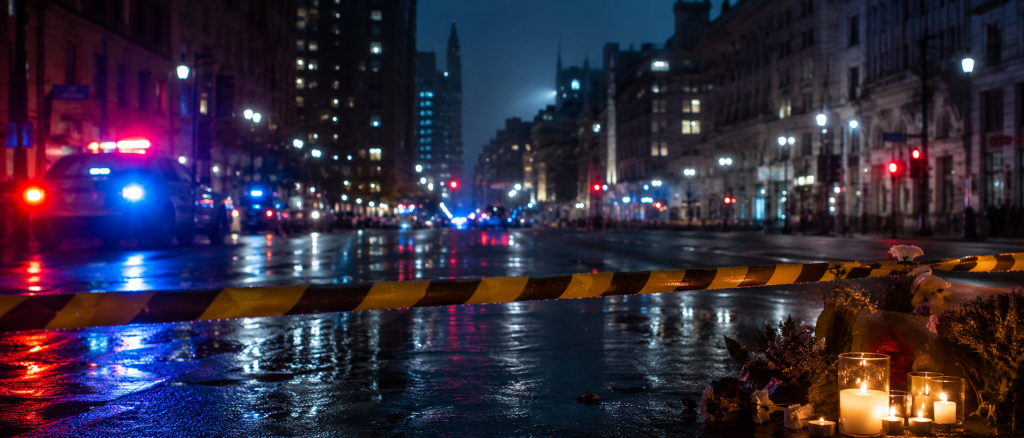
During the seven-day public reporting window from 17 to 23 June 2026, a concentrated series of mass-casualty shootings, targeted firearm attacks, public rampage-style incidents, and non-firearm attempted murders appeared across North American and British media. Over the seven-day period, the publicly documented cases examined here produced an estimated minimum of approximately 75 direct victims across the United States, Canada, and Scotland. This total includes about eight people killed and sixty-seven others injured in mass shootings, active-shooter-style attacks, and terrorism-aggravated attempted murders, with one additional suspect killed in the Montreal police response. The figures remain provisional because early casualty reports often change as hospitals, police departments, and investigators reconcile witness accounts, late-arriving victims, forensic findings, and formal charges.
The most defensible statistical picture depends on a careful separation between categories that are often conflated in public discussion. A mass shooting, in the broad numerical sense used by the Gun Violence Archive and by many U.S. media reports, generally means that four or more people were shot or killed, excluding the perpetrator. An active-shooter incident, in the narrower law-enforcement sense, concerns one or more individuals actively engaged in killing or attempting to kill people in a populated area. A homicide event may involve fewer than four victims, may be domestic or targeted rather than public, and may not qualify as either a mass shooting or an active-shooter case. The same seven-day interval therefore contains several overlapping but analytically distinct phenomena: large group shootings in public or semi-public spaces, shootings connected to interpersonal or gang disputes, a major fatal police-response shooting in Montreal, an alleged terrorism-aggravated series of attacks in Edinburgh, and an organized-crime-linked Canadian investigation into a broader network of paid firearm discharges.
The United States accounted for most of the mass-shooting incidents found in the public reporting sample. Using the four-or-more-shot threshold, the most reliable estimate from the available media and incident-listing data is approximately eleven U.S. mass-shooting events in or immediately adjacent to the period, with roughly four victim deaths and around sixty nonfatal shooting injuries. This figure does not include every homicide or every shooting in the United States during the week; it isolates events that crossed the mass-shooting casualty threshold. It also does not mean that all incidents had the same social character. Some were public attacks on crowds, others were disputes that escalated into gunfire, and some were associated with apartment complexes, restaurants, parties, or neighborhoods where the factual record remained incomplete at the time of reporting. The resulting picture is therefore not one of a single coordinated wave, but of a recurrent pattern of high-casualty firearm incidents dispersed across multiple jurisdictions and social contexts.
Chicago formed the most visible U.S. urban cluster in the reporting period because the city experienced both a discrete mass shooting and a broader weekend pattern of lethal gun violence. During the extended Juneteenth holiday weekend, public reporting recorded at least eight people killed and thirty-nine others injured in shootings across the city, with victims ranging from teenagers to older adults. This citywide figure should not be treated as one event. It was an aggregate of more than two dozen incidents across several neighborhoods. Within that aggregate, the most prominent mass-shooting case occurred during a Juneteenth gathering on the South Side, where a vehicle reportedly approached a crowd and two people opened fire. Initial national wire reporting placed the number of people shot at at least twelve, while later local and national reporting put the number of injured at thirteen or fourteen, depending on whether all victims and late hospital presentations were included. The most cautious formulation is therefore that at least twelve people, and probably thirteen or more, were wounded in the drive-by attack. No deaths were reported in that specific mass-shooting event, but it occurred within a weekend in which several other shootings produced fatalities.
The Chicago case illustrates why raw casualty totals can mislead if the analytical categories are not kept separate. The Juneteenth drive-by was a mass shooting under the numerical threshold because a group of victims was struck in a single episode. The broader weekend total was a citywide homicide-and-injury count, not a single mass shooting. Political commentary rapidly attached itself to the violence, including renewed claims that federal or military-style intervention could suppress crime in Chicago. Yet the factual core of the public reporting remains narrower and more concrete: an extended holiday weekend, multiple shootings, at least eight deaths, nearly forty nonfatal injuries, and one major crowd-targeted attack that became the emblematic event within the wider violence.
Other U.S. mass shootings in the same period were geographically dispersed and varied in apparent motive. Baton Rouge, Louisiana, recorded a drive-by shooting at an apartment complex in which five children or teenagers were wounded, with reports indicating that the victims were expected to survive. Amarillo, Texas, saw six people injured in a shooting described by local reporting as gang-related, with bystanders among those struck. Milwaukee, Wisconsin, reported four people shot near a McDonald’s after what police characterized as an argument. Kansas City, Missouri, experienced a fatal mass shooting near the 18th and Vine Historic Jazz District, where one man was killed and five others were wounded after multiple people reportedly fired weapons in different directions. Hanover, Maryland, recorded six nonfatal shooting injuries after a crowd disturbance, including juvenile victims and hospital walk-ins. Montgomery, Alabama, reported two deaths and two injuries in a quadruple shooting near a gas station, making it one of the deadlier U.S. mass-shooting events in the period. Dallas, Texas, reported at least five people injured after gunfire at a large party. Harlem in New York City recorded four wounded, including two teenagers, near 143rd Street and South Lenox Avenue. Petersburg, Virginia, reported five men shot at a restaurant, one of them with life-threatening injuries. Taken together, these incidents show the breadth of the U.S. mass-shooting category: it includes crowd attacks, party shootings, street disputes, restaurant shootings, apartment-complex shootings, and firearm violence connected to local conflicts.
The deadliest clearly active-shooter-style U.S. event in the period occurred in Chico, California, where two adults were killed and a child was injured in a shooting at a public library. Police reporting described the attack as a deliberate public assault rather than a private dispute, and later media accounts indicated that the suspect had no known connection to the victims and may have been inspired by the Columbine school massacre. The Chico case therefore differs from many of the other U.S. mass-shooting entries. It did not produce four wounded victims, so depending on the precise definition used it may not sit comfortably inside the broad mass-shooting database category. Yet it is closer to the public’s intuitive understanding of an active-shooter attack: a firearm assault in a civic space, directed at people apparently selected because they were present in that location, with fatalities and a rapid police response. In analytical terms, Chico belongs with the Montreal incident more than with some of the dispute-driven group shootings, because its social meaning lies in the vulnerability of ordinary public spaces.
Montreal, Canada, was the most significant fatal developed-world shooting outside the United States during the period. On 22 June 2026, police responded to reports of a person armed with a long gun at or near a Hilton hotel in the Côte-des-Neiges area. According to the public reports available at the time, the gunman opened fire on responding officers. Constable Mohamed Lamine Benredouan, a Montreal police officer, was killed, another officer was seriously injured, and the suspect was killed by police. A civilian also died, though early reporting did not establish with certainty who fired the shot that killed him. The known casualty estimate is therefore two victim deaths, one suspect death, and one seriously injured officer. The event triggered emergency warnings, shelter-in-place instructions, transit disruptions, and a large police operation. Authorities stated that there was no continuing threat after the suspect was neutralized and did not classify the incident as terrorism in the early public reporting.
The Montreal case is important because it does not fit easily into the same category as many U.S. mass shootings. It was not primarily reported as a crowded-party shooting, a gang dispute, or a generalized street attack. It appears, on the available evidence, to have been a police-response ambush or active-shooter-style confrontation involving a long gun in a densely populated urban district. The death of a serving Montreal police officer gave the case national significance in Canada, particularly because line-of-duty police killings are comparatively rare and because the incident occurred in a country where firearms regulation and gun-crime patterns differ sharply from those of the United States. Canada’s national homicide rate remained below two homicides per 100,000 population in the latest official national statistics available before the incident, and the country’s mass shootings remain far rarer than in the United States. That comparative rarity does not reduce the gravity of the Montreal event; rather, it explains why it generated broad attention and why authorities were cautious in describing motive, threat status, and the source of each fatal shot.
A second Canadian development reported in the same seven-day media window was not a single mass-casualty event but a major organized-crime and security investigation in Toronto. Toronto police publicly linked multiple shootings, including an earlier attack on the U.S. Consulate and attacks on synagogues or Jewish institutions, to what they described as multilayered gun-for-hire networks. Investigators said young adults and teenagers were being recruited through encrypted messaging applications and paid to carry out shootings, in some cases required to film the attacks as proof. Police reported that two seized handguns were linked to twenty-seven firearm discharge incidents across the Greater Toronto Area. This Toronto material should not be merged statistically with the Montreal shooting or counted as a new seven-day mass shooting, because the incidents themselves unfolded over a longer period and the reporting concerned an investigation rather than a single event. It is nevertheless relevant to the broader developed-world picture because it shows a different form of firearm violence: not a lone active shooter or spontaneous public dispute, but a networked, outsourced, intimidation-oriented model of urban gun crime in which shootings are allegedly commissioned, performed, documented, and circulated as part of criminal or ideological signalling.
The Edinburgh, Scotland, case belongs to a separate category because it was not a shooting and produced no deaths in the public reporting available during the window. On 19 June 2026, Police Scotland received multiple calls about violent attacks, threats, robbery, and vandalism across Edinburgh. Five men, aged twenty-two to thirty-nine, were injured, and three required hospital treatment, though none of the injuries were described as life-threatening by police. A thirty-six-year-old man was arrested and later charged with five counts of attempted murder aggravated by a terrorist connection, as well as other charges including assault, robbery, breach of the peace, and reckless conduct. Reporting indicated that the attacks were being investigated as suspected anti-Muslim or faith-based hate attacks, with incidents beginning near or around the Broomhouse mosque area and then extending across other parts of the city. Counter-terrorism officers supported the investigation, and authorities said there was no indication of a wider ongoing threat.
The Edinburgh attacks demonstrate the need to include non-firearm mass-casualty or attempted-murder events when examining public violence in Western countries. If the analytical lens is restricted only to mass shootings, Edinburgh disappears from the dataset. If the lens is broader and concerns public attacks, ideologically aggravated violence, and attempted multiple homicide, Edinburgh becomes one of the most serious developed-world cases in the period. It involved multiple victims, a sequence of locations, alleged hate motivation, and terrorism-aggravated charges. Unlike Montreal and Chico, it did not involve firearm lethality. Unlike Chicago or Kansas City, it was not described as a crowd shooting or local dispute. Its importance lies in the intersection of public violence, minority-community targeting, and counter-terrorism classification. The absence of deaths should not lead to analytical dismissal, because attempted murder charges indicate that prosecutors considered the alleged conduct to involve lethal intent.
Within the developed or Western-world subset outside the United States, the publicly visible cases in the seven-day period were therefore concentrated in Canada and Scotland. Montreal supplied the principal fatal non-U.S. shooting, Toronto supplied a major investigative disclosure about networked firearm violence, and Edinburgh supplied the major non-firearm attempted-murder series. Searches of contemporary public reporting did not reveal a comparable new mass shooting in Australia, New Zealand, or Western Europe during the same short window. Several major recent or historical developed-world mass shootings appeared in search results, including the 2025 Bondi Beach attack in Australia, the 2025 Graz school shooting in Austria, earlier European mass shootings, and the 2019 Christchurch mosque attacks, but those were outside the seven-day period and should not be counted in the current casualty estimate. Similarly, a January 2026 mass stabbing in Antwerp appeared in some search results but was outside the seven-day window. The developed-world comparison should therefore not be padded with stale events simply because they resemble the cases under study.
A broader global search did identify the Tacloban City school shooting in the Philippines, where two students reportedly opened fire at a high school, killing three fellow students and injuring twenty others. That event is relevant to any global accounting of public mass shootings in the same period, but it sits outside the narrower “developed world / Western world” comparison requested here. It does, however, provide a useful contrast. Like Chico, it involved an educational or civic environment and young victims. Like Montreal, it occurred in a country where such attacks are relatively unusual and therefore prompted institutional reassessment. But it should not be used to characterize Western developed-country patterns unless the scope is explicitly expanded beyond that category.
Across the full U.S. and developed-world sample, the casualty burden is substantial but unevenly distributed. If the U.S. four-or-more-shot mass-shooting events are counted separately from the citywide Chicago aggregate and from non-U.S. non-shooting attacks, the estimated U.S. mass-shooting subtotal is approximately eleven incidents, four deaths, and about sixty nonfatal shooting injuries. If Chico is added as an active-shooter-style public attack, the U.S. death count rises by two and the injury count by one child, though it may not qualify under every mass-shooting threshold. Montreal adds two victim deaths, one suspect death, and one seriously injured officer. Edinburgh adds five injured victims and no deaths. Toronto adds no new single-event casualty figure for the seven-day window but supplies context for a continuing firearm-discharge network linked to twenty-seven incidents. Excluding duplicate citywide aggregates and excluding stale events, the developed-world non-U.S. casualty figure for the period is therefore at least two victim deaths, one suspect death, and six nonfatal casualties if Montreal and Edinburgh are combined; if Toronto’s longer-running network is considered context rather than an event, it should not alter that seven-day casualty count.
The main interpretive conclusion is that the same week produced very different types of public violence. The U.S. cases were numerous and mostly involved firearms, with mass-shooting classification driven by the number of people struck rather than by motive. Chicago represented a high-frequency urban gun-violence cluster with one especially visible crowd shooting embedded in a broader weekend of homicides and injuries. Chico represented a rarer public-space attack more closely resembling the active-shooter model. Montreal represented a fatal police-response shooting and public threat event in a major Canadian city, with two victims dead and a suspect killed. Edinburgh represented a suspected hate- or terrorism-aggravated series of non-firearm attacks, with five injured and no fatalities. Toronto represented an investigative picture of organized, commissioned gun violence rather than a single mass-casualty incident.
The distinction between these forms matters because a single undifferentiated phrase such as “mass shooting” cannot carry the full empirical load. A party shooting with five wounded, a library attack with two killed, a hotel or street confrontation that kills a police officer and a civilian, and a terrorism-aggravated knife attack injuring five men are not the same phenomenon, even when they enter the same media cycle and produce public fear. Their prevention problems differ: illegal firearm supply, retaliation cycles, group disputes, lone-actor radicalization, security of public spaces, protection of religious minorities, police-response risk, and organized criminal recruitment of young shooters all require different analytical and policy frameworks. What unites the cases is not a single cause, but the exposure of ordinary public, semi-public, and communal spaces to sudden lethal or potentially lethal violence.
The reporting also shows the limits of real-time casualty accounting. Early figures often change as hospital walk-ins are identified, police clarify whether victims were shot or otherwise injured, and medical conditions stabilize or deteriorate. Chicago’s mass-shooting count moved from at least twelve wounded to higher figures in later reports. Edinburgh’s early reports referred to four injured before police updates and subsequent charging information identified five injured men. Montreal’s early reporting established the death of a police officer and suspect, then added or clarified the civilian fatality while leaving open the precise source of the fatal shot. For this reason, the most accurate public report must use ranges or cautious formulations where necessary, avoid overclassifying motive, and distinguish between confirmed deaths, nonfatal injuries, suspect deaths, and unresolved forensic questions.
Seen as a whole, the seven-day period was marked by a high U.S. frequency of mass shootings, one major Canadian fatal shooting involving police, one Canadian organized-shooting investigation with broader security implications, and one serious Scottish terrorism-aggravated attempted-murder case. The developed-world non-U.S. pattern did not approach the numerical frequency of the U.S. mass-shooting pattern, but it was not empty: Montreal and Edinburgh were significant events in their own right, and Toronto suggested a longer-running structure of commissioned firearm violence. The most accurate conclusion is therefore not that the United States was alone in experiencing serious public violence, but that the United States produced the overwhelming majority of mass-shooting incidents in the week, while Canada and Scotland supplied fewer but analytically important cases of fatal firearm attack, organized gun violence, and suspected hate-driven attempted murder.


Leave a comment