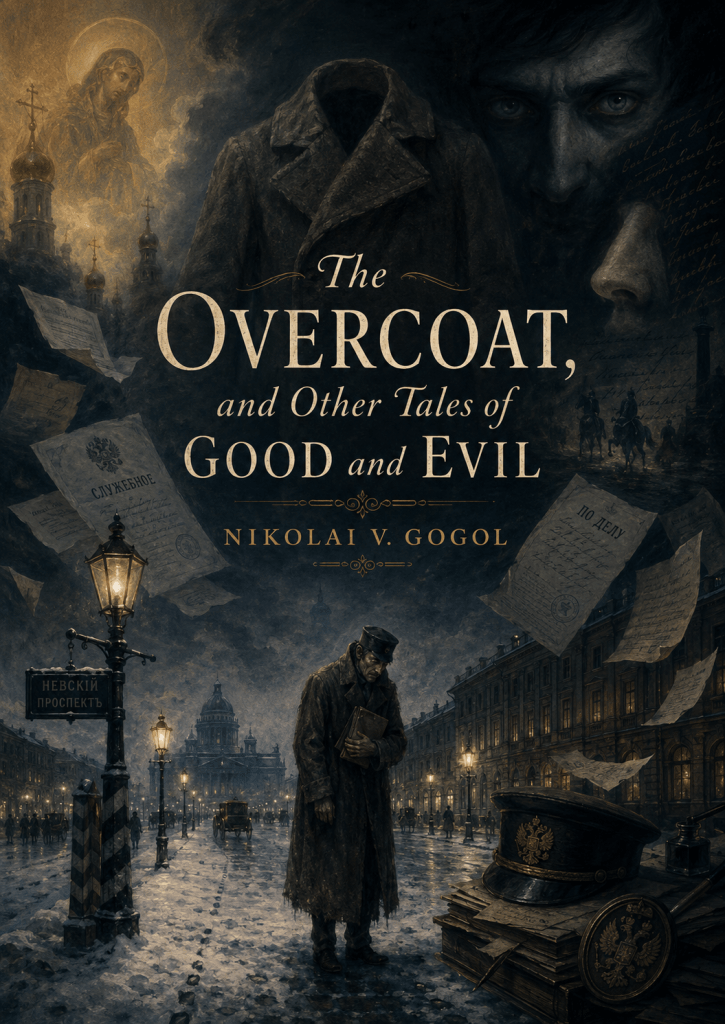
The central question of The Overcoat, and Other Tales of Good and Evil concerns the conditions under which a person, image, institution, or judgment possesses reality beyond its outward marks. Across the collection, faces, uniforms, titles, documents, dreams, money, and garments acquire powers their bearers cannot govern; inward life becomes visible through surfaces that also falsify it. The volume’s arrangement permits a governing ambition to be reconstructed: good and evil are tested under altered regimes of causality, from ancestral curse and divine judgment to artistic representation, urban spectacle, bureaucratic classification, and material deprivation. Its distinctive value as an object of study lies in the precision with which comedy, terror, compassion, and narratorial uncertainty become philosophical evidence, and in the way each tale makes later determinations revise the meaning of earlier appearances.
The evidentiary object supplied for this reading has two materially different strata. The PDF is the full Robert Bentley volume entitled *The Overcoat, and Other Tales of Good and Evil*, translated and introduced by David Magarshack. Its preliminaries identify a 1979 reprint of a 1957 edition, itself issued under the earlier title *Tales of Good and Evil*, and explain that an earlier London collection had contained “Taras Bulba,” whereas this edition replaces that work with “Ivan Fyodorovich Shponka and His Aunt” and “The Nose” in new Magarshack translations. Its table of contents gives the operative sequence: “The Terrible Vengeance,” “Ivan Fyodorovich Shponka and His Aunt,” “The Portrait,” “Nevsky Avenue,” “The Nose,” and “The Overcoat,” preceded by Magarshack’s introduction. The EPUB, by contrast, identifies itself simply as *The Overcoat*, supplies an unattributed translation of that tale together with a very brief biographical notice, and contains none of the other five narratives or the translator’s introduction. Its lexical choices differ visibly from the PDF’s: where Magarshack gives “Very Important Person,” for example, the EPUB gives “prominent personage,” and where the PDF distinguishes the new “overcoat” from the degraded “capote,” the EPUB often uses “mantle.” The EPUB therefore serves here as a limited witness to the overlapping story. It cannot determine the anthology’s order, its editorial argument, or the exact diction of the translation that binds the PDF volume together. This source asymmetry is an internal fact of the supplied materials rather than an external bibliographic conjecture.
That asymmetry has an immediate philosophical consequence. The volume cannot responsibly be described as a single treatise whose six movements Gogol designed in this order. The printed dates themselves prevent such an attribution: the sequence moves from works dated 1830–31 and 1831 to the revised “Portrait” dated 1841–42, then back to 1834 and 1835–36, and finally to “The Overcoat,” dated 1841. The unity available to interpretation is consequently a layered unity. Gogol’s tales provide recurrent narrative operations; Magarshack’s selection, translation, title, and introduction place those operations in an ordered field; the later reprint preserves that field while acknowledging that it results from replacement and reorganization. When the collection is treated as an internally developing argument, the term *argument* must therefore name an articulated relation produced by arrangement, recurrence, and retroactive illumination. It does not name a continuous authorial exposition. This qualification strengthens rather than weakens the possibility of systematic reading, because the book repeatedly makes mediation itself one of its objects: a legend is finally explained by a blind singer; a domestic story arrives through a forgetful transmitter and a mutilated notebook; a portrait’s history is narrated at an auction; city life is filtered through a mobile and self-correcting observer; an impossible bodily event passes through police, press, medicine, and gossip; the life of an obscure clerk is preserved by a narrator whose memory and information remain insistently incomplete.
Magarshack’s introduction operates as the first interpretive instrument of the volume. It proposes “the conflict between good and evil” as a continuity extending from the early Ukrainian legend into the later metropolitan tales, while it also describes a historical and artistic displacement in the form that conflict assumes. In its account, “The Terrible Vengeance” gives evil a sorcerous embodiment and then grounds that evil more deeply in treachery between sworn brothers. “Ivan Fyodorovich Shponka and His Aunt” moves toward a comic realism generated from insignificant details. “The Portrait,” especially in the revised form printed here, reduces the overtly demonic mechanism while retaining an evil that seems to subsist outside the individual and to enter artistic and economic life through money. “Nevsky Avenue” relocates the conflict into the incompatibility between ideal conception and empirical reality. “The Nose” becomes social satire, and “The Overcoat” accords the underling and misfit the status of a human being entitled to happiness. This introduction supplies a proposed law of transition: supernatural exteriority yields ground to social and psychological mediation, while the opposition of good and evil remains.
The tales both support and place pressure upon that proposed law. The sorcerer in “The Terrible Vengeance” is indeed an external agent of murder, incestuous desire, political betrayal, and sacrilege; yet his final destruction follows from a punishment invented by the wronged Ivan, and God’s assent includes a sentence against Ivan for the terribleness of his chosen revenge. Evil here cannot be isolated in the sorcerer alone, because righteous injury generates a demand whose eternal excess deprives the avenger of heaven. Conversely, the ostensibly realistic “Overcoat” ends with a dead clerk who strips living citizens of their coats, terrifies policemen, and forcibly reforms a general’s conduct. The later tale therefore does not abandon supernatural exteriority. It reassigns its function. The fantastic ceases to establish the original world-order and becomes a supplementary jurisdiction that appears when ordinary jurisdiction has failed. “The Nose” removes even that moral assurance: the autonomous organ travels as a higher official, returns without explanation, and leaves its owner ethically unchanged. “The Portrait” gives its malignant image a genealogy, although the genealogy concludes with the image’s renewed disappearance. Each explanatory gain opens a fresh remainder. The introduction’s developmental thesis is therefore best understood as a disciplined hypothesis supplied by the editor-translator, one that the stories continually revise through their own compositional acts.
The volume’s first methodological commitment lies in this refusal to make explanation coincide with exhaustion. Its narrators supply exact dates, ranks, sums, routes, garments, foods, household arrangements, and institutional procedures; at decisive points, the same narrators admit ignorance, forget names, lose causal links, or allow rumor to take over. Determinacy and indeterminacy form a single procedure. The opening of “The Nose” dates the extraordinary event to 25 March and identifies the barber’s avenue, trade, signboard, domestic breakfast, and weekly shaving relation to Major Kovalyov. The narrative then hides the barber’s interrogation under a fog, later lets another fog descend upon the circulation of rumor, and never explains how the nose entered the loaf, acquired a uniform, obtained a passport, or resumed its anatomical place on 7 April. “The Overcoat” enumerates Akaky Akakyevich’s inheritance down to quills, government paper, socks, loose buttons, and the ruined capote, while professing no interest in who received these objects. It identifies the title and habits of his persecutors more readily than the department in which he serves, and it leaves the precise office of the Very Important Person unascertained. The narratorial gaps do not cancel the particulars. They disclose a world in which the systems competent to count, name, file, price, and rank are incompetent to give a sufficient account of singular existence.
This relation between enumeration and insufficiency governs the very idea of evidence in the collection. A detail may function as proof, distraction, symptom, or parody of proof, and its role changes as the narrative proceeds. The monstrous transformation at the wedding in “The Terrible Vengeance” appears when sacred icons expose the unknown Cossack; visual alteration is initially evidence of sorcery. Danilo’s subsequent observation of the father through the castle window adds experimental confirmation, while Katherine’s dream and the nocturnal appearance of her soul complicate the status of observation by locating knowledge outside waking consciousness. The blind bandore-player at the end then supplies the ancestral narrative that makes the sorcerer’s fate intelligible. The singer cannot see the assembled listeners, yet his song furnishes the widest historical vision in the tale. In “The Portrait,” seeing acquires the contrary danger. Chartkov’s professional eye recognizes mastery in the damaged canvas and later distinguishes the life of the painted eyes from the harmony of art, but his sight becomes fascinated by gold and by social visibility. The second part explains the making of those eyes through another painter’s attempt at exact observation. Here evidence itself has been contaminated: the closer the painter studies the usurer’s gaze, the more the effort at fidelity suppresses the spiritual disposition that, according to the tale’s later aesthetic doctrine, allows nature to become art.
An inference follows from these textual arrangements. The book repeatedly treats an excess of visible precision as capable of producing blindness. This implication is never announced as a general maxim, yet it is warranted by a series of explicit contrasts. The portrait’s eyes are finished with uncanny exactitude and thereby disrupt the image’s totality. Nevsky Avenue presents an exhibition of whiskers, moustaches, sleeves, waists, hats, shoes, medals, profiles, and smiles, while the persons who bear these features disappear into the display. Kovalyov knows the pimple on the left side of his recovered nose and can catalogue the acquaintances before whom noselessness would be disastrous, while he cannot explain either the organ’s autonomy or the form of selfhood by which it declares, in the cathedral, “I am myself.” Akaky’s colleagues become aware of him through the new coat and almost immediately forget him as soon as cards replace the garment as the evening’s object of attention. Precision attaches to the sign and leaves the bearer ontologically underdetermined. The volume’s realism consequently cannot be reduced to abundance of detail. Its more exact operation consists in showing how detail enters regimes of recognition and how easily recognition hardens into substitution.
Substitution is already active in names. Akaky’s given name reproduces his father’s after the calendar offers a sequence of names his mother finds intolerably strange. The narrator insists that no alternative was possible and imagines the infant grimacing as though he foresaw his future rank. The apparent anecdote converts naming into fatal repetition: the son receives the father’s name and later performs copying as his entire vocation. Shponka’s school life is likewise organized by repetition, cleanliness, careful ruling, obedience, and the familiar passages of his fortune-telling book. He enjoys rereading what he already knows in the same way that a civil servant enjoys finding familiar names in the service list. Kovalyov prefers the military equivalent “major” to the civil designation “collegiate assessor,” since the alternate name raises the social force of the same formal rank. The usurer in “The Portrait” possesses no securely identified nationality; the narrator offers Indian, Greek, and Persian as possibilities, while the man’s physiognomy and economic function become more determinate than his communal name. Piskarev and Pirogov, by contrast, acquire names and contrasted biographies only after Nevsky Avenue has first displayed the city as a stream of detachable features. Naming sometimes fixes fate, sometimes upgrades appearance, sometimes fails to identify, and sometimes arrives as a belated retrieval of persons from the crowd.
The same instability structures offices and ranks. Rank in these tales is a public grammar that precedes character. The narrator of “The Overcoat” says that rank must be stated before anything else and accordingly introduces Akaky through the ninth of fourteen grades. The story then demonstrates the violence of this precedence: caretakers do not rise, superiors thrust papers under his nose, younger clerks discover how far wit may extend against someone unable to retaliate, and the general’s borrowed grandeur depends on making inferiors wait. In “The Nose,” rank emancipates a part of the body from the body’s owner. The nose’s fifth-rank uniform outweighs Kovalyov’s eighth-rank status so completely that the latter cannot formulate his claim without embarrassment. The nose points to their different departmental buttons as proof that no intimate relation can exist between them. An anatomical bond yields to an administrative classification. This is comic in form and exact in implication: where institutional signs command recognition, even the body’s unity must petition for acknowledgment.
The book does not present institutions as abstractions floating above daily life. It materializes their authority in thresholds, clothes, tones of voice, waiting rooms, writing implements, ledgers, seals, and routes of referral. The Very Important Person practices his hard voice before a mirror, introduces a sequence by which a petition passes from one official to another, and displays his importance to a visiting friend through Akaky’s delay in the anteroom. His cruelty is therefore theatrical and procedural at once. He remains capable of sympathy, yet his rank blocks its expression until the ghost removes the warm overcoat that protects his social body. The newspaper clerk in “The Nose” counts letters and fees while deciding which losses can enter print; he rejects Kovalyov’s case because the newspaper’s reputation would suffer, then recommends converting it into a report of a rare natural phenomenon for the instruction of youth. The police inspector turns bodily catastrophe into a question of respectability and postprandial timing. The doctor converts the recovered nose into a possible specimen preserved in spirits. Each institution can process the event only by translating it into its own genre. The translations are locally rational and collectively absurd.
Writing itself thus occupies an equivocal place. It can preserve, copy, distort, authorize, or disappear into use. Akaky loves individual letters, reproduces documents without attending to their practical effects, and finds the change from first to third person in a report almost intolerably demanding. His copying gives him pleasure and a complete world, yet the institution values it only as replaceable function: after his burial a taller clerk fills his place and forms letters at a different angle. Shponka’s story comes through Stepan Ivanovich Kurochka’s notebook, half of which the frame narrator’s illiterate wife uses beneath her excellent pasties. The narrator’s bad memory, failed knots, and missed recollections leave the tale without its promised next chapter. Its incompletion is therefore produced by the material life of writing, by paper’s availability for culinary reuse, and by a domestic economy indifferent to literary continuity. “The Portrait” twice places pictures amid markets and auctions, where frames, varnish, ownership, and price mediate what can be seen. “The Nose” tests petition, advertisement, private accusation, official report, and public rumor. The collection repeatedly asks what kind of inscription can carry a life without reducing that life to a transferable sign.
At the deepest level of the volume’s organization, this question governs the movement from “The Terrible Vengeance” to “The Overcoat.” The legendary tale inscribes action into ancestral and cosmic memory: every new crime awakens the dead, distant mountains become visible, the earth trembles under the movement of a buried ancestor, and the bandore-player’s song binds present listeners to events beyond living recollection. The final tale begins from the opposite social condition. Akaky leaves almost no record in the human community; his office learns of his death only when a caretaker is sent to summon him, and Petersburg continues as though he had never existed. The ghost supplies the inscription that ordinary memory withheld. He becomes a rumor distributed through the city, and rank is made to feel on exposed shoulders what it had refused to recognize in a living subordinate. The first tale gives memory a terrifying excess; the last responds to social oblivion with fantastic recurrence. Between them, the collection examines intermediate media—household anecdote, painted image, metropolitan spectacle, newspaper, letter, bureaucratic copy—each of which preserves by transforming and transforms by exposing its object to fresh misrecognition.
The moral cosmos of “The Terrible Vengeance” provides the broadest scale on which these questions are first posed. Its wedding scene gathers kinship, military fellowship, Christian blessing, music, dance, food, drink, and public festivity into a temporary image of communal integration. The unknown Cossack has already participated in the dance and produced laughter. His monstrosity becomes perceptible only when Captain Gorobetz raises the icons given to him by the hermit Father Bartholomew. Sacred representation here performs a diagnostic act: the icon does not merely depict holiness; its presence forces concealed evil into visible deformation. Nose, mouth, tooth, chin, eyes, and back lose their human proportion as the stranger becomes an old man. The tale thus begins with a theory of appearance in which goodness supplies the light under which a socially accepted surface betrays its essence. The icon’s protection remains local, however. It expels the sorcerer from the wedding without destroying him, and communal celebration resumes amid mutually incompatible explanations. Revelation interrupts festivity, while knowledge remains distributed as rumor.
The sorcerer’s evil has several articulated dimensions. He is Katherine’s father and the murderer of her mother; he directs incestuous desire toward his daughter; he conspires with enemies to sell the Ukrainian people to the Catholics and burn Christian churches; he kills Danilo from concealment, murders his daughter when she recognizes him, and kills the hermit who cannot pray for him. His opposition to the tale’s order therefore crosses domestic, erotic, political, religious, and sacramental relations. Yet these dimensions do not simply accumulate as a catalogue of crimes. They are variations of one operation: a bond that should sustain reciprocal life is converted into an instrument of unilateral possession. Fatherhood becomes predation, alliance becomes betrayal, hospitality becomes infiltration, political relation becomes sale, and the request for intercession becomes occasion for murder. The sorcerer’s demand that Katherine love him concentrates this structure. He can summon and torture her soul while her body sleeps, though the soul insists that only God can determine its will. Evil here reaches toward mastery over inward freedom and discovers a boundary it cannot directly cross.
The distinction between body and soul initially appears to protect moral autonomy. Katherine’s soul knows more than her waking consciousness, visits the place of childhood and the murdered mother, recognizes the father’s crimes, and refuses infidelity to Danilo. The sorcerer can separate this soul from the sleeping body, call it into his chamber, and subject it to fear. He cannot make it consent. This metaphysical immunity is severely qualified by the narrative that follows. Katherine’s embodied life remains vulnerable to deception, guilt, grief, madness, and physical force. Her father gains release by staging repentance through a theological appeal to divine mercy, and her compassion opens the prison that his magic alone cannot penetrate because its walls were built by a holy hermit. The very moral capacity that distinguishes her from him becomes the medium of his escape. Later he invades her grief under the guise of Danilo’s comrade and kills her with the knife she raises against him. The tale therefore grants freedom to the soul while showing how moral action in the world depends upon interpretation, and interpretation can be manipulated by an evil that speaks the vocabulary of repentance.
Katherine’s release of her father is among the tale’s most tension-laden episodes because every available norm divides against another. She has disowned him as Antichrist and has promised allegiance to her husband. The prisoner invokes the unhappy mother, Christian forgiveness, the conversion of the Apostle Paul, the mercy of God, monastic withdrawal, fasting, prayer, and the distribution of treasure among monks. Katherine knows that she lacks power over punishment in the next world, yet she believes she can save a soul by making repentance possible. Her act is at once a betrayal of Danilo’s trust and an attempt to honor the highest mercy named by the prisoner. The prison door can be opened only with the holy key; this material fact makes her free decision necessary to his escape. When she afterwards tells herself that she has performed a deed pleasing to God, the assertion is neither confirmed nor refuted by a direct authorial judgment. Consequences condemn the practical error: the sorcerer returns to conspiracy and murder. The moral intention remains distinct from those consequences. The episode prevents the concept of goodness from collapsing into correct prediction.
Danilo’s goodness is comparably composite. He embodies courage, fidelity to comrades, military memory, defense of the Orthodox faith, affection for his child, and a readiness to reconcile after combat with his father-in-law. His death is narrated as the departure of a gallant soul from a noble body. At the same time, his world is ordered by patriarchal command and martial violence. He silences Katherine, opposes the alleged effeminacy of listening to wives, speculates about the sorcerer’s gold, threatens to sew Katherine in a sack and drown her if she released the prisoner, and recalls enemies in terms of severed heads, captured trappings, and souls allowed to escape. His reconciliation follows Katherine’s desperate invocation of their child and her accusation that refusal would expose the boy to future atrocity. The story can idealize the Cossack warrior and still allow the ideal to carry a coercive domestic logic. This pressure matters because the introductory opposition between ideal hero and embodied evil otherwise risks becoming too simple for the tale’s own evidence.
The tale’s political world produces a related tension. The Polish raiders are represented through sacrilege, drunkenness, sexual disorder, mockery of Orthodox Christians, contempt for Ukrainians, and alliance with a corrupt priest. Danilo’s memory of earlier Cossack unity contrasts with a present in which colonels and captains quarrel, gentry imitate Polish fashion, some accept the Uniat faith, and the poor suffer oppression. The threat from outside coincides with internal disintegration. His nostalgia identifies order with a lost hetmanic command and with the shared glory of battle. Yet the narrative makes the sorcerer, a member of Katherine’s own lineage, the active mediator between external enemies and domestic destruction. Political evil enters through intimate relation. An inference is justified here: the tale’s geography of threat refuses a clean border between community and enemy. Its most destructive figure is simultaneously father, returned exile, clandestine traitor, and supernatural outcast.
Landscape extends this moral topology beyond human institutions. The Dnieper, woods, hills, moon, clouds, stars, and Carpathian mountains are repeatedly endowed with motion, feeling, voice, and memory. Seen from the river, hills become double images suspended between upper and reflected sky; woods become the hair of a wood-demon whose beard is rinsed in the water; meadows become a girdle encircling the round heavens. In the great apostrophe to the Dnieper, calm water reflects sun, stars, woods, and flowers, while storm makes the river terrible and assimilates its waves to a mother lamenting the departure of her Cossack son. These personifications are more than decorative enlargements. Human action is embedded in a world capable of resonance. When the sorcerer flees, trees extend branches as though to strangle him, stars seem to run ahead and point him out, and the road itself appears to pursue him. At the end, geological tremor is interpreted twice: learned men explain it through a fiery mountain near the sea, whereas the elders of Hungary and Galicia attribute it to the vast dead Petro struggling under the earth. The narrative preserves both explanations long enough to mark a contest between impersonal natural cause and morally saturated cosmology, then grants the legendary explanation the final imaginative force.
This saturation of nature by morality does not mean that nature behaves as a transparent code. The cemetery corpses rise crying for air before the ancestral account explains them. The dead grow successively taller, hairier, bonier, and more terrible, though the boat’s witnesses initially possess no genealogy by which to interpret the sight. The face that appears unbidden in the sorcerer’s magic cloud terrifies him despite lacking any obviously fearsome feature. The sleeping armored rider crosses the Carpathians before his identity is disclosed. Cause is staged after effect. The tale allows dread to acquire form prior to knowledge and then lets the bandore-player’s story reorder the meaning of earlier scenes. This retroactive causality is one of the book’s most important compositional inventions. Later discourse does not merely add information; it changes the ontological status of what has already been seen. The rider becomes Ivan, the weakest buried giant becomes Petro, the corpses become the sorcerer’s agitated ancestors, and the sorcerer becomes the terminal product of a lineage condemned to culminate in maximal wickedness.
The bandore-player’s coda also redistributes responsibility. Before the song, the sorcerer appears as an unprecedented sinner whose crimes make the holy letters drip with blood and defeat the hermit’s power of intercession. After the song, he is revealed as the final descendant through whom Ivan’s divinely ratified sentence against Petro’s line reaches completion. This does not acquit him; the narrative shows his choices and his repeated escalation from fear to murder. It does, however, place those choices inside a punishment designed before his birth. He must become the wickedest member of the lineage so that ancestral vengeance can be consummated. Freedom and fate become inseparable at the point of guilt. The sorcerer acts with deliberate malice and fulfills an inherited juridical function. The tale never supplies a conceptual formula that reconciles these determinations.
God’s judgment intensifies the difficulty. Invited to choose Petro’s punishment, Ivan requests the unhappiness of every descendant, the disturbance of all ancestors in their graves, the emergence of a supremely evil final heir, the eternal gnawing of that heir by the dead, and Petro’s own inability to participate in the vengeance he desires. God calls the punishment terrible and allows it to stand, while condemning Ivan to remain forever on the mountain outside the Kingdom of Heaven. Divine authorization and divine reservation occur in the same pronouncement. The result corresponds closely to Magarshack’s introductory claim that retribution here lacks the essential element of mercy. The story itself provides the textual warrant: Ivan’s righteous injury becomes an eternal identity, his watching of suffering becomes his own exclusion, and the condemned lineage produces further innocent victims across generations. The vengeance reaches the sorcerer, yet it also encompasses Katherine, Danilo, their child, the murdered mother, the hermit, and even unknown persons crushed when the buried giant shakes the earth.
The word terrible consequently migrates from object to judgment. It describes corpses, crimes, looks, laughter, punishment, and vengeance itself. The adjective ceases to identify one side of a moral opposition and marks the magnitude generated when justice assumes the temporal form of inherited retaliation. The final spectacle gives the sorcerer’s body to ancestral teeth and makes his dead eyes behold the process. This is a completion in plot and a controlled antinomy in ethics. The punishment fits the logic of betrayal by returning the offender to the lineage he has tormented; its endlessness reproduces the very inability to release a bond that characterized his evil. Ivan’s punishment reveals that vengeance can mirror its object even when God permits it.
The story’s representations of women add another source of pressure. Katherine is praised for beauty, fidelity, maternity, meekness, and compassion. Her voice repeatedly mediates between men: she halts the duel, solicits reconciliation, gives Danilo a reason to live, disowns her father, and later attempts to avenge his crimes. Yet the same structure that makes her morally central denies her stable authority. Danilo dismisses her counsel as womanly fear; the sorcerer enters her sleep; her release of him becomes a secret that terrorizes her; the murder of husband and child drives her into a madness expressed through broken songs, disordered dance, and fragments of memory; the father finally exploits that derangement. Her soul’s refusal is absolute, while her embodied agency is crushed between paternal predation and marital command. It would exceed the text to attribute a systematic doctrine of gender to this pattern. The textual basis permits the narrower inference that the tale locates the cost of its male structures of honor and vengeance in the body and speech of the woman through whom kinship lines intersect.
Her madness is composed from damaged forms rather than mere formlessness. She dances out of time, turns a slow traditional dance into exhausted tapping, confuses the dead child with a sleeping one, searches the woods with a knife, and strings together fragments of songs about carts covered in blood, dead Cossacks, grieving mothers, cottages without doors or windows, dancing animals, and failed love. Earlier, communal song coordinated wedding, war memory, and lullaby. In Katherine’s speech, song loses sequence while preserving images of the catastrophe. This is another mode of inscription. Trauma cannot be narrated as a continuous causal report, yet it returns in rhythm, image, and bodily repetition. The collection will later transpose the same problem into Piskarev’s dreams, Chartkov’s hallucinated eyes, Kovalyov’s incompatible explanations, and Akaky’s feverish cycle of coat, thief, general, apology, and obscenity.
Laughter in “The Terrible Vengeance” has no stable moral ownership either. The unknown Cossack amuses the wedding guests before the icons reveal him. The horse laughs at the fleeing sorcerer, and the mounted Ivan’s laughter reverberates through the mountains and within the sorcerer’s body immediately before death. The bandore-player ends the tale by returning to comic songs, though his audience remains absorbed in terror. Laughter can accompany fellowship, disguise, supernatural judgment, and the attempt to resume ordinary life after dreadful knowledge. This mobility anticipates the later tales, where laughter can awaken compassion, enforce humiliation, cover violence, or erase it. The comic in Gogol’s collection is therefore a mode of ontological instability as much as a tone: it reveals that the same gesture changes its value with the relation in which it occurs.
The transition to “Ivan Fyodorovich Shponka and His Aunt” contracts this cosmic field without abandoning its structural problems. The old curse gives way to school discipline, military routine, farm management, property title, court procedure, courtship, and dream. The supernatural terror of the father becomes the comic terror of a possible wife. Ancestral land remains at issue, though now through a missing deed of gift and an inheritance dispute rather than a divine sentence. A powerful woman still mediates the hero’s future, though Vasilisa Kashporovna acts as energetic household governor rather than endangered daughter. Most importantly, causality remains retroactive and incomplete. The frame tells the reader in advance that the written ending has been destroyed, while the final sentence promises that the aunt’s newest scheme belongs to the unavailable next chapter. The tale thus converts the abyss of the legend into a missing piece of paper. Both structures deny direct access to the terminal ground of events.
The comic reduction in scale is philosophically exact. In the legend, the whole earth trembles because Petro’s growing bones move underground. In “Shponka,” a schoolmaster’s cough in a corridor terrifies a class before his frieze coat and pockmarked face appear through the door. In the legend, holy icons force a sorcerer’s body to disclose itself. In the schoolroom, a teacher’s hand emerges from a coat, seizes young Vanya by the ear, confiscates a butter-soaked pancake, and canes the hands that accepted a bribe. The later memory of punishment helps explain Shponka’s reluctance to enter civil service and the intensification of his native timidity. Grand theological causality has become a small pedagogical event whose disproportionate afterlife shapes a personality. The collection’s question has shifted from the inheritance of guilt to the accumulation of habit.
Habit constitutes Shponka’s inward world. As a boy he sits with folded arms, keeps a clean ruled book, preserves his penknife in a leather case, avoids damaging desks, and administers the class register conscientiously. As an officer he abstains from his comrades’ gambling and excess, cleans buttons, places mousetraps, reads a fortune-telling book, and lies on his bed. His promotion after eleven years is narrated as rapid. At home he watches harvesters, counts stooks, joins workers for dumplings, and takes pleasure in a landscape whose sounds merge into harmony. The minuteness of these actions does not merely ridicule him. It establishes a consciousness for which repetition, bounded tasks, familiar objects, and low-intensity pleasures provide continuity. His fear of marriage becomes intelligible as fear of an ontological category that would abolish the separateness upon which this continuity depends.
The aunt’s proposal therefore has a deeper effect than ordinary social embarrassment. Shponka imagines that another person will always be in his room and that the singular form of his life will become a permanent pair. His dream proliferates the wife until she occupies chair, garden, hat, pocket, ear, cloth shop, and belfry. Her face becomes a goose’s face; his own identity becomes a bell; marriage becomes a rule requiring him to hop on one leg; finally the wife becomes material measured, cut, carried under his arm, and judged unsuitable by a tailor. The dream does not offer a coherent symbolic lexicon, and Shponka’s dream book cannot interpret it. Its inferential force lies in proliferation: relation is experienced as loss of categorical boundaries. Person becomes object, body becomes architecture, spouse becomes ubiquitous content, and social status becomes compulsory locomotion. The comic nightmare translates the legendary fear of possession into the domestic fear that there will be no remainder of a self outside a relation.
This does not make the proposed marriage objectively catastrophic. Maria Grigoryevna is described as modest and well behaved; the conversation about summer flies and a flyswatter made from an old slipper shows mutual banality rather than menace. Shponka’s terror arises before any coercive act by her. The active pressure comes from his aunt, who has already discussed the match with Maria’s mother and interprets her thirty-eight-year-old nephew as a lad still too young to understand. The aunt’s affection and competence coexist with domination. She has made his estate flourish, saved money for him, manages labor, taxes carts, hunts, rows, disciplines serfs, rewards merit, supervises crops, and imagines future children as an extension of her stewardship. The marriage scheme extends the same practical intelligence into the governance of his intimacy. Good administration becomes intrusive when the object administered is another person’s relation to solitude.
Property and marriage are joined before the aunt explicitly proposes the match. The visit to the Storchenko household is occasioned by the missing deed through which Stepan Kuzmich allegedly granted Shponka a meadow. The aunt’s recollection also insinuates an uncertain relation between Kuzmich and Shponka’s mother, since he visited only during the father’s absence and made the gift before or around the son’s early life. The story neither confirms the deed nor clarifies the kinship implication. Storchenko changes the subject to a cockroach in his ear, denies possession of the document, and surrounds his denial with food, drink, hospitality, family, and command over servants. The aunt then transforms the household that withholds property into the household that may supply a wife. A legal claim becomes a marital alliance. The same Maria who appears within a possible settlement also enters Shponka’s dream as cloth that a shopkeeper measures and sells. The commodifying implication remains an inference, though it rests on this explicit sequence of meadow, deed, dowry, threatened litigation, and materialized bride.
The tale’s social world renders domination through hospitality and apparent generosity. Storchenko embraces Shponka, insists that he drink, locks the gates, orders servants to kneel while offering turkey, contradicts Ivan Ivanovich, and treats refusal as impossible. His cordiality is a form of enclosure. Vasilisa’s love for her nephew has the same structural tendency in a benevolent register: she cares for his property and body, recalls his infancy, plans his descendants, and determines that he will understand in time. Neither figure resembles the sorcerer in moral magnitude. Both demonstrate how the will of another can be absorbed by everyday arrangements that remain socially recognizable as care, sociability, or practical reason. The collection thereby narrows evil from monstrous intention toward the unexamined coercion of ordinary virtues.
The frame narrator complicates every such inference by making his own competence comic. He forgets whatever he is told, mistakes his reader for a visitor familiar with his furniture, relies on a knot and a sneeze as mnemonic devices, and offers elaborate directions to Kurochka’s house while remaining unsure whether it is the second or third gate. His wife’s illiteracy destroys half the manuscript, though her pasties are pronounced unsurpassable. Transmission is governed by appetite, age, marriage, domestic space, and accident. The missing ending consequently mirrors Shponka’s fear: the text itself has been subjected to a wife’s material use. Yet the frame refuses misogynistic certainty by presenting the loss through the husband’s faulty memory and by treating the wife’s baking as real accomplishment. The incompletion has plural causes, including his failure to make a copy, his delayed recollection, and his decision to publish the fragment.
Magarshack’s introduction says that the tale only seems unfinished because nothing further is needed to make Shponka intimately known. The story partly supports this claim: the dream gathers school fear, military subordination, material habit, solitude, and marital dread into a culminating image of character. The explicit promise of a new scheme nevertheless leaves the action unresolved. Form and character pull in different directions. As a portrait of disposition, the tale achieves closure through the repetition of Shponka’s timidity under a new pressure. As a narrative of deed, marriage, property, and household strategy, it remains open. This double status becomes important when “The Portrait” follows it. There, a painted image can look finished in its most compelling feature and remain unfinished as a whole; apparent completion may be the very sign that one part has usurped the harmony of the work.
“The Portrait” raises this problem into an explicit philosophy of representation. The tale begins in Pike’s Yard before an art dealer’s shop, where painted objects occupy a continuum from popular prints and caricatural curiosities to neglected canvases of uncertain provenance. Market women, servants, soldiers, hawkers, apprentices, peasants, and the young artist Chartkov look according to different habits. Fingers poke, viewers laugh, food grows cold, the dealer praises wet varnish and frames, and the artist asks who could want pictures in which the pretension to art reveals only mechanized incompetence. The shop is already a theory of judgment embodied in traffic. A picture’s visibility depends on where it hangs, who pauses, what price the dealer invents, whether a frame retains gilt, and what narratives of discovery the prospective buyer brings to the rubbish heap. The old portrait enters Chartkov’s life through this mixed economy of discernment and embarrassment: he recognizes a great hand, feels the eyes’ uncanny force, and buys the canvas partly because he is ashamed to leave after looking so long.
The portrait’s first contradiction is technical. Its face appears unfinished, while the eyes concentrate an almost intolerable completion. Their vitality destroys the harmony of the whole. This judgment is given first through Chartkov’s trained perception and then developed in his nocturnal reflections. He asks why exact imitation can produce the effect of a discordant scream, why one artist can illuminate lowly nature with a peace-giving light, and why another can render the same material sordid even while remaining faithful to appearances. The comparison with anatomical dissection is precise: a search for beauty conducted with the scalpel discovers only the repellent inside of a body. The problem therefore lies neither in low subject matter nor in empirical accuracy as such. It lies in the relation between accuracy and the formative thought or sympathy through which particulars enter a totality. The sun in a landscape becomes Chartkov’s analogy for this inward illumination. Without it, visible truth remains spiritually uncomposed.
This aesthetic reflection supplies a criterion that the tale then tests against Chartkov’s entire career. Before the purchase he possesses talent, impatience, powers of observation, a susceptibility to fashionable color and effect, intermittent discipline, and a real capacity to lose himself in work. His professor’s warning does not divide an already pure artist from an external temptation. It identifies an instability within the talent itself. Chartkov can perceive and can work; he also envies the speed, brilliance, dress, money, and public success of foreign showmen. Poverty sharpens both possibilities. Lack of food, rent, paint, brushes, casts, and social recognition can drive him toward patient concentration or toward the fantasy of escaping practice. The gold hidden in the frame does not create these dispositions ex nihilo. It gives one of them the means to govern the rest.
The nested dream before the discovery of the coins makes this relation between exterior agency and inward desire deliberately undecidable. Chartkov sees the painted old man leave the frame, unwrap rolls marked with sums of gold, and sit near his bed. He seizes a roll, fears its recovery, awakens, discovers that he is standing before the uncovered portrait, awakens again, sees the covering move, and awakens once more. Each awakening is absorbed into another level of dream until the distinction between event and hallucination becomes unstable. The next day the police officer’s pressure on the frame dislodges a real roll whose wrapping and amount correspond to the dream. This correspondence warrants the inference that the portrait mediates the money’s discovery. It does not establish complete supernatural compulsion. Chartkov’s hand reaches greedily in the dream; his waking reason first imagines using the money to secure three years of undisturbed study; his youth then proposes clothes, restaurants, theater, carriage rides, perfume, and publicity. The decisive expenditure is represented as his act under conditions the portrait has arranged.
Gold changes temporal experience before it changes style. The disciplined plan would convert money into time free from immediate necessity: rent, food, materials, a lay figure, plaster casts, and sustained comparison with masters. The adopted plan converts money into instantaneous visibility. Chartkov wants fame overnight. He buys the signs of social arrival, moves from Vassilyev Island to Nevsky Avenue, rides without destination, passes his professor with his nose in the air, and pays a newspaper editor to announce a genius whose works the public has scarcely seen. Money here is stored labor capable of releasing artistic time, yet it is spent as a device for abolishing the duration through which artistic ability becomes determinate. The later inability to paint the fallen angel follows from this temporal choice. His hand cannot recover in a moment what it has failed for years to learn.
The newspaper notice translates this temporal substitution into public language. It announces Chartkov’s studio, compares him to Van Dyck and Titian, promises immortalization to beautiful women, heads of families, merchants, warriors, citizens, and statesmen, and predicts popularity and wealth. The notice creates the evidence it claims to report. Chartkov’s pleasure in seeing his Christian name and patronymic in print resembles the civil servant’s pleasure in finding familiar names in the service list in “Shponka.” In each case, printed recognition supplies an external confirmation detached from substantive novelty. The advertisement also prefigures the newspaper scene in “The Nose,” where Kovalyov seeks print as a means of recovering bodily identity. The press can manufacture a reputation more readily than it can acknowledge an event that threatens the categories on which reputation depends.
Chartkov’s first aristocratic commission converts portraiture into a negotiation among observation, desire, and class power. He sees in the daughter a porcelain transparency, slight sallowness, blueness under the eyes, a pimple, a delicate neck, and the possibility of a new tonal achievement. The mother demands pastoral simplicity while her own and her daughter’s exhaustion visibly bears the life of balls; she also rejects the yellow and blue shades as inventions. What the painter recognizes as the conditions of likeness are treated as insults. He removes them and thereby removes part of the resemblance. The scene is philosophically exact because idealization is not imposed through a general command to falsify. It proceeds by deleting one minute truth after another under the authority of the sitter’s preferred self-conception.
The unfinished Psyche provides an unexpected solution. Chartkov transfers to an ideal face the tonal observations excluded from the commissioned portrait. The narrator says that the previously conventional head comes alive and acquires individuality through features abstracted from the young woman, while the work remains independent of her. This is the positive process of artistic mediation that the tale’s theory requires: study enters memory and is reconstituted by an idea rather than mechanically duplicated. The mother and daughter, however, take Psyche for the commissioned likeness and praise the very synthesis produced outside their instructions. Chartkov allows the misrecognition to stand and adds enough resemblance to secure it. A genuine artistic act becomes the vehicle of a social fraud. The episode demonstrates that aesthetic truth and ethical truth can diverge in practice even when the same canvas bears both.
The success of Psyche establishes the formula for Chartkov’s fashionable work. Sitters ask for Corinne, Undine, Aspasia, Lord Byron, Mars, frankness, nobility, force, energy, and inspired eyes. A civil servant asks to rest his hand on a book whose visible inscription declares that he always upheld truth. The portrait no longer discovers a relation between singular appearance and inward life; it assigns a recognizable cultural type to the sitter’s desired status. Chartkov learns to infer the request from a few words and to supply beauty as compensation for diminished resemblance. The variety of actual faces is processed through a finite repertoire of poses and signs. His rapidity is therefore real. It is the rapidity of classification.
This mechanism connects portraiture to bureaucracy more closely than the explicit moral about money alone would suggest. The fashionable portrait and the service rank both stabilize identity by attaching a codified appearance to a person. Mars, Byron, state councillor, lieutenant, society beauty, and truth-upholding official become templates into which living difference is fitted. The resulting images please because they return to patrons a legible and elevated version of themselves. In “The Nose,” the uniform enables an organ to pass as a state councillor; in “The Overcoat,” the new garment allows colleagues to perceive Akaky as the center of a celebration; on Nevsky Avenue, collars, moustaches, sleeves, and hats exhibit social identity in detachable parts. “The Portrait” supplies the theory of production behind these surfaces: convention replaces observation through a series of acts that each appear reasonable within the economy of commission.
Chartkov’s corruption is thus registered in the hand before it is named in the soul. At first he still searches for an individual pose. Later pupils complete the work after he sketches the head. Eventually even invention becomes burdensome, and repeated official faces teach the hand a narrow set of positions. Drapery, movement, passion, composition, and dramatic purpose disappear. Uniform and corsage remain. The hand has acquired speed and lost freedom. This reversal matters because it locates artistic character in sedimented practice. Repentance can awaken desire and moral knowledge, while the body retains the habits formed by years of evasion. When Chartkov tries to begin again, his own technique testifies against the sincerity of the wish.
His public theory of art is an ideological expression of that habituation. He dismisses extended labor as hackwork, calls pre-Raphaelite figures herrings, reduces Michelangelo to anatomical display, praises modern brilliance, and cites the speed of his own productions as evidence of genius. Later, as he grows older, he invokes Raphael and the old masters against younger artists. The apparent reversal does not amount to recovered judgment. In both phases, inherited names are used to confirm his present social position. Youthful modernism justifies rapid commercial production; mature traditionalism justifies authority over the young. The content changes while the function remains fixed. This is one of the collection’s clearest examples of a definition migrating without changing the relation it serves.
The Italian-trained painting interrupts this closed circuit because it affects Chartkov prior to his ability to classify it. The picture combines disciplined study of Raphael and Correggio with an originating conception that has passed through the artist’s own spirit. Lines possess the roundedness of nature without becoming copied angularity; every detail belongs to the inward law of the whole; the assembled viewers fall silent and then weep. The description gives artistic success an almost sacramental temporality: an entire life of preparation condenses into a moment of inspiration that appears to descend from above. Chartkov initially attempts to deploy the familiar vocabulary of condescending criticism. Sobs replace the formula. His body recognizes the work after his public language has become incapable of doing so.
The force of this recognition should not be confused with a simple contest between an authentic genius and a counterfeit. Chartkov’s tears testify that his capacity for truth has survived within the corrupted practice. The painting reactivates youth, memory, shame, and desire. He removes fashionable works, isolates himself, adopts patience, and selects a fallen angel as a subject consonant with his condition. His failure follows from the objective loss of means. He cannot arrange bodies, drapery, hands, attitudes, or unfamiliar movement because his technique has been trained into repetition. This is a severe conception of artistic responsibility. The soul’s conversion does not retroactively supply the work that discipline would have formed.
The choice of a fallen angel makes the attempted picture reflexive. Chartkov wishes to represent a being whose spiritual deformation mirrors his own. Yet the inability to paint the figure discloses a distinction between living a fall and comprehending it artistically. Experience alone does not become form. The tale’s later doctrine will insist that the artist must find inward meaning, keep the heart pure, and allow creation to pass through a purifying spirit. Chartkov has the subject and the anguish; he lacks the trained freedom and purified mediation through which anguish could become a work capable of peace. His attempted self-portrait in mythic form remains forced and disconnected.
The rediscovered old portrait then provides him with a causal explanation that is both true and dangerous. He remembers the gold, identifies the image as the cause of his transformation, and has it removed. The portrait did mediate the treasure, and its eyes continue to exercise uncanny force. Yet this explanatory concentration permits Chartkov to externalize the history of choices, habits, payments, commissions, assertions, and pleasures through which his talent was ruined. The tale does not explicitly say that he shifts blame. Its sequence warrants the inference: immediately after identifying the portrait as cause, he moves from failed self-recovery into murderous envy. The recognition of an external evil does not free him from it because the internal form acquired under its influence remains active.
Envy completes the reversal of creative power into destructive power. Chartkov purchases excellent works solely to slash, tear, trample, and annihilate them in private. The market, which at the tale’s beginning allowed a neglected masterpiece to be discovered among trash, now allows accumulated money to remove masterpieces from the world. Patronage becomes anti-creation. His gold finances a systematic attack on the evidence of possibilities he has forfeited. The act is more determinate than resentment. He makes beauty disappear so that no object can continue to judge him.
The ensuing illness converts the portrait from external object into perceptual world. Painted eyes multiply over walls, ceiling, and floor; every person at the bedside appears as another dreadful portrait; the room expands to contain further gazes. The doctor hears the biography and tries without success to connect hallucinations with events. Medical causality fails where aesthetic and moral causality have already been narrated. Chartkov dies amid images that no longer distinguish original, copy, object, person, recollection, or symptom. His wealth vanishes, while the destroyed works reveal the purpose to which it had been put. At the beginning, price obscures value; at the end, destruction permits observers to infer how value was consumed.
The transition between the tale’s two parts occurs through an auction, another scene in which death, ownership, classification, and spectatorship converge. The belongings of a wealthy collector are dispersed among merchants, aristocratic connoisseurs, habitual bidders, impecunious spectators, furniture, books, vases, and pictures. The narrator compares the room to a funeral procession and the buyers to birds of prey around a corpse. This auction repeats Pike’s Yard at a higher social and economic level. In both places heterogeneous objects lose their original relations and solicit new acts of attention through price. The malignant portrait returns within this circulation, restored and revarnished, its eyes still more compelling than its history. Two collectors bid until the artist B. interrupts by claiming a special right grounded in narrative. Economic title is suspended while genealogical testimony attempts to determine what the object is.
Artist B.’s account changes the epistemic form of the tale. Part One follows Chartkov closely through dream, decision, career, remorse, envy, illness, and death. Part Two begins from the portrait’s public reappearance and moves backward to its origin through a son’s recollection of his father’s testimony. The object that first seemed to initiate a private tragedy is disclosed as the residue of a social history. The usurer had already transformed patrons, spouses, workers, merchants, and drivers before Chartkov encountered his likeness. The portrait itself was produced at the usurer’s request to continue living after death. Its later effects repeat, in new subjects, the corruption associated with the living model’s loans. The second part therefore gives the first part a genealogy, while the final theft keeps the genealogy from becoming mastery over the object.
Kolomna is essential to this genealogy. Artist B. describes a district neither fully metropolitan nor provincial, inhabited by pensioned widows, retired officials, former cooks, actors, old women, impoverished clerks, and figures whose clothes, faces, hair, and eyes share an ashen-grey indeterminacy. Life appears withdrawn from future and public ambition. The moneylender settles where immediate need makes small loans unavoidable and where suffering remains largely invisible to wealthy lenders and their clients. This social placement qualifies the language of supernatural evil. The usurer may possess demonic power; his efficacy also depends upon a material ecology of poverty, isolation, debt, and unequal access to time. People borrow because delay is impossible. The loan translates urgency into prolonged domination.
His terms are described through a paradox of apparent fairness and hidden arithmetic. He lends readily to every rank, asks conditions that seem reasonable, and then makes repayment enormous through a calculation no borrower controls. This is an economic analogue of the portrait’s eyes. One part appears unusually exact and alive, while the whole relation becomes distorted. The borrower sees the offered sum and date; the totality is governed by an invisible operation. In “The Overcoat,” Akaky’s savings reverse this process by making every small sacrifice visible to himself; in “The Nose,” advertisements calculate loss by the letter while being unable to price the missing organ; in “Shponka,” a deed whose existence cannot be proved determines control of productive land. The collection’s recurring sums are never inert facts. They are measurements through which institutions and objects acquire power over possible life.
The two exemplary borrowers demonstrate that money corrupts through the social capacities it releases. The young statesman begins as a patron of learning and art. Debt permits him to continue the patronage after his resources fail, then his disposition changes into suspicion, persecution, interpretive malice, and accusations of revolutionary intention. The young prince borrows to overcome the beloved woman’s family objection to his poverty; marriage follows, then jealousy, cruelty, attempted murder, and suicide. In each case the original end has positive moral content—support of art, union with a beloved—and borrowed wealth makes the end attainable. The corruption does not initially appear as greed. It arises when a means that promises to rescue a good intention transforms the agent who employs it. This structure echoes Katherine’s use of the prison key to make repentance possible: a morally intelligible aim opens the passage through which destructive force returns.
The usurer’s request for a portrait makes explicit what remains implicit in the loans. He wants an image so completely alive that his existence will remain in the world after bodily death. Representation is asked to become a vehicle of survival rather than a remembrance accepted as representation. The painter accepts because the face seems perfectly suited to his planned Prince of Darkness. Each man attempts to appropriate the other. The usurer wants the artist’s craft as a vessel for life; the artist wants the usurer’s physiognomy as a ready-made essence of evil. Their purposes converge in the demand for exact likeness.
The father’s practice before this commission is defined by the opposite relation. A self-taught painter of religious subjects, he discovers rules through inward vocation, distinguishes historical painting by the presence of an idea rather than by scale or declared subject, works for enough to support family and practice, helps poorer artists, and refuses to flatter fashionable judgment. Faith allows exalted expression to appear in his figures. His roughness and pride remain part of his character, so the tale does not present an immaculate saint at the outset. He possesses an artistic orientation capable of integrating observed nature into spiritual meaning. The usurer’s face activates the unresolved pride within that orientation.
The studio conditions at the usurer’s house reproduce the metaphysics of the request. Lower windows are blocked, and light descends from above upon the seated face. The painter recognizes a technically perfect arrangement and fears that faithful depiction will make the figure overpower every saint and angel in his planned composition. His first response already subordinates the painting’s spiritual whole to the force of a single model. As he studies the eyes, repugnance and prostration increase. He stops because continued accuracy feels like penetration by the object. This refusal distinguishes him from Chartkov, who remains fascinated. Yet enough has been painted for the usurer to declare that living features have been captured and for the portrait to acquire its subsequent power.
The moneylender’s death after the unfinished picture is returned does not settle whether life literally enters the canvas. The subsequent effects provide repeated experiential testimony: the painter becomes jealous, his friend feels murderous unrest and insomnia, the nephew reports nocturnal apparitions, later owners cannot tolerate the work, and Chartkov’s life repeats the structure of envy. The witnesses agree on disturbance, though the transmission passes through family memory and rumor. The portrait’s causal power is therefore strongly staged and never converted into demonstrable mechanism. This retained ambiguity accords with the introduction’s observation that the revised tale has reduced overt demonic machinery while preserving the idea of external evil.
The father’s jealousy of his pupil is the first exact repetition. A man previously committed to supporting artists begins scheming to displace a younger talent from a church commission. He uses an ostensibly fair competition to conceal a hostile purpose. His resulting picture surpasses the other submissions in technical quality, yet a clerical judge finds no saintliness in the faces and detects a demonic expression in their eyes. Examination confirms that the usurer’s gaze has spread through the sacred figures. The scene gives visible form to the migration of intention into style. Envy does not appear as an allegorical emblem added to the composition; it deforms the eyes through which saintliness should become present.
This episode also tests the story’s claim that technique cannot neutralize the moral orientation of creation. The father produces one of his best works while acting from one of his worst motives. Technical excellence and spiritual failure coincide. His pupil wins because the panel judges the work’s religious truth rather than skill alone. The father’s first response is rage, familial violence, destruction of tools, and an attempt to burn the usurer’s portrait. Once his cheerful friend takes the canvas away, he recovers enough freedom to recognize that rejection was deserved and to seek the pupil’s forgiveness. Physical separation from the portrait is causally important; ethical self-judgment remains necessary. The narrative distributes recovery between external removal and internal repentance.
The friend’s later account confirms that possession of the image induces unrest, dreams, suspicion, and violent fantasy. His cheerful disposition returns after transferring it to a nephew. Transfer, however, merely sends the danger elsewhere. The economy of ownership becomes an economy of displaced suffering. A sale or gift resolves the present holder’s crisis while preserving the image’s circulation. The end of the tale repeats this law when the portrait disappears during Artist B.’s account. Destruction has been commanded and publicly justified, yet narrative attention itself provides the thief’s opportunity. The act intended to identify and terminate the object enables its next movement.
The father’s monastic withdrawal is a prolonged attempt to purify the relation between hand, soul, and image. He interprets the deaths of wife, daughter, and young son as punishment, settles debts, places the surviving son at the Academy, takes vows, refuses a church commission, intensifies fasting and bodily labor, and enters the wilderness. The tale records these acts with the vocabulary of sanctity and mortification. It does not provide independent confirmation that the family deaths were divinely imposed for his painting. That causal interpretation belongs to the father. This distinction matters in a work where intense guilt repeatedly enlarges itself into cosmology. Ivan’s vengeance receives direct divine speech; the painter’s self-accusation remains a penitential understanding of events.
His eventual icon of the Nativity is presented as the positive counterpart to the usurer’s portrait. The Blessed Virgin’s humility, the Child’s distant intelligence, the Magi’s solemn amazement, and the stillness of the whole produce a harmonious and magical effect even on monks without formal expertise. The Father Superior attributes the work to divine guidance. Unlike the malignant portrait, the icon does not compel viewers through one hyperreal feature. Its power belongs to relations among figures and to an atmosphere of holy stillness. The contrast revises the icon scene at the beginning of “The Terrible Vengeance.” There sacred images reveal evil by proximity; here the making of a sacred image becomes evidence that a contaminated hand can be restored through transformed life and practice.
The father’s final discourse to his son is the most explicit philosophical statement in the collection. Talent is a divine gift carrying heightened responsibility. Study must attend to everything visible and seek inward meaning. Nothing in nature is too low for the creative artist because a divine spirit can be discerned through the lowly. Creation exceeds destruction; a pure work offers an intimation of paradise; artistic passion should be gentle and heavenly; great art brings peace, reconciliation, and the movement of prayer. The artist must therefore preserve greater purity than the ordinary person, since conspicuous stains are more visible on festive clothing than on everyday dress. This doctrine gathers the tale’s images of light, clothing, surface, judgment, and responsibility into a normative account.
The doctrine also generates a self-reflexive difficulty that the tale leaves active. “The Portrait” itself represents envy, demonic eyes, cruelty, suicide, madness, and destruction with intense sensory power. If great art always reconciles and cannot sow dissatisfaction, the status of a narrative devoted to malignant representation becomes uncertain. The father’s criterion offers a response: low or terrible material can be transformed through the artist’s inward orientation and compositional whole. Yet the portrait within the tale is also a compelling artistic object, recognized as a masterpiece by trained viewers even while it spreads unrest. The book distinguishes technical mastery from great art in the fullest sense. The distinction is normatively clear and phenomenologically unstable, because the destructive image continues to fascinate the very viewers capable of identifying its deformation.
A second pressure arises from the relation between purity and knowledge. The father’s holy icon follows years of suffering and mortification; his knowledge of evil is embodied in memory. The Italian-trained painter’s masterwork follows severe discipline, solitude, comparative study, and refusal of social diversion. Chartkov’s best unrealized possibility existed amid poverty, impatience, temptation, and ambition. The collection does not demonstrate that innocence alone produces art. It shows form emerging where experience, study, self-limitation, and inward orientation are integrated. *Purity* therefore names a relation to desire and to other persons rather than an absence of conflict. The father becomes able to paint after acknowledging envy, asking forgiveness, and relinquishing rivalrous self-assertion.
The opposition between creation and destruction similarly extends beyond literal art. Ivan’s punishment creates a lasting moral order through an act whose content is endless destruction. Vasilisa creates a flourishing household through coercive supervision. Nevsky Avenue continually creates social appearances that dissolve persons into fragments. Bureaucracy creates documents and replaces the dead clerk without preserving his life. Akaky’s copying creates duplicates that give him joy while leaving institutional reality unchanged. “The Portrait” makes these tensions conceptual by insisting that making becomes creation only when particulars are subordinated to a life-giving whole. The rest of the volume tests how difficult that subordination is in social forms.
The tale’s final unresolved disappearance is therefore methodologically necessary. Had Artist B. burned the portrait, the genealogy would culminate in a purgative act and the father’s doctrine would govern the object completely. Theft leaves the explanatory burden divided. The story has identified origin, intention, medium, effects, and ethical remedy. It has not secured the world against recurrence. Evil remains capable of using curiosity, ownership, and narrative absorption as means of movement. The audience wonders whether the eyes were ever seen or were a collective illusion produced by fatigue. The same story that has supplied the strongest causal history in the collection ends by reopening perception itself.
At this point the editorial sequence turns from the framed image to the metropolitan street. “Nevsky Avenue” disperses the portrait’s fixed gaze into an urban field of looking. The question of whether a represented face contains a living inwardness becomes the question of whether any visible city surface can be trusted. The tale will answer through two men whose desires move in opposite styles: Piskarev transforms an encountered woman into an ideal image and dies when the living person resists that image; Pirogov treats another woman as an available object and returns almost untouched after her household forcibly resists him. Art, desire, rank, and surface leave the studio and become rhythms of collective space.
Nevsky Avenue first appears as a total social medium, “everything” within Petersburg and the place where private purpose seems briefly suspended. The narrator praises it as carnival, communication center, popular entertainment, and common surface upon which otherwise separated districts and classes encounter one another. This praise is immediately organized by time. Early morning belongs to workers, beggars, bread, old women, sleepy servants, and civil servants crossing toward offices. Noon belongs to tutors, governesses, and children. The period around two belongs to decorum, family display, ministerial refinement, miraculous whiskers, cultivated moustaches, waists, sleeves, hats, shoes, and bows. Three releases hungry ranks from departments. Four empties the street. Dusk brings bachelors, pursuit, erotic excitation, lamps, engravings, long shadows, and an atmosphere of purpose whose object remains uncertain. The street is one place and several social worlds, each defined by the bodies it permits to appear.
This temporal construction supplies a social phenomenology rather than a neutral timetable. At early hours clothing can remain disordered because no authoritative gaze registers it. At two, every detachable feature becomes exhibit. After dusk, the same respectable older men who displayed decorum in daylight compete with young clerks to look under women’s hats. The change of light does not simply reveal a hidden essence beneath daytime appearance. It enables another performance. Morning utility, afternoon prestige, and evening desire are equally real modes of the avenue, and each makes different parts of the person legible. The concluding warning that everything lies therefore concerns the false elevation of one mode into the whole truth of its bearer.
The grammar of the opening supports this interpretation by substituting parts for persons. Pavement records a dirty boot, a light shoe, and the scratch of a saber. The afternoon crowd becomes whiskers, moustaches, sleeves, waists, hats, eyes, rings, feet, cravats, and overcoats. Individuals “display” these attributes as though the avenue were an exhibition. The account is comic because the objects receive the intensity normally accorded inward character: years of vigilance and costly perfume are devoted to a moustache; divine providence appears to reserve black whiskers for officials of one ministry; a lady’s sleeve resembles a balloon capable of lifting her body into the air. The philosophical effect is a decomposition of social personhood. The city recognizes the bearer through curated fragments, while the narration exposes the fragment’s disproportionate independence.
This decomposition links the tale directly to “The Nose.” The later story literalizes what “Nevsky Avenue” first stages rhetorically. A nose can become a state councillor because the social field already treats bodily parts and signs as semi-autonomous bearers of rank. It also links the avenue to “The Overcoat,” where a garment briefly creates social existence for a man whom colleagues otherwise treat as a fly. The repeated structure is one of metonymic sovereignty: a part or covering becomes socially more efficacious than the person whose identity it is supposed to express. Gogol’s comic description does not merely mock vanity. It identifies a social ontology in which appearance is operationally real because institutions and desires act upon it.
The street lamp concentrates this ontology. At dusk its alluring light gives objects a magic character, stretches shadows, and makes pursuit possible. In the conclusion, the devil is said to light the lamps so that everything appears in colors other than its own. The lamp is a secular counterpart to the icon and to the portrait. The icon’s sacred presence exposes the sorcerer; the portrait’s painted eyes preserve malignant life; the lamp reorganizes the entire visible field without changing the objects materially. Light is never epistemically innocent in the collection. Its source, distribution, and relation to desire determine what visibility means.
Piskarev enters this field as a professional observer whose ethical and aesthetic disposition makes him unusually vulnerable. The narrator describes Petersburg artists as shy, meek, poor, devoted, northern figures who paint grey interiors, plaster limbs, old models, friends, river views, and accumulated studio disorder. They possess talent and love their work while lacking the expansive conditions imagined under Italian skies. This collective portrait closely anticipates Chartkov before his move to Nevsky Avenue and echoes Akaky’s absorptive relation to copying. Piskarev carries a “spark of genius” that might develop under favorable conditions; the phrase makes his death another account of unrealized form. The city does not destroy a completed artist. It captures a possibility before discipline and self-knowledge can stabilize it.
His first perception of the dark-haired woman is already pictorial. Lieutenant Pirogov’s blonde scarcely registers for him; the brunette is named through Perugino’s Bianca, profile, poise, cloak, eyes, and heavenly descent. Piskarev follows to discover the shrine in which such a being dwells. His desire initially lacks an avowed sexual aim and is narrated through chastity, knightly service, sacrifice, and reverence. This purity is real as a description of his conscious intention. It also contains an appropriation. Before the woman speaks, he assigns her aristocratic status, sacred interiority, mysterious need, and the right kind of commands for his own self-sacrifice. Her visible beauty becomes evidence for a complete moral narrative.
The house on the fourth floor breaks this inference. Dust, uncovered windows, male clothing, loud voices, women performing idle activities, and the stranger’s direct gaze identify a brothel. The young woman’s vulgar speech appears to Piskarev as a second loss following sexual corruption, the loss of intelligence. He flees rather than use the situation. His refusal distinguishes him from Pirogov and from the male customers whose presence is registered through boot, uniform braid, laughter, and voice. Yet his judgment never grants the woman an opacity independent of his categories. She must be either divine beauty joined to purity or beauty monstrously misplaced among vice. The person between these poles remains unexamined.
The narrator partly shares this idealizing structure. Beauty is called the crown of creation and is said to belong with innocence, domestic devotion, the ballroom, a loving husband, and silent admirers. Vice appears as a demonic violation of world harmony. This discourse supplies the tale’s explicit moral language and cannot be dismissed as merely Piskarev’s private fantasy. At the same time, the plot places pressure on it. The woman is never given a name or history, and Piskarev’s proposed rescue depends on her accepting his preferred life of poverty, embroidery, inspiration, and marriage. When she rejects work and treats his homily with amusement, the narrative interprets the response as proof of a mean, idle life. The absence of her history makes this judgment structurally underdetermined. A scrupulous reading must register both strata: the story condemns prostitution and idleness through its narrator, while its own restriction of the woman to an aesthetic and moral type demonstrates the mechanism by which Piskarev fails to meet her as a singular consciousness.
Dream begins where this encounter leaves an intolerable contradiction. Piskarev returns home and falls asleep before a guttering candle. A liveried servant arrives, a carriage conveys him to a brilliant gathering, and the woman appears as an aristocratic dancer who wishes to disclose a secret explaining the earlier scene. Court chamberlains, gowns, uniforms, music, card tables, and ceremonious language surround her. The dream does not merely correct empirical details. It translates the woman into the social world already implied by Piskarev’s visual judgment. Her beauty now has the house, servants, clothing, and rank appropriate to his concept of it.
The dream’s most important promise is explanation. The woman tells him that circumstances must have seemed strange and that she does not belong to the class among whom he found her; she is about to reveal a secret when interruption and awakening occur. Piskarev desires a causal history that will reconcile appearance with moral essence. The dream continually withholds that history while renewing the image. In this respect it repeats the structure of “The Terrible Vengeance” before the bandore-player’s coda and of “The Portrait” before Artist B.’s testimony. Those tales finally provide genealogies, however difficult. “Nevsky Avenue” gives Piskarev only his own recurrent production.
Opium turns that production into a deliberate practice. When ordinary sleep ceases to supply the desired vision, he obtains laudanum from a Persian shopkeeper in exchange for a promised picture of a beautiful woman. Art, commodity, drug, and desire enter a circuit. The Persian wants an image of himself beside an idealized beauty; Piskarev wants chemical access to an idealized beloved. Both seek technical means for arranging desire in a picture. The scene condenses the collection’s theory of representation: images can be commissioned to overcome the resistance of reality, and the cost is borne in the form of another image or another dependence.
As dreams become his principal life, waking and sleeping exchange functions. He appears somnambulistic during the day and alive only at night. The dream woman becomes simple, rural, domestic, remorseful, and eventually his wife beside the easel. Each transformation purifies her according to an element of his ideal. She repudiates the life he imputes to her; she inspires art; she inhabits an orderly studio; she rests her head on his breast. Repetition adds determinations without adding external evidence. The process resembles portraiture after the sitter has left: remembered features are reorganized by the artist’s governing conception. Unlike Chartkov’s Psyche, however, Piskarev mistakes the internally created figure for a truth about the living model.
His proposal of marriage is explicitly derived from the dream of married artistic life. He imagines that vice may have been imposed by accident, that repentance awaits an offered hand, and that marriage will restore a beautiful ornament to the world. The moral ambition is compassionate. Its form remains unilateral. He has already assigned repentance to her and imagines her future labor before asking how she understands her situation. His long address in the brothel presents work and mutual poverty as salvation. Her reply that she is neither washerwoman nor dressmaker destroys the imagined identity at a single point. The words reveal aversion to the life he offers; they do not explain the origin or total meaning of her present life. Piskarev receives them as a comprehensive verdict.
His suicide is thus caused through a collision among several determinations: erotic fixation, aesthetic idealization, moral pity, drug dependence, insomnia, physical decline, social isolation, and the woman’s refusal. The story calls him the victim of mad passion and preserves sympathy for his gentleness and unrealized talent. It also supplies enough evidence to prevent his death from functioning as proof that beauty and reality are metaphysically incompatible in themselves. The incompatibility has been produced by the only relations he can imagine between them. Reality appears disgusting because it does not assume the form composed by his dream.
This qualification changes the meaning of Magarshack’s claim that the tale shifts conflict to the incompatibility between ideal conception and reality. The introduction accurately identifies the explicit structure. The narrative gives that structure a further reflexive edge: the ideal conception is itself an act with a history, a medium, and exclusions. It emerges from Piskarev’s artistic habits, the avenue’s deceptive light, a moral language that equates beauty with purity, the absence of social knowledge about the woman, and opium-assisted repetition. “Reality” is equally mediated through a narrator who condemns the brothel and has little access to the woman’s interiority. The conflict is between two composed regimes of appearance, one dreamlike and one socially brutal, with no uncontaminated viewpoint supplied outside them.
Pirogov’s parallel story tests the opposite error. Where Piskarev treats visible beauty as evidence of spiritual transcendence, Pirogov treats it as an invitation guaranteed by his rank, masculine self-confidence, and social talents. He pursues the blonde after assuming no woman can resist him. When she enters a German artisan’s lodging, he follows without converting her into a mysterious ideal. His perception is more empirical and his intention more predatory. The tale’s two lines therefore cannot be divided into innocent illusion and healthy realism. Realism without recognition of another’s freedom becomes entitlement.
The social portrait of Pirogov is constructed from rank, milieu, recitation, smoke rings, theatrical attendance, literary opinion, and the capacity for small talk that pleases under-stimulated young women in official households. He belongs to an intermediate officer class accepted by state councillors and excluded from higher society. He can quote familiar dramatic passages, narrate a standard joke, discuss actresses, and patronize artists. His interest in Piskarev includes the wish to see his own manly face painted. These details make him another consumer of representation. He does not create images; he commissions, recites, and performs them.
The German artisans introduce an alternate order of material exactness. Schiller calculates the annual expense of his nose, schedules his waking, lunch, drinking, savings, marital kisses, and pepper, and structures life toward a fixed capital. Hoffmann and Kuntz belong to trades that make and repair bodily extensions: shoes, metalwork, sheaths, spurs, coffee-pots, locks. Their names comically invoke literary prestige while their existence is practical, corporeal, and economic. Pirogov enters this world through desired access to Schiller’s wife and remains by ordering objects. Spurs and a dagger sheath turn the workshop into a legitimate pretext for repeated visits. Commissioned craft becomes the material cover for sexual pursuit, just as commissioned portraiture covered patrons’ preferred self-images.
The drunken scene around Schiller’s nose anticipates the autonomous organ of the next tale. Schiller wants the nose cut off because snuff costs twenty roubles and forty copecks a year; Hoffmann holds it and raises a knife. The calculation treats the body part as an uneconomic attachment open to removal. Pirogov’s entrance interrupts the act. In “The Nose,” removal occurs without known agent, and the organ acquires the rank its owner desires. The editorial juxtaposition makes the later impossibility look like the fantastic completion of an earlier economic joke. Body, money, craft, and status already converge before the nose escapes.
Schiller’s wife repeatedly refuses Pirogov through fear, monosyllables, appeal to her husband, and fidelity. The narrator calls her stupid and presents that stupidity as compatible with beauty and marital virtue. Pirogov interprets refusal as an obstacle that sweetens conquest. His proposed dance gives him a socially coded way to approach and touch her; he turns the gavotte into kisses. The arrival of the three drunken artisans ends the sequence through physical punishment whose exact form the narrator declines to describe. This narratorial refusal contrasts with the detailed account of Piskarev’s cut throat, convulsed arms, and delayed death. The unspoken beating acquires comic force through omission, while Pirogov’s rank makes the indignity culturally unsayable.
His first response invokes general, police, Siberia, lash, and successive levels of complaint. Institutional violence stands ready to translate wounded rank into punishment of artisans. That translation fails for a trivial reason: he eats pastries, reads *The Northern Bee*, walks in pleasant weather, attends a party, and performs a successful mazurka. Appetite, print, climate, society, and dance dissolve indignation. The same institutions that could magnify his grievance are never activated because his selfhood has little depth of attachment to the injury. He can resume performance.
The asymmetry between the two men is exact and severe. Piskarev’s imagination internalizes an encounter until it reorganizes sleep, body, time, vocation, and the possibility of life. Pirogov externalizes everything into rank and social routine; even an assault becomes metabolized by pastry and applause. The sensitive artist dies without funeral honor, attended only by officials and a drunken retired soldier. The officer continues to dance. The tale does not endorse Pirogov’s resilience as health. It exposes a society in which shallowness protects and inward intensity destroys when neither is mediated by adequate knowledge of another person.
The conclusion returns from the two stories to the avenue and asks whether anyone receives what desire seeks. Its examples—fine horses without equestrian passion, passion without horses, culinary talent joined to a small mouth, a large mouth joined to potatoes—render mismatch as a law of fate. The final warning then shifts responsibility from fate to appearance: wealth may consist only in a coat, architectural discussion may concern crows, political gesture may concern Lafayette, and feminine display is declared especially untrustworthy. The devil’s lamps complete the account. The transition from fate to deceptive visibility is itself unstable. Some mismatches arise from chance, some from social structure, some from projection, and some from deliberate performance. The narrator gathers them under the avenue’s lie without erasing their differences.
The phrase that all is deceit, dream, and other than it seems is consequently a methodological warning rather than a license to dismiss appearance. The street’s surfaces produce real effects. Piskarev dies from the relation he constructs through them; Pirogov nearly mobilizes state violence; women’s social positions, artisans’ labor, officers’ rank, and artists’ poverty are organized by what can be seen. Appearance is false when treated as exhaustive and effective even when false. This double character becomes the starting point of “The Nose,” where the distinction between appearance and being collapses into a comic fact: the nose appears as a state councillor and is socially received as one.
“The Nose” begins by dividing one event between two subjects who cannot supply a common cause. Barber Ivan Yakovlevich finds a familiar nose in bread baked by his wife; Collegiate Assessor Kovalyov awakens to find the corresponding place on his face smooth and empty. The barber fears accusation, tries to dispose of the object, and is stopped by a police inspector. Kovalyov fears social nonexistence, pursues the organ, and seeks assistance from office, press, police, doctor, and private correspondence. The narrative fog covers the transition between discovery and pursuit, so the two lines touch without becoming an explanation. The barber’s weekly contact with the major’s face makes physical agency conceivable, though the absence of wound, pain, memory, and means makes it impossible to establish. Causal plausibility is offered as another comic object.
The loaf is the first of several containers that fail to preserve categorical boundaries. A baked interior contains part of a living face; a piece of paper later wraps the organ; a carriage contains it as a passenger; a passport contains its assumed civil identity; a uniform and stand-up collar contain it as a state councillor; a proposed bottle of spirits would contain it as medical specimen; Kovalyov’s face eventually contains it again. Each enclosure translates the nose into a different order—food, evidence, traveler, official, curiosity, anatomy. The story’s impossible event persists because every material or institutional frame can receive it under some description while no frame can explain the transitions among descriptions.
Kovalyov’s own identity is already translational. He obtained the civil rank of collegiate assessor in the Caucasus and habitually names himself by its military equivalent, major. The narrator distinguishes academically qualified assessors from Caucasian assessors, then refuses generalization on the ground that every official from Riga to Kamchatka will feel personally attacked. Kovalyov’s preferred title is neither simple fraud nor stable essence. It is an authorized equivalence chosen for greater prestige. The nose’s promotion to state councillor extends the same logic beyond his control. A part bearing higher insignia acquires a self publicly superior to the whole.
The cathedral exchange gives this logic its pure form. Kovalyov addresses the organ deferentially because its uniform marks a rank three grades above his own. He tries to explain the “proper place” of the nose by invoking his own major’s status, anticipated vice-governorship, social calls, and need for a respectable face. The organ replies that it is itself and cites departmental buttons as proof that no close relation exists. Anatomical identity and bureaucratic identity make rival claims. Bureaucratic evidence wins the immediate encounter because it supplies the only publicly legible code. Kovalyov knows the nose as his through bodily memory; the nose knows itself as autonomous through uniform and department. The story offers no tribunal above these claims.
The scene also reveals why the loss matters to Kovalyov. He does not primarily fear impaired breathing or smell. He fears inability to visit Mrs. Chekhtaryov and Mrs. Podtochin, to pursue women, to seek office, to smile, to attend theater, and to appear as a man of rank. A missing arm or leg would be less catastrophic in his own hierarchy of losses; without the central facial sign, he becomes socially unclassifiable. His anguish is genuine and comically mediated. The organ’s bodily function recedes, while its function in recognition becomes absolute.
The narrative repeatedly returns to snuff in order to keep both functions connected. Ivan Yakovlevich’s hands smell; Schiller in the preceding tale prices his nose through annual snuff consumption; the newspaper clerk offers snuff to a man who lacks the organ with which to take it; the recovered Kovalyov ostentatiously fills both nostrils in front of Mrs. Podtochin and her daughter. Snuff is material, social ritual, recurring joke, and test of restoration. It reminds the reader that the symbolically sovereign organ is also a mundane bodily aperture. The story’s abstraction of rank never fully leaves the body behind.
Kovalyov’s institutional itinerary is a sequence of incompatible genres. The police commissioner is absent. The newspaper office considers the event reputationally dangerous and proposes recasting it as natural curiosity. The district inspector interprets a lost nose through assumptions about disreputable nocturnal conduct and refuses effort after dinner. The doctor performs a solemn examination, declares reattachment harmful, and recommends preservation and possible sale. The returning police officer explains capture through passport control and requests an indirect gratuity by mentioning food prices, dependents, and a promising son. Every encounter possesses a local coherence. Together they demonstrate that an institution preserves its own intelligibility by changing the problem.
The newspaper scene is especially exact because it surrounds Kovalyov’s claim with socially accepted absurdities. Advertisements offer servants, vehicles, seed, property, animals, and worn boot soles; a countess promises a large reward for a small dog; a previous notice about a runaway black poodle concealed a libel against a treasurer. The clerk’s caution therefore has a real basis. Language can convert a person into an animal and an insult into a report. Kovalyov’s nose is simultaneously more literal and less printable than the poodle. The organ truly is absent, while the form of that truth resembles satire too closely for the paper to accept.
Writing to Mrs. Podtochin produces a different failure. Kovalyov turns suspicion into accusation, treating detachment, flight, disguise, and witchcraft as acts intended to force marriage. Her reply understands “nose” idiomatically as a prospective refusal and reaffirms willingness to accept his proposal. The same word carries body, honor, romantic rejection, and magical injury. Kovalyov judges from the reply’s style that she is innocent. This is one of the rare successful interpretive acts in the story: attention to how guilt would write persuades him to abandon a false cause. Yet the success leaves him with no cause at all. Correcting error increases mystery.
Rumor then socializes the event by detaching it further from Kovalyov. Crowds gather at a store to see the nose; a businessman rents viewing benches; a colonel finds an old lithograph instead; the site moves to a garden associated with a visiting prince; students and aristocratic families seek instruction and entertainment. An individual catastrophe becomes spectacle, commercial opportunity, educational object, and test of government competence. The city accepts the nose more readily as public rumor than as private injury. This circulation repeats the portrait’s movement through owners and the ghost’s movement through Petersburg. An impossible object acquires reality by generating practices around itself.
The story marks two large absences with fog, then restores the nose without any mediation. On 7 April it is simply back between Kovalyov’s cheeks. The date is exact, the cause withheld. Repetition of mirror, washing, towel, servant’s inspection, barber’s fear, pastry shop, office, acquaintance, theater, women, and snuff confirms restoration across every relevant register. Bodily fact becomes secure only when each social scene reflects it. The return is less an anatomical conclusion than a distributed verification.
Kovalyov learns nothing ethically from the interval. He resumes pursuit of pretty women, refuses marriage to the daughter he has accused, buys the ribbon of an order he does not possess, and remains in high spirits. The absence exposed the dependence of his selfhood on rank and appearance; restoration allows that dependence to continue. This refusal of conversion distinguishes “The Nose” from “The Portrait,” where recognition arrives too late, and from “The Overcoat,” where the Very Important Person moderates his conduct after terror. The comic event has revelatory force for the reader and almost none for its principal beneficiary.
The narrator’s closing reflection stages the demand for moral benefit and withdraws it. He lists improbabilities, asks how the nose entered bread, wonders how an author could choose such a subject, and says the story offers no benefit to the country. He then reverses course just enough to claim that there is “something in it” and that such things do happen, though rarely. This conclusion neither explains nor allegorizes. It places the tale between impossibility and occurrence, uselessness and significance. The narrator’s inability to say what the “something” is becomes the final form of methodological restraint.
This restraint prevents a single symbolic decoding of the nose. The organ can be read, on explicit textual grounds, as social face, erotic confidence, rank-bearing sign, bodily part, object of hygiene, site of appetite, target of craft, portable property, and autonomous claimant to selfhood. No one of these determinations absorbs the rest. The tale’s philosophical density lies in their literal coexistence. The nose does not stand for one hidden content; it demonstrates what happens when functions ordinarily unified in a person become separately operative.
The story also radicalizes the collection’s treatment of responsibility. In “The Terrible Vengeance,” guilt is overdetermined by act, lineage, prophecy, and vengeance. In “The Portrait,” corruption is distributed among image, gold, poverty, market, ambition, habit, and choice. In “Nevsky Avenue,” fatal error emerges from desire, city light, social violence, dream, and drug. “The Nose” removes the agent of the initiating act almost completely. Ivan Yakovlevich may be implicated, Mrs. Podtochin is suspected and cleared, magic is imagined, police name the barber as accomplice, and no account prevails. Responsibility migrates from originating cause to response. What institutions and persons do with the inexplicable becomes more available to judgment than the inexplicable itself.
This migration prepares “The Overcoat.” There, the initiating need is materially intelligible: cloth wears through, cold penetrates, wages constrain replacement, and social vulnerability follows. The tale’s fantastic ending still exceeds causal realism, though the chain leading to Akaky’s death can be reconstructed with painful precision. After the radical causal void of “The Nose,” the final story returns to ordinary reasons and asks whether intelligibility produces responsibility. It shows that everyone can understand a small piece of the clerk’s situation while no institution assumes the relation as a whole.
The opening refusal to name the department establishes this relation between general knowledge and withheld identification. Official bodies are said to take fictional representation as personal insult, so the narrator protects the story by designating “a certain department.” The joke has a methodological consequence: anonymity does not make the institution vague. Its behavior is reconstructed through rank, office humor, paper circulation, waiting, command, and replacement. Suppression of the proper name permits a more exact account of the form. Akaky is introduced in the corresponding way as “a certain Civil Servant,” then differentiated through height, complexion, hair, sight, baldness, wrinkles, and the Petersburg climate. Institution begins as generality; person begins as apparent interchangeability; the narrative works by extracting singular relations from both.
His name deepens rather than resolves the problem of singularity. The family name is linked conjecturally to footwear, while the history of the transformation from *bashmak* remains unknown. The given name is selected after a liturgical calendar offers a succession of alternatives the mother rejects. She finally repeats the father’s name, and the narrator insists that no other outcome was possible. Akaky Akakyevich is at once comically overdetermined and nearly tautological: the son of Akaky named Akaky. Birth appears as entry into repetition. The infant’s grimace anticipates the office rank, and later memory cannot identify the date or patron of his appointment. The person seems born already in uniform with bald patch and copying function.
The office initially recognizes him through nonrecognition. Caretakers treat his passage as that of a fly; superiors place papers under his nose without ordinary courtesies; young clerks invent a biography around his landlady, scatter paper as snow, interfere with his hand, and measure wit against his inability to retaliate. His social invisibility is therefore active production rather than mere absence of notice. Colleagues repeatedly notice enough to humiliate and withhold the recognition that would limit humiliation. The distinction becomes audible when he asks why they pester him. One new clerk hears within the mild protest the claim “I am your brother,” withdraws from his companions, and later remembers the event whenever refined manners conceal brutality. The ethical recognition occurs as an echo beyond Akaky’s literal sentence. It is an interpretive act, and the story marks it as transformative.
The episode supplies the collection’s simplest positive criterion of reading. To recognize another is to hear more in an utterance than social convention has trained one to hear, while remaining answerable to the person who uttered it. The young clerk does not invent an aristocratic secret for Akaky, as Piskarev does for the woman. He hears a universal kinship in a concrete plea to stop causing pain. The inference changes his relation to his own group and persists beyond the moment. This is the ethical counterpart to artistic mediation in “The Portrait”: a lowly appearance becomes luminous through an inward meaning that does not erase its particulars.
Akaky’s love of copying complicates every account that would treat him only as a victim. His work gives him pleasure, expressive play, favorite letters, smiles, winks, and a “multifarious and pleasant world.” He copies at home when no official papers remain and anticipates the next day’s documents with happiness. The narrator does not represent this contentment as sheer false consciousness. It is a genuine mode of attention through which minimal differences become affectively rich. The tragedy lies partly in the fact that the institution makes no room for the value he experiences in its function.
His limitation is equally explicit. Asked to alter a heading and change grammatical persons in a completed case, he perspires, rubs his forehead, and requests ordinary copying. Reproduction is inhabitable because it preserves the given relation among signs; transformation demands a standpoint he cannot assume. The shift from first to third person is tiny in administrative terms and existentially decisive for him. His difficulty mirrors the larger narratorial problem of the collection: how can one move from the singular “I” to an account of another person without reducing that person to a case? Akaky avoids the danger by refusing the operation altogether.
The narrator’s comparison of him with a fly returns when describing the absence left by his death. Even a naturalist who pins and examines an ordinary fly would have found no interest in him. This image joins bureaucracy and empirical science under one failure of attention. The office sees a function; the hypothetical observer sees a specimen; neither sees a life. The tale itself adopts exact description while refusing the pin. Its digressions, jokes, uncertainties, and shifts of sympathy prevent Akaky from becoming a clean example of a sociological category. Scientific exactness is present as disciplined attention to conditions, and the moral meaning arises from resistance to objectification.
His domestic routine before the coat is a closed economy of copying, eating without taste, accidental debris, worn clothes, and sleep. Street objects become written lines; rubbish falling from windows adheres to his hat; a horse’s breath is required to make him notice that he is in the street. Unlike Piskarev, whose visual imagination transforms reality too intensely, Akaky translates visible life into script. He is protected from metropolitan spectacle by occupational absorption and exposed to physical contingency by the same absorption. His world is narrow, peaceful, and materially precarious.
Cold introduces the body as a limit that copying cannot absorb. The northern frost attacks noses across rank, though unequal clothing makes its impartial blows socially unequal in effect. High officials suffer aching foreheads and tears; poorly paid titular councillors lack protection. The physiological fact is common, the capacity to withstand it stratified. Akaky first experiences the problem on back and shoulders, then examines the coat and finds cloth reduced almost to homespun cotton, lining dissolved, collar repeatedly cut down for patches. The capote is a history of deferred replacement embodied in diminishing material. Each repair consumes another part of the same finite object.
Petrovich’s refusal to patch the capote forces a change in Akaky’s temporal horizon. The tailor is introduced through craft, former serfdom, drinking, marriage, one eye, a tortoise-like toenail, occupational pride, and strategic pricing. His judgment that new patches have nothing to hold onto is materially decisive. Repair requires a substrate capable of receiving relation; once the whole fabric has lost integrity, local correction accelerates disintegration. This small technical truth resonates across the collection. Chartkov cannot repair lost technique through one burst of repentance; Piskarev cannot repair a social world by assigning one woman a redemptive marriage; a missing deed prevents legal restoration of land; Akaky’s overcoat cannot be saved by another fragment.
The price first appears as a shock staged by Petrovich’s taste for dramatic effect. One hundred and fifty roubles, possibly two hundred with marten and hood, exceeds Akaky’s annual room for maneuver. Further negotiation establishes that a workable coat may cost eighty. The distinction between theatrical price and practical price resembles the contrast between social appearance and material requirement. Akaky must learn the latter through repeated consultation. The coat becomes possible only when vague catastrophe is translated into exact economies.
His savings have two temporal layers. For years he has placed a small portion of each spent rouble into a locked box and periodically converted copper into silver, accumulating more than forty roubles. The remaining sum requires a new ascetic program: no evening tea, no candle when the landlady’s light is available, lighter steps to preserve soles, less frequent laundering, immediate change into an old dressing gown, and reduced food. The eventual holiday bonus of sixty roubles accelerates completion. The coat is therefore financed by prior habit, intensified deprivation, administrative contingency, and bodily self-discipline. No miracle supplies it.
The language of marriage used for the anticipated garment is philosophically central. The coat becomes an agreeable companion and helpmate sharing joy and sorrow; Akaky’s existence grows fuller, his character firmer, his eyes brighter, and his indecision recedes. This personification does not show simple fetishism in the narrow sense of mistaking cloth for a human being. It shows how a material project can organize time, intention, conversation, imagination, and self-relation. The garment is still unreal, yet coordinated action around it gives Akaky a future. In “Shponka,” marriage threatens to fill every space of the self; here the imagined spouse creates a self capable of aims.
The contrast reveals that relation itself has no fixed value in the collection. Shponka’s stable solitude experiences another person as invasive multiplication. Akaky’s near-solitude experiences a material project as sustaining companionship. Katherine’s kinship is the path through which both fidelity and predation act. Chartkov’s relation to viewers can nourish practice or replace it with applause. The moral quality of relation depends on whether it permits determinate freedom, reciprocal recognition, and a future, rather than on whether its object is conventionally a person or a thing. The coat’s positive function arises because Akaky actively forms it through sacrifice and deliberation, whereas the office imposes relations in which he is passive and unseen.
Petrovich participates as collaborator and creator. Akaky consults him monthly about cloth, color, price, collar, and construction. Together they inspect shops and choose strong cloth, fine calico judged superior to silk, and the best cat fur available as a visual substitute for marten. The substitute is openly known between makers and wearer. It differs from the deceptive portrait because it serves function and proportion rather than false social identity. From a distance cat may look like marten, yet the coat’s value to Akaky does not depend on convincing connoisseurs of luxury.
The tailor’s labor receives detailed acknowledgment: two weeks, extensive quilting, silk thread, double seams, marks made by teeth, twelve roubles. On delivery Petrovich adopts solemn gravity, places the garment on Akaky, adjusts it, and later takes a shortcut to see the work from the front. He understands the difference between repair and making and recognizes that he has crossed it. This is the collection’s most modest successful scene of creation. No divine inspiration is claimed, no audience falls silent, and no market newspaper announces genius. Material knowledge, adequate means, pride in execution, and a user’s need enter one coherent object.
The coat immediately alters perception in several directions. Akaky walks as if through air and experiences warmth and goodness. Petrovich admires the object independently. The office learns of it before the wearer can explain, rushes to the hall, praises it, congratulates him, and demands a celebration. A superior substitutes his own birthday party for the impossible expense. The garment makes Akaky socially visible while also exposing him to a new obligation. Recognition comes in the form available to the group: inspection, congratulation, consumption, and evening sociability.
Akaky’s initial attempt to call the coat old repeats his habitual strategy of minimizing disturbance. He later welcomes the party because it offers another chance to wear the garment. At home he compares it with the capote, laughs, eats with pleasure, and suspends copying. The coat has opened appetite, leisure, comparison, and anticipation beyond script. This expansion is neither wholesale spiritual rebirth nor a purely comic lapse. It is a brief reorganization of sensibility produced by material security and public attention.
His evening journey traces the spatial hierarchy already mapped in “Nevsky Avenue.” Poorly lit, deserted streets yield to crowds, beaver collars, velvet caps, lacquered sledges, and carriages. A shop-window image of a woman removing a shoe while a man watches awakens an obscure grin. At the party, candles, officials, pipes, cards, food, champagne, and conversation overwhelm him. He is again noticed through the coat and then forgotten while others play whist. The object has granted entry into a social world without giving him the practices needed to inhabit it.
The two glasses of champagne produce a small echo of the collection’s altered states. Akaky finds the room livelier and later runs briefly after a woman whose body is in rapid motion. The impulse ends almost immediately. Unlike Piskarev, he does not build an ideal around the stranger; unlike Pirogov, he does not pursue possession. The episode records the emergence of desire and its modest cessation. The coat’s transformation expands possibility without erasing his character.
When he leaves, the overcoat lies on the floor among other garments. He experiences a pang, removes dust, and puts it on. This moment foreshadows the approaching loss through social indifference rather than occult agency. The party that celebrated the coat has already reduced it to one item in a pile. Akaky’s care restores its singular relation to him, and the journey home removes him from the lighted community that briefly recognized it. The great square then appears as a desert whose opposite houses are barely visible, while a distant sentry-box seems to stand at the world’s edge. Social space becomes cosmically empty at precisely the point where institutional protection should be present.
The theft is narrated with brutal economy. Two moustached men appear, one declares the coat his, the other raises a fist the size of an official’s head, and Akaky is stripped, kicked, and left in the snow. Their assertion of ownership precedes violence in the same manner that institutional classification precedes recognition. The declaration does not persuade; it establishes the operative reality because force supports it. The assailants have no history, motive, or later fate. Their anonymity directs attention toward the consequences and the failed network of response rather than toward criminal psychology.
The nearby constable says that he saw men stop Akaky and assumed they were friends. Visible relation is misclassified because conflict does not fit the expected sign. The landlady directs Akaky past the ordinary inspector to the commissioner on the basis of a former cook’s employment, church observation, and the commissioner’s cheerful glances. Access to justice depends on domestic networks and physiognomic inference. Akaky returns repeatedly at different hours, confronts clerks who demand a preliminary account, and for the first time invokes official business and threatened complaint to gain admission. Loss produces a capacity for assertion that the coat’s creation had begun to form. The institution receives this new voice only after procedural mimicry.
The commissioner then displaces investigation onto Akaky’s respectability. Why was he out so late, and had he visited a disorderly house? Questions about the victim’s conduct replace questions about the stolen object. The move recalls the inspector in “The Nose,” who says a respectable man would not have his nose pulled off. In both scenes, regular social identity is treated as protection against irregular harm; the occurrence of harm consequently casts doubt on identity. The victim must prove conformity before the institution acknowledges the event.
At the office, sympathy is immediate and inadequate. Colleagues collect money, though prior subscriptions to the director’s portrait and to a book promoted through personal connection have depleted generosity. Art and official loyalty indirectly compete with the clerk’s need. The detail joins “The Portrait” to “The Overcoat” through patronage’s material opportunity cost: funds that publicly honor a superior or author leave little for the vulnerable colleague. The collection neither condemns portraits and books in themselves nor calculates what each clerk ought to give. It shows a social economy in which symbolic tribute is organized and personal relief residual.
Good advice replaces insufficient money. A colleague explains that ordinary police procedure may recover the coat only to demand documentary proof of ownership; he recommends direct appeal to a Very Important Person who can communicate with the right people. The advice recognizes institutional reality accurately. It also sends Akaky toward the encounter that precipitates his death. As with Katherine’s compassionate release and Piskarev’s rescue plan, a benevolent intention becomes destructive through the structure in which it intervenes.
The Very Important Person is one of the volume’s most exact studies of role possession. Recently promoted, he invents stairside reception, sequential referrals, anteroom delay, and a rhetoric of repeated strictness to enlarge an office whose objective importance remains modest. His system is imitation: Holy Russia is said to contain superiors aping superiors, down to a titular councillor who creates a tiny “presence chamber” guarded by commissionaires. Rank spreads as a copied form. The clerk who could not transform first person into third reproduces documents; the superior who can transform persons into petitioners reproduces authority.
The general’s inward disposition remains accessible to good impulses. Among equals he is decent, even intelligent; among inferiors he becomes silent, rigid, and theatrical because he fears familiarity will diminish importance. His celebrated phrases are rehearsed before a mirror. The story therefore locates cruelty in a division between person and role whose hierarchy prevents the person from appearing. This is the institutional counterpart to the portrait in which one feature usurps the whole. Rank’s eye stares through the man.
Akaky arrives while the general is with a childhood friend. Their meaningful conversation has ended, and long pauses are filled by mutual slaps and formulaic agreement. The waiting subordinate becomes a prop with which the general demonstrates power to the friend. Delay is neither administrative necessity nor personal hostility. It is spectacle. When admitted, Akaky is already physiologically and linguistically disadvantaged by fear. His fragmented appeal mentions the newness of the coat, the shamelessness of the theft, and possible contact with police. The general hears a violation of procedure and converts one hesitant observation about unreliable secretaries into youthful mutiny against superiors.
The culminating questions—how dare he, whom is he addressing, does he realize who stands before him—reverse the ethical question posed by Akaky’s earlier plea. The young clerk once learned to hear a brother in the ridiculed copyist. The general demands that the copyist perceive a rank in the man before him. Recognition flows upward as obligation and fails downward as responsibility. The asymmetry is the story’s institutional core.
Akaky’s collapse gratifies the general because it verifies the efficacy of his performance. He glances at the childhood friend and sees fear there too. The official voice has produced a bodily effect exceeding its administrative content, and this excess is taken as success. The scene parallels the icons exposing the sorcerer, the portrait’s eyes invading viewers, and the Italian painting reducing Chartkov to tears. In each case representation acts upon the body. Here the represented object is authority itself, and the affect it seeks is fear.
The Petersburg climate converts symbolic violence into illness. Akaky leaves unable to remember stairs or street, walks through a blizzard with mouth open, develops inflammation and fever, and reaches home unable to speak. The doctor predicts death, prescribes a poultice so that medicine will appear to have acted, and advises a cheap coffin. No single sentence says that the reprimand alone kills him. The causal chain includes theft, cold, exposure, shock, delay, weakened resources, official terror, and climate. The narrator’s ironic statement about the power of an official reprimand condenses this chain without erasing it.
Fever reorganizes the tale’s elements into a final interior theater. Petrovich makes coats with traps for thieves; robbers hide under bed and blanket; the old capote confronts the absent new coat; the general’s reprimand repeats; apology gives way to obscenity; every thought returns to the overcoat. The language that office discipline kept meekly fragmented becomes violent after conscious control fails. “Your excellency” directly precedes curses. Rank and revolt occupy one delirious syntax. As with Katherine’s song fragments and Piskarev’s opium dreams, disordered consciousness preserves the structure of injury in transformed images.
The inventory after death is deliberately smaller than the social narrative already generated around the coat. Quills, paper, socks, trouser buttons, and capote constitute the inheritable remainder. The new coat has disappeared; the copied documents belong to the state; no heirs or beloved persons claim the room. The narrator then performs the act the city did not: he gathers this negligible material into the account of a human being whose brief joy and disaster deserve comparison with the mighty. The phrase “Bright Visitant” elevates the overcoat without denying its cloth, cost, cat fur, and seams. Transcendence appears within adequate material protection and the hope it made possible.
The office receives knowledge of death through a failed command to appear. The caretaker’s report encounters an absence where obedience had always been guaranteed. Replacement occurs the next day, and the new clerk’s slanted handwriting differs from Akaky’s upright script. This minimal difference is the institution’s entire memorial register. Function persists, style changes, person vanishes. The tale’s own continued attention opposes this administrative succession.
The ghost story begins as recompense for unnoticed life, though its justice is immediately impure. The apparition removes every kind of coat from people across ranks, including persons unconnected to Akaky’s loss. Like Ivan’s ancestral vengeance, compensation exceeds the offender and generalizes suffering. Titular and court councillors now share exposed backs and fear of cold. The material vulnerability once concentrated in the poor clerk becomes universal through theft. Equality appears as equal dispossession.
Police response becomes energetic only after ranked bodies are affected. Orders demand capture of the corpse dead or alive and exemplary punishment. The contradiction in catching a corpse alive reproduces institutional language’s inability to adapt its categories. Three constables almost seize the ghost, then snuff causes a sneeze that blinds them and allows escape. Thereafter fear of the dead makes them unwilling to seize even the living. Law’s failed contact with the impossible alters its ordinary function. This is the social consequence that “The Nose” largely withholds.
The narrative then remembers the general and identifies him as the cause of the fantastic turn in an otherwise “perfectly true” story. The phrase carefully limits causality. He did not steal the coat, create the frost, or administer medical neglect. His performance completed a chain and blocked the final avenue of hope. His later compunction shows that the capacity to understand existed before the supernatural lesson. He sends an official after a week, learns that Akaky is dead, suffers conscience for a day, and then seeks diversion among equals. Sympathy arises slowly and is socially anesthetized.
Champagne and the planned visit to Karolina Ivanovna place him in the same circuit that restored Pirogov after humiliation. Pleasant company, alcohol, erotic adventure, warm clothing, and a sledge protect important men from sustained reflection. The general’s domestic life is described as satisfactory; the lady friend is neither younger nor prettier than his wife. The visit serves style and masculine convention rather than unmet attachment. This surplus adventure is interrupted by the ghost’s demand.
The encounter reverses every term of the office scene. Akaky seizes the general by the collar, makes the overcoat the condition of release, recalls neglect and abuse, and uses grave breath where the general used a rehearsed hard voice. The superior now experiences fear so intense that he anticipates bodily illness. He gives up the coat himself and orders the driver home. The lost subordinate makes rank answer through the same material surface that insulated it from vulnerability.
The effect is limited and real. The general returns to family, says nothing about the intended visit, and thereafter asks about circumstances before deploying his formulas more sparingly. He is not transformed into a universal brother or active reformer. The story records a moderation in administrative violence. Such modesty differentiates the episode from moral allegory. Terror creates a procedural pause.
The ghost’s cessation after obtaining the general’s coat suggests that targeted redress stabilizes the indiscriminate vengeance. The coat is presumed to fit. Yet busybodies report a later apparition, taller and moustached, moving toward another bridge. This figure cannot simply be identified as Akaky, whose short stature and appearance were repeatedly established. The story ends by separating urban ghost rumor from the moral plot that had made it intelligible. As in “The Portrait,” the dangerous object outlives the explanatory genealogy; as in “The Nose,” improbable occurrence persists after the principal case is closed.
The “fantastic ending” therefore performs three functions that remain in tension. It compensates narratively for a life erased by social routine. It redistributes material exposure across rank and induces a small ethical change in the responsible superior. It also becomes an autonomous folklore of coats and corpses whose later forms exceed Akaky’s identity. Justice, social satire, and urban legend coexist without final subordination.
Viewed across the entire volume, clothing is the medium in which these functions most visibly converge. The sorcerer alternates between Cossack dress, scarlet coat, Turkish trousers, pistols, and a lettered headdress as identity shifts between father, stranger, conspirator, and supernatural enemy. Shponka’s uniform marks obedient service, while his aunt’s body seems to the narrator to call for dragoon boots and moustache rather than dress and shawl. The moneylender’s oriental robe makes origin visually mysterious; Chartkov’s worn overcoat first indicates devotion and poverty, then fashionable tailoring announces his altered ambition. Nevsky Avenue decomposes society into coats, collars, redingotes, uniforms, gowns, and sleeves. The nose wears the uniform that secures its autonomy. Akaky’s capote and overcoat decide whether he freezes, whether colleagues see him, and whether the ghost recognizes justice. Garments never remain merely decorative. They mediate climate, gender expectation, class, rank, nationality, erotic display, occupational identity, and fantasy.
This mediation explains why the volume’s surfaces cannot be dismissed as superficial. A coat may conceal poverty or materially prevent death; a uniform may falsify personal worth and still command real obedience; an oriental robe may invite uncertain ethnic classification while preserving the usurer’s social otherness; a woman’s dress may appear ethereal while her material circumstances remain unknown. Surface is the place where bodies meet institutions and other bodies. Its danger lies in monopoly. When one visible sign becomes the whole person, the resulting recognition is deformed. When surface is integrated with need, history, and use, as in the making of Akaky’s coat, it can become a genuine bearer of life.
Faces and organs undergo the same movement. The icons deform the sorcerer’s face into disclosure. The portrait concentrates life in eyes so exact that the rest of the composition loses harmony. Piskarev reads moral purity from profile, brow, complexion, hair, and lips. Kovalyov’s facial blank destroys his confidence, while the detached nose acquires its own face-like authority. Akaky’s mild face is socially unread until voice awakens one colleague; the general’s practiced facial severity and hard tone manufacture importance. These tales do not oppose inward essence to deceptive exterior in a uniform way. They ask what relation allows an exterior to express inward life without replacing it.
Eyes supply the most sustained answer. Katherine’s soul has pale blue eyes and sees more than the waking woman knows. The terrifying face in the cloud looks at the sorcerer without possessing conventionally terrifying features. The portrait’s eyes are living fragments that stare into viewers and reproduce envy. The successful Italian picture lowers its figures’ eyes in modesty and makes viewers weep through harmonious composition. Nevsky Avenue is constituted by glances, shop windows, looking under hats, being seen, and being led by light. The nose’s absence is repeatedly checked in mirrors. Akaky scarcely looks at the street and is scarcely looked at by others; the Very Important Person looks sideways to measure his friend’s fear. Vision becomes ethical only when the viewer can move from sign to relation. Mere intensity produces fascination, shame, desire, or domination.
The collection’s mirrors sharpen this principle. Chartkov sees fashionable dress and rehearses artistic celebrity before mirrors; the general rehearses authority before one; Kovalyov needs repeated mirror verification; Akaky’s social world functions as a mirror that first ignores him and then reflects the overcoat. A mirror returns a surface with exactness and no interpretation. It can test presence, amplify vanity, or train performance. The tales’ narrators aspire to a different kind of reflection: they include distortions, digressions, gaps, and changes of scale through which what a surface cannot state directly becomes perceptible. Their unreliability is partly a discipline against mirror-like reproduction.
Money supplies another reflective surface. The price of an object can reveal labor, conceal value, organize time, or corrupt judgment. Shponka’s meadow promises annual hay income and becomes inseparable from an uncertain deed and possible marriage alliance. Chartkov’s gold can purchase three years of practice or the instantaneous signs of celebrity; once hoarded, it becomes passion without use; once directed by envy, it destroys works whose value exceeds price. Nevsky Avenue’s trinkets carry the odor of money, and Piskarev’s opium is acquired through a promised painting. Kovalyov’s recovered organ elicits a gratuity and a proposed specimen sale. Akaky’s eighty roubles condense years of coppers, deprivation, bonus, and craft. The book’s moral economy distinguishes wealth by the temporal relations it makes possible.
This temporal criterion clarifies why the same ascetic vocabulary receives different values. Akaky gives up tea, light, laundry, food, and wear on shoes for a finite project whose completion protects the body and expands life. The painter-father fasts and labors to restore a hand he believes contaminated, then produces an icon whose harmony is socially shared. Chartkov’s early poverty could have become the duration of mastery; he spends the released time on display. Piskarev starves ordinary waking life to feed recurrent dream. Ivan on the mountain persists eternally in watching vengeance, a duration without reconciliation. Self-denial becomes intelligible through its end, relation to others, and possibility of completion. Duration can cultivate form or imprison desire.
Routine is similarly double. Shponka’s careful habits protect a gentle self and render him unable to imagine marriage. Akaky’s copying gives pleasure and makes him vulnerable to everything outside script. Schiller’s calculations produce craft, solvency, fidelity, hunger, drunken Sundays, and comic rigidity. Bureaucratic routing can preserve accountability in principle and become an obstacle when treated as the substance of justice. Artistic repetition can accumulate skill or harden into Chartkov’s lifeless template. The collection never identifies freedom with the simple rejection of routine. Freedom requires a practice able to revise itself when a new object makes a justified claim.
The ability to revise distinguishes the few successful transformations from the many failures. The young clerk revises his judgment of colleagues after hearing Akaky. The painter-father recognizes envy, asks his pupil’s forgiveness, changes his life, and eventually returns to art. Kovalyov revises his accusation against Mrs. Podtochin after reading the character of her reply, though he does not revise his vanity. The general moderates reprimands after supernatural terror. Piskarev cannot revise the identity assigned to the woman; Chartkov revises his aim after seeing the Italian picture and discovers that practice can no longer follow; Ivan’s vengeance becomes eternal precisely because revision is excluded. Moral change in this volume depends on timing as much as insight.
The narrators themselves perform revision publicly. They interrupt descriptions, correct possible assumptions, confess forgetfulness, shift from praise to warning, and reopen endings. The “Nevsky Avenue” narrator begins with rapture and ends by distrusting every lamp. “The Nose” narrator exposes improbability and then concedes occurrence. “The Overcoat” narrator calls the story poor, true, and fantastic at different moments. The frame narrator of “Shponka” tries mnemonic techniques and publishes despite failure. Artist B. tells a history that seems capable of closing the portrait’s career, only to discover that the object has vanished. These voices do not stand above the world as fully informed judges. Their movement models the interpretive labor demanded from the reader.
Their humor is central to that labor. Comic exaggeration loosens the authority of official, romantic, aesthetic, and theological vocabularies. Rank becomes an organ in a plumed hat; marital anxiety becomes a wife in a pocket; artistic celebrity becomes paid comparison with Titian; bureaucratic strictness becomes a tiny presence chamber with ceremonial door-openers; German calculation ends in a request to amputate a costly nose; police logic seeks to catch a corpse dead or alive. The joke does not make the underlying relation unreal. It creates cognitive distance from terms that characters experience as absolute.
Compassion enters through the breach opened by humor and can itself be tested by humor. The introduction recounts that others laughed at the anecdote behind “The Overcoat” while Gogol felt pity for the clerk. Within the tale, office jokes suddenly sound like an appeal from a brother. Katherine’s compassion is manipulated by counterfeit repentance. Piskarev’s pity for the woman is fused with an ideal that denies her present voice. Colleagues’ sympathy for Akaky produces little money and consequentially bad advice. The stories distinguish compassion by whether it remains attentive to the other’s determinate situation. Feeling alone offers no immunity from error.
The volume’s representations of gender make this requirement especially urgent. Women repeatedly appear as bearers of beauty, domestic order, temptation, fidelity, mediation, and male fantasy. Katherine’s soul resists paternal possession while her embodied life is broken by structures of kinship and war. Shponka’s aunt exercises economic and physical authority in forms the narrator codes as masculine, while the prospective bride remains largely silent and becomes material in his dream. The society mother in “The Portrait” controls the visible truth of her daughter’s face; Psyche converts the daughter into a classical type. The women of Nevsky Avenue are classified through beauty, vice, stupidity, fidelity, availability, and deceit, often without names. Mrs. Podtochin becomes the suspected cause of bodily loss because Kovalyov links marriage pressure with witchcraft. Akaky’s landlady, Petrovich’s wife, and the general’s wife and mistress enter through domestic and narrative functions rather than developed interiority.
These patterns belong to the primary text and cannot be corrected by attributing unsupported motives to Gogol. They can be described as an internal limit on the collection’s theory of recognition. The narratives expose the violence of reducing a person to rank, face, garment, or use; they also repeatedly organize women through male perception and narratorial type. “Nevsky Avenue” makes the contradiction most visible because its critique of deceptive appearance is carried by a voice that treats beauty as evidence of a prescribed moral destiny. The work’s categories generate pressure against their own application. That pressure is philosophically productive even where the story does not resolve it.
Nationality and confessional identity produce a related tension. “The Terrible Vengeance” organizes its world through Orthodox Cossack community, Poles, Catholics, Uniats, Jews, Turks, and Tartars, often using collective hostility and stereotype as moral shorthand. “Shponka” and “Nevsky Avenue” generalize about Jews, Russians, Germans, and foreign manners through comic social types. The moneylender’s uncertain southern origin intensifies his uncanny otherness. The Petersburg tales also show Russian officials, officers, landlords, artists, and police as agents of greed, vanity, brutality, and stupidity. The moral field never coincides completely with ethnic or confessional boundaries, even while the diction frequently relies on those boundaries. A text-grounded description must preserve this contradiction rather than modernize it away or treat every collective designation as a transparent authorial thesis.
The countryside and city are likewise distinguished without becoming simple moral opposites. The Ukrainian landscape participates in sacred and ancestral meaning, yet it contains war, patriarchy, treachery, and inherited revenge. Shponka’s farm offers harmony, labor, food, and seasonal perception, while property secrecy and marriage strategy organize its households. Petersburg offers art academies, theaters, newspapers, offices, markets, and encounters, while its crowds fragment persons and its climate exposes the poor. Kolomna appears as an internal margin of the capital where withdrawal and debt coexist. Space changes the available forms of relation; no space guarantees goodness.
The collection’s title therefore names a problem rather than a stable taxonomy. “Good” appears as fidelity, hospitality, courage, faith, mercy, art, beauty, work, family care, compassion, contentment, craft, and institutional order. Each can become coercive or destructive when detached from freedom and proportion. Fidelity can serve patriarchal command; hospitality can prevent departure; mercy can release a murderer; art can preserve malignant life; beauty can authorize projection; work can narrow consciousness; care can govern intimacy; order can replace justice. “Evil” appears as sorcery, murder, incestuous desire, betrayal, greed, envy, vanity, indifference, false representation, coercion, and bureaucratic cruelty. It often works through a form already associated with good. The tales’ moral exactness lies in tracing this conversion.
This conversion is most intelligible through the idea of disproportion. Ivan’s legitimate grievance becomes an eternal punishment of descendants. The portrait’s living eyes overpower the image’s harmony. Chartkov’s desire for recognition outruns the practice that could justify it. Piskarev’s moral meaning outruns knowledge of the woman. Pirogov’s confidence outruns consent. A nose’s rank outruns its body. The general’s importance outruns his office and humanity. The coat’s social visibility briefly outruns recognition of its wearer. Evil often appears as a partial determination that claims total authority.
Goodness, correspondingly, appears through proportion and articulated whole. The successful Psyche integrates observation and idea, even though its social presentation is compromised. The Italian painting joins study, inward conception, line, detail, and spiritual effect. The monastic Nativity orders figures into holy stillness. Petrovich’s coat joins material, seam, warmth, price, craft, and user. The young clerk’s recognition joins a particular voice with universal fraternity. These examples vary enormously in scale, and their common feature is relational adequacy. No element disappears; no single element usurps the whole.
The collection’s own form as anthology can be judged by this criterion. Its unity cannot consist in homogenizing six tales under a single doctrine. The printed order preserves legendary, comic-fragmentary, aesthetic, urban, absurd, compassionate, and fantastic modes. Magarshack’s introduction articulates a transition from supernatural evil to social reality and identifies continuities in the treatment of the underdog, art, dream, and satire. The tales challenge aspects of that account while remaining readable through it. Editorial mediation succeeds where it makes these differences relationally visible.
The order generates several retroactive determinations. Shponka’s damaged manuscript prepares the problem of incomplete images in “The Portrait.” The portrait’s theory of exact imitation prepares Nevsky Avenue’s deceptive display. Schiller’s proposed nasal amputation prepares the autonomous organ. The nose’s social rank prepares the overcoat’s sovereignty over recognition. Akaky’s ghost returns the collection to the supernatural world of the opening legend, now within a city of police reports and civil-service grades. This pattern is an inference from arrangement, justified by repeated objects and transitions. It should not be attributed as Gogol’s original sequencing plan.
The dates printed after the tales add a second, countervailing organization. Read chronologically by those dates, early legend and domestic comedy precede urban avenue and nose, followed by overcoat and revised portrait. The table of contents suspends that chronology to place the aesthetic theory at the center and the ethical claim of “The Overcoat” at the end. Historical sequence and editorial sequence therefore offer different developmental accounts. The volume chooses conceptual juxtaposition over simple temporal progress.
Magarshack’s biographical introduction supplies a third organization: youthful ambition, civil service, prose success, history teaching, drama, the Rome period, moral crisis, religious preoccupation, and final inability to reconcile artistic image with explicit preaching. Its closing contrast between speaking in living images and arguing about life acts as a rule for reading the tales. External context is unnecessary to extend that claim here; the volume itself states it. The stories think through images, episodes, voices, and objects whose relations exceed any proposition placed over them.
This excess does not mean that the collection lacks argumentative burden. It repeatedly asks for evidence capable of distinguishing life from its signs. It tests sacred exposure, empirical observation, artistic transformation, dream, rumor, print, rank, medical examination, legal process, and supernatural return. Each method discovers something and fails somewhere. Icons reveal the sorcerer without ending his power. Observation identifies malignant eyes while risking submission to them. Dream discloses desire while falsifying another person. Rank coordinates institutions while dismembering identity. Medicine handles bodies while turning singular loss into specimen. Rumor preserves erased lives while multiplying falsehood. The fantastic corrects social failure while exceeding just proportion.
The narratorial practice that emerges from these failures is methodological restraint joined to dense particularity. The voice states what is seen, heard, reported, inferred, forgotten, or unknown; it often violates its own standard and then exposes the violation through comedy or reversal. The reader is asked to hold determinate claims at their proper level. Katherine’s soul explicitly says that only God can control will; this supports a claim about the tale’s metaphysics. The painter-father interprets family deaths as punishment; this supports a claim about his penitential understanding. Piskarev imagines forced corruption; this supports a claim about his rescue fantasy. Kovalyov suspects witchcraft and retracts the suspicion; this supports a claim about his explanatory need. Distinguishing these levels is part of the work’s philosophy of truth.
The alternate book translation reinforces the importance of mediation by showing how translation changes conceptual pressure even within the same story. Its “prominent personage,” “official,” and “mantle” create a diction different from the PDF’s “Very Important Person,” “Civil Servant,” and “capote.” Both witnesses preserve the principal sequence of copying, garment, theft, rebuke, death, and ghostly retribution. The PDF’s repeated capitalization and terminology make rank and institutional type especially visible and govern the present reconstruction. The EPUB cannot be used to fill or revise the other tales. Its presence confirms that the book available for study is already stratified by translation and file form.
Sound provides another cross-cutting measure of relation. Wedding music, lullaby, battle cries, Katherine’s disordered songs, the bandore-player’s historical song, the portrait’s imagined ringing, dance music, official formulas, street noise, whispered gossip, sneezes, and the scrape of pens repeatedly determine what a character can know. The most ethically effective speech in “The Overcoat” is quiet enough to be ignored by almost everyone. The general’s voice is loud enough to make a body collapse and empty enough to have been rehearsed. The Italian painting produces silence before discussion. The malignant portrait appears to enjoin silence while its eyes communicate coercively. An inference supported by these contrasts is that genuine address does not correlate with volume. It creates a relation in which a hearer can revise conduct; noise often secures repetition.
Food and drink trace the body’s resistance to abstraction. The Ukrainian wedding feast establishes community; Danilo tests the father’s identity through refusal of dumplings, pork, mead, and vodka; Polish revelry turns consumption into sacrilege. A buttered pancake exposes Shponka to punishment and fixes timidity; Storchenko’s hospitality overwhelms resistance through vodka, poultry, and command; the frame manuscript becomes support for pasties. Chartkov moves from hunger to sweets, French dinner, champagne, and dissipated success. Pirogov’s outrage dissolves in pastries, newspaper reading, and an evening party. A nose appears in bread. Akaky eats without taste before the project of the coat, accepts hunger while saving, enjoys dinner when the garment is finished, and receives champagne at the party. Appetite can join fellowship, bribery, domination, distraction, or renewed sensibility. The tales repeatedly return lofty claims to metabolic conditions.
Changes of scale perform a related corrective. A mountain-sized dead ancestor shakes countries; a tiny schoolroom offense shapes decades; a painted eye overpowers a whole canvas; a small facial pimple becomes relevant to aristocratic likeness; a street reduces a capital to whiskers and sleeves; a nose outranks a man; a seam and a piece of cat fur determine survival; a small office generates a Very Important Person. Comic and terrible effects arise when scale of power and scale of object diverge. This formal law helps unify the collection without turning its objects into interchangeable symbols. Each tale asks how something locally small acquires systemic force through the relations surrounding it.
The repeated attention to climate prevents moral philosophy from floating free of material environment. Fog, moonlight, storm, river, northern damp, grey sky, frost, and blizzard alter perception and possibility. The Ukrainian landscape amplifies ancestral memory; Petersburg greyness enters artists’ colors and citizens’ bodies; street lamps govern evening desire; frost reaches every nose while clothing distributes harm; wind carries Akaky from reprimand into fever and later attacks the general’s collar before the ghost appears. Nature neither mechanically rewards virtue nor remains a neutral backdrop. It participates causally without assuming sole responsibility.
Genre is the book’s final medium of scale. “The Terrible Vengeance” calls upon legend, song, apostrophe, battle tale, family tragedy, and sacred judgment. “Shponka” converts biography, travel anecdote, estate comedy, courtship, dream, and damaged manuscript into a fragment. “The Portrait” joins artistic novella, moral biography, urban social survey, supernatural tale, auction narrative, and aesthetic discourse. “Nevsky Avenue” moves from panoramic city essay to paired tragic and comic pursuits. “The Nose” combines official case, bodily farce, rumor chronicle, institutional satire, and self-cancelling authorial apology. “The Overcoat” proceeds through office sketch, material economy, social excursion, crime report, pathos, fever vision, and ghost story. No single genre governs the evidence for long. The shift in genre changes what can count as cause, proof, and closure.
This generic mobility explains why the volume can approach a system without becoming a doctrine. A proposition stated in the introduction or by the painter-father is tested by modes of narration that show consequences, exceptions, and incompatible perspectives. The theological legend can make divine speech explicit; the urban tale can register only projection and social fact; absurd farce can withhold cause; compassionate realism can summon the fantastic when causal realism reaches institutional failure. Method follows object. The collection’s philosophical continuity consists in repeated questions subjected to different evidentiary disciplines.
By the end, the guiding tensions are stabilized through layered stratification rather than reconciliation. Cosmic justice remains divided between deserved punishment and merciless vengeance. Domestic order remains divided between care and control. Art remains divided between technical vitality and spiritually integrated creation. Urban vision remains divided between effective surface and deceptive totalization. Bureaucratic order remains divided between necessary form and inhuman substitution. Material objects remain divided between life-supporting mediation and sovereign fetish. These divisions recur with altered valence, so later tales do not solve earlier ones; they reveal the portability of their structure.
The final form of unity is therefore a controlled antinomy governed by methodological restraint. Good and evil are neither dissolved into ambiguity nor assigned once and for all to persons, classes, realms, or media. They become intelligible through relations of proportion, freedom, recognition, and temporal formation, while every available medium can deform those relations. The collection’s closing ghost does not abolish the office, restore Akaky to life, or found a just institution. It compels one superior to hesitate and leaves another apparition in the darkness. That limited change is consonant with the volume as a whole. Its philosophical unity lies in making the inadequacy of total resolution itself exact: images continue to move, stories remain partly missing, causes arrive late or never, and human significance becomes perceptible wherever attention resists the substitution of a sign, role, desire, or judgment for the articulated life it claims to represent.


Leave a Reply