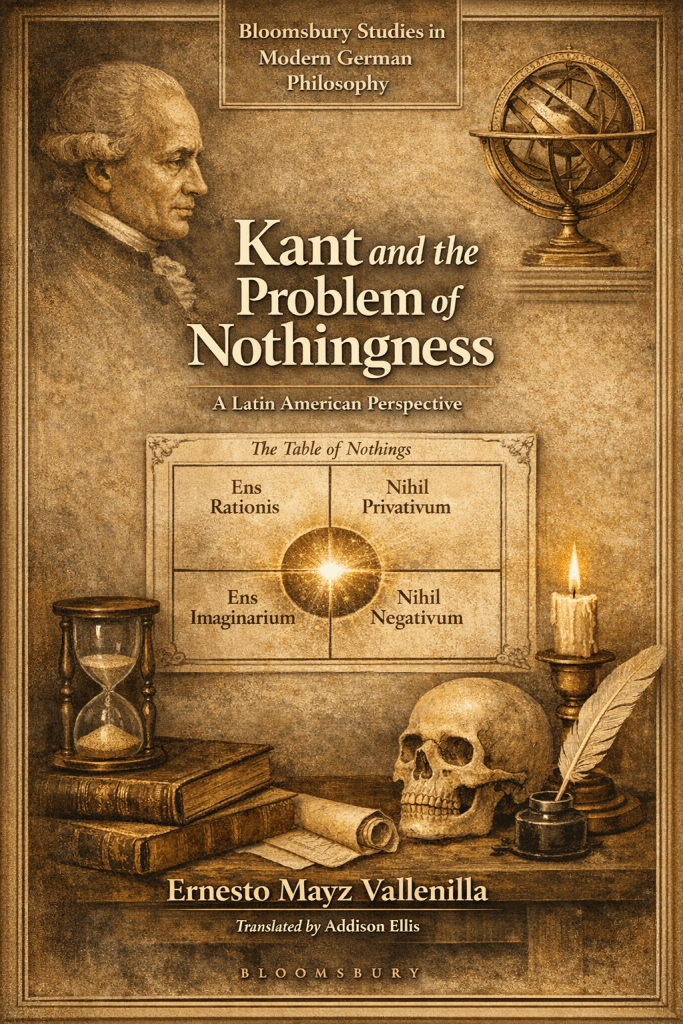
Ernesto Mayz Vallenilla’s Kant and the Problem of Nothingness, recently translated into English by Addison Ellis, marks a pivotal recovery of a neglected yet profoundly original philosophical voice from Latin America. Originally published in 1965, Mayz Vallenilla’s text undertakes a systematic investigation of the concept of nothing (nada) within the architecture of Kant’s Critique of Pure Reason, focusing especially on the Table of Nothings appended to the Transcendental Analytic’s Amphiboly chapter. Though briefly addressed by Kant and often disregarded by modern commentators, this Table is, according to Mayz Vallenilla, both methodologically essential and ontologically revelatory. It does not merely complete Kant’s architectonic; it exposes a hidden yet indispensable horizon of temporality that conditions the very intelligibility of metaphysical reflection. It takes as its guiding question whether the four-part division of “nothings” that Kant appends to the Amphiboly of the Concepts of Reflection in the Critique of Pure Reason can be made to yield a philosophically consequential account of nothingness as such, rather than a mere tidying-up of the categorial system. The book pursues this question by insisting on a temporal reading of each of Kant’s four concepts of nothing, and its distinctive value lies in the patience with which it turns an apparently marginal table into the aperture through which Kant’s whole transcendental project can be re-examined from the side of negativity.
The work aligns itself with and simultaneously critiques Heidegger’s radical rereading of Kant—most forcefully articulated in Kant and the Problem of Metaphysics—and thereby positions itself at the intersection of three traditions: classical German philosophy, 20th-century Continental hermeneutics, and a Latin American philosophical phenomenology that remains underacknowledged in the Anglophone world. That this text has now been rendered into English for the first time, sixty years after its initial publication, is not simply a matter of intellectual archaeology. It is a belated but necessary correction to a profound asymmetry in global philosophical discourse—an asymmetry that has historically excluded the Latin American contribution to Kantian and post-Kantian thought. Ellis’ translation, supplemented by a critical introduction and glossary, is meticulous in preserving Mayz Vallenilla’s terminological precision and phenomenological intent, and offers an indispensable resource for those seeking to understand how Kant’s system bears on the most fundamental question: the meaning and structure of nothingness.
Mayz Vallenilla’s approach begins by acknowledging the conceptual fragility of nothingness within language itself. All meaningful expression presupposes reference to some kind of being. To speak of “nothing” is already to posit it within a discursive framework saturated by ontological presuppositions. The opening pages of Vallenilla’s own Introduction take up the Hegelian confidence that ordinary speech is adequate to the labor of the concept, and it immediately raises the suspicion that this confidence was purchased at the price of passing over the ontological difference between beings and their being, and, correlatively, between nothings and their nothingness. The Word, as the author is careful to say, testifies to the presence of being, and precisely in so testifying tends to elide what makes such presence possible. When the Word is pressed into service for the thinking of nothingness, this same elision returns in an intensified form: language can only name a nothing, never nothingness as such, and every attempt to speak of the latter risks secretly importing the ontological framework that gives intelligibility to the former. Mayz Vallenilla registers this as an original predicament that no merely terminological reform can dissolve. Even so, he declines two symmetrical temptations. He refuses the Heideggerian confidence that the Word, once purified of its entanglement with entities, becomes a creative organ of ontological disclosure; and he likewise refuses the early-Wittgensteinian resignation that consigns whatever cannot be said clearly to mystical silence. The path that opens between these refusals is a distinctively phenomenological one: language fails when it tries to express the ontological difference, and in that failure it testifies to a reality that exceeds its expressive capacity. Failure, taken as phenomenon, becomes the point of entry, since it exhibits at once the finitude of ek-sistence and the secret summons that this finitude receives from what it cannot name. Language, in its ordinary function, elides the ontological difference by rendering Being and beings (or nothing and nothings) interchangeable. This compels a methodological reversal: the inquiry into nothingness must begin not with propositional assertions but with what language shows rather than says. In this way, Mayz Vallenilla follows the Heideggerian path of uncovering the phenomenon of nothingness via moods such as anxiety, where the world withdraws and the subject is confronted with its own finitude. Yet he does not rest with Heidegger’s account. Instead, he returns to Kant—not merely as a historical source, but as a philosopher whose categories and schemata reveal a hidden temporal logic that, once unearthed, allows for a radical rethinking of the concept of nothing itself.
It is important to see at the outset that this linguistic difficulty is not, for Mayz Vallenilla, merely preliminary. It announces the deeper problem that will shape every later chapter: the surreptitious ontological background, as he calls it, that operates even when one believes oneself to be thinking nothingness in its originality. Concepts traditionally mobilized for its analysis—beginning, origin, source, foundation, and the more technical cause, potency, act—were forged in the service of thinking being, and thus, when carried over to the discussion of nothingness, they already tilt the investigation back toward being. Negation, too, is an ontological positing: the “not” that cancels being cannot, of itself, lift us into a sphere free of being’s semantic gravity. The proposed corrective is not to invent a new vocabulary ex nihilo, for no such invention could reach its object; it is, rather, to submit the old vocabulary to a disciplined inversion of perspective through which nothingness might “appear in its originality” and, from that originary appearing, demand anti-categories and an anti-schematism of its own. The phrase “anti-categories” is introduced with care: it is not a mere negation of Kant’s table, but a proposal for concepts that carry negativity in themselves rather than acquire it by privation of positive determinations.
The second axis of the Introduction identifies time as the horizon at which such an inversion must be attempted. Here Mayz Vallenilla adopts a thesis associated with Heidegger—time as the meaning of being—and immediately submits it to an unexpected torsion. If time is the horizon of meaning for being, and if nothingness cannot simply be thought as the negation of being, then a sui generis Temporality must be sought that can serve as the horizon of meaning for nothingness itself. The author is explicit that he does not mean two times. Time is always one and the same; what varies is its immanent temporalizing and the autonomous configuration of its ekstasis. What must therefore be discerned is not a second time running parallel to ontological time, but a different configuration of the one time—a configuration in which the difference between being and beings, and thus between nothingness and nothings, is preserved rather than elided. This generates what will recur throughout the book as the circle: being is understood from time and time from being; nothingness is understood from time and time from nothingness; each attempt to fix one of these poles turns out to presuppose the other. The circle is not treated as a vicious regress. It is taken as the very structure within which the phenomenology of nothingness must operate, moving from an initial, pre-thematic understanding of nothingness toward the temporality that corresponds to it, and from that temporality back to a more articulated understanding of nothingness itself.
A translator’s decision in the English edition deserves notice here because it shapes the reader’s access to the argument. Ellis distinguishes between two Spanish terms, Temporalidad and Temporariedad, to register a distinction that Mayz Vallenilla does not spell out but that tracks the Heideggerian pair Zeitlichkeit and Temporalität. Temporalidad is used for the temporality of Dasein or finite existence, the “time” one lives as a being who asks about being; Temporariedad is reserved for the temporality of being in general, the structural horizon from which any being, and a fortiori any nothing, receives its meaning. The English translator has capitalized Temporality when rendering Temporariedad, and this typographical cue allows the English reader to follow a conceptual distinction that the Spanish original leaves implicit. The practical consequence is that when Mayz Vallenilla speaks of the Temporality of Nothingness, he does not mean merely the temporal experience of a finite subject in the face of nothingness, but the structural horizon from which nothingness as such acquires its sense. This is an instance in which editorial mediation does not merely transmit the text but stabilizes an interpretive decision whose philosophical weight would otherwise rest on the reader’s detection of subtle shifts in Spanish usage.
Against this double preparation—linguistic and temporal—the Introduction finally justifies the choice of Kant as the privileged interlocutor. The reasons given are neither hagiographic nor merely historical. Kant is chosen because the four concepts of the Table of Nothings are not isolated but structurally yoked to the four groups of categories, and thus each is yoked to a schematism that Kant himself, in the Analytic, has taught the reader to interpret as a time-determination. Kant’s doctrine, so construed, already provides the formal resources for asking how nothingness is temporalized, and it does so in a form that does not reduce the problem either to a logical curiosity or to a psychological experience. What Mayz Vallenilla therefore proposes is not to repeat Kant but to trace, within Kantian machinery, the point at which that machinery, if followed through to its consequences, must be corrected. The correction is named with a deliberately paradoxical expression: the “original Temporality of Nothingness” is to serve as a “purely negative schematism,” a horizon of meaning that opposes, almost to the point of contradiction, the ontological schematism Kant himself developed. Categories and schemata, considered from this new foundation, would exhibit a different meaning from the one they carry as ontological determinations of something.
The first chapter tests this program on the ens rationis, which Kant glosses as the empty concept without an object. The initial move is to register a structural parallel: Kant aligns the ens rationis with the noumenon in the negative sense, taken as a Grenzbegriff or boundary concept, and he treats it as a merely intelligible entity produced by the understanding in the absence of any sensible intuition. Mayz Vallenilla acknowledges this alignment while pressing on its consequences. If nothing-as-noumenon were only the phenomenon stripped of intuitive content, it would be, in its structure, a mere ontological modification of a phenomenon—a form of the same, deprived of matter. The chapter resists this conclusion by drawing attention to a feature Kant himself notes but scarcely develops: the ens rationis is said to arise from the conceptual function of None (Kein), and that function is defined as canceling (aufheben) everything. The author treats this cancellation as more than a verbal designation. Cancellation requires something to cancel; were the ens rationis simply a noumenon in Kant’s negative sense, no intuition would be present to be cancelled, and the canceling function would be ill-defined. The proposal is therefore that the category of None, when brought into contact with sensible intuition, does not simply leave it aside; it acts upon it, nihilating its quantitative determinations and yielding a negative reality—a nothing as zero—rather than a purely intelligible abstraction. This is a conceptual innovation within the Kantian text: it recovers, for the first category of nothing, a phenomenal register that Kant himself was reluctant to grant it.
The chapter’s next step has a double motion. On the one hand, the author reconstructs the Kantian connection between the categories of quantity, the schematism of number as successive synthesis in time, and the doctrine of intensive magnitude worked out in the essay on negative magnitudes of 1763. The essay is treated not as biographical background but as a conceptual resource. Kant had already distinguished there between logical opposition, which yields absolute nothing, and real opposition, which yields a relative nothing—a nothing that is still, in a certain sense, something, and that carries the sign of zero = 0. Mayz Vallenilla presses this doctrine back into the Amphiboly’s Table and argues that the ens rationis, when read through the cancelling function of None, inherits this real-opposition structure, so that its negativity is not mere intelligible emptiness but a measurable absence within a continuum whose schema must be something like a “negative number”—a schematic representation of the same temporal flow as positive number, but indexed to cancellation rather than addition. The schematism thus bears down on nothingness from within Kant’s own commitments.
On the other hand, the chapter reopens the question whether the transcendental unity of apperception, which Kant sometimes describes as if it were timeless, can really be held apart from temporality. The argument is careful and moves by stages. Kant’s doctrine of inner sense presents time as the formal condition of every representation, and since transcendental apperception is itself a “common function of the mind” whose operation consists in connecting, composing, and uniting the manifold, any act of such a function is, as act, temporal. The apparent timelessness of the transcendental “I” is rebutted with a parallel Kant himself draws elsewhere: time itself does not elapse while the existence of that which is changeable elapses in it, and the transcendental “I” is characterized as “standing” (stehende) and “permanent” (bleibende). If “standing” and “permanent” are not themselves temporal designations, it is hard to see what else they could be. The conclusion is that the “I” of transcendental apperception is not timeless but exhibits a temporal modality distinct from the flux of empirical consciousness. Its way of being in time is “to remain identical in its absolute presence,” and this “being present at all times” is itself a temporal predicate, not a negation of temporality. The consequence for the ens rationis is immediate. If even the purely intelligible structure of transcendental apperception is temporally characterized, there is no longer a principled reason to deny the ens rationis a temporal structure of its own. What is not yet decided, and what the chapter deliberately leaves open, is whether the temporality to be ascribed to the ens rationis is merely the temporality of intelligible entities in general or an original Temporality proper to nothingness. The author refuses to press this decision prematurely; he holds that phenomenal evidence adequate to force the issue has not yet been gathered. The first chapter thus ends in a posed question rather than a conclusion, and this methodological restraint—choosing to leave the fuller characterization for later phenomenal confirmation—shapes the reader’s expectations about what later chapters must supply.
The second chapter shifts from quantity to quality, and it opens by locating the nihil privativum in the semantics of privation, absence, or lack. Its grammar is that of a “Something” deprived of positive qualities—shadow, cold, darkness—and in Kant’s framework the privation is parametrized by the intensive continuum of sensation: every real has a degree, and negation is the limit in that degree at zero. The chapter notes a discrepancy between the Kantian use of privation and the Aristotelian σtέρησις, which presupposed that the substance naturally possesses the quality of which it is deprived. Kant’s privation is more neutral: it is a mere quantitative gradation of sensation filling or leaving empty inner sense. This observation already has consequences, because it places privation within the continuum of real determinations and leaves the possibility of absolute negation suspended outside any possible perception. The aporia to which the chapter orients itself is precisely Kant’s own doctrine that one can never perceive an absolute absence of the real, together with the demand that nothingness, if it is to be knowable, must have some phenomenal or quasi-phenomenal mode of givenness.
Vallenilla exposes the aporia by pressing on Kant’s premise that reality is something and negation is nothing. He notices that this formulation quietly elevates the “object in general”—the empty X that underlies the table of categories—to the rank of an ontological “Something,” and that this elevation imports a surreptitious primacy of being into the very framework by which being and nothing are supposed to be distinguished. Were this primacy left unchallenged, every concept of nothing would be a mere privation of some positive datum, and absolute negativity would be excluded by construction. The chapter’s constructive move is to distinguish, against Kant, between negation as an ontological category and negation as absolute negativity, and to argue that the latter is not a mere limit of the former but a distinct kind of phenomenon with its own qualitative structure. The category of the argument is not that all qualities are positive and that the “lack of positive qualities” exhausts the field; rather, there are negative qualities, qualities that are negative in themselves, and these are what a genuine phenomenology of nothingness must describe. The question is whether any experience confirms this.
It is here that the book introduces two phenomena that will carry disproportionate weight through the rest of the argument: deep sleep and anxiety. Heidegger’s invocation of anxiety is acknowledged and endorsed, but the emphasis falls on deep sleep, whose significance Mayz Vallenilla regards as inexplicably neglected in Western philosophy. In deep sleep, sensations are extinguished; the body, the world, and the individual self are no longer present as correlates of apperception; and yet the experience is not dismissed as a mere gap in conscious life but taken as a phenomenon that can be relived and described. What is revealed there, the author argues, is not the absence of positive data—not mere zero—but the presence of negative qualities whose material he calls a “transcendental matter” of nothingness. Anxiety, in Heidegger’s sense, performs an analogous disclosure: it is not anxiety in the face of some object, but anxiety in the face of the nothing that envelops being-in-the-world, and through it nothingness is made manifest as the absolutely other to what is. Both phenomena display nothingness as a positive negativity—a phrase the book uses repeatedly to mark its distance from any merely privative conception.
An important consequence follows for the temporal analysis. If in deep sleep or in the nihilation that accompanies anxiety, time were simply cancelled along with sensation, one could not even speak of these phenomena as experiences; no duration, however minimal, could be theirs. Yet time is not cancelled. It persists in these phenomena under a profoundly transformed guise. The quantitative, metric, chronometric character of ordinary time recedes; the direction, continuity, and irreversibility attributed to ontological time lose their grip; the “now” no longer has the individualizing content that allows it to serve as a position within a chronology. What remains is not nothing, but time as such, showing itself in a configuration suitable to the “appearing” of the nothing. The book’s formulation is striking and careful: from the nothing, time “is not”—not in the sense of a non-being, but because from the perspective of nothingness time reveals itself as nothingness itself. The parallel phrasing, “there is nothing” and “there is time,” is not poetic ornament but a phenomenological thesis: both expressions testify to an understanding in which being has been bracketed and its categories refused ontological privilege.
This result, still provisional at the end of the chapter, has an intellectual consequence that the book explicitly accepts: the circle between being and time, so central to phenomenological ontology, must be redoubled as a circle between nothingness and time. Existence understands time from its understanding of being; it understands a different time from its understanding of nothingness; and in both cases the understanding and the horizon mutually illuminate each other. The book does not treat the circle as a defect but as the shape in which the thinking of this region must proceed. The circle explains, for instance, why purely formal manipulation of Kant’s categories cannot yield the anti-categories needed: the anti-categories must be read off the phenomena of absolute negativity, and these phenomena can be approached only through a language that already fails to express them, forcing thought to advance by a movement that continually re-examines its presuppositions.
A terminological innovation deserves mention here because it quietly governs the argument. The book repeatedly speaks of the intrabody of meanings—the organic, self-referential nexus in which representations, concepts, and words mutually determine each other. The translator attributes this term to Ortega y Gasset, whose concept of intracuerpo Mayz Vallenilla appropriates without naming him. Its role is precise: it names that holistic-organic totality of sense within which categories become intelligible as a system. When the book says that the anti-categories must exhibit a different intrabody, it is saying that the semantic whole in which they function must itself be re-organized, and not merely re-labeled. The relevance for the theory of the nihil privativum is that absolute negativity cannot be pasted onto the categorial system of being as a local addition; it requires, if it is to be coherent, the re-articulation of the whole semantic organism in which the talk of negation has its place.
With the third chapter the investigation turns to the ens imaginarium, defined by Kant as the empty intuition without object—pure space and pure time considered as mere forms for intuiting, rather than as themselves intuited objects. The chapter poses a striking question: how can what is called “Nothing” also be a “Something,” and how can this “Something” at once exist and fail to be an object? The initial answer recovers a subtle point in Kant. Space and time are not objects; they cannot be perceived; and yet they are not fictions, for they exist “objectively” as conditions of the possibility of appearances. What is required, therefore, is a mode of existing that is not the mode of being of objects—a non-objective yet non-chimerical existence that Kant himself calls ideal in opposition to real. It is in this mode that space and time “exist”: they carry no empirical content, and yet their status as transcendental conditions imposes itself on every examination of a priori knowledge in geometry and arithmetic. The book insists on this distinction, since it provides the first clue to the distinctive ontology of the ens imaginarium.
From this point the chapter moves into a densely textured engagement with Kant’s doctrine of the imagination. The imagination, unlike sensibility, is a formative faculty; its products include both images, in the sense that mediates empirical apperception, and pure images, in which the formal conditions of intuiting—space and time—are themselves presented. The text is meticulous in distinguishing pure images from schemata. A pure image confers a sensible presentation (Kant’s exhibitio originaria) on what is to be intuited; the schema, by contrast, is a general procedure—a rule-governed way of producing, for a given concept, the image appropriate to it. A pure image is a synthesized manifold; a schema is a method for synthesizing manifolds in accordance with a concept. The distinction is not merely pedagogical, because the ens imaginarium is identified with space and time as pure images, not with the schemata. This identification has consequences: the nothingness of the ens imaginarium is the nothingness of a formally required condition that is nonetheless not itself an object, and the temporal analysis that must be given of it cannot be simply the analysis of the schemata.
Yet the imagination, for Kant, is also the seat of the schematism, and the schematism is a determination of inner sense, which is time. The chapter thus faces a delicate task: to clarify the relation between pure images and schemata without collapsing one into the other, and to specify the preeminent function of time—as against space—in the schematism. Its answer draws on the Transcendental Deduction and the doctrine of the three syntheses (apprehension, reproduction, recognition). Imagination is shown to be the middle term that binds sensibility to understanding, and time is shown to be the form to which every representation, qua modification of inner sense, must submit. This accords time the preeminent role of the “a priori formal condition of all appearances in general.” Once this is granted, a tension emerges: if the ens imaginarium has the structure of a pure image, and if every pure image is a succession of data through inner sense, then the ens imaginarium as such would seem to be the pure presentation of every possible real entity—a characterization that would strip it of its nothingness and reduce it to the empty form of being.
The response is to insist that the ens imaginarium, if it is to be an authentic nothing, requires its own schematism—one in which the pure succession of “nows” characteristic of inner sense is determined not by the concepts of substance, causality, and community (which govern real entities) but by their withdrawal or absence. The author works out this de-ontologized schematism with care. The schema of substance is permanence, the schema of cause is succession, the schema of reciprocity is simultaneity; in each of these, time is organized by a categorial act of the understanding on the pure succession of inner sense. If the ens imaginarium is characterized as the mere form of intuition without substance, then the categorial action of substance does not occur on it, and the presentation that inner sense offers is a pure succession of “nows” lacking the determinations that would allow any moment to be distinguished from another. The result is a disquieting image: time, stripped of the categorial action, appears as a succession of identical nows in which it seems not to elapse, since nothing distinguishes one now from the next. The Latin phrase nunc stans—the static now that the tradition has associated with eternity—reappears here as the schematic figure of a de-substantialized time. Kant’s own claim that “time itself does not elapse, but the existence of what is changeable elapses in it” is integrated into this picture.
The chapter immediately voices its own misgiving: the ens imaginarium so understood is the “negative residue” of ontological time, that is, time conceived as what remains when the categorial function is subtracted. As residue, it is parasitic on the ontology it denies, and thus fails to do justice to an authentic Temporality of nothingness. Here the argument performs a crucial pivot. The circle between time and being, now thematized, is turned against Kant: the permanence of time that Kant ascribes to substance (the schema of the First Analogy) is, in fact, an “entitative” determination of time derived from a prior understanding of being as Vorhandenheit, the present-at-hand. Once this is seen, a question arises about the very basis of Kant’s doctrine. Is the temporality that emerges from the action of the categories on inner sense the only possible temporality? Or does the ens imaginarium, considered phenomenologically as the horizon within which deep sleep and anxiety disclose nothingness, open onto a Temporality that does not derive from the ontological schematism by mere subtraction? The chapter closes by announcing, without yet resolving, that the ens imaginarium points past itself to a Temporality whose configuration cannot be read off from the action or inaction of the categories of being, but only from the phenomenal disclosure of nothingness itself.
The concluding chapter, on the nihil negativum, is described by the translator’s introduction as the most demanding and the most philosophically rich of the four, and the distribution of length in the English edition confirms this: it is the largest of the chapters, and it carries the argumentative weight of bringing the book’s earlier reflections to a unified formulation. Kant defines the nihil negativum as the empty object without a concept, illustrated by the two-sided rectilinear figure—an object whose concept is logically impossible because it contradicts itself. The book’s first move here is to refuse a purely logical reading of this impossibility. Kant himself, elsewhere, insists that the impossibility of a figure enclosed by two straight lines is not a mere contradiction of concepts but a failure of spatial construction: the concepts “two straight lines” and “intersection” do not logically negate the concept “figure”; rather, the attempt to construct the figure in intuition fails. This places the impossibility of the nihil negativum, for at least a significant class of cases, within the sphere of spatial and temporal construction, and opens the possibility that the nihil negativum is not wholly outside the reach of a temporal analysis.
From here the book presses a bold extrapolation. If the impossibility of the nihil negativum is rooted not merely in a logical schema but in the attempted temporal-spatial construction of its object, then reason, in attempting to think the contradictory, does not simply fall silent at the limits of thought. It discloses a region where the ontological lawfulness of time has been violated, and where a “sui generis Temporality”—distinguished with the capital letter in the English translation, indexing Temporariedad and thus Heideggerian Temporalität—is established precisely as the rupture of ontological lawfulness. Reason, on this reading, does not merely fail to construct the impossible; in failing, it comprehends the failure as impossible, and this comprehension carries its own temporal configuration. The book calls this a “logos of nothingness” to mark that reason, when it abolishes the borders of experience, is not evacuated of structure but turned into a pure negativity that has its own articulation.
This thesis is the book’s most vulnerable and most original claim, and it generates a real tension with Kant. For Kant, a contradiction is precisely what cannot be thought: two incongruent predicates cannot hold together in one unity of consciousness, and the thought destroys itself. The author does not ignore this Kantian scruple; rather, he argues that our capacity to identify the failure of the two-sided rectilinear figure—to recognize that it cannot be, and to understand why—requires that there be some structure within reason that comprehends this failure. He calls this structure a “logos” rather than a “category” because it does not gather the manifold into the unity of an object; it articulates the withdrawal of every possible object, and its articulation is a temporalization of that withdrawal. The “Temporality” that opens here is discontinuous with the ontological temporality that governs the schematism of the categories of being, and it can be phenomenally connected with the same phenomena—deep sleep and anxiety—that the earlier chapters had invoked in connection with the nihil privativum. Those phenomena now acquire a new valence: they are not merely illustrations of the failure of ordinary experience, but the experiential analogues of what reason undergoes when it attempts the impossible.
The architecture of the four chapters thus exhibits a careful and cumulative structure. The ens rationis opens the question of whether even the most intelligible operation of pure understanding escapes temporality; the nihil privativum opens the question of whether the absolute absence of sensation can be given as phenomenon; the ens imaginarium opens the question of whether pure forms of intuition, as pure images, can be assigned a temporality of their own; and the nihil negativum opens the question of whether the strictly impossible discloses a sui generis Temporality that the schematism of being cannot provide. Each chapter recapitulates and modifies the previous one. The cancelling function of None, introduced in the first chapter, returns in the second as the categorial structure that would need an anti-schematism for absolute negation; in the third, it returns again as the question of what schematism could be appropriate to the ens imaginarium; in the fourth, it acquires a new form as the structure that allows reason to articulate its own rupture with ontology. The phenomena of deep sleep and anxiety, adduced first in the second chapter, are not discarded when the analysis moves to the third and fourth: they continue to serve as the phenomenal testimony that Temporality, rather than ontological time, governs the appearance of nothingness as such.
A further pattern deserves comment. The book regularly names a circle that returns in each chapter: between being and time, between nothing and time, between substance and permanence, and, most generally, between an understanding and the horizon from which it is to be interpreted. This circle is not a rhetorical device; it expresses the book’s deepest methodological commitment. Mayz Vallenilla holds that the problem of nothingness cannot be settled by a linear argument from premises, because the premises themselves are shaped by the very distinction (being/nothing) whose clarification is sought. The only available procedure is to begin in the middle—with language, with Kant’s table, with the phenomena of deep sleep and anxiety—and to let each analysis retroactively adjust the standing of the others. The circle is the schema of philosophical work in this region. It also explains why the book resists definitive closure: each chapter ends in a posed problem rather than in a theorem, and the final chapter, rather than culminating in a system, closes on the insight that reason, as pure negativity, constitutes a sui generis form of Temporality whose full determination remains to be articulated.
One ought also to register how the book uses Kant against Heidegger without thereby reversing into a non-Heideggerian reading of Kant. The author repeatedly endorses Heidegger’s insistence that time is the meaning of being, that the ontological difference is suppressed in the metaphysical tradition, and that the imagination in Kant has a hidden primordial significance. Yet he departs from Heidegger at significant points. He is more cautious about the creative power of language: he denies that the Word can have a purely ontological function free from reference to entities, and he grounds his denial in the finitude of ek-sistence, for which every use of language must be inserted into a world. He gives equal weight to deep sleep as to anxiety in the disclosure of nothingness, and in this he departs from Heidegger’s exclusive emphasis on anxiety as the privileged mood of nothingness. He is also less confident about the immediate identification of the transcendental imagination with primordial time; while he follows Heidegger’s line on the temporality of transcendental apperception, he treats this identification as a question to be carefully argued rather than as an intuition to be asserted. The result is a distinctive voice that sits between Kant’s architectonic scrupulousness and Heidegger’s hermeneutical radicalism, using each to discipline the other.
Each of the four “nothings” in Kant’s table—ens rationis, nihil privativum, ens imaginarium, and nihil negativum—is treated by Mayz Vallenilla in a separate chapter, each of which constitutes a phenomenological excavation of that concept’s structure and implications. In the case of the ens rationis, Kant identifies a “concept without an object,” an abstraction that lacks any possible empirical referent, such as the noumenon. This is the epistemic limit-case of discursive reason, and Mayz Vallenilla argues that it cannot be dismissed as a mere conceptual placeholder. It reveals a deeper structure of cognition whereby the unity of apperception—the transcendental “I think”—is itself not timeless, as Kant sometimes implies, but temporal in a sui generis sense. Even the most abstract operation of the understanding, if it is to be understood as an act or function, presupposes temporality. The permanence and fixity Kant attributes to apperception are, on closer inspection, temporal determinations. Hence, ens rationis, although devoid of empirical objectivity, is disclosed through a temporal horizon that cannot be ontological in the classical sense. Mayz Vallenilla therefore uncovers a form of pure negativity that operates independently of empirical content but is still structured by time.
In analyzing the nihil privativum—a “concept of the absence of an object,” as in cold or darkness—Mayz Vallenilla confronts a Kantian paradox. Since all cognition requires sensation, and since privation is the absence of sensation, how can it be cognized at all? Kant seems to assert that total absence is not representable. Yet, through the phenomenology of deep sleep and Heideggerian anxiety, Mayz Vallenilla demonstrates that we do indeed experience nothingness as a phenomenon—not as a negation of something previously given, but as an original, self-revealing absence. In deep sleep, the subject is engulfed in a field devoid of sensory data, and yet time does not vanish. On the contrary, temporality is intensified in its abstraction from events. In such experiences, time is no longer the ontological succession of instants tied to perception and action. It becomes, instead, the horizon of the disappearance of presence—the pure temporality of nihilating experience.
The third concept, ens imaginarium, focuses on the forms of space and time as intuitions without objects. Kant describes these as “empty data” and insists that they are not appearances themselves, but conditions of the possibility of appearance. Mayz Vallenilla interrogates the paradoxical ontological status of such forms. They “exist” in a non-empirical mode; they are real, yet not beings. Kant’s characterization of them as “nothing” thus demands further analysis. What is the mode of existence of a form that is not actual but nonetheless operative in all acts of cognition? Mayz Vallenilla’s response is to push Kant’s theory of schematism to its limit. If space and time are formal conditions, then they too must be schematized. But schematism, as Kant defines it, operates only for the categories of being. What, then, is the schematism of nothingness? Mayz Vallenilla proposes an “anti-schematism” that would correspond to the anti-categories of the Table of Nothings. This leads him to posit a radical reconfiguration of temporality—not the time of physics or even the inner sense of empirical experience, but an originary temporality that is the condition of both being and nothingness. In this way, ens imaginarium becomes the key to disclosing a temporal structure that underlies even the purest abstraction. Time here is neither successive nor metric; it is ecstatic, horizonal, and pre-ontological.
The final category, nihil negativum, presents perhaps the most difficult problem: the nothing of contradiction. A two-sided rectilinear figure, for example, is logically impossible—not merely because it contradicts itself conceptually, but because its contradiction emerges through its attempted construction in space. That is, its impossibility is not merely logical but ontological. Mayz Vallenilla interprets this as a clue: the principle of contradiction is not only a law of thought but also a reflection of temporal form. When an object’s internal structure violates the schema of temporal presentation—when it posits incompatible determinations in a single instant—it ceases to be thinkable as an object. Thus, contradiction is not purely logical; it is temporally indexed. In this analysis, Mayz Vallenilla aligns with and extends Heidegger’s insight that time, not logic, is the primordial dimension of intelligibility. But he goes further, suggesting that this nihil negativum is not simply an epistemic failure. It is the point at which Reason, as pure negativity, discloses a “logos of nothingness.” This logos is not governed by the principle of identity but by the structural openness that allows for the appearance of impossibility itself. Reason, when it ceases to affirm, becomes a disclosive negativity—a temporal rupture that constitutes the very condition for the appearance of the impossible.
What emerges from Vallenilla’s inquiry is not a rejection of Kant but a reactivation of his critical project at its deepest level. He accepts Kant’s basic framework but insists that the Critique of Pure Reason contains within itself the seeds of a more radical philosophy—one in which the unity of cognition is rooted not in categories alone but in an originary temporality that enables both the appearance of being and the experience of its absence. Kant’s table of nothings, in this reading, is not a peripheral addendum but a suppressed center. It is the aperture through which the temporal structure of finitude can be seen—not as a deficiency, but as a philosophical resource. Vallenilla’s book is not without its challenges. His phenomenological method demands close attention, and his style—imbued with echoes of Ortega y Gasset and steeped in the idiom of post-Heideggerian metaphysics—may require effort from readers habituated to more analytic forms of Kant scholarship. Yet this effort is amply rewarded. For those willing to engage with its arguments, Kant and the Problem of Nothingness offers not only a reconstruction of a neglected Kantian motif but a transformative reorientation of critical philosophy itself. It shows how temporality, conceived not merely as the form of inner sense but as the horizon of all intelligibility, can ground an entire metaphysics of absence.
the significance of the book’s treatment of the ens rationis must be reassessed in the light of what the later chapters provide. In the first chapter, the ens rationis is opened to temporality through the argument that transcendental apperception, though not in empirical time, is nonetheless of time. This left open whether the temporality to be ascribed to the ens rationis is merely the temporality of intelligible entities or the original Temporality proper to nothingness. After the third chapter, this question acquires a new shape. If the ens imaginarium is characterized as the pure image whose schematism must be anti-ontological, and if this pure image is the horizon within which the phenomena of deep sleep disclose an original Temporality, then the temporality of the ens rationis cannot be that of ordinary intelligible entities: it must also share in this original Temporality, insofar as the ens rationis is not a chimera but a structure produced by the cancelling function of None on intuitively given material. The book does not draw this inference explicitly in the first chapter; rather, it deliberately defers it, declining to assert what phenomenal evidence would not yet justify. The inference becomes visible only retroactively, when the reader, having worked through the third and fourth chapters, sees that the first chapter’s provisional conclusion is retroactively stabilized by the later phenomenological analyses.
Similarly, the nihil privativum, which in its own chapter was diagnosed as inadequate to absolute negativity, acquires in the light of the fourth chapter a clearer systematic position. It is not false or useless; it is the ontological nothing within the framework of being, and its analysis exposes, by the very inadequacy with which it accommodates deep sleep and anxiety, the need for an absolute negativity that lies outside the reach of its categorial resources. The phenomena that the second chapter adduces are thus precisely what the fourth chapter will thematize as the experiential analogues of reason’s encounter with the impossible. The privative nothing and the contradictory nothing are not two species of a single genus but two stations on a path that, followed to the end, forces the recognition of a sui generis Temporality that neither species can quite accommodate.
The book’s own formulations of this convergence are deliberately restrained. The author refuses to claim that he has produced a completed system of anti-categories and anti-schemata; he claims only to have sketched the conditions under which such a system could be sought. His formulations regarding reason’s logos of nothingness—reason as pure negativity that comprehends the failure of a concept and thereby constitutes a Temporality grounded on the absolute rejection of ontological temporality—are offered as the beginning of a project, not as its culmination. The author is explicit that his investigation is a first attempt, conducted within the architectonic vocabulary of a Kantian doctrine that he has nonetheless turned inside out. The closing pages, where they venture anything like a programmatic statement, do so in the register of a sustained question. The book’s final unity, such as it is, is therefore the unity of a controlled antinomy rather than of a synthesis. It organizes the field of the problem; it identifies the landmarks by which that field can be surveyed; it articulates the temporality appropriate to each landmark; and it declines to settle, by formal manipulation alone, the question whether the “I” that inhabits ontological temporality is the same as the “I” that inhabits the Temporality of absolute nothingness.
In recovering this text, Addison Ellis has not only restored a major Latin American philosophical voice to the global conversation; he has also provided Anglophone philosophy with an indispensable resource for reassessing its own assumptions. As Morganna Lambeth (California State University Fullerton) has emphasized in her review, Mayz Vallenilla’s phenomenological method often surpasses Heidegger’s own in clarity and coherence, especially by anchoring metaphysical claims in phenomenologically concrete experiences like sleep and anxiety, rather than abstract transcendental deductions. More than a historical recovery, then, this translation constitutes a philosophical intervention. It urges a reckoning with the unthought within Kant, the temporal within the logical, and the nothing within the very structure of reason. In so doing, it opens a path that is at once faithful to Kant’s legacy and radically transformative of it.


Leave a Reply