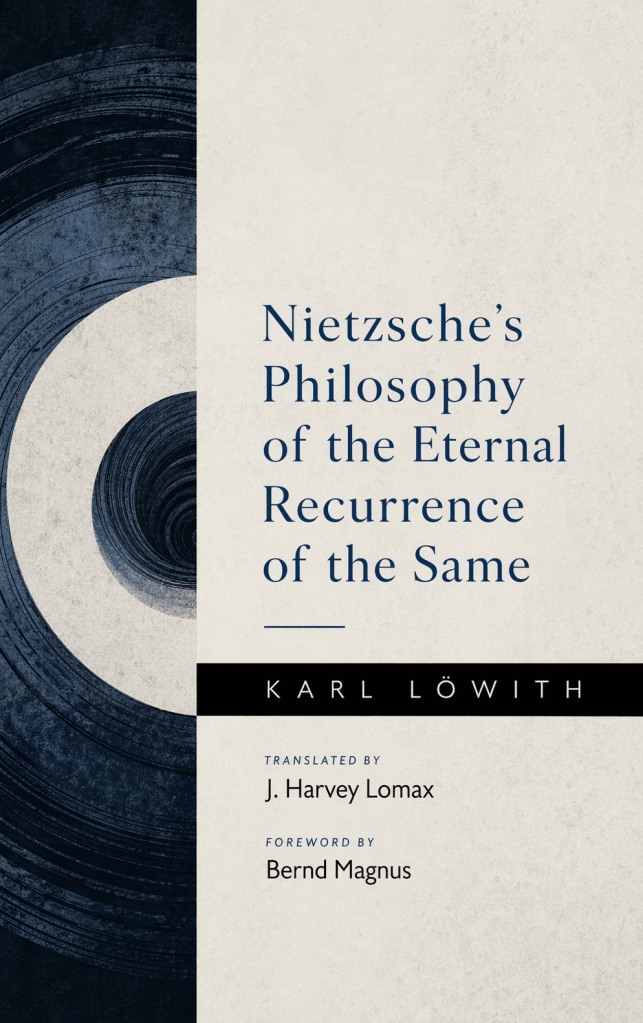
Karl Löwith’s Nietzsche’s Philosophy of the Eternal Recurrence of the Same is a monumental contribution to the scholarly understanding of Friedrich Nietzsche’s thought, offering a rigorous and critical exploration of one of Nietzsche’s most enigmatic and contested doctrines: the eternal recurrence. Löwith’s work, originally published in 1935 in the perilous intellectual and political climate of Nazi Germany, represents a courageous and incisive effort to reclaim Nietzsche’s philosophy from the clutches of ideological distortion. The book has been celebrated as a pivotal text in the interpretation of Nietzsche, influencing generations of scholars, particularly within the German-speaking world, and now finally accessible to a broader audience.
Nietzsche’s Philosophy of the Eternal Recurrence of the Same takes as its governing question the problem of philosophical center: whether Nietzsche’s extraordinarily diverse and apparently fragmentary body of writing possesses an organizational nucleus, and if so, what that nucleus is and what philosophical responsibilities it generates. Löwith’s answer — that the doctrine of the eternal recurrence is the organizing principle of the whole, and that this principle contains a constitutive and irreducible discord between its cosmological and its anthropological dimensions — produces a work of singular analytical precision that distinguishes itself from all available alternatives in the interpretation of Nietzsche by demonstrating that the teaching’s unity is a unity of tension rather than resolution, and that its systematic character is inseparable from its fundamental antinomy.
The English translation of Löwith’s monograph — published by the University of California Press in 1997, translated by J. Harvey Lomax, with a foreword by Bernd Magnus — arrives as an object whose bibliographic layers are themselves philosophically significant. The base text is the third Meiner edition of 1978, which was established according to the author’s own handwritten corrections and is described by Lomax as the authoritative witness to Löwith’s final intentions. This edition itself represents the culmination of a complex textual history: the work was first published in Berlin in 1935 under the title Nietzsches Philosophie der ewigen Wiederkunft des Gleichen — using Wiederkunft in the first edition — by Gerhard Bahlsen’s press “Die Runde.” In the 1956 revised edition published by W. Kohlhammer Verlag in Stuttgart, Wiederkunft was changed to Wiederkehr, and — crucially — the entire Appendix that had been suppressed from the first edition was restored. The 1978 Meiner edition, which is the basis of the translation, incorporates further corrections and is considered definitive.
Lomax’s translator’s introduction provides a more conventionally biographical and textual account, but it makes one philosophically important point that should not pass without notice: Löwith’s own account of his final courses in Marburg, given after the National Socialist seizure of power, describes an attempt to show students that “Nietzsche prepares the way for, and at the same time represents the severest rejection of, the present situation in Germany.” Nietzsche could serve as a “National Socialist” or as a “cultural Bolshevik,” depending on how one “maneuvered” him. In opposition to this ideological opportunism, Löwith says he “tried to establish the idea of eternity as the center of his philosophy.” This recollection, placed at the very beginning of the translator’s introduction, makes explicit the political stakes of the hermeneutic choice. To insist that the eternal recurrence — and not the will to power alone — is the center of Nietzsche’s philosophy is to make the appropriation of Nietzsche for a politics of historical violence and racial domination more difficult, because the eternal recurrence — properly understood — is an attempt to escape from history, not to consecrate it.
The two forewords that Löwith composed — one for the first edition of 1934, one for the second edition of 1955 — function as interpretive operators rather than mere prefatory materials. They frame the main text from two temporal perspectives separated by more than two decades, and the differences between them are philosophically instructive. The first foreword characterizes Nietzsche’s philosophy as a “twofold prophecy” of nihilism and of the eternal recurrence — a formulation that already announces the book’s central argument about the double character of the teaching — and it quotes a celebrated passage from Nietzsche’s correspondence in which Nietzsche asks to be characterized, to be described, but not deprecated, with “a dose of inquisitiveness, as if before a strange plant, with an ironic resistance.” Löwith accepts this methodological invitation almost literally: the entire procedure of the book is to describe from within rather than to evaluate from without, to reconstruct the internal logic of the teaching rather than to apply to it external philosophical standards.
Magnus’s foreword draws attention to the political dimension of the book’s belated English reception with characteristic directness. Löwith was a Jew in early self-imposed exile from Nazi Germany — the Rockefeller Foundation fellowship that supported his work in Rome from 1934 to 1936 effectively saved his academic career. He was, Magnus observes, “strikingly clearheaded about National Socialism at the very beginning of its hegemony in Germany” and “an apostate student of Martin Heidegger.” The combination of factors — Jewish ancestry, exile, and public opposition to the dominant Heideggerian interpretation — explains why what Magnus calls a “magisterial” study remained untranslated for more than half a century while virtually every other significant European Nietzsche study appeared in English. The reception history is itself a symptom of the interpretive politics that the book resists. Magnus’s foreword also contains an extraordinary personal confession: he had spent three decades writing about Nietzsche without fully acknowledging how thoroughly Löwith’s framework had shaped his own questions, even when he believed himself to be arguing against Löwith’s conclusions. This belated recognition is philosophically significant because it suggests that the distinctions Löwith introduced into the Nietzsche debate — above all the distinction between the ethical and the cosmological dimensions of the eternal recurrence — have organized subsequent scholarship whether or not that scholarship has been aware of its debt.
The second foreword, written after twenty additional years of reception history, takes a more sober and in some respects more critical tone. It registers the changed significance of Nietzsche’s image: from the prophet celebrated by Stefan George’s circle, through the caricature of the Third Reich, to Heidegger’s elevation of Nietzsche into “the ranks of the greatest European metaphysicians.” Löwith’s retrospective account deepens and in several respects sharpens the book’s argument. He now formulates more explicitly than before the thesis that the teaching of the eternal recurrence “is thus neither a mere flight out of time nor a mere praise of transitoriness” but means “the eternity of time itself in the world: the eternally recurring cycle of coming into being and passing away that is always the same, a cycle in which the permanence of ‘Being’ and the change of ‘becoming’ are one and the same.” This formulation already encodes, in condensed form, the dual character of the teaching — cosmological permanence and anthropological urgency — and the tension between them, which the main body of the work then unfolds across eight densely argued chapters. The second foreword also introduces the concept of “discord” (Zwiespalt) as the governing characterization of the teaching’s internal structure, and it argues that this discord is “essential and comprehensive,” arising “from a fundamental conflict in the relationship of man and world — where there is no God and no common order of creation.” This is not a discord of style or presentation but a constitutive feature of the philosophical content.
Chapter one establishes the methodological and conceptual foundation of the book, from which everything else flows. The central argument of this chapter is that Nietzsche’s philosophy is “neither a unified, closed system nor a variety of disintegrating aphorisms, but rather a system in aphorisms.” This formulation is deliberately positioned against two inadequate interpretive traditions. The older literary-critical tradition — still dominant in the period of the book’s composition — had treated Nietzsche primarily as an aphorist and poet, a critic of culture and a prophet of new values, whose work resisted systematic philosophical reconstruction. The newer tendency, represented by Heidegger’s emerging Nietzsche lectures (delivered from 1936 onward, published 1961), was in the opposite direction: toward a totalizing systematic reading of Nietzsche as the last metaphysician of the West, whose major doctrines could be integrated into a coherent account of the history of Being. Löwith refuses both alternatives, but his refusal is itself philosophically substantive rather than merely epistemically cautious: the category of “system in aphorisms” names a specific philosophical form that combines the systematic character of Nietzsche’s guiding questions with the aphoristic character of his experimental, anti-systematic procedure.
The key philosophical point of this chapter is the claim that what holds Nietzsche’s aphorisms together is not a deductive system, not a set of explicit propositions organized by logical inference, but an “innate systematic structure and relationship” of concepts — a “fundamental will of knowledge” that drives the experiment in a determinate direction without prescribing in advance what the experiment will discover. Löwith grounds this claim in a passage from Beyond Good and Evil in which Nietzsche observes that individual philosophical concepts are not “autonomous” but “grow up in connection and relationship with one another,” and that philosophers, however independent they may feel of one another, “always revolve once more in the same orbit” under “an invisible spell.” This passage has a double significance. First, it describes the form of Nietzsche’s own philosophy: not a freely chosen series of provocations but an internally governed experiment whose destination was, in retrospect, determined from the beginning. Second, it anticipates the doctrine of the eternal recurrence by appealing to the very structure of thought as a kind of return — a “recognition, a remembering, a return and a homecoming to a remote, primordial, total household of the soul.” The philosophy of the eternal recurrence is here seen to repeat, in its own structural character as a body of thought, what it claims as its content: the return of what always was.
The aphoristic form is understood by Löwith not merely as a literary choice but as the philosophically appropriate expression of a specific orientation toward truth. The systematizer, Nietzsche argues, lives in a “house of knowledge, pieced together and firmly believed in”; his basic prejudice is that “true Being” is in itself uniform, ordered, and systematically secured, so that one can trust it. The free spirit, by contrast, insists on living “on hypotheses” because certainty has been replaced by mistrust of all truth that previously was thought to have existed. “Nothing is true anymore, but everything is permitted” is the formula for this fundamental position — a formula that, as Löwith will show, is not the last word of Nietzsche’s experiment but its penultimate moment. The aphorism is thus the appropriate linguistic form for a philosophy in this condition: it preserves the “open horizons” of the experimental spirit while providing a vehicle for the “little kernels of truth” that the experiment uncovers. At the same time, Löwith draws attention to what Nietzsche himself acknowledges: that the aphoristic form creates a danger of seduction, a danger that the “cosmetic force” of brevity will give paradox “an undeserved luster.” The aphorism can produce effects out of proportion to its philosophical justification; the “congenital defect” of everything that lacks justification is that it cannot last.
Crucially, the aphoristic form has a limit point. In Zarathustra, Nietzsche moves from the “at-tempting language of the experiment” to what he calls the language of “inspiration,” claiming to “be in the whole of truth” through the metaphysically substantiated parable. This transition is philosophically significant: it is the moment at which Nietzsche’s philosophy makes its maximal claim, presenting itself not as one more experiment but as the culmination of all experiments, the “last experiment with the truth” that completes and systematizes everything that preceded it. The parable is supposed to be the linguistic form adequate to a truth that the aphorism could only gesture toward. But it is precisely here, Löwith will argue, that the system breaks apart: the parable unifies what the reflective analysis divides, and when the poetic power of allegorizing abandons Nietzsche, what had appeared as a necessary whole decomposes into its irreconcilable elements.
The chapter also establishes Löwith’s characterization of Nietzsche as an “at-tempter” (Versucher) — a figure explicitly associated with the Renaissance discoverers like Leonardo and Columbus, with whom Nietzsche repeatedly compared himself. The “new philosophers” of the future are “at-tempters” who “test themselves to the point of uncertainty, like the skipper on an unknown sea.” This experimental spirit is not mere tentativeness but a deliberate philosophical stance: the refusal to “close the open horizon of at-tempting examination and questioning” for the sake of the false certainty of the system. What makes Nietzsche’s experiment philosophically distinctive, in Löwith’s reading, is the determination of its direction: it is not an experiment that could have ended anywhere, but one that was guided from the beginning by the problem of what meaning human existence can have in the whole of Being — a problem that receives its definitive, if paradoxical, answer in the teaching of the eternal recurrence.
The second chapter establishes the periodization of Nietzsche’s writings that structures the book’s subsequent analysis. The division is into three periods: the first (romanticist) period of The Birth of Tragedy and the Untimely Meditations; the second (positivist, free-spirit) period of Human, All-Too-Human, The Dawn, and The Gay Science (first four books); and the third (mature) period beginning with Zarathustra and culminating in Ecce Homo. The third period alone “contains Nietzsche’s genuine philosophy.” But the division into periods is not introduced as an external schematization that could be replaced by a different scheme without damage. Löwith argues that the periodization is “confirmed in its full significance by Nietzsche himself” and that its “methodological weight derives from the fact that it marks the essential stages on Nietzsche’s ‘path to wisdom.’”
The hermeneutic orientation of this periodization is decisive: the earlier periods are understood from the perspective of the last, rather than the last being understood as a departure from the earlier. Nietzsche himself provides authority for this retrograde reading in the new prefaces of 1886 to his earlier writings and in the retrospective accounts of Ecce Homo, where he presents his earlier positions as stages that the mature philosophy “completes” rather than supersedes. The second period is thus not a “positivistic” phase that Nietzsche subsequently abandoned but “a philosophy of the ‘dawn’ and of the ‘morning,’” an “avenue to understanding” the specimen of humanity in whom “the liberated spirit frees itself once again from its most extreme freedom toward amor fati.” Looking back from the “noon” of the eternal recurrence, Nietzsche could “read backward the ‘long sentence’ of his life,” understanding earlier positions as “explicating the future” that the teaching of the recurrence eventually articulates.
This retroactive determination of sense is not merely biographical but formally significant for Löwith’s argument. The eternal recurrence does not simply follow the nihilism of the second period; it makes that nihilism, retroactively, into its own precondition. The philosophy of the morning becomes intelligible as an avenue to the philosophy of noon only because the noon perspective already governs it in advance — which is itself a structural feature of the eternal recurrence doctrine, in which the whole of what is is already always “there,” and what appears to be novelty is the recurrence of what always was. The book’s form thus mirrors its content: the retrograde interpretation of the earlier periods from the standpoint of the eternal recurrence enacts on the level of Löwith’s commentary the same movement of looking backward that Zarathustra performs when he confronts the “it was” of the past and wills it as his own.
The chapter pays particular attention to the allegorical figures that mark the transitions between periods. The wanderer of the second period — the secular form of the Christian pilgrim — is characterized by his being “without a goal,” by his freedom from all traditional ties, and by his inability to find “home” in any established position. He is the figure of nihilism in its “interim state,” the man who has liberated himself from “Thou shalt” without yet having discovered what his newly free will can will. The wanderer’s shadow accompanies him as the embodiment of the nihilism that underlies even his attempts at positivistic clarity: “Nothing is true, everything is permitted” is the shadow’s formula, and the wanderer who hears the shadow as if “hearing himself speak” acknowledges the nihilism that his own freedom carries within it. The wanderer persists into the third period, accompanying Zarathustra as his shadow — but now the shadow’s homelessness is revalued: “the goallessness of the endless wandering changes into the entirely different goallessness of eternal revolving.” The circular motion of the eternal recurrence is the terminus of the wandering, but it is a terminus that does not arrive at a destination. It arrives at the discovery that there is no destination other than the movement itself — which is what it means to say that the world is “goalless” in the sense of being perfectly self-sufficient.
The closing formulation of the chapter is the philosophical key to everything that follows: at the end of his path Nietzsche “recurs to the starting point,” so that “the whole of his movement comes to a retrograde conclusion in a circle and at the end catches up with the beginning.” The teaching of the eternal recurrence repeats The Birth of Tragedy, specifically the problem of “the highest kind of Dionysian Being” and the question of what meaning existence can have when confronted with the suffering and transience that tragedy reveals. But it repeats this problem on a higher level: now the affirmation of existence that tragedy provided through aesthetic experience is replaced by the philosophical affirmation of the eternal recurrence — an affirmation that must be total, unconditional, and willed rather than merely aesthetic.
At the heart of Löwith’s analysis lies a thorough examination of Nietzsche’s concept of eternal recurrence, a doctrine that Nietzsche himself regarded as the “highest formula of affirmation” and central to his philosophical project. Löwith approaches this doctrine not merely as an abstract metaphysical proposition but as a critical juncture where Nietzsche’s thought grapples with the profound implications of human existence, freedom, and fate. His analysis is distinguished by a careful disentanglement of the eternal recurrence from the will to power, two concepts that Heidegger, Nietzsche’s most formidable interpreter, sought to interweave into a unified metaphysical system.
The third chapter is the longest and philosophically weightiest of the book, unfolding across several major divisions that together constitute Löwith’s most sustained and original contribution to Nietzsche interpretation. The chapter traces the “unifying fundamental idea” of Nietzsche’s philosophy through the three stages of a liberation: from the “Thou shalt” of received obligation to the “I will” of the free spirit, and from the “I will” to the “I am” of the child of the world. This tripartite movement corresponds to the three metamorphoses of the spirit announced in the first speech of Zarathustra (camel, lion, child) and supplies the book’s governing philosophical narrative.
Löwith’s study uncovers the fundamental incompatibility between the eternal recurrence and the will to power, positing that the former represents a cosmological vision that stands in stark opposition to the latter’s dynamic and forward-looking energy. The eternal recurrence, as Löwith painstakingly elucidates, suggests a world governed by the infinite repetition of a finite number of states, a notion deeply rooted in ancient philosophical traditions, particularly those of Heraclitus and the Stoics. This cyclical view of time and existence implies a universe where every moment, every event, and every decision is destined to recur endlessly, raising significant questions about the nature of human freedom and the possibility of meaningful action within such a deterministic framework.
Löwith confronts the paradox inherent in Nietzsche’s challenge to “will the eternal recurrence” of each moment of life—a challenge that seems to simultaneously affirm and negate the very notion of individual agency. How, Löwith asks, can one genuinely will what is, by necessity, predetermined? This paradox, he argues, fractures Nietzsche’s doctrine into “incommensurable shards,” exposing a tension between the ethical imperative to embrace life in its entirety and the fatalistic undercurrent that seems to strip this imperative of its efficacy. The result is a philosophy that oscillates between the poles of radical affirmation and existential resignation, a tension Löwith characterizes as the collision of a “physical metaphysics” with an “atheistic religion.”
Löwith’s account of the movement from “Thou shalt” to “I will” begins, characteristically, by situating Nietzsche’s atheism within the history of the philosophical treatment of Christianity from Hegel to Feuerbach. The comparison with Hegel is not merely contextual but philosophically operative and carefully developed. Hegel’s philosophy is characterized as “from the beginning to end a philosophical theology” — not merely a philosophy that contains a philosophy of religion as one component, but a comprehensive philosophical project that takes the truth of Christian religion as its highest content and attempts to demonstrate this truth in speculative concepts. Hegel’s “speculative Good Friday” — the passage from Hegel’s early essay “Faith and Knowledge” — is quoted at length to show how Hegel transforms the empirical Christian fact of God’s death in Christ into a philosophical category: “the abyss of the nothing into which all Being sinks” and from which it emerges anew in the movement of becoming. For Hegel, this abyss is an element within the movement of absolute spirit’s self-mediation; it does not represent the end of God but his dialectical overcoming of death in the resurrection of spirit.
Nietzsche’s death of God stands in the starkest possible contrast to this Hegelian recuperation. For Nietzsche, the “speculative Good Friday” is not a moment in the self-development of absolute spirit but the historical fact of Christian culture’s exhaustion. The faith in God has “refuted itself historically” — which means not that God has been philosophically disproven but that the cultural forms in which the faith lived and moved have decayed to the point where faith can no longer sustain itself. What remains after the death of God is not the Hegelian resurrection of spirit but the nihilistic “interim state” of European modernity: “all gravity seems to have departed from existence,” and man, bound now by nothing external to his own will, must either sink into the lastness of the “last man” or discover in himself the resources for a new affirmation.
The analysis of Nietzsche’s free spirit — the figure of the second period — is reconstructed with considerable attention to the specific quality of the freedom involved. The free spirit’s freedom is “at first negative: a freeing from . . . by the resolute separation from all traditionally received ties.” This separation “does not result, as in the Enlightenment, in a struggle against the ecclesiastical authorities; rather, it only draws the conclusion from the dissolution of all previous ties that has already taken place.” The modern free spirit, as Nietzsche characterizes him, is “not born out of struggle like his forefathers, but rather out of the peace of dissolution.” He is a “hovering ambiguity,” an “investigating spirit” who cannot commit to any fixed position because commitment would compromise the openness that his freedom requires. His “ten commandments” — not to love or hate peoples, not to practice politics, not to seek wealth, not to mix with the famous, to take a wife from another people — are commandments of detachment, of what might be called philosophic homelessness. They constitute an ethics of the experiment rather than an ethics of commitment.
The deepening of this freedom toward a “mature freedom” that is “just as much selfishness as self-discipline” and “allows the path to multiple and opposite ways of thinking” is traced through the figure of the wanderer and his shadow, through the philosophical crisis that Nietzsche experienced in the period of “The Wanderer” — when he “stood still in the middle of his life,” at “the lowest point of my vitality,” and thought himself “an expert in shadows.” This crisis is the experiential correlate of the philosophical position: nihilism in its most resolved form, the form that Pyrrhon represents in the dialogue within the text of The Wanderer, where a “laughing silence” speaks the nihilism that “still hangs in a state of suspense.” Löwith is careful to characterize this nihilism as “irresolute” — it has not yet decided whether it wants to acknowledge the nothing or whether it will find, in the nothing, the reversal toward a new affirmation. The irresolution of the wanderer is the condition of possibility for the revelation of Zarathustra.
Within the third chapter’s treatment of the movement from “Thou shalt” to “I will,” a substantial section is devoted to the death of God and the prophecy of nihilism as the philosophical content of this first movement. Löwith argues that the death of God has a “double meaning” that corresponds, in negative form, to the double meaning of the eternal recurrence. On the one side, the death of God is “the greatest danger” and the “most terrible event” — the loss of the whole horizon of meaning that the Christian faith provided, the event that leaves man “unchained from his sun” and “rolling away from the center into an x.” On the other side, the death of God is simultaneously “the event that is richest in hopes” and “the cause of the greatest courage,” because it liberates the will from the “Thou shalt” of divine command and opens the possibility of a new, self-determined existence.
The famous passage of the madman announcing the death of God is read as the philosophical disclosure of what the event implies. The madman’s questions — “Where has God gone?”, “Who gave us the sponge to wipe away the entire horizon?”, “Are we not plunging continuously?” — are not merely rhetorical but philosophically precise: the loss of God means the loss of the orientation provided by any “highest and most comprehensive” point of reference, any “sun” around which the world of human meaning could revolve. The madman’s statement “I have come too early” registers that this understanding has not yet reached the consciousness of those who practically live as if God were dead without drawing the philosophical consequences.
Löwith’s analysis of nihilism distinguishes carefully between several modes and stages. The “interim state” of European nihilism — the condition of irresolute suspension between the old ties and the new affirmation — has its philosophical expression in the double form of romantic pessimism (Schopenhauer, Dühring, von Hartmann) and scientific positivism. Both are “preliminary forms of ‘radical’ nihilism”; both fail to resolve the ambiguity because they refuse to push the nihilism to its own extreme. Scientific positivism is “already an advance along the way to dis-illusionment,” with a view onto the nothing, but it lacks “a new faith” and believes “in disbelief for the time being.” Only when nihilism is “thought to the end,” when it arrives at the point where the will to the nothing itself becomes intolerable, does the reversal become possible. “Extreme positions are not superseded by moderate positions but once again by extreme positions — but of the opposite extreme.”
The connection between nihilism and the eternal recurrence is introduced in this section as the organizing thread of the whole chapter and of the whole book. The “belief in the eternal recurrence is a ‘counterweight’ against the will to the nothing” in the same way that the Christian faith provided a counterweight in an earlier epoch. Just as the Christian ascetic ideal “saved” the will by giving it something to will — even if that something was the negation of this-worldly existence — so the eternal recurrence restores “gravity” to an existence that had lost all gravity through the death of God. But the eternal recurrence is supposed to be a counterweight that does not require any “backworld” or any otherworldly sanction: it is an affirmation of this world, this life, in its eternal revolving.
In positioning the eternal recurrence as the linchpin of Nietzsche’s thought, Löwith departs from other prominent interpretations, particularly those of Heidegger and Jaspers. Heidegger, who famously portrayed Nietzsche as the last great metaphysician of the West, sought to integrate the eternal recurrence into a broader narrative of the will to power as the underlying force of all existence. Löwith, however, rejects this synthesis, arguing that Nietzsche’s aphoristic style and the fragmented nature of his writings resist such totalizing interpretations. Instead, Löwith emphasizes the discontinuities and contradictions within Nietzsche’s work, suggesting that the philosopher’s true insight lies not in the coherence of a system but in the relentless questioning and overturning of all certainties.
The section devoted to the eternal recurrence in Zarathustra constitutes the philosophical heart of the book, and Löwith’s procedure here exemplifies his claim to be reading “from within” the text’s own logic. Zarathustra is described as occupying “a special place, both literally and philosophically, within Nietzsche’s complete works” because it presents Nietzsche’s whole philosophy “in the form of a thoroughly pondered system of parables.” The parable is not a lesser form of philosophical exposition but the form appropriate to the content: in the parable, speech claims to be “the same as what it expresses, that is, as Being.” The “involuntariness of image, of parable” — Nietzsche’s own characterization of Zarathustra‘s language as “inspired” — is taken seriously by Löwith not as a psychological claim about Nietzsche’s states but as a philosophical claim about the relation of language to Being: when Nietzsche is at his highest, the parable claims not to represent Being from outside but to enact it from within.
The narrative development of the eternal recurrence through Zarathustra is traced with meticulous attention to the logic of the text’s own sequence. The preparatory stages — the “most silent hour” at the end of the second Part, the wanderer’s shadow’s cry of “it is time, it is highest time,” the parable of the prophet of nihilism, the dream of the castle of death — are read as stages in the progressive approach to the “most abysmal idea.” Each of these preparatory stages enacts a preliminary form of the same confrontation: the confrontation between the will that would destroy itself and the vision that transforms destruction into affirmation. The nihilistic prophet who teaches “everything is empty, everything is equal, for the man of the present there is no longer a future” represents the extreme of the will’s self-negation; Zarathustra’s falling into a “deep sleep” after this speech, and the subsequent dream, are the images of a consciousness that has been overwhelmed by the weight of the nothing and is about to be reborn into the opposite affirmation.
The analysis of the “Vision and the Riddle” is the centerpiece of this section. The gateway inscribed with the word “Moment,” from which two paths extend infinitely in opposite directions, is the symbolic formulation of the eternal recurrence’s temporal structure. Löwith’s analysis of the dwarf who sits on the stone and dismisses the vision with “all truth is crooked; time itself is a circle” is particularly important. The dwarf is wrong not in what he says but in how he says it: he makes the insight “too easy” by formulating it as a truism that requires no effort, no self-overcoming. The real difficulty of the eternal recurrence consists not in recognizing that time is circular — which any cosmological theory can accommodate — but in bringing this recognition into harmony with the purposeful willing of the man of the future. The difficulty is the unity of the revolving world and the directed will, the correspondence of cosmic necessity and human freedom — and it is precisely this unity that the dwarf’s facile formulation fails to achieve.
The analysis of the shepherd who bites off the snake of eternity and is transformed into a being that laughs “as no man had ever laughed” is equally careful. The snake in the shepherd’s mouth is the image of the eternal recurrence itself: a snake wound around itself, the symbol of eternity without beginning or end. The shepherd’s transformation through the act of biting is the image of the third metamorphosis, the passage from the lion’s defiant “I will” to the child’s innocent “I am.” But Löwith is alert to what this image implies: the transformation is figured not as a willed act — not as a decision, a choice, an act of autonomous self-determination — but as a response to a situation of mortal danger. The shepherd bites because Zarathustra’s hand cannot pull the snake out and because the only alternative is being strangled. The “most abysmal idea” overcomes nihilism not through an act of heroic self-creation but through a kind of necessity — which is already a hint that the “free will” to the eternal recurrence may be less free than the anthropological interpretation requires.
The chapter on Zarathustra reaches its philosophical summit in the analysis of the speech “On Redemption,” where the philosophical content of the eternal recurrence as a response to the problem of the will’s impotence before “it was” is most explicitly treated. “Willing liberates; but what is it that puts even the liberator himself in fetters?” The answer is the past, the “it was,” the domain over which the will has no power and against which it generates the “spirit of revenge.” Löwith reads this passage as Nietzsche’s most concentrated philosophical statement of the problem that the eternal recurrence is supposed to solve: not the cosmological problem of the world’s structure but the existential problem of what a finite will can do in the face of what has always already happened and cannot be changed. The eternal recurrence solves this problem — or claims to solve it — by transforming the will’s forward motion into a circular motion: if the will wills the eternal recurrence, it wills backward as well as forward, it wills what already was as well as what will be, and it thereby escapes from the “spirit of revenge” by including the past in the sphere of what it affirms.
But Löwith immediately registers the philosophical difficulty: Zarathustra himself breaks off the speech “On Redemption” at the critical moment, precisely when the question is posed of whether the will can genuinely “will backward.” The hunchback who witnesses the speech notes astutely that Zarathustra speaks differently to himself than to his disciples — which is to say that the proclamation is in some sense exoteric, and that the inner teaching may be more guarded than the outer. What Zarathustra “knows” but cannot publicly will is his “freedom toward death,” which is at one with the will to the eternal recurrence — the recognition that existence recurs precisely in sacrifice, that the affirmation of life is not separable from the affirmation of death. Before this proclamation can be made, the temptation to self-destruction must already have been overcome; but whether Nietzsche himself, as distinguished from Zarathustra, overcame this temptation is left as an open question that the later chapters will address.
The climax of the third chapter — and in one sense the climax of the book’s entire argument — is the analysis of the “double equation” into which the parable of the eternal recurrence decomposes when its poetic unity is subjected to conceptual analysis. This analysis is Löwith’s most original and most philosophically precise contribution. The teaching of the recurrence presents itself in two fundamentally different modes:
On the anthropological side: the eternal recurrence as “ethical gravity” — the new categorical imperative to “live in every moment so that you could will that moment back again over and over.” In this mode, the eternal recurrence functions as a practical postulate, a “plan of a new way to live” that gives a goal to an existence that had lost all goals through the death of God. It replaces Christian immortality with a “will to self-eternalization,” it gives “the new gravity after man has lost the old gravity that he had in the Christian faith,” and it functions as a “hammer” that selects — only those strong enough to will the eternal recurrence of their lives deserve to live, while the last men are condemned by the very thought. The time of the recurrence in this mode is not the cosmic cycle of the world but the “future time of a goal” — it is not so much a fact about the universe as a standard of evaluation applied to each moment of human existence.
On the cosmological side: the eternal recurrence as a “natural-scientific ‘fact’ in the goalless self-contained existence of the world of forces.” The physical universe contains a “definite quantity of force” operating in “infinite time”; since the number of possible states of a finite force is itself finite, every possible state must already have occurred and will recur infinitely. The world “lives on itself: its excrement is its nourishment.” This is not a metaphorical cosmology but an attempt to ground the teaching in physics — Nietzsche seriously considered studying physics and mathematics at the University of Vienna or Paris in order to provide a mathematical justification for the recurrence. In this mode, the recurrence is independent of all human willing: it happens regardless of whether anyone wills it, and it includes the very thought of the recurrence as one of the infinitely recurring moments of the world.
The incompatibility of these two modes is the central philosophical problem that Löwith identifies. Löwith quotes the single most compressed expression of the problem — a note from Nietzsche’s literary remains that was discarded rather than published: “The task is to live in such a way that you must wish to live again — you will anyway!” The categorical imperative of the recurrence (you must wish to live again) is immediately undermined by the parenthetical factual assertion (you will in any case, regardless of your willing). This formulation is what Löwith means by the teaching breaking into “incommensurable shards.” The two halves of the teaching cannot be held together in a single coherent doctrine: if one wills a fact, the willing adds nothing; if one wills a fiction, the knowledge that one wills a fiction undermines the conviction that the teaching requires.
Löwith examines the two drafts of the closing aphorism of The Will to Power to show how Nietzsche himself was aware of, and could not resolve, this tension. The first draft, which ends with the question of whether one could be “betrothed to the ‘ring of rings’” with a “solemn vow to one’s own return,” maintains the language of voluntary commitment; it frames the willing of the eternal recurrence as an act of human freedom in relation to a world that can be related to in this way. The second draft, which ends with the abrupt declaration “This world is the will to power — and nothing besides! And you yourselves, too, are this will to power — and nothing besides!” substitutes a categorical identification for the voluntary relation: the question of whether one can or will betroth oneself to the world is bypassed by the assertion that one is the world (as will to power), and therefore the separation that would make voluntary commitment meaningful — the separation between the willing subject and the world that is willed — is denied. But this denial does not resolve the problem; it conceals it. As Löwith observes, “the dubiousness of a willing fatality is concealed rather than brought up” with the “abrupt formula of the ‘will to power.’”
The chapter’s final section addresses what Löwith calls “the problematic unity in the discord.” The parable of the eternal recurrence “poeticially unifies what already falls apart in Nietzsche’s own attempt at speculative explication.” When the poetic power of allegorizing operates, man and world appear as two aspects of a single Dionysian life; when this power abandons Nietzsche, the two aspects reveal their irreducibility. The “circle of Nietzsche’s own existence” — hopeless, solitary, physically ill, existentially desperate — “shines into the mechanistic recurrence of the same,” and conversely, “Nietzsche’s hopeless existence tentatively plans itself into fate, as if his solitary ego belonged to the necessary conditions of the always same structure of the physical world.”
The symbol of the “noon” crystallizes this discord in its most compressed form. The noon is the time of the highest light, when shadows are shortest and the sun stands directly above things — the “abyss of light.” But noon is simultaneously the “critical center” of a crisis, the “highest time” in the sense of a moment of maximum distress and maximum possibility. In Nietzsche’s presentations, the noon appears as both the “cessation of time in which the world shows itself as perfect” and the “critical ‘center’ in which the man of a particular epoch should decide whether he will still will himself in the future.” These two meanings cannot be reconciled without contradiction: a “cessation of time” in which the world shows itself as perfect is not also a moment of historical crisis and decision. Pan’s noon — the ancient, Mediterranean experience of the stillness at midday when the god sleeps and all things participate in an eternity of natural presence — is not compatible with the eschatological tension of the “great noon” at which Zarathustra will teach the superman and the world will “break in two.” Löwith’s analysis of the speech “At Noon” in the final Part of Zarathustra is particularly acute: this is the single moment in the text where the Dionysian mood of natural repose genuinely appears, where “Zarathustra stretches out his soul” and hears “the voice of muteness, in a ‘time without goal.’” But even here, Zarathustra’s ego interrupts the noon nap; even here, the will reasserts itself; even here, what was presented as the moment of perfect self-forgetting is revealed as the moment of maximum self-consciousness. “Only Zarathustra’s ‘wandering’ corresponds to Nietzsche’s human reality.”
The fourth chapter situates Nietzsche’s philosophy within its specific historical position as an attempt to “repeat” the pre-Socratic understanding of the world “on the peak of modernity.” This historical argument supplements the systematic argument of the third chapter by showing where the philosophical project came from and why it was bound to remain attached, despite its intention, to the very tradition it sought to overcome.
The relationship to Heraclitus is the central thread of this chapter. Löwith’s Nietzsche finds in Heraclitus not merely a historical antecedent but a philosophical model: a thinker who “as a pre-Socratic man still understood his own existence primarily from the standpoint of the Being of the world” rather than from the standpoint of an ego that must bridge the gap between itself and the world. Heraclitean philosophy “knows no ‘ethical imperative,’ no Thou shalt, but also no mere ‘I will’”: the individual man is himself fate “down to his last fiber” and “altogether ‘unfree’” if freedom is measured against outer compulsion. What distinguishes men from one another is not whether they are free or determined but whether they exist “knowingly and willingly” or “ignorantly and unwillingly” in accordance with the logos of all that is. The wise man, for Heraclitus, is at one with logos — and it is this identification of philosophical wisdom with the logos of the whole that Nietzsche’s Dionysian philosophy aspires to, in the figure of the philosopher as the “persona of a god” through whom the truth of Being speaks.
But the chapter’s most philosophically significant argument is its demonstration that this attempt at a repetition of antiquity necessarily remains “calamitously modernized.” The evidence is cumulative: the literary form of Zarathustra (modeled on the Gospels, not on pre-Socratic philosophical prose); the prophetic stance that Nietzsche assumes (no Greek philosopher “thought so exclusively in the horizon of the future” or “took himself to be a historical destiny”); the emphasis on will and self-overcoming (which derives from the Judeo-Christian tradition, in which God and man are essentially will, rather than from the Greek tradition, in which creativity is understood as “imitation of nature”); the need for “effort” to achieve the Dionysian affirmation (whereas for Heraclitus, being at one with the logos requires no effort, only wisdom). Above all, the very fact that Nietzsche experiences the eternal recurrence as “the most terrible idea” and “the greatest gravity” — as something that must be overcome, that requires a “superhuman effort to will and to love fate” — reveals that his relationship to cosmic necessity is the opposite of the Heraclitean sage’s easy familiarity with what always is.
Löwith formulates this diagnosis with characteristic precision: “Nietzsche sang his new hymn to the ‘innocence’ of existence with a broken voice — on the basis of a Christian ‘experience.’” He was “through and through so Christian and anti-Christian, so Protestant and protesting, so demanding and hoping” that “only one question drove him on: his yearning for the future and his will to create it, in order to undo the alienation of the world.” The eternal recurrence — supposed to be the teaching of the return to a pre-Christian innocence — remains structured by the very Christian teleological orientation it opposes: it is not an observation of what always was, as Heraclitean wisdom is, but a “plan for a new way to live,” a project directed at the future. The historical section of this chapter — which traces the anti-Christian dimensions of Nietzsche’s thought back to Celsus and Porphyry, showing how little Nietzsche’s arguments against Christianity differ from the ancient pagans’ arguments — confirms the point from a different angle: by repeating the ancient anti-Christian position, Nietzsche also repeats the ancient pagans’ inability to overcome Christianity except by maintaining the very framework it established.
The chapter’s most challenging claim is about the “physical foundation” of the eternal recurrence in Nietzsche’s philosophy: the foundation is lacking. Nietzsche understood, at least at the level of the Dionysian mysteries, that the eternal recurrence of life in the physical sense is grounded in “sexuality” — in “the will to procreation,” in “the sexual symbol” as “the venerable symbol par excellence” of ancient piety, in “the pangs of the woman giving birth” as the sacred disclosure of the truth that life recurs by being born again. But “the physical foundation for an eternal recurrence of ‘this’ life is lacking in Nietzsche’s philosophy as in his own, noncarnate existence, which was anything but a deified form and self-justification of nature.” Nietzsche’s asceticism — his celibacy, his illness, his physical frailty, his radical intellectual isolation — separated him from the carnal ground that would have made the Dionysian affirmation genuinely pagan rather than Christian-in-reverse. The eagle and the snake of Zarathustra, taken together, are figures of pride and wisdom; but the “friendship” between the eagle who soars to the heights and the snake who is bound to the earth is, Löwith suggests, a “forced contrivance” — a parabolic assertion of unity between elements that, in Nietzsche’s actual experience, were never successfully brought together.
The fifth chapter takes up the subtitle of Ecce Homo — “How one becomes what one is” — and reconstructs, through careful reading of Nietzsche’s juvenilia and early writings, the philosophical development that led to the eternal recurrence. The chapter’s fundamental claim is that the final problem of Nietzsche’s teaching was “present from the beginning and belongs to those problems about which a thinker does not change his view but rather only learns all there is to learn.” Two school essays from 1862 — “Fate and History” and “Freedom of the Will and Fate” — are read as already containing in embryonic form the problem that the eternal recurrence eventually addresses.
Both essays circle around the tension between “history” (the domain of human willing and temporal becoming) and “fate” (the naturally necessary determination of all events). The young Nietzsche asks whether the “individual will” can find its way into the “circles of world history” through a correspondence with the “total will,” and whether “freedom of the will and fate” can be reconciled in a formula that does not simply subordinate one to the other. The question “whether freedom could perhaps be only the ‘highest potency of fate’” is already articulated here — which is the precise philosophical question that “amor fati” later answers. Löwith reads this as evidence that the eternal recurrence was not an arbitrary philosophical invention but the mature expression of a concern that had governed Nietzsche’s thinking from its earliest articulate form.
The chapter also traces the motif of eternity through the Second Untimely Meditation — “On the Use and Disadvantage of History for Life” — and shows how the distinction between the “historical” (man burdened by the past, incapable of forgetting) and the “unhistorical” (animal and child, absorbed in the present, capable of forgetting) is retrospectively comprehensible as a preliminary formulation of the problem that the eternal recurrence addresses. The “suprahistorical” perspective — the viewpoint from which “the world is ‘completed in every moment’ because it has no beginning or end” — anticipates the temporal structure of the eternal recurrence in its cosmological mode. The “eternalizing powers” of art and religion, which stand against the corrosive effects of historical consciousness, are the preliminary forms of what Zarathustra will teach as the eternal recurrence: the recovery of a relation to permanence within a world from which Christian eternity has been withdrawn.
The religious dimension of Nietzsche’s development is pursued through a sequence of early poems — addressed to the God of Christianity, challenging the Crucified, invoking an “unknown God” — that reveal an ambivalence never fully resolved. The young Nietzsche’s “hesitating doubt about the truth of Christianity, which he had originally encountered not as a world-overcoming faith but as ‘Naumburg virtue’” is the experiential beginning of the movement that ends in “Dionysus versus the Crucified.” But the final oscillation between these two signatures — including the note written during insanity signing himself as “the Crucified” — reveals that the opposition was never clean, that the anti-Christian was always also, at some level, Christian-in-reverse. The teaching of the eternal recurrence is the philosophical expression of this irreducible ambivalence: it is simultaneously the most radical anti-Christian gesture (affirming this world absolutely, without any beyond) and the most Christian in structure (requiring a “conversion” of the will, a “rebirth” into a new mode of existence, a “redemption” from nihilism).
The sixth chapter widens the argument’s scope to encompass the entire arc of modern philosophy from Descartes to Marx and Stirner. The historical diagnosis offered here is: the “discord” in Nietzsche’s double equation is not a local failure of philosophical argument but the expression of a fundamental structural problem that has characterized modern philosophy from its beginning. The problem is the Cartesian bifurcation of man and world — the separation of res cogitans and res extensa, of “inner world” and “outer world,” of the knowing subject and the nature it knows — which was the beginning of an alienation that deepened through the entire subsequent history of German philosophy.
Löwith’s reconstruction of this history is organized around the progressive attempts to bridge or overcome the Cartesian separation. Descartes himself still required God as the guarantor of the correspondence between the thinking subject’s clear and distinct ideas and the extended world those ideas represent; without God’s non-deceptive nature, the correspondence would be groundless. Kant’s famous formulation of the “two things that fill the heart with admiration” — the starry sky above and the moral law within — expresses the deepened separation: the infinity of the natural world and the infinity of the moral demand are now simply juxtaposed, admired in their respective domains, without any philosophical principle to ground their unity. Kant explicitly declined to demonstrate that the moral law and the natural world belong to a single ordered whole; their relation is posited as an object of faith (in the Critique of Practical Reason‘s postulates) rather than demonstrated as a philosophical truth.
Fichte’s resolution through moral faith — the reduction of the natural world to a “moral testing ground” for the freely willing subject, the subordination of nature to the demands of practical reason — is shown to be, in Nietzsche’s perspective, no resolution at all: it merely reasserts, in secular form, the Christian subordination of nature to spirit and thereby confirms the separation rather than overcoming it. Löwith’s treatment of Schelling is particularly important because Schelling is the only thinker within German Idealism who, in Löwith’s reading, has a “positive relationship to Nietzsche’s teaching of the eternal cycle.” Schelling’s concept of “first nature” — the “primeval living thing” that has “always already been” and “always remains present,” the “constant activity, a never-halting, revolving movement without beginning and end” — bears a structural resemblance to Nietzsche’s Dionysian world. Schelling’s characterization of this primeval nature as a “life that ceaselessly gives birth to itself and consumes itself again” echoes the closing aphorism of The Will to Power. But Schelling’s theogonic constructions — his insistence that this primeval nature is not God but only the “necessary material or possibility” of God’s realization — separate him decisively from Nietzsche, who after the death of God cannot posit any transcendent ground beyond the natural world itself.
The treatment of Hegel is briefer but philosophically pointed: in Hegel’s system, “nature has no original, fundamental, and autonomous meaning” — it is the “otherness of the idea,” the moment at which absolute spirit externalizes itself in order to return to itself enriched. This makes nature derivative in a way that Nietzsche — who wants to “translate man back into nature” — finds philosophically untenable. Hegel’s “reconciliation” of man and world through the absolute spirit only makes their separation “more visible,” because it requires a third term (absolute spirit) that is itself not natural.
The chapter’s most striking analyses are those of Stirner and Marx, which are developed at considerable length as the extreme logical conclusions of the Cartesian separation. Stirner’s “unique man” — “I’ve based my existence on nothing” — represents the ego at the limit of its self-assertion: having stripped away all claims of God, humanity, society, and reason, the unique man finds himself the “sole proprietor” of a world that is “his” precisely insofar as it is “nothing.” This nihilistic position is the philosophical expression of what happens when the Cartesian self-sufficiency of the thinking subject is radicalized to its extreme: the ego absorbs the world into itself, but the world it absorbs is drained of all independent reality and becomes mere “property.” Marx’s critique of Stirner — that the unique man merely absolutizes bourgeois private egoism while claiming to transcend it — is acknowledged but does not diminish the philosophical significance of the Stirnerian position as a disclosure of the nihilistic endpoint of the modern tradition. Both Stirner and Marx philosophize “against each other in the same ‘desert of freedom’” — the desert that results from the completion of the modern separation of man from nature, God, and community.
Nietzsche’s relationship to this history is presented as both continuous and discontinuous. He inherits the “desert of freedom” and begins from its extreme — from a nihilism more resolved than either Stirner’s or Marx’s. But he attempts what neither Stirner nor Marx attempts: to find a way back from the desert to the natural world, to recover a relation to physis that would give man a home in the whole of Being without requiring any divine guarantee. The eternal recurrence is the philosophical instrument of this recovery. Its failure — Löwith’s main argument — consists in the fact that the recovery cannot be accomplished by an act of will within the conditions of modernity: the world that Nietzsche wants to recover is a pre-modern world, a world structured by the Greek sense of man’s embeddedness in the natural cosmos, and this world cannot be willed back into existence by a modern ego whose very constitution is determined by the Cartesian separation.
The seventh chapter develops comparisons between Nietzsche’s teaching of the eternal recurrence and two other attempts, within the same historical moment, to recover a relation to permanence within post-Christian modernity: Kierkegaard’s category of “repetition” and Weininger’s concept of the “unidirectionality of time.” These comparisons are justified not by any claim of historical influence but by philosophical proximity: all three thinkers, as Löwith frames them, make “the same movement — from the temporal nothing to eternal Being” — and all three fail in ways that illuminate Nietzsche’s failure.
Weininger’s analysis is introduced first, and its philosophical contribution is the concept of the “unidirectionality of time” as the fundamental feature of the moral will. For Weininger, time is essentially aimed: it runs from past through present to future, and this directionality is identical with the structure of willing, which aims at what is not yet and cannot will backward to change what already was. The eternal recurrence — as a cosmic cycle in which all times are equivalent and all events recur — is, from Weininger’s ethical standpoint, “everything but a satisfaction of the need for immortality; it is only terrible, but not also elevating.” The circular motion denies the irreversibility that makes moral responsibility possible and reduces the freely willing human subject to a moment of “cosmic dance” indistinguishable from planets in their orbits. Weininger’s examples of the eerie quality of circular motion — Robinson Crusoe going in circles against his will, the feeling of having already experienced a situation in exactly the same way, the oppressiveness of the merry-go-round for the adult — are marshaled as evidence that circular motion is felt as a violation of the moral structure of human existence.
Weininger’s positive alternative — the “unidirectionality of time” realized in the form of authentic memory and moral repetition — provides a counterpart to Nietzsche’s forgetting and cosmic return. For Weininger, the man with the fullest memory — the “universal genius” — is the most fully realized human being precisely because his continuity of self-recollection gives him the inner coherence that makes moral responsibility possible. Memory is “a complete victory over time” in the sense that it preserves the past in the present and thereby gives man a stability in time that transcends mere temporal succession. This conception of memory as the foundation of moral selfhood stands in direct opposition to Nietzsche’s “divine art of forgetting” as the precondition for the eternal recurrence: where Nietzsche values the capacity to release the past and begin again, Weininger values the capacity to hold the past in continuous recollection. Löwith’s discussion of Weininger’s treatment of Nietzsche — his diagnosis that Nietzsche “hated himself most” and that this self-hatred was the source of both his most creative and his most destructive moments — is not intended as a psychological reduction but as a philosophically informed account of the inner tension that Löwith has been tracing throughout.
The treatment of Kierkegaard is philosophically the most sophisticated and most explicitly developed as a philosophical alternative to Nietzsche. Kierkegaard’s category of “repetition” is carefully distinguished from Nietzsche’s “eternal recurrence of the same” at every level. Where the eternal recurrence is cosmological before it is existential, repetition is existential before it is anything else. Where the eternal recurrence wills the return of the same, repetition “recollects forward” — it does not recover what was but retrieves what is essential in the form of a new relation to it. Where the eternal recurrence aspires to overcome time by affirming its circular structure, repetition aspires to overcome time by finding within temporal existence the point of contact with the eternal — which, for Kierkegaard, is always God.
Löwith’s reading of Kierkegaard’s Repetition is developed through the narrative of the young man whose failed attempt to recover a past love by returning to Berlin teaches him that nothing can repeat itself in the literal sense: “nothing at all repeats itself, but everything has become different from what it was.” This failure is philosophically productive: it shows that genuine repetition cannot be the return of the same, because time is irreversible and the same moment never recurs. What repetition recovers is not the moment itself but what that moment contained in principle — the relation to the absolute that makes individual existence meaningful. Job’s recovery of everything he had lost — “but not the children, for a man cannot be doubled in such a way” — is the model: what he receives is not the literal return of the same children but the same spiritual depth of relation restored and intensified.
Löwith’s account of how Kierkegaard opposes repetition to both Greek anamnesis (recollection of the eternally pre-existing) and Hegelian mediation (dialectical overcoming) establishes the philosophical originality of the category. Where Plato’s anamnesis looks backward to a pre-temporal realm of Forms, Kierkegaard’s repetition looks forward to a possible future that is also a recovery of the past. Where Hegel’s mediation resolves opposites through conceptual synthesis, Kierkegaard’s repetition maintains the paradox — the tension between finite temporal existence and the absolute — and makes the tension itself the form of authentic human life. Against both, Kierkegaard insists that repetition requires “transcendence” — the intervention of the absolute from beyond the human subject’s own capacities. This is what Nietzsche, who has declared God dead, cannot avail himself of: the move that Kierkegaard makes in response to the deepest nihilism — the “leap” into faith — is precisely the move that Nietzsche’s whole philosophical project forecloses.
The philosophical significance of this comparison is stated explicitly by Löwith: both Nietzsche and Kierkegaard attempt the same movement (from temporal nothing to eternal Being), but whereas Kierkegaard makes this movement under the sign of Christian faith — which provides the “absolute” into which the leap is made — Nietzsche makes it under the sign of Dionysian nature — which is supposed to be the eternal whole into which the human will is reabsorbed. The difference between “faith in the eternal recurrence” and “faith in God” is, in Löwith’s analysis, not as absolute as Nietzsche supposed: both are responses to the same problem (the groundlessness of finite human existence), and both require a movement beyond what the human subject can achieve by its own unaided rational and volitional powers. Nietzsche’s “credo quia absurdum” — the formula he applies to his own teaching — admits of this comparison: what is willed in the eternal recurrence is something that the will cannot coherently will by its own rational means, and yet it must be willed anyway, precisely because it is only in the willing of the impossible that the reversal from nihilism to affirmation can occur.
The eighth chapter applies what Löwith calls the “critical yardstick” to Nietzsche’s experiment as a whole. The assessment is conducted, characteristically, in Nietzsche’s own terms: the question asked is whether Nietzsche succeeded in achieving the position he set out to achieve — whether the “new Columbus” arrived at the India he was seeking or whether he “foundered on infinity.”
The critique has several interlocking dimensions. First, there is the question of extremism. Nietzsche’s philosophical radicalism — his insistence that “extreme positions are not superseded by moderate positions but once again by extreme positions of the opposite extreme” — is identified as a symptom of his modernity rather than a philosophical virtue. Between nihilism and the eternal recurrence, between last man and superman, “all medium concepts which according to Schelling’s understanding are the only ones that really clarify and explain are lacking.” The “seduction of the extreme” that Nietzsche himself identified as a danger of his age overtakes his own philosophy; the result is that the positions he advances are “rootless” rather than “radical” in the literal sense. A rootlessness that must continuously justify itself through superlatives — Übermensch, Überart, Überheld, Übermut — reveals precisely the absence of the natural rootedness in the whole of Being that the teaching of the eternal recurrence was supposed to restore.
Second, there is the gap between Nietzsche and Zarathustra, which Löwith analyzes with particular attentiveness to the autobiographical dimension of the parables. Zarathustra is Nietzsche “as he wanted to see himself” — a figure “who has climbed over himself,” who dances and laughs, who is the “advocate of life.” The actual Nietzsche, by contrast, is characterized by his own testimonials as a man who wrote to Overbeck that he would like “to laugh himself to death,” who confessed that Zarathustra was “wrested from the greatest privation and the most severe suffering,” and who, when insanity supervened, did not ascend to Zarathustra’s heights but descended into the pathetic condition of sending deranged notes signing himself as “Dionysus” and “the Crucified” simultaneously. The parables of Zarathustra admit of philosophical reading and psychological reading; Löwith restricts himself to the philosophical reading but acknowledges the other’s legitimacy, noting that “the ever recurring question, ‘But what happened to me?’” within Zarathustra reveals that “in all conscious willing on the part of Nietzsche-Zarathustra, something occurs of itself, something that cannot be willed.”
Third, there is the assessment of Nietzsche’s teaching in terms of what it most valuably contributes philosophically, even given its internal discord. Löwith offers a systematic list of eight philosophical alternatives or “theses” that articulate the ineliminable questions that Nietzsche raises by taking seriously the consequences of God’s death: that without a Creator, the Being of the world is philosophically primary; that the natural world must be understood as self-moving physis rather than as created artifact; that the eternity of the world must be temporal rather than timeless; that man belongs to nature and cannot be adequately understood apart from it; that the “accident” of individual existence becomes philosophically problematic when divorced from any guarantee of meaning; that the relationship between physical world and finite human existence cannot be evaded by any honest philosophy. These eight theses constitute neither a positive metaphysical system nor a dismissal of Nietzsche’s questions; they are the form in which philosophically honest thought must confront what the death of God implies for the philosophy of nature. “What can be learned from his teaching is not ready-made results but rather the indispensability of certain issues of the philosophy of nature” that cannot be avoided by any philosophy that accepts the historical fact of modern atheism.
The chapter closes with two images of exemplary humility. Jacob Burckhardt — to whom the insane Nietzsche addressed his final lucid letter as “our great greatest teacher” — is characterized as a man whose “skepticism, caution, and reserve demanded neither believers nor venerators, not even discipleship and allegiance.” Burckhardt’s measured, ironic, deeply cultivated relationship to historical knowledge — which Löwith finds superior to Nietzsche’s superlative claims as a historical destiny — represents the kind of “center and measure” that Nietzsche himself occasionally glimpsed but could not consistently maintain. And Nietzsche’s own confession to Overbeck — “I long to have a secret conference with you and Jacob Burckhardt, more to ask how you avoid this distress than to relate news. . . . I wish that someone would make my ‘truths’ unbelievable to me” — is the most authentically philosophical moment in Nietzsche’s career: the longing for refutation, for a truth more stable than his own “most abysmal idea,” is the expression of a genuine philosophic humility that the “will to power” rhetoric elsewhere conceals.
The Appendix — “On the History of the Interpretation of Nietzsche (1894-1954)” — supplies the polemical dimension of the book’s argument in a form suppressed from the first edition and restored only in 1956. The survey covers twelve interpreters, organized roughly chronologically and analyzed according to how each handles — or fails to handle — the specific problem of the eternal recurrence as the organizing center of Nietzsche’s philosophy.
The survey opens with the observation that “the very titles of most interpretations of Nietzsche demonstrate, through their juxtapositions of terms, what perplexity has resulted from the effort to understand Nietzsche’s work in his own terms.” Riehl pairs Nietzsche as “artist and thinker”; Joel places him in relation to “Nietzsche and romanticism”; Simmel compares “Nietzsche and Schopenhauer”; Hildebrandt traces “Wagner’s and Nietzsche’s mutual struggle against the nineteenth century”; Bertram constructs Nietzsche as “legend”; Klages analyzes “Nietzsche’s psychological accomplishments”; Baeumler presents Nietzsche as philosopher “and politician.” For all of them, “the concern is either not at all, or only within narrow limits, Nietzsche’s philosophic teaching.” The juxtapositions in these titles reveal the displacement: Nietzsche is always set alongside something else (Wagner, Schopenhauer, politics, romanticism) rather than being interpreted from within his own central concern.
The review of Lou Andreas-Salomé is notably generous, acknowledging that her 1894 study — composed even before the publication of Ecce Homo — already grasps many essential features that later interpreters miss: the return to the starting point that makes Nietzsche’s philosophy a “circle,” the discord that “reverts into itself without ever reaching beyond itself,” and the teaching of the eternal recurrence as the “foundation and conclusion of Nietzsche’s whole experiment.” But Andreas-Salomé reduces the theoretical content of the teaching to its existential significance for Nietzsche — to the reversal of suffering into “the most extreme transfiguration of existence” — and thereby misses the philosophical problem that interests Löwith: not what the teaching meant to Nietzsche as a lived experience but what philosophical claims it makes and whether those claims are coherent.
Simmel’s interpretation is the most philosophically developed of the alternatives surveyed, and Löwith’s engagement with it is correspondingly careful. Simmel argues that the eternal recurrence as a cosmological claim is philosophically incoherent: in a genuine recurrence where every moment recurs identically, there would be no consciousness that recognizes the recurrence, since the consciousness that recognizes it would have to be added to the state of the universe — which would make the state different and thus not the same recurrence. Therefore, the eternal recurrence must be understood as an ethical regulator, an “as-if” imperative: live as though each moment would recur, without claiming that it literally will. Löwith acknowledges the force of this argument but rejects the conclusion, for a reason that goes to the heart of the book’s thesis: to interpret the eternal recurrence “only as an ethical regulator” is to detach it from its cosmological claim and thereby to miss what is philosophically distinctive about Nietzsche’s attempt. The whole point of the teaching, in Löwith’s reading, is precisely the attempt to ground the ethical imperative in a natural-scientific fact — to make the “this is how things really are” and the “this is how you must will” correspond to each other. An interpretation that gives up the cosmological claim for the sake of philosophical coherence simply abandons the problem that Nietzsche was actually trying to solve.
Klages’s interpretation — which distinguishes an “orgiastic” truth in Nietzsche (the cosmic, Dionysian celebration of life) from a “falsifying humbug” (the will to power, the spirit’s domination of life) — receives a particularly acute critique. Löwith argues that Klages’s fundamental distinction is alien to Nietzsche’s self-understanding: Nietzsche himself “unites both in ‘amor fati’ as his own Yes to the ‘Yes of Being.’” Any reading that splits this unity — even if the split reveals a genuine tension — cannot be adequate to the philosophy, because the unity is what Nietzsche was trying to establish. Moreover, Klages’s argument that the eternal recurrence is “nothing but desperation once more” — a “formula for defense of the most inflexible self-affirmation against the tendency toward self-destruction” — is, in Löwith’s view, psychologically penetrating but philosophically insufficient. Even if the teaching arose from the desperation it describes, this would not settle the question of whether the teaching is philosophically coherent or philosophically important.
The critique of Baeumler is the sharpest in the Appendix and requires extended attention because it is directed at the most politically consequential of all the interpretations surveyed. Baeumler’s innovation — and what made his interpretation useful to National Socialist ideology — was the identification of Nietzsche’s “will to power” (separated from the eternal recurrence) as the philosophical foundation of a “heroic realism” that could be assimilated to a politics of “force against force,” of “the world as struggle.” By treating the eternal recurrence as “without importance” for Nietzsche’s system — as “the expression of a most personal experience” that “stands unconnected with the fundamental idea of the ‘will to power’” and that would, “taken seriously, dissolve the cohesion of the philosophy of the will to power” — Baeumler could produce a Nietzsche whose philosophy consists entirely in the affirmation of the will-to-power-as-struggle, unrestrained by the cosmological limit that the eternal recurrence imposes.
Löwith demonstrates the philosophical inadequacy of this interpretation by showing that the eternal recurrence is, in Nietzsche’s own texts and plans, explicitly described as the conclusion of The Will to Power — not its supplement or its personal appendage but its philosophical culmination. The plans for The Will to Power preserved in the literary remains show that the teaching of the eternal recurrence was to have provided the definitive answer to the question of nihilism that the work as a whole addresses. The will to power and the eternal recurrence are not two independent doctrines that happen to appear in the same corpus; they are philosophically interdependent, and the eternal recurrence is the form in which the will to power completes itself by including the “again and again” of its own cyclical self-affirmation. To read the will to power without the eternal recurrence is to read it as an unresolved question — as the affirmation of strength without any account of what strength ultimately wills, which is precisely the condition of irresolution that the eternal recurrence is designed to overcome.
The critique of Jaspers focuses on his tendency to “relativize” all of Nietzsche’s positions by reading them as moments in a movement of “existential transcendence” that aims at no determinate end. Jaspers’s Nietzsche is a philosopher of infinite “openness,” whose every determinate position is immediately qualified by countervailing considerations and whose “truth” consists entirely in the dynamism of the questioning movement rather than in any particular content. Löwith’s objection is that this reading cannot account for the decisive character of the eternal recurrence as Nietzsche’s “last experiment with the truth” — the teaching in which the whole of his experiment “dovetails, with systematic consistency, into a ‘teaching.’” A reading that reduces even this to a moment in an open-ended movement of transcendence misses precisely what Nietzsche himself most insisted upon: that the eternal recurrence is not one more position to be relativized but the position from which all previous positions can be assessed and found wanting.
Löwith’s critique of Heidegger extends beyond their divergent readings of Nietzsche. His work can also be seen as an implicit rebuttal to Heidegger’s own entanglement with National Socialism, a connection that Löwith, a Jewish scholar in exile, did not overlook. By reasserting the philosophical rigor and depth of Nietzsche’s thought, Löwith implicitly challenges the politicized and reductive appropriations of Nietzsche by both Heidegger and the Nazi ideologues who sought to co-opt Nietzsche’s legacy for their own purposes. This context imbues Löwith’s work with a political significance that resonates far beyond the confines of academic debate.
The critique of Heidegger is the most philosophically complex and in several respects the most significant. Löwith’s fundamental objection to Heidegger’s interpretation is that it imposes on Nietzsche a framework — the “metahistory of Western metaphysics” — that Nietzsche himself refused, and that this imposition distorts precisely what is most philosophically distinctive about the teaching of the eternal recurrence. In Heidegger’s reading, the “will to power” is the essentia of beings in Nietzsche’s metaphysics, and the “eternal recurrence of the same” is their existentia — the structure of their Being as beings. This reading makes Nietzsche a metaphysician in the technical sense, one who addresses the classical metaphysical question of the Being of beings, and places him within the history of metaphysics as its most consequential modern representative.
What this reading misses, Löwith argues, is precisely Nietzsche’s anti-metaphysical intention: the attempt to “translate man back into nature,” to recover the pre-Socratic understanding of the world in which man and world are not separated by the metaphysical distinction between essentia and existentia, between the form of beings and the matter that instantiates it. Nietzsche’s eternal recurrence is not the existentia of a will to power that is their essentia; it is the attempt to articulate the structure of a world in which the distinction between essence and existence has been overcome — in which what a thing is and that it is are not separate philosophical problems but a single reality expressed in the fact of eternal becoming. Moreover, Heidegger’s interpretation of the “noon” as a “transitoriness brought to a halt” — as a negative moment in the history of Being’s self-concealment — misreads Nietzsche’s own account of the noon as the moment of positive perfection, the “cessation of time in which the world shows itself as perfect.” And Heidegger’s claim that Nietzsche “did not truly overcome metaphysics” because his revaluation “only consummates” the preceding devaluation — that is, that Nietzsche remains within the horizon of value-thinking that he inherited — is rejected by Löwith on the grounds that it presupposes precisely the framework (Heidegger’s own “history of Being”) that is being imposed on Nietzsche rather than being read from his texts.
The publication of Löwith’s book during the rise of National Socialism was itself an act of intellectual defiance. In a time when Nietzsche’s works were being manipulated to serve the propaganda needs of the Nazi regime, Löwith’s critical engagement with Nietzsche’s philosophy represented a bold assertion of scholarly integrity and philosophical truth. His critique of contemporaneous interpreters, including the Nazi-affiliated Alfred Baeumler, further underscores the courage and clarity of Löwith’s scholarship.
Löwith’s Nietzsche’s Philosophy of the Eternal Recurrence of the Same is a key philosophical investigation that remains relevant to contemporary debates about Nietzsche’s legacy. The book’s influence, though long overshadowed by the dominance of Heideggerian interpretations, has been gradually recognized, especially in Anglophone scholarship, where it has inspired a more nuanced and critical approach to Nietzsche. Scholars such as Arthur C. Danto, Maudemarie Clark, and Alexander Nehamas, among others, have drawn on Löwith’s insights to explore the complexities and contradictions in Nietzsche’s work, contributing to a more comprehensive understanding of the philosopher who continues to challenge and provoke.
The suppression of the Appendix from the first edition is not a merely archival curiosity. The Appendix consists of twelve book reviews, each incisively critical of the author under review, including Alfred Baeumler — the officially sanctioned National Socialist interpreter of Nietzsche, whose 1931 publication had made the “will to power” (stripped of the eternal recurrence) the cornerstone of Nietzsche’s official interpretation for the Nazi regime. Baeumler had by 1935 become the editor of Nietzsche’s works under the Third Reich. Löwith’s critique of Baeumler by name was the primary reason the Appendix could not be published in 1935; it would have constituted a politically dangerous act of public opposition to an officially sanctioned figure. The necessity of expurgation measures the distance between what philosophical honesty required and what the political situation permitted. The Appendix also contains, in its final section, the beginnings of a sustained critique of Martin Heidegger’s Nietzsche interpretation — a critique directed at a man who was Löwith’s own teacher and who had by then publicly aligned himself with National Socialism in a manner that Löwith, as he later recorded, had discussed directly with Heidegger in Rome in 1936. At that meeting, Heidegger had acknowledged to Löwith that his concept of “historicity” was the philosophical foundation for his political commitment.
Löwith’s Nietzsche’s Philosophy of the Eternal Recurrence of the Same achieves its unity not through the resolution of the tensions it identifies but through the progressive articulation of those tensions at increasing levels of philosophical precision and historical depth. The formal structure of the book — the movement from the methodological chapter (Chapter I) through the periodization (Chapter II) to the central systematic argument (Chapter III) and then outward to the historical and comparative analyses (Chapters IV-VII) and finally to the critical assessment (Chapter VIII) and the polemical Appendix — enacts, at the level of the book’s organization, the same movement of accumulation and return that characterizes both Nietzsche’s philosophy (which curves back to its beginning in the eternal recurrence) and Löwith’s hermeneutic (which reads the earlier in light of the later and the later in light of what it retroactively determines in the earlier).
The book’s unity is, in a precise technical sense, a controlled antinomy. The fundamental discord of the eternal recurrence — its simultaneous status as cosmological fact and ethical imperative — is not overcome by the book’s argument; it is progressively shown to be essential rather than incidental, constitutive rather than correctable. What the argument achieves is the demonstration that this discord is not peculiar to one aspect of Nietzsche’s thinking but runs through the whole — through the problem of man and world in the history of modern philosophy (Chapter VI), through the comparison with Kierkegaard and Weininger (Chapter VII), through the symbol of the noon (analyzed throughout Chapter III), and through the gap between Nietzsche and Zarathustra (Chapter VIII). The unity of the book consists in the articulated totality of this demonstration, not in a synthesis that would transcend or dissolve the discord.
This formal character of the book’s unity corresponds to what Löwith takes to be the appropriate philosophical response to the problem Nietzsche raises. The problem — what meaning human existence can have in the whole of Being, when God is dead and the world has become a “desert of freedom” — is a genuine philosophical problem that cannot be dissolved by insisting it is badly posed. Nietzsche’s attempt to address it — the teaching of the eternal recurrence, with its necessary internal discord — represents, in Löwith’s assessment, “the most tragic of all histories with a heavenly solution.” The tragedy consists in the fact that the solution is not achievable by the means Nietzsche deploys; the history consists in the fact that the attempt was philosophically necessary, that Nietzsche could not have failed to make it given his philosophical starting point; and the heavenly quality consists in the grandeur of the aspiration — the “last attempt with the truth” that reaches beyond the human measure of finite, goal-directed willing toward the eternal, self-sufficient revolving of the natural world.
What the book ultimately provides — across its eight chapters, its two authorial forewords, its supplementary Appendix, and its paratextual apparatus — is the most disciplined available account of what Nietzsche’s philosophy is attempting and why that attempt necessarily breaks apart along the fault line of its own central doctrine. The philosophical value of this account does not depend on the attractiveness of Löwith’s conclusion (that the teaching fails) but on the precision with which it shows how and why it fails — in terms that are internal to the teaching itself, drawn from its own categories and its own philosophical commitments, without the imposition of alien standards that would make the failure merely contingent. It is this precision, this immanent rigor, that distinguishes Löwith’s study from all available alternatives and that constitutes its enduring philosophical contribution.
The cosmological version of the eternal recurrence, in its fullest formulation, rests on what Löwith calls a “natural-scientific ‘fact’” — though he is careful to note that Nietzsche himself recognized the speculative and preliminary character of the physical arguments he was inclined to deploy. The argument, reconstructed from the unpublished notes, runs as follows: the world is a “definite quantity of force” operating in “infinite time”; since the number of possible states of any definite quantity of force is itself definite (however large), and since infinite time is available for the exhaustion of these possibilities, every possible combination of force-states must already have occurred and must recur. More precisely: the total state of all forces “always recurs,” which means that every particular state — including every moment of every human life, every thought, every passion, every pain and joy — has already occurred “countless times” and will recur again “in this long lane out there, beyond us, in this long dreadful lane.” The hourglass of existence “is turned upside down again and again — and you with it, speck of dust!”
What this cosmological argument entails is that the recurrence is independent of all human willing. The hourglass turns regardless of whether any human being wills that it turn; the recurrence of the total state of forces includes the recurrence of the moment in which a human being decides whether to will the eternal recurrence, so that even the decision to will the recurrence — or to refuse it — is itself part of the recurrence and not an act of freedom in any ordinary sense. The cosmological argument, taken seriously and followed to its consequences, makes the ethical imperative of the recurrence strictly otiose: one need not will a fact, and if the eternal recurrence is cosmologically guaranteed, the decision to will it adds nothing to what would occur in any case. This is precisely what the discarded note expresses: “The task is to live in such a way that you must wish to live again — you will anyway!”
The anthropological version of the eternal recurrence is, in its fullest formulation, the “new categorical imperative” — the replacement of the Kantian “act only in accordance with that maxim whereby you can at the same time will that it should become a universal law” with the new imperative: “live in every moment so that you could will that moment back again, over and over, infinitely.” In this mode, the eternal recurrence is not a cosmological fact but a “plan of a new way to live,” a practical standard for the evaluation of each moment of existence. The “greatest gravity” that the demon whispers in aphorism 341 of The Gay Science — “Would you not throw yourself down and gnash your teeth and curse the demon who spoke thus? Or have you once experienced a tremendous moment when you would have answered him: ‘You are a god and never have I heard anything more divine!’?” — is a selective force: it separates those who can affirm their lives from those who cannot. Only the man who can genuinely will that every moment of his life recur has passed the test that the thought demands.
The philosophical problem with this anthropological version, which Löwith traces with exemplary care, is that it requires the thought of the recurrence to function as an “as-if” — as a possibility whose being-taken-seriously transforms the willing of the human being, regardless of whether it is literally true. Nietzsche’s note to Overbeck makes this explicit: “If it is true, or rather if it is believed to be true — then everything changes and spins around, and all previous values are devalued.” The conditional “if it is believed to be true” is philosophically significant: it concedes that the effectiveness of the thought as a selective force depends on the belief in the recurrence, not on its literal cosmological truth. This means that the anthropological version of the teaching is logically separable from the cosmological: the imperative “live in such a way that you could will the eternal recurrence” could function as a practical standard even if the cosmological claim were false.
But Nietzsche does not want this separation. He insists on both dimensions simultaneously: “Sirius and the spider and your ideas in this hour and this idea of yours that everything returns” — the cosmological and the anthropological are presented as identically necessary. Why? Because the anthropological version alone — the “as-if” imperative without the cosmological grounding — would be merely a fiction, a therapeutic device that works by inducing a useful illusion. And a philosophy of the caliber that Nietzsche aspires to cannot be founded on useful illusions: it must be founded on what is actually the case. The commitment to intellectual honesty — the “intellectual integrity” that Nietzsche identifies as the highest virtue — requires that the imperative be grounded in a fact, not merely in a fiction. If the eternal recurrence is not cosmologically true, then the imperative to will it is the willing of a lie, and a philosophy that advocates the willing of a lie has destroyed itself through its own standard of intellectual probity.
Löwith’s analysis shows how this impossible demand — for a willing that is both genuinely free (and therefore capable of adding something to what would occur anyway) and grounded in a cosmological necessity that makes the willing superfluous — produces the “incommensurable shards” into which the teaching breaks. The two halves of the teaching not only cannot be integrated into a single coherent doctrine; their very conjunction generates a logical contradiction. If the recurrence is necessary (cosmological version), then the imperative to will it is empty. If the imperative is genuine (anthropological version), then the recurrence cannot be a cosmological necessity but only a practical standard. And if it is only a practical standard, it requires a metaphysical grounding that Nietzsche cannot provide without either appealing to a divine guarantee (which the death of God forecloses) or treating the thought of the recurrence as a useful fiction (which intellectual honesty forecloses).
The examination of the two drafts of the closing aphorism of The Will to Power exemplifies this argument at the level of Nietzsche’s own textual practice. The first draft, which ends with the question “Do you want a name for this world? A solution for all its riddles? . . . This world is the will to power — and nothing besides! And you yourselves, too, are this will to power — and nothing besides!” is complemented by an alternative that ends differently: “unless a ring has a good will always to turn around itself on its own, old course, and to turn only around itself. . . . And must not the man who would be capable of that then have to do still more? Would he not himself have to become betrothed to the ‘ring of rings’? With a solemn vow to his own return? With the ring of eternal self-blessing, self-affirmation? With the will to willing-again-and-once-more? To the willing-back of all things that have ever been? To the willing forth toward everything that must ever be?”
The first draft conceals the problem by identifying man’s will with the world’s will-to-power; the second draft explicitly raises the problem of how a finite human will can betroth itself to the cosmic ring. Nietzsche published the first draft, which is philosophically less honest than the second; but the second draft is philosophically more honest precisely because it makes visible the question that the first draft obscures. The “betrothal” to the ring of rings — the “solemn vow to one’s own return” — requires a relation between the human will and the cosmic cycle that cannot be effected by a mere assertion of identity (“you yourself are this will to power”). The solemn vow presupposes a distance between the one who vows and what is vowed to; it presupposes that the human will is not already and automatically identical with the cosmic will but must freely choose to align itself with it. But if the human will must freely choose alignment with the cosmic will, then the cosmic will cannot be a simple natural necessity that determines the human will along with everything else.
Löwith’s analysis of the figure of Ludwig Klages — who, from a different direction, identifies the same split and draws different conclusions — serves to demonstrate the robustness of Löwith’s own diagnosis. Klages argues that the last aphorism of The Will to Power “breaks, through its final clause, into two parts”: a genuinely Dionysian first part that celebrates the cosmic life of rhythmic, self-moving forces, and a philosophically distorting second part that imposes the “will to power” — a spiritual-willful category — onto what should have remained a purely cosmic, rhythmic phenomenon. Where Klages sees the second part as a “dreadful derailment” from the truth of the cosmic-orgiastic, Löwith argues that Klages’s own preferred solution — accepting only the orgiastic dimension and rejecting the will-to-power dimension — is itself an arbitrary simplification of Nietzsche’s philosophy that fails to respect its internal logic. For the “will to power” and the “eternal recurrence” are, in Nietzsche’s own understanding, two inseparable aspects of the same teaching: one cannot affirm the cosmos without simultaneously affirming the will that aligns itself with the cosmos, because the cosmos in Nietzsche’s vision is not a neutral mechanism but a self-willing life. The discord is in the teaching; Klages’s solution merely displaces it.
Löwith’s sixth chapter merits a more detailed treatment than the overview above has been able to provide, because the historical argument it makes is philosophically significant in its own right and not merely as background to the Nietzsche interpretation. The genealogy of the problem of man and world that Löwith traces from Descartes to Marx constitutes a philosophical diagnosis of modernity that stands independently of the Nietzsche argument and that gives that argument its deepest historical resonance.
The philosophical significance of Descartes, in Löwith’s account, lies not in the technical details of the Meditations but in the structural character of the doubt that Descartes introduces: by subjecting everything to methodological doubt and finding certainty only in the thinking subject’s awareness of its own existence (“cogito ergo sum“), Descartes inaugurates a philosophical tradition in which the thinking subject is the fixed point and everything else — including the physical world — is epistemologically derivative. The world becomes an “external world” in a specific philosophical sense: it is not simply the world in which human beings naturally live and move but the world as it appears to a consciousness that has first doubted its own relation to that world and then sought to recover it through rational justification.
Nietzsche’s critique of Descartes, which Löwith reconstructs carefully, focuses on this feature. Descartes’s “I want not to be deceived” is itself, Nietzsche argues, the expression of a “moral prejudice in favor of certainty against semblance and uncertainty.” The demand for certainty — for a truth that can be held with complete assurance against all possible error — already presupposes a particular relation to truth (certainty as the criterion) that is not philosophically self-evident. Nietzsche’s own philosophical procedure begins from the opposite assumption: not that certainty is better than uncertainty, but that “uncertainty and open seas” may be philosophically more honest than any certainty achieved by methodological restriction. Yet Löwith notes the irony that Nietzsche’s very capacity to raise this doubt about Descartes presupposes the Cartesian achievement: it is only because Descartes established the primacy of the thinking subject that the “death of God” becomes philosophically significant, since only a philosophy that has made the thinking subject the center of its concerns will experience the death of God as an event requiring philosophical response.
The treatment of Kant deepens this analysis by showing how the Kantian Kritik radicalized the Cartesian bifurcation without resolving it. Kant’s famous “two things that fill the heart with admiration” — the starry sky above and the moral law within — are admirable precisely because they are two: their conjunction requires a philosophical mediation that Kant could provide only through the postulates of practical reason (God, freedom, immortality), which themselves are not theoretically demonstrable but practically required. The “problem” for all subsequent German philosophy — from Fichte through Schelling and Hegel to Nietzsche — is how to achieve, without these theological postulates, the unity of man and world that Kant’s Kritik had established as the fundamental philosophical desideratum.
Fichte’s solution — the reduction of the natural world to a “moral testing ground” for the freely willing subject — is shown to repeat the Christian subordination of nature to spirit in a secularized form, and thus to fail to address the problem at its deepest level. But Löwith’s reading of Fichte’s Destination of Man is philosophically acute in identifying the precise structure of the failure: Fichte begins from the recognition that man is “thoroughly determined” as a natural being — “I did not originate by means of myself” — and proceeds to show that this natural determination is incompatible with the moral self-sufficiency that consciousness of duty requires. The resolution through “faith” — the positing of a divine will that mediates between the naturally determined individual and the morally commanding universal — simply relocates the theological guarantee that the Kantian Kritik had formally excluded.
Schelling’s response to Fichte — the insistence that nature has “an original, fundamental, and autonomous meaning” rather than being merely the material through which spirit works — is presented by Löwith as the moment of German Idealism most sympathetic to Nietzsche’s project. Schelling’s concept of “first nature” — the “prehistoric being that is preceded by none other, and that has no other being but itself, and that must accordingly develop purely out of itself, out of the impulse and willing most proper to it” — and his characterization of this primeval nature as a “constant activity, a never-halting, revolving movement without beginning and end” provide a structural anticipation of Nietzsche’s Dionysian world. Schelling’s “primeval living thing” is “a willing of itself,” a self-sufficient circularity of creative-destructive force, and Schelling even characterizes it, explicitly invoking Heraclitus, as “a life that ceaselessly gives birth to itself and consumes itself again.”
What distinguishes Schelling’s conception from Nietzsche’s, however, and what makes Schelling’s a philosophical position that Nietzsche could not simply adopt, is Schelling’s insistence that this primeval nature, left to itself, is a condition of “anxiety and repulsiveness” that “longs for a steadfast Being.” The primeval nature that revolves endlessly in itself is, for Schelling, not a satisfying ontological terminus but a stage in a theogonic process that seeks resolution in the free being of God — a God who is “pure will that wills nothing,” “free of obsession and desire,” “pure, natureless spirit.” Man’s own condition — whose “innermost constituent is likewise that wheel of nature” — seeks redemption from this endless revolving through the free decision that “posits a true beginning.” Without this redemption — without the theogonic resolution of the anxiety of the primeval nature into the freedom of divine Being — the cosmos is not a home but a prison.
Nietzsche’s situation, in Löwith’s analysis, is precisely that he cannot make Schelling’s theogonic move: the death of God forecloses the resolution that Schelling’s system requires. What remains is the primeval nature without the redemption — the “wheel of nature” that Schelling characterized as a condition of “anxiety,” now affirmed without any qualification. The eternal recurrence is Nietzsche’s attempt to affirm this wheel as perfect — to say that its “anxiety” is actually a form of creative joy, that its endless revolving is not a lack of resolution but a completeness that transcends the very concept of resolution. But in doing so, Nietzsche must overcome what Schelling’s analysis already showed: that the endless revolving of primeval nature, taken simply as what it is, generates a “longing for a steadfast Being” that it cannot itself satisfy. Nietzsche must will that this longing is itself misguided — that “steadfast Being” is a concept to be overcome rather than a genuine philosophical need — and this willing-against-the-longing is itself a form of the “spirit of revenge” that he seeks to overcome.
The treatment of Hegel in this chapter is briefer but pointed. Hegel’s attempt to restore the “lost unity of self-sameness and otherness in a mediating philosophy of absolute spirit” is presented as the most sophisticated attempt to overcome the Cartesian bifurcation from within the tradition that the bifurcation created — and as an attempt whose failure is, paradoxically, more philosophically revealing than Fichte’s or Schelling’s. Hegel’s “reconciliation” of man and world through the dialectical self-development of absolute spirit succeeds in showing how each apparent opposition (nature and spirit, finite and infinite, individual and universal) can be understood as a moment in a single comprehensive movement. But it achieves this by making nature itself a “moment” of spirit’s self-development — by denying nature any “original, fundamental, and autonomous meaning” and subordinating it to spirit’s self-mediation. The result is that the separation between man and world is not overcome but sublated: it is preserved as a moment within spirit’s self-understanding, rather than being dissolved in favor of the pre-Socratic unity that Nietzsche seeks.
Löwith’s argument that Hegel’s reconciliation only made “man’s separation from the world more visible” is philosophically precise: the very success of Hegel’s system in showing how the opposition of man and world can be dialectically mediated demonstrates that the opposition is real — that it is not a confusion to be dissolved by better analysis but a genuine feature of the situation of modern man that requires philosophical mediation. This is why, Löwith argues, the “crow of the cock of positivism” could announce the end of Hegel’s system: the system’s very comprehensiveness revealed the theological backworld that it had never fully left behind (absolute spirit as the displaced name for God), and once this backworld was exposed, the system’s claim to have achieved genuine reconciliation collapsed.
The Appendix deserves more careful attention than the general survey above has provided, both because it was the most politically sensitive part of the book (hence its suppression in 1935) and because each of the twelve reviews it contains contributes a distinct philosophical insight that illuminates Löwith’s own position from a different angle.
The review of Ewald is philosophically important because it represents the most sophisticated attempt before Löwith to maintain the distinction between the ethical and the cosmological dimensions of the eternal recurrence while arguing for the priority of the ethical. Ewald’s conclusion — that Nietzsche’s teaching is sustainable only as “an ethical-psychological imperative” and that its cosmological dimension is a “wild assertion, unfounded and meaningless” — is the interpretive position that Löwith most clearly opposes, and his critique of Ewald illuminates his own position precisely by contrast. Where Ewald resolves the tension in the teaching by simply discarding the cosmological dimension, Löwith insists that the tension must be preserved and analyzed, because it is precisely the tension — the attempt to ground the ethical in the cosmological — that constitutes Nietzsche’s philosophical originality. To reduce the teaching to an “as-if” imperative (as Ewald and, in a more sophisticated form, Simmel both do) is to give up on what Nietzsche was actually attempting: not a pragmatic therapy for nihilism but a philosophical recovery of the world that has been lost.
The review of Bertram is instructive for a different reason. Bertram’s attempt to present Nietzsche as a “legend” — to translate his philosophical problems into mythical-symbolic form — is criticized by Löwith as an “inappropriateness in principle of this sort of presentation for the type of subject being presented.” The criticism is philosophically specific: Nietzsche, unlike the heroic figures of antiquity or the saints of the medieval tradition, “wanted to bring about spiritual decisions” — he was emphatically not a legendary figure but a philosopher who posed determinate questions and demanded determinate answers. To treat him as a myth or emblem is to dissolve the very quality that makes him philosophically significant: his insistence on intellectual rigor, on the “long logic of a very specific philosophic sensibility,” on the demand for “slow reading” that attends to the systematic connections among apparently scattered aphorisms.
The review of Andler is interesting for a different reason. Andler, as a literary historian rather than a philosopher, is praised for his comprehensive reconstruction of Nietzsche’s sources and parallels but criticized for his inability to follow Nietzsche’s philosophical argument at the point where it most matters. Andler recognizes the double character of the teaching — its “cosmological vision” and its anthropological imperative — but does not see why this doubleness is a philosophical problem rather than a complementary richness. When confronted with the question of how these two dimensions are united, Andler falls back on the language of “mystical intuition,” which is not philosophically evasive by intention but by limitation: it correctly identifies that the unity is not rationally demonstrable but fails to press the question of what this undemonstrability implies about the teaching’s philosophical status.
The review of Maulnier — a French philosopher writing from a Cartesian perspective — is particularly illuminating because it reveals how the teaching appears from outside the German tradition that generated it. Maulnier’s critique — that Nietzsche’s “monistic” identification of man with the cosmic necessity of the eternal recurrence sacrifices “the dignity of the human spirit” and makes tragedy impossible, since tragedy requires a genuine opposition between human freedom and external fate rather than an identification of the two — is philosophically sharp and carries genuine force. The argument is: if man and world are ultimately identical (as the eternal recurrence, interpreted cosmologically, implies), then the “freedom and conscience” that constitute man’s dignity are dissolved into the “mechanism” of cosmic force, and with them goes the possibility of genuine moral and existential struggle. Löwith’s response is not to deny the force of this critique but to point out that it presupposes the Cartesian-French framework (the irreducible opposition of spirit and matter, conscience and mechanism) as a philosophical standard, and that Nietzsche’s whole project is precisely to overcome this framework. The critique is valid within its framework; what is at issue is whether the framework itself is adequate to the philosophical situation that modernity has created.
The review of Giesz is philosophically interesting because Giesz attempts to integrate the eternal recurrence with the will to power through the category of “self-overcoming” — reading both doctrines as expressions of the subject’s reflexive relation to itself. For Giesz, the eternal recurrence expresses in cosmological-temporal language the same structure that the will to power expresses in ontological-dynamic language: both are forms of the self-referential circularity of a subject that affirms itself through its own surpassing of itself. Löwith’s objection to this reading is that it eliminates precisely what the eternal recurrence is supposed to address: the problem of the willing ego’s relation to a world that exceeds it and is not its creation. The eternal recurrence, as Löwith reads it, is not the expression of the ego’s reflexive self-affirmation but the attempt to embed the ego in a natural whole that is prior to, and more comprehensive than, the ego. An interpretation that reduces the eternal recurrence to the reflexivity of self-overcoming simply misses this dimension — and with it, misses the problem that the teaching was generated to address.
Löwith’s book is remarkable, among other things, for the degree to which it maintains philosophical neutrality with respect to the questions it raises — neutrality in the sense of declining to offer its own positive answer to the questions that Nietzsche’s failure to answer them leaves open. This characteristic neutrality is philosophically significant and deserves explicit acknowledgment.
Throughout the book, Löwith conducts a sustained demonstration that Nietzsche’s teaching of the eternal recurrence fails on its own terms — that it cannot coherently hold together its cosmological and its anthropological dimensions, that its claim to recover the pre-Socratic unity of man and world is calamitously modernized, that its aspiration to escape the “spirit of revenge” through a willing of fate is internally self-undermining. But Löwith does not conclude from this demonstration that the questions Nietzsche raises are thereby dissolved, or that the failure of Nietzsche’s teaching implies that there is no philosophy of nature adequate to the situation of modern atheism. On the contrary, the closing section of the eighth chapter explicitly affirms the “indispensability” of the questions about the philosophy of nature that Nietzsche raises, identifying them as the unavoidable philosophical consequences of the death of God that no honest post-Christian philosophy can evade.
This combination — indispensable questions, inadequate answers — is the form in which Löwith’s engagement maintains its philosophical seriousness while refusing the twin temptations of discipleship (which Nietzsche himself warned against) and dismissal (which the depth of the questions forecloses). The philosophical position implied by Löwith’s procedure might be described as a kind of philosophical epoché — a suspension of judgment on the questions of man’s relation to the natural world, combined with a rigorous analysis of the conditions that any adequate answer would have to satisfy. This epoché is not the same as skepticism: it does not deny that the questions have answers, but it declines to offer answers that the available philosophical resources cannot warrant.
This position can be illuminated by contrast with the alternatives that the Appendix surveys. Heidegger’s “metahistory of Being” offers an answer to the question of man’s relation to the world — an answer organized around the “forgetfulness of Being” and the historical destinies of its self-disclosure — but this answer imposes a framework on Nietzsche (and on the philosophical tradition as a whole) that Löwith regards as a falsification, a reading of the texts through a lens that distorts what they actually say. Jaspers’s “existential transcendence” offers another kind of answer — organized around the movement of consciousness toward an indeterminate absolute — but this answer dissolves the determinacy of Nietzsche’s philosophical questions into an undifferentiated openness that Löwith regards as evasive. Klages’s “philosophy of the orgiastic” and Baeumler’s “heroic realism” both offer answers that are purchased by selective reading — by arbitrarily excluding dimensions of the teaching that cannot be accommodated by the preferred interpretation.
Löwith’s own procedure avoids all these moves: it does not impose an external framework, does not dissolve the questions into indeterminacy, and does not achieve unity by exclusion. What it achieves, instead, is a rigorous account of why the available answers fail — an account that is itself philosophical in the sense of clarifying what any adequate answer would have to accommodate. The philosophical value of this negative achievement is not inconsiderable: to know with precision why a given set of available answers fails is already to know something important about the structure of the problem.
There is also a biographical and historical dimension to Löwith’s philosophical position that should be noted without being overemphasized. Löwith was a German scholar of Jewish descent, writing in exile from a country in which Nietzsche’s name was being systematically appropriated for a politics of racial domination and historical violence. The book’s insistence on the eternal recurrence — on a cosmological dimension of Nietzsche’s thought that has nothing to do with any particular historical community’s “heroic” mission — as the philosophical center of Nietzsche’s system is, in this context, a philosophical act with political resonance. The eternal recurrence, properly understood, is an affirmation of the natural world as it always was and always will be — an affirmation that makes no reference to any specific historical community’s destiny, to any particular historical moment’s world-historical significance. In insisting on this dimension of the teaching, Löwith is not only making a philosophical point about the internal structure of Nietzsche’s philosophy; he is also, implicitly, resisting the reduction of that philosophy to the service of a historical agenda. The philosophical and the political are not identical in Löwith’s book, but they are not entirely separable either.
The two forewords that Löwith composed for the first and second editions of the book are philosophically more significant than is usually acknowledged in discussions of the work. Both forewords are, in their different ways, acts of philosophical positioning that frame the main argument in temporally specific ways — and the difference between the framings, separated by more than two decades, is itself philosophically instructive.
The foreword to the first edition (dated Rome, June 1934) is characterized by a particular tone: a combination of philosophical seriousness and what might be called epistemological modesty. Löwith does not claim to have solved the problem that Nietzsche posed; he characterizes his work as “an attempt to comprehend Nietzsche’s aphorisms within the hidden whole of their peculiar set of problems.” The emphasis falls on comprehension rather than critique, on understanding before evaluation. The citation from Nietzsche’s letter — asking to be “described” rather than “depreciated,” characterized rather than evaluated — functions as a genuine methodological directive: Löwith accepts the invitation to understand from within rather than judge from without. But the foreword also already anticipates the critical dimension: the “real problem in Nietzsche’s philosophy is, however, at bottom none other than what it always was: What meaning does human existence have in the whole of Being?” — and this formulation already implies that Nietzsche’s answer to this question may not be entirely satisfactory, since what “always was” the problem suggests that Nietzsche’s attempt, however radical, has not yet resolved what philosophy perennially confronts.
The foreword to the second edition (dated Carona, October 1955) is philosophically richer and in several respects more candid. Written after the entire tragedy of the Third Reich, with which Nietzsche’s name had been associated in the most calamitous ways, and after two decades of additional philosophical reflection, this foreword provides Löwith’s most comprehensive retrospective formulation of the book’s thesis. The language is more confident and more explicit than the first foreword’s: the “teaching of the eternal recurrence of the same” is now characterized directly as “the central and conclusive idea that lies at the bottom of the uncompleted Will to Power,” and the “overturning of the truth of nihilism into the truth of the eternal recurrence” is identified as “the general principle for all particular revaluations.” The foreword also introduces, more explicitly than the main text does in any single place, the characterization of the fundamental contradiction as “essential and comprehensive” — arising not from accidental inconsistency but from “a fundamental conflict in the relationship of man and world — where there is no God and no common order of creation.”
The second foreword’s discussion of Nietzsche’s collapse into insanity is both psychologically acute and philosophically pointed. The question — whether the insanity was “a senseless, external accident, or a destiny that belonged to him inwardly, or a holy insanity” in which “the phenomenon of Dionysian frenzy . . . was embodied in him like lightning, only to expire in idiocy” — is not answered definitively, but the very formulation reveals Löwith’s philosophical orientation. The “holy insanity” interpretation — which would make Nietzsche’s breakdown the embodiment in reality of the Dionysian principle he had theorized — is presented as a genuine possibility, not merely as a romantic fantasy, because if the eternal recurrence is the truth of the natural world and if Nietzsche’s philosophy was the attempt to align the human will with this truth, then the breakdown of the boundary between the human and the cosmic might indeed have a philosophical rather than merely pathological significance. But Löwith declines to commit to this interpretation — “It is not easy to decide” — and this refusal to decide is itself philosophically characteristic of the book’s overall posture of epistemological restraint.
The first and most fundamental contribution is the demonstration that the eternal recurrence — and not the will to power, not the superman, not the death of God alone, not the revaluation of values — is the organizing center of Nietzsche’s philosophy. This claim, which Löwith defends through systematic reading of the entire corpus from the earliest school essays to the latest posthumous plans, is not merely an interpretive preference but a thesis for which Löwith provides extensive textual evidence. The evidence includes: Nietzsche’s own repeated insistence that the eternal recurrence is his “last experiment with the truth,” his “destiny,” his “most abysmal thought”; the structure of the plans for The Will to Power, which consistently place the eternal recurrence as the conclusion toward which the earlier discussions of nihilism and the will to power converge; the retrospective account in Ecce Homo, which presents the eternal recurrence as the culmination toward which all the earlier periods of Nietzsche’s development were tending; and the internal logic of Zarathustra itself, in which the eternal recurrence is the teaching for the sake of which Zarathustra descends from his mountain and toward which all the preparatory speeches and visions converge.
The second contribution is the precise diagnosis of the internal discord in the teaching. Löwith’s demonstration that the eternal recurrence is simultaneously and incompatibly a cosmological fact and an ethical imperative — that these two dimensions cannot be held together in a single coherent philosophical doctrine — is conducted with a rigor that few subsequent interpreters have matched. The key move is the identification of the specific logical structure that generates the incompatibility: if the recurrence is cosmologically certain, then the willing of the recurrence is superfluous; if the willing is genuine, then the recurrence cannot be cosmologically certain. This is not a local inconsistency that could be corrected by adjusting a premise; it is a constitutive feature of the teaching’s own logic that Nietzsche could not escape without abandoning either the cosmological ambition (which intellectual honesty forbade) or the ethical ambition (which the practical significance of the teaching required).
The third contribution is the historical diagnosis of the problem’s genealogy, from Descartes through German Idealism to Marx and Stirner. By showing that Nietzsche’s philosophical predicament — the need to recover a relation to the natural world that modern philosophy’s Cartesian starting point had made inaccessible — is not a peculiarity of Nietzsche’s biography but a structural feature of the philosophical situation of modernity, Löwith situates the Nietzsche problem within a philosophical context that gives it enduring significance. The question that Nietzsche’s teaching raises — how can finite human existence find a philosophical home in a natural world from which the divine guarantee of meaning has been withdrawn? — is not a question that Nietzsche invented but one that the history of modern philosophy imposed on him and that his philosophy attempts, with unprecedented radicalism and unprecedented failure, to address.
The fourth contribution is the critical survey of alternative interpretations in the Appendix, which establishes the framework within which Anglophone Nietzsche scholarship has largely operated for the past several decades. By distinguishing clearly between the cosmological and the anthropological dimensions of the eternal recurrence, by showing that interpreters who collapse the one into the other (Simmel, Ewald) or who simply excise one dimension (Baeumler, Klages) fail to do justice to the teaching’s philosophical seriousness, and by demonstrating that even the most philosophically sophisticated alternative interpretation (Heidegger’s) falsifies what it claims to interpret, Löwith establishes a set of hermeneutic constraints — what an adequate interpretation must accommodate — that subsequent scholarship has been compelled to take seriously.
The fifth and perhaps most enduring contribution is the characterization of Nietzsche’s philosophy as a system in aphorisms — an internally governed philosophical experiment whose direction is determined by the problem of man’s relation to the whole of Being, and whose conclusion (the eternal recurrence) is both philosophically necessary given its starting point and philosophically impossible given its commitments. This characterization establishes the terms within which Nietzsche can be taken seriously as a philosopher — neither dismissed as a literary phenomenon nor incorporated into a philosophical system (Heidegger’s) that falsifies him — while also maintaining the critical distance necessary to assess his philosophical achievement honestly.
Taken together, these contributions constitute a philosophical work of the first order: a work that has shaped the Nietzsche debate for generations, that continues to pose questions that subsequent scholarship has not exhaustively answered, and that demonstrates, in its own formal organization and argumentative procedure, the philosophical virtues it commends in its analysis of Nietzsche — precision, patience, internal rigor, and the willingness to follow an argument to its genuine conclusion rather than to a conclusion that is convenient or comfortable.
The book’s most lasting lesson — applicable far beyond the Nietzsche literature — is methodological: that the most adequate understanding of a philosophical position comes from reading it from within, following its internal logic wherever it leads, and measuring it against its own stated commitments rather than against external standards. This is not a method that precludes criticism; on the contrary, it is the method that makes the most rigorous criticism possible. By showing that Nietzsche’s teaching breaks apart along a fault line that is internal to the teaching’s own logic — not imposed by an alien standard but generated by the teaching’s own philosophical commitments — Löwith demonstrates how philosophical criticism can be at once maximally charitable and maximally precise.
This English translation offers readers the opportunity to engage with Löwith’s rigorous analysis and to appreciate the depth of his philosophical inquiry. Löwith’s work invites readers to reconsider the place of the eternal recurrence within Nietzsche’s thought and to reflect on the broader implications of this doctrine for questions of time, existence, and the human condition. It is a book that demands careful study and thoughtful reflection, offering no easy answers but instead challenging us to grapple with the enduring questions at the heart of Nietzsche’s philosophy. Through Löwith’s penetrating critique, Nietzsche is seen not as a prophet of nihilism or a harbinger of political ideologies, but as a philosopher of unsettling insight, whose thought continues to resonate in the philosophical explorations of our time.


Leave a Reply