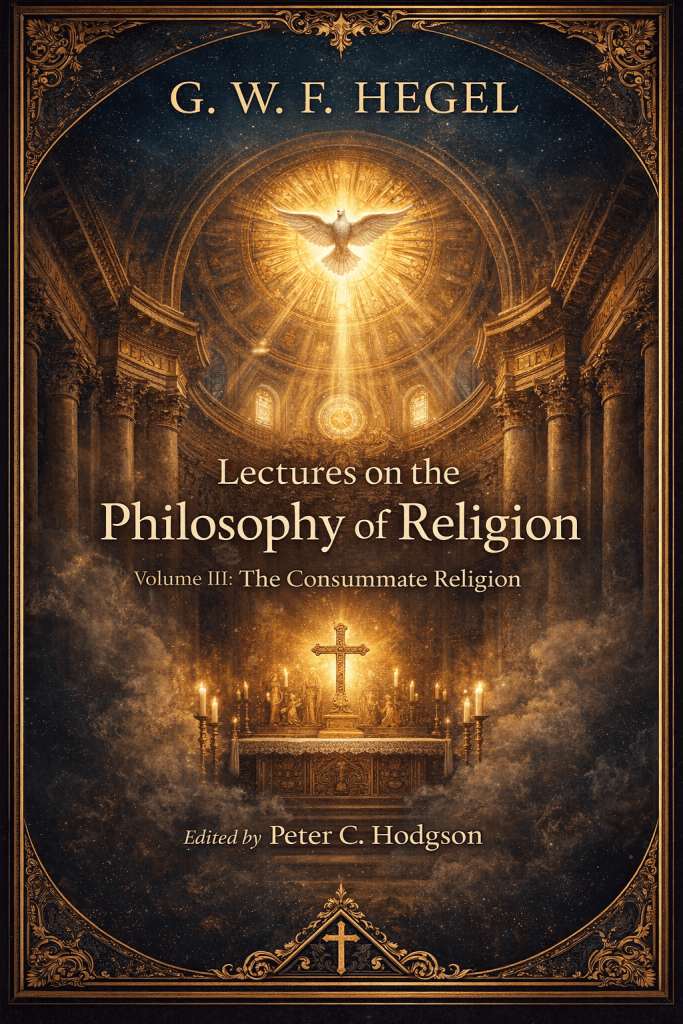
Hegel’s Lectures on the Philosophy of Religion, Volume III: The Consummate Religion, edited by Peter C. Hodgson, stands as a monumental contribution to the understanding of Hegel’s philosophical system and its implications for theology, spirituality, and the nature of consciousness.
This volume encapsulates the culmination of Hegel’s reflections on religion, in which he articulates his sustained investigation of the concept of religion wherein Christianity is the concept of religion that has become objective to itself as the “consummate religion,”—the moment when religious consciousness achieves explicit self-knowledge of its own fundamental structure, a designation that not only signifies its completion in the trajectory of religious development but also its role as a revelatory framework through which the divine is made manifest in human experience. The volume invites readers into a rigorous exploration of Hegel’s dialectical method, which operates through a series of speculative interpretations of core Christian doctrines, such as the Trinity, creation, the nature of humanity, the problem of evil, the role of Christ, and the unfolding of the Spirit within the spiritual community, culminating in the relationship between the church and the world. Rather than a fixed systematization, the volume reveals a continuous reworking of philosophical problems internal to the task of rendering Christian doctrine conceptually intelligible without reducing it to external historicity or subjective feeling.
The governing ambition of this work is to demonstrate that Christianity, when philosophically comprehended, is the religion in which the absolute reveals itself to finite consciousness in a manner that alone satisfies the concept of religion itself. This is not a theological defense of Christian doctrine understood as positive, historical revelation. Rather, it is a claim that the logical structure of what Christianity represents—the unity of divine and human nature, the self-mediation of absolute spirit through its own otherness—constitutes the inner truth toward which all religious consciousness strives, and which only Christianity consciously articulates. The work’s unity lies in this central thesis progressively elaborated through multiple frameworks, each adjusting the conceptual apparatus to render the matter more transparent. The foundational presupposition is established immediately: the concept of religion is the relationship of finite consciousness to absolute spirit, but more precisely, the return of this relationship to itself, its becoming objective to consciousness, such that finite spirit knows itself as a moment in the self-realization of the infinite. When this concept becomes fully objective—when religion knows itself as what it is—the consummate religion has appeared. This is the definition operative throughout all four lecture series, even as the means of articulating and defending it shift significantly.
Hegel’s philosophy of religion is distinguished by its historical development, particularly as articulated in his Berlin lectures delivered across four significant years: 1821, 1824, 1827, and 1831. Each iteration of these lectures reveals Hegel’s developing thoughts and the nuanced adjustments he made in response to the intellectual and spiritual milieu of his time. Unlike previous editions that conflated disparate materials into a single, often confusing narrative, this critical edition adheres to a re-examination of Hegel’s sources, allowing readers to engage with each lecture series as an independent unit while also tracking the trajectory of Hegel’s thought across different contexts and formulations. This approach offers a clearer insight into the logic and development of Hegel’s philosophical arguments, which are rich in their implications for modern theology and philosophy. The careful reconstruction of Hegel’s lectures reveals the philosophical underpinnings that inform his view of Christianity as not merely one religion among many but as a necessary culmination in the historical development of religious consciousness.
A persistent tension marks the entire work. Hegel inherits from the earlier lectures on determinate religion a triadic analytic framework: abstract concept, concrete representation, and cultus (or community). This framework serves the systematic mapping of religious consciousness across history. However, when applied to Christianity, this structure threatens to distort the very thing it is meant to illuminate. The abstract concept of God (the ontological proof), the concrete representation of God in creation and history, and the community of faith do not distribute themselves neatly across this outer triad. Instead, the concrete representation itself contains an inner triad—the immanent Trinity, creation, and the appearance of divinity in finite spirit—and this inner ordering demands recognition as profoundly trinitarian in character, not merely architectonically convenient.
The 1821 manuscript presents this tension most starkly. Hegel acknowledges that the “Son” (understood as the appearance of the divine idea in finite spirit, encompassing Christ and the history of redemption) occupies the third moment of the outer triad rather than the second, while the “Spirit” (the community, the return of consciousness to itself) becomes a kind of appendage under the third moment of the community-cultus. This arrangement leaves the structure askew. Real trinitarian speculation, Hegel suggests, would require combining the philosophical categories of nature and finite spirit (the second and third moments of the outer triad) into the second moment of a genuine trinitarian mediation—God’s self-differentiation in creation and incarnation—with the community and its return-to-self constituting the third trinitarian moment.
By the 1824 lectures, Hegel has reorganized the presentation around “the development of the idea of God” in three elements: the idea in and for itself, the idea in representation and appearance, and community and spirit. The first element remains the immanent Trinity. The second combines God’s differentiation both intra-divine (the eternal Son) and ad extra (creation, the fall, incarnation, reconciliation). The third becomes God’s return to himself through the transfigured subjectivity of the faithful community. This is a decisive move, converting the static analytic framework into a dynamic economy of trinitarian self-mediation. Yet the adjustment creates new problems: the second element becomes unwieldy, requiring subdivision into differentiation and reconciliation; the temporal and eternal dimensions of the story begin to fracture each other.
In 1827, Hegel pursues a different strategy. He constructs elaborate categorial schemas—logical, conscious, spatial, and temporal—to show how the three elements can be articulated simultaneously in multiple registers without reducing any to the others. The division of the subject becomes more philosophically sophisticated, though also more difficult. By 1831, according to the Strauss excerpts and Werke materials, Hegel introduces the language of kingdoms—Father, Son, and Spirit—as explicit trinitarian designators for the three elements, finally making the trinitarian structure the dominant organizing principle rather than treating it as an implication of the logical scaffolding.
This architectonic progression reveals something crucial about the work: it is not a finished system but a series of experimental attempts to bring the logical structure of the Christian tradition into focus without either reducing it to abstract philosophy or leaving it imprisoned in mere representation. Each revision acknowledges the insufficiency of the previous approach while maintaining the fundamental claim that the task is possible and necessary.
The term “consummate religion” carries with it a wealth of philosophical and theological significance. For Hegel, this designation reflects the idea that Christianity embodies the culmination of the dialectical process of religion itself, wherein the concept of religion reaches its deepest expression. This is achieved through the doctrine of the incarnation, which serves as a pivotal moment in Hegel’s philosophy, illustrating the union of the finite with the infinite, the temporal with the eternal. Hegel argues that through the incarnation, God reveals himself fully to humanity, thus allowing for a reconciliatory relationship between the divine and human realms. The speculative nature of Hegel’s interpretation emphasizes the dynamics of faith and reason, as he posits that understanding religion requires a philosophical framework that reaches beyond mere historical or dogmatic approaches. In this volume, readers will encounter Hegel’s critical engagement with concepts of estrangement and evil, illustrating how these themes are integral to understanding the human condition in light of divine revelation.
Hegel’s lectures also navigate the relationships between individual consciousness and collective spiritual existence, proposing that the community of believers—the church—represents the manifestation of the divine spirit in the world. This connection between the church and the world is essential in Hegel’s thought, as it emphasizes the idea that the spiritual community functions as a vital expression of the consummate religion, where the truths of faith are realized within a collective framework. Hegel’s emphasis on the church as an institution through which the spirit operates further complicates and enriches our understanding of how religious life is experienced and expressed in the modern world. The volume elucidates Hegel’s understanding of the church not merely as a physical institution but as a living embodiment of spiritual truth that participates in the ongoing revelation of the divine.
Central to the work’s philosophical foundation is a rethinking of the ontological proof of God’s existence. Hegel inherits a crisis in this tradition: Kant’s critique of the classical Anselmian proof has established that being cannot be simply deduced from the concept, that finite subjectivity’s concepts do not automatically have reality, and that the move from thought to existence requires more than formal logical argument. Yet Hegel refuses both the Kantian rejection of the proof and a mere return to Anselm’s pre-critical formulation.
The essential task is to develop a post-Kantian version of the proof that acknowledges Kant’s critique of finitude while showing that the presupposition Kant found illegitimate—the unity of concept and being—is not merely presupposed but can be demonstrated through the self-mediation of the concept itself. Here Hegel’s doctrine of the concept (as elaborated in his Science of Logic) becomes operative. The concept is not a merely subjective representation; it is the unity of immediacy (being, pure relation to self) and mediation (all categorial determinations) such that being is already implicitly contained within it. Being is not a predicate that adds something external to the concept; rather, the concept in its nature inherently includes being.
But more than this: the concept necessarily objectifies itself. It realizes itself, takes on determinate being, actualizes what was initially only ideal. This self-objectification is the movement of the idea—the absolute unity of concept and objectivity. In the Christian religion, Hegel claims, this is made fully manifest. God (the concept of absolute spirit) realizes itself in and through the consciousness of finite spirit. The identity of God’s being and God’s concept is the result of an absolute process of self-differentiation and return. Thus the ontological proof is transformed from a formal static demonstration into the articulation of an eternal living activity that is God himself.
This restatement of the proof is developed most fully in the 1827 and 1831 lectures. Rather than proving God’s existence by abstract logical analysis, Hegel demonstrates that God’s very concept entails his reality because God is spirit, and spirit’s nature is precisely to actualize itself, to appear, to return to itself. The proof cannot begin from abstract perfection (as Anselm attempted) because that presupposes what must be shown. It must begin from the concept of absolute spirit, which is self-determining, self-revelatory activity. Once this is grasped, being is no longer something added externally; it is inherent in spirit’s nature to be.
The stakes of this reformulation go far. It means that God cannot be merely an external object beyond consciousness; God must be immanently related to finite consciousness as the condition of its own possibility. God’s being consists precisely in revealing himself, in becoming manifest to finite spirit in such a way that finite spirit knows itself as a moment of God’s self-knowledge. This establishes the philosophical ground for understanding why Christianity—the religion of incarnation, of God appearing in human form—is the consummate religion.
The doctrine of the Trinity represents the axial problem of the entire work. Hegel approaches it from two directions simultaneously. First, he must show how the Trinity is the necessary development of the concept of God as absolute spirit. Second, he must show how the representational language of Christian tradition—”Father,” “Son,” “Spirit”—expresses this speculative truth, even though understanding attempts to turn these symbols into logical contradictions.
God, according to Hegel’s speculative account, is absolute spirit, infinite self-relating negativity. As such, God is a process of eternal self-differentiation and return. God distinguishes himself from himself, posits an otherness within his own being, yet this otherness is never truly separate from him because it remains eternally contained within his infinite subjectivity. This inner movement, the actus purus of divine life, is what constitutes the immanent Trinity. It is not a Trinity of “persons” in the understanding’s sense (which would make three into one through numerical absurdity) but rather a Trinity of logical moments eternally present in God’s self-consciousness.
The “Father” represents universality, pure conceptual self-identity. The “Son” (the eternal Son, not yet incarnate) represents infinite particularity, the moment of self-objectification ad intra, God in the mode of appearance. The “Spirit” represents infinite singularity, the moment of absolute return, the identity that contains and transcends differentiation. Yet these are not successive or externally related; they constitute a single eternal movement. God is this totality; there is no moment where only one aspect obtains.
The representational language of love conveys something of this speculative truth. Love, Hegel argues, is the intuition of oneself in another while remaining identical with oneself. It entails distinction mediated by absolute unity. Yet representation cannot fully grasp the Trinity because representation operates through imagination and sensible categories, which inevitably translate the three moments into three beings or collapse them into undifferentiated oneness. Understanding encounters only contradiction; it counts three and cannot see how three equals one. But this apparent contradiction is precisely the mark that we are approaching the absolute—the truth that sublates the abstract categories of number and identity-in-difference.
Hegel recognizes that earlier religions and philosophical systems have glimpsed elements of this trinitarian structure. He surveys the Hindu Trimurti, the Platonic triad of the World Soul, Neoplatonic and Gnostic speculation, Boehme’s theosophy, even Kant’s triadic division of judgment forms. These are “hints and traces,” but they lack the integrative clarity that emerges in Christianity. The difference is not merely historical or quantitative; it is that in Christianity alone does the Trinity become the governing principle of the entire religious consciousness, from the abstract conception of God through the narrative of creation and redemption to the constitution of the community itself.
The relationship between God and the natural world presents Hegel with a delicate philosophical problem. He must avoid both crude pantheism (identifying the world directly with God) and an external dualism (treating God and world as independently existing substances). His solution is to distinguish sharply between the immanent Trinity (God’s inner differentiation) and what might be called the economic Trinity (God’s relation to world process), while showing their organic connection.
The created world is not identical with the eternal Son; yet it proceeds from the same principle of divine self-differentiation. Because otherness is already a (sublated) moment within the divine life, God is free to grant independent existence to an other beyond himself. The world, in other words, is the continuation and actualization of the divine differentiation ad extra. The world is created, dependent, immediately disappearing moment in the eyes of absolute consciousness. Yet precisely because it flows from the divine self-differentiation, it participates in the divine nature in a way that justifies calling it the manifestation of the wisdom of God.
Here Hegel explicitly guards against pantheism while maintaining what might be called panentheism: the world exists in God and is radically dependent on God, yet is not identical with God. Creation is a continuous act (preservation), not a single historical event, because the world has being only insofar as it is held in relation to the divine idea. The natural world, as nature, is the moment of immediate externality, the realm where the idea appears as other to itself. Nature exhibits the idea in spatial juxtaposition and temporal succession; life in nature represents the highest exhibition of the idea within nature, yet life itself entails the sacrifice of immediate self-identity, pointing toward spirit.
This doctrine of nature as the appearing moment of the divine idea (Hegel’s “Philosophy of Nature”) governs the transition to the third sphere. Nature is not an evil or error but rather the necessary externalization of spirit, the realm where spirit realizes itself by overcoming its own otherness. Yet nature itself, lacking the infinite subjectivity that would make it truly spiritual, remains appearance. The question becomes urgent: how does spirit emerge from nature? How does the history of finite consciousness, with all its cleavage and suffering, represent the continued self-realization of the divine idea?
The third major sphere—the appearance of the divine idea in finite spirit—constitutes the longest and most psychologically detailed section of Hegel’s manuscript. It encompasses both the condition of natural humanity (estranged from its own truth) and the history of redemption and reconciliation through Christ. The two are internally related: the estrangement is not merely a privation or absence but an active rupture, a willing away from the infinite in pursuit of finite particularity.
Natural humanity, as Hegel determines it, is not evil by nature in the sense of having an inborn malice. Rather, natural humanity is the immediate, undeveloped condition of finite spirit existing according to the externality and singularity of natural existence. The natural human being is dominated by desire, self-seeking, dependence on external nature. It is not yet human in the fullest sense because it has not lifted itself into the universal, has not grasped itself as spirit. Yet this condition of immediacy contains an internal contradiction: human being is spirit, and spirit’s vocation is precisely to transcend immediacy, to mediate itself with itself, to achieve self-consciousness. Thus natural humanity is a being that ought not to be yet must be traversed.
The transition from natural immediacy to the awareness of good and evil—the fall—is therefore not contingent or external but essential to the emergence of consciousness itself. Knowledge (Erkenntnis), in Hegel’s precise sense, involves a judgment, a primal division (Urteil). To know anything determinate, consciousness must distinguish itself from its object, must posit the object as other. This act of knowing necessarily introduces cleavage (Entzweiung) and estrangement (Entfremdung). The moment consciousness awakens to itself as opposed to the infinite, in pursuit of its own singular interests, it has already fallen into the state of willing what is natural and immediate—which Hegel identifies as evil.
The biblical story of the Fall summarizes this speculative insight, though in representational form. The eating of the fruit from the tree of the knowledge of good and evil condenses two distinct meanings. First, it symbolizes the emergence of consciousness and distinction. Second, it represents the willful choice to remain in that state of distinction, to pursue the finite over the infinite, to treat one’s singularity as the measure of good. Hegel exposes the logical contradictions in the straightforward interpretation of the narrative. The knowledge forbidden is the knowledge of good and evil, yet this knowledge is precisely what constitutes the divine image in humanity. How can the divine likeness consist in what is forbidden? And if humanity was created in the image of God, how does eating a fruit transform the fundamental nature? These contradictions force interpretation beyond the merely narrative: the truth of the story lies in the speculative meaning of the emergence of consciousness as a kind of rupture with the infinite, a self-wounding that awakens human subjectivity.
Evil, for Hegel, is not then a cosmic force or an external temptation but the conscious, willful actualization of the state of separation. When consciousness knows the good and chooses its own singularity instead, it has committed evil and bears guilt. This makes humanity responsible for its condition; it also invests human freedom with profound dignity. “Humanity has dignity only through [the acceptance of] guilt.” Yet Hegel insists that evil is not, strictly speaking, constitutive of spirit’s essence. Rather, it is a necessary moment in spirit’s actualization, a negativity that must be overcome but that, paradoxically, is also the very principle by which consciousness awakens to itself.
Here cognitive principle becomes a kind of a redemptive principle: the same consciousness that produces the wound of separation is also the principle that heals it. The cognitive principle “both gives the wound and heals it.” This paradox finds its full expression in the narrative of Christ, where knowledge, love, and suffering are unified.
The movement of redemption begins with the recognition that humanity cannot overcome estrangement through its own efforts. The explicit unity of divine and human nature must be brought to consciousness from without, must appear to humanity in a form that immediate consciousness can grasp—which is to say, in sensible, historical actuality. This represents the necessity of the incarnation: God must become manifest in finite, singular human form. The incarnation is not arbitrary or external to the divine nature; rather, it flows from the very concept of God as absolute spirit, for spirit’s nature is precisely to appear, to objectify itself, to become present to consciousness.
Yet this appearance must be singular, unique. Multiple incarnations would represent a multiplicity of manifestations rather than the one ultimate appearance of the divine idea. The incarnation in a single individual who is at once wholly human and recognized as divine—this is the christological principle. Jesus of Nazareth is comprehended by faith as the one in whom the idea of divine-human unity has become actual, the one whose teaching, life, death, and resurrection constitute the divine history itself.
Hegel’s treatment of the teaching of Christ and his life concentrates on what these reveal about the content of reconciliation. Christ’s teaching emphasizes inwardness, the kingdom of heaven as interior kingdom, the displacement of all external hierarchies and worldly interests. He speaks prophetically, not merely as a teacher offering doctrines, but as one through whom God himself speaks. His teaching is revolutionary in its opposition to all established orders—religious, familial, political. He identifies himself with the universal (the Father), yet insists on being known as the Son of Man, the one man who is humanity as such.
But it is Christ’s death that occupies the place of supreme theological significance in Hegel’s account. The death of Christ is the ultimate portrayal of the unity of divine and human nature because death is the ultimate externality, the extreme point of finitude. That God—the infinite, eternal absolute—enters into death, suffers the dissolution of finite existence, represents an incomprehensibility at the heart of Christian faith. “God himself is dead.” This statement does not mean that God ceases to exist but rather that God enters into the most extreme negation of his own divine being, takes upon himself the ultimate fate of finitude. The infinite divestment of the divine idea is precisely love—the supreme surrender of oneself in the other, the transformation of the other’s suffering into one’s own.
The redemptive death of Christ accomplishes the reversal. Death, which seemed to be the end, becomes the beginning of return. The resurrection—not understood as a physical miracle but as the triumph over death, the negation of negation—represents the return of the divine idea to itself, the beginning of the ascension in which what seemed most unholy becomes most holy. The disgrace of the cross is inverted: what the state dishonors as a criminal execution is revealed as the act of God. Through this monstrous unification of the absolute extremes of divinity and death, love itself becomes manifest.
The 1824 and later lectures place less emphasis on the miraculous character of resurrection and more on the spiritual meaning. The community’s faith apprehends in Christ’s death and rising the eternal movement of God’s self-mediation. The resurrection and ascension to the right hand of God express the completion of Christ’s history at the level of spiritual consciousness. What was sensibly present to the disciples now becomes spiritually present to the faithful community. This transition from sensible to spiritual presence is not a loss but a gain, for it makes the truth of what occurred available to all times and places, not merely to those who witnessed the historical event.
The third moment of the consummate religion unfolds as the return of consciousness to itself, the actualization of reconciliation in the community of faith. The community is not a mere subjective gathering but the objective manifestation of the divine Spirit. The founding of the community is itself a divine act—the outpouring of the Holy Spirit that constitutes the faithful as the body of Christ. Yet the community has its historical point of departure: faith is awakened through the witness of the Spirit to the historical reality of Christ.
Hegel rejects all purely “historical” proofs of Christ’s divinity. Miracles, even the resurrection if taken as mere fact, cannot establish faith. What establishes faith is the witness of the Spirit—the profound inner recognition that what occurred in Christ is the very movement of God’s self-reconciliation. This witness is not accessible to mere historical investigation; it is a matter of spiritual discernment available only to those who have been transfigured by the Spirit.
The being of the community is constituted in three moments. First, it is a community of faith and doctrine. Faith is the certainty of absolute truth for the whole consciousness; it has objective content, not merely subjective feeling. This content must be taught, preserved, handed down in fixed expressions that constitute tradition and doctrine. The community guards the truth against distortion and forgetfulness. Second, the developed community becomes the church, taking on institutional and organizational form. It generates principles of civil and political life; it becomes a worldly reality with all the ambiguities that entails. Third, and centrally, the community enacts the cultus—the sacramental participation in Christ’s life, death, and resurrection.
Hegel’s discussion of the sacraments, especially the Lord’s Supper, reveals the profound significance he attributes to this practice. The sacrament is not mere symbol or commemoration but an eternal repetition of Christ’s redemptive act. Believers participate materially in the divine-human unity; they consume the substance of Christ. Hegel adopts language of both mystical union and sensible partaking (Genuss). The sacrament maintains the connection between the sensible and the spiritual, refusing to abstract away the bodily dimension. Through the cultus, the community actualizes the reconciliation accomplished by Christ, bringing it into the present reality of believers’ lives.
Yet Hegel acknowledges the ambiguities attending the community’s worldly existence. The community must exist in relation to the world—the realm of nature, self-seeking, finite interests. It constantly faces the temptation to become merely worldly, to reduce its teaching to moralism, to use its power for domination rather than liberation. The 1824 lectures especially trace the various forms in which the realization of faith is attempted: first, the external world of passions and nature; second, the reflective philosophy of the Enlightenment, which evacuates faith of all objective content; third, the philosophical mediation through which speculative reason recognizes the rational ground of religious truth.
The conclusion toward which the work moves is not apocalyptic or triumphalist. The community does not simply “pass away” but rather “passes over” into new forms. The 1827 lectures suggest that as ecclesiastical authority has waned in the modern world, the guardianship of religious truth has devolved upon philosophy—the community of reason. Yet Hegel is careful to insist that philosophy does not replace religion but rather justifies religion by showing how its representational content accords with reason. The “peace of God that surpasses all understanding” is revealed to surpass understanding not by being incomprehensible but by being what understanding is finally all about.
The progression from 1821 to 1831 reveals not a maturation toward increasing clarity but rather a continuous recalibration of how to present the matter philosophically. The 1821 manuscript, delivered when Hegel was settling into Berlin and developing his mature system, presents the most direct and least defensive exposition. The problem is posed and solved with a certain philosophical directness: religion is the self-consciousness of the absolute, Christianity is the religion in which this has become explicit, therefore the task is to comprehend this philosophically.
By 1824, Hegel has become acutely aware of specific polemical challenges. Schleiermacher’s theology of feeling has prompted a vigorous response: Hegel insists on the objectivity of religious content, against any reduction of religion to subjective emotional states. He also defends himself against historicism—the tendency to treat Christianity merely as a historical phenomenon whose truth cannot be philosophically established. The 1824 lectures are therefore more explicitly argumentative; they build cases for why pure feeling is not religious, why historical proofs cannot establish faith, why philosophy and not history must finally validate religion.
In 1827, a new adversary has emerged: Neopietism and its charge that Hegel’s speculative philosophy is pantheistic, that it dissolves the distinction between God and world, that it is effectively atheistic. The 1827 lectures devote considerable attention to defending the positivity and spirituality of Christianity—showing that revelation is both revelatory (a process) and revealed (a positive, historical fact), that the spiritual truth emerges through rather than against the positive historical forms. The philosophical vocabulary becomes more careful; Hegel emphasizes both the ideality of the absolute and the reality of the finite world as truly other to God, held in relation but not identified.
The 1831 lectures, known primarily through Strauss’s excerpts and the Werke materials, represent a final attempt at synthesis. The trinitarian structure is made fully explicit and governing. The three kingdoms—Father, Son, and Spirit—become the principal organizing scheme rather than derived from more fundamental categories. The treatment of natural humanity and evil is relocated to the third moment, integrated into the community’s own struggle and transformation. The emphasis on how the State embodies divine freedom and rationality suggests a further integration of the political and the religious that was less prominent in earlier versions.
These shifts reveal Hegel not as a man with a fixed doctrine that he merely restates, but as a thinker genuinely struggling with how to articulate a philosophical account of Christianity that neither colonizes its content for philosophy nor leaves it imprisoned in representation. Each iteration acknowledges the failure of previous formulations while maintaining that the task itself is possible and urgent.
The entire work is governed by a fundamental methodological commitment: the truth of religion can be known philosophically, philosophy and religion are not contradictory but rather constitute different modes of knowing the same content. Philosophy knows speculatively (through concepts) what religion knows representationally (through images, narratives, symbols). This is not a reduction of religion to philosophy; rather, it is a claim about the unity of truth and the capacity of reason to grasp what religion expresses in other forms.
Yet this commitment generates continuing tension. How can philosophy claim to know the truth of Christianity without pretending to replace or supersede Christian faith? How can speculative concepts capture what representation expresses through narrative and symbol? The Trinity is perhaps the most pressing case. Hegel’s speculative account of the Trinity as the eternal movement of divine self-differentiation and return is philosophically rigorous; yet it seems to leave behind something essential conveyed by the Christian symbols of Father, Son, and Holy Spirit. The language of persons, of relationship, of love cannot be reduced to logical categories without apparent loss.
Hegel himself seems aware of this tension. He repeatedly insists that representation has its own truth, that the understanding’s contradictions are not refutations but signs that we are approaching the absolute. Yet he also seems to imply that philosophy grasps a truth toward which representation can only gesture. The work does not fully resolve this tension but rather manages it through the distinction between the truth of content and the form of expression. The content—the divine self-realization through differentiation and return—is the same whether expressed in the language of love or of logical necessity. The form differs; the truth is one.
Another persistent problematic concerns the relationship between the eternal and the temporal. Hegel’s entire scheme depends on distinguishing between the immanent Trinity (eternal divine self-differentiation ad intra) and the economic Trinity (God’s relation to the world in time). Yet the attempt to hold these distinct while also showing their necessary connection strains the conceptual apparatus. Creation, incarnation, redemption are presented as both eternal (moments of the divine idea itself) and temporal (historical events). The community both enacts in time what occurred eternally in the divine life. These formulations are profound but also precarious; they seem to require constantly reasserting the unity that the distinctions threaten to fracture.
A third questions concerns the relationship between necessity and contingency. Hegel’s speculative account treats the divine self-realization as necessary—it belongs to the very concept of spirit to actualize itself, to appear, to return to itself. Yet Christianity is also presented as the historical religion, appearing at a particular time and place, contingent in its occurrence. How is a contingent historical event the necessary actualization of the eternal idea? Hegel attempts to hold this through the notion of the concept developing through history, of necessity expressing itself through contingent forms. But the tension remains: if Christianity’s appearance is necessary to the idea, how can it be truly historical and contingent? If it is contingent, how does it represent the culmination of spirit’s self-realization?
Throughout the work, Hegel maintains that representation—the pictorial, imaginative, narrative form of religious consciousness—has an essential role. Christianity is not merely abstract doctrine but is incarnational, material, sensible. The Incarnation itself insists on the significance of flesh, body, historical actuality. The sacraments maintain the material dimension. Yet representation also carries dangers: the understanding can take representational forms as literal truths, missing the speculative unity they express. The Trinity can become the apparent contradiction of three persons in one God rather than the eternal self-mediation of spirit.
Hegel’s solution is not to overcome representation but to understand it philosophically, to see through the representational form to the speculative truth it expresses. This requires a peculiar hermeneutical labor: taking the representations seriously enough to extract their inner meaning while not remaining imprisoned in their apparent contradictions. The key is recognizing that representation operates in time and externality while the truth it conveys is eternal and inward. The historical Jesus is real and unique, yet what is true about Jesus is that he is the appearance of the eternal idea, available to all times in spiritual consciousness.
This approach generates a complex doctrine of tradition. The Church’s teachings, creeds, and doctrines are not merely human constructions or historical opinions; they express the truth of revelation. Yet they require constant philosophical renewal to remain living rather than dead formulations. The speculative comprehension of doctrine is the way faith guards its own truth against both worldly distortion and spiritual emptiness.
The work is saturated with awareness of modernity’s challenges to faith. Enlightenment rationalism has shattered the naive acceptance of doctrine; Kant’s critical philosophy has established the limits of reason in a way that seems to exclude knowledge of God; Schleiermacher has attempted to preserve religion by removing it to the realm of feeling, beyond the reach of critique; historical scholarship has reduced Christianity to a merely historical phenomenon. Hegel sees these developments not as refutations of Christianity but as challenges that must be met philosophically. If Christianity can be shown to be identical with the rational truth of the absolute, then these modern critiques lose their force while their genuine insights—the emphasis on reason, on subjectivity, on historical actuality—are integrated into a higher comprehension.
This is why philosophy becomes essential in modernity, in Hegel’s view. In earlier, more immediate ages, faith could sustain itself through tradition and authority. But once the modern turn to subjectivity has occurred, once reason has been awakened to itself as a tribunal, faith must justify itself before reason or perish. The Church cannot simply reassert authority; it must show that its content is rational. But this need not mean reducing Christianity to abstract principle. Rather, it means demonstrating the profound rationality of incarnation, redemption, and community—showing that these are not irrational dogmas but the expression of reason’s deepest truth.
Yet Hegel also suggests something more unsettling: the community of faith may not be capable of this philosophical labor. The Church seems incapable of grasping philosophy; secular reason seems incapable of preserving faith. Thus the guardian of truth may have passed from the ecclesiastical community to the philosophical community. Philosophy becomes the custodian of religion’s truth in an age when the Church has lost the capacity to comprehend it. This is not triumph but a curious displacement: the truth of Christianity survives only in the philosophical comprehension of those who no longer participate in Christian faith in its traditional forms.
The work achieves a remarkable integration of elements that seem to pull against each other. The doctrine of the Trinity is simultaneously understood as eternal logical structure, as the self-realization of absolute spirit, and as the content of Christian faith expressed in representational form. The Incarnation is presented as both necessary to the idea (it must manifest itself) and as unique historical event. Redemption is both accomplished eternally (in the divine idea) and temporally realized (in the community). The work reconciles the claims of speculative philosophy with the positive content of Christian tradition, showing that the deepest philosophical truth is not opposed to but coincides with Christian revelation.
This achievement is not unproblematic. The reconciliation is real, but it comes at a cost. Christianity becomes fully intelligible only when comprehended philosophically, when its representational form is sublated into conceptual form. The sensuous, material, historical particularity that the Incarnation seems to insist upon tends toward abstraction in Hegel’s account. The unique individual Jesus becomes the appearance of the eternal idea; his contingent history becomes the expression of necessary logical development. Whether this constitutes a deepening of Christian understanding or a subtle distortion remains a matter of philosophical dispute.
Yet the work’s internal coherence and systematic power are undeniable. Every major Christian doctrine is reinterpreted as a moment in the self-realization of absolute spirit. The Trinity articulates the eternal structure; creation expresses God’s freedom to posit otherness; the Fall represents the emergence of consciousness; the Incarnation manifests divine-human unity in sensible form; Redemption accomplishes the overcoming of estrangement; the community embodies the spiritual presence of Christ; the realization of faith in worldly ethical institutions shows how the reconciliation of God with humanity becomes the reconciliation of human with human in justice and freedom.
Nothing is left as mere accident or external addition. Every element finds its place in the systematic whole. This integration is achieved through the consistent application of the principle that spirit, whether infinite or finite, must actualize itself, must appear to itself, must return to itself. The entire history of religion from nature religions through Judaism and paganism to Christianity is comprehended as the progressive actualization of this principle, with Christianity alone conscious of the principle itself.
The work stabilizes its guiding tensions not through final resolution but through the recognition that these tensions are themselves expressions of the speculative truth. That God is both infinite and finite, that eternity relates to time, that the universal appears in the particular—these are not contradictions to be overcome but the very structure of reality. Spirit exists precisely as the mediation of such apparent oppositions. The Trinity, far from being a logical impossibility, is the deepest articulation of how identity and difference, unity and multiplicity are reconciled in living totality.
Yet certain tensions remain not fully resolved but deliberately sustained. The relationship between philosophy and faith, between conceptual knowledge and representational knowing, between the eternal idea and its temporal manifestation—these are held in productive tension throughout. The work invites the reader into a labor of understanding, not as passive reception of doctrine but as active philosophical comprehension. To understand the work is, in a sense, to repeat its philosophical labor, to work through the same argumentative moves and methodological experiments that Hegel himself undertook across his four lecture series.
The volume’s philosophical unity consists in this integrated movement of thought rather than in formulaic consistency. The central claim—that Christianity is the consummate religion, the religion in which the concept of religion has become objective to itself—is reiterated and progressively elaborated across vastly different architectonic schemes, philosophical vocabularies, and polemical contexts. The work reveals that philosophical understanding is not a fixed achievement but a continuous task, a wrestling with the matter itself in all its dimensions. To read Hegel’s Philosophy of Religion is to encounter not a closed system to be learned but an unfolding meditation on how reason and faith, philosophy and revelation, the eternal and the temporal can be thought together in their deepest unity.
Hodgson’s editorial work in this volume is comprehensive, providing readers with critical annotations and contextual information that facilitate a deeper engagement with Hegel’s complex ideas. The inclusion of textual variants and a robust glossary supports readers in navigating the rich philosophical terminology that characterizes Hegel’s lectures. This critical edition, recognized as the definitive English translation of Hegel’s philosophy of religion, enhances accessibility while maintaining fidelity to the original texts, thus ensuring that Hegel’s insights can resonate within contemporary discussions of faith, reason, and the nature of reality.
Hegel’s Lectures on the Philosophy of Religion, Volume III: The Consummate Religion is thus not only as a key text for scholars of Hegel but a significant philosophical inquiry into the nature of religion itself. By positioning Christianity at the apex of religious development, Hegel invites readers to contemplate the implications of this perspective for understanding the role of religion in a modern context, addressing the perennial questions of existence, knowledge, and the divine. The volume serves as an invitation to explore the depths of Hegelian thought, encouraging a reflective engagement with the spiritual and philosophical challenges that continue to shape human consciousness and our quest for meaning in the contemporary world. Hodgson’s edition of Hegel’s lectures stands as a vital resource for understanding the intersections of philosophy, theology, and the enduring questions of the human spirit.


Leave a Reply