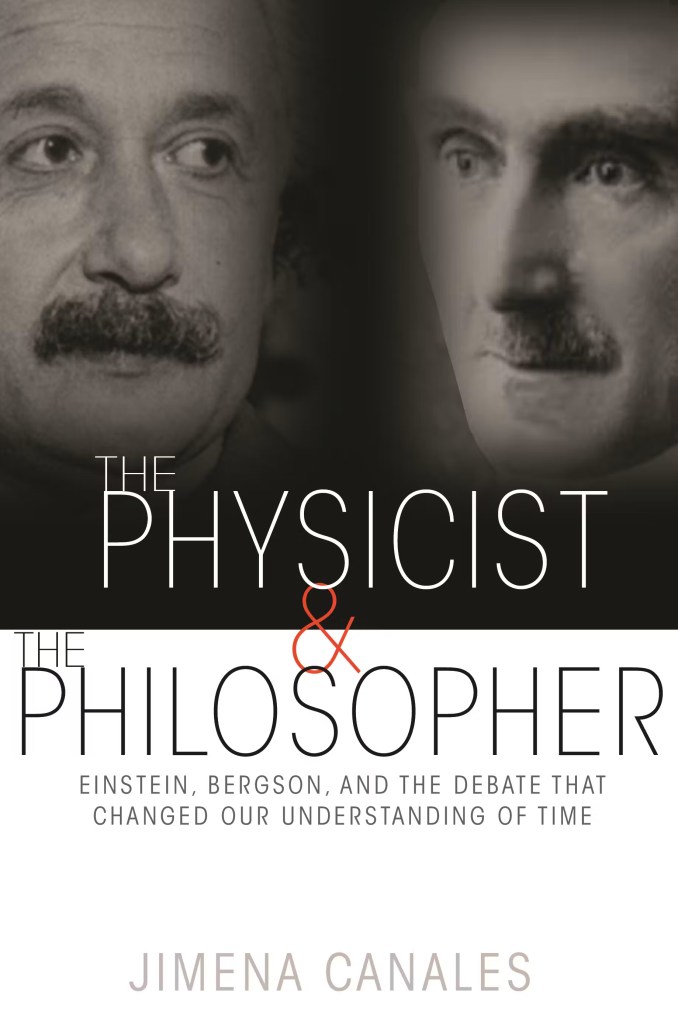
On April 6, 1922, a remarkable intellectual confrontation took place in Paris between two of the most influential figures of the early twentieth century: the theoretical physicist Albert Einstein and the French philosopher Henri Bergson. Their public exchange, conducted during a meeting of the Société française de philosophie, brought into direct confrontation two fundamentally different approaches to the nature of time, revealing profound disagreements concerning the relationship between scientific measurement, philosophical reflection, and human experience. Einstein, whose theories of special and general relativity had transformed the conceptual foundations of modern physics, defended an understanding of temporal relations grounded in mathematical formalization, empirical verification, and the physical operations through which measurements acquire meaning. Bergson, whose philosophy had established the concept of duration (durée) as fundamental to the understanding of consciousness, life, and becoming, questioned whether the quantitative representation of time could exhaust the reality of temporal experience. Their disagreement rapidly acquired significance beyond the immediate philosophical and scientific questions under discussion, becoming emblematic of a wider struggle over the authority of different forms of knowledge to determine the fundamental characteristics of reality.
In The Physicist and the Philosopher: Einstein, Bergson, and the Debate That Changed Our Understanding of Time, historian of science Jimena Canales reconstructs this extraordinary encounter and traces its consequences across twentieth-century intellectual history. Her investigation situates the debate within the scientific revolutions, philosophical controversies, technological innovations, and political transformations that reshaped modern conceptions of temporality. Combining historical scholarship with an examination of the conceptual foundations of physics and philosophy, Canales demonstrates that the confrontation between Einstein and Bergson concerned much more than competing definitions of time. At stake were questions about the limits of scientific knowledge, the status of subjective experience, the relationship between mathematical abstraction and concrete reality, and the authority to determine which dimensions of human existence could legitimately be described as objective. The controversy consequently became a focal point for wider disagreements concerning the relationship between the natural sciences and the humanities, disagreements that continued to shape intellectual culture long after the original encounter.
The scientific background of the debate lay in the transformation of classical conceptions of space and time inaugurated by Einstein’s special theory of relativity in 1905 and extended through his general theory of relativity in 1915. Classical Newtonian mechanics had traditionally treated time as a universal and homogeneous framework within which physical events occurred, independently of the particular circumstances of observation. Einstein’s special relativity challenged this assumption by demonstrating that measurements of temporal intervals and judgments concerning the simultaneity of spatially separated events depend upon the relative motion of observers. The theory established that the temporal ordering and measurement of certain events could no longer be understood through an independently existing universal time shared by all observers. Instead, time entered into the mathematical structure of spacetime, within which measurements of distance, duration, and simultaneity were related through transformations governed by the invariant speed of light. General relativity subsequently deepened this reconceptualization by incorporating gravitation into the geometry of spacetime and demonstrating that the measurement of elapsed time is also affected by gravitational conditions.
These theoretical developments carried implications extending far beyond technical physics. They challenged established philosophical assumptions about the universality of temporal succession and the relationship between physical reality and the conditions of its observation. The problem of simultaneity became particularly significant because it exposed the dependence of apparently immediate temporal judgments upon procedures of synchronization and measurement. Events that could be considered simultaneous within one inertial reference frame might not be simultaneous within another, even though the mathematical relationships between their descriptions remained precisely defined. Scientific time was thereby transformed from an apparently self-evident universal background into an aspect of physical reality whose determination required explicit operational and mathematical procedures. Einstein’s position derived its force from the explanatory coherence and empirical consequences of this transformation, which established relativity as a central theoretical achievement of modern science.
Bergson approached the problem from a different philosophical tradition. His earlier works, particularly Time and Free Will, Matter and Memory, and Creative Evolution, had developed an account of temporality that emphasized the qualitative continuity of lived experience. For Bergson, the time encountered in consciousness could not be adequately represented as a sequence of homogeneous, externally distinguishable units. Such representations, he argued, tended to substitute a spatialized image of succession for the continuous and internally differentiated movement through which experience actually unfolds. His concept of duration designated this irreducible continuity, in which past states persist within present experience and temporal development cannot be separated into discrete elements without transforming the phenomenon under investigation. Duration was therefore closely connected to memory, consciousness, freedom, and the creative emergence of novelty. It described a dimension of reality whose defining characteristics resisted exhaustive expression through numerical measurement.
Bergson’s philosophical objection to Einstein did not simply consist in rejecting the mathematical achievements of relativity or denying the usefulness of physical measurement. Rather, he questioned the philosophical interpretation of those achievements and the tendency to identify the temporality represented by physical theories with time in its entirety. In his view, the operational procedures through which physicists coordinate clocks, compare reference frames, and quantify intervals could establish legitimate relationships among measurable phenomena without necessarily resolving the philosophical question of what time itself is. Mathematical descriptions of temporal relations, however accurate within their appropriate domain, could not automatically eliminate the significance of lived duration or establish the complete equivalence of temporal reality with its quantitative representation. Bergson therefore challenged what he understood as the metaphysical assumptions that could become attached to relativity when its formal results were interpreted as an exhaustive account of the nature of time.
Einstein, conversely, regarded Bergson’s appeal to lived duration as insufficiently relevant to the determination of physical time. From the standpoint of relativity, questions concerning simultaneity, duration, and temporal measurement required procedures capable of producing determinate and experimentally meaningful results. The psychological experience of temporal passage might constitute a legitimate subject for investigation, but it could not override the physical relationships established through mathematical reasoning and empirical observation. The distinction between subjective temporal experience and objectively measurable time consequently became central to his response. Einstein was skeptical of the philosophical claim that an independently privileged conception of lived time could correct or supersede the temporal structure described by physics. His position reflected a broader transformation in scientific methodology through which concepts previously associated with philosophical intuition increasingly became subject to precise operational definition.
Canales reconstructs the encounter as a collision between competing intellectual conceptions of reality, while also demonstrating that the participants did not always understand the implications of their disagreements in equivalent terms. For Bergson, the central difficulty involved the relationship between mathematical representations and the temporal continuity they purported to describe. For Einstein, the decisive issue concerned the physical conditions under which temporal statements could possess objective validity. Their disagreement therefore involved different assumptions about the meaning of objectivity itself. Scientific objectivity depended upon publicly reproducible procedures, mathematical consistency, and experimentally testable relationships, whereas Bergson’s philosophical inquiry sought to establish the significance of dimensions of experience that could be obscured by the abstractions required for scientific measurement. The resulting controversy revealed the difficulty of establishing a common conceptual framework through which the claims of physics and philosophy could be evaluated without subordinating one discipline to the methodological expectations of the other.
The public character of the debate amplified its significance. By the early 1920s, Einstein had become an internationally celebrated representative of scientific modernity, while Bergson enjoyed extraordinary recognition as a philosopher whose writings had influenced intellectual discussions across Europe and beyond. Their confrontation attracted attention because it appeared to place two prominent forms of intellectual authority in direct competition. The scientist represented the unprecedented capacity of mathematical physics to reconstruct the fundamental structure of nature, while the philosopher defended the legitimacy of reflective inquiry into the conditions and meanings of human experience. The question of which thinker possessed the more adequate conception of time consequently became inseparable from broader concerns about the cultural authority of science, the continued relevance of metaphysics, and the status of philosophy in an age increasingly shaped by technological and scientific achievement.
Canales situates these tensions within a larger historical environment marked by the aftermath of the First World War, the reorganization of European intellectual institutions, and the continuing effects of national and disciplinary rivalries. Scientific theories did not circulate in a politically neutral cultural space, and philosophical controversies were frequently influenced by institutional affiliations, linguistic traditions, national identities, and competing conceptions of intellectual authority. The reception of relativity was shaped by these circumstances, as was the interpretation of Bergson’s objections. Public debates about time consequently became entangled with larger questions about cultural prestige, scientific progress, and the intellectual reconstruction of Europe following the devastation of war. Canales examines how arguments that initially concerned highly specialized conceptual problems acquired public meanings that extended beyond the intentions of their principal participants.
A particularly important dimension of the book concerns the subsequent reception of the Einstein–Bergson controversy among major twentieth-century philosophers and scientists. Bertrand Russell’s engagement with Bergson exemplified the emergence of a powerful philosophical orientation that emphasized logical analysis, conceptual precision, and the explanatory authority of modern science. Russell’s criticisms of Bergsonian philosophy reflected wider disputes over the reliability of intuition and the relationship between philosophical argument and mathematical reasoning. These disputes contributed to the development of analytical approaches that increasingly regarded the clarification of scientific concepts and logical structures as central philosophical tasks. The controversy over time therefore became associated with a broader transformation in the methods and priorities of philosophy, particularly within traditions influenced by mathematical logic and scientific empiricism.
Martin Heidegger’s philosophy represents another significant dimension of this intellectual history. His investigation of temporality, particularly in Being and Time, developed a conception of human existence in which time could not be adequately understood as a neutral sequence of measurable moments. Heidegger’s analysis of temporality as constitutive of human existence introduced questions concerning finitude, historical situatedness, and the temporal structure of understanding. Although his philosophical framework differed fundamentally from Bergson’s, the broader debate concerning measurable time and existential temporality provides an important context for understanding the development of phenomenological approaches to the problem. Canales traces the ways in which the controversy intersected with philosophical attempts to investigate time beyond the categories employed by mathematical physics, without treating these distinct philosophical projects as interchangeable.
The dispute also reverberated through American pragmatism, logical positivism, and the philosophical interpretation of emerging scientific theories. Within pragmatist traditions, questions concerning experience, process, practical consequences, and the relationship between knowledge and human activity offered alternative approaches to the apparent opposition between scientific abstraction and lived reality. Logical positivism, by contrast, developed a methodological orientation emphasizing empirical verification, linguistic clarification, and the elimination or reinterpretation of metaphysical propositions that could not be related to possible experience. The Einstein–Bergson controversy became relevant to these developments because it raised fundamental questions about the meaning of scientific concepts, the legitimacy of philosophical claims concerning reality, and the conditions under which statements about time could be considered cognitively significant.
Canales further examines the relationship between the debate and conceptual developments in twentieth-century physics, including discussions associated with quantum mechanics. The emergence of quantum theory introduced additional problems concerning measurement, observation, probability, and the interpretation of physical reality. Although quantum mechanics did not simply reproduce the disagreement between Einstein and Bergson, its conceptual controversies reopened questions about the relationship between mathematical formalism, experimental procedures, and the interpretation of observable phenomena. The broader intellectual environment was consequently characterized by recurring disputes about whether scientific theories could be understood as complete descriptions of reality or whether their success depended upon methodological limitations requiring further philosophical investigation. In this context, the confrontation between Einstein and Bergson appeared as an early and especially visible expression of tensions that would continue to develop within modern scientific thought.
An especially distinctive aspect of Canales’s historical reconstruction is her attention to the technologies through which time was increasingly measured, standardized, transmitted, and represented. The development and widespread adoption of precision clocks, wristwatches, telecommunications, radio broadcasting, and motion pictures transformed the temporal organization of everyday life. These technologies made synchronization increasingly important to economic activity, transportation, military coordination, communication, and social administration. They also changed the cultural experience of simultaneity, duration, and temporal distance. Time became an increasingly standardized and publicly coordinated dimension of modern existence, while new media introduced unprecedented ways of recording, reproducing, accelerating, interrupting, and rearranging the apparent continuity of events.
The wristwatch exemplified the growing integration of standardized temporal measurement into individual life, while radio created new possibilities for coordinating geographically separated audiences through shared broadcasts and transmitted time signals. Cinema, meanwhile, complicated the relationship between physical succession and experienced duration by making it possible to reproduce movement, manipulate temporal sequences, and present events according to rhythms independent of their original occurrence. These developments did more than provide practical applications of scientific knowledge. They influenced the conceptual and experiential conditions under which modern individuals understood time itself. Canales demonstrates how technological change contributed to a historical environment in which quantitative synchronization and qualitative experience became increasingly visible as distinct, although interconnected, dimensions of temporality.
The controversy also illuminates the relationship between scientific progress and the transformation of philosophical authority. As mathematical physics acquired increasing explanatory and predictive power, the boundaries separating legitimate scientific questions from philosophical speculation were progressively renegotiated. The Einstein–Bergson confrontation became a prominent example of this process because it concerned a concept traditionally treated as central to metaphysics but increasingly subject to precise scientific determination. The question was not merely whether philosophers could contribute to discussions of scientific theories, but whether philosophy possessed an independent capacity to investigate aspects of reality that scientific methods could not adequately encompass. This dispute contributed to the perception of a widening division between the natural sciences and the humanities, even though the historical relationships between these intellectual domains remained considerably more complex than a simple opposition between objective knowledge and subjective interpretation.
Canales’s account also demonstrates how public judgments concerning intellectual controversies can diverge from the conceptual complexity of the arguments themselves. Einstein’s scientific achievements provided strong grounds for accepting the physical predictions and mathematical structure of relativity, but the philosophical significance of those achievements remained open to competing interpretations. Bergson’s objections, for their part, involved questions concerning the relationship between abstraction and experience that could not always be resolved through demonstrations of the empirical success of physical theory. The historical reception of their encounter often simplified these differences into a confrontation between modern science and an allegedly obsolete philosophy, thereby obscuring the distinct levels of inquiry involved. Canales recovers the intellectual circumstances under which these judgments developed and examines how disciplinary boundaries influenced the subsequent interpretation of the dispute.
The concluding portions of the book extend the historical narrative into the later lives of Einstein and Bergson, examining how the original confrontation continued to acquire meaning under dramatically altered political and scientific conditions. Bergson’s final years unfolded against the background of the Second World War and the Nazi occupation of France, circumstances that transformed the cultural and political environment in which questions of freedom, historical development, and human experience were considered. Einstein’s later reflections took place in a world increasingly shaped by nuclear physics, global military conflict, and the destructive capacities of modern technological civilization. The advent of thermonuclear weapons provided a particularly stark context in which the relationship between scientific knowledge, technological power, and human responsibility acquired unprecedented urgency. By tracing the debate into these later historical circumstances, Canales demonstrates that the intellectual relationship between physics and philosophy was inseparable from the wider consequences of scientific modernity.
The retrospective significance of the Einstein–Bergson encounter therefore extends beyond the question of which thinker offered the more convincing conception of time. Their confrontation exposes a fundamental problem concerning the relationship between different modes of understanding reality. Physical theories establish mathematically articulated relationships among measurable phenomena, whereas philosophical investigations may examine the conceptual presuppositions, experiential conditions, and ontological implications of those relationships. The difficulty arises when the explanatory achievements of one form of inquiry are interpreted as sufficient grounds for dismissing the questions addressed by another. Canales’s historical analysis reveals how such disagreements are shaped by intellectual commitments, institutional circumstances, public expectations, and changing conceptions of legitimate knowledge.
The Physicist and the Philosopher ultimately provides a comprehensive account of how a seemingly specialized disagreement concerning the nature of time became a major episode in the intellectual history of the twentieth century. Through its reconstruction of the encounter between Einstein and Bergson, its examination of the subsequent philosophical and scientific responses, and its attention to the technological and political conditions of modern life, the book demonstrates that conceptions of time are inseparable from the historical contexts in which they are developed and contested. The controversy reveals the extent to which scientific discoveries can transform established philosophical categories while simultaneously generating new questions about the meaning and limits of knowledge. Its enduring importance lies in the recognition that the relationship between measurable physical processes and the temporal structure of human experience remains a fundamental subject of investigation across philosophy, physics, psychology, and the humanities. Canales thus presents the debate as a historical lens through which to understand the changing boundaries of modern knowledge, the tensions between disciplinary forms of authority, and the continuing effort to determine how the temporal reality described by science relates to the time in which human beings think, act, remember, and live.


Leave a Reply