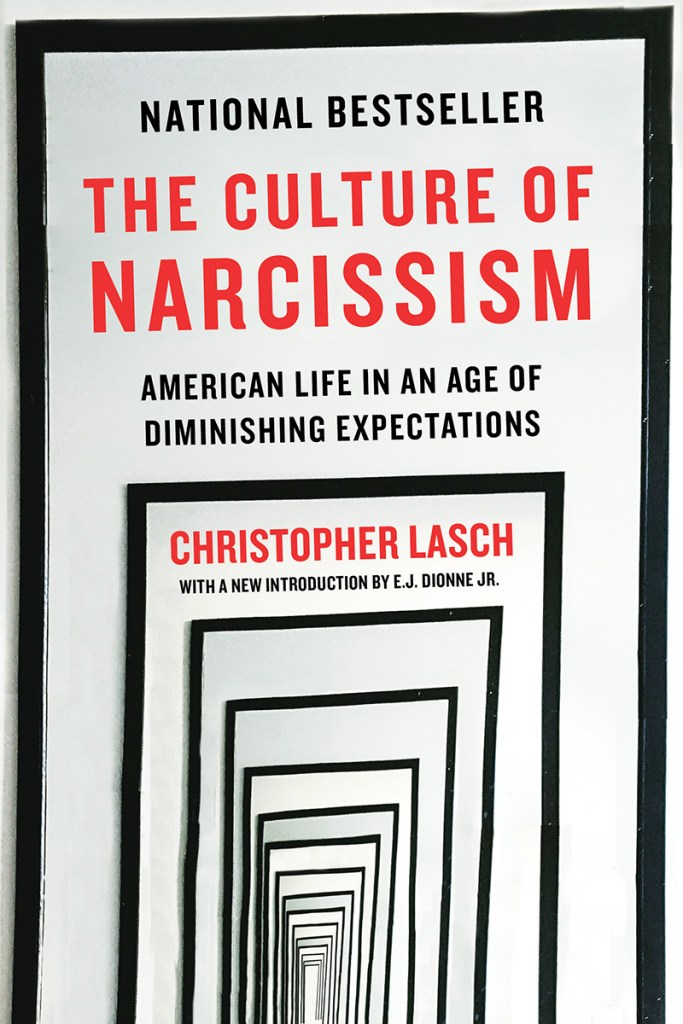
When Christopher Lasch’s The Culture of Narcissism: American Life in an Age of Diminishing Expectations was first published in 1979, it offered a penetrating diagnosis of the psychological, cultural, and institutional transformations taking place within American society. Written against the background of profound changes in family life, economic organization, political authority, and social expectations throughout the twentieth century, the book examined the emergence of a distinctive cultural orientation characterized by intensified self-preoccupation, emotional insecurity, dependence on external recognition, and the progressive weakening of durable interpersonal commitments. Lasch identified these tendencies as manifestations of a broader historical transformation in which the institutions that had traditionally mediated between individuals and society were increasingly displaced by bureaucratic administration, professional expertise, consumer capitalism, and the expanding influence of mass communications. His analysis suggested that changes in the structure and authority of the family were inseparable from the wider reorganization of social life, and that the psychological consequences of these developments could be understood only within their historical and institutional context.
At the center of Lasch’s argument is the proposition that narcissism should be understood as a socially significant psychological configuration rather than merely as an individual moral deficiency or an exaggerated form of vanity. Drawing upon psychoanalytic theory, particularly discussions of narcissistic personality organization, Lasch investigates how cultural conditions can encourage forms of subjectivity marked by unstable self-esteem, heightened sensitivity to criticism, difficulties sustaining emotional intimacy, and an enduring preoccupation with personal image and social approval. The narcissistic personality, in this interpretation, increasingly experiences the external world as a source of potential threats to psychological security while simultaneously depending upon that world for affirmation and recognition. Consequently, the pursuit of self-realization becomes entangled with persistent anxieties about inadequacy, declining personal significance, and the inability to establish a stable sense of identity independent of external evaluation.
Lasch situates these developments within the historical weakening of the family as a relatively autonomous institution responsible for socialization, emotional continuity, and the transmission of cultural authority. Throughout the twentieth century, he argues, functions previously exercised within households and local communities were progressively transferred to schools, medical professionals, social workers, psychological specialists, government agencies, and commercial institutions. This transformation altered the relationship between parents and children, undermined confidence in inherited forms of authority, and subjected intimate relationships to increasingly elaborate systems of professional supervision and therapeutic interpretation. The family, rather than remaining a comparatively independent sphere in which individuals acquired their earliest experiences of trust, discipline, obligation, and mutual recognition, became more thoroughly integrated into the organizational and ideological structures of modern industrial society. For Lasch, this development contributed to a paradoxical situation in which individuals were encouraged to regard themselves as autonomous and self-determining while becoming increasingly dependent upon institutions that claimed specialized authority over their personal lives.
The consequences of this institutional transformation extended beyond the household. Lasch examines how the expansion of consumer capitalism, the commercialization of leisure, and the growing cultural importance of advertising encouraged individuals to interpret their identities through consumption, appearance, personal satisfaction, and the cultivation of desirable social impressions. The economic system increasingly addressed individuals as consumers whose needs, aspirations, and emotional deficiencies could be satisfied through the acquisition of commodities and experiences. In this environment, selfhood became closely associated with the management of personal image, while the distinction between authentic experience and its public representation grew increasingly unstable. The proliferation of promotional imagery and mass-mediated ideals intensified the pressure to compare oneself with unattainable standards of success, attractiveness, happiness, and psychological fulfillment. What appeared to be an expanding field of personal choice could therefore coexist with intensified conformity to externally manufactured models of identity.
Lasch also investigates the growing influence of therapeutic culture, which he understands as an important expression of changing attitudes toward morality, authority, and personal responsibility. As traditional religious, civic, and ethical frameworks weakened, psychological well-being increasingly became a dominant criterion for evaluating individual conduct and interpersonal relationships. Problems previously understood through the language of duty, character, obligation, or collective responsibility were more frequently reformulated in terms of emotional adjustment, self-esteem, personal development, and psychological health. Lasch does not simply dismiss the importance of psychological suffering or the value of therapeutic knowledge. His criticism concerns the tendency to transform broader social contradictions into problems of individual adaptation, thereby encouraging people to seek personal remedies for difficulties rooted in economic organization, institutional dependency, and the erosion of meaningful collective life. Under these circumstances, the pursuit of psychological security could become an endless process of self-monitoring, introspection, and dependence upon professional reassurance.
A further dimension of Lasch’s argument concerns the transformation of work, authority, and ambition within increasingly bureaucratized organizations. The development of large institutions and managerial hierarchies altered the conditions under which individuals pursued recognition and advancement. Success became more closely dependent upon interpersonal performance, organizational adaptability, and the capacity to cultivate favorable impressions among superiors and colleagues. Lasch associates these changes with a growing emphasis on personality, image management, and strategic self-presentation. Traditional conceptions of achievement grounded in craftsmanship, durable accomplishment, or identifiable contributions to a shared enterprise were increasingly challenged by institutional environments in which approval and advancement could depend upon the manipulation of appearances. The individual was consequently encouraged to treat social relationships as instruments of personal validation and professional survival, reinforcing patterns of competitiveness, insecurity, and emotional detachment.
The book extends this analysis to the changing relationship between individuals and historical time. Lasch argues that the erosion of confidence in collective progress, the declining credibility of inherited traditions, and the multiplication of perceived social crises contributed to a cultural retreat into the immediate present. Under conditions in which the future appeared increasingly uncertain and the past seemed to offer diminishing guidance, individuals became more inclined to organize their lives around short-term gratification, personal survival, and the maintenance of psychological equilibrium. The diminishing capacity to imagine meaningful historical continuity weakened the relationship between private aspirations and collective projects. Lasch interprets this development as a central feature of a society in which expansive promises of individual fulfillment coexist with a narrowing horizon of political expectation and shared historical possibility.
His discussion of education, competitive sports, celebrity, and the mass media further illustrates the institutional diffusion of narcissistic patterns. Schools increasingly confronted competing demands to provide personal fulfillment, emotional adjustment, and social mobility, while their authority to transmit knowledge and standards of achievement became subject to wider cultural tensions. Competitive activities and public performances, meanwhile, could be increasingly interpreted through the imperatives of spectacle, commercial promotion, and individual visibility. The celebrity emerged as a particularly revealing figure of modern social life: an individual whose public significance depended upon continuous exposure and recognition, yet whose identity remained vulnerable to fluctuating public attention. Through these examples, Lasch demonstrates how the pursuit of admiration can become a generalized cultural principle extending far beyond the sphere of individual pathology.
An important implication of his analysis is that narcissistic culture does not necessarily produce individuals characterized by genuine self-confidence, independence, or psychological resilience. On the contrary, the apparent celebration of individual autonomy may conceal profound dependence upon external institutions, expert judgment, social comparison, and the approval of others. The demand for continuous self-improvement and personal fulfillment can intensify feelings of inadequacy precisely because it makes individual well-being appear to depend upon the successful management of an increasingly unstable identity. The resulting psychological configuration combines grandiose aspirations with experiences of vulnerability, a desire for admiration with fear of rejection, and a rhetoric of personal liberation with the persistence of institutional dependency. Narcissism thus emerges as a contradictory response to the conditions of modern social existence rather than as a straightforward consequence of excessive individual freedom.
Lasch’s examination of the family is especially significant because it connects these psychological tendencies to questions concerning the reproduction of social relationships across generations. In his account, the weakening of familial authority cannot be separated from broader changes in economic dependency, professional intervention, and the organization of everyday life. The authority of parents becomes increasingly uncertain when the cultural legitimacy of their judgments is displaced by external expertise and when their capacity to shape the conditions of family life is constrained by institutions beyond their control. At the same time, the family continues to bear responsibility for providing emotional security and stable attachments in a society that increasingly undermines the conditions under which such relationships can flourish. The resulting contradictions place significant pressures upon both parents and children, while revealing the limitations of explanations that attribute changing family relationships solely to private choices or individual moral failures.
The wider significance of The Culture of Narcissism lies in its attempt to establish a systematic relationship between psychological experience and the historical organization of society. Lasch rejects the assumption that contemporary forms of dissatisfaction can be adequately explained by reference to isolated individual attitudes, just as he challenges the belief that expanding consumption, psychological expertise, and formal opportunities for self-expression necessarily produce greater personal autonomy. His argument instead locates the development of narcissistic tendencies within a complex transformation of social institutions, cultural expectations, and patterns of dependency. This approach makes the book an important contribution to the interdisciplinary investigation of modern subjectivity, connecting psychoanalytic categories with historical sociology, cultural criticism, and political theory.
Published during a period marked by the aftermath of the Vietnam War, economic instability, declining confidence in political institutions, and growing disillusionment with established narratives of national progress, Lasch’s study articulated concerns that extended beyond the immediate circumstances of late-1970s America. Its diagnosis of institutional dependency, the commercialization of identity, the dominance of therapeutic language, and the increasing centrality of public recognition has continued to inform debates about consumer society, individualism, mass communication, and the psychological consequences of modernity. At the same time, the scope and explanatory force of Lasch’s account remain open to critical examination, particularly concerning the relationship between clinical concepts of narcissism and generalized cultural patterns, the interpretation of historical changes in family life, and the extent to which diverse social experiences can be understood through a single psychological framework.
The Culture of Narcissism presents a historically grounded critique of a society in which the promise of individual liberation is accompanied by deepening insecurity, fragmented social relationships, and increasing dependence upon impersonal systems of authority. Its central concern is the erosion of those institutional and cultural conditions that enable individuals to develop stable identities, sustain meaningful attachments, exercise independent judgment, and participate in collective forms of life extending beyond immediate personal gratification. By tracing the relationship between changes in the family, the expansion of bureaucratic and therapeutic authority, the commercialization of everyday existence, and the transformation of individual expectations, Lasch provides an influential account of the tensions inherent in modern American culture. The continuing relevance of his work rests upon its fundamental question: how can individuals achieve genuine autonomy, psychological maturity, and meaningful social belonging within a society that increasingly organizes personal existence around consumption, external recognition, institutional dependency, and the perpetual pursuit of self-fulfillment?


Leave a Reply