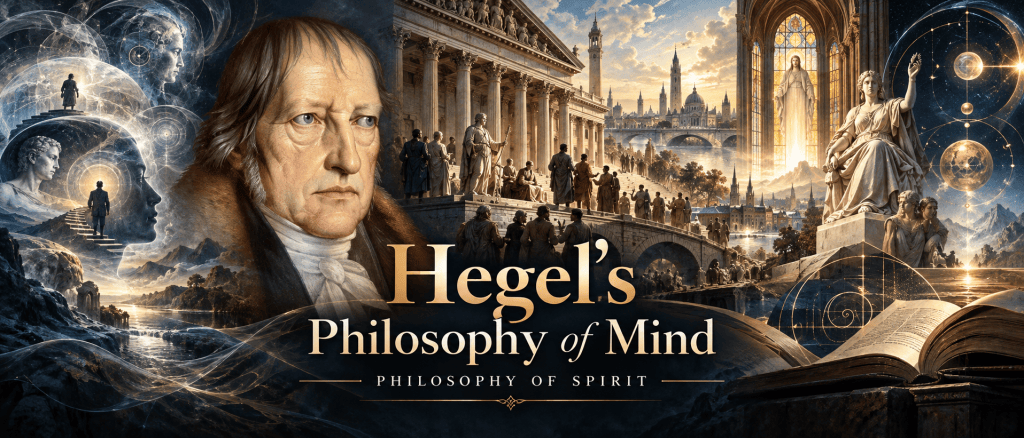
Philosophy of Mind, also known as Philosophy of Spirit (Philosophie des Geistes), is the third and concluding part of Georg Wilhelm Friedrich Hegel’s (1770–1831) monumental Encyclopaedia of the Philosophical Sciences, one of the most ambitious attempts in the history of philosophy to construct a comprehensive account of reality, human consciousness, freedom, society, and the nature of knowledge. Bringing together psychology, anthropology, ethics, political philosophy, aesthetics, religion, and metaphysics within a single philosophical framework, this work represents the culmination of Hegel’s mature systematic thought. It examines the development of human consciousness from its most immediate and elementary forms to the highest expressions of rational self-understanding, tracing the processes through which mind becomes conscious of itself, realizes its freedom in the institutions of social life, and ultimately comprehends its own nature through art, religion, and philosophy.
First published in 1817, during Hegel’s professorship at the University of Heidelberg, the Encyclopaedia was conceived as a systematic exposition of his philosophical system and as a foundation for his university lectures. Hegel subsequently revised and considerably expanded the work in 1827 and again in 1830, producing its final edition just one year before his death. Following his appointment to the University of Berlin in 1818, the Encyclopaedia remained central to his teaching and intellectual activity. Its three interconnected divisions—the Science of Logic, the Philosophy of Nature, and the Philosophy of Mind—present the successive moments of a unified philosophical system. Whereas Logic investigates the fundamental structures of thought and being, and the Philosophy of Nature examines their manifestation in the natural world, the Philosophy of Mind explores the emergence of spirit from nature and its progressive realization as conscious, rational, and free existence.
The German term Geist, traditionally translated as either “mind” or “spirit,” possesses a significance extending far beyond the modern psychological understanding of individual mental activity. For Hegel, spirit encompasses not only consciousness, perception, memory, and thought, but also the collective forms of human existence expressed through language, law, morality, social institutions, historical development, religion, and culture. His philosophy consequently rejects a rigid separation between individual consciousness and the historical and social world in which it develops. Human beings do not acquire their rational capacities or achieve freedom in isolation; rather, their intellectual and practical identities take shape through relationships with others, participation in institutions, and engagement with historically developed forms of knowledge. The central concern of Philosophy of Mind is therefore not simply what consciousness is, but how consciousness develops into self-consciousness, how self-conscious individuals become capable of rational freedom, and how that freedom acquires objective reality.
The first major division, Subjective Mind, investigates the development of individual consciousness through three successive stages: Anthropology, Phenomenology, and Psychology. In Anthropology, Hegel examines the soul as the immediate unity of mental and bodily existence, considering the relationship between nature and consciousness, physical sensation, feeling, temperament, habit, and the embodied foundations of human experience. Rather than treating mind and body as two entirely independent substances, he emphasizes their essential interconnection, drawing upon aspects of the Aristotelian conception of the soul. The subsequent Phenomenology section explores the emergence of consciousness as a relation between subject and object, the development of self-consciousness, and the transition toward reason. Although related to his earlier Phenomenology of Spirit (1807), this discussion occupies a distinct position within his mature philosophical system. Finally, Psychology examines the capacities of mind in their more developed forms, including intuition, representation, memory, imagination, language, thinking, feeling, desire, and will. Hegel distinguishes theoretical intelligence from practical activity while demonstrating how both contribute to the development of free and self-determining spirit.
The second division, Objective Mind, moves beyond the individual to investigate how freedom becomes embodied in the institutions, practices, and normative structures of human society. Here Hegel develops, in condensed form, many of the central arguments of his Elements of the Philosophy of Right. The discussion begins with Abstract Right, examining the legal recognition of persons, ownership, property, contractual relations, and the violations of rights that make legal responsibility and punishment necessary. It then progresses to Morality, where questions of intention, responsibility, conscience, personal conviction, and the distinction between subjective purposes and objective ethical requirements become central. Hegel argues that neither the possession of formal rights nor the pursuit of individual moral intentions is sufficient to realize human freedom. Freedom requires concrete social conditions in which personal autonomy and universally recognized ethical principles can be reconciled.
This argument culminates in Hegel’s conception of Ethical Life (Sittlichkeit), which encompasses the family, civil society, and the state. Each institution constitutes a distinct form of human association and provides different conditions for the realization of freedom. The family represents an immediate ethical unity grounded in personal relationships and mutual commitment. Civil society introduces a complex network of economic activity, individual interests, legal relationships, professional organizations, and social interdependence. The state, in Hegel’s philosophical conception, is intended to provide the institutional framework within which particular interests and universal principles can be mediated through rational law and political organization. His account also investigates the contradictions of modern social life, including economic inequality, poverty, conflicts between individual and collective interests, and the difficulties of reconciling personal freedom with institutional authority. The division concludes with an examination of world history, understood as a historical process in which different forms of political and ethical organization express changing conceptions of human freedom.
The third and final division, Absolute Mind, brings the entire philosophical system toward its conclusion through an examination of art, revealed religion, and philosophy. These represent three interconnected forms through which spirit seeks to comprehend ultimate reality and its own rational nature. In art, truth and spiritual meaning become accessible through sensuous forms, including artistic representation and aesthetic experience. Hegel regards artistic creation not merely as a source of pleasure or individual expression, but as a historically significant manifestation of the ways human communities understand themselves and their world. In revealed religion, particularly Christianity as interpreted within Hegel’s system, spirit encounters the absolute through religious representations, doctrines, and conceptions of the relationship between humanity and the divine. Philosophy, finally, seeks to express through conceptual thought what art presents sensuously and religion communicates through representation. In Hegel’s account, philosophical knowledge does not simply reject these preceding forms, but comprehends their underlying content in a systematically articulated and self-conscious manner.
Throughout these three divisions, Hegel develops his distinctive conception of freedom as something considerably more complex than unrestricted individual choice or independence from external constraints. Genuine freedom involves rational self-determination, recognition by others, participation in ethical relationships, and an understanding of the social and historical conditions that make autonomous action possible. The development of spirit is consequently both an individual and a collective process. Consciousness becomes increasingly capable of recognizing the conditions of its own existence, while human institutions and cultural achievements provide the objective forms through which that recognition can acquire practical significance. This continuous movement between subjectivity and objectivity, individual experience and shared existence, constitutes one of the organizing principles of Hegel’s dialectical philosophy.
The work also illuminates Hegel’s intellectual relationship with several major figures in the history of philosophy. His account of the soul and embodiment engages with Aristotle, while his treatment of consciousness and the mind–body relationship responds to problems associated with René Descartes and subsequent modern philosophy. His analyses of reason, autonomy, morality, and freedom develop and critically transform central themes in Immanuel Kant and Johann Gottlieb Fichte. At the same time, his conception of historical and social consciousness anticipates questions that would become fundamental to later philosophical traditions, including Marxism, phenomenology, existentialism, critical theory, philosophical anthropology, and contemporary theories of social recognition.
The significance of Philosophy of Mind also extends to the relationship between Hegel’s systematic writings and the extensive lecture courses published after his death. Its treatment of objective spirit provides an essential framework for understanding his political and ethical philosophy, while its final division establishes the systematic foundations of his celebrated lectures on aesthetics, the philosophy of religion, and the history of philosophy. The Encyclopaedia thus offers an unusually concentrated presentation of themes that Hegel explored at much greater length elsewhere. Although its compressed, technical style can present substantial challenges, the work rewards sustained engagement by revealing the conceptual relationships that unite the otherwise diverse fields of his philosophical investigations.
The classic English translation by William Wallace, originally published by Oxford’s Clarendon Press in 1894, is based on the mature text of Hegel’s Encyclopaedia, particularly its final 1830 form. Wallace, a distinguished philosopher and professor of moral philosophy at the University of Oxford, was an important figure in introducing German idealism to English-speaking readers. His original edition also included five substantial introductory essays addressing the scope of mental philosophy, the methods of psychology, psychological aspects of ethics, the development of mind, and the relationship between ethics and politics. These essays provided historical and interpretative context for Hegel’s arguments and contributed to the reception of Hegelian philosophy in Britain. Later editions of Wallace’s translation have appeared with different supplementary materials, including lecture-based additions translated by A. V. Miller and an introductory foreword by J. N. Findlay.
More than a nineteenth-century contribution to psychology or metaphysics, Philosophy of Mind remains a foundational work for understanding the relationships between consciousness, embodiment, rationality, ethical life, and historical development. It raises enduring philosophical questions concerning how human beings become self-conscious, what distinguishes rational thought from immediate experience, why freedom depends upon relations with others, how social institutions shape individual identity, and whether the diverse achievements of human culture can be understood as expressions of a common rational structure. As the concluding part of Hegel’s mature philosophical system, it offers an integrated vision of human existence in which the development of mind, the organization of society, and the pursuit of philosophical knowledge emerge as interconnected dimensions of the realization of freedom and self-understanding.


Leave a Reply