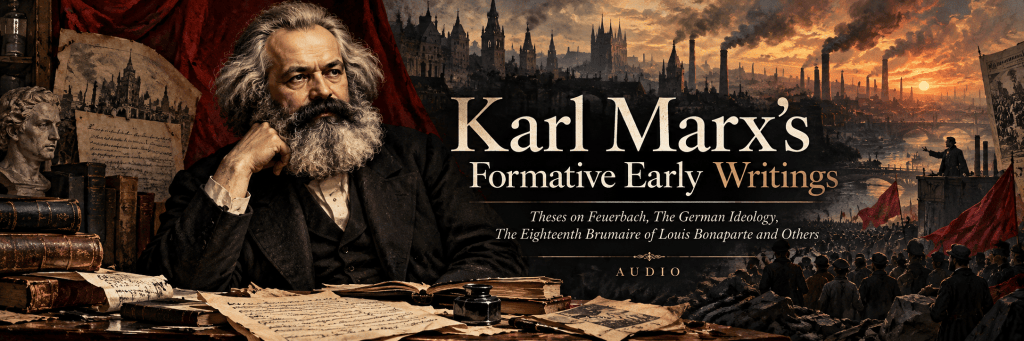
Karl Marx (1818–1883) remains one of the most influential and controversial figures in the history of modern philosophy, political economy, and social theory. Although his name is most closely associated with The Communist Manifesto (1848), written with Friedrich Engels, and Capital: A Critique of Political Economy (1867), the intellectual foundations of these works emerged through a prolonged engagement with German idealism, French revolutionary politics, British political economy, and the social transformations accompanying European industrialization. Before developing his systematic critique of capitalism, Marx investigated the relationship between philosophy and political power, the origins of religious and social alienation, the historical conditions of human emancipation, and the economic structures underlying modern society. His transformation from a radical critic of religion and the state into a theorist of historical materialism and capitalist production was neither immediate nor entirely linear. Rather, it developed through successive confrontations with the philosophical traditions, political conflicts, and social realities of nineteenth-century Europe.
Formative Early Writings by Karl Marx brings together six significant texts that illuminate this development between the early 1840s and 1859. Ranging from philosophical essays and unpublished theoretical manuscripts to historical analysis and political-economic criticism, the collection documents Marx’s gradual movement beyond the intellectual framework of the Young Hegelians toward a distinctive account of history grounded in material production, social relations, and class conflict. It also reveals the breadth of Marx’s literary and analytical methods: the speculative philosopher interrogating the foundations of the modern state, the polemicist challenging established religious and political assumptions, the revolutionary theorist emphasizing transformative human activity, and the historian interpreting political events through the contradictions of class society.
The collection begins with A Contribution to the Critique of Hegel’s Philosophy of Right: Introduction, written in 1843–1844 and published in Paris in February 1844. This influential essay emerged from Marx’s critical examination of Georg Wilhelm Friedrich Hegel’s political philosophy, particularly the relationship between the state, civil society, and the realization of human freedom. Marx questioned whether the modern political state could genuinely reconcile the conflicting interests of society or whether its apparent universality concealed persistent inequalities and divisions. His criticism of Hegel was simultaneously an attempt to transform philosophy from an interpretation of political reality into an instrument of social emancipation. In this context, Marx identified the proletariat as a social class whose liberation could become the basis of a more comprehensive human emancipation. The essay also contains his celebrated characterization of religion as “the opium of the people.” Frequently quoted in isolation, this formulation belongs to a broader argument in which religion appears both as a response to suffering and as a form of consolation arising from oppressive social circumstances. For Marx, the criticism of religion must therefore develop into a criticism of the political and material conditions that make such consolation necessary. The introduction was published separately from the substantial critique of Hegel’s political philosophy that Marx had drafted in 1843.
This examination of religion, political authority, and human emancipation continues in On the Jewish Question, written in 1843 and first published in 1844. Responding to the Young Hegelian philosopher Bruno Bauer’s arguments concerning the political emancipation of Jews in the German states, Marx moves beyond the immediate controversy to investigate the limitations of modern constitutional freedom. Against Bauer’s contention that religious renunciation was necessary for political emancipation, Marx argues that a secular state can grant equal citizenship without requiring individuals to abandon their religious identities. He nevertheless distinguishes political emancipation, achieved through civil rights and equality before the law, from the more comprehensive transformation of social relations that he calls human emancipation. This distinction leads him to examine the separation between the individual as a citizen of the political community and the same individual as a private participant in civil society. His argument raises questions about individual rights, private property, economic dependence, and the extent to which formal political equality can coexist with substantive social inequality. The essay also contains polemical formulations concerning Judaism, money, and commerce that reflect troubling stereotypes and remain the subject of substantial scholarly criticism. Despite these difficulties, it occupies an important position in the development of Marx’s critique of the modern state and his understanding of the relationship between political institutions and material life.
A more decisive philosophical transition appears in the eleven brief propositions known as the Theses on Feuerbach, written in Brussels in the spring of 1845 and first published in an edited form by Friedrich Engels in 1888. Ludwig Feuerbach had profoundly influenced Marx by criticizing religious idealism and interpreting theology as the projection of human qualities onto an imagined divine being. Yet Marx came to regard Feuerbach’s materialism as insufficient because it treated human beings primarily as objects of contemplation rather than as active participants in the creation and transformation of their circumstances. In the Theses, Marx develops an understanding of human knowledge and social existence centered on practical, sensuous activity, or praxis. Human beings do not simply observe an independently constituted social world; through labor, cooperation, conflict, and political action, they participate in its historical formation. Marx consequently challenges the separation of theory from practice, insisting that the significance of philosophical understanding cannot be detached from the possibility of changing material conditions. The final thesis expresses this orientation in one of the most influential formulations in modern intellectual history: “The philosophers have only interpreted the world, in various ways; the point is to change it.” These compressed reflections anticipate central elements of Marx’s subsequent account of history, social transformation, and revolutionary activity.
The philosophical implications of this transition receive a more extensive development in The German Ideology, composed jointly by Marx and Friedrich Engels principally during 1845–1846. Written against the background of disputes within post-Hegelian philosophy, the manuscripts criticize figures such as Feuerbach, Bruno Bauer, and Max Stirner, whose approaches Marx and Engels considered inadequate for explaining the actual conditions of human existence. Their central contention is that historical investigation should begin not with abstract consciousness or independently evolving ideas, but with living human beings engaged in producing the necessities of life. The organization of labor, the division of social activities, the development of productive capacities, and the changing forms of property establish the conditions within which political institutions, legal systems, religious beliefs, and philosophical doctrines emerge. Consciousness, in this conception, cannot be understood independently of the social relationships through which people reproduce their material existence. Marx and Engels also examine how the dominant ideas of an epoch relate to the social groups possessing economic and political power, thereby introducing a powerful analysis of ideology as a historically conditioned form of consciousness. Their investigation connects the development of private property, class divisions, and the modern state with larger transformations in production and social cooperation. Although the manuscripts were not published as a completed work during the authors’ lifetimes and were subsequently assembled through complex editorial processes, they remain indispensable for understanding the emergence of Marx’s materialist conception of history.
The collection then moves from philosophical foundations to the interpretation of concrete historical events in The Eighteenth Brumaire of Louis Bonaparte, written between December 1851 and March 1852. This work examines the political crisis of the French Second Republic and the coup d’état of December 2, 1851, through which President Louis-Napoleon Bonaparte dissolved the National Assembly and established authoritarian rule before proclaiming himself Emperor Napoleon III the following year. Its title alludes to the coup of November 9, 1799, by which Napoleon Bonaparte, the future Napoleon I, assumed political power. Marx uses this historical parallel to explore the ways political actors invoke inherited symbols, institutions, and revolutionary traditions while operating under conditions they have not themselves chosen. Rather than explaining the French crisis solely through the ambitions of individual leaders, he reconstructs the unstable relationships among the bourgeoisie, industrial workers, petty bourgeoisie, peasantry, military, and state bureaucracy. His analysis shows how conflicts within and between social classes can create opportunities for an executive authority to acquire considerable independence from the groups it ostensibly represents. Particularly important is his examination of the French peasantry, the contradictions of parliamentary politics, and the growing power of the centralized state apparatus. Combining historical narrative, political satire, and structural analysis, The Eighteenth Brumaire demonstrates how Marx applied his developing conception of class struggle to the interpretation of political events, institutional transformations, and authoritarian government.
The final work, A Contribution to the Critique of Political Economy (1859), represents a further stage in Marx’s movement toward the systematic economic investigations that would culminate in Capital. Published after years of research into classical political economy, the text examines fundamental categories of commodity production, value, money, and exchange, while preparing the conceptual framework for Marx’s mature analysis of capitalist society. Its celebrated preface is especially important because Marx offers a retrospective account of the intellectual path that led him from the criticism of Hegel’s political philosophy to the investigation of the economic foundations of social life. He explains how the organization of material production gives rise to historically specific relations of production and how these relations constitute the economic structure within which legal, political, and ideological institutions develop. Historical transformation, in this account, becomes intelligible through contradictions between developing productive forces and the established social and property relations governing their use. When these relations cease to facilitate further development and instead become obstacles, the conditions for profound social conflict and institutional transformation may emerge. The preface thus offers one of Marx’s most concentrated statements of his materialist conception of history, connecting the philosophical concerns of his earlier writings with the economic categories and historical explanations central to his later work.
Together these six texts reveal both continuity and transformation in Marx’s intellectual development. His early concern with alienation, religion, freedom, and the relationship between the individual and society does not simply disappear as his attention shifts toward economic structures and class relations. Instead, these concerns acquire new analytical foundations as he increasingly locates the possibilities and limitations of human emancipation within historically specific forms of production and social organization. The collection also makes clear that Marx’s theoretical development was inseparable from his collaboration with Engels, his controversies with contemporary philosophers, and his engagement with the revolutionary upheavals and political reaction of nineteenth-century Europe. It provides an opportunity to trace the emergence of ideas that would subsequently influence socialist movements, labor organizations, political parties, revolutionary governments, and major debates within philosophy, sociology, economics, and historiography.
Beyond their historical significance, the writings raise questions that remain central to modern social and political thought. How should the relationship between economic power and political authority be understood? Can formal equality before the law coexist with substantial inequalities in material conditions? To what extent are religious beliefs, moral systems, and political ideologies shaped by the social circumstances in which they arise? How do established institutions reproduce relations of domination, and under what conditions can collective action transform them? What distinguishes philosophical criticism from an effective theory of historical change? Marx’s answers continue to inspire disagreement, reinterpretation, and criticism, but the questions themselves have retained much of their philosophical and analytical force.
Narrated by Derek Le Page and produced by Ukemi Audiobooks, this approximately twelve-hour-and-twenty-two-minute collection offers an accessible way to encounter the formative arguments, historical investigations, and political controversies that shaped Marx’s mature thought. It is particularly valuable to listeners interested in German idealism, the intellectual legacy of Hegel and Feuerbach, the origins of historical materialism, nineteenth-century European history, and the philosophical foundations of Marx’s critique of capitalism. By bringing these different writings into a single chronological and thematic perspective, Formative Early Writings by Karl Marx provides a substantial introduction to the emergence of one of the most consequential bodies of social and political theory in modern history.


Leave a Reply