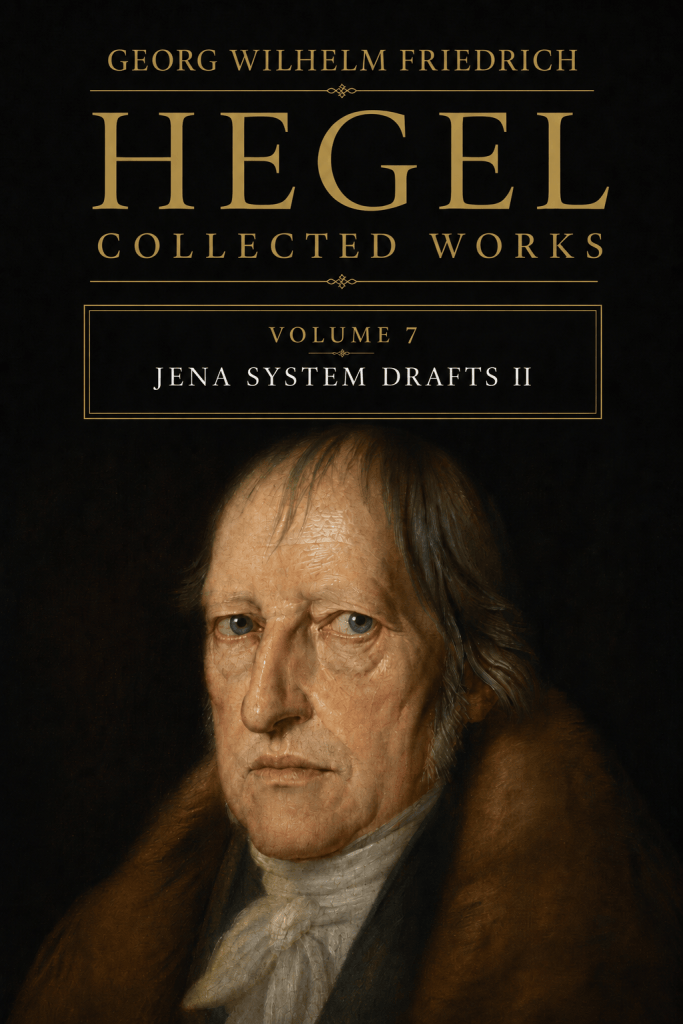
Georg Wilhelm Friedrich Hegel: Collected Works, Volume 7: Jena System Drafts II presents one of the most important surviving documents from the formative period immediately preceding the Phenomenology of Spirit: Hegel’s extensive fair-copy draft of a philosophical system composed between the summer of 1804 and the beginning of 1805. Unlike the fragmentary 1803/04 materials of Jena System Drafts I, this manuscript preserves a sustained treatment of Logic, Metaphysics, and the Philosophy of Nature and appears to have been conceived in connection with plans for a publishable systematic work. It nevertheless remained unfinished. Hegel broke off the manuscript during the Philosophy of Nature, before completing the philosophy of the organic and before writing the projected Philosophy of Spirit and Natural Right. The surviving document is additionally incomplete because several gatherings and individual leaves, including the beginning of the Logic, were already lost by the nineteenth century. Volume 7 consequently preserves both a remarkably developed systematic project and the evidence of a system undergoing further transformation.
The Logic opens in fragmentary form within Hegel’s treatment of simple relation and develops through quantity, numerical unity and multiplicity, infinity, relation, substantiality, causality, reciprocal action, concept, judgment, syllogism, definition, division, and cognition. Particularly important is the increasing distance from a logic understood merely as a formal classification of propositions. Logical determinations are made to demonstrate their instability and to pass into other determinations through their own internal relations. The progression from substantiality through causality to reciprocal action, and from concept through judgment and syllogism to cognition, already anticipates structures that would later be transformed within the Science of Logic. Hegel also subjects mathematical and demonstrative cognition to sustained examination, asking whether construction and proof truly comprehend the necessity they exhibit. The surviving Logic is more elaborately articulated than the later portions of the manuscript and contains remarks in which Hegel explains or criticizes particular positions, giving it a formal organization that already approaches features of his later logical writings.
Metaphysics begins where Hegel says Logic ceases, but it does not simply return to traditional metaphysical speculation. Its opening section examines cognition as a system of principles, taking up the classical laws of identity or contradiction, the exclusion of a third, and sufficient ground. Hegel’s treatment is critical rather than merely affirmative: propositions such as A = A are analyzed to demonstrate the inadequacyacy of abstract self-identity when detached from difference and mediation. The argument then develops into a Metaphysics of Objectivity, organized around the Soul, the World, and the Supreme Being, followed by a Metaphysics of Subjectivity treating theoretical consciousness, practical subjectivity, and finally Absolute Spirit. The manuscript therefore occupies a decisive transitional position in Hegel’s development: Logic and Metaphysics remain formally distinct disciplines, yet their contents increasingly undermine the possibility of keeping them separate. The movement of cognition toward self-relation, universality, subjectivity, and absolute spirit points toward the later reorganization in which logic itself becomes the systematic exposition of the Idea.
The Philosophy of Nature begins with the System of the Sun and develops the concept, appearance, and reality of motion before passing into the Terrestrial System. Hegel again engages directly with the mathematical and natural sciences of his period while attempting to reconstruct their phenomena conceptually. Motion, space, time, celestial bodies, gravity, mechanical relations, shape, and the lever are treated as stages in the emergence of determinate physical individuality. The terrestrial system proceeds from mechanics into the process of matter, first as an ideal process and then as the real process of Chemism. Specific gravity, cohesion, crystallization, heat and cold, chemical elements, acids, bases, metals, oxidation, neutrality, solution, precipitation, and chemical combination become moments within an increasingly dynamic conception of matter. Rather than regarding substances as permanently fixed units that merely enter external reactions, Hegel interprets their determinacy through the processes in which they become other than themselves and return to themselves.
The culminating sections of the surviving Philosophy of Nature move toward Physics and the definition of the Earth, where mechanical and chemical processes are integrated into a conception of natural individuality capable of sustaining differentiated processes within itself. The final pages are especially significant because the chemical process ceases to be merely an interaction among independently existing substances: substance increasingly becomes the process of arising and passing away itself. Hegel explicitly identifies the next systematic determination as the organic, in which process, subsistence, and self-relation would achieve a higher unity. At precisely this transition, however, the fair copy ends. The philosophy of organic nature and the projected Philosophy of Spirit were never written into this manuscript. This abrupt termination makes Volume 7 a particularly revealing document: it shows Hegel arriving at the threshold from physical nature to life while simultaneously abandoning a systematic architecture that he would soon reconstruct on substantially different foundations.
Three supplementary texts illuminate this unfinished project without simply filling its gaps. The Outline for the Structure of Metaphysics sketches a conception centered on cognition, soul, world, freedom, necessity, and God, but its organization differs from the elaborated Metaphysics and therefore represents a related yet distinct stage of Hegel’s thinking. The Two Notes on the System and A Sheet Concerning the System likewise provide evidence concerning alternative arrangements and transitional systematic ideas. Their inclusion is important precisely because the edition does not treat every surviving document as belonging to a single finished system. The extensive editorial apparatus reconstructs the physical manuscript, its missing gatherings, stages of revision, alternative readings, later marginal additions, and the long history of attempts to restore the lost beginning of the Logic. The editors also establish that the fair copy dates from 1804/05 rather than from Hegel’s Frankfurt period or earliest Jena years, as earlier scholarship had often assumed.
Jena System Drafts II thus occupies a crucial place in the development of Hegel’s philosophy. Volume 6 showed the 1803/04 system moving principally through nature into consciousness, labor, recognition, and ethical life; Volume 7 reveals a new attempt to establish the system from the other direction, beginning with an extensively developed Logic and Metaphysics before reconstructing nature. Many structures later central to Hegel’s mature philosophy are already visible—self-sublating determination, infinity, substantiality and causality, concept, judgment and syllogism, cognition, subjectivity, absolute spirit, and nature understood as a hierarchy of increasingly self-related processes—but they remain organized within an architecture Hegel would soon abandon. For readers of Hegel, German Idealism, logic, metaphysics, the philosophy of nature, and the genesis of the Phenomenology of Spirit and Science of Logic, Volume 7 offers an unusually direct view of the moment when Hegel’s system had become highly developed yet was still sufficiently unstable to undergo another fundamental reconstruction.
Buy on Amazon


Leave a comment