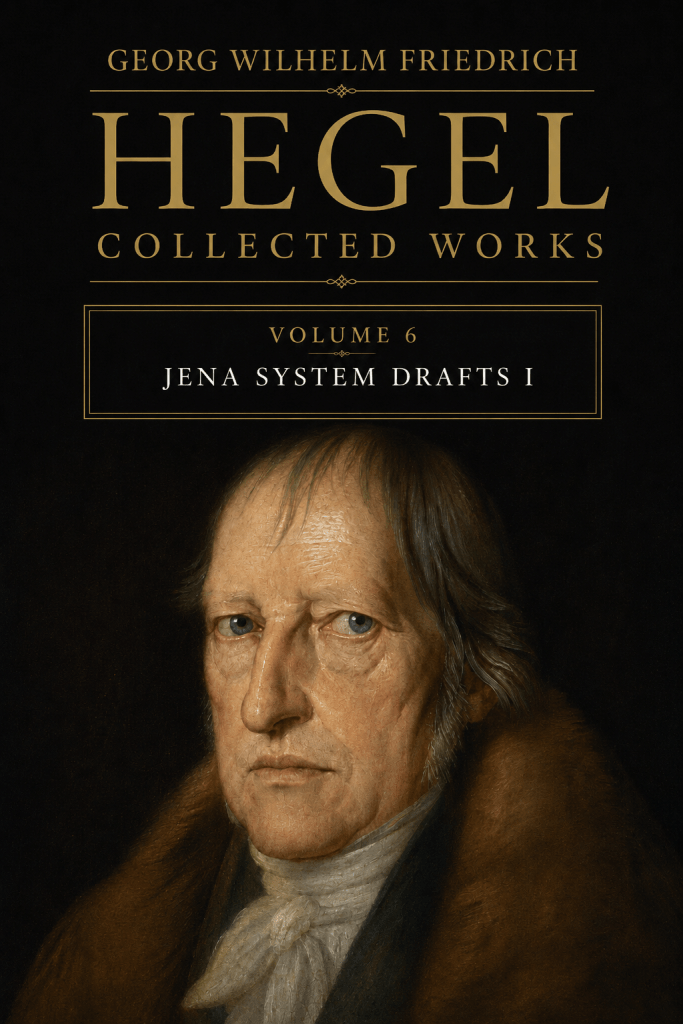
Georg Wilhelm Friedrich Hegel: Collected Works, Volume 6: Jena System Drafts I presents the surviving fragments of Hegel’s first fully elaborated attempt to construct a complete system of speculative philosophy. Written and extensively revised for his teaching at the University of Jena in 1803–1804, these manuscripts occupy a decisive position between the experimental writings of the early Jena period and the systematic philosophy that would later emerge in the Phenomenology of Spirit and Hegel’s mature works. The projected system comprised Logic and Metaphysics, the Philosophy of Nature, and the Philosophy of Spirit, but the manuscripts of the first division have not survived. What remains consists principally of fragments from the Philosophy of Nature and Philosophy of Spirit, together with two supplementary pieces whose exact position within the system cannot be established with certainty.
The volume is therefore not a finished treatise but a critical reconstruction of a complex manuscript corpus. Hegel repeatedly reworked the texts through deletions, interlinear corrections, marginal additions, inserted leaves, and alternative formulations, while some passages break off because material has been lost or because Hegel himself left them unfinished. The editors reconstruct the sequence of the surviving manuscripts on the basis of physical, palaeographical, and conceptual evidence. Throughout much of the edition, the critically constituted text is accompanied by a reconstructed First Stage, representing Hegel’s earlier continuous transcription before later revisions. This unusual arrangement allows the reader to observe the system developing through successive stages of composition.
The surviving philosophical exposition begins within the Philosophy of Nature, with the transition from the celestial system to the terrestrial world. Hegel moves from the relations of sun, planets, moon, comet, light, motion, and rest toward the conceptual emergence of the Earth. From there the argument develops through Mechanics, treating mass, inertia, atoms, continuity, center of gravity, fall, projectile and pendulum motion, the lever, impact, fluidity, tone, specific gravity, cohesion, and magnetism. Mechanical relations gradually prove insufficient, and the body becomes intelligible only through processes in which its apparently fixed determinations are transformed. Mechanics therefore passes into Chemism, where Hegel examines chemical affinity, acids, bases, salts, water, fire, electricity, metals, oxidation, and the relations among substances, engaging directly with contemporary scientific theories, including the chemistry of Claude Louis Berthollet.
From chemical and physical processes the system moves toward organic nature. Hegel investigates the Earth as a structured physical whole and then develops an account of plant and animal life in which organization cannot be reduced to externally assembled mechanisms. Plants already transform elemental nature into an organic cycle, but their individuality remains comparatively dispersed. Animal life represents a more complete return of organization into itself. The manuscripts examine skin, bone, muscle, nervous organization, bodily fluids, digestion, sensation, reproduction, disease, and death as moments of an integrated living totality. Reproduction is especially important because the individual animal produces another individual and thereby reveals a universality exceeding its own numerical existence. At this point nature passes into spirit: in Hegel’s formulation, spirit is the form in which nature returns into itself and becomes what it implicitly was.
The surviving Philosophy of Spirit contains some of the most historically significant material in the volume. Hegel follows consciousness from sensation through recollection, memory, naming, language, understanding, and formal reason. Language gives the object an ideal existence within consciousness, while memory and conceptualization free thought from immediate dependence upon sensation. Theoretical consciousness then passes into practical consciousness through desire, labor, and the tool. Unlike animal desire, which simply consumes its object, human labor transforms the object while allowing both worker and object to persist. The tool becomes what Hegel calls the existent rational middle of this process: an objective embodiment of practical intelligence that can survive the individual worker and be transmitted through tradition.
From labor Hegel moves into possession, love, marriage, the family, and education. In marriage, natural desire becomes an enduring relation between mutually conscious individuals rather than a merely contractual association. The child gives objective existence to the unity of the parents, while education describes the transmission of an already formed spiritual world from one generation to the next. The argument then develops into the struggle for recognition. A self-conscious individual can become fully actual only through recognition by another consciousness, yet recognition initially takes the form of conflict in which possession, honor, and ultimately life itself are placed at risk. The manuscripts contain an early and striking version of the nexus later made famous in the Phenomenology of Spirit: recognition, the struggle to the death, mastery, and servitude. The contradiction of isolated recognition ultimately drives consciousness toward a universal form of existence.
This movement culminates in the spirit of a people and ethical life. Spirit is no longer merely a collection of individual minds but a living universal expressed through customs, institutions, labor, and collective activity. Hegel also analyzes the social division of labor, drawing upon Adam Smith’s example of pin manufacture. Specialization enormously increases production but simultaneously narrows individual activity, makes labor more mechanical, and creates an increasingly opaque system of reciprocal dependence. Money becomes the material universal representing the possibility of satisfying needs, while the economic system as a whole appears as a self-moving network requiring regulation. The main manuscript sequence breaks off before the Philosophy of Spirit reaches a completed conclusion, but the surviving additions include a brief structural note on intelligence and a fragment concerning love, religion, art, and the relation of singular consciousness to absolute consciousness, suggesting that further drafts for the conclusion of the system once existed.
Jena System Drafts I is therefore one of the most important documentary records of Hegel’s transition from early critical philosophy to systematic philosophy. It reveals the emerging architecture of a system in which mechanics, chemistry, organic life, consciousness, language, labor, family, recognition, economic dependence, and ethical community belong to a single speculative movement from nature to spirit. At the same time, its extensive apparatus preserves the actual history of composition: first formulations, revisions, lost connections, competing arrangements, and unfinished transitions. For readers of Hegel, German Idealism, the philosophy of nature, the history of science, theories of recognition, social philosophy, and the genesis of the Phenomenology of Spirit, the volume offers an unusually direct view of Hegel’s system while it was still being constructed.
Buy on Amazon


Leave a Reply