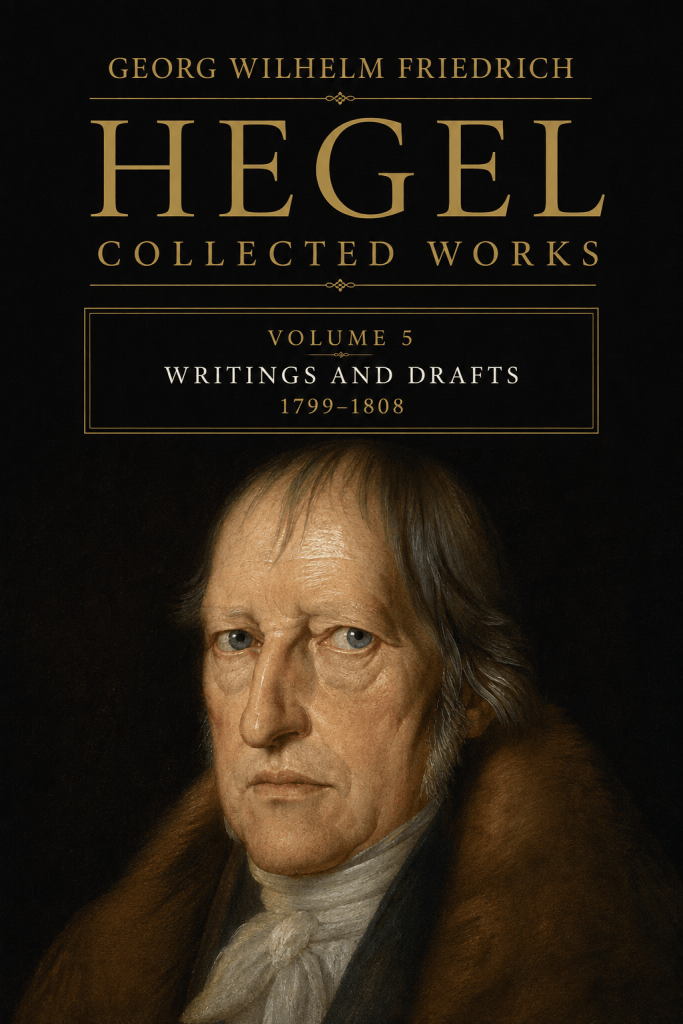
Georg Wilhelm Friedrich Hegel: Collected Works, Volume 5: Writings and Drafts (1799–1808) brings together an unusually extensive and heterogeneous body of material from one of the most consequential periods in Hegel’s intellectual development. Extending from his final Frankfurt years through the decisive Jena period and into his work as a newspaper editor in Bamberg, the volume contains political manuscripts, philosophical drafts, habilitation texts, lecture fragments, systematic experiments, notebooks, documentary excerpts, mathematical investigations, journalistic material, supplementary texts, secondary reports of writings now lost, and the extensive scholarly apparatus required to establish their transmission and chronology.
Rather than presenting a sequence of finished philosophical books, Volume 5 gives access to Hegel’s intellectual workshop. Many of its most important texts survive as unfinished drafts, successive revisions, fragmentary fair copies, lecture materials, excerpts, or works preserved only indirectly through later witnesses. Precisely for this reason, the collection offers an exceptional view of Hegel’s thought in formation: concepts, structures, and systematic divisions appear, are revised, abandoned, recombined, and gradually transformed into positions recognizable from his mature philosophy.
The volume opens with the extensive Fragments of a Critique of the Constitution of Germany (1799–1803). Hegel began this political project during his final Frankfurt period and continued to rethink it after moving to Jena. The edition does not reconstruct the surviving pieces into an artificially completed treatise. Instead, it presents successive stages of composition, including preliminary work and drafts from 1799–1801, Jena drafts and elaborations, fragments of a fair copy from 1802–1803, and a substantial body of excerpts and notes connected with the project.
At the center of these manuscripts stands Hegel’s diagnosis of the political weakness and fragmentation of the Holy Roman Empire, expressed most famously in the proposition that “Germany is no longer a state.” He examines sovereignty, military organization, finance, feudal relations, constitutional law, the Imperial Estates, confessional divisions, political representation, territorial particularism, and the failure of imperial institutions to constitute an effective political unity. The result is not merely a constitutional analysis but an early investigation of a problem that would remain central to Hegel’s political philosophy: the distinction between the formal existence of institutions and the actuality of a state capable of integrating its differentiated parts into an effective whole.
The associated excerpts and notes demonstrate how extensively this political analysis depended upon historical and documentary research. Hegel draws upon constitutional writers, political histories, diplomatic documents, imperial decrees, parliamentary proceedings, newspaper reports, and discussions of contemporary European affairs. Machiavelli, the Peace of Westphalia, the Imperial Diet, the secularization of ecclesiastical territories, relations between Catholic and Protestant states, French and British politics, and the reorganization of the German territories all form part of the documentary environment within which the constitutional project developed.
A second major section contains the Texts for the Habilitation of 1801, produced when Hegel sought authorization to teach at the University of Jena. These include theses associated with his disputation and the Latin Philosophical Dissertation on the Orbits of the Planets. The dissertation is particularly revealing of the intellectual breadth of Hegel’s early Jena philosophy, bringing astronomy, mathematics, natural philosophy, and speculative reasoning into direct relation. Together with the accompanying habilitation materials, it documents Hegel’s formal entrance into university philosophy and the beginning of his career as an academic lecturer.
The volume then preserves Fragments from Lecture Manuscripts (1801/02), including material belonging to an introduction to philosophy and to Hegel’s early treatment of logic and metaphysics. These texts are of exceptional importance because they record some of his earliest attempts to articulate philosophy as a systematic whole. The relation between absolute being, philosophical cognition, logic, metaphysics, consciousness, and systematic method is still in development, and the terminology has not yet settled into the forms familiar from Hegel’s later works.
One of the central texts of the volume is the System of Ethical Life: Fair-Copy Draft (1802/03). This manuscript represents a major stage in the development of Hegel’s social, ethical, legal, and political philosophy. Ethical life is treated not as obedience to abstract moral commandments by isolated individuals but as an objective system of relations through which human beings acquire determinate social existence.
The argument moves through desire, enjoyment, labor, possession, property, tools, exchange, surplus, money, trade, recognition, personality, crime, punishment, servitude, war, virtue, political community, constitution, and government. Labor is analyzed as the transformation of the object through postponed enjoyment; possession and property progressively acquire juridical significance; economic relations develop toward exchange and money; and the individual becomes intelligible as a person only within structures of recognition. Crime and retributive justice are then analyzed within the same system of relations, before the discussion moves toward the ethical totality of a people and its political organization.
The System of Ethical Life therefore occupies a crucial position between Hegel’s earlier reflections on religion, community, political unity, and reconciliation and the later analyses of ethical life in the Phenomenology of Spirit and the Philosophy of Right. Concepts such as labor, recognition, personhood, property, punishment, ethical community, war, and the state already appear here in interconnected form, although they have not yet acquired the systematic configuration they would possess in Hegel’s mature philosophy.
Further Fragments from Lecture Manuscripts (1803) continue this development. They preserve additional stages in Hegel’s attempt to organize philosophical knowledge around the concepts of universality, spirit, and systematic totality. Their fragmentary character is philosophically valuable: they make visible a system undergoing reconstruction rather than retrospectively presenting the finished architecture of Hegel’s later thought.
The chronological sequence then reaches the fair copy of Who Thinks Abstractly? from 1807. In this concise and deliberately accessible essay, Hegel reverses the ordinary accusation that philosophers are the people who think abstractly. Abstraction, as he presents it here, consists precisely in reducing a concrete individual or situation to a single isolated characteristic while ignoring the network of relations, circumstances, history, and mediations through which it has become what it is. Concrete thinking, by contrast, apprehends a determination within the larger whole that gives it meaning. In miniature, the essay offers one of Hegel’s clearest demonstrations of a principle fundamental to his philosophy.
A substantial group of texts follows from the Bamberg Newspaper of 1807 and 1808, which Hegel edited after leaving Jena. These materials must be approached with particular documentary caution. They belong to the newspaper associated with Hegel’s editorship, but contemporary journalistic practice involved extensive reproduction of official announcements and material taken from other periodicals, and not every item can therefore be regarded as an independently authored Hegel text. The critical edition accordingly distinguishes a separate group of pieces whose attribution remains doubtful.
Even with this qualification, the Bamberg material provides valuable evidence of the historical and political environment in which Hegel worked immediately after completing the Phenomenology of Spirit. The newspaper records the rapidly shifting military, diplomatic, and governmental circumstances of Napoleonic Europe and demonstrates the practical context of Hegel’s activity as an editor. Among these materials is also a contemporary announcement of his System of Science, First Volume, containing the Phenomenology of Spirit, accompanied by a concise description of the new work and its intended philosophical function.
After the principal chronological corpus, the volume contains a substantial section of Additions. These materials require careful distinction from Hegel’s surviving autograph manuscripts. They include additional information concerning the Critique of the Constitution of Germany and material transmitted from Hegel’s Jena lectures, much of which survives only through later reports, quotations, and summaries by figures such as Karl Rosenkranz and Rudolf Haym.
The additions include material concerning logic and metaphysics, natural law, the system of philosophy, and “speculative philosophy.” They provide important evidence for reconstructing Hegel’s developing Jena system, but they do not all possess the same textual status as the surviving lecture manuscripts. In many cases the reader encounters Hegel’s thought through secondary transmission rather than through an extant manuscript in his own hand. The edition preserves these reports precisely because the original documents consulted by nineteenth-century witnesses have subsequently disappeared.
Among these secondary materials are significant discussions of religion, ethical life, nature, spirit, speculative philosophy, and the relation between successive stages of Hegel’s Jena system. They also preserve evidence of Hegel’s growing distance from simplified forms of Schellingian philosophy of nature and of his attempts to formulate a philosophical method capable of comprehending differentiation without reducing it to empty formal schemata.
The collection next turns to the material conventionally designated the Jena Notebook (1803–1806). This is one of the most fascinating but also one of the most textually complicated components of the volume. The notebook is known through secondary transmission, particularly through Rosenkranz, and the surviving record contains a mixture of excerpts from Hegel’s reading, notes on contemporary intellectual and political matters, critical observations, apparently independent reflections, and materials whose precise authorship or status cannot always be established with complete certainty.
The editors therefore resist treating every notebook entry automatically as an independently composed Hegelian aphorism. Some materials that earlier witnesses regarded as Hegel’s own reflections can be identified as excerpts from published sources, occasionally supplemented by his comments. Even the chronological boundaries of the notebook remain partly dependent upon nineteenth-century testimony. The conventional designation 1803–1806 is useful, but the exact dating and sequence of individual entries cannot always be reconstructed with certainty.
Within those limitations, the notebook provides an extraordinary cross-section of Hegel’s intellectual world during the years immediately preceding the Phenomenology of Spirit. It contains reflections and excerpts concerning history, philosophy, religion, logic, natural science, literature, economics, political conditions, German culture, classical antiquity, contemporary intellectual fashions, and everyday observations. Its tone ranges from compressed philosophical reflection to satire and polemic. Figures such as Plato, Spinoza, Kant, Schelling, Goethe, Gall, Görres, and others appear within a remarkably diverse intellectual field.
Several entries are particularly revealing of Hegel’s critical style. He mocks fashionable pseudo-scientific speculation, attacks intellectual pretension, reflects upon the peculiarities of German political and cultural life, comments on religion and popular festivity, considers questions of money and interest, and repeatedly contrasts living conceptual comprehension with mechanical or merely formal modes of thought. Some formulations preserved from the notebook can also be related to ideas that subsequently appear in the Phenomenology of Spirit.
A further group of Supplements contains smaller but nonetheless significant materials. These include the poem Resolve, a brief conceptual Note, Hegel’s contribution to H. E. G. Paulus’s edition of Spinoza, and a substantial body of mathematical calculations and investigations. The presence of this mathematical material is important for understanding the breadth of Hegel’s activity during these years. Mathematical and geometrical problems were not simply peripheral interests but belonged to the larger scientific and philosophical environment within which he was attempting to define the scope and limits of speculative knowledge.
The volume also contains a separate section designated Doubtful. Its inclusion reflects the critical edition’s refusal to assign materials to Hegel when the evidence does not justify certainty. Among these items is a drawing composed of triangles whose connection with Hegel’s own authorship cannot be securely established. Such materials are retained as part of the documentary record while their uncertain status is explicitly marked rather than concealed.
Particularly important is the section Reports on Lost Writings. These reports assemble evidence for manuscripts known to nineteenth-century scholars but no longer extant. They concern Hegel’s habilitation materials, lost Jena manuscripts, his lecture on the history of philosophy, writings associated with the philosophy of nature and spirit, and material connected with the Phenomenology of Spirit.
The reports on the history of philosophy are especially valuable because Rosenkranz and later editors had access to Jena materials that subsequently disappeared. They indicate that Hegel had already developed a substantial lecture manuscript on the history of philosophy during his Jena period, and they preserve evidence concerning its organization, terminology, and later reuse.
The material concerning the Phenomenology of Spirit is equally significant. Although the Phenomenology itself is not reproduced in Volume 5, the reports document a now-lost short summary or lecture manuscript associated with it. According to the surviving testimony, this text presented an “extract from the whole” and also contained the transition from phenomenology toward logic. The volume therefore contains not only writings surrounding the genesis of the Phenomenology but documentary evidence concerning Hegel’s own early pedagogical presentation of the work.
This is one reason Volume 5 is so important for understanding the transformation of Hegel’s philosophy during the Jena years. The materials reveal that the Phenomenology of Spirit did not emerge from a single stable systematic plan. Logic and metaphysics, nature and spirit, ethical life, consciousness, religion, political organization, and philosophical method were repeatedly reorganized as Hegel reconsidered the structure of the system itself. The surviving manuscripts and secondary reports preserve different stages of this development.
The final portion of the volume is devoted to the scholarly apparatus that makes such reconstruction possible. It includes sigla and abbreviations, an extensive Editorial Report, detailed Notes, and a Person Index. The Editorial Report examines manuscript transmission, handwriting, chronology, revisions, relations among fragments, first publications, secondary witnesses, lost materials, and the principles governing the constitution of the text. It repeatedly distinguishes surviving autograph manuscripts from secondary reports and later editorial reconstructions.
The Notes greatly expand the historical and intellectual context of the writings. They identify Hegel’s sources, explain constitutional and political references, trace quotations, discuss figures from philosophy, science, history, literature, and theology, and clarify the documentary circumstances behind individual passages. The final Person Index likewise follows explicit editorial criteria concerning what can securely be connected with Hegel’s own texts and what derives from the peculiar conditions of secondary transmission or newspaper production.
Writings and Drafts (1799–1808) is consequently not simply a collection of minor works surrounding Hegel’s canonical publications. It documents an extraordinary period of philosophical experimentation in which political theory, constitutional history, logic, metaphysics, natural philosophy, mathematics, astronomy, economics, jurisprudence, ethical theory, philosophy of spirit, religion, history, journalism, and systematic speculation remained closely interconnected.
The volume also demonstrates how cautiously the history of Hegel’s development must be reconstructed. Some texts survive directly in his handwriting; others are incomplete fair copies or lecture fragments; some are excerpts from his reading; some derive from his editorial work; others have uncertain attribution; and still others are accessible only because Rosenkranz, Haym, Michelet, or other nineteenth-century witnesses saw manuscripts that have since disappeared. The critical edition preserves these distinctions instead of presenting the material as a homogeneous body of finished Hegelian works.
For precisely this reason, Volume 5 offers something unavailable in the canonical works alone. It permits the reader to observe Hegelian philosophy in the process of becoming: concepts migrate between political analysis and systematic philosophy; ethical and economic categories are tested and reorganized; logic and metaphysics are repeatedly reconceived; nature and spirit acquire changing positions within the system; and the intellectual trajectory leading toward the Phenomenology of Spirit becomes visible through both surviving texts and traces of writings now lost.
Following the formative writings and excerpts of Volumes 1–3 and the public philosophical interventions collected in Volume 4, Collected Works, Volume 5: Writings and Drafts (1799–1808) moves into the interior of Hegel’s Jena development. It preserves not merely the results of that development but its drafts, revisions, experiments, failures, documentary sources, secondary traces, and unfinished possibilities. For scholars and serious readers of Hegel, German Idealism, political philosophy, ethics, intellectual history, philosophy of nature, and the history of modern European thought, it provides an exceptionally detailed record of the years in which Hegel’s mature philosophical project was taking shape.


Leave a Reply