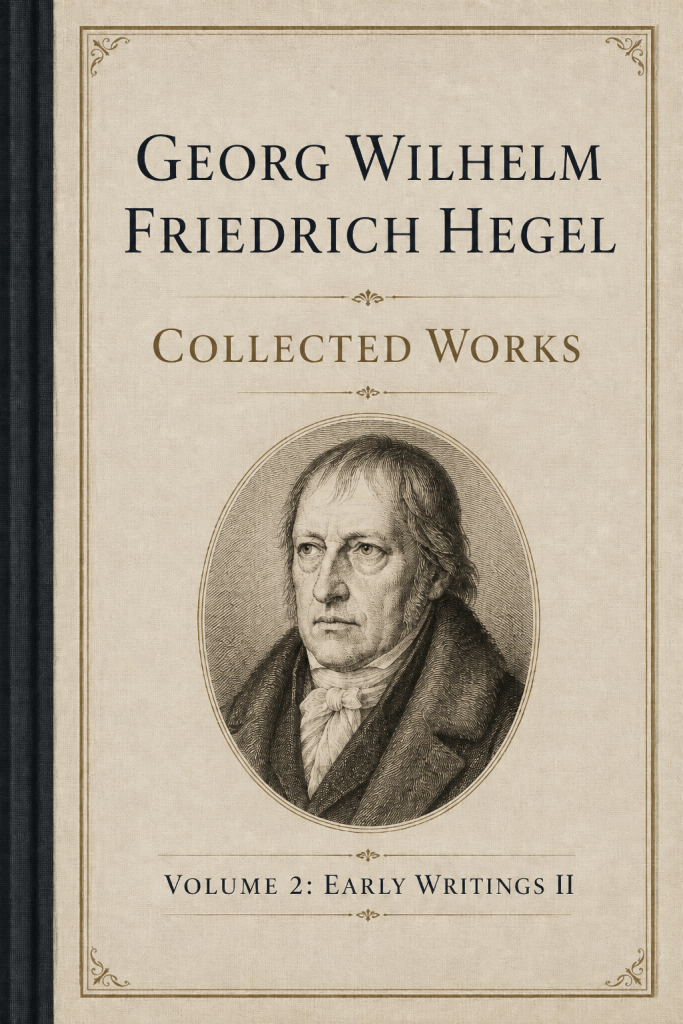
Collected Works, Volume 2: Early Writings II continues the documentary reconstruction of Georg Wilhelm Friedrich Hegel’s intellectual formation, concentrating primarily on the decisive Frankfurt period from 1797 to 1800. Based on the second volume of the authoritative Gesammelte Werke critical edition, prepared by Friedhelm Nicolin, Ingo Rill, and Peter Kriegel and edited by Walter Jaeschke, the volume brings together the manuscripts, fragments, political writings, translations, studies, and related materials through which Hegel moved beyond the theological and historical concerns of his youth toward the distinctive philosophical position that would characterize his mature work.
The Frankfurt years constitute one of the most important transitional periods in Hegel’s development. During this time he returned to and extensively revised manuscripts originally composed in Bern concerning faith, religion, and the history of Israel, while producing new investigations into Greek, Jewish, and Christian religion. The volume also preserves later fragments on religion and a new version of an introduction to a projected study of positive religion. Across these writings, Hegel increasingly examines religion not simply as a body of doctrines or institutions, but as a historically developed form of human consciousness and communal life. Questions of law, authority, separation, love, reconciliation, freedom, and the relation between the finite individual and a larger ethical or spiritual whole begin to acquire the conceptual importance they would retain throughout his philosophy.
Yet Early Writings II demonstrates that Hegel’s intellectual activity during these years extended far beyond theology. The collection includes fragments of his first political pamphlet concerning the constitution of Württemberg, geometrical studies, shorter literary and critical writings including an assessment of Schiller’s Wallenstein, and his extensive annotated translation of Jean Jacques Cart’s letters concerning the political relationship between the Pays de Vaud and Bern. These materials reveal Hegel’s growing engagement with constitutional reform, political representation, contemporary European affairs, mathematics, literature, and the problem of reconciling historical institutions with the demands of freedom.
The volume also incorporates texts from this period preserved through Hegel’s biographer Karl Rosenkranz, together with the manuscript conventionally titled An Ethics, which survives in Hegel’s handwriting although its author has not been conclusively identified. The inclusion of such materials reflects the documentary principles of the Gesammelte Werke, which seeks to preserve not merely Hegel’s finished publications but the surviving textual record from which the development of his thought can be reconstructed.
These writings capture Hegel at a philosophical threshold. The concerns of the earlier theological manuscripts remain prominent, but they are increasingly transformed into broader investigations of history, society, political institutions, ethical life, human division, and reconciliation. Problems that would eventually become central to Hegel’s mature philosophy—the relationship between individuality and universality, freedom and social order, subject and object, religion and philosophy, historical conflict and reconciliation—can be observed here emerging from concrete theological, political, and historical reflection.
Early Writings II is indispensable for understanding the genesis of Hegelian philosophy. Read alongside Early Writings I, it documents the transition from the young Hegel’s theological and classical studies toward the increasingly systematic conception of reason, history, freedom, and spirit that would soon lead into the Jena period and ultimately to works such as the Phenomenology of Spirit. It offers scholars and serious readers an unusually close view of a major philosophical system before its final conceptual vocabulary had been established: not philosophy retrospectively arranged into a finished doctrine, but Hegel’s thought in the process of becoming.


Leave a Reply