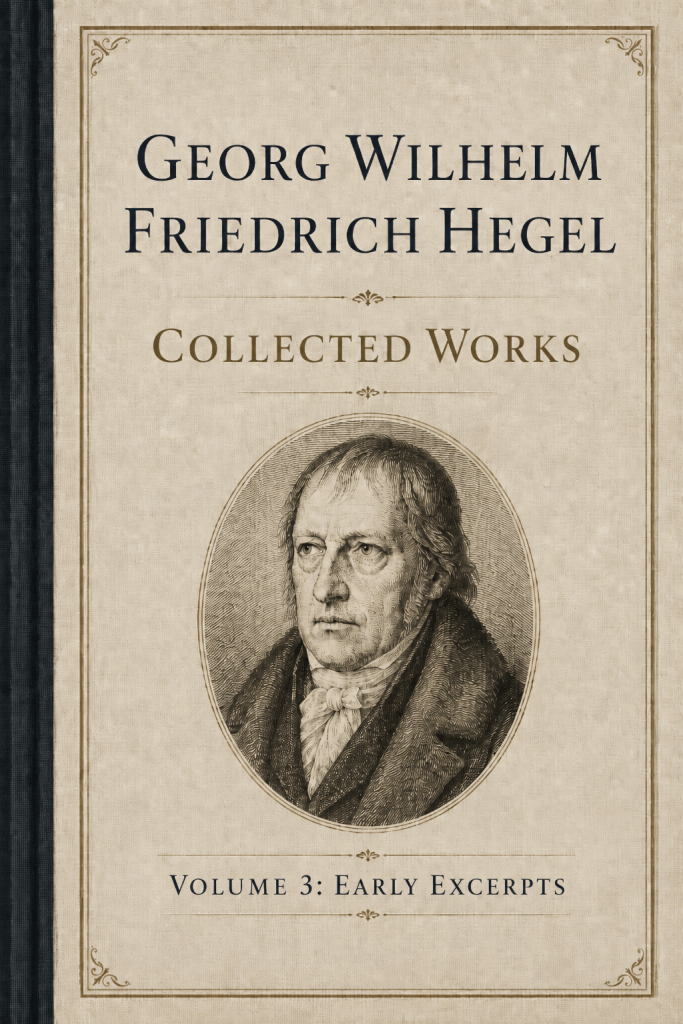
Collected Works, Volume 3: Early Excerpts (1785–1800) opens a distinctive window onto the intellectual formation of Georg Wilhelm Friedrich Hegel by presenting not primarily finished compositions, but the excerpts, reading notes, definitions, and documentary materials through which he absorbed and organized the intellectual world of his youth. Based on Volume 3 of the authoritative Gesammelte Werke, edited by Friedhelm Nicolin with the collaboration of Gisela Schüler and first published in 1991, the collection covers materials extending from Hegel’s Gymnasium years in Stuttgart through his period in Bern and into the closing years of the eighteenth century.
The earliest group, dating from approximately 1785 to 1788, preserves Hegel’s extensive practice of excerpting and classifying material encountered in his education and private reading. Its subjects range across pedagogy, philosophy, psychology, classical antiquity, religion, history, and moral reflection. Notes address such themes as education, Stoicism, happiness, the soul, methods of teaching, Egyptian learning, psychology, natural theology, providence, wit, the history of philosophy, ancient Enlightenment, myth, freedom, and the relationship between metaphysics and religion. Alongside these excerpts appear concise definitions of subjects such as philosophizing, change, logic, and states.
These writings are especially valuable because they disclose the intellectual environment from which Hegel’s later philosophy emerged. The young Hegel appears here not yet as the author of an autonomous philosophical system but as an unusually systematic reader, extracting arguments, concepts, historical information, and formulations from the literature available to him. The notebooks demonstrate the breadth of his early interests and the degree to which philosophical questions were already interconnected in his thinking with history, religion, education, psychology, politics, and classical culture.
The later excerpts, particularly those dating from Hegel’s years in Bern between 1794 and 1796, show a widening intellectual horizon. Hegel takes notes from contemporary scholarly journals, theological and ecclesiastical history, and works of travel and political observation. Among his sources are the Allgemeine Literatur-Zeitung, the Neues theologisches Journal, Johann Lorenz von Mosheim’s church history, and Georg Forster’s writings on the Rhineland. A separate group of excerpts concerns the political constitution and government of Bern and Switzerland, drawing on French-language accounts of the Bernese state.
The political materials are particularly significant when read alongside Hegel’s early writings. They demonstrate that his developing interest in freedom, political institutions, constitutional organization, and the historical character of states was supported by detailed empirical reading rather than arising solely from abstract philosophical speculation. His engagement with the Bernese political order belongs to the broader process through which the young Hegel confronted the relationship between formal authority, inherited institutions, civic freedom, and the possibility of political reform.
The volume also contains excerpts whose precise dates cannot be securely determined, including material from Rousseau and Homer, as well as editorial documentation concerning excerpts that are known to have existed but are now lost. The critical apparatus records the surviving manuscripts, textual characteristics, abbreviations, editorial principles, and persons associated with the material, preserving the documentary character central to the Gesammelte Werke edition.
Unlike the more continuous theological, political, and philosophical manuscripts collected in Early Writings I and Early Writings II, Early Excerpts allows the reader to examine something closer to Hegel’s intellectual workshop. It documents what he read, what he selected for preservation, which concepts attracted his attention, and how he categorized knowledge before the characteristic vocabulary of his mature philosophy had fully developed. The excerpts consequently provide important evidence for tracing both the sources of Hegel’s thought and the gradual transformation of inherited Enlightenment, classical, theological, and political materials within his developing philosophy.
The importance of the volume lies precisely in this intermediary status between reading and authorship. Concepts that would later occupy central positions in Hegel’s system—freedom, reason, religion, state, history, spirit, metaphysics, logic, and the relation between individual and communal life—appear here within the heterogeneous intellectual materials from which his own philosophical architecture would eventually be constructed. The reader can observe not only the emergence of particular doctrines, but the formation of the intellectual habits that would characterize Hegel throughout his career: the historical comparison of forms of thought, the integration of apparently separate disciplines, the attention to conceptual development, and the effort to understand ideas within the cultural and institutional worlds that produced them.
Early Excerpts (1785–1800) is an indispensable companion to the first two volumes of Hegel’s Collected Works. Together the three volumes reconstruct the earliest phase of his intellectual development from complementary perspectives: the first two through his own developing compositions, and the third through the sources, extracts, definitions, and reading practices that helped make those compositions possible. For scholars and readers concerned with Hegel, German Idealism, the Enlightenment, intellectual history, political thought, theology, and the genesis of modern philosophy, the volume offers an unusually direct view of the materials from which one of the most ambitious philosophical systems of the modern period was gradually formed.


Leave a Reply