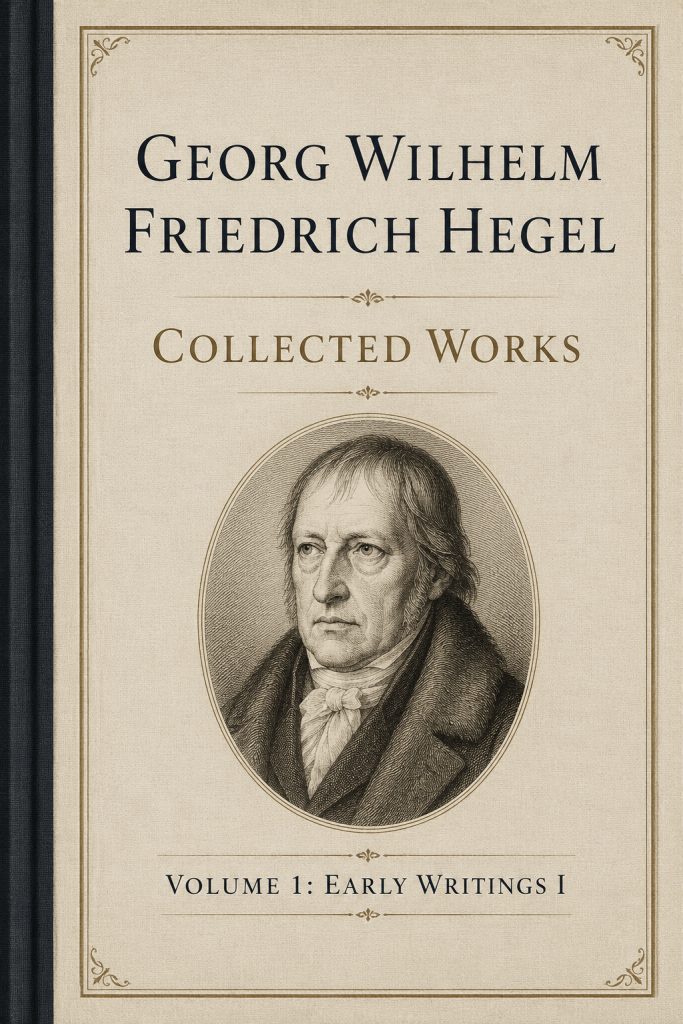
Collected Works, Volume 1: Early Writings I presents the formative writings of Georg Wilhelm Friedrich Hegel, documenting the intellectual development of one of the central figures of modern philosophy before the emergence of his mature philosophical system. Based on the first volume of the authoritative Gesammelte Werke critical edition, originally edited by Friedhelm Nicolin and Gisela Schüler, the collection preserves Hegel’s earliest surviving writings in their historical and textual context.
The volume follows Hegel from his youth and education through the decisive years in which the concerns that would later define his philosophy first began to take shape. It includes his early diary, writings from his Gymnasium and Tübingen periods, sermons and theological studies, reflections from the years 1792–1796, the extensive Life of Jesus, writings concerned with psychology and transcendental philosophy, his account of an Alpine journey, the poem Eleusis, additional fragments of uncertain date, and reports concerning writings that have subsequently been lost. The accompanying editorial material provides further information on the textual history, surviving manuscripts, dating, variants, and principles governing the critical edition.
These texts reveal a Hegel still in formation, engaging intensely with classical antiquity, Christianity, theology, morality, history, psychology, Enlightenment thought, and the emerging post-Kantian philosophical landscape. Concepts that would later assume systematic importance—freedom, reason, spirit, ethical life, religion, alienation, reconciliation, and the relation between the individual and the community—appear here in experimental and frequently unfinished forms. Read chronologically, the writings make it possible to observe the gradual transformation of Hegel from a student of theology and classical culture into an independent philosophical thinker.
Early Writings I goes beyond a mere collection of juvenilia. It comprises a documentary record of the genesis of Hegelian philosophy, preserving the problems, influences, revisions, and abandoned paths from which the mature system eventually emerged. For readers of Hegel, German Idealism, intellectual history, theology, and the history of modern European philosophy, the volume provides an unusually close view of philosophy in the process of becoming.


Leave a Reply