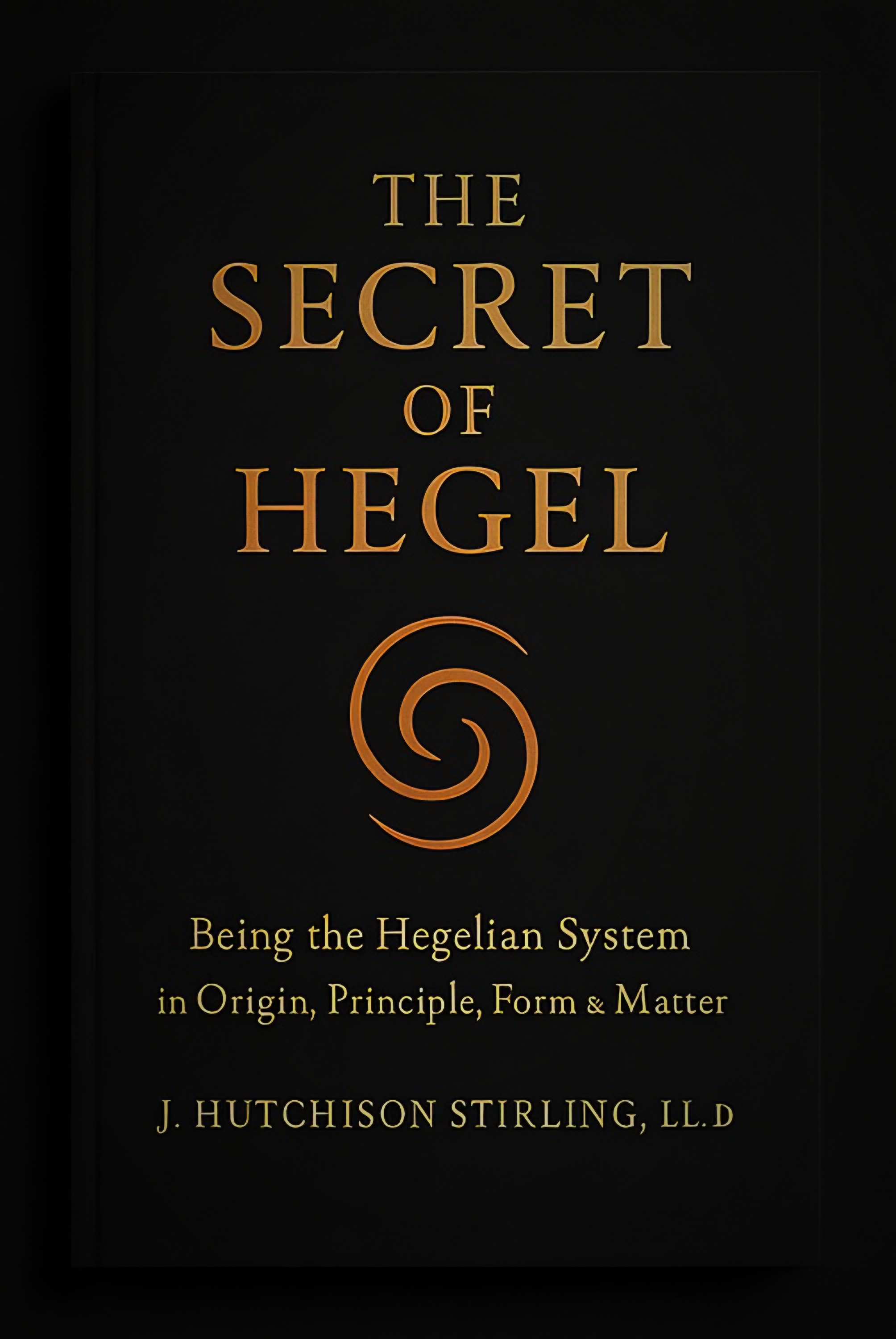
The Secret of Hegel by James Hutchison Stirling asks what would be required for English thought to receive Hegel as Hegel intended to be received: as the articulated self-genesis of conceptual life rather than as a vocabulary of strange formulae or a metaphysical scandal. Its governing ambition is to mediate the speculative logic of Hegel to a reading public whose inherited habits of empirical sobriety and literary imagination have not yet acquired what Stirling, with a marked recurrence, calls the organ for such matters. Its distinctive value as an object of study lies in the fact that translation, polemical reconstruction, and conceptual commentary are not externally adjoined components of a textbook but mutually conditioning strata of a single pedagogical instrument, where each is calibrated against the resistance of the others.
The book opens by professing itself the last fruit of a labour devoted in the main to two figures, Kant and Hegel, and more closely to the three Critiques of the one and to the Logic and Encyclopaedia of the other. From this localization a method follows that the work reflectively foregrounds: the reader is told that there is an order of approach by which alone the system will yield its sense, and that this order does not coincide with the order of any logical exposition. The reader is to begin with the embedded translation of the first section of the Logic, on Quality, and to dwell there longer than seems reasonable, in order to confront at maximum strength the impression of strangeness that any genuine encounter with Hegel must include. Only afterwards is the reader to pass into what Stirling calls the Struggle to Hegel, where notes formed in the throes of the author’s own apprenticeship are deliberately preserved with their interim character intact, since to revise them retrospectively would amount to anachronising the very evidence of struggle that gives them their pedagogical value. The technical commentary, which interprets the translated section sentence by sentence, follows only after the reader has been broken in by both the translation and the apologetic prolegomena. The work is therefore not built as a straightforward exposition followed by illustrations; it is built as a dialectic of approach, in which the reader’s resistance is treated as a first datum to be transformed by exposure rather than circumvented by clarification. This commitment is announced as a methodological wager, and it is the wager from which nearly every later compositional decision derives.
That wager rests on a diagnosis of the English intellectual climate which Stirling pursues with sustained polemical fervour but also with conceptual precision. He insists that the genius of the language for what he calls Vorstellungen, here glossed at first mention and thereafter rendered as figurate conceptions or imaginative analytic images, has been cultivated by poetry and by empirical letters to a height that few other modern cultures have achieved; and he allows himself to point to figures of English imagination as makers of images that are already thinking in sensuous form. The strength of this gift, however, becomes a hindrance the moment the task is to move out of figurate conception into the Begriff, the pure notion that has no figurate body of its own. To take the example with which Stirling himself drives the point home: it is one thing to say that God might have thrown a single germ-cell into space from which the world unfolded, where God, germ-cell, and space stand side by side as three pictures arranged by the writer’s fiat; it is quite another to think what is involved in the very thought of a beginning, in such a way that the pictures dissolve into the determinations they have hitherto carried in solution. The diagnostic moment in Stirling’s argument is the claim that contemporary English writing has so habituated itself to picture-thinking that even its philosophical and theological prose has become, in his striking image, a peep-show; reading itself has been reorganised as a sensuous entertainment requiring only mechanical attention, and the consequence is an atrophy of the organ for speculative movement. The pedagogy of syllabification, which Stirling repeatedly calls into service as a self-deprecating description of his own commentary, is therefore not a confession of failure but the diagnostic remedy: when the culture has lost the organ for pure determination, it must learn to read the syllables aloud, like a child first encountering the alphabet, until the rhythm of necessity becomes audible again.
The polemical preface to the original edition refuses to bypass the contemporary objections which had, by mid-century, almost congealed into a settled verdict against German philosophy. These objections are taken under two heads: that the philosophy in question is obsolete, and that it is bad. To the charge of obsolescence Stirling responds with a careful historical reconstruction of what he treats as the central pivot, Schelling’s late and very public sentence upon his own earlier thinking and that of Hegel, the famous characterisation of the entire speculative movement as a poem. He marks the apparent authority of this sentence, observing that no other German could plausibly claim Schelling’s combination of acquirements, his early ascendancy over Kant and Fichte, his historic relation to Hegel, and his decades of further engagement with the works that issued from his former friend; he registers how journalistic culture took the cue and announced the conclusion of speculative fever. Yet Stirling refuses to grant the sentence the force of an accomplished fact. He notices that, in the practice of study, the verdict has been quietly disregarded: translations have continued to appear, fresh generations of German interpreters have continued to claim a superior significance for Hegel, opposing voices have characterised Schelling’s late estimate as spiteful and envious, and the works of both Kant and Hegel are still handled with the kind of longing sigh that indicates a public conviction that something has yet to be unfolded from them. The argument is therefore not that Schelling’s authority should be denied a priori, but that history, as a record of effective study, has not in fact ratified his pronouncement; and on this empirical ground Stirling rebuffs the temptation to take obsolescence as a verdict to which one merely defers.
To the charge that German philosophy is bad, Stirling pursues a parallel structure of reasoning that doubles the polemic into ethical territory. He distinguishes between two strata of argument. There are those who infer the malignity of the German movement from the indirect evidence of its supposed friends, the materialistic and rationalistic publicists who have arrogated to themselves the inheritance of Kant and Hegel; and there are those who base their judgement on the direct testimony of intelligent foes, who, in his estimate, are usually less acquainted with their object than their reputation would suggest. Against the first he insists that the pupils whom popular discourse ascribes to Hegel would have found their own programmes contradictory and obstructive within his system; against the second he allows himself a sometimes severe diagnosis, distinguishing private rights of judgement from public reputations, and reserves his greatest sharpness for those who pretend to refute what they have not been able to construe. The strongest formulation of his counter-position emerges from this contest: the express mission of Kant and Hegel, he writes, is to replace the negative of the enlightenment with an affirmative, to restore faith in God, immortality, and freedom of the will, but in harmony with the rights of private judgement and with the legitimate claims of intelligence. The polemical structure here is integral to the conceptual structure that follows. Stirling’s later commentary on the Logic acquires its specific moral and religious weight only because the preface has dissolved the binary by which speculative reason is presumed to be the enemy of conscience.
The condensed formula by which the secret is announced should be read against this background. Stirling offers it as a single sentence of historical staging: as Aristotle, with considerable assistance from Plato, made explicit the abstract universal that was implicit in Socrates, so Hegel, with less considerable assistance from Fichte and Schelling, made explicit the concrete universal that was implicit in Kant. The lapidary formulation does several things at once. It places Hegel in a lineage and assigns him a structural function rather than merely a rank: he is named the historical executor of an implicit content whose articulation has been the work of philosophy as such. It defines that content as the concrete universal, the universality which contains its particular within itself rather than abstracting away from it. And it ascribes to Kant the discovery of this notion under the figure of the conditions of possible experience, where the universal forms of intuition and intellect are not added to a given particular but co-determine its very having of any content. The formula therefore inverts the canonical relation of universal and particular within the philosophical tradition; whereas Socrates had ascended from the multitude of valours to the universal valour, Hegel descends from the truth of the universal as already containing its particular, and traces the necessary self-genesis of those notions whose articulated system culminates in the Idea. The slogan of the reversal of Socrates therefore announces, in compressed form, the entire methodological commitment of speculative logic.
Stirling unpacks this announcement by attaching to it what he calls the double constitution of the nature of thought, and consequently of things: that the absolute is relative, in the sense that absoluteness consists in containing its own relations within itself; and that the method of thought must accordingly be the method by which any purported immediacy discloses its inner conditions, collapses into its opposite, and is reconstituted as a richer identity. The first of these formulations is decisive for the entire interpretive labour. The reader must understand that, when Stirling speaks of the absolute as relative, he does not intend a sceptical levelling by which the unconditioned would be reduced to the conditioned. He intends the constructive thesis that absoluteness is the capacity of a determination to carry its other within itself as its truth, so that an absolute that could not migrate into its other and return from it as enriched identity would be self-stultifying. The formula thereby converts what looks like a metaphysical paradox into a logical diagnosis of how categories of any depth must behave. The second formulation supplies the operational rule that translates this diagnosis into a method: thought is to be exhibited as the movement of any presumed immediacy into the difference it implicitly contains, and from this difference back into a new identity that no longer rests on the suppression of its other.
It is in this light that the opening triad of the Logic, the sequence Being, Nothing, Becoming, ceases to be a scandalous identity-statement and acquires the status of a logical diagnosis of indeterminacy. Stirling refuses the temptations of both apology and exoticism. He does not soften the reading by translating Being is Nothing into a more emollient formulation; he does not invest it with mystical pathos. He treats it as the shortest way to say that a thought of pure immediacy, stripped of every determinateness, is indistinguishable from the emptiness that thought names nothing; and he infers from this that the system cannot begin with a richly determinate being, since to begin with content already present would be to smuggle into the system the very determination that the system is designed to generate. The system must therefore begin with that thought whose content is least, Being, without any further definition, and the paradoxical identity with Nothing records the failure of such a thought to maintain itself in self-identity. Becoming is then not a third object to be added to the previous two but the minimal difference that keeps them apart while making each the passage into the other. Stirling’s commentary takes pains to insist that what is at issue here is not the content of the world but the grammar of thinking as such; the reader must remain inside this grammar long enough to feel why the logic must move. The thoroughness with which Stirling pursues this point is itself a methodological commitment: he is showing what it is to read a sentence in Hegel without flight to metaphor.
This pattern is then deployed across the determinations that follow, with each repetition adding further determinations to the originally bare structure. There-being, the shape of determined existence, emerges as the answer to the question of how Becoming settles into a relatively stable somewhat, and within There-being the moments of Reality and Negation, of Something and Other, of Qualification, Talification, and Limit are unfolded as further specifications of the same logical motion. Finitude is exhibited as the form of being that carries within itself its own dissolution, the to-be-to (the ought) that points beyond the finite into the infinite. Here Stirling registers, with marked emphasis, the crucial difference between the bad infinity that runs out in endless alternation between finite and infinite, and the affirmative infinitude in which the relation to limit has been internalised and the supposed infinite has ceased to be merely the negation of finitude. The move to Being-for-self is then exhibited as the next stage of self-relation, where the One posits itself by excluding others and discovers, through its own act of exclusion, that it has generated a manifold of many Ones along with the dynamics of Repulsion and Attraction. What at first sight looks like metaphysical atomism, with its scattered ones and its merely external relations, unravels under its own suppositions: the logic of relation reasserts itself, and the One discovers that its very identity is inseparable from the field of difference it had wished to negate. Stirling marks at each transition the temptation to translate these moves into psychological anecdotes or physical analogies, and at each transition he insists that the English reader resist that temptation and allow the logical structure to perform its work as a structure of pure categories.
The transition from Quality to Quantity is treated as a paradigmatic instance of the same refusal to take short cuts. Quality, once pursued to its limit, shows itself indifferent to itself, since its further determinations no longer alter what it is. The system therefore opens onto the second movement, where Quantity and its own antinomies are treated, the continuity and discreteness of magnitude, the difference of extensive and intensive quantum, and the quantitative infinite with its progressive series. Stirling’s treatment of this section employs a more compressed paraphrase than was used for Quality, on the announced ground that the reader, having endured the disciplined exposure of the first triad and its consequences, has now acquired some of the rhythm of the movement and no longer requires the same length of literal translation. The transition itself is therefore exhibited as a didactic necessity: the system must show that the qualitative pathos, with its high stakes of identity and difference, gives way to a sphere where determination no longer changes what is and where, accordingly, the categories of more and less, of magnitude and number, take the place of the categories of more and other. The strict accounting that Stirling extends to this transition is significant because it documents how the system reorganises its evidence at each stage: what counted as determination in the first section yields, at the limit, a region in which determinations have become indifferent, and the conceptual labour must be retuned to the new register without abandoning the inferential commitments that delivered it.
Behind this disciplined movement through specific transitions there lies a more general methodological claim that Stirling repeatedly returns to. The reading of Hegel demands that the reader stop treating notions as labels for objects already known and start treating them as the very objects of investigation. The chapter that lays out the Notion in itself and for itself makes this commitment most explicit. To say that the Notion is in itself is to say that it is implicit in its objects, that the world we encounter is the externalisation of conceptual determinations whose explicit form is the matter of speculative logic; to say that the Notion is for itself is to say that it has come to consciousness of those determinations within reflection, in the long detour of essence and appearance, of substance and accident, of cause and effect. The unity of these two characters, the Notion in and for itself, names the Idea, the condition in which the Notion thinks itself as the Notion. Stirling’s commentary is at pains to show that the famous Hegelian triad of in itself, for itself, and in-and-for-itself is not an arbitrary scheme but the very pattern of the migration by which any determinate content discovers itself to have been implicit, becomes explicit, and is finally reconciled with its own explicitness. The pattern repeats in every region of the system, and each repetition is also a deepening, since the determinations that emerge later are richer in content than those which preceded them. The system is articulated, then, not by the repetition of a formula but by the cumulative deposit of determinations that successive transitions have left behind.
The polemical apparatus and the technical commentary are not separable in the work, and one of the more striking features of Stirling’s pedagogy is the way the Struggle to Hegel chapters are made to bear conceptual weight even where they appear at first to be merely autobiographical. Stirling preserves these chapters in their original interimistic form because they are evidence of what it cost to come to a position from which Hegel could be construed. The narrative records the failed first encounters with the Encyclopaedia, the temptation to take Rosenkranz’s biographical and expository volumes as a shortcut, and the slow recognition that the Encyclopaedia is what Stirling repeatedly calls a handy leading-string, useful only to one who has already penetrated the Logic in detail. The argument here is that the systematic outline cannot deliver the system, because the necessity of the transitions can be felt only by a reader who has been through them. To inhabit the Encyclopaedia without that prior labour is to inhabit a form whose content has been borrowed from elsewhere and whose movement is therefore inert. The struggle chapters function, then, as a continuous diagnostic of the conditions of philosophical reading; their preserved imperfection is itself part of the argument.
Within this struggle, Stirling reconstructs the genetic relation of Hegel to Kant with a precision that the rest of the literature, in his estimation, has consistently obscured. He argues, with what he openly acknowledges to be a measure of partisan emphasis, that Hegel has insufficiently acknowledged his debt to Kant, and that the deeper conceptual machinery of speculative logic is contained, very largely ready-formed, in the Kantian deduction of the categories. The argument turns on a sustained reading of the Critique of Pure Reason and, with equal weight, of Kant’s own Logic, where the conception of a universal grammar of thought, an objective net of necessary forms which the matter of sensation crassifies into the world of experience, supplies, according to Stirling, the very picture that Hegel sets himself to realise. Hegel’s Idea is presented as the realisation of what Kant had only ideated; Kant’s transcendental synthesis is then read forward into Hegel’s logical Idea, and Stirling claims for himself the credit of having discerned the bridge that the existing commentary had failed to construct. He registers with notable candour that the discovery is one his own paper records in the tone of a contemporaneous astonishment, and he refuses to suppress the immodesty that attaches to the announcement; he frankly remarks that the very claim of discovery, in such conditions, must invite scepticism, but he persists, on the conviction that the structural relation must be made visible if Hegel’s labour is to become legible at all. The reconstruction therefore performs a double office: it shows how the categories acquire their objective sense as the very thoughts that constitute the world, and it shows how, once this sense is granted, the apparently arbitrary order of the Hegelian Logic is a derivation from the Kantian one, broken open and unfolded into its consequences.
This reconstruction has further consequences for the conception of what Stirling calls the objective categories. Kant had vindicated the categories for self-consciousness as functions of the subjective Ego, but he had retained a residual element foreign to thought, the thing-in-itself, which acted upon the senses and supplied the material that the categories then formed. Hegel, in Stirling’s account, completes the Kantian programme by abolishing this residue: the thing-in-itself is itself a product of thought, of abstracting thought, and accordingly there is no element external to the notion that the notion does not already comprehend. The categories therefore cease to be mere subjective forms imposed on a foreign matter and become the inner determinations of being itself. The notion is at once subject and substance; what is, is the notion in its various determinations, and the system of these determinations is the Logic. Nature is then the externalisation of this Logic, the same content in the form of being-outside-itself, and Spirit is the return of the same content from externality to internality. The three spheres of Logic, Nature, and Spirit do not therefore stand as three independent regions but as the three articulated moments of a single concrete totality, the Absolute Spirit, which gathers them into the unity whose unity is precisely the articulated relations among them.
Stirling is careful not to present this synthesis as a mere assertion but as the upshot of a reading practice that the book has tried to install in the reader. He repeatedly returns to the claim that, where the Encyclopaedia would offer a synoptic statement which the reader can only repeat by mouth, the Logic offers the inner movement by which such a statement becomes earned. The treatment of causality is a particularly clear example of this discipline. In one of the longer expository sequences in the Struggle, Stirling stages a confrontation between the Kantian theory of causality, with its intricate machinery of imaginative schema, time-sequence, and categorial unity, and the Hegelian one, which appears at first sight, by contrast, to consist of an extended abstract description of the very phenomenon to be explained. The Kantian account, he writes, presents itself as a chain of definite links between two presupposed unknowns, the mind on the one side and things-in-themselves on the other; the Hegelian account, he writes, presents itself as a description so rigorous that the description is itself the notion of causality. The question that organises this contrast is whether description can ever count as explanation, and Stirling’s eventual answer is that, when the description traces the movements of thought itself in its own register, the description is no longer subjective but objective, and the demonstration of the necessary place of a determination within the system of determinations is itself the explanation of that determination. Causality is therefore not accounted for by reasons that lie outside it; it is accounted for by being shown to occupy a necessary place within the disjunctive sphere of substantiality and reciprocity, where each term implies and is implied by the others. The treatment of causality is therefore exemplary in showing how, within the Hegelian system, the rationale of explanation is reconceived; explanation is no longer the reduction of an explanandum to a foreign explanans, but the integration of a determination into the articulated whole of which it is a moment.
The reading practice thus reconstructed has implications for the way the book treats the apparent jargon of the system. Stirling devotes a careful passage of the preface to the original edition to the defence of what is called, with marked exasperation by many of Hegel’s German contemporaries, barbarisch terminology. He grants the descriptive accuracy of the complaint on one side and refuses it on the other. On the one hand the words are unfamiliar; on the other they constitute a philosophical nomenclature whose strict regimen of meaning is itself a remedy for the chronic logomachies of the discipline. He insists that in Hegel thing and word arise together and must be comprehended together, and he claims for the Hegelian terms the peculiar virtue that their definition consists in the reflection of the differentia into the proximate genus, so that the term acquires its meaning in the very act of being produced. He notes that, for this reason, there is little dictionary in Hegel and small need for explanation of terms: the book is its own dictionary, and how each term emerges is its explanation. The polemical force of this defence is to convert what the public takes as a defect into a methodological feature: the so-called jargon is the protection against the verbal disputes that have hitherto sapped philosophy, and the reproach of jargon will dissolve in proportion as the reader takes the trouble to follow each term through the conditions of its emergence. The reading practice that the book installs is therefore also a practice of vocabulary; the technical lexicon is to be learned not by memorisation but by the same disciplined exposure that the reading of the Logic requires.
This defence of vocabulary is paired, in the same preface, with a treatment of the contrast between Vorstellung and Begriff, here translated as figurate conception and pure notion, that anchors much of what follows. Stirling marks that the great gift of English literary culture has been a power of Vorstellung so highly developed that it has crowded out the labour of Begriff. The example of the writer who allows himself to think a beginning through the juxtaposition of three pictures, God, space, and germ-cell, becomes diagnostic: such writing is not thought but the unguided association of finished images, and the consequence is that an enormous burden of philosophical work is shifted onto the reader, who must supply, from his own conceptual resources, the determinations that the writer has not generated. The strength of this gift is not denied; on the contrary, Stirling takes pains to insist that the same English idiom that has produced the literature of imagination has, in its best representatives, produced images that are themselves already philosophical analyses. The challenge is to transfer the power that English poetry displays in such analytic images to a cognate power in philosophical thinking, so that the images do not hinder but assist the ascent into the concept. The book is therefore, in this respect, an invitation to the English literary intelligence to retrain itself for speculative work without forfeiting the gifts of its native idiom. The invitation is offered with no concealed condescension; the Vorstellung is repeatedly granted its own dignity as a stage of cognition, but it is denied the right to substitute itself for the Begriff at the point where conceptual determination has become the operative task.
The book’s most insistent claim about the relation between philosophy and the wider intellectual culture turns on this diagnosis. Stirling argues that the conversion of Aufklarung into what he, with a play on the German verb, calls Auskliirung, the Light-up turning into the Light-out, has left a generation of educated readers in a condition in which they retain the negations of the enlightenment without retaining its positive content; they are cleared, as he puts it, of every article of their stowage. The remedy is not a return to pre-critical dogma but a completion of critique as a concrete logic of concept and freedom. The reading of Hegel is therefore, for Stirling, the practical instrument by which the enlightenment can be completed without being betrayed. This claim is sometimes presented in a register that may strike a contemporary reader as ostensibly polemical, but it is structurally integrated into the methodological argument: if the Vorstellung of the materialist as to space rebukes the Vorstellung of the spiritualist as to a clear ether in which no God could be seen, the rebuke moves in both directions, and both parties stand reproached by a thinking that has not yet attained the Begriff. The polemical middle of the book therefore performs the philosophical work of clearing the rhetorical space in which the categories can be allowed to do their own work.
A further articulation of this position emerges in the chapter that mediates between the polemic and the technical commentary. Stirling devotes considerable space to the discussion of generalisation as the activity by which thought ascends from the particular of sense to the universal of reason, and he argues that this ascent is the very vocation of humanity, distinguishing the human animal from the lower animals not by any specific power that the latter lack but by the systematic and self-conscious exercise of an activity that the latter possess only in rudimentary form. The argument is rich in its implications for the rest of the book. It supplies a justification for the methodological wager by which the Logic is to be read as the explicit articulation of an activity whose implicit form is universal in human cognition; it supports the polemical claim that to remain by the particular of sense is to refuse the very ascent which constitutes one’s humanity; and it prepares the ground for the treatment of the universal as already containing its particular, which is the conceptual heart of the system. The universal, on Stirling’s reading of Hegel, is not the empty abstraction of the formal logic that strips away every determination; it is the concrete universal, the universal which lives in and through its particular, and the singular is the unity of universal and particular in which each lives by reason of the other. The grammar of universal, particular, and singular thereby becomes the grammar of the Idea, and the reading practice that the book has been recommending is the practice by which this grammar is acquired.
The treatment of Repulsion and Attraction in the commentary on Quality offers an unusually rich example of how the book stages the friction between the inferential surface of the Logic and the natural-philosophical associations that English readers are likely to bring to it. Stirling shows that what the system calls Repulsion is not the physical force but the logical structure by which the One, in maintaining itself as One, generates a manifold of many Ones, each of which is what every other is, and that the supposed independence of each One is conceptually inseparable from the field of difference it presupposes. The Kantian construction of matter from forces of attraction and repulsion is registered as a polemical foil rather than as a model; the system claims for itself the priority of the conceptual structure, and the natural-philosophical employments are derivative. Stirling extends to this section a long remark in which he distinguishes the Hegelian treatment of repulsion and attraction from the Leibnizian monad and from the atomism, showing that Leibniz’s plurality of monads is undeduced and merely posited, while the atomism altogether lacks the ideality that the system is in the process of unfolding. The structural contrast is precise: the system requires not merely that the One generate a many but that the many be understood as the externalisation of the inner repulsion of the One, and that the unity of one and many be the result of an articulated movement rather than a presupposed datum. The example shows how the book uses the comparative-historical register without allowing it to displace the inferential register; the references to Leibniz and the atomism are framed as illustrations of what Hegel has overcome, but the work of overcoming is performed by the structural argument itself.
Once the reader has been brought through the qualitative sphere and into the threshold of the quantitative, the commentary opens onto a more compressed treatment of the second section of the Logic, and the rationale of this compression is itself part of the argument. Stirling does not pretend that the labour of reading has become less, but he marks the change in the relation between translation, paraphrase, and gloss as a sign that the reader has, in some measure, internalised the rhythm of the dialectic and can now accompany the system at a faster pace. The treatment of pure Quantity, of continuous and discrete magnitude, of extensive and intensive quantum, and of the quantitative infinite is therefore presented in a less literal manner, with the Kantian antinomies of the divisibility and infinite divisibility of space, time, and matter assimilated under the same scheme of dialectical movement. Stirling notes that the Hegelian critique of the bad infinite, the infinite which runs out in endless alternation, recurs in the quantitative register with a different valence: where, in the qualitative register, the bad infinite was the form of mere addition without internal reflection, in the quantitative register it is the form of the progressive series whose continuation supplies no further determination than what it had at any stage. The affirmative infinitude of quantity is therefore not the boundless quantitative series but the determinate inner relation by which any quantum is itself a moment of the qualitative whole that supplies its rationale. The transition into Measure is announced, in the commentary, as the next stage at which the qualitative and the quantitative are reconciled into a unity that supersedes both, but Stirling does not pursue Measure into detail; he marks the transition as the gate through which the Logic passes from the doctrine of Being into the doctrine of Essence, and he reserves further treatment for elsewhere. The compositional decision is itself instructive: the book is not a translation of the entire Logic but a propaedeutic that aims to install a reading practice, and once the reader has acquired the rhythm, the system is allowed to recede into the background while the more general claims about the Notion return to the foreground.
The chapter on the commentators, which assembles Stirling’s accounts of Schwegler, Rosenkranz, and Haym, performs a different but related office within the work. It is a ledger of what others have achieved in their interpretive labour, and it functions, on the one hand, as a tribute to genuine industry and, on the other, as a sustained demonstration of the inadequacies which even careful study can leave behind when it has not undergone the inner reversal that the system demands. Schwegler, whose summaries Stirling has personally translated, is recognised for the lucidity and balance of his exposition, and his early death is registered as a loss; the limitation of his work is the limitation of the summary form itself, which gives the form of the system without the necessary movement of its content. Rosenkranz, whom Stirling repeatedly calls the Hegelianer par excellence, is granted his fidelity and his deep familiarity with the corpus, and the chapter records his most striking expository formulations with marked respect; the criticism is that even Rosenkranz, despite this fidelity, has not reached what Stirling calls the single secret, and that his admirable suggestive Reformation of the Hegelian Logic, which arrived too late to influence the present work, only confirms that admirable readers can produce admirable accounts of Hegel without quite passing the threshold of inner reversal that the system requires. The most extensive treatment is reserved for Haym, whose brilliance of literary expression and historical-critical method had produced a striking volume on Hegel und seine Zeit which Stirling had encountered as a polemical interlocutor of the first order. Haym is treated with mingled admiration and indignation; his rhetorical promise that he will provide an objective history of the philosophy by analyzing its origin and development is set against his actual delivery, which Stirling characterises as the production of a Hellenic Cosmos that arrives, after enormous expenditure of literary energy, as the verdict that Hegel was an artificially manufactured construction, without ever supplying the inner key. The reproach is sharp and the rhetorical pitch is high, but the conceptual argument is precise: the Litterateur, in Stirling’s phrase, has the careless abundance of images, the Philosopher the anxious parsimony of distinctions, and Haym’s failure is the failure of the first to ascend into the second.
The function of this chapter on commentators is not exhausted by its critical office. It also reflects back on the book’s own self-conception. By measuring his contemporaries against the criterion of the single secret, Stirling implicitly claims for his own work that it has met the criterion, and the claim is presented with a candour that does not pretend to modesty. He insists, indeed, that he is the first to have discerned the literal derivation of Hegel from Kant, and he professes that, until this derivation is seen, the system can only present itself as an arbitrary construction whose internal necessity remains opaque. The claim is consonant with the book’s larger compositional commitment: the secret is not announced as a doctrine to be received but as a recognition that is itself the result of a reading practice, and the work of demonstrating that practice is what the book has been undertaking. The chapter on the commentators therefore performs a kind of negative pedagogy; it shows what the reading practice is not, and by negation it sharpens the contours of what it is.
The reflective register of the book intensifies when Stirling turns, in the new preface and at intervals throughout, to the biographical portrait of Hegel himself. The portrait, as he gives it, is brief but determinate: Stuttgart and the Gymnasium, the five years at Tübingen, the family tutorship, the Habilitation at Jena under Schelling’s mentorship, the brief professoriate before the catastrophe of war, the editorship at Bamberg, the rectorate at Nuremberg, the call to Heidelberg and finally to Berlin, the death by cholera in 1830. Stirling emphasises the breadth of Hegel’s preparation, classical languages, mathematics, physical science, the arts, and the geniality of his bearing, characterising the man by what he calls Biederkeit and Rüstigkeit, integrity together with vigour. The function of this portrait within the work is not hagiographic but conceptual. It contextualises the plausibility of the claim that what is may be exhibited in its intellectual constitution by anchoring this claim in a workerly scholarship and a civic vocation. The philosopher’s business of articulating the universal principles in and through which the world is organised is shown to be the office of a thoroughly educated public man rather than the eccentricity of a priestly temperament, and the thesis loses its scandal when it is read against this background. The compositional integration is significant: the portrait is not a paratext that the philosophical exposition can do without; it is itself a means by which the exposition is rendered intelligible to a public that has been schooled to suspect speculative reason as the property of mystics.
This contextual labour is most explicitly avowed in the small but consequential passage where Stirling records the inception of his own engagement with Hegel: the encounter with the name in a review, the supper with two students of German who spoke of Hegel as the deepest and the darkest of philosophers, the report that Hegel had not only completed philosophy but reconciled to philosophy Christianity itself. The reflective marker, that struck, by which he records the moment, is significant in its restraint. The phrase does not announce a conversion; it records an attentional event, and the rest of the book is, in effect, the account of what that attentional event required of its recipient. The autobiographical register is therefore continuous with the polemical and the technical: the struggle is preserved because the system can be inhabited only by passing through it, and the preservation is the gift of the author to the reader, who is invited to undergo a parallel struggle in the conviction that the inner reversal will repay it.
The conclusion of the work returns, with considerable expansion, to the contemporary stakes of the philosophical labour, and at the same time it brings the conceptual exposition to a culminating articulation. Stirling devotes the closing chapter to a sustained engagement with what he calls the materialism of the day, which he treats as the logical end-point of an Aufklarung that has lost its filling. He registers the voice of Schopenhauer, whose late writing he quotes at length, as the voice of an atheism that has fairly arrived at the place into which the materialistic ruin had been leading; he registers the figure of what he calls, with a deliberately archaic Latinate phrase, the unhappy consciousness, the consciousness which finds itself isolated, atomic, and disjunct, and which longs for the season of systole after a diastole in which the traditional substance of life has fallen out. The diagnosis is integrated with the technical commentary by the recurrence of the very categories that the Logic has articulated: atomism is now the social-historical externalisation of the unresolved One, the moral disintegration of modernity is its conceptual analogue, and the recovery of Sittlichkeit, the ethical substance of a people that has deposited objective reason in its institutional life, against the Moralität of abstract conscience, is named as the practical correlate of the speculative reconciliation. Stirling does not pretend that this recovery is the affair of philosophy alone; he acknowledges that the work of philosophy is a contribution to a wider task. He insists, however, that the work of philosophy is indispensable, since the recovery cannot proceed by mere reaction against the enlightenment without falling into the regression that the enlightenment had correctly refused.
The concluding chapter also contains the most extensive polemical engagement of the entire work, in the form of a sustained critique of what Stirling, with a deliberate flatness of register, calls the Darwinian industry. He treats this critique as a worked example of the explanatory difference between the Vorstellung and the Begriff with which the preface had begun. He marks the rhetorical reliance of the new evolutionary speculation on a stock of figurate conceptions, the primitive atom, the giraffe stretching its neck, the chain from animalcule to man, and he shows that each of these figurate conceptions is the carriage of a Vorstellung that, when transferred to the inferential register of the Begriff, reveals presuppositions that the figurate form had hidden. He invokes, with detailed citation, the Kantian distinction between the Regulative and the Constitutive use of the Ideas of Reason, and he argues that the principles of the homogeneity, the specification, and the continuity of forms are regulative laws which the reasoner projects onto nature from his own faculties, and which become transcendent when they are mistaken for constitutive principles of the objects themselves. The argument is not a refutation of the natural-scientific labour as such; it is a diagnosis of the metaphysical confusion that arises when a transcendental law is taken to be an objective fact, and the diagnosis is offered with full acknowledgement that the natural-scientific labour, properly understood, is consistent with the Hegelian thesis that nature is the externalisation of the Notion under the conditions of contingency. The treatment of disease in the Encyclopaedia is brought forward as an example of how, even within the philosophy of nature, the Notion shows through the matter without ever quite mastering the refractoriness of the natural; Stirling registers the inequalities of Hegel’s Philosophy of Nature with candour, allows that there are crudities and things that revolt, and notes that consideration tempers initial disapproval. The point of the example is not that Hegel is correct in detail but that the structure of the explanation, the firm fundament of the Notion, is what supplies the inner unity even in the regions where the application is imperfect.
The conclusion’s most strenuous formulation of the secret itself proceeds at this stage by a series of reformulations that gather together the work’s various conceptual threads. The secret is named, in turn, the concrete notion, the reflexion of difference into identity, the identity of identity and non-identity, the concrete reciprocity of a disjunctive sphere, the primitive and original radical, and the Roe’s egg of the whole huge universe. The plurality of names is itself an argument: that the same content can be stated in such various ways is a sign that what is being stated is not a doctrine but a structure, and that the structure can be tracked along multiple inferential paths. The structure itself is the duplicity by which the notion cannot explicate without, to the same extent, implicating; cannot set into position without, at the same time, setting into negation. The forms of Simple Apprehension, Judgment, and Reason are interpreted as the three absolute reciprocals by which this structure articulates itself in the cognitive register; the corresponding triplicity of universal, particular, and singular articulates it in the categorial register; the corresponding triplicity of Logic, Nature, and Spirit articulates it in the systematic register. The repeated articulations are not redundancies; each adds a determination of the structure that the others have left implicit, and the cumulative effect is the integration that the methodological wager of the work had announced.
Within this articulation, the formula of the absolute is relative, which the prefatory matter had announced as the double constitution of thought, receives its definitive interpretation. Stirling makes clear that absoluteness is not the abstract identity of a substance that excludes all otherness, but the determinate self-relation of a content that has its other within itself as the very condition of its identity. The Trinity, named explicitly as a structural illustration in one of the footnotes near the conclusion, is offered as the theological figure of the same speculative grammar: an affirmative which involves a negative, a first and second which are identical in a third. The thesis is presented as one which can be stated in many languages, theological, metaphysical, logical, and the variety of statements is itself evidence that what is being stated is the structure rather than any one of its modes. This is the most explicit moment at which the book signals its anti-sceptical commitment: the variety of formulations does not relativise the content; it confirms it, by showing that the same articulated structure appears at every level of analysis.
The defence of Hegel’s imaginative power, which Stirling pursues with sustained energy near the end of the chapter on commentators and again in the conclusion, performs a final reorientation of the book’s argument. Against the insinuation, attributed to Schelling and echoed by others, that Hegel was prose incarnate, the purest exemplar of inner and outer Prosa, Stirling argues that the imagination of Hegel held in solution as deep, as pure, and as comprehensive a thought as any imagination that philosophy has yet seen. The argument turns on the proposition, recurrently formulated in the conclusion, that the value of anything is to be measured by the amount of thought it contains; and the imagination of Hegel, on this measure, holds a thought at least as deep and as comprehensive as the imagination of the greatest poets. The provocation here is deliberate. Stirling is not asserting that Hegel is a poet in the conventional sense; he is asserting that the imagination, when it has taken on the burden of conceptual articulation, ceases to be the merely figurate faculty that produces Vorstellungen and becomes the speculative imagination that produces the system of Begriffe. The polemical defence is, therefore, also a methodological claim about the unity of imagination and concept at the highest level of philosophical labour, and it brings the Vorstellung–Begriff contrast that opened the book to a final resolution: the contrast is not absolute but a contrast of stages, and the highest stage, the speculative Begriff, includes the imaginative power without dissolving the conceptual discipline.
The book closes with a citation from Bacon, in the same Latin formulation with which Kant had opened the Critique of Pure Reason: that the work concerns not the persons but the matter, that it pretends to no sect or doctrine but to the foundations of human use and amplitude, and that the reader is invited to think the matter not as an opinion but as a work. The citation is doubly significant. It places Hegel and Kant within a single line of philosophical labour whose intent is the public good rather than the formation of a school, and it places Stirling’s own work within the same line, as a public-spirited mediation rather than a partisan advocacy. The choice of the Baconian epigraph, with its express priority of the matter over the persons, is the final compositional commitment of the work: the book has been about Hegel, but it has been about Hegel in the service of a thought whose articulation transcends the persons who have brought it forward.
The work’s unity is therefore not the unity of a doctrine but the unity of an integrated reading practice that has produced, in the course of its own exercise, a series of conceptual deposits that retrospectively determine the sense of its earlier moments. The methodological wager of the opening pages, which had recommended the embedded translation as the first object of reading, is vindicated by the eventual recognition that the inner reversal of absolute is relative could be experienced as a necessity only by a reader who had been broken in by the literal sentences of the Logic. The polemical scaffolding of the preface, which had refused both the verdict of Schelling and the German Party misconstrual, is vindicated by the final demonstration that the affirmative content of speculative reason has not been a luxury of theory but the very condition of any practical recovery of substance. The technical commentary on Quality is vindicated by the recurrence of the very categories of identity, difference, repulsion, and attraction in the diagnosis of modern atomism; the historical reconstruction of Hegel’s derivation from Kant is vindicated by the closing argument that even the materialism of the day, when its problem is properly stated, returns to the Kantian question of how a priori synthetic judgements are possible, which is the question Hegel has answered by the concrete Notion.
This recurrent vindication is what gives the book its tension-laden unity. The tensions are not resolved by being explained away; they are integrated into the very form of the work. The tension between translation and paraphrase, which the preface had formally acknowledged, is preserved in the alternation between literal reproduction and compressed commentary that runs through the entire commentary on Quality and the summary on Quantity. The tension between polemic and exegesis, which had been acknowledged in the apology for the Struggle to Hegel, is preserved by the continued recurrence of polemical interludes throughout the technical commentary itself. The tension between Stirling’s own authorial voice and the editorial mediation of his footnotes, often marked (New) to distinguish later additions from the original 1865 stratum, is preserved as a visible record of the book’s stratified composition. The tension between the modesty appropriate to a translator and the immodesty of the claim to have discovered the secret is preserved as a stylistic feature of the Struggle chapters, where the early notes are reproduced with their tone of contemporaneous astonishment intact. None of these tensions is decorative; each is functional within the work’s pedagogical strategy, and each contributes to the impression of an integrated philosophical project that has earned the right to its peculiar form by the very labour it documents.
A further articulation of these tensions emerges in the treatment of what Stirling, with his characteristic equivoque, calls the inner reversal. The reversal in question is not a single event in the reading of the book; it is a recurrent pattern by which determinations that had appeared as fixed terms reveal themselves, on further articulation, as moments of a movement that has produced them. The reversal is exhibited at the beginning of the Logic in the identity-statement Being is Nothing, where the determinations of Being and Nothing yield up their fixity in the movement that they conjointly compose; it is exhibited again in the transition from finitude to infinitude, where the determinations of the finite and the infinite cease to stand opposed in mere alternation and are integrated into the affirmative infinitude that internalises their relation; it is exhibited again in the development of Being-for-self, where the determinations of one and many surrender their fixity to the dynamic of repulsion and attraction. The pattern is the same in each case, but each repetition is also a deepening, and the cumulative effect is the conviction that the system is not a series of independent insights but a single articulated movement whose unity consists precisely in the way each later moment retroactively determines the sense of those that preceded it. Stirling registers this retroactive determination with marked attention; he repeatedly returns to determinations that the reader had supposed to be fixed and shows how their sense has been altered by the determinations that have subsequently emerged. The integration is not announced but performed, and the performance is what the methodological wager of the work had been designed to enable.
The book’s treatment of Reciprocity deserves a final word in this connection, since Stirling himself identifies it as the bottom consideration of all modern philosophy. He reconstructs the sequence by which modern philosophy is exhibited as the inferential elaboration of a single underlying notion: Bacon, Descartes, Spinoza, Leibniz, Locke, Hume, Kant, Fichte, Schelling, Hegel are arranged as the historical actors of a single conceptual labour whose final articulation is Hegel’s Idee. Within this sequence, Kant’s reciprocity, in which subject and object alter their relative positions, is presented as the notion of reciprocity in itself; Fichte and Schelling, in their successive treatments of subjectivity and objectivity, are presented as the notion of reciprocity for itself; Hegel, in the Idee, is presented as the notion of reciprocity in-and-for-itself, the concrete singular which exhibits itself everywhere as the substantial, original, creative cell. The historical sequence is itself an instance of the very triplicity that the system articulates, and the integration of the historical and the conceptual is exhibited as a structural feature of the work rather than as an ornament. The argument is striking in its formal economy: the philosophy of philosophy, the history of philosophy as one of the system’s own moments, the system as the philosophy of philosophy, all coincide, and the coincidence is itself the Idee in its self-articulation.
In this context, the recurrent contrast that the work draws between an outside reading and an inside reading of the system acquires its definitive sense. The outside reading is the reading that takes the categories of the Logic as already given doctrines and arranges them according to schemes that the reader supplies from his prior conceptual resources; the inside reading is the reading that takes the categories as the determinations of an inner movement which the reader must himself perform if he is to understand them. The outside reading is exemplified by the summaries of the Conversations-Lexicon, by the brilliant rhetorical impressions of Haym, and by the lapidary expository sentences of Rosenkranz; the inside reading is exemplified, in Stirling’s reckoning, by the labour of his own commentary, which has not been satisfied with any of these expedients. The contrast is not condescending in form; Stirling repeatedly acknowledges what the outside reading has achieved, and he distinguishes his own performance only by the claim that it has attempted the further step. The contrast is, however, decisive in substance, since the entire reading practice that the book has been recommending is the inside reading, and the demonstration of that practice is what the book has been undertaking.
The compositional choice to embed within the work a substantial translation of the first section of the Logic should be read in this light as well. The translation is not an appendix; it is, in the order of recommended reading, the very first object of attention, and the commentary and the polemic depend upon it for their intelligibility. The choice of Quality as the section to be translated is itself significant: Quality is the section in which the categories of Being, Nothing, Becoming, There-being, Finitude, Infinitude, and Being-for-self are unfolded, and it is therefore the section in which the inner reversal of absolute is relative is exhibited at its sharpest. By beginning the reader’s exposure to the Logic here, Stirling installs the reading practice in its most demanding form, on the conviction that any later section can be read with proper rhythm only by a reader who has been broken in at this point. The pedagogical wager is therefore reinforced by the editorial decision, and the unity of the work consists, in part, in the way in which its compositional commitments embody the methodological claims that the prefatory matter has announced.
The conclusion’s final movement therefore returns the reader to the very point at which the book had begun, but with the difference that the determinations of that beginning have now acquired their full weight. The secret of Hegel, which the preliminary notice had stated in a lapidary sentence, has been unfolded into the entire labour of the book, and the reader who has followed the recommended itinerary has been brought, by the disciplined accumulation of determinations, to a position from which the lapidary sentence can be read as a compressed map of the conceptual space it had announced. The reading practice that the book has installed is now the reader’s own, and the secret that had been the object of the search has become the practice by which the search was conducted. There is no contradiction between this last formulation and the realist claim, repeatedly advanced throughout the work, that the Logic exhibits the determinations of what is rather than the operations of a subjective faculty; on the contrary, the realism of the Notion is precisely what makes the practice possible, since the practice is the inhabitation of a structure that the practice did not create.
That the book stabilises its guiding tensions in this way does not entail that it dissolves them. The polemical interludes remain polemical, and the immodesty of the claim to have discovered the secret remains conspicuous in its first announcement, even though the unfolding of the work has retrospectively endorsed it. The inequalities of the Philosophy of Nature are acknowledged but not retracted; the dependence of Hegel on Kant is reconstructed in detail but the lacuna in Hegel’s own acknowledgements is registered as a macula that cannot be wholly removed. The tensions are integrated into the work but not erased from it, and the form of the work’s unity is therefore a layered stratification rather than a final reconciliation. The earliest stratum, the original notes of the Struggle, is preserved in its interimistic character; the later stratum, the commentary and the conclusion, is preserved in its mature form; the editorial stratum of footnotes marked (New) is preserved as a record of revision; and the entire layered composition is offered to the reader as the documentation of a long labour rather than as a polished doctrine.
The form of philosophical unity that the work attains is therefore distinctive. It is not the unity of a treatise that proceeds from definitions through demonstrations to conclusions; it is not the unity of an essay that articulates a single thesis through varied illustrations; it is the unity of a sustained pedagogical project whose form is dictated by the difficulty of its object. The unity consists in the articulated relations among translation, polemic, commentary, biography, historical reconstruction, and conclusion, where each component bears on the others and where the whole is held together by the recurrent claim that the secret of Hegel is the practice of reading that the work has installed. The book is, in this respect, a methodological monument as much as a philosophical mediation; it bears witness to what it cost to bring Hegel into English, and it offers itself to subsequent readers as a record of how that cost was paid and what it bought.
It remains to register, finally, the way in which the work’s claims about jargon, Vorstellung, and the organ for speculative movement converge in its closing pages. The thesis that an entire philosophical lexicon must be acquired by exposure rather than by translation; the thesis that the imaginative power of English literature is convertible into a power of speculative articulation if it is trained to follow the rhythm of the Begriff; the thesis that the Aufklarung must be completed by an affirmative content that the Logic alone has supplied; these three theses are not three independent claims but three aspects of a single proposal about the relation between a culture and its conceptual resources. The proposal is that the conceptual resources are not foreign to the culture but lie implicit within its highest achievements, and that the labour of philosophy is to make them explicit. The proposal is conservative in its respect for what the culture has produced and revolutionary in its insistence that the production must be carried further; it is conservative in its refusal to abandon the rights of private judgement and revolutionary in its insistence that those rights must be reconciled with the substance of inherited life. The recovery of Sittlichkeit through the Notion is the practical correlate of this proposal, and the work’s closing pages, with their critique of atomism and their longing for a return to substance, are the rhetorical figure of a conceptual program that has been articulated, in technical form, in the body of the work.
The reader who has followed the recommended itinerary is therefore prepared for a final recognition: that the secret of Hegel, which had appeared in the preliminary notice as a lapidary sentence, has become, by the end, an integrated practice of reading and a layered conceptual structure whose unity is the unity of its own articulation. The recognition is not announced; it is occasioned by the cumulative form of the work itself, and it would, perhaps, escape any reader who had taken the conclusion as an independent treatise. The integration of the conclusion with the prefaces, the commentary, and the Struggle is what makes the recognition possible, and the integration is what the work has been designed to enable. The form of philosophical unity that the book attains is therefore, in the strictest sense, internal: it is the unity of a project that has performed its own articulation, and the externalisation of that unity, in the printed form of the book, is the testimony that the project has been carried through.
It is in this sense that the work fulfils its compositional commitments. Its central question, how English thought might receive Hegel as Hegel intended to be received, has been answered by the installation of a reading practice that exhibits, in its own movement, the inner reversal that the speculative logic has been articulating. Its governing ambition, to make explicit, in the medium of English prose and commentary, the concrete universal that has remained implicit in Kant, has been satisfied by the demonstration of the genetic relation between the two systems and by the cumulative unfolding of the categories of Quality. Its distinctive value, as an object of study, lies in the fact that it has not severed translation from polemic and commentary, but has woven them together into a single instrument whose use is the formation of the very organ whose absence had motivated its composition.
The work’s stratification is, in the end, its strongest claim to a distinct philosophical character. The new preface and the preliminary notice mediate the older preface to the original edition, which itself mediates the Struggle to Hegel chapters, which mediate the embedded translation, which is in turn mediated by the technical commentary and by the chapters on the commentators and the conclusion. Each stratum bears upon the others; each is preserved in something close to its original form; and the editorial marks by which later additions are distinguished from the first publication are themselves part of the work’s argument about the temporality of philosophical labour. The book is therefore not a finished product but a documented process, and the documentation is what gives it its lasting interest as an object of study. To read the book is to inhabit, in turn, the various strata of a labour that has spanned decades and that has been edited but not effaced into a smoothness it could not have honestly attained.
In closing, the work’s most enduring achievement may be the way in which it has rendered its own difficulty intelligible as a philosophical commitment. The book is hard in proportion as the system it mediates is hard, and it does not pretend otherwise; it is hard in proportion as the cultural distance it must traverse is great, and it does not pretend that distance is small. The hardness is itself part of the argument, since the argument is that the organ for speculative movement is acquired only by exposure to the resistance of the matter, and that exposure cannot be replaced by paraphrase. The book is therefore both an instrument of mediation and a confession of the limits of mediation; it has done what mediation can do, and it has insisted that the reader’s own labour cannot be substituted by any external aid. The form of philosophical unity that the work attains is the unity of this confession with its instrument, of the methodological restraint with the technical execution; and the book’s success, when it succeeds, consists in its having drawn the reader into the very movement where Hegel’s sentences become legible as the stages of thought’s own self-knowledge. At that point the mediating labour is indistinguishable from the thing mediated, and the work’s wager, that the English language can be taught to bear the weight of speculative logic without breaking, stands vindicated, not as a doctrine of the work but as a result of the reader’s own activity, which the work has done what it could to enable.
What the work leaves unresolved is precisely what the system leaves unresolved, and the candour of the leaving-unresolved is one of its most marked features. Stirling does not pretend that the Philosophy of Nature is free of crudities; he records his own discomfort with certain of its applications; he allows that, where the Notion is to penetrate the matter of the natural sciences, the matter is naturally stiff and refractory. He does not pretend that every transition in the Logic has been demonstrated with the same internal necessity; he allows that, in certain passages, the Hegelian instrument carries with it temptations to arbitrary product. He does not pretend that the Encyclopaedia is self-sufficient; he repeats, with characteristic emphasis, that the outline cannot deliver the system, and he warns the reader against the seductiveness of borrowed content. The unresolved character of these admissions is integrated into the work’s claim to philosophical seriousness: a work that pretends to have solved everything would be a work that had not understood the structure it was mediating, and Stirling’s preservation of these unresolved moments is the mark of his fidelity to the matter.
The work’s form of unity is, accordingly, neither the reconciliation of all its tensions nor the dissolution of any of them, but the integration of articulated relations among them. It is, in this respect, an embodiment of the very speculative grammar it mediates, since speculative grammar is the grammar by which determinations live by reason of the determinations they negate, and a work that exhibited that grammar by suppressing its own internal frictions would have falsified its object in the very act of exhibiting it. The candour with which Stirling preserves the strata of his own labour is therefore not a literary mannerism but a methodological commitment, and the layered stratification by which the work attains its unity is therefore the most appropriate form for what the work has been undertaking. The reader who has been brought through the recommended itinerary is therefore positioned, at the end, to recognise that the form of the work is itself an argument about its content, and that the unity of the form with the content is the unity of the mediation with the matter mediated.
The book therefore stabilises its guiding tensions by reordering them within a stratified pedagogical project whose unity is the unity of an articulated reading practice rather than the unity of a final doctrinal pronouncement. Where doctrinal exposition would have settled the tensions by silencing one or another of them, the work integrates them by giving each its determinate place within the project. The reader who has followed the work through to its end has been brought to a position from which the secret of Hegel is no longer a mystery to be solved but a structure to be inhabited, and the inhabitation is the philosophical unity that the work has been preparing for. That this is the kind of unity that the work attains, and not the kind that a more conventional treatise might attain, is itself the most distinctive feature of its philosophical character; and that it has attained this unity at the cost of preserving rather than effacing its internal frictions is the measure of its fidelity to the system it has undertaken to mediate.
If a final word is to be ventured on the conditions under which such a work continues to repay study, it should be that the work repays study to the extent that it is read in something like the order it recommends. To begin with the conclusion would be to mistake the work for a treatise; to begin with the polemical preface would be to mistake it for a tract; to begin with the embedded translation, as the work itself proposes, is to enter the project at the point of maximum resistance and to allow the rhythm of that resistance to set the rhythm of the subsequent reading. The reader who proceeds in this manner is offered, in turn, the technical commentary, the historical reconstruction, the chapters on the commentators, and the conclusion, each of which deepens the determinations that the translation had introduced. The reader who has completed this itinerary will find, perhaps with surprise, that the determinations of the preliminary notice have acquired a weight they did not have at first reading, and that the lapidary formula of the secret has become, by the end, the compressed map of the conceptual space the reader has traversed. The work’s philosophical unity is, in this sense, an unity that the reader earns by working through it, and the form of that earning is the form of the work itself.


Leave a comment