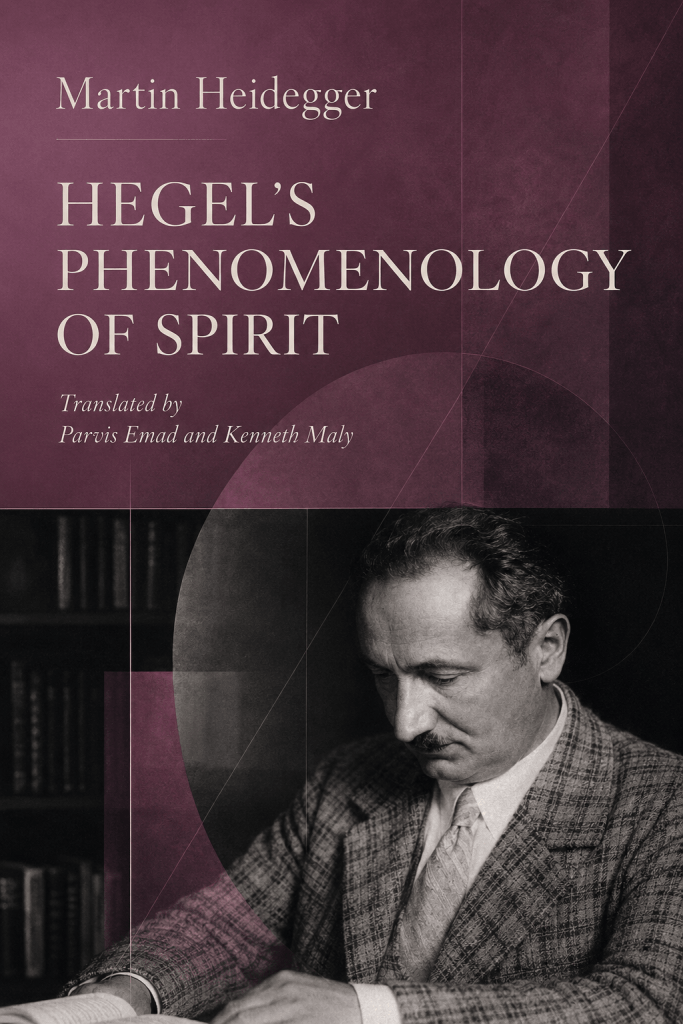
The work under consideration is a sustained interpretive engagement with the opening movement of Hegel’s Phenomenology of Spirit, delivered as a winter lecture course at Freiburg in 1930–1931 and posthumously edited as the thirty-second volume of the Gesamtausgabe from Heidegger’s own manuscript together with several student transcripts. Its central question is whether the philosophy that conceives being as infinity, and that consummates this conception by allowing absolute knowledge to come to itself in its own coming-forth, can be confronted, in something other than refutation, from a position that grasps being as finitude. Its distinctive value lies in the disciplined, almost slow procedure by which it lets Hegel’s text become legible from within while letting that very immersion expose the question of being which the text presupposes and elsewhere leaves unraised.
The reader who approaches this volume meets, at the threshold, a body of paratextual matter that conditions everything that follows. There is a translators’ foreword that announces the text as a “reading,” a German editor’s epilogue that records its compositional history, a glossary of German terms whose entries are themselves miniature interpretive operators, and the standing format of the Gesamtausgabe, whose policy is to publish each volume without an editor’s introduction or commentary. That policy is given thematic weight: the editor refrains from supplying a hermeneutic key precisely so that the reader’s first encounter with the work of thinking may not be displaced into an encounter with an interpretive supplement. The lecture course itself is, in the editor’s account, traced back to Heidegger’s own forty-eight pages of fully written-out text, completed by parenthetical and outline-form additions and by short retrospective summaries of individual sessions; this manuscript is supplemented by two essentially identical student transcripts (one from Curd Ochwadt, one from the literary remains of Helene Weiss) and a transcription by Ute Guzzoni made and later revised with Heidegger himself. Stylistic adjustments are admitted: the rearrangement of verb position, the elimination of expletives, the recovery of clauses omitted by negligence, the reinsertion of a sentence wrongly typeset in the first German edition, and the construction of a thematic table of contents in place of an index. None of these editorial gestures is invisible in the final book; they are openly catalogued, and in being catalogued they become part of the work’s truth. What is presented is not a treatise revised by its author for publication, but the residue, philologically reconstituted, of a particular pedagogical event that retained the rhythms of oral teaching, the marginal asides that punctuate a working semester, and the digressions, polemical and apologetic, that respond to the academic and ideological surround of 1930–1931.
To the translators of the English edition this stratification matters in a way that is registered both in the foreword and in the rendering itself. They argue that the text differs from a commentary in the usual sense because it does not stand outside Hegel’s work to score points for or against it; instead, it lets the Phenomenology of Spirit live again as a work of thinking, an ergon, in which the reader is expected to participate rather than simply to receive a survey of opinions about Hegel. Whether the work is taken as ergon or as object thus becomes a question already at the level of translation policy. The translators retain the German word absolvent untranslated, since neither “detachment” nor “the act of detaching” captures the simultaneity of being-absolved, being-in-the-process-of-the-absolute, and becoming-absolute that the word is asked to bear. They translate aufzeigen as “showing up” in order to keep alive the connotations of appearing, manifesting, and shining that the more familiar “pointing out” forecloses. They render wahrnehmen in places as “perceiving” and in others as “taking-for-true,” preserving the root sense of wahr-nehmen that Hegel himself thinks through when this knowledge is at issue. They acknowledge the difficulty of die Mitte, sometimes rendered as “middle term” with the caveat that this risks the reduction of experiential mediation to logical nexus, sometimes as “middle” or “midpoint” so as to keep the tension and movement intact. They mark the inability of English to preserve the German etymological web that ties meinen, das Meinen, and das Meine together, registering this loss as a real constraint on what their translation can transmit. Most consequentially, they decide that “die Phänomenologie des Geistes” must be split typographically into Phenomenology of Spirit, italicized and capitalized when Hegel’s text is named, and “the phenomenology of spirit,” unitalicized, lower-cased, and without quotation marks, when the movement of thinking is named. They concede this is an interpretive operation that the German edition does not make explicit and that Heidegger himself may not have needed to make. Their question—whether the work of thinking suffers more with or without the distinction—remains open in the foreword and is allowed to remain open. The distinction is precisely the kind of editorial mediation that one must keep in view, since it pre-shapes how every subsequent claim about phenomenology will be read.
Heidegger’s own decisions about how the work shall be approached are at once methodological and substantive. He bypasses Hegel’s preface and his introduction—the two pieces most often used by philosophical pedagogy to enter the Phenomenology of Spirit—and begins the interpretation, after his own framing chapters, at the place where, as he puts it, the matter itself begins. The opening of Section A on Consciousness is taken as the inaugural moment of the work’s inner argument; the sections on Sense Certainty, Perception, and Force and Understanding are explicated; and Section B on Self-Consciousness is reached, but only its introductory portion and the new concept of being that this introductory portion articulates are unfolded before the lecture course breaks off. Why these chapters and not others is something Heidegger answers obliquely throughout, and the editor records the answer in her epilogue: in this stretch of the text the further development and overcoming of Kant’s position in the Critique of Pure Reason is enacted, and especially in the third part of Section A there occurs both the confrontation with the one-sided philosophies of understanding and reflection and the preparation of the absolute position of idealism. The selection thus has a historical-systematic motive that is also a confessional one. Heidegger is interested in the transition from the Kantian foundations of metaphysics to those of German Idealism, since it is in that transition that the question of being, in the form it received under the title of the transcendental, is at the same time consummated and obscured.
The compositional architecture of the lecture course itself reflects this selectivity and the labor it entails. There is an Introduction of four numbered sections devoted to the task of the Phenomenology of Spirit as the first part of the system of science, then a Preliminary Consideration that turns to the presupposition of the work, then three chapters that interpret Sense Certainty, Perception, and Force and Understanding under the title of the first part, “Consciousness,” and finally a chapter on Self-Consciousness as the truth of consciousness that opens, but does not traverse, the second part. A short Conclusion declines to summarize artificially. An Editor’s Epilogue and a Glossary of German Terms close the volume. Nothing about this distribution is incidental. The disproportion between the introductory and preliminary chapters and the actual interpretation of the Hegelian text is itself an argumentative feature: Heidegger is at pains to defer the encounter with sense certainty until the conditions for that encounter are exhibited. By the time Sense Certainty arrives, the reader has been told, in advance and in considerable detail, how it must be read, what kind of seeing must be brought to it, who the “we” addressed by Hegel’s first sentence must be taken to be, and what the words experience, consciousness, appearance, phenomenology, and spirit are doing in the title. To interpret the Phenomenology of Spirit, on this approach, is first to interpret what its title says, then to interpret the placement of that title within a system that twice changed its shape, and only then to interpret the first sentence.
The interpretation of the title is undertaken at length. Heidegger begins by recovering the work’s complete original title from 1807: System of Science: Part One, The Phenomenology of Spirit, where the Phenomenology is announced as the first item of a system. He distinguishes carefully between the main title and the subtitle, observes that the subtitle had two versions—”Science of the Experience of Consciousness” and “Science of the Phenomenology of Spirit”—and traces what happens when the Logic, instead of appearing as the projected second part, is published separately in 1812 and 1816, and when in 1817 the Encyclopedia presents itself as the new and final form of the system in three parts: logic, philosophy of nature, philosophy of spirit. He gives proper names to the two relevant configurations: the phenomenology-system, in which the Phenomenology of Spirit serves as the foundational first part and the Logic as the second, and the encyclopedia-system, in which the phenomenology of spirit shrinks into a segment of a segment of the third part, the philosophy of spirit, between anthropology and psychology. The implication is that the Phenomenology of Spirit occupies, within the encyclopedia-system, a double position: it is both a foundational part for the system, since it prepares the element in which absolute knowledge breathes, and an affiliated component within the system, since it must finally be assigned a location among the modes of subjective spirit. This double position is read as the outcome of the system itself, rather than as a deficiency or as Hegel’s failure to make up his mind. Three questions are then thrown forward as governing the entire lecture course: how is the double position systematically grounded, to what extent can Hegel accomplish this grounding on the basis he provides, and which fundamental problem of philosophy comes to light in the double position. The first two questions are partially answered in the course; the third is the question to which the course is, in the end, addressed.
It is here that the most consequential terminological move of the work is introduced. Heidegger asks what the main title’s System of Science can mean. He proceeds negatively, then positively. The expression System of Science, lacking the plural, has nothing to do with a compilation or classification of the existing sciences of nature or history. It is also not an instrument for grounding the scientificality of every conceivable scientific discipline, since for German Idealism the determination of philosophy as the science arises from impulses that are more radical than those of grounding knowledge; the impulses concern the overcoming of finite knowledge and the attainment of infinite knowledge. The opening question of ancient philosophy, “What is a being?”, stands behind this drive, and the answer Hegel will give—that a being as such is the idea or the concept and that the pure concept annuls time—is presented as the radical completion of the answer prepared at the start of ancient philosophy. The Hegelian philosophy expresses the disappearance of time, on this reading, by conceiving philosophy as the science or as absolute knowledge. Heidegger then states his own counter-thesis explicitly, that philosophy is not the science, and identifies the positive content of this thesis with the title Being and Time. He resists any reduction of the thesis to fanaticism or to existential proclamation and locates the genuine task of philosophy in renewing the question of ontology, the question of being, which relates to logos in both method and content.
Within this terrain the qualitative transposition of absolute and relative takes place. Heidegger insists that for Hegel these terms designate not the quantitative scope of a knowledge but the quality of its knowing. A knowledge that knows everything that is to be known is only quantitatively absolute and may still, qualitatively, be relative; this would be the case where a knowledge of all beings remains a knowledge that is carried over to its known and is held fast by it. The crucial Latin formula is scientia relativa as scientia relata, knowledge that as relatum is borne across to what it knows and remains, as a knowing, in what is known. Hegel’s name for such knowing is consciousness. The qualitative concept of relative knowledge thus designates that knowledge which is consumed by, surrenders to, and is lost in its known. The qualitatively non-relative knowledge has the character of ab-solving itself from what it knows while remaining a knowledge of it. To ab-solve from what is known is to preserve it by elevating it; it is the elevation that is itself an absolving which knows. The neologism absolvent is then introduced, with a deliberate echo of absolution, in order to mark this manner of knowing absolutely, of being relative in an absolute manner, and of bringing about, by virtue of being relative, the relative’s own dissolution. The essence of the absolute is described as in-finite absolving, in which both negativity and positivity are absolute. Heidegger calls this restless absolute knowledge absolvent, and the term thereafter operates as the central methodological category of the entire interpretation. It does not appear in Hegel; it is Heidegger’s coinage; and the translators retain it precisely because no English equivalent is adequate. The use of this term inflects every claim that follows: that knowledge appears under the heading of consciousness because consciousness is the form of relative knowing in which the relative does not yet know itself as such; that self-consciousness is the form in which knowledge has detached itself from its object while remaining relative, since it is now bound to the self that knows itself; and that reason is the form in which absolute knowledge has explicitly absolved itself even from self-consciousness, taking both consciousness and self-consciousness as belonging together in the unbounded origin of their unity.
The introduction of absolvent permits Heidegger to clarify the methodological premise that the lecture course presses with great patience: the Phenomenology of Spirit begins absolutely with the absolute. This is treated not as a hidden weakness exposed by a careful reader but as the manifest and necessary condition of the work. The presupposition of philosophy, Heidegger argues, lies precisely in being there from first to last, waiting to be unfolded; it is the opening of the whole itself and the history of the manifestation of beings as a whole. Whoever wishes to understand anything of this work must say again and again that Hegel presupposes already at the beginning what he achieves at the end. The end is the beginning that has only become other and thus come to itself. To object to this circle is to mistake the essential character of philosophy, which is not concerned with proving in the manner of a formal principle of proof in a logic alien to itself. Hence the demand placed on the reader at the very threshold: to have read the entire work once before reading any of its parts a second time, because the standpoint that grasps the beginning is the same as the standpoint that grasps the end, namely the standpoint of absolute knowledge.
The fragility of this demand provides much of the work’s argumentative texture. Heidegger acknowledges that to require the reader to comport himself or herself absolutely is to require what is most difficult, especially for what is most finite, and that the danger of the work is not in any local opacity but in the constant fact that we must always already be one step ahead of what is presented. The step that runs ahead is, for Heidegger, possible only because the step is taken in the direction of absolute knowledge, which is, from the beginning, the properly knowing knowledge and which completes the phenomenology of spirit. The “we” who reads is not the contingent we of the auditorium; it is the we who has already taken its place in absolvence and who, in reading the first sentence of the first chapter, is already in the element of mediation. The translators of the work record Heidegger’s repeated insistence on this point: it is solely from this perspective that one can ask which knowledge must at first be our object, and the answer is that our immediate knowledge is the immediate insofar as it appears to us absolvent mediators. The im-mediate is the un-mediated of our mediation; it is not innocent immediacy but the immediate as we, mediators, allow it to stand for the sake of the absolvent movement.
The thematization of experience in the title of the work proceeds along the same lines. Heidegger surveys ordinary linguistic usage of erfahren: to have learned, to have heard from those who were there, to have established how things are, to find out, to confirm an opinion by recourse to the matter itself, to be experienced in the sense of having undergone enough learning to know how things must go if they are to go rightly. He then distinguishes two clusters of meanings: experiencing as demonstrating an opinion through intuition of a thing, in which the term naturally extends to the empirical sciences and to the phenomenological intuition of essences as Scheler and Husserl extended it, and experiencing as undergoing an experience with something, in which the thing or matter at issue is verified, the verification often involving surprise and disappointment because things turned out otherwise than expected, and in which an enrichment by additional learning emerges. Hegel’s concept of experience is placed in the second cluster, with the crucial qualification that for Hegel what undergoes the experience is consciousness itself, and consciousness is at once the subject of experience and the field in which the experience takes place. The genitive in “experience of consciousness,” Heidegger insists, must be read not as objective—not as referring to experiences had of consciousness, in the way that one might have an experience of an object—but as explicating the experience that consciousness undergoes with itself. Consciousness experiences itself as that which must undergo such experience with itself, that is, consciousness experiences the inevitability of its own essential character. The result of this experience is that the new true object issues forth for consciousness, that consciousness comes to know that the object for it is not yet the true object, that the truth of its object lies in what the object is for us who know absolvently. Experience, on this reading, is the movement in which the immediate, the un-experienced, becomes alienated from itself and then returns to itself from out of this alienation, and is for the first time revealed in its actuality and truth, and so becomes a property of consciousness. The crucial words are Hegel’s, but the inflection is Heidegger’s: experience is a movement, and consciousness exercises this movement on itself.
The second subtitle of the work, “Science of the Phenomenology of Spirit,” is then subjected to the same scrutiny. Heidegger insists that here too the genitive must not be read as objective. Husserl’s transcendental phenomenology of consciousness investigates consciousness in its self-constitution and in the constitution of the totality of objects of consciousness; in such a project the genitive is naturally objective, since consciousness is the field investigated. In Hegel, by contrast, phenomenology is not one way among many in which spirit might be investigated. Phenomenology is the manner in which spirit itself exists. It is the genuine and total coming-out of spirit before spirit itself. To be a phenomenon, to appear, is to come forward in such a way that something shows itself which is other than what previously showed itself, in such a way that what comes forward does so in opposition to what previously appeared, and what previously appeared is reduced to mere illusion. To appear means coming out in the twofold sense of showing oneself and of showing oneself against what has already shown itself by showing it to be mere illusion. Hegel writes, in the Difference essay of 1801 that Heidegger frequently invokes, that “appearing and separating are one”; this formula is taken to mean that appearance includes the becoming-other-than-itself in which what becomes is shown as the negation of what was. The “phenomenology of spirit” is thus the self-presentation, the history of appearance, of spirit; the genitive is explicative, and the science of the phenomenology of spirit is the science whose unfolding is the very process by which spirit comes out to itself.
A long aside on neighboring misinterpretations belongs to this passage. Heidegger devotes one of his more energetic stretches to the claim, current in his time, that Hegel’s Phenomenology of Spirit is to be assimilated to phenomenology in the contemporary, that is Husserlian, sense, or that it is to be received as a typology of philosophical standpoints in the manner of various recent manuals and series. He refuses both assimilations. The typologies, he says, multiply at a time when sophistry has the upper hand: they attach a label to a philosophy, then leave that label to fight with other labels in the literary public sphere, and finally generate a Kant-literature more important than Kant. He observes that the discussion of typologies in the contemporary sense routinely appeals to Hegel for sanction, on the assumption that something like a typology is aimed at in the Phenomenology of Spirit. The refusal of all three misreadings—as phenomenology in the current sense, as a typology of standpoints, and as an introduction to philosophy in the propaedeutic sense—prepares the positive determination of phenomenology as the absolute self-presentation of reason whose actuality is absolute spirit. The polemic against typology is more than a piece of academic temper; it indicates how, for Heidegger, the seriousness of philosophical confrontation requires that one read the work as the unfolding of its presupposition rather than as the staking of a position to be compared and contrasted with other positions.
This concern with kinship over against typology shapes the lecture course’s announced posture toward Hegel. Heidegger cites the Difference essay’s remark that the living spirit dwelling in a philosophy must be born through a kindred spirit and that the spirit of philosophy slips by the historical approach guided by some interest or other in information about opinions. To confront Hegel is to be kindred with him. Kinship, however, is carefully delimited: it is not identity, not sameness, not agreement on propositions and concepts, not the leveling produced by mutual concession on so-called research results, not membership in a school. It is commitment to the first and last necessities of philosophical inquiry arising from the matter. In every philosopher, Heidegger says, there are neither predecessors nor successors; every real philosopher is contemporaneous with every other, precisely by being most intrinsically the word of his time. The lecture course thus sets aside, with deliberate severity, both the appeals to the so-called collapse of Hegel’s philosophy after his death and the consolation prize of being condescendingly called “classical.” It is not Hegel’s philosophy that has broken down, on Heidegger’s account; what has broken down is the capacity to encounter it. The book’s mode of address is therefore peculiar. Its readers are repeatedly told that, unless they have already read the entire Phenomenology of Spirit before the lecture course begins, there is no sense in remaining in the room. They are told that the difficulty of the work is essentially the difficulty of being absolutely commensurate with the absolute. They are told that going along with Hegel requires patience, the kind of patience that has become unavailable in an age that has more means for knowing everything quickly and less understanding of what is essential about anything than any previous age.
Within this preparatory frame, the actual interpretive engagement with Sense Certainty begins. The procedure is detailed and unforced, with no anxiety about taking time. Heidegger reads the very first paragraph of Hegel’s chapter as already announcing the entire problematic of the chapter and the entire result. The knowledge that is at first our object cannot be anything other than immediate knowledge itself, a knowledge of the immediate or of a being; the approach to the object must also be immediate or receptive; nothing must be altered in the object as it presents itself; one must refrain from comprehending it. Heidegger parses each phrase. The “at first” is the at first of a sequence within a progression that has not yet been determined as a sequence of forms of consciousness; it is the at first of an absolvent unfolding. The “immediate” is the immediate as the un-mediated of our mediation. The “our” of “our object” must be read as the our of those who know absolutely, who already from the outset apprehend and determine things in the manner of absolute knowing, who detach themselves from what is known so as to know the knowing of it. The “object” must be read as an object that is twice an object: it is the knowledge that is our absolvent object, and it is the object of that knowledge, the immediate object that the immediate knowing has. Hegel’s formulation that perception is no longer a taking that just appears, as in sense certainty, but a necessary one, is then read as marking the fact that the taking-in of sense certainty as object is not itself necessary in the way that perception’s taking-in is, although sense certainty is the necessary first object. The taking-in is a condescension: we, the mediators, condescend to immediate knowledge by postponing our sublating, even though we do not surrender our mediation, since the im-mediate to which we condescend already stands under the dominion of mediation.
These methodological insistences are coupled with a substantive reading of sense certainty itself. Sense certainty is treated, in the first instance, as it presents itself to itself: as the richest and truest cognition, as a pure having of something before oneself, as the mode of knowing in which I, like everyone else, see this lectern, this bench, this window, this blackboard, this tree, this blade of grass, with the dimensions of space and time extending indefinitely outward and narrowing indefinitely inward. The wealth of sense certainty is treated as a wealth that does not, however, belong to sense certainty as it knows itself, since sense certainty does not know its wealth in such a way as to have it. Sense certainty expresses its truth in a proposition: this is. The “is” is the statement and the truth of sense certainty. Its truth contains nothing but the being of the matter, in Hegel’s words, which Heidegger emphasizes by lingering on the “nothing but.” The knowing involved in sense certainty is correspondingly poor: consciousness is in this certainty only as a pure I, or I am there only as a pure this, with the restrictive “only” and “nothing but” thrown around the entire structure. Sense certainty appears, but it appears in the light of a gaze that, taking it immediately, disregards the mediating sight that already belongs to that gaze. Heidegger calls this an absehendes Zusehen, a looking that looks by disregarding, since it must disregard the mediation that constitutes it in order to see what is immediate as immediate.
The dialectical movement of sense certainty is then traced patiently. Sense certainty intends the singular this, but in saying this it says only the universal this. When asked what the this is, sense certainty answers by saying that it is here and now. When asked what here and now are, sense certainty answers by pointing to the lectern and the afternoon, then turning around to find that the here is now the blackboard, that the afternoon has become evening, that the now is no longer this but that. The example of the sentence “Now is afternoon” written on the blackboard, read by the janitor the next morning when “now” is morning, and corrected by the janitor only to find that by midday “now” is midday again, is used to expose the structure: the now remains the now in that what is the now in each case—morning, noon, afternoon, evening, night—is in each case not. The now is always not-this. This negation removes the immediate this and replaces it with another, all the while leaving the now indifferent to what it is now. The now is simple, permanent in and through its mediation, a universal. The same analysis applies to the here. The conclusion of the dialectic of sense certainty is therefore that sense certainty, in articulating what it means by this, produces the universal as its truth, even as it intends the singular. Sense certainty, in expressing itself, says the opposite of what it means; the meant singular cannot be said.
Here Heidegger introduces the famous remark about language. Language says the opposite of what we mean; we mean the singular, language says the universal. Language repudiates the intention and at the same time delivers what is true. Language is in itself mediating; it prevents us from sinking into that which has the character of the this, that which is totally one-sided, relative, and abstract. By turning things into their opposites, language brings about the turning away from what is relative. Hegel calls this the divine nature of language, its essence of immediately perverting the intention. Heidegger takes this seriously: language has an absolute, non-relative, absolvent essence. Language detaches us from one-sidedness and allows us to state what is universal and true. Man, whose existence language constitutes, has access to “something this-like” only through the character of the this itself, only because we speak. The definition of man from antiquity as zoon logon echon, an animal possessing logos, is thereby ratified, but ratified in such a way that the logos is not the indifferent neutral logos of formal logic but the absolvent logos of the Phenomenology. The ontological difference Heidegger associates with his own work is also located here, in the place where sense certainty cannot say what it means and language says the universal “is” rather than the singular this. The relation between being and beings, between universal and particular, between mediation and intention, is glimpsed in the very impossibility of saying the singular as singular. The dialectic, on this reading, is nothing other than the absolvent movement conceived on the basis of the logos, which is logical in the original sense; it is restlessness, it is absolvent, it is understood in terms of infinity, and it is for Hegel inseparable from the question of being’s orientation to logos.
The implication is registered in a passage that Heidegger devotes to what he calls the conflict of the form of a proposition. The simple difference between subject and predicate as carried by the ordinary proposition is destroyed by the speculative proposition; the proposition of identity which the former becomes contains the counter-thrust against that subject-predicate relationship. In the speculative philosophical proposition the difference between subject and predicate is not abolished through identity; the difference is sublated. The “is” of the speculative proposition is therefore not the indifferent copula of formal predication but the locus where absolute restlessness comes to expression. Hegel’s whole work, on Heidegger’s reading, is devoted to making this restlessness real in the quiet “is” of the general proposition.
The chapter on Sense Certainty is then drawn to a close with a detailed account of the second movement of its dialectic. Sense certainty, having found that the truth it intended to fix in the object turns out to be a universal, retreats into the I. The truth, having been driven out of the object, settles itself in the “I know,” in the knower. Here too sense certainty must undergo an experience with itself. Sense certainty discovers that the I, too, is universal. When each person says I, what they say is something everyone can say, since everyone is an I; the simple I that everyone is, this universal, is not what is immediately given in any particular intending. The intending I and the intended this are equally mediated; sense certainty must move beyond both. The mediation it discovers is itself one-sided, and the truth of sense certainty turns out to be the immediate as the un-differentiation of I and object, an undifferentiated unity in which neither pole stands out and from which the absolute restlessness of the absolvent gaze must now displace it. The transition to perception is thus prepared by the very structure of sense certainty’s claim: in always already being absolvently mediated, sense certainty cannot remain in its immediacy and must yield its place to a knowing that takes what is true.
A pause in the interpretation is then taken in order to address the question of how this complex of construction and reconstruction is supposed to be intelligible at all. The exposition has been, simultaneously, an absolvent construction of sense certainty from within the horizon of absolute knowledge and a reconstruction by which sense certainty is allowed to come back to itself in its own immediacy. This goes back and forth, this Konstruktion in reconstruction, is what is called in shorthand dialectic. Heidegger warns against the temptation to take dialectic as a gimmick that can be performed by cunning, in which all doors will open but they open from one vacuity onto another. Even Hegel, he says, in his later period did not entirely overcome the danger of dialectic; for Hegel dialectic was productive in itself because the absoluteness and infinity of being never became a problem, since they could never become a problem for him. This is treated not as a personal limitation but as the result of the power of the Weltgeist, whose ways are followed to the end by Hegel while we remain, Heidegger says, its small satellites.
This is the juncture at which the problem of finitude and infinity is named for the first time as the matter of the confrontation. Heidegger announces that, in our obligation to the first and last necessities of philosophy, we shall try to encounter Hegel on the problematic of finitude. Through a confrontation with Hegel’s problematic of infinitude we shall try to create, on the basis of our own inquiry into finitude, the kinship needed to reveal the spirit of Hegel’s philosophy. Infinitude and finitude are not, on this reading, two different-sized blocks of wood to be rubbed together or thrown around in verbal gymnastics; they are pre-suppositions in the technical sense, names for tasks and questions. The question is whether the finitude determinant in philosophy before Hegel was the original and effective finitude installed in philosophy, or only an incidental finitude that philosophy was constrained to take up and transform. The question must be asked whether Hegel’s conception of infinitude did not arise from that incidental finitude, in order to reach back and absorb it. Finitude, Heidegger says, is the innermost distress at the heart of the matter in question; it determines the necessity of questioning. The Hegelian sublation of finitude into infinitude is taken seriously, but the question of what is sublated and the manner of the sublation is the question through which the confrontation must be conducted. The distress of being, which is the distress not only of human Dasein but of being itself, becomes manifest only when we ourselves are compelled, and the compulsion is registered as a necessity of commitment for the philosopher whose actuality remains only as work. This necessity, in turn, is also a necessity of exposure, of being exposed to the fact that the distress will be fought over as a subjective standpoint and perverted into sentimentality. The lecture course is candid about the precariousness of its own project under such conditions.
When the interpretation of the Phenomenology of Spirit now resumes with the chapter on Perception, the procedure is by this point so well-prepared that the work of close reading runs more swiftly. Perception is introduced as a new object that has arisen necessarily from the previous one, since the absolvent movement requires that what is now object for us already attests to its absolvent origin in sense certainty and points beyond itself to its absolvent future. Perception is the middle term between sense certainty and understanding, and Heidegger emphasizes that as middle and between, perception is precisely a transition, in which the movement of absolvence is unsettled. Perception itself is not to be taken as an inevitable outcome, as sense certainty had been; what perception is going to be belongs already to perception. Perception is only what it is in its having-been and its future. Here Heidegger deliberately points to temporal moments in the being of what is to be known in absolvent manner, while warning that he is going beyond Hegel and indeed in a direction Hegel would have resisted. Hegel, Heidegger says, speaks occasionally of having-been but never of the future; Hegel’s view of the past as a fading away, transitory and bygone, is a kind of orientation toward time in which time is determined logically and dialectically in accordance with a predetermined idea of being. This brief diagnostic remark is one of several places in which Heidegger marks the boundary between his own approach and Hegel’s without crossing it overtly; he announces only that the problematic of time will have to be unfolded from out of the problem of being itself, and that this requires not so much a critique of what Hegel said about time as a transformation of the inquiry into time and being.
The chapter on Perception is then carried through with patient attention to the structure of the thing and its properties. Perception’s object is the thing, this salt, which has many properties—white, tart, cubical, heavy, and so on. In sense certainty the singular “this salt” had been all that was said and all that was meant; in perception the universal what of the salt is what is taken for true, and what is taken for true is articulated as “this salt is white and tart and cubical and heavy.” The thingness of the thing is exhibited under two contrasting figures: the also, which is the indifferent unity of the indifferent many, and the one, which is the unity of exclusion by which the thing distinguishes itself from other things. Perception requires both: the also for the multiplicity of properties to belong together in one thing, the one for the thing to be distinct from another thing. Each is required, and the requirement of each is incompatible with the requirement of the other. The thing is to be both the one and the also; perception’s response to this incompatibility is to alternate the attribution of unity and multiplicity between itself and the thing. When the also is taken to belong to the thing, the unity is taken back into perceiving; when the unity is taken to belong to the thing, the multiplicity is taken back into perceiving. The “insofar as” by which perception keeps the contradictory moments separate is added and removed alternately. In this oscillation, in this constant playing of one side against the other, perception’s deception is exhibited as essential. Perception is in itself a deception, a continual self-deception, a talking-oneself-into-something. The “deception” in the title of the chapter is not the occasional possibility of going astray in particular acts of perception but the structural untruth of perception as a mode of knowing. Perception is sophistry, Heidegger says, in following Hegel; the sophistry consists in the constant reciprocal reversal of one-sided positions, but above all in the fact that this drive resists what comes to light precisely in the drive itself.
The unity that perception cannot grasp is the unity of contradiction: the unity in which being-for-itself and being-for-another are essential at the same time. Perception cannot tolerate contradiction because perception, limited to itself, is a finite knowing. The principle of avoiding contradiction is precisely the fundamental law of sound common sense, and perception, as the mode of knowing of sound common sense, must avoid contradiction even where the contradiction lies in the very essence of the thing it claims to apprehend. When the contradiction is acknowledged as essential, perception is sublated into understanding, since understanding is the mode of knowing that can think the unity of the one and the also as a unified, unconditioned universality. The transition from perception to understanding is therefore not a gradual refinement of the perceptual stance but a leap forced by perception’s inability to think what its own analysis of the thing reveals. With the unity of the one and the also, of being-for-itself and being-for-another, the universal becomes unconditioned, absolute universality, and the object of consciousness is no longer the perceptible thing but the supersensible.
The third chapter on Force and Understanding is given especially detailed treatment. Heidegger has by this point set the stage for it by inserting, between the close of Perception and the opening of Force and Understanding, an extended philosophical-historical excursus on what he calls onto-theo-logy. The term is presented as the name of the form taken by the problem of being in the philosophical tradition once the question of the on as such is from the beginning oriented to the logos and is at the same time conducted under the guidance of the question of the highest being, theion. Aristotle had already brought philosophy in the genuine sense into close connection with a theological discipline, and Hegel will later say that for philosophy too there is no other object than God, that philosophy is essentially rational theology, that the service of philosophy is service to truth. The expression onto-theology is not meant to claim that philosophy is theology in the sense of speculative or dogmatic theology, nor to introduce a discipline called theology that would govern ontology from outside; it is meant to indicate the most central thrust of the problem of being itself, in which the logical is theological and this theological logos is the logos of the on, and in which logical means at the same time speculative-dialectical, proceeding in the three steps of mediation. The term is then refined still further when the egological dimension is added. Since Descartes the inquiry into beings as a whole has become not only ontological and theological but also egological: the ego cogito is co-determinant for the development of the concept of the theion as that concept was prepared in Christian theology. The question of being as a whole is onto-theo-ego-logical; the logical reappears in each of the three components, and the unity of these three components in Hegel is expressed in the thesis that the absolute is spirit. Spirit is knowledge, logos; spirit is I, ego; spirit is God, theion; spirit is actuality, beings purely and simply, on.
The Hegelian inquiry, on this account, is rooted in the inner coincidence of these three perspectives in the question of being. It is only by recognizing this inner coincidence that one understands why Hegel must determine the being of the thing under the heading of force. Force is the unconditioned universal that does not have the particular beside or under itself but in itself and that itself unfolds necessarily into particulars. To see how this designation is appropriate one must follow it through the Kantian categorial inheritance. Kant had divided his categories into the mathematical and the dynamic, the dynamic comprising the categories of relation: substance and accident, causality and dependence, community. Hegel had taken account of the first of these dynamic categories in his interpretation of the thinghood of the thing as object of perception. Now Hegel’s interpretation of the truth of the thing as force is shown to incorporate Kant’s problematic of the dynamic categories in a deeper way; force is in Heidegger’s reading the speculative penetration of the categorial determination of relation, encompassing causality and community at once and unifying them in the relation in which being-identical and being-separate, identity and difference, belong together as the identity of being-separated, as infinity. The Hegelian determination of the truth of the thing as force is therefore the speculative grasp of the Kantian categorial problem from the ground up. The connection between judgment and category that for Kant was secured by the table of judgments is for Hegel itself problematic; the speculatively oriented determination of the essence of the judgment turns out to be the speculative origin of the categories themselves. Understanding, the faculty of concepts and rules, is by Hegel speculatively transformed: the principle of understanding is the universal unity in itself, an a priori unity that does not depend on contingent collecting.
The Hegelian object of understanding is then unfolded with great care. Force is initially taken as something simple, but its concept demands that it be both being-driven-back-into-itself and being-driven-toward-externalization, both being-for-itself and being-for-another. In its actuality force itself is this difference between being-driven-back-into-itself and being-driven-toward-the-outside. Force does not first exist and then occasionally externalize itself; force is precisely that in which being-for-itself and being-for-another have their subsistence at the same time. This in turn means that, where force is actual, there are necessarily two forces, the soliciting and the solicited, each independent in seeming but in actuality constituted only through the play between them. The truth of force consists precisely in losing its actuality as substantialized extreme. What is actual is the play of forces, the middle, which relates the extremes in their comportment to each other and is itself the relation. The forces are not extremes that exist independently and that transmit something between them through an indifferent middle; the forces are what they are only in terms of this middle and in this contact. With this insight, the relation has become unconditioned universality, and the simple unity of the one and the also of the perceptual thing has been speculatively recovered and transformed.
The next move concerns appearance. Understanding does not stop with the play of forces but takes the play as appearance and seeks the law that governs it. Appearance, on Heidegger’s reading of Hegel, has a double character: it is at once self-showing and vanishing. To appear is to come up and to disappear; this is the moment of negativity within appearing, which Heidegger emphasizes as belonging to the very essence of appearance as movement. In the play of forces something arises and something vanishes, and what makes its appearance is something other than the play: the interior, the supersensible, the law. Understanding simplifies the appearing manifold into the law that governs it, and the reduction of appearance to law is what Hegel calls explanation. The mode of understanding’s knowing is explanation. But the law thus arrived at is initially only one particular law among others; the application of the law unfolds into an indefinite number of extant laws, and understanding, whose principle is unity, must therefore allow the plurality of laws to come together into one. Yet the universal law turns out to be one only by setting other laws aside, and what is then in fact attained is not unconditioned universality but only the universal that depends on a manifold whose unification it is. The dialectic Heidegger traces here, with reference both to the philosophy of nature of the Jena period and to the texts on the law of universal attraction and the law of motion, reveals that the concept of law as the universal unifying principle goes beyond the law as such and turns against it. Force, taken now as the ground of law, no longer designates a thing among others but the differentiated unity that law as law regulates, and this brings the dialectic up against a new duality: force as the ground of law, and law as expressing force. Each is found in the other, each is referred back to itself through the other, and explanation, in moving back and forth between them, becomes pure tautology. The tautology is absolute change, the simultaneous positing and revoking of a difference within the same content.
This is the moment at which the first supersensible turns into the second. The first supersensible is the calm realm of laws standing over against appearance in its restless play; the second supersensible is the inversion of the first, in which the identical law becomes unequal and the unequal appearance becomes equal. The inverted world is the world itself in its opposite, taken back into the world in a unity. The unity that differentiates itself and in the difference is itself undifferentiated, that contains within itself the difference of itself from itself, is the inner difference, and this is what Hegel calls infinity. Heidegger emphasizes that infinity here is not the indefinite continuation of a series of determinations one after another but the return of something into itself in which the determinate, as other, returns to the one, the other as differentiated from the determinate receives it, and the other in unison with the determinate becomes undifferentiated and remains preserved in sameness with it. Infinity is the simple essence of the law of the truth of the object of understanding. Infinity is the unconditioned universal. For ordinary representation the universal is already the concept; the infinity in question is the absolute concept, the universal that is no longer relative to the extant particular subsumed by it, the universal that is the differentiated in its difference and at the same time the unity of the differentiated. Hegel calls the absolute concept the simple essence of life, the soul of the world; Heidegger calls it the essence of being. The absolute restlessness with which the lecture course began as a characterization of spirit is now found to coincide with this infinity, and Heidegger remarks that infinity has been the soul of all that has gone before in the Phenomenology of Spirit, that it could not emerge freely as such because in the earlier modes of consciousness the object was the other to knowing and was taken as it presented itself, and that the explicit emergence of infinity requires the willingness to think the contradiction.
Within this conceptual yield Heidegger inserts a further consideration which becomes one of the touchstones of the entire lecture course: the connection between infinity and the I. The concept of infinity finds its proof and its concretion equally immediately in the I, for the I is that actual which, in positing itself as I, differentiates itself from itself in such a way that what is differentiated does not fall away from what makes the differentiation but is taken back into what makes the differentiation and remains preserved therein. This peculiar difference of the non-differentiated is actual in the I. The logical difference, determinateness, and the logical concept of infinity are rooted in the I; logic as thinking is “I think.” A logic of this orientation is a doctrine of the proposition not detached from the I; in a Kantian sense it is a transcendental logic which has understood that, because logos is infinite, the I-character is essential for thinking, and consequently that the actuality of the infinite is subject in the absolute sense of spirit. Heidegger marks here, with the deliberate care of someone for whom this is not a passing matter, that being determines itself logically and that the logical proves to be egological. The egological determination of being is traced from its beginning in Descartes through Kant and Fichte until it receives in Hegel’s Phenomenology of Spirit its comprehensive and explicitly absolvent justification.
With infinity thus exhibited, the entire first section on consciousness has reached its closing point. The objectivity of the object of consciousness is dissolved in the unconditioned universality, in the inner difference, which exists only as I. The illusion of the relative is dissolved in the truth of the first simple absolute, in the truth of the infinite. The interior of the thing into which understanding penetrates is the interior of the genuine interior, the interiority of the self. Only because the interior of things is basically the same as the interior of the self is understanding constantly satisfied with its explanation; in believing that it is doing something else in its explanation, understanding in deed hovers around only with itself and enjoys itself. The supersensible is therefore not something behind a curtain but the self-comprehension of knowledge. The famous Hegelian formulation that behind the so-called curtain that is supposed to conceal the interior of things there is nothing to be seen unless we go behind it ourselves, both so that we may see and so that there be something behind there that can be seen, is read by Heidegger in the literal sense that the “we” who go behind the curtain are not the readers in their natural attitude but the readers in their absolvent stance. What is known absolutely is no longer an object that stands over against absolute knowledge as alien; it is what knowledge knowingly lets emerge and which, only as emerging thus, stands in knowing. Heidegger introduces here a counterpart to Gegen-stand in his coinage Ent-stand: what is known absolutely is not an ob-ject but an emergence, maintained only in its emergence and as such in the history of absolute knowledge. We ourselves, as those who know absolvently, bring the thing in itself to a stop; what we know in the thing in itself is our spirit. Kant and Hegel share, on this reading, the conviction that absolute knowledge alone knows things in themselves; Hegel only differs from Kant in claiming that absolute knowledge is possible for us in this life and not only practically.
This consummation prepares the transition to Self-Consciousness, and it is to this transition that the second main part of the lecture course is devoted. The transition is treated with even greater care than the others, since it is here that the fundamental misreading of the work is most likely to enter. Heidegger draws attention first to a small but telling detail: while Section A bears only the title “Consciousness,” Section B carries the more elaborated heading “Self-Consciousness: The Truth of Self-Certainty,” and Section C carries “Reason: The Certainty and Truth of Reason.” In Section A no truth is yet present; truth is constructed in advance in view of the whole as the truth of absolute knowledge, but consciousness as such has not yet appropriated this truth. With self-consciousness, Hegel says, we have entered the realm where truth is at home. The word einheimisch, at home, is one of the crucial signals: it recurs in the preface to the Phenomenology of Spirit, where the concept is described as the truth ripened to the form in which it is at home. With self-consciousness truth is on its own ground and soil, while in the sphere of consciousness truth is in a foreign land, alienated from itself, without a ground. Heidegger remarks that the contradiction whose thinking is the fulfillment of philosophy is precisely what consciousness defends itself against and tries to avoid. Yet self-consciousness is no resting-place; it is the middle between consciousness and reason, and as middle it points both backward to its origin in consciousness and forward to the future that is its due, namely the disclosure of spirit. The German zukommen, to come to, is exploited in both senses: spirit belongs to self-consciousness as what is due to it, and spirit arrives at self-consciousness as what is not yet at its disposal but will be.
The transition from consciousness to self-consciousness is the most demanding interpretive task of the lecture course, and Heidegger devotes its longest unbroken stretch to it. Hegel’s statement “consciousness is self-consciousness” is read against the most plausible misreading—namely, the misreading that takes the statement to mean that every act of consciousness is accompanied by a reflective act of self-consciousness, in the manner that Descartes’s cogito sum operates in the sphere of consciousness. Hegel, on Heidegger’s reading, is not making this claim, nor is he disputing it; the question does not move in this dimension at all. Hegel’s statement means that the essence of consciousness, understood speculatively and absolutely, lies in self-consciousness. Consciousness presences as self-consciousness. Heidegger gives an analogy in the proposition “dissimilarity is sameness,” which to common sense is nonsensical. Dissimilarity is possible only insofar as the dissimilar things are related to the unity of what is the same; in this sameness dissimilarity can be what it is essentially. The “is” of the speculative proposition has the meaning has the essence in, with essence determined in advance speculatively in accordance with the guiding concept of being as onto-theo-ego-logical. Sameness is not empty interchangeability of something with itself; it is the belonging-together of what is different. Dissimilarity has its essence in sameness, and sameness has dissimilarity in itself. The transition from consciousness to self-consciousness is therefore the return into the essence of consciousness, which is essentially self-consciousness and which as such constitutes the inner possibility of consciousness in everything and anything that belongs to consciousness itself. The transition has nothing to do with the trivial claim that every act of consciousness has a reflective companion; it is the speculative return of consciousness into its own essence.
This re-description of the transition allows Heidegger to insert the most direct of his interpretive judgments. The transition is the absolvent return from the transcendentally interpreted essence of consciousness into the essence of self-consciousness. By tying Hegel’s speculative explication of consciousness to the Kantian original synthetic unity of transcendental apperception—the “I think” that must accompany all my representations—Heidegger shows that Hegel must take over Kant’s basic starting point even as he absolutely overcomes the Kantian position. The transcendence of consciousness, the dimension in which Kant’s transcendental philosophy moves, is contracted and formalized through its orientation toward the relational character of knowledge, thinking, understanding, logos. This formalization is already operative in Kant; but in Hegel it permits both the absolutization of transcendence and its dissolution. Whatever stance is then taken on this dissolution, it is crucial to recognize that the speculative explication of consciousness in all its forms posits consciousness from the beginning as transcendental, and only in its transcendence. Heidegger inserts a deliberate acknowledgment that despite his fundamental critical reservations regarding the manner of the absolvent overcoming of the finitude of transcendence, the unprecedented power, confidence, and fullness with which philosophizing in Hegel moves in transcendence itself is to be admired in a positive sense. This is not a rhetorical concession; it is a structural feature of the confrontation. Heidegger is not in the business of dismissing Hegel; he is in the business of marking the difference between his own inquiry and Hegel’s at the point where the two diverge most decisively, while honoring the philosophical achievement that Hegel’s path makes possible.
The most striking philosophical moment of the lecture course is reached when Heidegger turns to the introduction of the new concept of being that accompanies the introduction of self-consciousness. In the introductory passage of Section B Hegel undertakes nothing less than to develop a new concept of being; if such considerations are necessary as introduction, then the entire section must be devoted to an essential problem of being. Heidegger reminds the reader of the terminological multivalence of Begriff in Hegel—it stands sometimes for “representation” and sometimes for “concept” in the traditional sense, and sometimes for the Hegelian coinage of “absolute concept”—and of the corresponding multivalence of being in the Phenomenology: it sometimes means the indifferent substantive of the neutral “is” as copula, sometimes the designation for each and every actual being, sometimes in a limited sense the objectivity of the object of consciousness. The new concept of being introduced in Section B is none of these. It is the speculative grasp of being as the simple, fluid substance of pure movement within itself, the essence in which all differences are sublated as the sublatedness of all differences. Hegel suddenly, without preparation, identifies this essence as “the simple essence of time, which in this equality with itself has the pure shape of space.” The single sentence is one of the many compressed statements in the Phenomenology of Spirit that conceal whole investigations of the Jena period within their brevity.
Heidegger reads this sentence with the greatest of care, because for him it bears the thesis that decides everything. He insists, with characteristic forcefulness, that for Hegel the essence of being is infinity, and therefore that time is one appearance of the simple essence of being qua infinity. The Hegelian thesis is that being is the essence of time. Heidegger’s own thesis is the reverse: time is the essence of being. This juxtaposition is presented with deliberate care so that the contrast is not misread. He says explicitly that to read the problematic of Being and Time into Hegel, as has recently been attempted in his hearing, is at best nonsensical and at worst a misreading of both sides of the relation. The Hegelian thesis is the exact opposite of what Being and Time tries to demonstrate. For Hegel, conceived logically and onto-logically, the essence of being is being-identical-with-itself in being-other; conceived egologically, the essence of being is the inner difference as the relation of I to I, which is at the same time not a relation; conceived theo-logically, being is spirit as absolute concept. In the light of this onto-ego-theo-logical concept of being qua infinity, time proves to be an appearance of being, and indeed an appearance that belongs to nature, which is opposed to spirit as absolutely real. Hegel’s interpretation of being is therefore an interpretation in which time is left behind on the road to spirit, which is eternal. For us, in Heidegger’s contrasting formulation, time is the original essence of being, and being is the horizon of ecstatic time. He concedes that these are not theses simply to be played against each other antithetically; essence says something fundamentally different in each thesis, precisely because being is understood differently in each. Essence is only a consequence of the understanding of being and its concept.
This is the point at which the lecture course’s philosophical wager becomes most explicit, and the point at which the work’s title and Heidegger’s other major book stand most fully in dialogue. The contrast cannot be reduced to formal opposition; the philosophical debate that Heidegger envisages cannot be reduced to an either-or. The contrast indicates from what dimension we come when we meet Hegel in the question of being. The Hegelian determination of being as infinity belongs to a logos that has been speculatively transformed in such a way that it absorbs the difference between determinate and indeterminate into itself; the Heideggerian determination of being as the horizon of ecstatic time belongs to a logos that has been transformed in another direction, in which the determinations of being are not absorbed into a logical-egological closure but are exhibited in their dependence on the temporal opening that makes them possible. The translators record Heidegger’s claim, in a passage embedded in this discussion, that one could speak of an onto-chrony corresponding to the onto-theo-logy of the tradition; chronos would stand in the place of logos. The point of this proposed designation is not the simple substitution of one term for another. The point is to unfold everything anew from the ground up by taking over the essential motive of the question of being. It is important, Heidegger says, to show, in the form of his own formulation against Hegel, that it is not the concept that is the power of time but time that is the power of the concept. Hegel, of course, would understand time differently from what Heidegger means by it; Hegel basically understands time as nothing other than the traditional concept of time that was developed by Aristotle. This deliberate refusal to translate one thinker into the categories of the other is the disciplined center of the confrontation.
Around this central confrontation the rest of the chapter on Self-Consciousness arranges itself. Self-consciousness is no longer to be represented according to common understanding; it is not a sphere of lived experiences within which the I would be found, in the sense of a region of possible research; it is the actuality of spirit in the form in which spirit first sees itself as itself. The task is to render the being of the self, the self-being, intelligible in absolvence. The new concept of being that Hegel introduces is called life. Heidegger pauses to ground this designation in Aristotle: life, in the words of De Anima, is the being of living beings, and life is precisely a manner of being. Hegel’s early theological writings had already identified pure life with being. In the Phenomenology of Spirit the absolute concept is the simple essence of life, where life means the being which produces itself from out of itself and maintains itself in its movement; the determinations of self-preservation, growth, and decline through itself are taken from Aristotle and are understood as that in view of which the essence of this being can be characterized. The unity of life is the self-developing whole which dissolves its development and in this movement simply preserves itself, a higher and genuine unity that does not get split off as a result persisting for itself but refers to the higher of the high, in which everything is sublation to a knowing that must itself be life. This other life is self-consciousness, and it is unfolded by being guided by the moments of life that have been presented and that are grasped as moments only if they are taken back into the circular movement.
The new concept of being therefore arrives, in Heidegger’s reading, as the recovery of an ancient concept in its most extreme and total completion. It is, he says, as old as Western philosophy in its two main stages—Parmenides and Heraclitus on the one hand, Plato and Aristotle on the other. Hegel’s crucial step consists in unfolding the fundamental motifs predetermined in the ancient starting point, the logical, egological, and theological motifs, in their own essential import. The Phenomenology of Spirit is, on this account, the fundamental ontology of absolute ontology, the onto-logy in general, the last stage of a possible justification of ontology. The Hegelian determinations of being are categories, and the problem of being has, since Aristotle, the form of the problem of categories. Kant arrives at the multiplicity of categories by taking as a guide the table of judgments inherited from traditional logic. Hegel objects, from the standpoint of absolute knowing, that to take up the plurality of categories as a discovery from the judgments is an offense against science; where else should the understanding be able to demonstrate a necessity, if not in its own self, which is pure necessity? This harsh judgment of Kant is intelligible only when we understand “science” in Hegel’s sense as the essence of philosophy, the absolute science whose unfolding is the Phenomenology of Spirit itself. Kant’s own talk of a scandal of philosophy is, Heidegger remarks, not addressed to persons but to the course of the most intrinsic problematic of philosophy, which is always scandalous when measured against what at any given time boasts of being philosophy.
The lecture course’s interpretation of self-consciousness therefore arrives at the new concept of being not as an external philosophical thesis to be evaluated for its truth or falsity but as the announcement of a particular configuration of the onto-theo-ego-logical question. Self-consciousness is described in its essential structure: the to-itself that belongs to the being-in-itself of the self is grasped as desire, as the passion of the self for itself, with the satisfaction of this desire taking place by way of the consciousness of objects and so always producing new desires. The self is not simply extant, to be met in a reflective gaze; the self must in its being become necessary for itself. The moments of being-for-itself and being-for-another are not two determinations standing side by side but belong to each other in such a way that the consciousness of the object is taken up into the self-consciousness as its essential moment. The successive shapes of self-consciousness, lordship and bondage, stoicism, skepticism, and the unhappy consciousness, are not treated in detail; the lecture course does not proceed through them. Their place in the larger architecture is sketched: self-consciousness drives itself to continual defeat in attempting to overpower reason, remains unhappy in this failure, and the disruption that it knows in knowing about happiness through knowing about its unhappiness becomes the way in which true being arrives at certainty in self-consciousness. The unhappy consciousness is neither simply unhappy nor first made unhappy afterwards; it is not yet happy, but in such a way that it knows about happiness in knowing about its unhappiness, and this knowing of unhappiness is the restlessness, the disruption of not being able to achieve happiness, that constitutes self-consciousness in its highest tension before it passes over into reason.
The lecture course breaks off shortly after the new concept of being as life is introduced and developed in its initial moments. The Conclusion is brief and is announced as such. Heidegger declines to offer an artificial summary; he insists that everything should remain open. He asks the reader not to snatch up a fixed opinion about the work or a point of view from which to judge it but to learn to understand the task of the confrontation that becomes necessary at this place—what it is, what it requires. He observes that what has been confronted is a position of philosophy that proves itself through the work by presenting itself in its actuality, although this position does not prove itself in the original sense of grounding its possibility. He asks whether the impossibility of the position is most acutely refuted by its actuality, which establishes its possibility at the same time; he asks whether the absolute is really actual in the Phenomenology of Spirit; he asks whether, if the absolute must be actual before the beginning of the work, the legitimacy of the beginning cannot be established by the end. The questions are arranged so that they are not to be answered by the lecture course but by whoever takes the lecture course seriously. They culminate in a question about man as transition: where does man stand, that he should or should not make the leap and so become something other than man; does man stand at all, or is man rather a transition; is man as transition wholly incomparable, so that he would be driven before being in order to comport himself as the one who exists toward beings as beings; can and should man as transition try to leap away from himself in order to leave himself behind as finite, or is his essence not abandonment itself, in which alone what can be possessed becomes a possession. The first and proper indication of understanding, Heidegger says, can only take the form of awakening a will to do justice to the work in its innermost demand, each for his part and according to his ability and measure. The Conclusion thus declines, with deliberation, to close the work that was opened with such patience.
The book’s unity, considered against this final refusal of closure, is achieved not by the comprehensive coverage of Hegel’s text but by the disciplined enactment of a method of reading. The lecture course explicitly does not pretend to be a chapter-by-chapter commentary on the Phenomenology of Spirit. It treats four chapters out of many. Within those chapters it is more interested in the inner law of absolvent thinking than in the comprehensive cataloguing of figures and shapes; the unhappy consciousness is mentioned chiefly as a landmark within the structure of self-consciousness, while the immense central sections of the Phenomenology—on reason, on spirit proper, on religion, on absolute knowledge—are left untouched. This selectivity is itself a methodological wager. By treating in depth those sections in which the transition from Kantian transcendental philosophy to Hegelian absolute idealism is accomplished, the lecture course exhibits the most general structure of absolvent thinking in its most demanding moments and lets the structure speak for the whole. The reader who is to complete the Phenomenology of Spirit on his or her own does so in the absolvent stance that the lecture course has constructed.
A second principle of unity lies in the deliberate maintenance of what is announced from the beginning as the kinship required for confrontation. The lecture course is, throughout, a confrontation with Hegel, but a confrontation that refuses to become a refutation. It refuses, equally, to become an appropriation. The translators and the editor of the volume both record this refusal in their respective forewords and epilogues, and the lecture course itself dramatizes it. Whenever a critical remark threatens to harden into a thesis—as when Heidegger says that for him time is the essence of being while for Hegel being is the essence of time—the critical remark is immediately reframed as the marking of a difference between two formulations of the question of being, both of which require the same essential motive of inquiry and the same willingness to be exposed to the distress of being. Whenever the danger arises of substituting Heideggerian categories for Hegelian ones—as when the Ent-stand is set against the Gegen-stand, or when onto-chrony is suggested in place of onto-theo-logy—the substitution is presented as the marking of the dimension from which Heidegger comes when he meets Hegel, not as the proposal of a doctrine that would refute Hegel’s. The discipline of this confrontation is precisely what the editor’s epilogue identifies as the antithesis held together in an affinity between the transcending of man, conceived in his finitude and detached from beings, and the dialectical detachment of absolute knowledge from its relation to the objectivity of beings. The crossing point between finitude and infinity, the editor records, is where the confrontation arrives, and her phrase—”this crossing which is located between finitude and infinity”—captures the unity of the work as the deliberate occupation of the line between two ways of asking the same fundamental question.
The most consequential conceptual yield of the lecture course is therefore not a doctrine but a structural diagnosis: a diagnosis of what it means for the question of being to be conducted under the heading of logos, what it adds to logos to be conducted under the heading of theion, and what is required to bring out the egological dimension that the modern philosophy after Descartes installs at the center of the inquiry. The diagnosis is enacted, not asserted. It is enacted through the recovery of Hegel’s title as the announcement of a system of science whose first part is the science of the experience of consciousness or the science of the phenomenology of spirit; through the displacement of the alternative readings of phenomenology, typology, and propaedeutic; through the qualitative reinterpretation of absolute and relative; through the introduction of absolvent as the term that captures what it is for knowledge to be aware of itself as the unbounded origin of consciousness and self-consciousness; through the recovery of experience as the undergoing-an-experience-with-oneself in which consciousness verifies itself as spirit; through the careful attention to the place of the “we” in Hegel’s prose; through the patient reading of sense certainty as the moment in which language already says the universal that intention cannot reach; through the exposition of perception as the deception that is essential to its mode of knowing; through the unfolding of force, play of forces, law, the supersensible, inverted world, and infinity in their absolvent connections; through the recovery of the new concept of being introduced in the opening of self-consciousness; and through the contrast between this concept and the concept of being as horizon of ecstatic time. Each of these recoveries operates as both a fidelity and a displacement, a fidelity to the text and a displacement of the text into a different field of legibility.
A third principle of unity is the work’s deliberate accommodation of editorial mediation as part of its philosophical content. The text published in the Gesamtausgabe is, as the epilogue declares, a text reconstructed from a manuscript, a comparison with two transcripts, and a revised transcription by collaborators. The reconstructive process has made selective decisions: which expletives to retain, which to remove; which sentences to leave in their syntactically oral form, which to regularize; which paragraph divisions to honor, which to alter; which additions to absorb, which to leave aside; how to handle the response to polemic. The first German edition is acknowledged to have contained a typesetting error that resulted in a sentence wrongly typeset, a sentence whose correct formulation is supplied in the English translation through editorial correspondence. The English edition adds another stratum: the foreword on translation, the glossary, the policy regarding paragraph divisions and italics, the use of brackets to mark insertions, the policy on Hegel’s referencing, the inclusion of consultations with the French translator. The work is at once a thinker’s lecture course and a layered editorial-translational construct, and it remains philosophically intelligible only when these strata are not collapsed into one. The book itself is, in this respect, an instance of what its main thesis says about all philosophy: it is the unfolding of its presupposition, and the presupposition has to be reconstructed each time anew.
The integration of these principles allows the work to attain a form of philosophical unity that is unusual in its character. The unity is not that of a doctrine internally derived from premises; it is not the unity of a commentary that proceeds chapter by chapter and produces a comprehensive paraphrase. The unity is the unity of a deliberate occupation of a particular moment in the history of metaphysics, an occupation conducted through a particular text by means of a particular method. The moment is the moment at which the question of being, under the headings of logos, theion, and ego, reaches its most powerful self-thematization in the work of a thinker who places infinity at the heart of being. The text is the Phenomenology of Spirit. The method is the absolvent reading, in which the reader is required to be absolutely commensurate with what is read. The occupation is not a critique because it does not assume an external standpoint from which the text is to be judged; it is not an appropriation because it does not subordinate the text to a different philosophical project; it is a confrontation in the precise sense that the text is allowed to come to language in its own terms while the question of being is held open as the question on which the confrontation depends. The unity, accordingly, is the unity of a tension. The tension is that between Hegel’s onto-theo-ego-logical determination of being as infinity and Heidegger’s ontological determination of being as horizon of ecstatic time; between Hegel’s absolute self-presentation of reason and Heidegger’s transcending of man beyond beings; between the absolvent overcoming of relativity and the transcending opening of finitude; between the eternal that is spirit and the temporal that is Dasein. The unity is the unity of holding these two formulations together in their full philosophical seriousness without collapsing them into a debate that one of them must win.
This unity is registered, perhaps most quietly, in the lecture course’s treatment of patience. Patience is named, in the long methodological excursus that interrupts the chapter on Sense Certainty, as the basic virtue of philosophizing. Patience is the care that has turned away from procuring and has turned to the whole of Dasein; it is the truly human way of being thoughtful about things. Patience is the willingness to build the pile of kindling with properly selected wood so that it may at one point catch fire. Patience, Heidegger says, is a word that has withdrawn from essential language; the will to make it a slogan would defeat it, and the only thing to do is to practice it. The lecture course practices patience by allowing the interpretation to take as long as it takes, by not hurrying through the sections it has chosen, by inserting long preparatory considerations, and by being willing to spend its closing pages on the question of the new concept of being that the opening of Section B introduces. The patience is methodological because the matter requires it; the matter is what becomes manifest when one is willing to remain with it long enough for its inner law to come forth.
In retrospect the work organizes itself around a series of interlocked terminological transformations that, once introduced, do not lapse but accumulate further determinations as the reading proceeds. Absolute is at first contrasted with relative as quantitative, then with relative as qualitative, and finally re-described as absolvent. Phenomenology is at first read as a discipline, then as a typology, then as a propaedeutic; each of these readings is refused; and the term is then re-described as the manner in which spirit itself exists, the genuine and total coming-out of spirit before spirit itself, the absolute self-presentation of reason. Experience is at first read as the experimental, then as the phenomenological intuition of essences, then as the Hegelian undergoing-an-experience-with-oneself, with the genitive of “experience of consciousness” interpreted not objectively but explicatively. Consciousness is at first read as the natural attitude of the perceiver, then as relative knowledge, then as the form of knowledge that is hidden from itself in being self-consciousness. Self-consciousness is at first read as the reflective accompaniment of intentional consciousness, then as the truth of consciousness in the speculative sense, then as the middle between consciousness and reason that is unhappy in its anticipation of spirit. Being is at first read in the indifferent substantive sense of the “is” as copula, then as the objectivity of the object of consciousness, then as the actual, then as the absolute concept, then as life, then as infinity. Time is at first taken in Hegel’s terms as the simple essence of being qua infinity in its initial externalization in nature, then placed under the counter-thesis according to which time is the original essence of being. I is at first taken as the I of common reflection, then as the I of transcendental apperception, then as the actual locus in which the inner difference of the non-differentiated is enacted, then as the egological dimension whose unfolding belongs to the onto-theo-ego-logical history of the question of being. Each of these terms is permitted to acquire further determinations through the unfolding, and the determinations earlier given do not lapse; they are recovered with altered valence at the later places where they reappear.
The architecture of these accumulations is the architecture of the book’s unity. The accumulations are not additive in the manner of a glossary; they are mutually constitutive in the manner of a system in which the later determinations alter the meaning of the earlier ones. By the time being is identified in Section B as the inhering-in-itself of life, the senses of being that operated in Sense Certainty as the “is” of the proposition and as the extant character of what is extant have been not so much corrected as displaced into a new constellation. By the time infinity is identified as the inner difference that is actual in the I, the sense of absolute that operated at the beginning of the Introduction as the qualitatively non-relative has been not so much corrected as integrated into a richer determination in which absolution, self-restless, infinite affirmation, and absolute negativity reveal themselves as a single structure. By the time spirit is identified as the absolute that is at the same time logos, ego, theion, and on, the senses of spirit that operated earlier as the absolute restlessness, as the being-alongside-itself coming back to itself in becoming other, and as the actuality of absolute self-consciousness have been gathered into the onto-theo-ego-logical formulation in which spirit is the absolute concept. The text’s later claims retroactively determine the sense of its earlier claims, and the unity of the text is the unity by which this retroactive determination operates.
Two further features of the work deserve to be marked in this assessment. The first is the persistent foregrounding of the question whether absolvent thinking is itself transcendence in disguise. The editor’s epilogue records this question as the question that frames the entire confrontation. Heidegger asks, in a passage that the editor preserves verbatim and locates in her own formulation in the epilogue, whether the understanding of being is absolvent and the process of becoming absolute the absolute, or whether absolvence is transcendence in disguise, finitude. Our confrontation with Hegel arrives at this crossing between finitude and infinity. This crossing is the philosophical question that the lecture course bequeaths to its readers and that the lecture course itself does not pretend to settle. It is, in this respect, an open question intentionally left open, a controlled antinomy with which the work concludes by refusing to dissolve. The unity of the work, as far as this question is concerned, is the unity of antinomy. The antinomy is held without dissolution because the matter does not permit dissolution at this stage of the inquiry. Hegel’s solution and Heidegger’s solution are presented as genuinely alternative responses to the same fundamental question, and the genuine alternativity of the responses is exhibited as belonging to the matter itself.
The second feature is the persistent acknowledgment that the philosophical wager Heidegger places on his counter-thesis is itself fragile and contestable. The lecture course is willing to expose itself to the risk that the contrast between Hegel’s “being is the essence of time” and Heidegger’s “time is the essence of being” will be misread as a competitive comparison between two doctrines, with one to be preferred. Heidegger refuses this misreading with care. He says that the contrast is not a simple antithesis but a marking of the dimension from which Heidegger meets Hegel, that essence says something different in each formulation because being is understood differently, that the matter cannot be reduced to an either-or. He insists that to read Being and Time into Hegel is nonsensical, since the Hegelian thesis is the exact opposite of what Being and Time tries to demonstrate. He insists, equally, that Being and Time is not an advertisement for a panacea but the name for a task. The acknowledgment of fragility is a structural element of the confrontation. The work is willing to be exposed to the misreadings of those who will treat it as a competitive comparison, and the willingness to be so exposed is part of what it means, for Heidegger, to philosophize.
The book’s afterlife, considered from within the volume itself, is therefore explicitly thematized. The lecture course observes, in several places, that the so-called collapse of Hegel’s philosophy after his death is not a collapse of Hegel’s philosophy but a collapse of the capacity to encounter it. The lecture course observes that the typologies of philosophical standpoints which are now in vogue mistake the matter of philosophy for a labeling exercise. The lecture course observes that the popularity of historical surveys of philosophy is the symptom of a sophistical condition in which philosophy has become a managerial concern. The lecture course observes that the Hegelgesellschaft and the Kantgesellschaft are formats in which the uniqueness of philosophical work is dissolved into the indifferent recognition of an anniversary, and it observes that the hundredth anniversary of Hegel’s death, which falls within the year of the lecture course, is one such accidental and indifferent number. The lecture course observes that fame, in Rilke’s words, is only the sum total of all misunderstandings that gather around a new name. All of these observations belong to the deliberate self-positioning of the work as something that is to be received not in the conditions of the contemporary academic philosophical scene but in the conditions of the matter itself. The reception of the work, on its own terms, is to be measured by the extent to which a reader is willing to bring to the work nothing less than a living question and its demand for an appropriate treatment.
The interpretive payoff of the work, on this self-positioning, is therefore not the formulation of new theses about Hegel but the production of a reading that allows Hegel’s text to be seen in the light of its own absolvent movement, while at the same time letting the question of being come forward as the question on which the movement turns. The reading does not summarize Hegel; it reconstructs the conditions under which the Phenomenology of Spirit can be read as a work of thinking. The reading does not refute Hegel; it confronts him on the ground of the question of being, with kinship as the precondition of confrontation. The reading does not appropriate Hegel into the project of Being and Time; it marks the dimension from which the encounter takes place. The work attains the unity of a method, the unity of a confrontation, and the unity of a controlled antinomy held open at its decisive point.
To grasp this unity in still another register, one may attend to the recurrent formulations that act as anchors throughout the volume. The formulation “absolvent knowledge knows the absolute” is one such anchor. The formulation “the immediate is the un-mediated of mediation” is another. The formulation “the genitive in the phenomenology of spirit must be read as explicative” is another. The formulation “experience is the undergoing-an-experience-with-itself” is another. The formulation “appearance is the arising and passing away that does not itself arise and pass away” is another. The formulation “the I is the inner difference of the non-differentiated actual” is another. The formulation “being is the essence of time” and the formulation “time is the essence of being” together form a final pair of anchors that articulate the crossing at which the confrontation stops. Each of these formulations is laid down at one point in the volume and then returned to with an altered valence in subsequent passages, where its earlier sense is recovered with additional determinations. The recurrence is not repetition; it is the accumulation of determinations by which the unity of the work is built.
It would distort the work to treat its assertions as the assertions of a Hegel-commentator. Heidegger is not, in this volume, in the position of someone explaining what Hegel meant. He is in the position of someone who is taking Hegel’s text as the occasion for a reading that is at once a confrontation with Hegel and an unfolding of the question of being. The translators’ insistence that the text is a reading and not a commentary is, in this respect, fully borne out by the texture of the volume. The frequent insertion of long methodological excursuses, the frequent return to the question of how the reader is to comport himself or herself, the frequent insertion of polemical observations about the contemporary academic scene, the frequent invocation of Being and Time and The Metaphysical Foundations of Logic and Kant and the Problem of Metaphysics—all of these textures indicate that the lecture course is not, and does not pretend to be, a neutral textual exegesis. It is a reading, in the demanding sense that Heidegger’s translators understand the term: a participation in the absolvent movement of the work being read, and an opening of the question that the work being read presupposes and elsewhere leaves unraised.
It is in light of this characterization that the editor’s strategic decisions can be understood as philosophically meaningful. The decision to publish the lecture course without an editorial introduction is consistent with Heidegger’s insistence that the reader must encounter the work without intermediation. The decision to mark Heidegger’s insertions in quotations with curly braces is consistent with the requirement that the strata of the text remain visible. The decision to retain Heidegger’s terminology even where it strains the German language is consistent with the requirement that the matter of philosophy come to expression in a language that does not lapse into common formulations. The decision to construct a table of contents based on themes rather than to provide an index is consistent with the requirement that the reader follow the inner movement of the work rather than search for particular topics. The decision to record, in the epilogue, the specific antithesis at which the confrontation arrives is consistent with the requirement that the reader take the confrontation as the matter of the lecture course rather than as a means to a doctrinal end.
The translators’ decisions, equally, are philosophically meaningful in this register. Their decision to retain absolvent preserves the term that operates as the central methodological category. Their decision to translate aufzeigen as “showing up” preserves the connotations of appearance and shining that are crucial in the chapter on Sense Certainty and the chapter on Force and Understanding. Their decision to render wahrnehmen sometimes as “perceiving” and sometimes as “taking-for-true” preserves the philosophical concern with the receptive character of the act of perceiving that Hegel and Heidegger both work to bring out. Their decision regarding die Mitte preserves the experiential character of mediation against the temptation to reduce it to a logical nexus. Their use of italics to distinguish the title from the activity is, by their own acknowledgment, an interpretive operation that the German edition does not perform, and they offer this distinction with the open question whether the work of thinking that the reader is to participate in is better served with the distinction or without it. The translators, in other words, recognize that their work is itself an interpretive operator and that the philosophical content of the lecture course is articulated, in part, by the precise way in which the work is rendered into the receiving language.
These editorial and translational strata, taken together with the philosophical strata of the lecture course, allow the volume to function as a particular kind of philosophical object: an object whose unity is the unity of a confrontation that is enacted at multiple levels and that is held open at its decisive point. The lecture course as a written text is the product of Heidegger’s own labor in a particular semester. The lecture course as an edited text is the product of the editor’s labor in reconstructing, from multiple sources, what the lecture course was. The lecture course as a translated text is the product of the translators’ labor in conveying, into another language, what the edited text contained. Each of these strata is a fidelity and a displacement at once. The volume’s philosophical achievement is in part the result of the fact that none of these strata effaces the others.
There is one further aspect of the work that should be marked in this assessment, and that concerns the role of historical references throughout the lecture course. Heidegger is generous, even lavish, in his historical placements. He situates Hegel against Parmenides and Heraclitus, against Plato and Aristotle, against Descartes, against Leibniz, against Kant, against Fichte, against Schelling. He situates the Phenomenology of Spirit against the Logic, against the Encyclopedia, against the Philosophical Propaedeutic, against the Difference essay, against the early theological writings, against the Jena-period manuscripts in logic, metaphysics, and natural philosophy, against Hegel’s late lectures on aesthetics and on the proofs of the existence of God. He situates Hegel’s terminology against the terminology of the surrounding contemporaneous works. He situates the new concept of being in Section B of the Phenomenology against the corresponding treatment in the Jena-period philosophy of nature. He situates the Kantian categorial inheritance, the relation between judgments and categories, against Hegel’s transformation of it. He situates Aristotle’s De Anima and the formula about life as the being of the living against the Hegelian determination of life as a new concept of being. He situates the medieval ens infinitum and ens finitum distinction against the speculative determination of finitude and infinity. He situates the doctrines of contemporary phenomenology, Husserlian transcendental phenomenology in particular, against the Hegelian use of the term. He situates Scheler’s phenomenological experience against Hegel’s experience. He situates Nicolai Hartmann’s appropriation of Hegel against the Hegelian project itself. He situates the ordinary usage of ontology in the early twentieth century against the speculatively transformed ontology that Hegel brings to completion. The historical placements are not used to display erudition; they are used to mark, at each stage, the dimension from which the lecture course is approaching its matter and the dimension in which Hegel’s text operates. They allow the reader to see, at each stage, what is being preserved and what is being displaced.
The historical placements also operate as a kind of internal warning. They warn the reader against the conflation of distinct historical projects under the cover of the same vocabulary. They warn the reader against assimilating Hegel’s phenomenology to Husserl’s. They warn the reader against assimilating Hegel’s consciousness to the Cartesian cogito. They warn the reader against assimilating Hegel’s time to the Aristotelian chronos without acknowledgment of the speculative transformations that Hegel imposes on the inherited concept. They warn the reader against assimilating Hegel’s idealism to the doctrines that bear that name in the post-Hegelian schools. The warnings are presented not as denunciations of misreadings but as registers of the historical specificity of what is being read.
A reading attentive to the warnings will note, as well, the lecture course’s own self-positioning within the history of phenomenology. Heidegger writes that we have all learned from Husserl and continue to do so, even as Husserl in his most recent publications emotionally rejects those who worked with him so far and the term phenomenology should perhaps in the future be given only to what Husserl himself has created and continues to produce. This rueful self-positioning is consistent with the lecture course’s broader effort to define phenomenology in terms broader than the contemporary discipline of that name and to recover, in the Hegelian usage of the term, a sense of phenomenology as the manner in which spirit exists. The phenomenology that Heidegger is interested in is, in this lecture course, the phenomenology of the Phenomenology of Spirit, and the phenomenology that Heidegger is interested in remains, in his own ongoing project, something to be determined in confrontation with this Hegelian phenomenology rather than something to be inherited from any contemporary movement.
The book’s distinctive philosophical voice, accordingly, is the voice of someone who is engaged in a particular project of his own and who has gone to Hegel because Hegel is the thinker on whose ground that project must be defined. The Hegel of this lecture course is not a Hegel as he is in himself but a Hegel as he must be read by someone in the dimension from which Heidegger comes when he meets Hegel in the question of being. This is acknowledged repeatedly. Heidegger says, when introducing the absolvent reading, that we must always be one step ahead of what is presented and that this step is possible only because it is taken in the direction of absolute knowledge. He says, when introducing the question of finitude and infinity, that we shall try to encounter Hegel on the problematic of finitude through a confrontation with his problematic of infinity, on the basis of our own inquiry into finitude. He says, when introducing the inversion of the relation between being and time, that for Hegel being is the essence of time while for us time is the essence of being. He says, when introducing the onto-chrony counterpart to the onto-theo-logy, that the title indicates from what dimension we come when we meet Hegel in the question of being.
These acknowledgments inscribe the lecture course’s perspective into its content. They prevent the work from being misread as a neutral exegesis of Hegel and they prevent it from being misread as a competitive replacement of Hegel by Heidegger. The work is the deliberate articulation of a confrontation by someone whose own philosophical project is not yet complete and who treats Hegel’s Phenomenology of Spirit as the work in which the question of being attained its most powerful formulation under the headings of logos, theion, and ego. The confrontation requires that Heidegger occupy the absolvent stance with sufficient fidelity to read Hegel’s text from within; it also requires that he mark, at the decisive points, where his own stance differs from the absolvent stance. The discipline of holding both requirements at once is the disciplinary achievement of the lecture course.
The Conclusion’s refusal to summarize is therefore not an evasion. It is a structural feature of the work. The work has built, in eleven sections, the conditions under which Hegel’s Phenomenology of Spirit can be read as a work of thinking; it has carried through, in those sections, the absolvent reading of Sense Certainty, Perception, Force and Understanding, and the opening of Self-Consciousness; it has reached the point at which the new concept of being as life is introduced and the question of the relation between being and time, between Hegel’s onto-theo-ego-logy and Heidegger’s onto-chrony, is at its sharpest; and it has decided that the only way forward, at this point, is to refuse to close. The closing questions are addressed to man as transition. They ask whether man stands at all, whether man is rather a transition between beings and being, whether the leap away from man into something other than man is possible or required. They thereby return the reader, at the very end, to the threshold that has been crossed many times in the preceding pages: the threshold between consciousness and the absolvent stance, between relative knowledge and absolute knowledge, between man and the being whose horizon man is.
The form of unity that the work attains by the end is, in summary, a layered stratification. There is the unity of the methodological premise, by which absolvent reading is constituted as the disciplinary mode in which the lecture course proceeds. There is the unity of the terminological architecture, by which a finite number of terms—absolute, relative, absolvent, phenomenology, spirit, experience, consciousness, self-consciousness, being, time, I, force, thing, thinghood, appearance, interior, supersensible, law, infinity, life, concept—are introduced and gradually thickened with further determinations as the reading proceeds. There is the unity of the historical placement, by which Hegel is exhibited as the consummation of the onto-theo-ego-logical tradition. There is the unity of the confrontation, by which Hegel is approached on the basis of kinship and refused both refutation and appropriation. There is the unity of the controlled antinomy, by which the question whether absolvent thinking is itself transcendence in disguise is held open at its decisive point. There is, finally, the unity of the editorial-translational mediation, by which the strata of the text—Heidegger’s manuscript, the student transcripts, the editor’s reconstruction, the translators’ rendering—are kept visible as strata that compose the philosophical object. The work is unified in being layered, and it is layered in such a way that the layers do not collapse into each other.
The reader who completes the book is therefore left with a particular philosophical task. The task is not to choose between Hegel’s determination of being as infinity and Heidegger’s determination of being as horizon of ecstatic time. The task is not to evaluate the merits of dialectical method or to consider the prospects of speculative ontology. The task is to recognize, in the disciplined occupation of the crossing point between finitude and infinity that the lecture course represents, the kind of confrontation that the matter of philosophy requires. The reader is asked to attend to what is essential, to bring patience to the matter, to read the Phenomenology of Spirit in its own absolvent movement, and to ask the question of being on the basis of the inquiry that the text presupposes. The reader is asked, in short, to receive the lecture course as what it is: a reading of the Phenomenology of Spirit, conducted by someone whose own philosophical project depends on the success of this reading and who is willing to expose his own project to the risk of being misread in its very dependence on the reading he produces. The reception that the lecture course solicits is the reception of a sustained occupation of the threshold between two ways of asking the same fundamental question. The threshold is held open. The two ways are not collapsed. The question is not answered. The work attains its unity by precisely this refusal to collapse and this refusal to answer.
Within this philosophical orientation the local moments of the interpretation acquire their density. The chapter on Sense Certainty becomes, when read in the light of the Conclusion’s refusal of closure, an extended exercise in the demonstration that immediacy is always already mediated and that the language we use to speak about the immediate is itself the absolvent operator that displaces the immediate into its truth as universal. The chapter on Perception becomes, when read in the same light, an extended exercise in the demonstration that thinghood is structurally contradictory and that the avoidance of contradiction by sound common sense is precisely the mode of self-deception that constitutes perception as a mode of knowing. The chapter on Force and Understanding becomes an extended exercise in the demonstration that the supersensible is not behind appearances as a hidden reality but is the absolvent self-comprehension of appearance as appearance and is therefore identical with the inner difference of the I, with infinity, and with absolute self-comprehension. The chapter on Self-Consciousness becomes an extended exercise in the demonstration that consciousness is at its essence self-consciousness in the speculative sense of having its essence in self-consciousness, and that the new concept of being introduced under the heading of life is the recovery of the ancient determination of being as that which produces itself from out of itself and maintains itself in its movement. The local moments are not isolated; they are integrated by the absolvent reading into the disciplined occupation of the crossing point.
The integration is also temporal in a peculiar sense. The work is the work of a particular semester. It carries, in its texture, the rhythms of oral teaching: the long methodological excursuses that interrupt the close reading, the polemical observations about the contemporary academic scene, the references to the lecture hall and to the janitor and to the lectern, the references to Friday’s reading or to next week’s session, the apologies for spending so much time on a single sentence, the invitations to give up and resign rather than to half-understand. These rhythms are preserved by the editor with deliberate care. They give the work a temporal quality that is not characteristic of treatises composed for publication. They allow the work to function as the record of a particular pedagogical event, in which the absolvent reading was performed in real time before students who, on Heidegger’s own account, had been asked to read the entire Phenomenology of Spirit before the course began. The temporal quality of the work is consistent with the temporal quality of its matter. The lecture course is itself a transition, an Übergang, between the writing of Being and Time and the later transformations of Heidegger’s own project. It carries that transitional quality in its texture as well as in its content.
The work’s unity is therefore at once philosophical and historical and pedagogical and editorial. The philosophical unity is the unity of the absolvent reading. The historical unity is the unity of the confrontation with Hegel as the consummation of the onto-theo-ego-logical tradition. The pedagogical unity is the unity of a lecture course conducted under conditions of patience and resistance to sophistry. The editorial unity is the unity of a text reconstructed from multiple strata and presented without an editor’s introduction. These four unities reinforce each other in such a way that the work attains, at the end, the form of a coherent occupation of a crossing point, an occupation that refuses to collapse the two sides of the crossing and refuses to answer the question for which the crossing is the site.
This characterization of the work permits one final reflection on the philosophical wager that it embodies. The wager is that, by occupying the crossing between Hegel’s onto-theo-ego-logy and Heidegger’s onto-chrony, by reading Hegel’s Phenomenology of Spirit in its absolvent movement while marking the dimension from which Heidegger meets it, by refusing both refutation and appropriation, and by holding the question of being open at its decisive point, the lecture course will produce, in its readers, the willingness to undertake the same inquiry with the same patience and the same discipline. The wager is registered, with great care, throughout the volume. It is registered in the methodological excursuses, in the polemical observations, in the invitations to give up rather than to half-understand, in the closing questions about man as transition. It is registered, equally, in the editorial decision to publish the work without an introduction and in the translational decisions that preserve the terminology in its strangeness. The wager is that the matter of philosophy is more important than the doctrines that come and go on its surface, and that the matter of philosophy can be entered only by those who are willing to be exposed to the distress of being in their own existence.
The lecture course is a vivid demonstration of what it would look like for such a willingness to be enacted. It is also a deliberate refusal to spell out, in propositional form, what the willingness would produce if it were sustained. The refusal is not an evasion; it is the conviction that the matter cannot be reduced to a doctrine and must be received in the form in which it presents itself, which is the form of a confrontation held open at its decisive point. The unity that the work attains is the unity of this conviction. It is a unity that may be received either as the disciplinary discipline of a thinker who has not yet completed his project, or as the controlled antinomy of a confrontation that is willing to wait, or as the layered stratification of an editorial-translational construct that preserves the strata of its own making, or as the unity of all three at once. In the last register, in which all three are taken together, the lecture course functions as a particular kind of philosophical object: an object whose unity is the unity of a confrontation enacted at multiple levels and held open at its decisive point. The work attains the form of philosophical unity that is appropriate to its matter. The form is the form of the held-open question of being, conducted under the conditions of kinship, performed in the absolvent stance, and recorded for transmission with deliberate attention to the strata of its production. The form is, in short, the form of an inquiry that has not finished and that does not pretend to have finished.
The lecture course’s positioning of itself as work-in-progress is one of its most consequential features. It does not give the impression of finality. It marks itself as a moment in an inquiry that continues beyond it. The marks are everywhere: the references to Being and Time as a name for a task and a way of working rather than as a finished doctrine; the references to The Metaphysical Foundations of Logic and Kant and the Problem of Metaphysics as companions to the present lecture course rather than as previous chapters of a closed system; the references to the question of being that has not yet been raised and is just now about to be raised; the references to the necessity of unfolding the problematic of time from out of the problem of being itself, with the implication that this unfolding has not yet been accomplished. The work-in-progress quality is consistent with the methodological insistence that philosophy is the unfolding of its presupposition and that the presupposition has to be re-engaged each time anew. The unity of the work is the unity of a thinker who has not finished his thinking, who has identified the next step but not taken it, and who has chosen, in this lecture course, to approach the next step through a confrontation with the thinker against whom that step must be defined.
What does it mean, finally, for a work to attain unity by the deliberate refusal to close, by the deliberate occupation of a crossing point, by the deliberate exposure to misreading, by the deliberate maintenance of the strata of its production, and by the deliberate marking of itself as work-in-progress? It means that the unity of the work is not the unity of a doctrine but the unity of a stance. The stance is the absolvent stance taken with respect to the Phenomenology of Spirit, modified by the awareness that absolvence may itself be transcendence in disguise, qualified by the recognition that the matter has not been settled and may not be settleable from the present standpoint, and conducted under the conditions of kinship with a thinker whose philosophy has been treated as the consummation of a tradition that has not yet been brought to its own question. The stance is the stance of one who reads Hegel as if absolute knowledge were possible while marking the dimension from which absolute knowledge appears as something other than what it claims to be. The stance is the stance of one who participates in the absolvent movement while preserving the possibility of asking, in the very moment of participation, whether the absolvent movement is the truth of what is at stake.
In this sense the lecture course attains a unity that is unusual in its character and that may be its most distinctive feature. The unity is, on the one hand, the unity of a sustained reading conducted with the patience that the matter requires. The unity is, on the other hand, the unity of a confrontation conducted under the conditions of kinship. The unity is, in the third place, the unity of a controlled antinomy held open at its decisive point. The unity is, in the fourth place, the unity of a work-in-progress that marks itself as such. The unity is, in the final place, the unity of an editorial-translational object whose strata are preserved as strata. These five unities are not simply juxtaposed; they reinforce each other in such a way that the work, considered as a whole, presents itself as a particular kind of philosophical object whose form is appropriate to its matter. The matter is the question of being, conducted at the moment of its consummation in the onto-theo-ego-logical tradition and at the moment of its opening to a new formulation under the heading of ecstatic time. The form is the absolvent reading of the Phenomenology of Spirit, suspended at the threshold of its own counter-movement. The work attains its form by holding both sides of the matter together without collapsing them. It is in this disciplined holding that the work’s unity consists.
If the work has an unresolved residue, that residue is the residue that the work has chosen to leave unresolved. The residue is the question whether the absolvent overcoming of the finitude of consciousness is itself a way of being finite that has not yet been recognized as such. The residue is the question whether time is an appearance of being in nature, as Hegel claims when he identifies the simple essence of being with the simple essence of time in its equality with itself as the pure shape of space, or whether time is the original essence of being, as Heidegger claims when he identifies being with the horizon of ecstatic time. The residue is the question whether the leap into absolute knowledge is possible at all, or whether man is a transition who must comport himself toward beings as beings without being able to leave himself behind. The residue is the question whether the absolute is really actual in the Phenomenology of Spirit, or whether the work is the testimony of a position that proves itself in presenting itself in its actuality without grounding its possibility in the original sense.
These questions are not asked in order to refute Hegel. They are asked in order to expose the matter to its own difficulty. They are asked in such a way that the reader is left to undertake the inquiry himself or herself, on the basis of the absolvent reading that the lecture course has performed and under the conditions of kinship that the lecture course has demanded. The unresolved residue is not a deficiency of the work; it is the work’s deliberate refusal to settle a matter that, in its conviction, cannot be settled at this stage of the inquiry. The refusal is the form of unity that the work attains. The form is the form of an inquiry that has reached the threshold of its own decisive moment and has chosen, with discipline, to remain at the threshold rather than to cross it under conditions that would falsify the crossing.
The reader who has followed the work to this point is therefore in the position of someone who has been brought to a place from which a further step is required but whose further step is not the responsibility of the lecturer. The lecturer has performed the reading, has marked the dimension, has held the question open, has refused to summarize, has indicated the further step in the form of the closing questions about man as transition, and has thereby transferred to the reader the task of taking the further step on his or her own. The transfer is itself a philosophical gesture. It assumes that the matter of philosophy cannot be received in any form other than the form in which the receiver is willing to undertake the inquiry. It assumes that the reader who is unwilling will not be persuaded by argument and that the reader who is willing will not need the lecturer to take the further step on his or her behalf. The transfer is, in this respect, the most demanding philosophical gesture of the volume. It is a gesture that places the responsibility for the inquiry on those who have been brought to the threshold by the absolvent reading, and that refuses to relieve them of that responsibility by closing the work in the form of a doctrine.
This is the philosophical unity that the volume attains by the end. It is a unity that is consistent with the volume’s matter, with its method, with its editorial-translational form, and with its self-positioning as work-in-progress. It is a unity that resists the misreadings to which it is most exposed. It is a unity that registers itself in the every detail of the text—in the terminology, in the polemical observations, in the methodological excursuses, in the historical placements, in the editorial decisions, in the translational choices. It is a unity that is unusual in its character and that may be the volume’s most distinctive philosophical feature. The volume attains its unity, in summary, by the disciplined occupation of a crossing point between two formulations of the question of being, conducted under the conditions of kinship, in the absolvent stance, and recorded for transmission with deliberate attention to the strata of its production. The unity is the unity of the held-open question of being. The unity is the unity that is appropriate to the matter. The unity is the form of philosophy that has not finished and that, by not finishing, has done justice to what it is.
The volume thus closes by leaving open what its reading has discovered must remain open. The closing is the deliberate refusal to summarize, the deliberate exposure to misreading, the deliberate placement of the responsibility for the further step on the reader. The closing is the form by which the matter of philosophy is transmitted from the lecturer to the reader. The closing is, in this respect, the most disciplined of the volume’s gestures. It is the gesture that completes the volume by refusing to complete the inquiry. The inquiry is left to those who will take it up, on the basis of the absolvent reading that has been performed, in the dimension that has been marked, with the patience that the matter requires. The volume’s unity is the unity of this transmission. The transmission is the unity that the matter requires. The matter is the question of being, conducted at its decisive moment, and held open at its decisive point. The volume is the record of one thinker’s disciplined performance of a reading whose performance is itself the matter of philosophy at the moment in which the work was conducted, and at which it continues, to be read, to be received, and to be carried forward.


Leave a comment