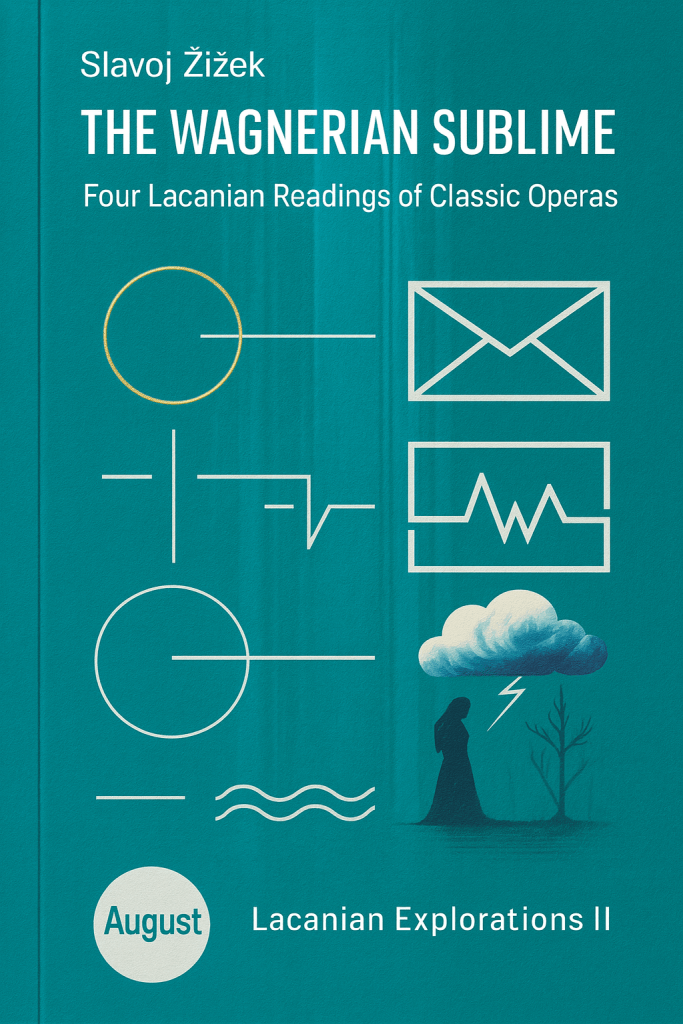
Žižek’s The Wagnerian Sublime: Four Lacanian Readings of Classic Operas stakes a precise claim: that opera’s most persistent scenes of longing, blockage, and impossible union are not melodramatic ornaments but analytic diagrams of desire’s economy, and that music—the privileged bearer of an inner “truth”—stages the objectless insistence of drive more rigorously than narrative ever can. Across Wagner, Tchaikovsky, Janáček, and Schoenberg, he reconstructs how ritual, confession, duel, storm, and scream crystallize the deadlocks of erotic and political life, and how these forms, when pressed to their limit, expose the surplus that no subject can “live.” The distinctive contribution lies in re-situating familiar operatic topoi (the Liebestod, the letter scene, the punitive storm, the hysterical monologue) within a lateral network of correspondences that binds composers, characters, and motifs into a single psychoanalytic topology of the sublime.
The book’s outer frame is spare and decisive—part of the “Lacanian Explorations” series, it presents four essays that are less discrete case studies than interlocking relays: a long inquiry into Wagner, then excursions through Tchaikovsky’s Onegin, Janáček’s Káťa Kabanová, and Schoenberg’s Erwartung. The composition sequence matters, because the first essay builds a methodological matrix (death drive against Schopenhauer’s oceanic feeling; mathematical versus dynamic sublime; ritual as the solution and problem of meaning) that the later essays redeploy and displace. The movement is cumulative and rotational: what appears in Wagner as dynamic exaltation returns in Janáček as symbolic weather, in Tchaikovsky as the detour of a duel that misses its true address, and in Schoenberg as the remainder the form cannot absorb. The trajectory is declared in the table of contents—The “Lehrstück” Parsifal, The Portrait of a Russian Gay Gentleman, The Young Woman and a River, Staging Feminine Hysteria—and punctuated by sectional rubrics that signal both argument and mise-en-scène: “Wagner with Kierkegaard,” “Wagner as a Theorist of Fascism,” “Marxism against Historicism,” “Art and the Unconscious,” “The Impasses of Atonality,” “The ‘Dream-Thought’ of Erwartung.” These labels do not subdivide the essays into summaries of plots; they telegraph a procedure: to treat formal features as lateral links that cut across composers and epochs.
The book opens by rectifying a too-easy opposition between a Freudian unconscious of coded sense and a nineteenth-century aesthetic unconscious of oceanic dissolution. Žižek affirms the difference yet insists that Freud’s “death drive” is neither a name for Schopenhauer’s self-obliterating Will nor a sanction of nihilist entropy, but a compulsion-to-repeat that persists “beyond life and death,” stubborn like a motor that will not switch off; in that insistence he locates the kinship between psychoanalysis and modernist form, wherein small, non-narrative details “insist” against plot and affect. This is method: the libretto’s declared content is less decisive than the structural reiteration that makes music resemble drive—an insistence without positive aim, a pressure that cancels expression when pushed to its end. The argument is textually secured in the initial pages’ three-point supplement to Rancière: modernism breaks with late-Romantic self-dissolution; the death drive is anti-entropic insistence; and Wagner’s Romanticism cannot be reduced to a formless abyss because music, in this tradition, “speaks” the noumenal—what Rousseau, Schopenhauer, and Lacan align with a truth that words dodge.
Placed against that conceptual armature, Beethoven’s Symphony No. 9 becomes a dialectical test: the same gesture that reads as dignity at one angle appears as hysterical flailing at another. The point is not a taste verdict; it secures the book’s central aesthetic thesis: there is no kitsch “in itself,” because context can redeem a melody by defetishizing it, as with the transposition that allows a “kitsch” Lehar line to emerge organically in Bartók. But this redemption has a terminal point. When music descends to the subject’s core, it arrives at an enjoyment the subject cannot “own”; the voice turns mechanical, the human returns as automaton, as in the frozen mimicry of Schubert’s Leiermann. This is both an interpretive claim and a method statement: read the moment when form flips into the automatic, because there the drive shows itself as the kernel that expropriates the subject from itself.
Within this matrix the book’s titular “Wagnerian sublime” is split. Žižek distinguishes a Rossinian “mathematical sublime”—the mania of demands flooding the subject, exemplified by Figaro’s ecstasy at being overwhelmed—from Wagner’s “dynamic sublime,” the concentrated absolutization of a single demand, the unconditional call of love that culminates in Tristan. The contrast is exacting: in Rossini the hero’s jouissance is to be bombarded by requests; in Wagner it is to be overpowered by the one. The Kantian pairing is more than analogy; it formalizes an ethics of address: obsessional happiness in the other’s demand versus ecstatic subjection to a singular injunction. This judgment is textual, argued through examples and Kantian nomenclature; it is not an external imposition.
Built from that opposition, the first essay proceeds by “horizontal” interpretation rather than vertical hermeneutics: compare motifs laterally—Kundry’s kiss against Siegfried’s, the Grail against the Ring, the staged competition in Tannhäuser against the comic contest in Meistersinger—to disclose a web of structural relations that no single plot yields. Wagner’s triad—Tristan, Meistersinger, Parsifal—is aligned with Kierkegaard’s aesthetic/ethical/religious stances: uncompromised passion that embraces death; sublimation into the ethical and return to symbolic obligations; and finally a religious denial in ecstatic jouissance. The sequence is not archaeological but functional: one opera answers a deadlock in another by displacing its coordinates. The book emphasizes this as a compositional logic, not a periodization; its evidence is the micro-linkages Wagner orchestrates—a logic of echoes rather than a chain of meanings.
The strongest dislocation concerns ritual. Parsifal is read as a learning-play about liturgy under conditions of lost transcendence: if no outside guarantees the rite, what does the rite do? The answer is two-sided. Ritual secures the zero-degree of sense—not a determinate content but the thereness of meaning that compels interpretation; at the same time ritual can slide into ersatz religion, its aesthetic climax indistinguishable from “Klingsorian” spectacle. Here Žižek’s argument tracks a paradox—liturgy both keeps open the place for radical change (by sustaining a signifying non-sense that solicits invention) and risks occluding it (by satisfying the demand for mystery with a predictable big number). This double movement is documented in the analysis of Parsifal’s Grail scenes and in the question of whether Amfortas’s resistance, complaint, and acquiescence are themselves part of the rite—interpretive claims anchored in the essay’s core pages.
The same liturgical problematic is extended to political ceremony: the staged “Storming of the Winter Palace” in 1920 is cited to underscore that even revolutionary rupture requires a frame of enactment—“all of Russia acting”—that both produces and reflects the enigmatic surplus of meaning. The inference is measured: it is not that Parsifal is “really” about politics; it is that ceremony, wherever it appears, does the same work of organizing the gap between the certainty that something means and the absence of a specific what—it sustains the objectless insistence that compels new sense. This is a methodological relay, not an allegory; the book marks it as such.
From here, the Wagner essay models another kind of relay—between the community and the singular subject who “sticks out.” The tension between Grail chorality and the chromatic otherworld of Klingsor is sharpened by the fact that the music’s most forceful passages belong to individuals (Amfortas’s two laments, and Parsifal’s decisive refusals). Schoenberg’s Moses und Aron is invoked as a radicalization of this split—between a communal choral spirit and the singularity of Moses’s Sprechstimme—to name a constitutive impasse rather than a solved problem. The parallel is neither casual nor topical; it installs a second axis across which the later essays move, shifting the stress from the “we” of ritual to the “I” that resists absorption, and from Wagnerian chromaticism to the non-absorbable remainder of atonal form. The author explicitly coordinates these axes in discussing Parsifal and Moses und Aron.
A controversial strand of the Wagner chapter undertakes a double displacement of commonplaces about proto-fascism and anti-Semitism. First, by presenting Hagen as a prefiguration of the ruthless executive whose “fidelity unto death” offloads the ruler’s dirty work, the essay isolates a structure of delegated cruelty that survives any simple moralization; second, by refusing historicist decoding (“Alberich is a Jew; Amfortas’s wound is syphilis”), it insists that such figures are already encodings of social antagonism, not their referents. The argument is anti-reductive without being exculpatory: Wagner’s practice sometimes undercuts his prejudices from within, and the Ring’s catastrophe arises from Wotan’s foundational violence—law’s self-wounding—long before Alberich’s revenge. This is a contentious thesis, but it is advanced with internal textual warrants: the contrast of the White and Black Alb; the spear of runes that fossilizes law; the Wanderer who inherits the “wandering Jew” position. The central methodological claim—read the opera’s own plasticity before applying codes—is stated explicitly.
In this same argumentative register, Parsifal’s obscenity is relocated. Rather than treat the decay of the Grail order as ossified institution, Žižek points to an excess of life at its core, personified by Titurel as obscene père-jouisseur—a reading he illustrates with a staging in which Titurel emerges as a frog-like creature demanding the rite’s unveiling to feed his enjoyment. The claim is intentionally anti-edifying: the community’s sickness is immanent, not introduced from outside; Klingsor is an ex-Grail knight; the imbalance begins with the father’s demand. The book marks this as a textual redirection (Titurel’s unrelenting imperative, Amfortas’s pleas) and uses it to pry open the famous line “Erlösung dem Erlöser”—not as a call to “de-Semitize” Christ but as a tautological admission that only the wound’s own spear can close it. The concluding inference—the paradox that revolutions must consume their own children to stabilize—belongs to the book’s dialectical habit: it draws a structural lesson from a textual knot.
If Wagner furnishes the book’s conceptual grammar, the Tchaikovsky essay stresses the oblique self-entanglement of life and form, not as biographical key but as evidence that fiction supplies the coordinates through which the composer interpreted his predicament. The Onegin reading pivots on two claims, both textually secured. First, that Francesca da Rimini—composed just before Onegin—supplies the negative horizon: consummated heterosexual passion appears as infernal punishment, a storm that separates lovers forever; this gives retrospective weight to Onegin’s double miss, where letters arrive and are refused in mirror sequence. Second, that the famous duel is misaddressed: the true triangle is not two men for Olga but Olga and Onegin competing for Lensky, because the libretto’s rhymes and placements cue Lensky’s aria to address not Olga but Onegin—“desired comrade, come, I am your husband”—a masculine address that emerges when the poetry is sung in the scene’s altered sequence. These are not extrinsic speculations; they are argued from the opera’s textual choices and staging possibilities the essay explores.
The larger claim follows: Onegin’s tragedy is not that desire fails to meet its object but that desire is calibrated by the obstacle that makes the object unobtainable. In Act I Tatyana’s love is “false” in the technical sense—she loves an image prefigured in her book; only in Act III does she love the man, and by then Onegin’s love is “false” in the complementary sense—what ignites him is the elevation of the woman into the prohibited place of the older husband’s wife, the structural triangle of courtly love. The point is not psychology but economy: the desire is of the obstacle, and the libretto dramatizes this by staging the letter/rejection symmetry, then bringing Onegin face-to-face with the prohibition that gives his passion its contour. This reading is marked in the essay with exact quotations from the libretto’s English version and the analysis of the “why now?” question that isolates the obstacle as the motor.
Where the Wagner chapter centered ritual, the Janáček essay centers weather—storm and river—as figures of the “big Other,” the substantial Real whose cycles, in a pre-modern matriarchal universe, orient life and return to their place. The argument is careful: it treats the river as the Great Mother, the storm as her anger, and shows Káťa Kabanová poised at the limit where electricity abolishes natural night even as the subject’s core becomes the Night of the World. This is not a metaphorical flourish but an explicit analytic schema the essay develops: in a society still keyed to natural cycles, confession and death rejoin the river; in an industrial one, the compass disappears and—and this is the hinge—hysteria steps forward as the modern figure because the “Other” loses wisdom and reveals its stupidity. Paul Robeson’s rewritten “Ol’ Man River” is adduced to secure the shift: the river “keeps rolling,” but stripped of sage indifference; it is now the blind endurance of an order that should be fought. The book marks this as a transformation in the Other’s status that does not yet happen in Káťa Kabanová—hence the heroine’s collapse into confession, not revolt.
The Janáček chapter also sharply contrasts two confessional economies: Jenůfa’s murder and confession, both “for love,” operate as tragic justification; Káťa’s affair and public avowal are non-crimes that serve no prudential good and precipitate self-destruction. This distinction is textual, grounded in the libretti and the operas’ ethical atmospheres, and leads to a compositional tableau of couples in Act II: the normal joy of Varvara and Kudrjaš; the sadomasochistic moral monsters Kabanicha and Dikoj; and Káťa with Boris, situated between, whose failure is overdetermined because Kabanicha’s world hates not insincerity but the absence of it—she demands hypocritical form, not authentic affect. The analysis is explicit that Kabanicha’s reproach is for failing to perform grief, not for failing truly to feel it. This is internal to the act’s construction and to the economy of ritual form the book has been tracking.
The contrast with Shostakovich’s Lady Macbeth of Mtsensk sharpens the historical thesis. There the heroine kills her husband and father-in-law and is rewritten—by libretto and reception—as a Soviet moral triumph of feminist revolt, whereas Janáček’s Káťa turns violence against herself. The essay’s comparison remains scrupulous: it notes what the Shostakovich adaptation omits (the third murder) and why; it cites the programmatic claims about a “ray of light” in the Dark Kingdom; and it locates the difference of staging the sexual act itself—full onstage display versus offstage consummation—as a structural marker, not a moral index. The lesson is austere: different regimes of the Other engender different logics of act; Janáček’s space is the “heroic innocence of the Unconscious,” before psychoanalysis transforms artistic practice; after that transformation, opera in the classical sense becomes increasingly impossible, because modernism will insist on the remainder as such.
This insistence sets the stage for the Schoenberg essay, which assembles the book’s conceptual threads—the non-absorbable remainder, the collapse of natural compass, the hysterical woman as modern figure—into a reading of Erwartung as form organized by what it cannot contain. The claim is crisp: in “cheap melodrama,” music returns the repressed content; in Erwartung, what is repressed is not a determinate content but the void of subjectivity that eludes musical form and therefore appears as its remainder. The consequence is not a disorder of narrative but a precision of excess: the work is the map of its own impossibility. This is the Lacanian turn of the screw the book has been aiming toward: the sublime is not the swelling of meaning but the exposure of a pressure that de-subjects expression. It is corroborated in the essay’s closing pages, where “the impasses of atonality” and the “dream-thought” of Erwartung are proposed as names for a formal situation whose truth the Wagnerian system glimpsed but could not state.
It helps, at this point, to gather the book’s methodological moves, because the four essays do not simply line up four composers. The first move is the substitution of lateral comparison for thematic interpretation. The text explicitly instructs readers to compare kisses, rings, contests, choruses; to track how an element does different work in different frames. This is the analytic reconstruction of a network in which motifs circulate as operators of desire. The evidence is collected in the Wagner essay’s programmatic paragraph on “horizontal” reading.
The second move is a sustained refusal of historicist decoding that would stop at “X stands for Y.” The book’s polemic against reduction (Alberich “as Jew,” wound “as syphilis”) is not an apologia; it is an insistence that ideological figures are themselves condensations of antagonism, not transparent names for it. Accordingly, the normative stance is to let the opera provide the context for its epoch, not vice versa. This methodological claim is expressed directly, with the telling aside that the eye-witness “lies” if context is allowed to smother the work’s own plasticity.
The third move is the conversion of ritual from metaphysical guarantor to structural frame. By reading Parsifal’s ceremonies as both necessary and suspect, Žižek installs a principle that reappears as weather in Janáček and as amputated guarantee in Schoenberg. Liturgy is the organized maintenance of non-sense; when it fails, subjects either confess into the river or spin in the forest without compass. This is neither moral lament nor triumphal modernism; it is a map of positions in which the subject can or cannot “own” the kernel of enjoyment. The book’s explicit reflections on the zero-degree of sense and the vitality of enigmatic signifiers ground this claim.
A fourth move concerns how the community and the exceptional voice are staged. In Wagner, Amfortas and Parsifal puncture the chorale; in Schoenberg, the Sprechstimme opens a rift in communal song; in Tchaikovsky, the letter and the aria readdress themselves; in Janáček, the public avowal overwrites prudential calculus. The formal lesson is consistent: the singular event is not the content of speech but the shift in address that redistributes who is speaking to whom—Lensky’s masculine “comrade/husband” rhyme sung as if to Olga but cued to Onegin; Tatyana’s Act III question that reveals the structural obstacle as motor; Káťa’s confession spoken to a crowd that cannot metabolize it; the hysteric’s speech in Erwartung that constructs its own void. Each case is argued from textual, musical, or staging details the essays carefully extract.
In this field of operations, what then is the “Wagnerian sublime”? Not a single feeling or tone, but a rule of transformation: under the dynamic sublime’s overpowering demand, subjects either ritualize the demand into liturgy (with all the risks of spectacle), sublimate it into ethical work, die into it as passion’s truth, or deny it by affirming a higher, religious jouissance. The pattern is marked in the Kierkegaardian triad and in the work-to-work relays the book traces. And because this rule is formal, the Rossinian “mathematical” counter-case is not a foil; it is the other operator the field requires. Together they render the two economies of excess within which nineteenth-century opera oscillates. The book’s evidentiary basis for this pairing is explicit and abundant in the opening essay; it is not merely asserted.
At a finer grain, Žižek’s Wagner chapter advances several precise textual theses. The Tannhäuser conflict is not “body versus spirit” but a split within the sublime: Venus and Elisabeth are both metaphysical figures, respectively of excessive enjoyment and untouchable ideality; the sin is to raise sexuality to absoluteness, joining the sacred on its reverse. Hence the staging proposal—one singer for both roles—to exhibit the identity of the adored woman under opposed attitudes. The result is a disturbance in sublimation, oscillating between Law and Superego, Ideal-Symbolic and Real. This is not a provocation from outside; it is a consistent reading of the opera’s logics and recalls the earlier claim that Wotan’s violence, not Alberich’s resentment, inaugurates catastrophe.
A second Wagnerian thesis concerns Parsifal as a “learning-play.” The work’s own text invites the reversal of pieties: the obscene father who demands the ritual, the tautology in which the wound is healed only by its own spear, the “Redeem the Redeemer” that names a circular structure rather than a confession of theological guilt. The essay’s most striking inference—the suggestion to re-inscribe Parsifal in the tradition of revolutionary parties—does not claim that Wagner’s politics are radical, but that the structure of self-wounding and self-redemption, if lifted from its religious frame, clarifies a logic of revolutionary stabilization. The textual anchor is the pair of formulae the essay foregrounds.
The Tchaikovsky chapter’s most precise claim is that Francesca retroactively encodes Onegin’s avoidances. A woman reading suffering lovers at the opera’s start can plausibly be reading Dante; the pale face that “finds pleasure in pain” is configured to be captured by the obstacle, and the opera’s structure obliges: letter and refusal in mirrored acts, desire aroused by prohibition. The reading of Lensky’s aria is not a hermeneutic flourish but a close attention to rhyme, pronoun, and staging, which, when arranged in the opera’s sequence, relocates the addressee. The essay then advances regulated conjectures—how one might stage Act III as Onegin’s fantasy after the duel; how one might reorder acts to make the fatal logic explicit. These proposals are flagged as possibilities, not textual necessities; the distinction between secured claims and speculative staging is maintained.
The Janáček chapter’s most exacting contributions are twofold: the differentiation of confessional logics and the cartography of couples. The first isolates Káťa’s irrational confession and self-annihilation against Jenůfa’s sacrificial justification; the second places Káťa between normative youthful love and ritualized cruelty, thereby making her “perfect wife” status intolerable to a world that requires hypocrisy as form. The reading remains internal to the acts’ speech situations; it does not appeal to sociology for its force.
Finally, the Schoenberg essay secures the book’s closing clarification. Where Wagner believed that music could carry the noumenal truth as ritual spectacle—his most naive and most audacious claim—Erwartung shows the form confronting its own remainder, staging not an ineffable content beneath narrative but the subject’s vanishing point that music can only circumscribe. To name this is not to celebrate atonality as emancipation; it is to register “impasses,” genuine blockages that only an art after psychoanalysis can acknowledge without recourse to the big Other’s wisdom. The book ends not with triumph but with a technical settlement: opera becomes a theater of remainder, or else it retreats into ritual and spectacle. The text says this plainly.
Across the four essays, then, the book’s evidentiary pattern is steady: claims about desire’s economy are secured by local textual details—rhymes, pronouns, stage timings, recurrent ritual forms—while broader historical and political inferences are openly marked as such and kept under the governance of those details. Where the author stages conjectures—staging Tannhäuser with one singer; reordering Onegin’s acts; reading Parsifal’s finale as revolutionary tautology—they are framed as productive thought experiments anchored in the works’ own compositional choices. The constant is a forensic ear for how music and libretto triangulate a scene’s address, how ritual frames meaning without determining it, and how the subject appears at the point where expression freezes into mechanism.
Clarifying, at the end, the precise scholarly stake: The Wagnerian Sublime offers a method for reading opera as a laboratory of psychoanalytic structures rather than a gallery of narratives. Its distinctive contribution is to replace moral and historicist decodings with lateral formal relays that let Rossini illuminate Wagner, Dante illuminate Tchaikovsky, electricity disclose Janáček’s storm, and Moses und Aron mirror Parsifal. The wager is that music’s truth lies where it cancels its own expressive pretensions—in insistence without aim, in ritual without guarantor, in confession without prudence, in a scream that draws the border of form. In that sense the book is not about four operas; it is about a single topology of the sublime that these operas, in their differences, collectively inscribe.
DOWNLOAD: (.pdf)


Leave a comment