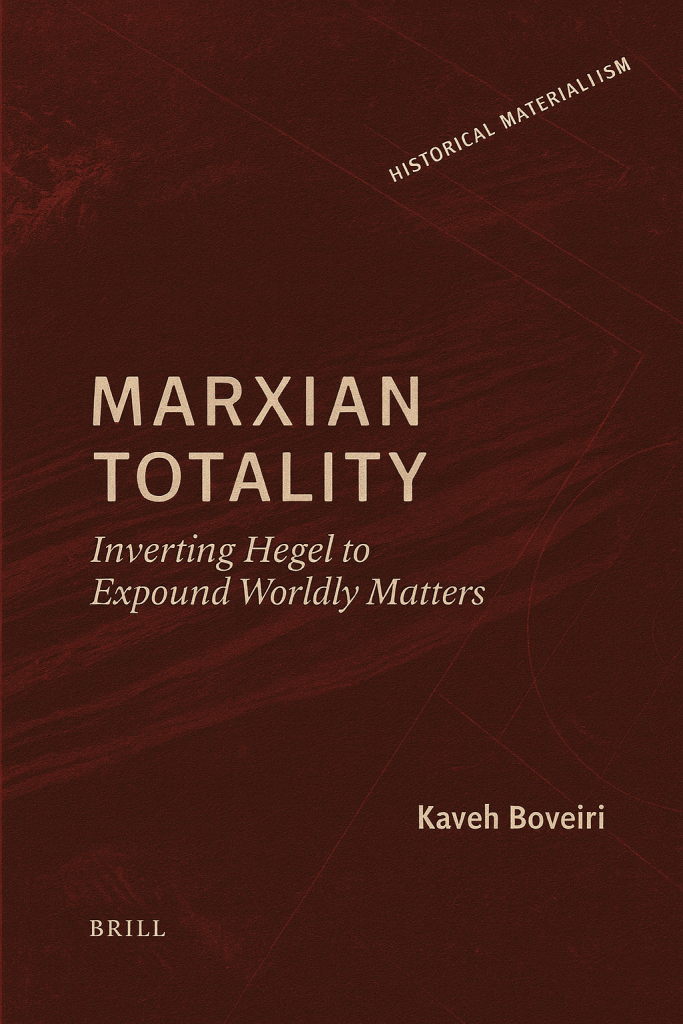
The declared ambition of Marxian Totality: Inverting Hegel to Expound Worldly Matters is methodological before it is doctrinal. Its opening gesture situates the project in a landscape where Marx’s intellectual preeminence sits uneasily alongside theoretical disarray on the Left; from this discrepancy Boveiri extracts a single wager: that clarity about totality—what it is, how it moves, how it can be known and presented—provides the missing ground for coherent analysis and practice. The argument proceeds by carefully pruning away two persistent misdescriptions, measuring Hegel’s systematic achievement against its own closures, recalibrating two emblematic Marxist attempts (Lukács and Kosík), and only then staging the positive determination of Marxian totality as a categorial movement reconstructed across Marx’s early and mature writings. The concluding move denies any methodological rupture between the Grundrisse and Capital and instead articulates a strict relation between the method of enquiry and the method of exposition, a relation that does as much to dissolve stale polemics as it does to state the internal architecture of Marx’s procedure. The book is thus both a map of false trails and a reconstruction of a path that constantly doubles back on its own presuppositions, not to neutralize contradiction, but to complicate it into a principle of intelligibility.
The initial clarification treats totality as a contested name whose history is saturated with methodological distortions. Boveiri’s diagnosis of the atomist-rationalist picture reconstructs Wittgenstein’s early Tractatus stance as a paradigmatic case in which the “totality of facts” evacuates the very concept of a world in process, because a logic of independent items and yes/no valuations cannot accommodate genuine becoming, mediation, or internal relation. The result is an illegitimate whole, a sum that remains external to its parts and a mystified standpoint in which the whole, as whole, is either unsayable or epiphenomenal. That this stance appears to save “totality” by naming it only shows, on Boveiri’s reading, how a grammar of discrete facts abolishes the conditions for a dialectical whole to appear as more than aggregation or limit feeling; its quietism about change and connectedness is the index of a methodological error that confuses enumeration with comprehension. The symmetrical error, exemplified via Schelling and Spann, reverses the priority and hypostasizes the whole, assigning to it existential precedence and explanatory force over its parts. This produces a metaphysics of emergence without law, a politics of subordination where Allheit becomes a warrant for hierarchy. Boveiri’s point is not that each picture contains nothing true—it is rather that each, by absolutizing one pole of the whole/part relation, destroys the very reciprocity by which wholes and parts are co-determined, mediated, and transformed. The consequence is not only theoretical: atomism tends toward a society of isolated individuals; organicism lends itself to corporatist or despotic imaginaries. A Marxian conception is proposed as the only one capable of stepping outside this binary without defaulting to mere eclectic compromise.
The pivot to Hegel is neither ritual homage nor ritual denunciation. Boveiri’s reconstruction in the Science of Logic tracks how “totality” appears as a sequence of determinate shapes: as a presupposed, indifferent, and formal whole at the level of Being; as a reflected and relational unity in Essence; and as Begriff—the notion that is itself totality—in the Doctrine of the Notion. The detail matters because the concept’s itinerary is the method’s itinerary: only when each determination undergoes a double transition—forward into its successor and back into its predecessor—does a whole become more than an inert container or a merely negative unity. Yet the same measure that allows Boveiri to register Hegel’s unparalleled articulation of internal relation obliges him to name the closure that results when the system’s completion leaves little space for a subject whose practical transformation of social reality is genuinely open, historical, and future-bearing. On this reading, the logical accomplishment is taken over, the teleological consummation is not.
The engagement with Lukács is exemplary in its equilibrium. Boveiri does justice to the fact that Lukács placed totality at the center of Marxist method and recognized that what distinguishes a dialectical science is not the primacy of any one motive (least of all an economistic one), but a standpoint in which the “concrete totality” names the category adequate to reality and to its intelligibility. Lukács’s insistence that method and proletarian praxis are internally bound by the category of mediation remains, for Boveiri, a decisive gain; it rebinds knowledge to the process that produces its object and subject alike and refuses to let “revolution” be a punctual event abstracted from a processual continuum. But this same fidelity to totality sometimes slides, in Lukács’s formulations, toward an “all-pervasive supremacy of the whole,” and Boveiri is attuned to how such phrasing risks reinstating the organicist danger in a Marxist idiom, even where Lukács explicitly aims to overcome it. The critique is not dismissive: it disentangles an indispensable methodological insight from a rhetoric that can blur the reciprocal constitution of part and whole that a Marxian totality requires.
Kosík receives the most intricate treatment because his Dialectics of the Concrete provides Boveiri with the conceptual resources to name illusions of concreteness and to parse the vocabulary of object, objectivity, and objectification with a delicacy commensurate to Marx’s own usage. The lexical analysis—objekt/Objektivität versus Gegenstand/Gegenständlichkeit and the distinct valences they carry when attributed to praxis, to law, to social formations—becomes a methodological instrument. It helps Boveiri to mark how objective and objective do different work when we speak of reality as given and of reality as practically produced; the point is more than terminological, because the nuance secures a path between a naïve objectivism and an idealism of forms without material traction. Still, Boveiri identifies two deficits: Kosík leaves underdeveloped the developmental differentiation of Marx’s own concept of totality across distinct works and moments, and he affirms the necessity of distinguishing enquiry and exposition without concretely reconstructing their internal relation in Marx’s practice. These lacunae set up Boveiri’s constructive core.
The heart of the book is a reconstruction of Marxian totality through sustained, text-internal exegesis. Here Boveiri’s claim is twofold: first, totality is not a label imposed upon the social world from the outside, but a movement of categories in which the forms of capitalist life reproduce and expose themselves as a structured whole; second, the movement can be tracked only if one respects both the historical genesis of Marx’s concepts and the systematic order of their presentation. The developmental thread begins with juvenile texts—letter and poem—as indices of early motifs that will be clarified rather than abandoned; passes through the 1844 Manuscripts, The German Ideology, and the Theses on Feuerbach, where praxis and the critique of reified objectivity prepare the ground; then pauses over the Grundrisse, whose explicit discourse of totality is both its strength and its risk, oscillating between chapters on money and capital; and finally settles in Capital, where the term “totality” recedes but the form of the totality saturates the exposition as categorial movement. The decisive demonstration is to show how “commodity,” as the cellular bearer of the whole, is rendered determinate through the progression across the three volumes—production, circulation, and the configurations of the total process—until the movement culminates in the category of “classes.” The method does not simply “add” domains; it socializes, concretizes, and totalizes the initial abstraction such that the whole is cognitively reconstructed by exhibiting the necessary relations that bind its moments.
This reconstruction underwrites the book’s most programmatic thesis: there is no epistemological rupture between the Grundrisse and Capital. Rather, there is a difference in function within a single method. The Grundrisse performs the triune labor of enquiry—appropriating the material in detail, analyzing developmental forms, and tracking their inner connection; this work makes possible the method of exposition in Capital, where the real movement is presented in the order appropriate to its intelligibility. To state this relation is not to collapse the two moments. Enquiry and exposition are distinct, and against proposals that make the latter a mere “correction” of the former, Boveiri argues that they are internally related moments of one investigative method. The upshot is a precise answer to a long-standing question: how can a synchronic display of economic categories be true to their diachronic formation? By recognizing that enquiry traces the genesis that exposition presupposes in order to present necessity. The claim is textual, not speculative; it relies on Marx’s own formulation of the difference in form between the two and marshals close readings to show that the three volumes of Capital advance a unified leading thread from commodity to classes.
A significant merit of the book is its methodological conscience. The insistence that a Marxian totality cannot be either a sum or a hypostasis leads Boveiri to articulate a norm for intelligibility: totality appears in and as mediations that are themselves historical, contradictory, and productive of novelty. This entails that empirical richness and theoretical necessity are not opposed. The more a concept is differentiated through its relations, the more content it has; the more the content is grasped in its necessity, the less the concept is an empty generality. On this score Boveiri’s frequent returns to the double transition that animates Hegel’s logic are not digressions. They function as a reminder that the order of exposition in Capital is neither chronological reportage nor arbitrary architecture; it is an immanent reconstruction of a whole whose parts are what they are only in the relations that transform them. The criticism of Lukács’s occasional emphasis on the supremacy of the whole takes its force here: if the whole is “all-pervasive” in a sense that flattens the determinate autonomy of its moments, then the dialectic loses the very leverage it needs for critical explanation and practical transformation.
The long engagement with Kosík yields further dividends. By laboring over the nuances of object, objectivity, and objectification—and by showing how Kosík’s Czech and Marx’s German each encode distinctions that English often erases—Boveiri demonstrates that the methodological stakes of totality penetrate the micro-structure of philosophical vocabulary. The point of preserving these differences is not scholastic piety. It is to mark that a Marxian materialism cannot be an “objectivism” that flees the subjective under the banner of neutrality; it must be a theory of praxis in which the objective world is what it is by virtue of determinate human activity and in which knowledge is itself a moment of social practice. Only such an account can honor Marx’s insistence that the truth of human thinking is a matter of gegenständliche activity and that the “world of human praxis is objective” in a sense irreducible to the objectivity of mere things. The analysis spares neither naïve realism nor self-enclosed idealism; it routes between them by binding cognition to the structured totality that produces both objects and the forms of their intelligibility.
If the positive picture has a center, it is this: Marxian totality is a dynamic, open-ended process of categorial self-development whose unity is exhibited in the passage from simple determinations to complex configurations under conditions of capitalist social relations. That unity is neither static identity nor external aggregation; it is a movement that concretizes its starting point through mediations that are at once economic, juridical, and political. The structural implication is that there is no need to oscillate between methodological individualism and methodological holism. Individuals and structures are moments of a single total process, each co-constituting the other and each graspable only when their reciprocal determinations are laid bare. The political implication, made explicit in Boveiri’s early framing and return to Spann and Polanyi, is that a correct conception of totality keeps practice from collapsing into either atomistic market fatalism or organicist authoritarianism; it supplies the analytic wherewithal to see how “means and ends” can be related without fetishizing either.
The book’s constructive difficulty is, fittingly, the problem it sets itself to solve: how to write about totality without writing as if totality were a finished whole. Boveiri’s answer—a carefully staircased exposition that repeatedly re-anchors general claims in determinate textual analyses—makes the argument answerable to its own norm. The reader is not asked to accept a thesis about Marx’s method; they are shown how the thesis is enacted when one reads the opening of Capital in light of the role assignments that Marx gives to the three volumes at the head of Volume III, and then follows that thread to “Classes.” That “totality” largely disappears as a word in Capital is part of the demonstration: when a concept has become the internal form of presentation, it need not announce itself to be operative.
By the end, the guiding claims stand in crisp relief. First, Marx’s concept of totality develops across his corpus in a way that can be reconstructed without invoking ruptures that sever youth from maturity or enquiry from exposition. Second, a dialectical method in the Marxian sense requires the distinction and coordination of two orders: the order of discovery that patiently tracks genesis and the order of presentation that exhibits necessity; to confound them is to court either empiricism without theory or theory without ground. Third, a materialist inversion of Hegel preserves the logic of internal relation and categorial movement while freeing it from a closure that would fix the future inside the system’s absolute idea; the openness of practice is not an addendum to method but its condition. These are not abstract consolations. They are criteria by which analyses of money, capital, circulation, profit, and class can be shown as moments of a single whole whose contradictions generate both crisis and the space of transformation.
One measure of the book’s achievement is that it renders familiar battle lines obsolete. The question “Hegel or Marx?” dissolves, not into syncretism, but into a precise distribution: take the categorial movement, leave the closure. The question “Lukács or his critics?” dissolves into a more discriminating accounting: retain the centrality of mediation and the concrete totality, resist formulations that inadvertently privilege the whole as sovereign. The question “Kosík’s concreteness or epistemological rigor?” dissolves once the lexical and conceptual distinctions are handled with the care Boveiri expends upon them. The remaining question—how exposition should be ordered when the world outpaces its own concepts—is not answered by a formula but by a practice: reconstruct the totality again, with the mediations that now exist. On that view, Marxian Totality is not only a contribution to the history of Marxist method; it is a manual for its renewal.
In placing method at the center and refusing both the aggregation of parts into a spurious whole and the hypostasis of a whole over its parts, Boveiri makes a substantive claim about the world that method seeks to know. Capitalist society is a structured process whose intelligibility emerges only when its categories are allowed to move, to externalize, to double back, to totalize. To write that movement without foreclosing its openness is the book’s constructive difficulty and its success. The result is a study that binds philosophical precision to sociopolitical consequence, clarifying how a dialectical totality can be both the critical form of knowledge and the immanent figure of a world that remains transformable because its unity is historical.


Leave a comment