Few works in the history of philosophy have exercised an influence as profound, enduring, and far-reaching as Plato’s The Republic. Written in the fourth century BCE, this monumental dialogue remains one of the foundational texts of Western political philosophy, ethics, metaphysics, psychology, and educational theory. Across ten interconnected books, Plato develops an extraordinary investigation into the nature of justice, the organization of political society, the foundations of knowledge, and the conditions necessary for a genuinely good and fulfilling human life. Far more than a speculative blueprint for an ideal state, The Republic is a searching examination of the relationship between the individual and society, between morality and political power, and between philosophical understanding and the pursuit of truth.
Presented through a dramatic conversation led by Socrates, Plato’s philosophical teacher, the dialogue begins with a deceptively simple question: What is justice? The discussion gradually expands as Socrates challenges conventional definitions offered by his interlocutors, including the provocative claim of the sophist Thrasymachus that justice is merely the advantage of the stronger. This confrontation raises a fundamental problem that continues to occupy political philosophers: Is justice intrinsically valuable, or is it simply a system of rules imposed by those who possess power? If injustice could guarantee wealth, influence, and happiness without the risk of punishment, would anyone have a compelling reason to remain just?
The challenge becomes especially forceful through the famous story of the Ring of Gyges, an object granting its possessor the power of invisibility. By imagining what an individual might do when freed from the consequences of wrongdoing, Plato explores the tension between moral character, self-interest, and public reputation. Socrates must establish not merely that justice produces desirable social consequences, but that living justly is inherently preferable to living unjustly, even when injustice appears to offer greater material rewards.
To investigate this problem, Plato constructs an ideal political community in thought, arguing that justice may be easier to recognize on the larger scale of a city than within the complexity of an individual human being. The resulting account of the just city introduces a carefully differentiated social order, organized around producers, auxiliaries, and rulers, whose respective functions contribute to the harmony of the whole. Plato then develops his celebrated theory of the tripartite soul, distinguishing reason, spirit, and appetite. Just as a well-ordered political community requires an appropriate relationship among its constituent groups, the just individual achieves psychological harmony when reason governs the other elements of the soul.
From this parallel between the city and the individual emerges one of the dialogue’s most influential insights: political justice and personal virtue cannot be understood independently of one another. The character of a political community reflects the dispositions of its citizens, while its institutions, customs, and educational practices shape the character of those who inhabit it. Questions of government consequently become inseparable from questions of moral psychology, intellectual development, and human flourishing.
Plato’s inquiry leads to his controversial conception of government by philosopher-rulers. He argues that political authority should ultimately belong to those who possess genuine knowledge of justice and the good, rather than those motivated primarily by ambition, wealth, popularity, or the pursuit of personal advantage. This proposal challenges ordinary assumptions about political legitimacy and raises enduring questions concerning expertise, democratic participation, political competence, and the dangers associated with the concentration of authority.
Equally provocative are Plato’s proposals for the education and organization of the ruling guardian class. He examines the formative influence of poetry, music, physical training, mathematics, and philosophical inquiry, insisting that education must cultivate the character and judgment necessary for responsible political leadership. His proposals include allowing suitably qualified women to serve as guardians and rulers, as well as establishing communal arrangements for property and family life among the guardian class. These radical suggestions coexist with stringent restrictions on artistic expression, individual freedom, and political participation, making The Republic a work of persistent controversy rather than an uncomplicated celebration of ideal government.
The dialogue reaches its philosophical height in Books VI and VII, where Plato introduces some of the most celebrated images in the history of philosophy: the Analogy of the Sun, the Divided Line, and the Allegory of the Cave. Through these interconnected accounts, he distinguishes between appearance and reality, opinion and knowledge, and the changing world of sensory experience and the intelligible objects of philosophical understanding. His theory of Forms culminates in the Form of the Good, which provides the ultimate foundation for intelligibility, truth, and the proper ordering of human life.
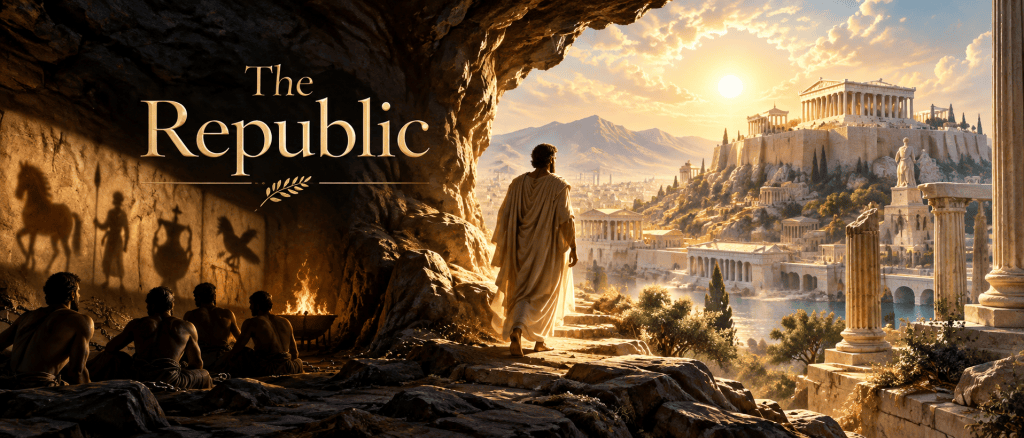
The Allegory of the Cave offers a particularly powerful representation of intellectual liberation. Plato imagines prisoners who have spent their entire lives confined within a cave, mistaking shadows projected upon a wall for reality itself. The difficult ascent of one prisoner into the sunlight symbolizes the transformation of consciousness through philosophical education: a movement from ignorance and illusion toward knowledge and understanding. Yet Plato’s account does not end with individual enlightenment. The liberated prisoner must confront the obligation to return to the cave, suggesting that philosophical insight carries responsibilities toward the political community. The allegory has consequently become an enduring point of reference in discussions of education, ideology, perception, intellectual freedom, and the distinction between reality and its representations.
In the later books, Plato turns from the ideal constitution to an analysis of political instability and moral decline. He traces a sequence of progressively deteriorating regimes, moving from an honor-centered timocracy through oligarchy and democracy to tyranny. Each political arrangement corresponds to a distinctive form of character, allowing Plato to explore how institutional structures and psychological motivations reinforce one another. His examination of democracy, particularly its susceptibility to disorder and the emergence of tyrannical leadership, remains among the dialogue’s most debated arguments. Although Plato’s political judgments often stand in sharp opposition to modern democratic ideals, they continue to provoke reflection on freedom, equality, demagoguery, political corruption, and the relationship between individual desires and collective authority.
The analysis culminates in an examination of the tyrannical personality, whose apparent possession of unlimited power conceals a profound condition of psychological enslavement. Plato argues that the individual ruled by uncontrolled appetite is ultimately less free, less harmonious, and less happy than the person whose soul is governed by reason. The dialogue thereby returns to its original question, attempting to demonstrate that justice is not simply an external social obligation but an indispensable condition of genuine human flourishing.
In the tenth and final book, Plato revisits the relationship between philosophy and poetry, questioning the capacity of artistic imitation to communicate truth and examining its influence upon the emotional and rational dimensions of human experience. His critique of Homeric poetry and dramatic representation raises fundamental problems concerning art, knowledge, moral education, and censorship that have continued to shape aesthetic theory. The work concludes with the extraordinary Myth of Er, an account of a warrior’s journey beyond death that explores judgment, the immortality of the soul, moral responsibility, and the choices through which human beings determine their destinies.
One of the remarkable achievements of The Republic lies in the breadth and integration of its philosophical concerns. A conversation initially devoted to defining justice develops into a comprehensive examination of political institutions, social hierarchy, education, gender, psychological conflict, the nature of reality, the acquisition of knowledge, artistic representation, and the ultimate purpose of human existence. Plato’s arguments are often radical, unsettling, and deliberately provocative. They invite readers not merely to accept a particular political ideal but to scrutinize the assumptions underlying their own judgments about morality, authority, freedom, and the good life.
The dialogue’s influence extends across more than two millennia of intellectual history. Its arguments helped establish central questions subsequently addressed by Aristotle, Neoplatonic thinkers, medieval philosophers, Renaissance humanists, German idealists, and modern theorists of politics and education. Its conception of justice as harmony, its treatment of philosophy as a transformative intellectual discipline, and its insistence upon examining the moral foundations of political authority remain indispensable points of reference in philosophical debate.
This highly regarded edition presents all ten books of The Republic in a modern English translation by Raymond Larson, making Plato’s intricate arguments and dramatic exchanges accessible to contemporary readers while preserving the scope and philosophical ambition of the original. Larson’s translation provides an opportunity to encounter one of antiquity’s most intellectually ambitious works in its entirety, following the development of Plato’s reasoning from the initial disputes over justice to the final reflections on the soul and its destiny.
At once a work of political speculation, a study of human psychology, an inquiry into the nature of knowledge, and a profound meditation on the meaning of justice, The Republic continues to challenge the intellectual foundations of individual and collective life. Its significance resides not simply in the answers Plato proposes, but in the questions he compels each generation to reconsider: What makes a society just? Who should govern, and on what grounds? Can knowledge provide a foundation for political authority? Are appearances reliable guides to reality? And, above all, why should a human being choose to live a just life?
More than two thousand years after its composition, The Republic remains an essential work for anyone seeking to understand the origins of systematic political philosophy and the enduring relationship between reason, virtue, power, and human freedom.


Leave a Reply