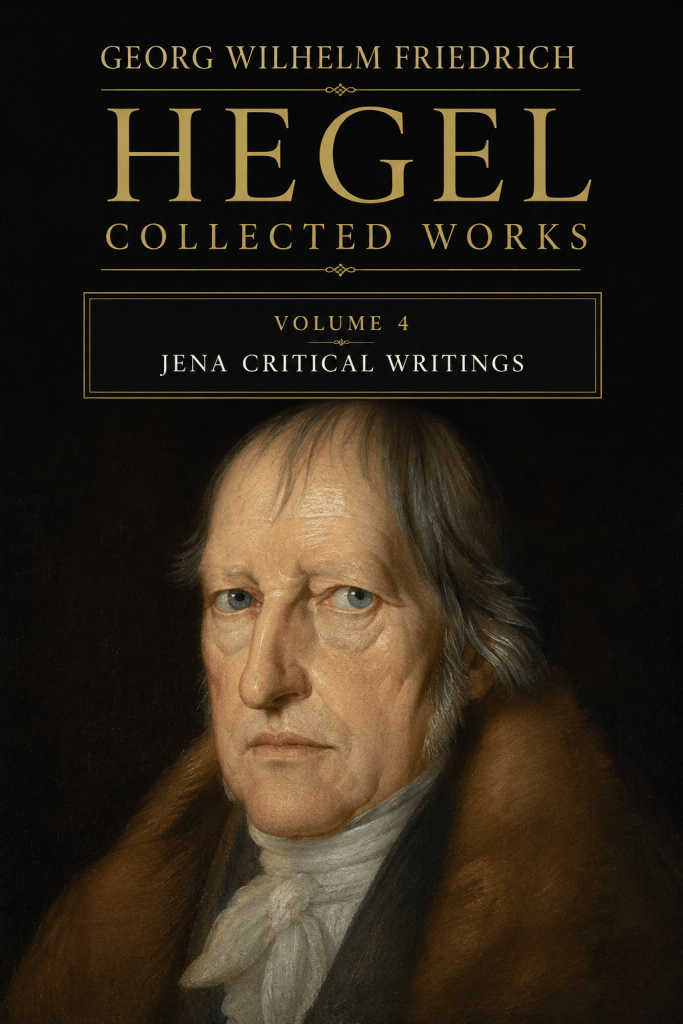
Collected Works, Volume 4: Jena Critical Writings marks a decisive transition in the intellectual development of Georg Wilhelm Friedrich Hegel. With these texts, the largely private theological, historical, political, and philosophical investigations preserved in the first three volumes give way to Hegel’s emergence as a public philosopher intervening directly in the central controversies of post-Kantian German philosophy. Based on Volume 4 of the authoritative Gesammelte Werke, edited by Hartmut Buchner and Otto Pöggeler and originally published by Felix Meiner Verlag in 1968, the volume brings together Hegel’s major critical publications from the opening years of his Jena period, including his first published philosophical book and the essays associated with the Critical Journal of Philosophy.
Hegel arrived in Jena in 1801 at a moment when the philosophical revolution initiated by Kant had produced an extraordinarily concentrated dispute concerning the foundations and limits of idealism. Fichte had transformed Kant’s transcendental philosophy into the systematic Wissenschaftslehre, while Schelling was developing increasingly independent philosophies of nature and identity. Reinhold, Jacobi, and numerous other thinkers were simultaneously attempting to determine what philosophy could become after Kant. It was within this environment that Hegel first presented himself publicly as an independent philosophical thinker. The Jena years would ultimately lead from these critical interventions through successive attempts at systematic philosophy to the Phenomenology of Spirit in 1807.
The volume begins with Hegel’s 1801 Difference between Fichte’s and Schelling’s Systems of Philosophy, his first philosophical publication. Ostensibly an examination of the distinction between two contemporary systems, the work is also Hegel’s first substantial public statement concerning the nature and task of philosophy itself. Against interpretations that treated Fichte and Schelling as representatives of essentially the same philosophical tendency, Hegel argues that a fundamental difference separates their systems. He criticizes the persistence of opposition and subjectivity within Fichte’s idealism while identifying in Schelling’s philosophy of identity a more adequate attempt to conceive the unity underlying the distinction between subject and object, freedom and nature, thought and being.
Yet the Difference essay is significant not merely because Hegel initially places himself close to Schelling. Already visible within it are conceptual tendencies that would eventually distinguish Hegel from both Fichte and Schelling. Philosophy is presented as responding to division or Entzweiung: the oppositions generated by reflection cannot simply be ignored, but must be comprehended within a higher unity that neither suppresses difference nor leaves it permanently unresolved. The problem of how unity can contain differentiation without collapsing into abstract identity becomes one of the central questions of Hegel’s subsequent development. In this respect, the work announces themes that would eventually become fundamental to his mature dialectical conception of reason.
The collection also includes Hegel’s reviews and notices from the Erlanger Literatur-Zeitung, directed at contemporary philosophical works by figures including Friedrich Bouterwek, Johann Friedrich Werneburg, Gerstäcker, and Wilhelm Traugott Krug. These shorter writings reveal Hegel operating within the immediate philosophical culture of his time, testing his developing conception of speculative philosophy against competing forms of transcendental idealism, formalism, empiricism, and philosophical eclecticism. The prominence of Krug is especially important, since Hegel repeatedly uses his work as an example of what he regards as the limitations of ordinary reflective thinking and its demand that speculative philosophy justify itself according to assumptions it is intended precisely to overcome. The surviving English translation project reflects the extensive range of these materials, extending from the Difference essay through the contemporary reviews and into the writings of the Critical Journal.
A substantial portion of Jena Critical Writings derives from the Critical Journal of Philosophy, founded and jointly edited by Hegel and Friedrich Wilhelm Joseph Schelling in 1802. The journal appeared only until 1803, but it became one of the principal vehicles through which Hegel formulated his emerging conception of speculative philosophy. Because many contributions originally appeared without individual signatures, questions of authorship have themselves formed an important part of the philological history surrounding these texts. The critical edition therefore preserves not only the philosophical writings but also editorial material concerning their genesis, attribution, textual transmission, and the collaborative intellectual environment in which the journal was produced.
Among these writings is the programmatic essay on the nature of philosophical criticism, in which Hegel considers what genuine philosophical criticism must presuppose and what distinguishes it from merely subjective judgment. Criticism, on this conception, cannot consist simply in placing one individual opinion against another. It requires an idea of philosophy itself and must determine whether a philosophical system genuinely raises itself to the standpoint of reason. The essay accordingly establishes a conception of criticism that is simultaneously historical, systematic, and immanent: philosophical positions are to be assessed through the principles they themselves claim to embody and through the contradictions that emerge from those principles.
The volume also contains Hegel’s extensive essay on the relationship of skepticism to philosophy, a text of considerable importance for understanding the prehistory of the dialectical method. Hegel distinguishes philosophical skepticism from the merely negative skepticism that treats knowledge as impossible. Properly understood, skeptical negativity belongs internally to philosophical reason because finite determinations reveal their own instability when consistently examined. The destruction of fixed oppositions is consequently not the terminus of philosophy but an essential moment in the movement toward speculative knowledge. This conception anticipates the systematic use of determinate negation that would become central to the Phenomenology of Spirit and the later Science of Logic.
Faith and Knowledge, published in 1802, expands Hegel’s confrontation with post-Kantian philosophy through sustained engagements with Kant, Jacobi, and Fichte. Hegel interprets these philosophers as different expressions of what he calls a philosophy of subjectivity: positions that recognize the inadequacy of finite understanding yet ultimately preserve an opposition between finite consciousness and the absolute. The absolute is consequently displaced into faith, an inaccessible beyond, moral postulation, or subjective certainty rather than comprehended philosophically. Hegel’s critique is already directed toward a central ambition of his mature philosophy—the demand that reason overcome the rigid separation between finite and infinite without reducing either side to the other.
Equally important is the major essay conventionally known as the Natural Law essay, in which Hegel examines the scientific treatment of natural law and develops an early account of ethical life. Here he criticizes both empirical approaches, which derive political and legal principles from isolated features of human nature, and formal approaches that attempt to construct ethical obligation from abstract universality. Against both, Hegel begins to formulate an account of ethical existence as an objective social whole in which individual freedom is constituted through institutions, customs, laws, and forms of communal life. The work represents an important stage in the development of concepts that would later receive systematic treatment as Sittlichkeit in the Phenomenology of Spirit and the Philosophy of Right. The structure of the present volume gives this essay a central place among the writings of the Critical Journal.
The collection ranges still more widely. It preserves Hegel’s critical discussions of contemporary philosophy of nature, philosophical construction, literary and cultural questions, reviews and notices concerning other authors, material connected with Dante and Scandinavian natural philosophy, announcements associated with the Critical Journal, maxims on German literature, and documentation concerning writings or reviews that have been lost. This breadth is philosophically significant. Hegel’s developing idealism was never confined to a narrow theory of knowledge: from its Jena beginnings it sought to comprehend philosophy, nature, ethics, law, politics, religion, literature, and culture as interconnected dimensions of a systematic account of reality.
Together these writings document a remarkable acceleration in Hegel’s philosophical development. The first three volumes of the Collected Works reveal the long formation of his thought through theological manuscripts, political reflections, historical studies, and extensive reading practices. Jena Critical Writings presents the moment when those accumulated concerns are transformed into an explicitly philosophical project. Hegel now confronts the most sophisticated philosophical systems of his age, develops a distinctive conception of speculation, investigates the philosophical significance of negativity and skepticism, begins constructing a theory of ethical life, and increasingly treats philosophical positions as historically determinate forms whose internal limitations generate the necessity of further conceptual development.
The volume is consequently indispensable for understanding the transition from the young Hegel to the author of the mature system. It occupies the intellectual territory between the formative manuscripts of Frankfurt and the systematic drafts that would soon follow in Jena. Many of the concepts later associated with Hegelian philosophy—absolute knowledge, speculative reason, dialectical negativity, identity and difference, ethical life, immanent criticism, mediation, and the overcoming of fixed oppositions—can be observed here before they acquire their mature systematic form.
Jena Critical Writings thus represents one of the crucial thresholds in Hegel’s Collected Works. Where Early Writings I, Early Writings II, and Early Excerpts allow the reader to reconstruct the formation of Hegel’s intellectual world, Volume 4 shows him actively entering the philosophical debates of his age and beginning to reshape them. It presents Hegel no longer principally as a young thinker preparing his philosophy, but as an emerging systematic philosopher whose critical engagement with Kant, Fichte, Jacobi, Schelling, skepticism, natural law, and contemporary intellectual culture was laying the conceptual foundations for the Phenomenology of Spirit, the Science of Logic, and the mature philosophy of spirit.


Leave a Reply