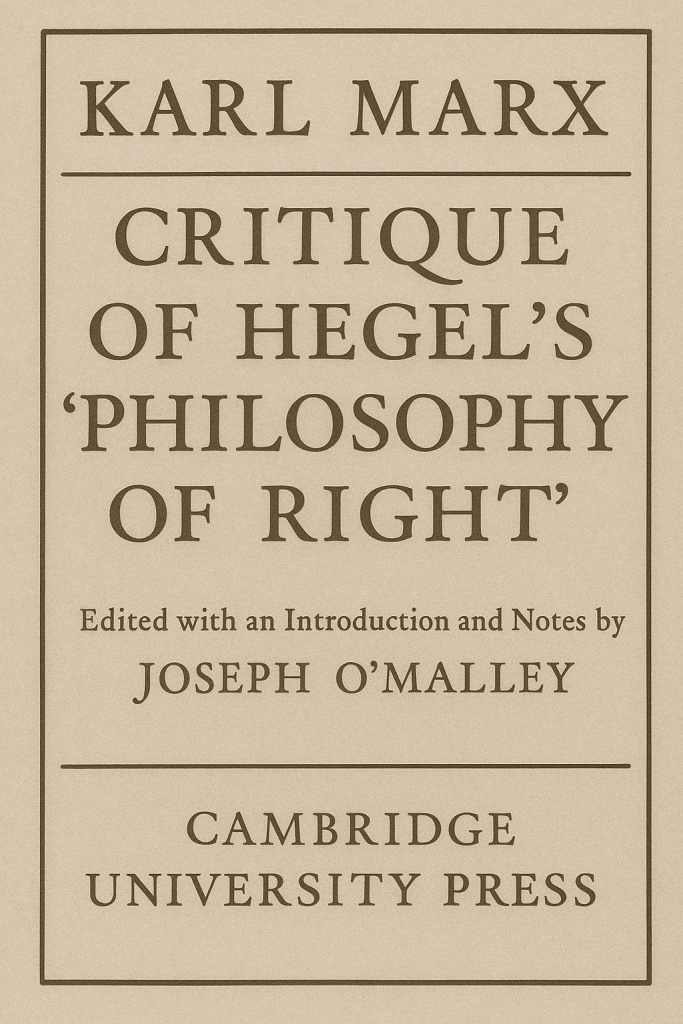
Karl Marx’s Critique of Hegel’s ‘Philosophy of Right’ asks what remains of Hegel’s constitutional doctrine once its speculative grammar has been separated from its descriptive content. Composed as a running commentary on the paragraphs treating the internal constitution of the state, and abandoned unfinished, the work pursues a single governing ambition: to establish that the mediations Hegel offers between civil society and the political state reproduce the separation they are appointed to overcome. Its value as an object of study lies in the visibility of its own procedure. Because the manuscript survives in the condition in which it was written, a reader can watch a method being assembled, tested against a text, extended by historical research, and finally outgrown by the results it generates.
The volume in which that manuscript reaches an English reader is itself an argument about how the manuscript should be read, and the first thing worth registering is the density of mediation that stands between the surviving leaves and the printed page. The book appears within a series devoted to the history and theory of politics, a placement that already assigns the text a genre: it is offered as a document in political thought rather than as a chapter in the history of metaphysics, though the text itself continually insists that the two are the same question posed twice. The Editor’s Preface states the textual protocol with unusual precision. The translation rests on the Berlin Werke text and on photographs of the original notebook held in Amsterdam; the earlier editions of Rjazanov, of Landshut, and of Lieber and Furth were consulted; every departure from the Werke reading follows Lieber and Furth on the evidence of the photographs, and every such departure is marked. Most consequential for the philosophical texture of the English text is a further decision announced in the same place: the passages Marx copies from Hegel appear in Knox’s Oxford version, on the ground that this is the standard English Hegel, and Knox’s renderings are therefore permitted to govern the translation of Marx himself. The reader consequently encounters a double displacement. Marx worked from Gans’s edition of 1833, as the Editor’s Introduction notes; the Hegel quoted here is Knox’s Hegel of a century later; and Marx’s own vocabulary has been aligned to that later English Hegel wherever the two texts touch. Since a considerable part of the commentary consists in demonstrating that Hegel’s transitions are effected by particles and by the placement of a single connective, the interposition of a translator between Marx’s ear and Hegel’s sentence is not a neutral convenience. It conditions what the argument can be seen to be doing.
The Editorial Note that stands immediately before the commentary makes the stratification explicit, and it deserves to be treated as a philosophical instrument rather than as housekeeping. Five distinct hands are separated typographically on the page. Marx’s own ellipses and insertions into the Hegelian text are marked; Knox’s additions to Hegel are marked; clarifications supplied by the translators appear in square brackets; the additions of the German editors appear in square brackets and are identified as theirs; footnotes by the German editors are keyed with asterisks, footnotes carried over from the Rjazanov edition and absent from the Werke are identified as such, and the notes prepared for the English edition are keyed with numerals. The effect is that a reader is never permitted to forget that the text is a reconstruction. Where Marx breaks off a Hegelian sentence with an ellipsis, the reader sees that the truncation is Marx’s own polemical act rather than an accident of transmission; where a bracketed word restores an antecedent, the reader sees that the manuscript’s syntax was elliptical in a way that presupposed a reader already holding the Hegelian paragraph in view. This apparatus performs, at the level of typography, exactly the operation the commentary performs at the level of argument: it distinguishes what is given from what has been supplied, and it refuses to let a supplied connection pass for a discovered one.
The table of contents prefixed to the commentary carries the same lesson. Its first entry is bracketed and unnamed, registering that the opening stretch of the manuscript bears no heading. The remaining divisions — the constitution considered on its internal side, the Crown, a résumé of Hegel’s development of the Crown, the Executive, the Legislature — are Hegel’s divisions. The commentary possesses no architecture of its own beyond the numbering of the text it follows. This is a formal fact with a doctrinal counterpart. The work’s central methodological wager is that Hegel’s descriptions may be retained while his order of derivation is dissolved; and the commentary form enacts that wager by borrowing its skeleton from the very text whose principle of articulation it denies. The single place where Marx interrupts the paragraph order to consolidate is the résumé of the Crown, and it is precisely there that the editorial intervention is heaviest: at that point Marx wrote a cross-reference to a later sheet of his own notebook, and all the German editions, followed here, transpose the material from that later sheet into the résumé. The one moment at which the commentary acquires a synthetic form of its own is therefore also the moment at which the reader’s sequence is determined by an editorial decision taken on the authority of Marx’s own marginal instruction. The instruction is his; the execution is theirs; the resulting continuity belongs to neither alone.
The Appendix to the Introduction supplies a description of the physical manuscript detailed enough to be read as evidence about the argument’s development, and the temptation to read it so should be handled carefully. The notebook lacks its cardboard cover and its first folded sheet, four sides in all, so that the text begins at what Marx numbered page five; the missing leaves probably carried commentary on the four paragraphs preceding the ones we have. Thirty-nine sheets remain, numbered by Marx in Roman figures from the second to the fortieth, with page numbering in his hand to a certain point and in a later hand thereafter. Several pages are blank and others only partly filled, almost always immediately before a blank, and the editor observes a pattern: Marx appears at intervals to have wanted a new development to begin at the head of a new sheet, leaving the remainder of the preceding one empty, as he did when opening his examination of the executive power. The watermarks change partway through the notebook, and a Dutch provenance is argued from them, which in turn bears on the dating, since Marx passed briefly through Holland after resigning his editorship. The handwriting varies from tight to open in a recurring rhythm, and one apparent break in composition is located at the remark distinguishing a constituent from a constituted assembly, shortly before a particular sheet begins. That break is the same place at which, on the editor’s account, the argument begins visibly to draw on the historical excerpting undertaken in the summer of 1843. It is an inference, and one worth marking as such, that the physical stratification of the notebook indexes an argumentative stratification: that the point at which the script changes is the point at which immanent commentary begins to require external historical material in order to continue. The textual evidence for the inference is that the commentary’s manner does change at approximately that place, and changes in the direction the editor describes, with medieval and modern institutional history entering as warrant where formerly the warrant had been a Hegelian sentence.
The Editor’s Introduction, which occupies more than sixty pages and thus stands in a relation of near parity to the text it introduces, is the volume’s most powerful interpretive operator, and its claims should be held apart from the manuscript’s own voice. It advances a developmental thesis about Marx’s intellectual life, organised around the proposition that criticism means for him three things at once — self-clarification, the clarification of others, and political organisation — and that his doctrinal development is continuous rather than divided into two incompatible periods. It offers a reconstruction of the pre-1843 political writings, drawing from them two claims: that the historical world of human institutions possesses its own immanent rational and ethical content, and that philosophy’s task is to grasp that content and to criticise the world by it. It reconstructs the Feuerbachian inheritance in detail, quoting the Provisional Theses on the conversion of predicate into subject and on the finite as philosophy’s proper beginning. And it proposes a schema of three critical techniques combined into a single procedure: a transformative criticism borrowed from Feuerbach, directed at the mystical form of the doctrine; a straightforward textual explication, which exposes the internal contradictions of Hegel’s account of existing political society; and a historico-genetic criticism, which clarifies those contradictions by tracing the genesis of the modern state, and whose technique the editor traces, following a French study he cites, to the influence of Savigny’s lectures at Berlin.
That schema is illuminating and it is not Marx’s. Nothing in the commentary announces three techniques or ranks them. What the commentary does contain, in a passage set off by the editors as one of Marx’s parenthetical excursions and placed at the height of the analysis of the legislature, is a methodological statement of a different shape. There Marx distinguishes a criticism that merely exhibits contradictions from a criticism that grasps their essence and necessity and comprehends their proper significance. The example he chooses is theological: an older criticism disposed of the doctrine of the Trinity by pointing to the arithmetical contradiction between one and three, whereas a true criticism exhibits the internal genesis of that doctrine in the human mind and describes the act of its birth. The generalisation drawn from the example is the sharpest methodological sentence in the work, and it is directed against Hegel’s practice in the form of a positive maxim: comprehension consists in grasping the proper logic of the proper object, in place of recognising everywhere the determinations of the logical concept. The reader should notice how much this maxim carries. It contains the demand for genesis, and therefore licenses the later historical materials; it contains the demand for specificity, and therefore licenses the recurrent complaint that Hegel’s determinations would apply equally to an animal organism or to the solar system; and it contains a theory of what a contradiction is, since a contradiction that has an essence and a necessity is a feature of the object rather than a defect in the concept of it. The three-technique schema names a procedure; the maxim states a criterion. The volume presents both, in different voices, and the difference between them is one of the more instructive frictions a reader has to manage.
The wager on which everything else rests is stated early and repeated with a regularity that becomes a formal signature of the work: within his peculiar philosophical form, Hegel depicts the existing institutions accurately. The commentary’s most explicit version of this appears in the remark on the second of the paragraphs it treats, where Marx observes that the difference lies in the way of considering the matter, or in the manner of speaking, while the content remains the same. He develops the point into a distinction between an esoteric and an exoteric history within a single exposition. The content belongs to the exoteric side, where the real development proceeds; the esoteric interest is to recover the history of the logical concept within the state. The consequence he draws is that empirical reality is at once emptied of intrinsic meaning and invested with a borrowed one, so that the features of the given order are preserved intact while being allegorically credited with ideal quality. Later he supplies a definition of that allegory in its most compressed form: the ascription to any empirical existent of the meaning of an actualised Idea.
This wager generates the work’s first and most persistent internal pressure. If Hegel’s descriptions are accurate, the object of criticism must be located somewhere other than in the descriptions; but if the object of criticism is the manner of speaking alone, the criticism risks becoming a stylistic complaint. The commentary handles the pressure by identifying a determinate operation performed by that manner of speaking, and by showing that the operation has consequences for what can be thought. The operation is the inversion of subject and predicate. Its canonical formulation occurs in the analysis of the paragraph in which the actual Idea sunders itself into family and civil society: the conditions are established as the conditioned, the determining as the determined, and the producing as the product of its own product. Family and civil society are the presuppositions of the state and the really active things; the exposition makes them the finite phase of an Idea that assigns them their material, so that the mass of human beings appears as the material an Idea parcels out rather than as the source from which a state issues. Marx’s translation of the paragraph into ordinary speech is intended to demonstrate that nothing is lost: the mediation of the individual’s station by circumstance, by caprice, and by personal choice is exactly what the speculative sentence reports, once the sentence is stripped of the pretence that this mediation is the appearance of a mediation the Idea conducts with itself behind the scenes.
From this the commentary derives a series of consequences that thicken as they recur. The most general is that logic here supplies the proof and the state supplies the illustration, so that the philosophical moment becomes the fact of logic rather than the logic of fact. Marx states this as a reversal of the philosophical task: the embodiment of thought in determinate political realities is replaced by the evaporation of those realities into abstract thought. He puts the same point institutionally by calling the entire philosophy of right a parenthesis to the logic, an insertion that leaves the logical development untouched, and by observing that the concrete determinations of the state could be exchanged for the concrete determinations of another sphere, such as physics, without disturbing the chapter of logic that remains when they are removed. The complaint that Hegel’s determinations fail to give a differentia specifica — that what is said of the organism of the state applies equally to the animal organism, and would apply to the solar system — belongs to the same family of objections, and it is worth noticing that this objection is the negative form of the positive maxim about grasping the proper logic of the proper object. The criterion and the complaint are one thought stated twice, and the fact that the criterion is formulated much later than the complaints it governs is the first clear instance of the work’s habit of determining its earlier claims retroactively.
Two subsidiary diagnostic instruments are developed within the same movement, and both recur later with altered weight. The first is the detection of tautology. To say that the parts of an organism stand in a necessary relation arising from the nature of the organism is a tautology; to say that the powers of a constitution determined as organic are related organically is another; and Marx’s point is that the appearance of derivation in Hegel’s sentences is produced by inserting an empirical proposition — that the members of the state are its various powers — between two statements of the tautology, and joining it with a connective that carries the force of inference. He goes so far as to set the paragraph out twice in parallel columns, once with the interpolated clauses removed, in order to display the seam. The second instrument is the detection of a hidden empirical borrowing. Where Hegel deduces the answerability of ministers and the irresponsibility of the monarch, Marx grants that the reasoning is conclusive if the constitutional provisions are taken as given, and observes that the provisions themselves are not established by being analysed. He generalises the observation into a claim about the whole: the uncritical character of the philosophy of right is rooted in this confusion, in which what is is presented as the essence of the state. The associated formula — that the assertion of the rationality of the actual is refuted by an irrational actuality which everywhere is the contrary of what it asserts and asserts the contrary of what it is — belongs to the analysis of the Estates, and its migration from the discussion of ministerial answerability to the discussion of popular representation is one of the clearest cases in the work of an argumentative responsibility moving from one conceptual cluster to another.
Against this apparatus the commentary sets, at an early point and inside a remark rather than at a systematic juncture, its one sustained positive doctrine. The passage on democracy arrives as a response to Hegel’s dismissal of popular sovereignty, and it changes the standing of everything around it. Democracy is called the resolved mystery of all constitutions; it is the generic constitution, of which monarchy is a species and a poor one; in it the constitution appears as what it is, a free product of men. The theological analogy is exact and is drawn explicitly: as man makes religion rather than religion man, so the people makes the constitution rather than the constitution the people. The distinction that carries the most weight is formulated as a chiasmus: in monarchy we have the people of the constitution, in democracy the constitution of the people. Marx adds that in democracy the formal principle is simultaneously the material principle, which makes it the first true unity of universal and particular; that in all other forms the state is dominant without really governing, without materially permeating the content of the non-political spheres; and that the political state, so far as it is constitution, becomes in democracy one self-determination of the people among others. The most radical sentence in the passage is attributed rather than asserted: the modern French, he reports, have conceived the matter as the disappearance of the political state in true democracy, and he endorses this on the ground that the political state ceases in democracy to be equivalent to the whole.
The tension this passage introduces is productive and never fully resolved. It supplies a standard by which every subsequent mediation is measured, and it does so before the institutions to be measured have been examined. From this point the commentary can be read as the systematic demonstration that each Hegelian device fails a test formulated in advance. Yet the standard is stated in a register that the rest of the work rarely uses. Democracy is characterised by way of genus and species, of form and content, of essence and existence; and the reader is entitled to ask whether a criticism whose principal charge is that political realities have been dissolved into logical categories can afford to state its own counter-position in the vocabulary of the Logic. Marx appears at the least aware of the difficulty, since the passage is careful to insist that democracy is the constitution’s return to its real ground, to actual man and the actual people, established as its own work. The ground named is human activity, and the logical vocabulary is used to describe the relation of that activity to its product. Whether the vocabulary can be so used without reintroducing what it was invoked to expel is a question the manuscript raises and leaves standing.
The democracy passage carries a historical thesis with it, and that thesis is where the historico-genetic dimension of the work first becomes load-bearing. The abstraction of the state belongs only to modern times because the abstraction of private life belongs only to modern times. In the medieval order property, trade, society and man were political; every private sphere possessed a political character, and the constitution of private property was itself a political constitution. Man was the actual principle of the state, and he was unfree, which is why Marx describes that order with a formula whose deliberate discordance is the point: it was the democracy of unfreedom, an accomplished estrangement. The modern order is characterised by contrast as an abstract dualism, where the medieval was a real one. In antiquity the public thing was the real content of the citizen and the private man was a slave; under Asiatic despotism the political state was the private will of one individual and both the political and the material state were slaves. What distinguishes the modern state from these is that its constitution has been formed into a particular actuality alongside the real life of the people. In the same register Marx supplies the formulation that governs the rest of the work and that the appended Introduction will later generalise: the political constitution has hitherto been the religious sphere, the religion of popular life, the heaven of its universality opposed to the earthly existence of its actuality, and political life in the modern sense is the scholasticism of popular life.
The treatment of the Crown takes the inversion operator and runs it to a conclusion that is meant to be intolerable. Sovereignty, as the moment of ultimate decision severed from the universality of the constitution and from the particularity of counsel, is identified with arbitrary choice — Willkür, the will’s groundless self-determination — so that the power of the crown and arbitrary choice become convertible terms. The two moments Hegel unites in majesty are then redescribed as the contingency of the will and the contingency of nature, birth, and their unity is named with a mock title: majesty is contingency. The argument about birth is conducted with a scrupulousness that is easy to underrate. Marx grants without reservation that the state acts through individuals, that a decision requires a decider, that subjectivity exists only as a corporeal individual, and that natural birth belongs to a corporeal individual. What he denies is the inference: it has been shown that a monarch must be born, and it has not been shown that birth makes a monarch. He presses the same distinction against the analogy with the ontological argument, granting that the conversion of concept into existence is precisely speculative and denying that this establishes a transition, since what is presented as identity is an absolute contradiction and what is presented as consistency is ultimate inconsistency. The most severe formulation is also the most economical: if a hereditary monarch stands in place of self-determining reason, then abstract natural determinacy appears as the highest determination of the state, and at that point monarchy can no longer preserve the appearance of being the organisation of a rational will. The notorious remark that follows — that the highest constitutional act of the king is the sexual activity by which he produces a royal body — is a reductio conducted in the idiom of the doctrine it destroys, and it is worth registering that it stands within the transposed material, in the section the editors assemble under the résumé.
That résumé also yields the formulation which converts the analysis of the Crown into the premise of everything that follows. The prince, as the abstract person who has the state in him, can mean only that the essence of the state is the abstract private person; he is the single private person in whom the relation of the private person as such to the state is actualised. Marx pairs this with an inversion drawn from Hegel’s own account of artificial persons: society, community and family are the species-forms in which the actual person brings his content to existence and leaves behind the abstraction of a person considered in isolation, and the speculative order reverses this by treating those forms as containing personality only abstractly, so that a single empirical man is produced as the ultimate actuality of the state in place of the state being produced as the ultimate social reality of man. The passage is the pivot of the whole work. Once the constitutional peak has been identified as the sanctioned existence of the abstract private person, the later demonstration that the constitution’s substantial anchor is abstract private property is no longer a fresh discovery. It is the same result reached from the side of the object rather than from the side of the subject, and the reader who has followed the résumé will recognise the analysis of entailed property, when it arrives, as the completion of an argument already half made.
Between the two stands the treatment of the executive, which contains the work’s most concentrated piece of institutional analysis and also its most explicit admission of a limit. Marx begins by denying that Hegel has developed the executive at all, remarking that most of the paragraphs could be found verbatim in the Prussian legal code, and that the executive as here presented reduces to the bureaucracy. The analysis proceeds by a series of chiastic identifications that have the character of definitions: the corporations are the materialism of the bureaucracy and the bureaucracy the spiritualism of the corporations; the corporation is the bureaucracy of civil society and the bureaucracy the corporation of the state. From these he derives the historical dialectic between them: the bureaucracy struggles against the corporations where it must establish itself as a new principle, and defends their existence once its own principle is attacked, because the mind it would be defending is its own. The definition that organises the rest is that the bureaucracy is the state formalism of civil society, the state’s consciousness, will and power constituted as a corporation, and therefore a closed society within the state.
The consequences are pursued with unusual patience. Because the bureaucracy makes its formal aims its content, it must everywhere present the formal for the content and the content for the formal, transforming the aims of the state into the aims of bureaus. Its hierarchy is a hierarchy of knowledge in which the summit entrusts the understanding of particulars to the lower ranks while the lower ranks credit the summit with understanding of the universal, so that the two deceive one another. Its general spirit is the secret, maintained internally by hierarchy and externally by its closure, from which it follows that publicity appears to it as a betrayal; authority is accordingly the principle of its knowledge, and the deification of authority its mentality. At the same time its spiritualism turns at its heart into a crass materialism of passive obedience and fixed forms, and for the individual official the end of the state becomes the private end of a career. Marx’s theological vocabulary here is systematic rather than decorative: the bureaucrats are called the Jesuits and theologians of the state, the examination is called the bureaucratic baptism of knowledge and the official recognition of the transubstantiation of profane into holy knowledge, and the executive is compared to the Church as the real existence of a sovereignty whose content lies elsewhere. The point of the vocabulary is the same as the point of the whole: an institution that claims universality while remaining particular exhibits the structure of a religion, and can be analysed with the instruments religion has already been analysed by.
The passage on the openness of the civil service to every citizen is the place where this analysis reaches its sharpest formulation and also states its own condition of satisfaction. Marx grants that every citizen may in principle enter the universal class, and answers with a comparison: every Catholic may become a priest, and the clergy confronts the laity as an opposed power all the same. The possibility of gaining the privilege of another sphere establishes only that one’s own sphere lacks the actuality of that privilege. The identity so constructed between state and civil society is then described in an image that fixes the argument: two hostile armies in which each soldier has the chance of joining the other by desertion. What a genuine state would require is stated positively and is the exact converse of the pseudo-universal: the capability of the universal class to be really universal, which is to say to be the class of every citizen. And the condition under which the bureaucracy could be abolished is stated with equal precision as a double transformation: the universal interest must really become a particular interest, which is possible only through the particular interest really becoming universal.
Here the commentary reaches the vacancy that its later reputation has filled, and the text should be reported exactly. The word for the modern propertyless class does not occur in the manuscript. What occurs, in the analysis of class within civil society that accompanies the treatment of the Estates, is a description: the lack of property and the class in need of immediate, concrete labour form less a class of civil society than the basis upon which the spheres of civil society rest and move. The formulation is structural rather than sociological; it distinguishes a stratum from the classes by denying it the status of one and assigning it the function of ground. It is an inference, and one the editorial apparatus itself entertains in a footnote, that this vacancy stands in some relation to the identification made a few months later in the appended Introduction: that the place emptied by the demonstration of the bureaucracy’s pseudo-universality is the place the later text fills. The textual basis for the inference is the strict complementarity of the two determinations — a class whose universality consists in its deprivation would satisfy exactly the criterion Marx formulates here, namely that the identity of universal and particular interest cease to be imaginary. The textual basis against overstating it is that the manuscript nowhere makes the connection, and that the description of the propertyless as the basis of civil society occurs in a passage devoted to something else, in which Marx interrupts himself to say that these matters belong properly to a critique of Hegel’s treatment of civil society. That critique is twice announced and was never written; the editorial notes record the suggestion that Marx’s silence about Hegel’s own account of impoverishment may be explained by his intention to reserve it for those paragraphs. The work therefore contains a determinate gap, marked by its author, which the volume’s second text partially fills from outside.
With the legislature the commentary changes register, and the change is both formal and material. It becomes longer, more digressive, more willing to leave Hegel’s page for historical comparison, and more explicitly self-interrupting. The opening problem is an antinomy that Marx treats as the model for the rest. The legislature is the power that organises the universal and therefore extends beyond the constitution; and the legislature is a constitutional power and therefore falls under the constitution. Hegel’s solution, that the constitution lies outside the sphere directly determined by the legislature while nonetheless maturing through the elaboration of the laws, is rejected as the transformation of one antinomy into another. Marx’s formulation of what has happened is precise: the constitution’s real, constitutional effect has been placed in contradiction with its constitutionally determined character, so that the legislature does indirectly what it may not do directly, and does materially what it does not do formally. He then converts the diagnosis into a general proposition about appearance and essence, in which the appearance is the conscious law of the constitution and the essence its unconscious law, and asks the question this poses for the whole edifice: whether in the state that is supposed to be the existence of self-conscious reason, a blind natural necessity governs in place of law.
The answer he gives is the second of his positive doctrines and it is derived rather than asserted. If the constitution changes without the form of change, then the remedy is to make the movement of the constitution its principle, which is to say to make the people, as its real cornerstone, its principle; progress would then itself be the constitution. From this he draws the political consequence in the form of a question and an unqualified answer: a people has the right to give itself a new constitution, because a constitution becomes a practical illusion the moment it ceases to express the people’s will. The collision between constitution and legislature is thereupon redescribed as a conflict of the constitution with itself, since a constitution is an accommodation between the political and the non-political state and therefore a treaty between heterogeneous powers, in which no part can be authorised to modify the whole. It is at this point, in the remark on the distinction between a constituent and a constituted assembly, that the editors locate the break in the handwriting and the entry of the summer’s historical reading; and it is here too that the MEGA apparatus preserves a deleted clause in which Marx had begun to draw a democratic corollary about the legislature’s relation to the organisation of the whole. The deletion is legible only because the first edition recorded struck-out matter in its notes, and its survival in this volume is a direct effect of the editorial protocol announced at the front. A reader interested in how a doctrine is formed can watch, at this one place, a conclusion being reached for and withdrawn.
The account of the Estates that follows is the longest sustained analysis in the work and its terms are unusually stable. The Estates are the political illusion of civil society. They are the sanctioned, legal lie of constitutional states, the lie that the state is the people’s interest or the people the interest of the state. Their existence is a pure formality, and Marx’s demonstration of this proceeds by turning Hegel’s own remarks against the function they are meant to support. Hegel had written that the people, taken as a section of the citizens, is precisely the section that does not know what it wills, and that the highest civil servants possess deeper insight and greater habituation and can do what is best even without the Estates; he had written that the good will attributed to the Estates is suspect because they proceed from private points of view. Marx accepts both propositions as true of the arrangement described and draws the conclusion Hegel does not: the knowledge of the Estates is superfluous and their will is suspect, from which it follows that their content is superfluity and their existence a formality in the most literal sense. The tautology that public affairs are public affairs can appear, he observes, only as an illusion of practical consciousness in states so constituted.
The analysis then supplies a reason why the illusion should have settled where it did, and the reason is one of the finest pieces of reasoning in the work. Marx asks why the lie establishes itself as the legislature rather than elsewhere, and answers that the legislature has the universal for its content and is more an affair of knowledge than of will, which makes it the metaphysical power of the state; had the same lie settled in the executive it would have had to dissolve itself or become a truth, since the executive must act. The metaphysical power of the state was therefore the likeliest seat for the state’s metaphysical illusion. This is an argument about the distribution of ideological function across institutions, derived entirely from the character of the functions themselves, and it is arrived at by pressing a distinction Hegel had drawn for other purposes. The same movement produces the work’s most compressed judgement on the legislature’s status: the Estates are the established contradiction of the state and civil society within the state, and at the same time the demand for the dissolution of that contradiction.
The critique of mediation proper follows, and it is conducted at two levels which the text keeps carefully distinct. At the institutional level Marx traces the migrations of the middle term until they collapse into absurdity. The Estates are to mediate between the crown and the people, and between civil society and the executive; the executive is to mediate between the crown and the Estates; the crown, as representative of both, would have to mediate between the executive and the Estates, and thus between the very terms it requires as its own means. He gives the collapse three images. It is a mutual reconciliation society, in which each party alternately claims the position of the mean and thereby exempts itself from attack. It is like a man stepping between two opponents, only for one of them to step between him and the other. And it is like the mechanical whose player announces that he is the lion and is also not the lion but the joiner, so that each extreme is by turns the lion of opposition and the joiner of mediation. The image of the wooden sword names the result: a middle term that conceals the opposition it is supposed to dissolve.
At the logical level the same passage advances a doctrine of extremes that Marx presents as the ground of the institutional criticism and immediately defers for treatment elsewhere. Actual extremes admit of no mediation precisely because they are actual extremes, and they require none, because they are opposed in essence and share nothing. He then distinguishes this case from the apparent counter-example. The poles of a magnet and the sexes of a species attract one another and are united, and they are differentiated determinations of one and the same essence, developed to their highest degree; truly real extremes would be a pole and a non-pole, a human and a non-human gender, where the difference is one of essence rather than of existence. He adds a second and subtler observation: an abstraction taken as independent turns into its own opposite, so that abstract spiritualism is abstract materialism and abstract materialism is the abstract spiritualism of matter. Three errors are said to follow from confusing these cases — that every abstraction takes itself for the truth, that the sharpening of actual oppositions into extremes is treated as harmful, and that their mediation is attempted. The passage closes with the remark that anything further belongs to a critique of Hegelian logic. The deferral is characteristic. At the point where the immanent criticism has reached the logical presupposition on which its own institutional findings depend, the work marks the place and moves on, and the promised critique is not in this manuscript.
The examination of how a member of civil society acquires political significance is the passage in which the work’s central historical thesis and its central conceptual operator meet, and it is the place where the commentary most nearly becomes a phenomenology. Since civil society is defined by its separation from the political state, a man cannot enter political life as what he already is. To acquire political significance he must renounce himself as a member of civil society; the political act is therefore a complete transubstantiation, in which he abandons his civil actuality and abstracts from it. Marx describes the resulting condition as an essential schism within the individual, and gives it institutional coordinates. As an actual citizen the man stands within a twofold organisation: the bureaucratic, an external determination of an otherworldly state that does not touch his independent actuality; and the social, the organisation of civil society, within which he stands outside the state as a private man. In the first, the state relates to him as a formal opposition; in the second, he relates to the state as a material one. His political existence, having no place in either community, is therefore purely individual, and lies outside the communal existences he actually inhabits.
From this Marx derives his answer to Hegel’s charge of atomism, and the derivation is a model of the kind of reversal the work performs. The atomistic standpoint is undeniably abstract, and it is the abstraction of the political state itself; it is atomistic, and it is the atomism of society. A standpoint cannot be concrete when its object is abstract. The atomism into which civil society is driven by its political act follows necessarily from the fact that the commonwealth within which the individual exists has been reduced to a civil society separated from the state. The editorial note attached to this sentence deserves attention, because it records that Marx first wrote the word for a commune, struck it out, and substituted the word for communal being, and that he uses a cognate expression alongside it. A reader is therefore permitted to watch a technical vocabulary being chosen. The passage ends with a sentence that states the work’s verdict on Hegel’s achievement and its limit in a single stroke: by expressing the strangeness of this occurrence Hegel has not eliminated the estrangement. The German pairing on which the sentence turns, of the strange and the estranged, is preserved by the translators in brackets, which is one of the places where the apparatus lets an English reader see a wordplay carrying an argument.
The critique of the Estate constitution is completed by a historical account which is the fullest use the manuscript makes of its author’s summer reading. The medieval estates were political in their whole existence; their legislative activity was a particular issue of a political significance they already possessed, and their relation to the realm was a transaction between quasi-states. They did not become political classes by participating in legislation; they participated because they were political classes. The absolute monarchy began the transformation of political estates into social ones, since the bureaucracy asserted the idea of unity against the states within the state, and the French Revolution completed it, making the class distinctions of civil society merely social and meaningless in political life. What remains within civil society is a division whose principle is arbitrariness, in which money and education are the prevailing criteria, and in which class no longer relates to the individual as an objective communal being organised by firm laws. Marx’s judgement on the Estate constitution follows from this history: it attempts, from within the political sphere, to thrust a man back into the limitation of his private sphere and to make his particularity his substantial consciousness. He generalises the point into a proposition about estate as such — that its significance is to make difference, separation and subsistence pertain to the individual, so that a man’s mode of life becomes his privilege and makes him an exception from society rather than a functional member of it — and then delivers the two symmetrical verdicts that close the discussion. The Middle Ages constitute the animal history of mankind, its zoology, because they make a man’s being coincide immediately with his determinate character. Modern civilisation commits the opposite error by separating a man’s objective essence from him and taking it as external and material. Neither order is preferred; both are named as errors of the same relation.
Against this background the analysis of entailed property acquires its full weight, and it is the analysis in which the work’s several lines of argument converge. The starting point is Hegel’s own case for it: that a capital independent of the state’s capital, of the fluctuations of business, of favour from the executive or from the mob, and even of the owner’s own willfulness, provides the material condition of a disinterested political disposition. Marx accepts every element of the description and reverses its significance term by term. Independence from the state’s capital and from social capital means that this property alone is private property in the strict sense, since the capital of the official class and that of the business class are both mediated by participation in a universal or social capital. Inalienability means that its social nerves have been severed; exclusion of equal division among children means independence even of the smallest natural society. The conclusion is stated with the precision of a definition: at its highest point the political constitution is the constitution of private property, and the highest political disposition is the disposition of private property.
The demonstration that follows is conducted, remarkably, out of Hegel’s own doctrine of abstract right, and it is the clearest case in the work of an immanent contradiction established without external premises. Hegel had held that property is mine in so far as I put my will into it, and that the alienability of an external thing follows from this; he had held that what constitutes my own personality and the universal essence of my self-consciousness is inalienable, naming personality, universal freedom of will, ethical life and religion; and he had derived contract from the requirement that property exist for another will, so that I hold it through participation in a common will. Marx sets these beside the doctrine of entail and draws the consequence. If landed property is inalienable, then it has been made into one of those substantive characteristics that constitute personality and the universal essence of self-consciousness. It follows that the inalienability of private property is the alienability of universal freedom of will and of ethical life. He states the reversal in its exact form: property is no longer determined by my will putting itself into it; my will is in so far as it is in property; here my will is owned. The extension to inheritance completes the inversion. What is permanent in the arrangement is the entailed estate, and the owner is the accident; landed property anthropomorphises itself through the generations and inherits, as an attribute attached to it, the first-born of each. The subject is the land and the predicate is the man, and the owner is the serf of his property. Marx adds that the subordination of actual serfs to him is the practical consequence of the theoretical relation in which he himself stands to the estate.
Two further determinations are drawn from the same material and each of them widens the analysis. The first concerns the family. The class whose fitness for political position was grounded on family life as its basis is the class in which the principle of family life, love, has been abrogated, since the estate passes undivided to one child. Marx’s formulation is that this is the barbarism of private property against family life, and that family life becomes the life of love in civil society only in opposition to the class whose ethical life is called natural. The second concerns the political state’s claim to determine property. Hegel had presented entail as a sacrifice made for political ends, and had conceded that outside a political context the encouragement of primogeniture would be a chain upon the freedom of private rights. Marx accepts the concession and inverts its direction: entail is a consequence of the exact nature of landed property, petrified private property in the highest independence of its development, and what is presented as the political state’s power over private property is private property’s own power brought to existence. The state breaks the will of family and society only in order to give existence to a will of private property that lacks both. What remains to the political state is the illusion that it determines where it is determined. He states the general form of the finding twice, once as a claim about grounds and once as a claim about accidents: political independence flows from a being that is not the being of the political state, namely abstract private property, and is therefore an accident of private property rather than the substance of the state.
The historical comparison that follows is the manuscript’s most extended piece of external research and it functions as the genetic complement to the analysis just given. The Romans formulated the right of private property in its classical shape, as the right of the abstract person, with its two components of use and abuse; and Marx observes that the actual basis of private property, possession, is a fact and no right, which acquires the quality of rightful possession only through determinations society attaches to it. Yet among the Romans private right was never mystified into a right of the state. Imperial power was the sovereignty of an empirical will rather than the power of private property; the fullest development of private right belongs to the imperial epoch and is a consequence of political dissolution rather than its cause; state honours were never hereditary; and the testator’s willfulness appears as a derivative of private property rather than, as under entail, its negation in property’s favour. The Germanic development is the mirror image. There every form of right and of freedom appears as a privilege, and Marx supplies the formula that unifies the observation: private property is the species-existence of privilege, of right as an exception. Trades were the private property of corporations, offices of estates, provinces of princes, spiritual life of the clergy, sovereignty of the emperor. The consequence he draws for the constitutional question is that where sovereigns attacked corporate property they attacked private property as the social bond, and that under feudal rule the power of the crown appears as the power of private property. The two developments are then named with a symmetry that is more than rhetorical: the Romans are the rationalists and the Germans the mystics of sovereign private property.
The treatment of the two chambers applies this apparatus to a contemporary constitutional question and produces the work’s one clear passage of qualified approval. The upper and lower houses, Marx argues, derive from essentially different principles rather than being two instances of one. The chamber of peers is the political constitution of civil society in the sense proper to estates; the chamber of deputies is the political constitution of civil society in the modern sense, the actualisation of its abstract political existence. It follows that the second cannot be constituted as a representation of corporations, since it represents a political existence rather than an existence as estate; and it follows that only the estate element of civil society, sovereign landed property, sits in the first, because the estate principle survives in that element alone. The advance beyond the medieval order consists in the reduction of estate politics to one political existence alongside the politics of citizenship. Marx then turns to France and credits a development he might have been expected to deride. The French reduced the chamber of peers to a nullity, abolished heredity, gave the peers life tenure, and had them created by the sovereign in abstraction from civil society; and he judges this a merit, because they thereby produced the political principle in its uniqueness and marked the abstract actuality of the modern state. The abstraction for which they are reproached is a genuine consequence of a patriotism rediscovered in opposition. The passage matters for the reading of the whole because it shows that the criticism of abstraction is not a preference for the concrete as such. An abstraction that presents itself as abstraction is treated as an advance over an abstraction that presents itself as a reconciliation.
The discussion of suffrage that follows is the culmination of the manuscript’s political argument, and its formulations should be reported with care because they are more delicately balanced than their later reputation suggests. Marx first restates the question at issue. Whether civil society enters the legislature through deputies or through all as individuals is a question posed within the abstraction of the political state; in its proper form the opposition is between individuals participating as all and individuals participating as a few, and in both cases the totality is an external plurality that leaves the character of abstract individuality untouched. He then poses the disjunction that determines everything: either the separation of political state and civil society actually obtains, or civil society is actual political society. On the first hypothesis, participation by all is impossible, and participation through deputies is precisely the expression of the separation and of a merely dualistic unity. On the second, the demand loses its sense, because legislative power would then cease to be representative in the political sense at all.
The positive concept of representation that Marx develops for the second case is one of the most consequential passages in the work and it has no institutional apparatus attached to it. In a society that is actual political society, the legislature is representative in the sense in which every social function is representative: the shoemaker is my representative in so far as he satisfies a social need, and every determinate social activity, being a species-activity, represents the species, in the way that each man represents the other. What makes a man a representative here is what he is and does, rather than something other than himself which he stands for. The formulation converts representation from a constitutional device into a description of the division of social labour, and it does so by generalising a concept the rest of the commentary has spent many pages denying to the Estates. It is an inference, though a well-supported one, that this is the positive counterpart of the demand that the universal class be the class of every citizen; the two passages share a form, in which a predicate reserved to a particular body is redistributed across all members of the society, and each is stated as the condition under which the institution presently bearing that predicate would cease to be necessary.
The sentences on unrestricted suffrage then draw the conclusion. The vote is the actual, immediate, existing relation of actual civil society to the civil society of the legislature; it is therefore the chief political interest of actual civil society. In unrestricted suffrage, active and passive alike, civil society raises itself for the first time to an abstraction of itself, to political existence as its true universal and essential existence. And the achievement of this abstraction is at once its Aufhebung — its transcendence, in the term the translators retain and gloss. In establishing its political existence as its true existence, civil society establishes its civil existence as inessential; and with the one separated, the other falls. Within the abstract political state, the reform of voting advances the dissolution of that state and the dissolution of civil society together. The argument is not that suffrage is a good institution. It is that suffrage carried to universality is the operation by which the separation that constitutes both terms is brought to its own dissolution, and the reasoning that supports this is entirely internal to the analysis of the political act as transubstantiation given many pages earlier. What civil society does in the electoral act is to renounce itself; universalised, that renunciation ceases to have a remainder to be renounced.
Two features of this passage should be held in view against the temptation to read it as a programme. The first is that Marx immediately defers its completion twice, promising to return to the question of electoral reform from the standpoint of the interests and to treat the further conflicts arising from the twofold character of the legislature. Neither promise is kept, because the manuscript breaks off. The second is that the analysis of the following paragraphs is conducted with an increasing impatience that reads as the exhaustion of a form. Marx catalogues the contradictions of Hegel’s account of election with something close to exasperation: representation is grounded on trust, and the actual election, in which trust is realised, is called superfluous or a trivial play of opinion and caprice; the deputies are drawn from the corporations and are required to vindicate the universal interest against corporate interest, which separates them from the body that produced them and separates that body from itself, since it must vote in its non-existence as a corporation; the guarantee owed to the electors converts, within two paragraphs, into a guarantee demanded against the electors and their self-confidence. On this last reversal Marx makes an observation whose symmetry is exact: if presupposing bad will in the executive is the outlook of the rabble, then presupposing bad will in the people is as much and more so.
Amid this catalogue the volume’s apparatus preserves a detail whose significance exceeds its size. Where Marx quotes the paragraph declaring that the Estates retain within their own function the class distinctions of civil life, an editorial note records that he here misquotes, writing significance where Hegel had written determination, and that he had quoted the same clause correctly a few pages earlier. The whole of Marx’s argument at that point turns on significance: on the claim that class distinction acquires in the political sphere a significance different from the one it has in the civil sphere, that the same subject is taken in different meanings, and that the meaning is an allegorical determination foisted upon the subject rather than a self-determination. The slip therefore substitutes, for Hegel’s word, the very word around which the criticism is organised. It would be an overreach to treat this as anything but a slip; it is not an overreach to observe that the slip is symptomatic in a strict sense, since it shows the pressure of a reading deforming the text it reads at the point of maximum interpretive strain. That an English reader can observe this at all is a direct consequence of the collation protocol announced in the Editor’s Preface, and it is the clearest single illustration of why the editorial apparatus in this volume functions as an interpretive operator rather than as scholarly furniture.
The same apparatus records several variants where the choice between manuscript readings alters an argument. Where the text characterises the private class, the translators follow Lieber and Furth in reading it as the class of civil society set against the class, with the Werke reading of state given in a note and the translators bracketing a tentative supplement. Where Marx concludes that incorruptibility must be built into a particular political power, the two editions divide between a verb of proving and a verb of being conscious, and the sense of the inference turns on which is read. In the satire on mediation, at the point where an extreme that has just been mediated intervenes once more, the Werke has it intervening as a mean where Lieber and Furth have it intervening as an extreme; the choice determines whether the passage describes a circulation of positions or a proliferation of them. None of these is decisive for the work’s doctrine, and each is decisive for the local reasoning, which is a good description of how textual criticism bears on philosophical reading generally.
The manuscript’s end is abrupt in a way that its editors record with exactness, and the abruptness is philosophically legible. Marx introduces the last two paragraphs by saying that they have been dealt with by his earlier comments and merit no special discussion, and that he will simply set them down as they stand. He quotes the paragraph that derives the division of the Estates into two houses from the requirement that the moment of mediation acquire a separate existence, and appends a two-word exclamation of weary derision. He then quotes the following paragraph, in which the division is credited with securing ripeness of decision, with obviating the accidental character of a snap division and of numerical majorities, and with reducing the chance of a direct opposition between Estates and executive, so that the weight of the lower house’s opinion is strengthened by appearing less partisan and its opposition neutralised. He adds nothing. The manuscript stops in the middle of a folded sheet, and at the head of the next sheet, otherwise blank, stands a heading for a section on Hegel’s transitions and explications that was never written. Two observations follow, the second of which is an inference. The first is that the work terminates by announcing a topic: its last written act is the naming of a task. The second is that the exclamation and the silence which follows it together register the exhaustion of the commentary form. The evidence for this is that Marx says as much — that the paragraphs require no discussion because his earlier analysis has covered them — and that the earlier analysis in question is the general theory of mediation, which had already been carried to the point where it demanded a critique of Hegel’s logic that the commentary could not accommodate. Once the general form has been established, the remaining instances become redundant, and a commentary whose instances have become redundant has no reason to continue.
The volume then presents, as a second text, the essay written in Paris as an introduction to a revision that was never undertaken. The Editor’s Preface gives the reason for its inclusion in a single clause about its special relationship to the earlier and lengthier work, and the phrase deserves to be taken at face value as an editorial judgement rather than as an authorial one. The consequence of that judgement is that the volume presents a torso followed by a preface to a book that does not exist, and it is worth noting that this configuration reproduces, at the level of the book’s construction, the structure the commentary had spent a hundred pages analysing: a formal existence that stands in for an actuality it does not possess. The observation is offered as a description of the volume’s shape rather than as a claim about anyone’s intention.
The essay’s opening movement establishes the presupposition of all criticism through the criticism of religion, and its formulations are the most familiar in the volume. Man makes religion; religion does not make man; and the man in question is no abstract being outside the world but the world of man, the state, society, which produce an inverted world-consciousness because they are an inverted world. The catalogue of what religion is for that world — its general theory, its compendium, its logic in popular form, its point of honour, its moral sanction, its universal ground of consolation and justification — is followed by the sequence of appositions culminating in the phrase about opium, and it is important for reading the earlier text that the sequence is analytical rather than dismissive: religion is named as at once the expression of real wretchedness and the protest against it. The demand that follows is stated as a conditional relation between abolition and condition: to call for the abandonment of illusions about a condition is to call for the abandonment of a condition that requires illusions. The image of the flowers on the chain specifies the aim: criticism plucks them so that the chain may be cast off and the living flower gathered. And the transition to the volume’s own subject is stated as a chain of substitutions: the criticism of heaven becomes the criticism of earth, the criticism of religion the criticism of law, the criticism of theology the criticism of politics.
What the essay adds to the commentary, and what makes its inclusion more than convenient, is the justification of the wager the commentary had presupposed. The commentary had asserted that Hegel’s account is empirically faithful, and had grounded its whole procedure on that assertion without explaining why it should be so. The essay supplies the explanation in a single articulated sentence. The German thought-image of the modern state, which abstracts from actual man, was possible because and in so far as the modern state itself abstracts from actual man, or satisfies the whole man only in an imaginary way. The abstract and presumptive character of German thinking corresponded to the partial and stunted character of the actuality it thought about. In politics the Germans thought what other nations did. This is the missing premise of the commentary, and its position outside the commentary is a fact about the volume’s structure that a reader should register: the text that grounds the method appears after the text that uses it, and was written to introduce a revision in which the grounding would have preceded the use.
The essay’s account of Germany develops the same relation historically. Beginning from the German situation would produce an anachronism, since the negation of the German present is already a dusty fact elsewhere, and the negation of German conditions places one, by French reckoning, some decades in the past. The German regime is described as the perfection of the old order, which is itself the hidden defect of the modern state, so that the struggle against the German present is a struggle against the past of the modern nations. The distinction between tragedy and comedy is used to periodise: an order that believed in its own justification while struggling against a new world declined tragically, and an order that merely imagines that it believes in itself, and asks the world to imagine so too, performs the comedy that lets mankind part from its past with a good conscience. The Historical School of Law is treated as the theoretical form of this comedy, and the treatment is continuous with the pre-commentary journalism the Editor’s Introduction summarises, in which the mere historical existence of an institution was denied to constitute its moral justification.
The essay’s diagnosis of the two political parties gives the sharpest statement of its methodological position and completes a figure the commentary had left open. The practical party demands the negation of philosophy and errs by limiting itself to a demand it cannot fulfil, turning its back on philosophy while forgetting that the nation’s germs of life have hitherto sprouted only in its head; one cannot transcend philosophy without actualising it. The theoretical party, originating in philosophy, was critical of its counterpart and uncritical of itself, and believed that it could actualise philosophy without transcending it. The symmetry is exact and the conclusion is the joint negation of both errors. Theory becomes a material force when it seizes the masses, and it can seize them once it becomes radical, which means grasping matters at the root; and for man the root is man himself. The criticism of religion accordingly terminates in the doctrine that man is the supreme being for man, and thence in the categorical imperative to overthrow the conditions in which he is a debased and contemptible being. The Reformation is invoked as the precedent and analysed with the same instruments the commentary had used on the bureaucracy: Luther overcame a servitude of devotion by installing a servitude of conviction, shattered faith in authority by restoring the authority of faith, and freed the body of chains by chaining the heart. The formulation is a compressed application of the doctrine that an abstraction taken as independent becomes its own opposite, and it demonstrates the continuity of the two texts at the level of procedure rather than of theme.
The concluding argument identifies the material condition the earlier text had left as a vacancy. A partial political revolution requires that a section of civil society emancipate itself and achieve universal dominance, which requires in turn that another sphere concentrate in itself all the defects of society and stand as the notorious crime of the whole, so that liberation from it appears as universal liberation. Germany, on this analysis, possesses no class with the consistency, the keenness and the ruthlessness to be the negative representative of society, and none with the breadth of soul or the revolutionary boldness to fling at its adversary the claim to be nothing and to be everything. Each sphere begins to assert itself only when circumstances create a lower stratum against which it can press, so that the relation of German spheres is epic rather than dramatic and each suffers its defeat before it celebrates its victory. The positive possibility is therefore located in a class defined entirely by negations: a class with radical chains, in civil society and not of it, an estate that is the dissolution of all estates, universal in character because of its universal suffering, claiming no particular right because unqualified wrong is done to it, able to claim no traditional title but only a human one, opposed to the premises rather than the consequences of the political system, and unable to emancipate itself without emancipating all the other spheres. The specification that follows is important for the connection with the earlier text: what constitutes this class is artificially produced rather than naturally existing poverty, the mass resulting from the acute dissolution of society and especially of the middle class. The final formulations pair the two texts of the volume as head and heart: philosophy is the head of the emancipation and the proletariat its heart, philosophy cannot be actualised without the abolition of the proletariat, and the proletariat cannot be abolished without the actualisation of philosophy.
Read alongside the commentary, this conclusion answers one question and leaves another open. It answers the question the analysis of the bureaucracy had posed, since a class whose universality consists in the universality of its deprivation satisfies exactly the criterion Marx had stated when he required that the identity of universal and particular interest cease to be imaginary. It leaves open the question the analysis of suffrage had posed, since the earlier text had located the dissolution of the separation in a political operation performed by civil society upon itself, and the later text locates it in the formation of a class defined by its exclusion from that society’s benefits. The two accounts are compatible and they are not identical, and the volume gives no text in which their relation is worked out. The reader who wants that relation is directed, by the editorial notes, to writings outside this book, and the direction is itself a mark of the book’s incompleteness rather than a supplement to it.
It remains to say what kind of unity the work achieves. It is not the unity of a completed demonstration, and the manuscript’s own materials forbid the reader from supposing otherwise: an opening lost with the cover, a section on Hegel’s transitions announced and unwritten, a critique of Hegel’s logic promised and deferred, a critique of Hegel’s treatment of civil society announced twice and never begun, two explicit undertakings to return to electoral reform from the standpoint of the interests, and a terminal exclamation followed by silence. Nor is it the unity of a reconciliation, since the work’s principal finding is that reconciliation, in the form Hegel gives it, is the name for a technique of postponement.
What the work does achieve is a unity of operation. A single procedure — the restoration to a predicate of its actual subject — is applied to a sequence of objects, and each application both confirms the procedure and enlarges what it is capable of. Applied to the derivation of family and civil society, it yields a thesis about the manner of speaking. Applied to the constitution, it yields the demand for the proper logic of the proper object. Applied to the monarch, it yields the identification of the state’s summit with the abstract private person. Applied to the bureaucracy, it yields the concept of a pseudo-universal and the condition under which universality would cease to be pseudo. Applied to the Estates, it yields the account of a formal existence whose content lies elsewhere, and the explanation of why such an existence settles in the legislature. Applied to entailed property, it yields the inversion of will and thing, and thence the constitution of private property. Applied to the political act itself, it yields the doctrine of transubstantiation and the schism in the individual. And applied to the vote, it yields the proposition that an abstraction fully achieved abolishes itself. The procedure is one; its results accumulate; and the accumulation is what converts a commentary into an argument.
The tensions the work generates are, by the end, stabilised in three distinct ways, and the difference between the three is the most precise thing that can be said about its form. Some are resolved by displacement: the antinomy between constitution and legislature is dissolved by making progress the constitution’s principle, which is to say by transferring the question from the constitution to the people. Some are stabilised as controlled antinomies and deliberately held open: the doctrine of extremes establishes that actual oppositions neither admit nor require mediation, and then refuses to draw the consequence for Hegel’s logic, marking the place instead. And some are stabilised by stratification, in which a finding is retained at one level while the level that would ground it is postponed: the demand for a class capable of actual universality is stated as the condition for abolishing the bureaucracy, and the class is not named. The work’s unity is therefore layered rather than architectonic. It holds together as a set of results produced by one operation, arranged in an order borrowed from the text it criticises, and left open at exactly the points where its own procedure had shown that a different form of inquiry would be required.
The edition, finally, participates in this form rather than merely reporting it. Its apparatus marks the seams; its collation preserves the deletions in which a doctrine was reached for and withdrawn; its transposition of a later sheet into an earlier section executes an instruction the author left and could not himself have executed; its translation protocol interposes a later Hegel between the reader and the text; and its decision to append an introduction written for a revision that was never made completes the volume by supplying the premise the commentary had used without stating. A reader who takes the apparatus seriously will find that the book’s most persistent lesson is enacted in its own construction: that a form which presents itself as the actuality of a content may be, on inspection, a formal existence standing alongside an actuality it does not contain — and that the honest course is to mark where the seams are, rather than to make them disappear.


Leave a comment