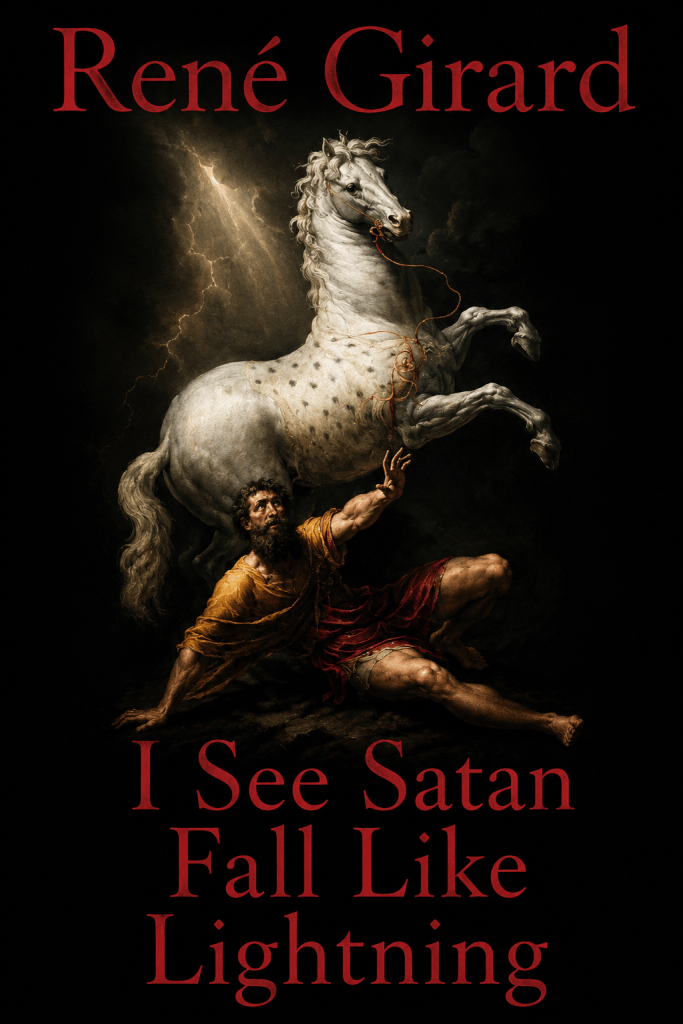
René Girard’s I See Satan Fall Like Lightning asks how the manifest similarity between the Gospel Passion and the world’s mythologies, long treated as an embarrassment to Christian claims of uniqueness, can be converted into the very ground on which that uniqueness becomes demonstrable. Composed late in Girard’s career and presented by its translator as a summation of mimetic theory in its most accessible and most theologically consequential form, the book unfolds a single argument in three concentric movements: an anthropology of desire drawn from the Bible, a resolution of the enigma of myth, and an account of the Cross as epistemic event. Its value as an object of study lies in the rigor with which it binds anthropology to revelation while claiming to demonstrate neither faith nor theology. The present reconstruction will take Peter Thiel’s later presentation of Girard’s thought as its late focal point, the external testimony through which the book’s institutional and political logic, its account of how orders found, preserve, and lose themselves, becomes especially visible.
The volume’s paratextual frame already performs interpretive work that conditions everything within it. The title is a citation, an abbreviated rendering of Luke 10:18, printed as epigraph immediately after the copyright apparatus: “I saw Satan fall like lightning from heaven.” The grammatical shift from the evangelist’s past tense to the title’s present tense, slight as it appears, announces the book’s central historical thesis before a single argument has been made: the fall of Satan names an event still underway, a process in which the reader’s own world is implicated. The English edition, published by Orbis Books in 2001 from the French of 1999, arrives “translated, with a Foreword, by James G. Williams,” and this foreword constitutes a genuine interpretive operator rather than decorative preliminary matter. Williams, himself a biblical scholar associated with the Girardian school, organizes his introduction as a sequence of eight numbered questions and answers, a catechetical form that mirrors, perhaps deliberately, the pedagogical structures of the religious tradition the book defends. The foreword fixes the technical vocabulary in advance: mimetic desire as the chief identifying characteristic of human beings, scandal as the paradoxical stumbling block, the single victim mechanism as the community’s unconscious convergence, Satan as the accuser, double transference as the genesis of the gods, the Bible as the disclosure of the victim’s standpoint. A reader who begins at the beginning therefore encounters Girard’s conceptual system twice, first in Williams’s didactic compression and then in Girard’s own argumentative unfolding, and this doubling shapes the book’s epistemic status: the concepts arrive certified, glossed, stabilized, before they are earned. Williams also situates the author institutionally, noting Girard’s retirement in 1996 after a career culminating at Stanford University, his bestseller status in France, and the slower diffusion of his work in the English-speaking world. The Stanford location, mentioned almost in passing, will matter for the present reconstruction, since it is the site at which the book’s most consequential American reader encountered its author.
The translator’s footnotes, scattered through the text and marked as his own, perform a second order of mediation that deserves explicit registration. Williams discloses that the French mimétisme, for which English has no equivalent, is frequently rendered as “violent contagion”; that emballement mimétique, literally an excitement or runaway outburst, becomes “mimetic snowballing,” the image of the snowball gaining mass and speed down a slope; that mécanisme victimaire becomes “single victim mechanism,” with the explicit editorial note that the mechanism could select more than one victim but that the analysis keeps focus on the simplest and exemplary case; that le souci des victimes becomes “the concern for victims,” with a remarkable note linking the French souci to the German die Sorge, the term Heidegger made central to his analysis of human existence, so that Girard’s late chapter title carries, for the reader of the apparatus, a deliberate philosophical resonance with the very thinker the book’s fourteenth chapter will indict. These decisions are not neutral. “Violent contagion” imports the epidemiological register into passages where the French names a more general imitative dynamism; “snowballing” mechanizes what the French presents as affective escalation; “single victim mechanism” forecloses, by terminological fiat, the plurality of victims that the note itself concedes. The translation thus hardens the theory’s mechanistic self-presentation, and since Girard himself insists on the word “mechanism” to signify automatism, unconsciousness, and the participants’ obedience to a process they do not understand, the translator’s choices amplify a tendency already present in the authorial voice. The volume one reads in English is in this respect a collaborative artifact whose terminological surface is more systematic, more machine-like, than its French original, and any account of the book’s inferential structure must acknowledge that the system’s apparent closure is partly an effect of this mediation.
Girard’s own introduction defines the work’s genre with unusual explicitness and thereby sets the constraints under which every subsequent claim must be read. The book calls itself an essay in comparative religion; it announces that the similarities between mythology and the Gospels, which Christians have always denied or minimized “with disastrous results,” should instead be boldly explored, since they provide the sole basis on which Christian uniqueness can be made obvious. The introduction then states the thesis in compressed form: all mythical and biblical dramas, including the Passion, represent the same type of collective violence against a single victim; myths see the victim as guilty; the Bible and the Gospels see these same victims as innocent. The difference between archaic religion and biblical revelation is therefore a difference in interpretation laid over an identity of event, and the entire book will consist in widening, deepening, and testing this single asymmetry. Two methodological declarations in the introduction govern the whole. First, the book defines itself as “an apology of Christianity rooted in what amounts to a Gospel-inspired breakthrough in the field of social science, not of theology.” Second, and in tension with the first, Girard declares that at no point does he attempt to demonstrate the undemonstrable, the scientific truth of religious faith; the vindication of the Bible’s intellectual power can only indirectly strengthen confidence in the tradition. The book thus assigns itself a double burden it must carry to the end: it must remain anthropology, arguing from texts and comparative evidence under rational constraints, while serving an apologetic purpose it openly avows. The reader is invited to watch for the point at which the anthropological thread runs out, and the conclusion, as will be seen, marks that point with deliberate candor.
The argument proper begins where few works of social theory begin, with the Decalogue, and the choice is itself a methodological wager: that the Bible contains, in legislative form, an analysis of desire more lucid than anything the modern human sciences have produced. The first chapter reads the tenth commandment as the key to the four that precede it. The commandments against killing, adultery, theft, and false witness prohibit acts; the tenth, longer than the others and different in kind, prohibits a desire, the desire for whatever belongs to the neighbor. Girard presses on the Hebrew verb, observing that modern translations mislead by rendering it as “covet,” which suggests a perverse desire reserved for hardened sinners, whereas the Hebrew term means simply to desire, the same word that names Eve’s desire for the fruit. The supreme commandment therefore addresses desire as such, and Girard reconstructs, in a passage of striking interpretive intimacy, what he presents as the lawgiver’s own intellectual process: the attempt to enumerate the objects over which people fight, the recognition that the objects are innumerable and in any case always changing, and the turn to the one constant, the neighbor, who appears in the final clause as the true source of the objects’ desirability. The commandment thereby sketches, without explicitly defining, what Girard calls a fundamental revolution in the understanding of desire: desire rests neither in the object nor in the subject but in a third party, the model, usually the nearest one, whose desiring confers value. This is mimetic desire, and the chapter immediately develops its conflictual logic. The object I desire in imitation of my neighbor is one the neighbor means to keep; my desire, thwarted, intensifies rather than relenting; my imitation gives my model a rival and thereby returns to him the gift of desire he gave me, reanimating a desire that quiet possession had allowed to die. Opposition exasperates desire; rivalry engenders imitation as surely as imitation engenders rivalry; and the antagonists, striving to differ, come to resemble one another ever more exactly. The chapter’s most consequential conceptual decision follows: mimetic desire is intrinsically good. Without it human beings would be creatures of fixed instinct, incapable of learning, language, culture, freedom, or openness to the divine; the same borrowed desire that makes us human makes us rivals; our unending discords are, in the book’s phrase, the ransom of our freedom. This double valence, repeated and thickened throughout the volume, blocks in advance any reading of Girard as a simple moralist of imitation, and it will return with particular force when the book’s late readers, Thiel among them, attempt to separate a good mimesis from a bad one.
The chapter’s second conceptual invention is the rehabilitation of a Gospel word that modern translation, in Girard’s view, has systematically weakened: skandalon, the scandal or stumbling block. Girard notes the term’s derivation from a verb meaning to limp, and offers the image of the limping person who appears to collide perpetually with his own shadow. Scandal names the paradoxical obstacle that attracts in proportion as it repels, the model-rival against whom the desiring subject injures himself repeatedly and returns to injure himself again. Scandals secrete envy, jealousy, resentment; they are responsible for what the text calls the false infinity of mimetic rivalry; and Jesus’ solemn warnings against scandal, especially the scandalizing of children, together with his hyperbolic counsel to cut off the offending hand, are read as precise anthropology rather than moral ornament. The chapter closes on the saying that gives it its title: scandal must come. Girard is careful to strip the necessity of any fatalist or determinist sense; individuals taken singly are not condemned to mimetic rivalry, but communities, by the sheer number of individuals they contain, cannot escape it, and once the first scandal occurs it breeds others. The modulation from individual freedom to collective necessity is one of the book’s quiet methodological constants: the theory operates at the level of the group, and its mechanisms claim statistical rather than individual inevitability, a distinction that bears directly on the question, raised much later, of whether knowledge of the mechanism can weaken it.
The second chapter sets this conceptual pair in motion within the Passion narratives, and here the book’s distinctive procedure first appears in full: the Gospels are treated as the theoretical text, the source of the anthropology, and simultaneously as the exemplary case to which the anthropology applies. The dominant theme of the Passion accounts, Girard argues, is the uniformity of reactions, the convergence of the most diverse individuals against a single victim. Peter’s threefold denial is the spectacular case. Girard expressly rejects psychological readings that locate the cause in Peter’s temperament, his impulsiveness, his individual portrait; such readings, he argues, destroy the typical character of the event, and their deeper function is self-exculpation, since in attributing Peter’s failure to Peter we assure ourselves that in his place we would have behaved otherwise. The text aligns this maneuver with the Pharisees who build tombs for the prophets their fathers killed while declaring that they themselves would not have joined in, and Girard draws the generalization that the children repeat the crimes of their fathers precisely because they believe themselves morally superior, a false difference he identifies with the mimetic illusion of modern individualism. Pilate, who would prefer to spare Jesus, surrenders to the crowd for fear of a riot, and the narrative’s insistence on his preference serves, in this reading, to underscore the omnipotence of contagion over sovereign power itself; the two crucified thieves, the most crushed of the crushed, howl with the wolves; and the Barabbas episode displays a Roman administrator who understands substitution professionally, offering the crowd a legally condemned victim in exchange and yielding the moment he sees that the time for substitutions has passed. Around these readings the chapter builds the concept that organizes the whole book: the mimetic cycle. Scandals proliferate; rivals become doubles and forget their objects; smaller scandals are absorbed into greater ones in a mimetic competition of scandals until a single polarizing scandal remains; the war of all against all converts into a war of all against one; the community, emptied of hostility by the destruction of its single enemy, finds peace. Girard insists on the word mechanism for the final phase precisely to signify its automatism and the unconsciousness of its participants. The chapter then performs its first structural comparison, setting the death of John the Baptist beside the Passion: in both, a sovereign who wishes to spare the victim yields to collective pressure; in both, the violence is collectively inspired though not directly executed by the crowd; in the Baptist’s case Herodias deploys her daughter’s dance, the art the Greeks held most mimetic, to weld the banquet guests into a bloody pack. The resemblances, Girard argues, owe nothing to literary plagiarism; the details differ entirely; what renders the accounts similar is their shared internal structure, and that structure is mimetic. The chapter closes with Second Isaiah, reading the leveling of valleys and mountains in chapter 40 as an image of the mimetic crisis, the loss of differences that transforms persons into doubles, and the death of the Suffering Servant at the hands of a hysterical crowd as the crisis’s resolution, so that John the Baptist’s citation of the “voice crying in the wilderness” amounts to a prophecy in the strict structural sense: the announcement that a new mimetic cycle is forming and that it will end in the collective execution of a new envoy of God.
The third chapter gathers the cycle into the figure that gives the book its name, and it is here that the work’s most distinctive conceptual operation occurs: the rehabilitation of Satan as a rigorous anthropological concept. Girard begins by noting, with dry irony, that the demythologizing theologians of the Bultmann era did not do the prince of this world even the honor of demythologizing him; Satan simply fell from theological discourse. The chapter reconstructs him as the personification of the entire mimetic process. Satan is first seducer, the model who counsels the abandonment of prohibitions and presents himself as easier to imitate than Christ; he is then obstacle, the same model transformed into rival, appearing unexpectedly on the broad road to block the desire he inspired; and he is finally the principle of order itself, the mechanism that expels disorder at its height. The exegetical center is Jesus’ reply to the scribes who accuse him of casting out demons by the prince of demons: how can Satan cast out Satan? Girard’s reading insists that Jesus affirms rather than denies Satan’s power of self-expulsion; the proof that Satan possesses this power is the repeated announcement that it is coming to an end. The Satan who is expelled is the furnace of scandals; the Satan who expels is that same furnace at the point of incandescence sufficient to trigger the single victim mechanism. Satan makes of his own disorder, at its highest heat, the means of expelling himself, and this extraordinary feat is what makes him indispensable, the genuine prince of a world that owes him its shaky order and can therefore never free itself from him by its own resources. The chapter performs a second conceptual consolidation through the Gospel of John’s discourse on the devil, the father of lies who was “a murderer from the beginning.” Girard reads the abrupt transition in that discourse, from the devil as model of desire to the devil as murderer, as anything but arbitrary: the succession of themes reproduces exactly the stages of the mimetic cycle, from rivalistic imitation through scandal to the collective murder in which the cycle terminates. Satan’s lie is the false accusation, the unanimous conviction of the victim’s guilt; his quintessential being is violent contagion, which has no substance; and the chapter draws from traditional theology a consequence it presents as a precise convergence: Satan has no actual being, exists as parasite on God’s creatures, is totally mimetic and therefore nonexistent as an individual self. The mimetic concept thus allows the New Testament, on Girard’s reading, to give evil its full due without granting it ontological substance, and it explains the division of labor the chapter observes between the synoptic Gospels, which possess a discourse on scandal but none on Satan, and John, which possesses a discourse on Satan but none on scandal: scandal accents the interindividual beginnings of the process, Satan its collective consummation, and the two concepts name one and the same reality at different moments of its unfolding. The chapter ends with a question it postpones: why does the consummation bear a personal name at all, why is Satan always someone rather than an impersonal principle? The answer, deferred to the second part, is that Satan designates the principal consequence of the mechanism, the emergence of false transcendence, and false transcendence is always personified because it is the matrix of the gods.
The second part, titled “The Enigma of Myth Resolved,” executes a deliberate change of evidentiary terrain, and its opening move is among the book’s most calculated: rather than proceeding directly to the great mythologies, Girard installs at the center of his comparative argument a text that is, by his own account, only half a myth. Philostratus’s Life of Apollonius of Tyana recounts the celebrated guru’s healing of a plague at Ephesus: Apollonius leads the population to the theater, points out a wretched blinking beggar, and commands the Ephesians to stone this “enemy of the gods.” The Ephesians initially refuse, shocked at the idea of murdering a stranger so manifestly miserable; Apollonius insists; the first stones fly; the beggar’s desperate glance is read as demonic fire; the stoning becomes total; and when the stones are removed, the crowd finds in place of the beggar the pulped body of a monstrous hound, over which the statue of the Averting god, Heracles, is raised. Girard’s procedure with this text exemplifies the book’s method at its most granular. He observes that the account is too rich in concrete detail to be wholly invented; that the word plague, in the ancient world, almost always carried a social dimension, so that a city prey to internal tensions could be cured by a cathartic discharge upon a substitute victim even where no bacterium yielded; and that Philostratus himself, in the chapter immediately preceding the miracle, places in Apollonius’s mouth a discourse on good and bad rivalry aboard a ship, distinguishing the healthy emulation of sailors who vie only in excellence from the unrestrained rivalries of those who, failing to master themselves, “impersonate the storm.” The proximity of this discourse to the miracle cannot, Girard argues, be unintentional: the guru diagnoses the city’s actual illness, an epidemic of mimetic rivalry, and prescribes the archaic remedy, an improvised victim. The analysis then pivots to the Gospel scene that the book sets against the Ephesus stoning as its exact structural inverse: the woman taken in adultery. Both texts, Girard shows, pivot on the same unstated problem, the first stone, the only stone without a model. Apollonius never names it, because to trigger unanimous violence the instigator must conceal its mimetic nature; Jesus names it with maximal emphasis, placing it at the end of his single sentence, because to discourage the same violence its mimetic nature must be exposed. The Ephesians’ initial pity and final relentlessness, the accelerating rhythm of the stoning as each stone provides a model for the next, the reverse contagion of nonviolence that spreads from the first man who drops his stone and withdraws: all of this, Girard argues, displays the mimetic structure of crowd behavior with documentary precision, and the persistence of “casting the first stone” as a universally understood metaphor in a world without ritual stoning testifies that the structure remains operative. Two further details receive sustained attention. Jesus bends and writes in the dust, and Girard reads the gesture as avoidance of the gaze, since angry men would find in any returned look only the mirror of their own provocation; the Ephesian beggar’s feigned blindness is read as the same prudence in a weaker register, and his final trapped-animal glance as the trigger of his demonization. The chapter ends with an identification whose theological weight the book will spend its third part redeeming: the Cross is the equivalent of the Ephesus stoning; Jesus, who saved the adulterous woman and could not save himself, identifies himself with every victim; Jesus is the beggar.
The following chapters convert this exemplary case into a general theory of myth, sacrifice, and cultural origin, and the conversion proceeds by a metaphor of calibrated decay that deserves careful notice, since it carries the book’s entire comparative epistemology. Myths, Girard argues, generally begin in a state of crisis, undifferentiation, plague, or paralysis; they resolve the crisis by a violence that is collective or echoes collectivity; and they conclude with the restoration or foundation of order under the presidency of the very being who was destroyed. The victim is transfigured twice, first demonized as the cause of the crisis, then divinized as the author of the peace, and this double transference, the projection upon the victim of all the community’s fears and then of all its hopes, is the birth of the gods. The peoples of the world, in the book’s lapidary formulation, do not invent their gods; they deify their victims. What blocks scholarly recognition of this genesis is, Girard contends, the refusal of the real, the systematic prejudice that treats the violence in myths as fantasy; and the Apollonius narrative is precious precisely because it is anemic, a truncated myth in which only the first transference occurred. The stoning produced a mediocre demon and no god; Heracles had to be borrowed from the existing pantheon to lend the event its religious meaning; and this incompleteness breaks into visible phases a genesis that true myths present in compact, undecipherable form. The volcano image fixes the method: when the volcano of collective violence was fully active it produced true myths, and the lava and smoke made it impossible to lean over the crater; the Ephesus stoning belongs to a cooler period, approachable, still glowing; the medieval witch-hunts are cooler still, transparent to us, deceiving no one. The book’s wager is that these are one series, a single textual family ordered by degrees of transformation, with the Passion at the far end as the least transformed of all, the only account that completely reveals the cause of violent unanimity. The historians of the Middle Ages, who refuse to deny the reality of the victims of witch-hunts, are enlisted as methodological allies against the mythologists, and the argument takes the form of a challenge: if the victims of medieval persecution texts are real, by what right are the structurally identical victims of myths declared imaginary? The chapter on sacrifice extends the series into ritual. Bloody sacrifice is the deliberate reenactment of the founding violence, performed as precaution against relapse; the pharmakos rituals of Greece, in which the cities maintained wretched persons at public expense in order to assassinate them collectively at the appointed festivals, supply the institutional background against which the Apollonius miracle reads as an improvised pharmakos rite; and the testimony of sacrificing peoples themselves, that their rites please the gods and restore the community’s peace, is accepted as the truth that anthropology has refused to take seriously. The theory of ritual origin is developed with a temporal depth the book acknowledges as speculative in detail while defending as structurally necessary: communities reconciled by spontaneous unanimous violence, threatened by the return of crisis, reproduce the saving event as exactly as possible; many rituals therefore begin with a deliberate acting out of disorder, since the mechanism requires the crisis that triggers it; the awesome danger universally attributed to ritual reflects the participants’ accurate intuition that the only good violence is unanimous violence and that contagion short of unanimity merely spreads.
It is in the chapter on the founding murder that the argument reaches its most expansive anthropological claim, and the chapter’s architecture shows the book’s characteristic movement from exegesis to theory and back. The founding role of the single victim, Girard observes, is proclaimed by the great origin stories themselves: Sumerian institutions emerge from the dismembered Tiamat and the blood of Kingu, the Indian caste system from the dismemberment of Purusha, and the theme is so widespread that Mircea Eliade, a comparativist little given to generalization, registered a “creative murder” common to origin myths worldwide while declining, in keeping with his descriptive practice, to explain it. The Bible, Girard argues, contains the explanation, and contains it as interpretation rather than as myth: the story of Cain is the biblical reading of all founding myths. Cain murders Abel and founds the first culture, and the text binds the two facts by the law God promulgates in the lull that follows the murder, the sevenfold vengeance that protects the marked murderer. Girard reads this first law against murder as ritual in embryo: a repetition of murder distinguished from vengeance by intention alone, a difference fine and precarious that nonetheless bears all the cultural differences to come. The Gospel texts that speak of the blood of the prophets shed “since the foundation of the world,” from Abel onward, and the Johannine designation of the devil as murderer “from the beginning,” are then read with philological insistence: the Greek terms bind the murder to the origin internally, so that the first murder and the foundation of the first culture are the same thing, and each subsequent culture begins with a murder of the same type. From this exegetical platform the chapter launches its frontal engagement with Enlightenment social theory. The rationalist account of institutions, which imagines first humans as so many little Cartesians conceiving institutions theoretically before realizing them practically, leaves religion functionless and must therefore explain its universality as parasitic imposture, the invention of deceitful priests; against this, Girard proposes that religion is the heart of every social system, the original form of all institutions, and the argument’s evidentiary pivot is the observation that in archaic societies the institutions the Enlightenment held indispensable did not exist, while rituals occupied their place. Rites of passage prefigure education; funerary mounds of stones are read, in a conjecture the text presents with disarming literalness, as the by-product of stonings, the cairn over the victim geometrized into the pyramid; and sacred monarchy, the book’s most consequential institutional derivation, is reconstructed as a modification of sacrifice: a victim of commanding intelligence whose execution is deferred, and who converts the religious veneration owed to a future sacrifice into a power that did not previously exist, which he does not seize but literally forges. Kingship, on this account, is the victim mechanism with the killing postponed; political authority is sacrificial authority under deferral; and the reader who carries this derivation forward will find that the book’s later treatment of the powers, and the present reconstruction’s late engagement with a modern financier’s reading of Girard, both turn on it. The chapter closes with formulations whose boldness the surrounding caution sets in relief: the true guide of human beings is ritual rather than abstract reason; religion invented human culture; humanity is the child of religion.
The chapter on the powers and principalities completes the second part by translating this genetic theory into the New Testament’s political vocabulary, and it is here that the book’s political philosophy, such as it is, receives its most direct statement. Early Christianity, Girard observes, distrusted the sovereign states within which it spread, on account of their violent origin, and named them by a specific vocabulary rather than by their proper names: powers, principalities, thrones, dominions, princes of this world, princes of the kingdom of the air. The chapter pauses over the curious doubleness of this lexicon, which oscillates between terms asserting the powers’ earthly concreteness and terms asserting their celestial, spiritual character, and reads the oscillation as a symptom of a real conceptual difficulty rather than confusion: the New Testament writers were attempting to name a reality that human language has never assimilated, the combination of material power and effective though unreal transcendence that constitutes sovereignty rooted in founding murder. Institutions are very real; the transcendence that grounds them is false; yet the false transcendence commands obedience and therefore acts in the world. Girard finds in Durkheim’s social transcendence the nearest sociological approximation to this paradox, crediting the sociologist with seeking access to the juxtaposition of real immanence and transcendental power while marking the absence, in Durkheim, of the mimetic cycle and the victim mechanism. The Roman Empire supplies the test case: the successive emperors draw their authority from the divinized first Caesar, assassinated by numerous murderers, so that the supreme power of the Christian era rests, with almost diagrammatic exactness, on a collective victim divinized, and Shakespeare, “an incomparable reader of the Bible,” is enlisted for having centered his tragedy on the founding and refounding character of that murder, the dream interpretation in which Rome sucks reviving blood from Caesar’s statue. Two consequences of this analysis carry forward. First, the powers, though tributaries of Satan, are never simply diabolical; sacrificial order seeks to hold the satanic at bay rather than to commune with it; and Paul’s realism, which commands respect for the powers as authorized by God so long as they require nothing contrary to faith, is endorsed as the Church’s considered attitude toward institutions that are indispensable to order in a world alien to the kingdom. Second, and in tension with the first, the entire apparatus of order is built over a concealment, and the revelation that exposes the concealment cannot leave the apparatus intact. The book’s third part is the working out of this tension, and the reconstruction now turns to it.
The ninth chapter opens the third part with a methodological clarification that retroactively determines the status of everything preceding. Girard distinguishes his procedure from two adversaries. The old anti-Christian anthropologists, who believed in truth, sought to dissolve Christian uniqueness by accumulating resemblances between Gospel and myth; the postmodern opponents, who have renounced truth, dissolve all religions into incommensurable difference, venerating differences precisely because they attach no importance to any of them, praising all religions as one praises kindergartners’ paintings. Girard’s method sides with the old adversaries on the decisive point: the common reality they sought does exist, and it is the mimetic cycle; their failure was a failure of nerve, since fear of the Gospels’ orbit kept them from using the Gospels as the analytical key. The book’s own procedure, beginning from the Gospels and moving outward to Apollonius and the myths, is then defended against the suspicion of apologetic circularity by an argument from asymmetric illumination: the Gospels are explicit about mimetic contagion and therefore clarify the myths, while the myths, obscure about their own generative process, would clarify nothing. Yet this defense raises the problem the chapter exists to pose in its sharpest form. If Gospel and myth share the full mimetic cycle, crisis, collective violence, and sacred revelation, then nothing at the structural level distinguishes the resurrection of Jesus from the divinization of any scapegoat, and Christianity’s claim to uniqueness appears to rest on nothing. Girard’s response is the book’s most consequential argumentative maneuver, and he announces it as a deliberate tactical detour: the problem is divided in two, and the Hebrew Bible is examined first. In the Hebrew Scriptures the mimetic cycle appears truncated; crisis and collective violence are present, while the third phase, the divinization of the victim, is absent; God is never victimized and the victim never divinized; and this absence is the first uniqueness, the achievement of a monotheism that cannot be suspected of issuing from the scapegoat process because it systematically refuses the process’s crowning operation. The demonstration proceeds through the sustained parallel of Joseph and Oedipus, conducted with the granularity of a structuralist comparison and turned against structuralism’s conclusions. The convergences are pressed hard: both heroes expelled in childhood after a family crisis, both foreigners in the land of their exploits, both raised to eminence by the gift of solving riddles, both confronted with an accusation of sexual transgression against a parental figure, both implicated in a scourge that strikes their adopted country. The single divergence is then shown to organize everything: the myth holds the victim guilty and the expulsions justified; the biblical account holds the victim innocent and the expulsions unjustifiable. Oedipus really committed parricide and incest, and his final expulsion heals Thebes; Joseph is innocent at every station, and his triumph, sealed by the test he stages for his brothers and by Judah’s self-substitution for Benjamin, ends in a forgiveness that the text identifies as the only force capable of halting the spiral of reprisals once and for all. Girard anticipates the objection that this difference might be mere authorial preference, the taste for happy or unhappy endings, and answers it by the density of the structural correspondences: the web is too tight to be accidental, and the biblical narrative must therefore be read as deliberate critique, an antimythological inspiration that condemns in general the crowd’s tendency to justify its violence. The chapter extends the finding to the psalms, the first texts in human history, on this account, in which the victim speaks while the crowd encircles him, cursing his persecutors with an energy that scandalizes modern professors of compassion who see only the verbal violence of the victim and never the physical violence of the lynchers; and to Job, the immense psalm in which the hero, terrorized by the crowd’s delegates into confessing a guilt that would ratify the crowd’s divinity, instead wrests God free of the persecution process and declares his Defender living. The Levinas citation that crowns the chapter, the talmudic principle that a defendant condemned unanimously must be released, condenses the entire argument into a juridical maxim: unanimity is rarely a vehicle of truth and most often a mimetic phenomenon.
The tenth chapter then confronts the problem the ninth deferred: the Gospels restore the third phase. Jesus is a collective victim whom a community proclaims divine, and the suspicion of relapse into myth is, Girard concedes, structurally well founded; Jewish and Muslim perceptions of Christian trinitarianism as compromised monotheism, and the modern drift of entire churches toward a pluralism that regards itself as kinder than dogma, are registered as serious testimony rather than dismissed. The response proceeds by locating the difference at a level the structural comparison cannot reach. Mythic divinization is performed by the unanimous crowd of persecutors; the divinization of Jesus is proclaimed by a dissenting minority, a small group that separates from the collective violence and breaks its unanimity, and this structure, the community divided into unequal groups of which only the smaller proclaims the victim’s divinity, has no equivalent anywhere in mythology. There is, moreover, no prior demonization beneath the divinity of Christ, no guilt attributed and then transfigured; and the Passion accounts, far from being dominated by the mechanism they narrate, represent it completely, including its grip on the disciples themselves, whose failure is recorded without extenuation by the very tradition they founded. The chapter’s most audacious pages then take up two Gospel passages that seem designed, Girard argues, to display the writers’ sovereign unconcern with the resemblances that trouble modern readers. Luke’s notation that Herod and Pilate became friends on the day of the Crucifixion, having been enemies before, is read as a deliberate registration of sacrificial catharsis, the reconciling effect of collective murder, included precisely so that the pagan reconciliation may stand beside the Christian one and be distinguished from it. And the account, in Mark and Matthew, of Herod’s belief that John the Baptist has risen, the only flashback in the Gospels, is read as a miniature myth of origin embedded in the text: a false resurrection generated directly by the murderer’s obsessive recollection of his murder, externally indistinguishable from the true resurrection the same Gospels proclaim, and narrated without the least embarrassment by writers whose faith was too strong to fear the comparison. The difference between the true resurrection and the false lies, the chapter concludes, in the power of revelation rather than in thematic content: the false resurrection consecrates the mechanism, the true one exposes it.
The eleventh chapter raises this exposure to its theological maximum through a sustained commentary on the letter to the Colossians, and its argumentative texture repays close attention, since here the book performs its most intricate interweaving of metaphor and mechanism. The Pauline text declares that Christ canceled the accusation standing against humanity, nailed it to the cross, disarmed the principalities and powers, and made a public spectacle of them, leading them in his triumph. Girard unfolds the Roman triumph image with philological care, Vercingetorix in chains behind Caesar’s chariot, and then inverts it: the victory in question was won by submission rather than infliction, and what the metaphor retains is the public exhibition of what the enemy had to conceal. The powers are not put on display because they are defeated; they are defeated because they are put on display. The formula condenses the book’s entire theory of revelation as efficacious exposure: the victim mechanism requires the ignorance of its participants; the Passion accounts, by representing the mechanism truthfully, deprive it of the darkness it needs; and the Cross therefore operates as an epistemic weapon whose effects unfold in history with the slowness of dawning comprehension. The chapter defends, against Western theological suspicion, the patristic theme of Satan duped by the Cross, the divine ruse by which the prince of this world, triggering his own mechanism against Jesus, set in motion the process of his own destruction; Girard argues that the metaphor requires no magic and offends no divine dignity once Satan is identified with mimetic contagion, since contagion, clever in everything concerning rivalry and persecution, is structurally blind to a love that renounces violence, and the trap is therefore nothing other than Satan’s own incomprehension. The chapter also contains the book’s most explicit methodological self-defense, organized around the distinction between representation and the represented. A text dominated by the victim mechanism cannot represent it, since the mechanism is a principle of illusion that functions only unperceived; a text that represents the mechanism explicitly cannot be dominated by it; the myths are of the first kind, the Gospels of the second; and the modern habit of treating texts obsessed with persecution as therefore persecutory, the hermeneutic of no smoke without fire that Girard traces to Nietzsche’s slave morality, inverts the actual relation. The Dreyfus affair supplies the chapter’s historical parable: the anti-Dreyfusards, serene in their possession of a collective victim, were living a true myth, a false accusation confused with truth and maintained by contagion against all disclosure; the Dreyfusards, few, suspected, accused of morbidity, were the dissenting minority; and Péguy, the chapter notes, perceived the analogy with the Passion. The reader is thereby given, in a fully documented modern case, the complete structure the book attributes to the relation of Gospel and myth, and the choice of example quietly advances a further claim: that the capacity of French society to vindicate Dreyfus at all was itself a historical effect of the revelation the book describes.
With the twelfth chapter the book turns from the structure of revelation to its historical efficacy, and the pivot is semantic: the word scapegoat itself. The term designates first the goat of Leviticus, driven into the wilderness bearing the sins of Israel; then, by extension, the victims of all archaic rituals of expulsion; and finally, in modern usage, the victims of nonritual collective transference, the employee’s dog, the innocent colleague, the minority blamed for the community’s malaise. Girard argues that this third, spontaneous usage, which anthropology avoids precisely because it leaps the barrier between archaic and modern, constitutes a popular insight richer in true knowledge than the concepts of the human sciences: the modern speaker who cries scapegoat has understood, without instruction, the relationship between the ancient ritual and the hostile transferences of the present, and this understanding is itself a historical product of the Bible’s diffusion. The chapter’s diagnosis of the present follows: because of Jewish and Christian influence, scapegoat phenomena survive only in shameful, furtive, clandestine forms; our belief in our victims is, in the book’s arresting figure, 90 percent spoiled; to have a scapegoat is to believe one does not have any, and the modern persecutor, deprived of ritual good conscience, conceals the operation from himself with increasing difficulty. Yet the same knowledge that weakens persecution arms it anew: we ferociously denounce the scapegoating of our neighbors while retaining our own substitute victims, hunting the hunters of scapegoats in a second-degree persecution that Paul’s letter to the Romans is quoted as having foreseen, the judge who condemns himself in judging. And Jesus’ hard saying about bringing the sword rather than peace, setting son against father and daughter against mother, is read as the precise announcement of this condition: a world stripped of sacrificial protection, where rivalries, physically milder, insinuate themselves into the most intimate relationships and transform them into relations of doubles. The thirteenth chapter generalizes the diagnosis into the book’s reading of modernity entire. The concern for victims, le souci des victimes, is declared the distinguishing mark of contemporary civilization, an anthropological first without precedent in the China of the mandarins, the Japan of the samurai, Athens, or Rome; its genealogy is Christian, whatever the anticlerical self-understanding of the humanisms that carry it; its institutional archaeology runs from the medieval Hôtel-Dieu, the hospital that first dissociated the idea of the victim from every concrete identity, through the abolition of slavery and serfdom to the protections of children, women, foreigners, and the disabled; and its present form is paradoxical in a manner the chapter formulates with deliberate provocation: our world is at once the worst of all worlds, making more victims than any other, and by far the best, saving more victims than any other, and the two propositions are true simultaneously. The concern for victims, the chapter concludes, has become the absolute of a world that believes it has no absolutes, the secular mask of Christian love, and the criterion that determines, even and especially among Christianity’s enemies, what may and may not be said.
The fourteenth chapter completes the historical argument by weighing the other scale, and its center is the figure the book treats as its one great adversary-witness. Nietzsche, Girard argues, was the first thinker, Christian or otherwise, to identify the anthropological key to Christianity: that the collective violence of Dionysian myth and the violence of the Passion are the same in fact and opposed only in meaning, Dionysus approving the lynching and the Crucified condemning it. The fragment “Dionysus versus the Crucified” is quoted and endorsed on its analytic point, and Girard’s account of what follows is unsparing: having seen the identity of the violence, Nietzsche refused to see its injustice, attributed the biblical defense of victims to the resentment of slaves, and was driven, in late fragments the chapter quotes, to justify human sacrifice itself, the species enduring only through the sacrifice of those who weigh it down. The book treats Nietzsche’s madness as internally connected to this refusal, the mind unable to hold out against the evasion it required, and it draws the historical line it knows to be contested: National Socialism is read as the attempt to act Nietzsche’s program, to bury the concern for victims under millions of corpses, and Heidegger’s authority is indicted for having placed the Dionysus texts under a prudent prohibition without ever disavowing their content. The chapter’s final movement, however, turns the diagnosis forward in a direction the book’s late readers have found most prophetic and most uncomfortable. Hitlerism failed, and its failure has both accelerated the concern for victims and demoralized it, hystericizing it into caricature; and the principal beneficiary of the victory is what Girard calls the other totalitarianism, the more cunning of the two, which outflanks Christianity on its left, claims the concern for victims as its own, radicalizes it in order to paganize it, and reproaches the churches for insufficient ardor in the defense of the oppressed. The New Testament name for this usurping imitation is given without flinching: the Antichrist, de-dramatized into something banal and prosaic, Satan making a new start by borrowing the language of victims and imitating Christ better and better in order to surpass him. The book is careful, even here, to concede the semblance of reason in the usurpation, the real deficiencies of historical Christianity that make the blackmail effective; the neutral register of the present reconstruction requires noting both the analytical structure of this final reversal, which applies the theory of mimetic rivalry to the fate of the revelation itself, and its polemical exposure, since the chapter’s examples of neo-pagan practice are drawn from contested moral terrain and mark the point at which the book’s anthropology presses hardest against its own claim to scientific neutrality.
The conclusion gathers these threads with a candor about method that retroactively organizes the whole volume, and it does so around three determinations. First, the apocalyptic theme is reclaimed as integral to the Christian message and given a purely anthropological sense: the revelation, by spoiling the victim mechanism, deprives humanity of its only peace, the truce founded on scapegoats; Satan, no longer able to expel himself, is unbound; and the threat of apocalyptic destruction is therefore rational rather than superstitious, entering every day more profoundly into the concrete facts of armament, ecology, and population. Paul’s katechon, that which holds back, glossed through Dupuy as containing in the double sense of harboring and restraining, names the inertial force of the powers that delays the unbinding, and the reader who recalls the eighth chapter will recognize the structure: the institutions founded on concealment now function, in the time of revelation, as the restraint that buys time. Second, the limit of the anthropology is marked from within. Until the final pages, Girard insists, every question has received a plausible answer in a commonsensical and anthropological frame; the question of how the disciples, more than half possessed by the contagion, found strength to oppose the crowd, admits no such answer, since the entire investigation has established that no power on earth exceeds violent contagion. To break mimetic unanimity a power superior to contagion must be postulated, and the book names it with the Gospels: the Spirit, the Paraclete, the defender of the accused, whose juridical name is set against Satan’s juridical name, advocate against accuser, in a symmetry the conclusion presents as the deepest confirmation of the whole reading. The Resurrection is thereby assigned a precise epistemic function, the entrance into the world of the power that makes the dissenting minority possible, and the anthropology is declared inseparable from, rather than competitive with, the theology it has bracketed. Third, the conclusion stages the two conversions, Peter’s repentance and Paul’s Damascus road, as one and the same discovery made twice: each man finds that he was a persecutor without knowing it, and the question “Why do you persecute me?” is generalized to every reader of a world structured by victim mechanisms from which all profit unknowingly. The book’s last word before its closing Pauline citation is a formula that compresses its entire reversal of archaic religion: humankind is never the victim of God; God is always the victim of humankind.
It is against this completed structure that the testimony of Peter Thiel can be brought into focus, and the present reconstruction must first delimit its status with care. The conversation in which Thiel presents Girard forms no part of the volume; it postdates the book and belongs to the reception history of mimetic theory rather than to its argument; nothing in what follows treats Thiel’s statements as evidence for what the book says, and every claim about the book continues to rest on the volume itself. The interest of the testimony is of another order. The book’s third part argues that the revelation it describes propagates historically, altering the self-understanding even of those who do not share its faith, weakening mechanisms by exposing them, and being appropriated, imitated, and converted by the powers it unmasks. Thiel’s presentation is a document of precisely this propagation: a reader formed at the institution where Girard taught, occupying a commanding position within the contemporary powers in the book’s own sense of the word, who reports adopting the anthropology, translating it into institutional technique, and drawing from it a forecast about the survival of the world. The testimony therefore offers what the book itself cannot contain, a controlled observation of its theses operating downstream, and the points of fidelity and friction in the translation illuminate the book’s internal tensions with unusual sharpness.
Thiel situates his encounter in the late 1980s at Stanford, where Girard’s reputation circulated among students as that of an original professor out of step with prevailing academic conformity, and the first feature of his account worth registering is its own mimetic structure, which the book’s first chapter would predict rather than merely permit. The attraction Thiel describes is the attraction of a model distinguished by difference, sought out by students who wanted an alternative vocabulary; the initial reaction he reports is disbelief at the thesis’s scope; and the conversion he narrates is gradual, accomplished over years through repeated application, the explanatory reach of the theory accumulating across domains until a new perspective consolidated. The book’s account of how persuasion occurs in a mimetic world, slowly, through models, against the resistance of an individualism that experiences the theory as humiliating, is thus enacted in the testimony’s very form, and Thiel’s forecast that intellectual history written around 2100 may count Girard among the major thinkers of the twentieth century reproduces, in secular idiom, the book’s own temporal self-understanding, its repeated insistence that the revelation works in history with extreme slowness and that its full assimilation remains incomplete. The substance of the appropriation then divides, in Thiel’s telling, into two managerial theses and one civilizational one, and each can be mapped onto the volume with precision. The first thesis concerns markets: awareness of imitation makes visible the herding of investors and entrepreneurs upon the same goals, narratives, and opportunities, convergence appearing as structural pattern rather than as independent choice, and the practical consequence is a contrarian posture, the pursuit of what collective attention has abandoned, since consensus concentrates competition and destroys differentiated value. The second concerns organizations: against the standard account that explains conflict by difference, Thiel reports that across a decade and more of company leadership the major conflicts arose from convergence on the same scarce object, the same role, status, or recognition; the preventive discipline is role differentiation, the deliberate reduction of ambiguity about responsibilities, hardest precisely in early-stage companies whose fluidity is their virtue; and the fate of companies is determined, in his account, more by these internal dynamics than by external competition. The third is the criterion he offers for a workable century: a future in which good mimesis exceeds bad mimesis, with the alternative framed as the question whether the world blows itself up.
The fidelity of this translation to the book’s letter is, at certain points, almost verbatim. The diagnosis of conflict as born of convergence rather than difference is the book’s first chapter compressed into a management maxim: the tenth commandment’s discovery that we desire what the neighbor desires, the dissolution of real differences as antagonism sharpens, the deceptive celebration of difference raging loudest where differences are disappearing. The observation that scapegoating operates most effectively when participants do not recognize the mechanism, and that understood mechanisms become harder to sustain in their classic form, is the book’s twelfth chapter and its theory of efficacious exposure, the belief 90 percent spoiled, restated as a probabilistic hope; and Thiel’s accompanying concession, that knowledge of a mechanism does not automatically dissolve it and that pathologies reappear in new forms, tracks the book’s own double diagnosis, the persecution that survives by becoming subtle, the hunt for hunters of scapegoats. Even the apocalyptic framing is the book’s: the conclusion’s argument that the spoiling of sacrificial protection makes destruction rationally thinkable, that Satan unbound names a world deprived of its old means of containing its own violence, reappears in Thiel’s stark systemic terms, the century that must learn practices of coexistence or perish. And the valorization of mentorship as a relational structure that aims at the other’s development without converting success into zero-sum rivalry echoes, at whatever distance, the book’s account of the one imitation that does not ensnare, the model who never becomes obstacle because he desires nothing greedily.
Yet it is exactly at the points of closest fidelity that the book’s own categories begin to generate pressure against the appropriation, and the present reconstruction marks the following as interpretive inferences warranted by the volume’s explicit claims rather than as judgments delivered from outside. The contrarian posture, first: the book’s analysis of mimetic doubles includes, in so many words, the observation that each rival “consistently takes the opposite view of the other in order to escape their inexorable rivalry,” and that this systematic opposition returns each to collision with the fascinating obstacle. Within the book’s conceptual economy, deliberate counter-positioning is a recognized modality of imitation, negative imitation, the inverted dependence of the rebel on the model; a strategy that determines where to look by determining where others are looking remains, on the volume’s own terms, structurally mimetic, its gaze fixed on the crowd it means to escape. The book does acknowledge, through the Philostratus passage on the ship’s crew, a healthy emulation distinguished from unrestrained rivalry, and Thiel’s good mimesis can claim that warrant; but the volume locates the escape from rivalry in the imitation of a model who desires without greed, and ultimately in the imitation of Christ’s own imitation of the Father, whereas the contrarian discipline locates it in a redirection of acquisitive desire toward uncontested objects. The difference is the difference between conversion and arbitrage, and the book’s categories can name it even where its courtesy would not. Role differentiation, second: the book’s seventh and eighth chapters derive institutions in general from the ritual management of mimetic crisis, the artificial maintenance of differences being the archaic world’s principal protection against the undifferentiation in which violence breeds; prohibitions and distinctions, the book argues, are the sacrificial system’s gentler instruments, and their modern, deritualized descendants perform the same containing function. An executive discipline that prevents rivalry by clarifying who occupies which position is therefore, in the volume’s own genealogy, a secular instance of the katechontic function, order maintained by the engineered preservation of difference, and the book’s Pauline realism about the powers, which honors what restrains, extends to it without irony. But the same genealogy entails that such order treats the symptom the revelation has made visible rather than the desire the revelation addresses, and the volume’s conclusion is explicit that no earthly arrangement exceeds contagion’s power. The managerial appropriation, on the book’s terms, equips the powers with the anthropology of their own foundation, and this is the third and deepest friction: the eighth chapter’s powers and principalities, sovereignties rooted in founding violence and indispensable to order, are represented in Thiel’s testimony not as objects of the analysis but as its subject, the financier and founder of sovereign-adjacent institutions adopting the theory that unmasks institutional foundation and converting it into a technique of institutional self-preservation. The book itself describes this reflexive turn in its fourteenth chapter, where the powers learn to speak the language of the revelation, and it describes it there under the heading of usurping imitation; the testimony under examination does not claim the concern for victims, speaks the idiom of conflict management rather than of compassion, and therefore escapes the chapter’s specific indictment while exemplifying its general structure, the revelation absorbed by the world it judges and redeployed at a lower energy, stripped of the Cross, the Paraclete, forgiveness, and conversion, and retaining the diagnostic apparatus entire. What survives the translation is the anthropology; what does not survive is everything the book’s conclusion declares inseparable from it.


Leave a Reply