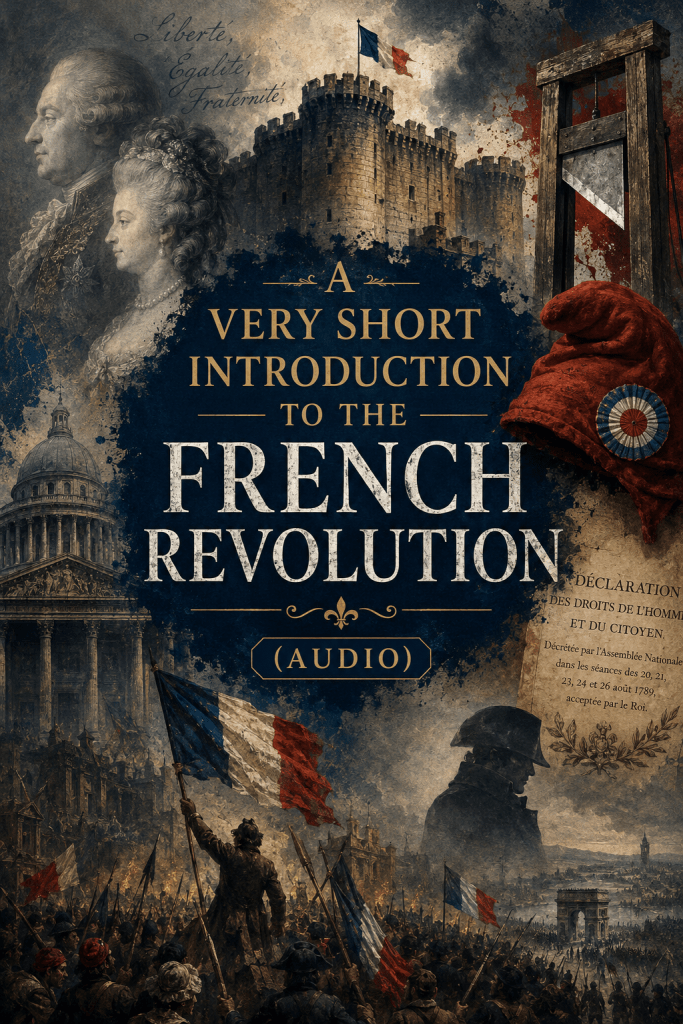
The French Revolution survives in cultural memory through the literary refractions of Dickens in A Tale of Two Cities, Baroness Orczy in The Scarlet Pimpernel, and Tolstoy in the Napoleonic aftermath that haunts War and Peace, as well as through the half-remembered iconography of tricolor cockades, the Phrygian bonnets of the sansculottes, and the apocryphal pronouncement that the starving should be given cake — a phrase Rousseau had already attributed to an unnamed grande princesse in the Confessions well before it was hung around Marie Antoinette’s neck.
What began in 1789 with the convocation of the Estates-General, the Tennis Court Oath, and the storming of the Bastille on the fourteenth of July rapidly outgrew its initial constitutional ambitions to become one of the most consequential ruptures in European political history. The monarchy that had defined France since the Capetians was abolished within four years; Louis XVI was tried as Citizen Capet and beheaded in January 1793, his queen following him to the scaffold in October. Under the Committee of Public Safety, the Terror swept perhaps forty thousand victims to the guillotine — an instrument that bore the name of the deputy who had proposed it as a humane alternative to the wheel and the rope — before turning, in the Thermidorian reaction, on its own architects, Robespierre and Saint-Just included.
From the wreckage of the Directory rose a Corsican artillery officer whose coup of 18 Brumaire and subsequent imperial wars would redraw the map of the continent. Yet the Revolution’s deeper legacy lies less in its body count than in the institutions and habits of thought it bequeathed: the Declaration of the Rights of Man and of the Citizen, with its still-radical insistence on universal natural rights; the metric system and the short-lived decimal calendar, expressions of the Enlightenment dream of rationalizing time and space themselves; the modern figure of the citizen displacing that of the subject; the conceptual vocabulary of left and right, descended from the seating arrangements of the National Assembly; the secularization of public life under the auspices of the Cult of Reason and later the Cult of the Supreme Being; and, in reaction, the great counter-revolutionary tradition from Burke and de Maistre to Carl Schmitt that continues to define conservative reflection down to the present.
- Introduction
2. Echoes
3. Why it Happened
4. How it Happened
5. Polarization
6. What it Ended
7. What it Started
8. Where it Stands


Leave a Reply