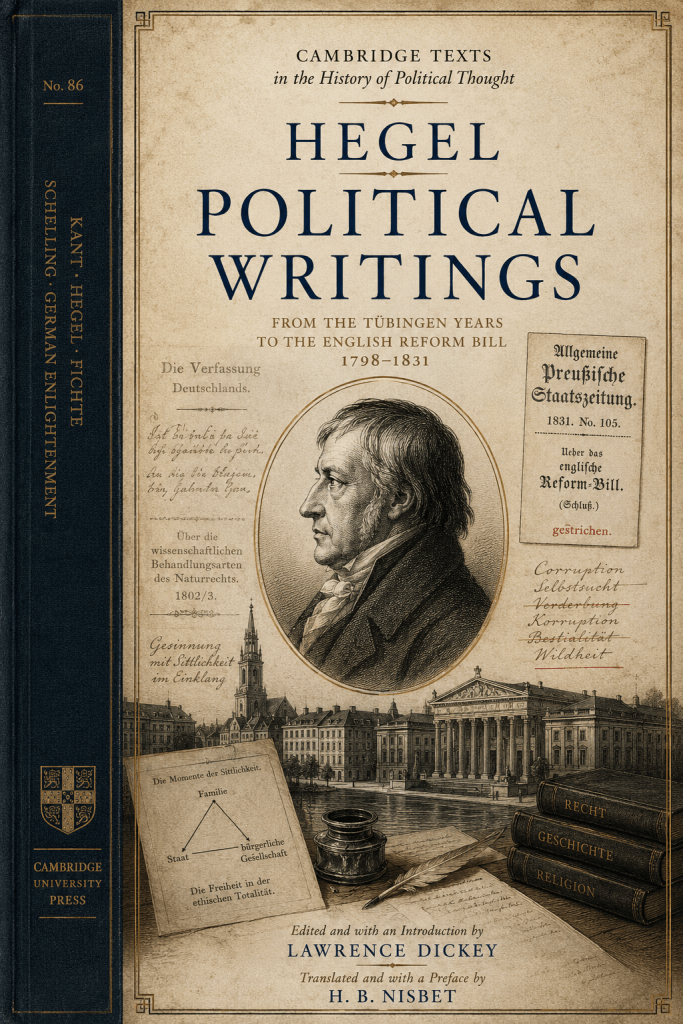
The volume gathered by Lawrence Dickey and H. B. Nisbet under the title Political Writings in the Cambridge Texts in the History of Political Thought series presents eight pieces by Hegel composed between his Tübingen youth and the final months before his death in November 1831. Its governing question is how a rational political order absorbs historical pressure without losing its rationality, and the volume is distinguished by its willingness to treat that question as inseparable from Hegel’s metaphysical commitments rather than as an inheritance to be insulated from them. The collection acquires its late point of condensation in On the English Reform Bill, an essay published in the Allgemeine Preußische Staatszeitung in April 1831, partially censored at its close, and posthumously restored. Read in retrospect, that essay reorganises the volume’s earlier writings into a single sustained meditation on reform, representation, monarchy, civil society, and the endurance of constitutional life.
The first thing that must be said about this volume is that it has a thesis, and that the thesis is announced editorially. The general introduction does not pretend to be a neutral situating of the texts; it openly stakes a position against the earlier Knox–Pelczynski edition of 1964 and its successors. Knox and Pelczynski, on Dickey’s reading, sought to liberate the so-called “minor” political writings from Hegel’s Philosophy of Right in order to display a more “liberal,” “rational,” and “western” Hegel whose practical commentary could be read independently of his metaphysical apparatus. The label “minor” was meant to signal accessibility; in practice it functioned to detach the journalistic and constitutional pieces from the deeper philosophy of ethical life — Sittlichkeit, a term I will mostly render in English as “ethical life” except where Hegel’s own terminological pressure forces the German term back into use. Dickey rejects this strategy. His claim is that Hegel’s lifelong intervention in political thought cannot be intelligibly reconstructed without the very metaphysical premises Knox and Pelczynski meant to bracket. Accordingly the volume refuses the major/minor distinction and presents the texts in chronological sequence, with three pieces of “comparative” practical-political analysis (the Württemberg pamphlet, The German Constitution, On the English Reform Bill) interleaved with five more openly philosophical texts (the essay on Natural Law, the two academic addresses delivered at Berlin, the excerpt from the Lectures on the Philosophy of History, and the section on The Relationship of Religion to the State drawn from the 1831 lectures on the philosophy of religion).
This editorial wager is not merely defensive. By restoring continuity between the practical and metaphysical writings, Dickey aims to establish that Hegel’s analysis of any concrete political question — the senility of the Holy Roman Empire, the constitutional inadequacy of Württemberg, the inability of English parliamentary reform to reach the rural pauperised class — moves within a single conceptual horizon governed by the question of how individuals become political beings rather than merely civil ones. Hegel’s recurrent diagnosis, present in the earliest pamphlet and the latest essay alike, is that the modern individual has been progressively depoliticised: confined to the sphere of private interest, civil law, and personal morality (Moralität), and accordingly cut off from participation in the ethical universal that the state, properly conceived, embodies. The texts collected here are best read as variations on the question of how that depoliticisation might be reversed without sliding into the opposite excess of revolutionary abstraction, which Hegel diagnoses in France from 1789 to 1830 as the consequence of attempting to derive political life from formal principles alone.
The translator’s preface, by H. B. Nisbet, is brief but consequential, and it functions as a second interpretive operator alongside the general introduction. Nisbet acknowledges that the texts collected span virtually the whole arc of Hegel’s writing life, from the impassioned youthful rhetoric of the 1798 Württemberg pamphlet to the academic Latin of the Augsburg address, the dense conceptual abstraction of the Natural Law essay, and the political journalism of On the English Reform Bill. The stylistic span entails a corresponding span in technical vocabulary, and Nisbet candidly admits that the kind of strict terminological consistency feasible in his earlier translation of the Philosophy of Right could not be sustained across so heterogeneous a corpus. Words that bear semi-technical or programmatic significance in one essay — Nisbet names aufnehmen, Bestimmtheit, Potenz from the Natural Law essay — may revert to ordinary meanings or be displaced by other expressions elsewhere. The glossary is accordingly more elastic than the one prepared for the Philosophy of Right, listing alternative renderings for many terms. Two pieces appear in English for the first time: the Inaugural Address delivered at the University of Berlin in October 1818 and the Latin Address on the Tercentenary of the Augsburg Confession of June 1830. Nisbet records that he worked directly from Hegel’s Latin for the latter, finding the parallel German rendering by Lasson, even with Hoffmeister’s revisions, too inaccurate to rely on. Notably, the translator also reports that in re-translating the Natural Law essay and On the English Reform Bill he corrected substantial errors in the earlier Knox versions — over seventy in Natural Law, almost as many in On the English Reform Bill, and well over a hundred in The German Constitution. The number itself is part of the volume’s argument: an edition that wishes to restore the unity of Hegel’s political thought must first repair the textual instruments through which earlier readers received it.
There is a third paratextual stratum, less visible but operative throughout, in the editorial notes. These are extensive, conceptually engaged rather than merely informational, and they make explicit what Hegel’s compressed prose often only gestures toward. A note appended to a single phrase in The Relationship of Religion to the State about the “right kind of piety” reminds the reader that, for Hegel, piety is properly oriented toward Sittlichkeit and accordingly toward outward, communal, and ethical realisation rather than inward subjective absorption. A note appended to a brief reference to “police” in the Lectures on the Philosophy of History connects the term to a precise Hegelian theme: the Polizei function of government covers public works, regulation of economic activity, and what we would call welfare provision, and must be sharply distinguished from the policy of an authoritarian state. The editorial notes also openly mark the points where Hegel’s text was censored. The closing portion of On the English Reform Bill, in which Hegel develops his most consequential prognosis about the impossibility of mediating between privileged property and the demand for material rights without a stronger monarchical element, was suppressed by the Prussian censor and did not appear in the periodical printing. The volume restores it from Hegel’s manuscript. Where the published text and the manuscript diverge — “corruption” softened to “selfishness,” “depravity” to “corruption,” “bestiality” to “savagery” — Nisbet flags the discrepancy in footnotes. The effect is not merely scholarly fastidiousness: the censor’s hand becomes a visible feature of the text, a small historical residue marking precisely those formulations the late Restoration order found too sharp to print. The volume thus presents Hegel’s political thought as one mediated by the institutional conditions under which it was published, rather than as a self-contained discourse, an inflection the reader is meant to register.
With these interpretive operators in place, the eight texts begin to disclose their inner logic. The earliest piece, surviving only as a fragment, is a 1798 pamphlet on the Württemberg estates whose original title was That the Magistrates Should Be Elected by the People. Hegel later softened the phrasing, replacing “by the people” with “by the citizens,” and the substitution is symptomatic of his early instinct to politicise without populising. The pamphlet was occasioned by the calling of the Württemberg estates in 1796 for the first time since 1770, an opening that, as Hegel saw it, allowed a serious examination of the political edifice. Its opening sentences strike a register that will not be heard again until On the English Reform Bill. Hegel writes that it is time for the people of Württemberg to cease vacillating between hope and fear, time to focus the still undirected will on the parts of the constitution founded on injustice, and that political institutions whose spirit has departed cannot continue to exist merely by force of their forms. The “ground shakes beneath our feet”; to wait blindly for the collapse of an edifice “full of cracks and rotten to its foundations” is, he says, contrary alike to prudence and to honour. The image of the political building cracking, the appeal to a justice that requires the unjust possessor to relinquish what he possesses, the diagnosis of a regime in which forms have outlived the spirit that animated them — these motifs return with deepened conceptual articulation in the 1831 essay. Already in 1798, then, the basic structure is in place: Hegel calls for institutional reform driven from the conviction that a constitution which has lost its inner truth cannot be sustained by external fidelity, refusing in the same gesture the equally inadequate alternatives of revolutionary upheaval and resigned acceptance.
The pamphlet’s central anxiety is institutional. Hegel identifies the chief problem of Württemberg as the inertia of its provincial estates, and more specifically the way in which a small caste of officials — consultants and lawyers attached to the Council — has captured the deliberative process, secured their independence even from those who nominally employed them, and reduced the political body to compliance. Their function, Hegel says with bitter precision, is to keep the Council on leading-strings because it has not learned to walk unaided. The reformer’s question becomes: in whose hands should the responsibility for change be placed? He surveys the available institutional sites and finds each disappointing. Government officials, however enlightened, cannot be trusted to reform the institutions that sustain them. The various councils of the estates are encrusted with the very interests reform must displace. Yet to entrust the responsibility to “the people,” as the pamphlet originally suggested, is for Hegel only marginally more promising: as long as the people do not know their rights, as long as there is no collective spirit (Gemeingeist), as long as the power of officials remains unchecked, popular election would serve only to overthrow the constitution rather than reform it. Hegel accordingly proposes a middle term: the right of election ought to be placed in the hands of “a body of enlightened and upright men” who are not dependent on the Court. The fragment breaks off as Hegel struggles to specify the constitutional form of such a body, and the difficulty of that specification is itself instructive. The pamphlet is a record of the moment when Hegel first encounters the problem of political mediation — the problem of finding an institutional locus capable of carrying reform without itself becoming an organ of either reaction or revolt.
The same difficulty animates The German Constitution, the long unfinished essay composed in stages between 1798 and roughly 1802 and never published in Hegel’s lifetime. The opening sentence is among the most quoted in Hegel’s political writings: Germany is no longer a state. The older teachers of constitutional law, Hegel says, had the idea of a science in mind when they wrote on Germany; their modern successors have abandoned the search, treating the German Empire as a phenomenon to be described empirically rather than comprehended through a rational Idea. What can no longer be brought under a concept no longer exists, and the present condition of Germany, were the parts not held together by the memory of an earlier bond, would have to be called anarchy. Hegel illustrates the point with an image whose precision is characteristic: fallen fruit can be seen to have belonged to a particular tree because it lies beneath its branches, but its position beneath the tree cannot preserve it from decomposition.
The German Constitution unfolds the diagnosis at length. Hegel’s method is comparative and historical. He treats feudalism as an evolving system of social organisation common to all Europe but differentiated in its political effects, and he writes that the form of government had arisen “in the forests of Germania” — a phrase that allows him simultaneously to honour the Germanic origin of representative liberty and to acknowledge its differential maturation across nations. The same feudal stock degenerated, on his account, into French despotism, into an “institutional system of controlled political anarchy” in the German Empire, and into the constitutional limited monarchy of England. Following Montesquieu, with whom he had been engaged at least since the mid-1790s, Hegel argues that England represents the most mature political expression of “Germanic liberty,” not because England has succeeded by any abstract principle but because in England feudal institutions evolved under conditions that permitted the steady balancing of crown, nobility, and commons across changing economic circumstances. The argument is at once admiring and instrumental: Hegel uses England as a polemical mirror in which to show Germans the political maturity they have failed to attain. In the late 1790s such a use of England converges with the position of the so-called Hanover Whigs in Germany, who had appealed throughout the 1780s to the English constitution as a model for moderation against the centralising tendencies of Prussia and Austria. The German Constitution aligns Hegel with that pre-revolutionary anglophile reform tradition, and the volume’s general introduction is at pains to note the genealogical link.
But the essay’s diagnostic frame extends further. Hegel argues that the absolutist Prussian “machine state” and the revolutionary French democratic state, however opposed they appear, share a common error: each constitutes a political correlate of modern atomisation. Both reduce the citizen either to the obedient subject of an external administrative will or to the abstract bearer of formal rights, and both accordingly miss the substantive political reality that Hegel will later call Sittlichkeit. The “machine state” is a term Hegel takes over from earlier German thought — Schiller’s Letters on the Aesthetic Education of Man are explicitly named — but he extends it to cover both Prussian rationalised absolutism and French revolutionary democracy, and the extension is itself a piece of political reasoning. By treating the two systems as exhibiting the same political pathology, Hegel positions himself as a thinker of mediation between extremes, refusing both the inertia of imperial pluralism and the violence of revolutionary unification.
The diagnostic carries a normative load: The German Constitution repeatedly emphasises the need for what Hegel calls “public spirit” (Gemeingeist), the mark of a citizenry that has not been reduced to private subjects. The Württemberg pamphlet had already invoked the figure of the Staatsbürger — the citizen who understands that sharing in and promoting the public good is the mark not only of political maturity but of civilisation. The German Constitution presses the figure further. Germans, Hegel argues, must participate in rulership; lip-service to cosmopolitanism or to revolutionary democracy is not yet political life, nor is the trading of civil liberties for governmental quietism that he describes, with calculated precision, as a “theory of happiness” or eudaemonism. Political life is realised in the active responsibility of citizens for matters that concern the whole, and where such responsibility is institutionally precluded, the polity decays even if its formal structures remain intact. Hegel’s quarrel with the Holy Roman Empire is precisely that its forms of representation no longer touch any living interest: the Imperial Diet has become a stage on which formal entitlements are recited while the substantive direction of the German nation slips into the hands of foreign powers. The essay concludes — in the section the editors mark as proposing constitutional reform — with a proposal at once concrete and improbable: that the German Empire might be reconstituted by being given a single army with the Emperor at its head, financed directly by the provinces, and represented through delegates drawn from military districts rather than from the ossified Imperial colleges. Hegel acknowledges that such reorganisation never proceeds from deliberation alone. It would require a “Theseus” capable of binding scattered communities into a single political mass, and capable of accepting the unpopularity that always falls on those who break the particular forms of life that distinguish individuals from their fellows. The image is striking, and it sets up a problem that returns at the end of On the English Reform Bill: when the mediating power of monarchy has weakened to the point that the executive belongs effectively to Parliament, who or what can perform the Theseus-function of binding the disparate interests of civil society into a political whole?
The third practical-political text, the long essay on Natural Law of 1802–3 — its full title is On the Scientific Ways of Treating Natural Law, on its Place in Practical Philosophy, and its Relation to the Positive Sciences of Right — operates at a quite different conceptual register. Where the Württemberg pamphlet and The German Constitution address concrete institutional questions, the Natural Law essay sets out the philosophical foundations from which Hegel will, throughout the rest of his life, return to those questions. Its function in the volume is foundational rather than topical. The general introduction’s strongest claim — that Natural Law deserves to be read as Hegel’s “first philosophy of right,” following the suggestion of Hyppolite and others — is meant to forestall the conventional habit of treating the 1820 Philosophy of Right as the unprecedented breakthrough in which Hegel suddenly becomes a political philosopher. The collection puts the Natural Law essay roughly at the centre, both temporally and conceptually, and the volume’s argumentative structure assumes that the reader will allow its categories to reverberate forward into the late writings.
The Natural Law essay attacks two opposed but equally one-sided treatments of right and political life. The first is “empirical” natural law theory, which derives its supposed principles from observation, historical example, or the alleged constants of human nature, and which Hegel diagnoses as unable to ascend to the rational Idea. The second is the “formal” natural law of the Kantians and Fichteans, which derives its principles from the autonomous moral will and treats political institutions as the external scaffolding required for the coexistence of such wills. Hegel’s verdict on the formal approach is uncompromising: by abstracting from the concrete content of ethical life, it generates principles that are universal in form but devoid of determinate substance, and it accordingly cannot guide the construction of an institutional order capable of integrating freedom with social reality. Against both, Hegel proposes a science of right grounded in Sittlichkeit, by which he understands the ethical totality in which individual freedom is realised through participation in concrete institutions — family, civil society, the state — each of which embodies a moment of the ethical Idea.
It is in Natural Law that the conceptual pair Moralität and Sittlichkeit receives its first sustained articulation, and the volume’s general introduction treats the essay as the moment at which Hegel commits himself to becoming the philosopher of Sittlichkeit. Moralität — the morality of the subjective individual, the morality whose paradigm Hegel finds in Kant — is treated as one-sided rather than as wrong: high-minded in its inwardness, scrupulous in its self-examination, yet unable on its own resources to organise a community. Without Sittlichkeit, Moralität tends to isolate the individual; it makes private conscience the sufficient criterion of right action and thereby cuts the moral agent off from the substantial ethical relations through which freedom is realised. Hegel’s prescription is to mediate Moralität through Sittlichkeit rather than to abolish it, so that subjective conscience is enacted in ethical institutions rather than confined to the inner court of judgement. The essay accordingly treats the political sphere as the place at which the individual ethical disposition externalises itself into communal form, and it treats the loss of Sittlichkeit — already documented historically, Hegel suggests, in the late Roman world — as the index of a society that has surrendered itself to economic accumulation and juridical privacy.
This is the precise point at which Hegel’s analysis of civil society and his analysis of Sittlichkeit converge. The general introduction is right to mark, in Natural Law, the moment when Hegel begins to incorporate economic categories into his political philosophy. Hegel had read political economy from the late 1790s, and he uses what he had learned to show how privatising processes in economics, property law, and morality together produce a class of citizen-proprietors whose primary interest lies in securing private possessions rather than in participating in public life. He calls this class — using the term that Rousseau had set against citoyen — bourgeois, and the Natural Law essay implies that the bourgeoisification of citizens in modern society poses precisely the same political danger that, in late antiquity, accompanied the depoliticisation of Roman political life. The argument is doubly important. First, it reveals that Hegel’s quarrel with civil society is structurally embedded in the same conceptual matrix that produces his philosophy of Sittlichkeit: civil society is the necessary, indispensable sphere of subjective freedom and economic differentiation, but left to itself it generates atomisation. Second, it lodges, already in 1802, the political programme that will resurface a generation later in On the English Reform Bill: that a state which fails to address the material distress of its citizens will see those citizens turn from political participation to political revolt, and that the legitimacy of political institutions depends not only on their formal rationality but on their capacity to organise economic life ethically.
The Natural Law essay is also the place where Hegel develops the conceptual apparatus of “ethical totality,” in which the individual nation (Volk) appears as the bearer of a determinate ethical life whose character must be understood as a whole rather than as a sum of parts. The discussion is openly indebted to Montesquieu, whom Hegel praises in terms that should be remembered when one reads his comparative diagnosis of England in The German Constitution and On the English Reform Bill. Montesquieu’s immortal work, Hegel writes in the Natural Law essay, was founded on his perception of the individuality and character of nations; he did not deduce institutions from abstract reason, nor did he abstract them from experience and then elevate his abstractions to universal principles; instead he understood the higher relations of constitutional law and the lower determinations of civil relations through the character of the whole and its individuality. This methodological commitment shapes Hegel’s entire approach to the comparative study of constitutions: any reform that ignores the determinate ethical totality of a nation, and that imposes principles drawn from abstract reason or from another people’s history, will fail because it ignores the living context in which institutions function. The methodological commitment will be tested, with particular intensity, in On the English Reform Bill, where Hegel sets the English political order against the continental states in order to identify both what is internal to English particularity and what reveals itself, through that comparison, as common backwardness with respect to the modern state’s responsibility for the material welfare of its citizens.
The Natural Law essay also articulates a further pair of categories on which the volume will subsequently draw heavily: the distinction between the genuinely positive law that consolidates an ethical whole and the merely positive law that survives after the life that animated it has departed. Hegel writes that laws which were once at one with the customs of a people may, when customs change, remain in force as mere legal husks; if the law’s consciousness of its earlier determinacy predominates over its unconsciousness of newly emergent life, the result is internal contradiction between laws, and the dissolution of the legal whole. Laws that exempt individual parts and determinacies from the dominion of the whole, that withdraw authority from those parts in favour of particular exceptions, are intrinsically negative; they are, Hegel writes, “signs of approaching death,” and they multiply as a polity moves toward dissolution. Read forward, the diagnosis prefigures what On the English Reform Bill will say about the English constitution as an aggregate of particular rights, freedoms, and privileges, granted, sold, or wrested on contingent occasions, which has not yet undergone the development and transformation accomplished in the more rationalised continental codes. The essay’s conceptual armature thus does work that the later essay’s journalistic prose can presuppose.
A long gap follows. The volume contains no piece from the Nürnberg years, and the next text is the Inaugural Address Hegel delivered at the University of Berlin in October 1818, on his appointment to the chair he had won in preference to Fries. The general introduction notes that the address has often been read as evidence either of Hegel’s accommodation to Prussian absolutism or, on the contrary, of his alignment with the liberal reform faction within the Prussian bureaucracy. The volume tilts toward the second reading without simplifying it. The Inaugural Address is taken as the moment when Hegel openly articulates a fourfold philosophical-political programme for the German educated class: to shift the focus of philosophy from feeling to thinking, in continued antipathy to subjectivist sentimentalism; to identify the university as the place where serious thought about the universal substance of ethical life can be undertaken; to claim for Germany the custodianship of philosophy at a moment when, on Hegel’s view, the Weltgeist requires emancipation from what he calls French religious, philosophical, and ethical shallowness; and to anticipate that the “spiritual culture” of Europe will become more Protestant — not, on Hegel’s account, in a confessional sense, but in the sense that learning will become less hierarchical and more open to laymen and to the kind of critical thinking on which the sciences depend.
The Inaugural Address thus inaugurates what the general introduction calls Hegel’s “Berlin project”: the gradual reshaping of his political philosophy so that the question of Sittlichkeit is no longer separable from the question of Protestantism, and the question of Protestantism is no longer separable from the philosophy of history. This is one of the volume’s most consequential editorial claims. It implies that the Philosophy of Right of 1820, however monumental, is best read as the beginning rather than the culmination of a project that runs through the 1820s and into Hegel’s final essays. The Berlin Hegel becomes a philosopher whose theory of the modern state requires the simultaneous treatment of religion, ethical life, and history — and the four Berlin texts in this volume (the Inaugural Address, the Augsburg Confession address, the Philosophy of History excerpt, and The Relationship of Religion to the State) are gathered precisely to make that simultaneity visible. The reader who follows the editorial sequence will find the Sittlichkeit-question and the Protestant-question becoming progressively interwoven, and will accordingly find the Berlin Hegel taking shape as a thinker whose political concerns cannot be detached from his religious and historical commitments without distorting the very claims he makes about the modern state.
The Inaugural Address itself is a measured, deliberately academic piece, written for delivery to a university audience and constrained by the genre. Yet its emphasis on philosophy as a discipline of thinking, on the courage of cognition before which the closed essence of the universe must open, and on the special vocation of philosophy to think the universal substance of ethical life, prepares the way for the more politically pointed Augsburg address of 1830. The general introduction is also right to note that the Inaugural Address marks the moment when Hegel becomes an institutional figure in Prussian intellectual life — and accordingly the moment when the political stakes of his pronouncements become heightened. Whatever Hegel says about Protestantism, Sittlichkeit, the state, or the rationality of laws will now be heard, by his opponents, as an utterance from within the Prussian educational establishment, even where the substance of what he says cuts against the orthodox Lutheran and feudal-theological forces that dominated Restoration Prussia after the Carlsbad Decrees. The volume’s careful reconstruction of the political context — the alliance of throne and altar that, by 1830, dominated public policy; the deep suspicion of Hegel by orthodox Lutherans, neo-Pietists, and advocates of patrimonial ideology — makes it possible to read his subsequent pronouncements with the appropriate sense of friction. Hegel is not a spokesperson for the regime; he is, on Dickey’s reading, a “liberal Protestant humanist” whose political-religious programme cuts against the very alliance that surrounded him.
The Augsburg Confession Address, delivered in Latin on 25 June 1830 to mark the tercentenary of the Augsburg Confession, makes the friction explicit. The address — translated into English for the first time in this volume — is constructed on a careful rhetorical dual register. At its surface it offers what one might expect of an official Protestant tercentenary in Prussia: praise for the heroism of the German princes at Augsburg, condemnation of the Roman Church’s distortions of ethical life, celebration of the reconciliation of state and religion in Protestant lands. But the substance of what Hegel says reaches further. He develops at length the idea that the abolition of the priest–laity distinction in Protestantism opened the way to a religious life ethically integrated with the world, and he insists that the German princes’ declaration at Augsburg was not a “fortuitous and external” agreement between political and theological authorities but a substantive convergence of principles. He then mounts a critique of the three Catholic precepts — celibacy, vowed poverty, and blind obedience — that had set sanctity against ethical life, family love against asceticism, industrious acquisition against contempt for property, and the active will against mental servitude. The critique is calibrated, but its target is wider than Rome. Where Catholicism had set sanctity above ethical life, orthodox Lutheranism — Hegel does not name it but the implication is unmistakable — had refused to carry the Reformation’s principle of subjective freedom into ethical and political life; it had, in his earlier formulation, “fettered the spirit of Protestant religious freedom in order to preserve the letter of orthodoxy.”
This is the point at which the volume’s general introduction speaks of two Reformations. Hegel inherits a distinction, used among Protestants since at least the late sixteenth century, between a “first” Reformation concerned with doctrine and a “second” Reformation concerned with life. Luther, on Hegel’s account, accomplished the first: he reformed Christian doctrine by establishing the religious legitimacy of subjective freedom, and he gave us, in the Augsburg address’s Latin formula, the idea of liberi — freedmen in abstract theory. But Luther’s Reformation did not by itself reform Christian life. To accomplish that, Protestant inwardness must be turned outwards — toward Sittlichkeit, civic engagement, and the institutional realisation of subjective freedom in the structures of the state. The second Reformation is the name for that completion. Hegel commits himself to it openly. At the end of the Augsburg address, when he speaks of the Protestant “cause” to which the audience is bound, the cause is neither that of Lutheran orthodoxy nor that of the existing Prussian state. It is the cause of a liberal Protestant humanism that proposes, as the general introduction puts it with admirable precision, to turn Lutheranism “inside out”: to insist that subjective freedom is realised only through the agency of Sittlichkeit. The address calls on Prussia to complete the work that the Reformation had only begun.
Read alongside Hegel’s broader Berlin programme, the Augsburg address makes visible the political stakes of the religious argument. If the modern state’s legitimacy depends on its capacity to integrate subjective freedom into a substantive ethical life, then a Protestant state whose institutions remain captive to inwardness — to a piety that, in Hegel’s earlier formula, refuses to turn outward into the world — will reproduce the very atomisation he had diagnosed in civil society. Hegel’s praise of the Augsburg princes functions accordingly as a normative measure against which Restoration Prussia is being silently measured, more than as a celebration of Restoration Prussia. The volume’s editorial apparatus does not push this point polemically, but it preserves it: the editorial notes flag the moments at which Hegel’s argument cannot be reconciled with the official ideology of throne and altar, and they record his use of Protestant norms to criticise Prussian conditions — a usage, the editors note, that is already present in Hegel’s writings of the 1820s and that prefigures the more open Protestant-political critique mounted by the Young Hegelians in the late 1830s.
The selection from the Lectures on the Philosophy of History — drawn from the section that the editors call “modern history,” covering the Reformation, the Enlightenment, and the French Revolution — develops the same constellation in a different idiom. The selection’s argumentative structure is governed by Hegel’s claim that the modern world is to be understood as the historical unfolding of subjective freedom, beginning with Luther’s recognition that what is the eternal destiny of human beings should be enacted within themselves. The Reformation triumphantly establishes spiritual freedom and the concrete reconciliation of subject and object; but the content of what is to be enacted is taken by Luther as already given, as revealed by religion. The Enlightenment then sets up the principle that this content should be a present one, of which the individual can become inwardly convinced, and that everything must be reduced to this inner ground. The Enlightenment’s principle is presented as advancing on the Reformation’s, but it remains formal: it eliminates all speculative content, and the will it isolates as the will free of foreign determination is, taken in itself, abstractly identical with itself, content-less, devoid of determinacy. The French Revolution then attempts to realise this formal principle in political institutions. The result, on Hegel’s account, is the antinomy that defines the contradictions of modern Catholic politics: a constitution founded on principles of formal freedom must yet generate a determinate ordering of duties and rights, an articulated structure (Gliederung) in which inequality of function is unavoidable, and yet the principle of abstract equality denies the legitimacy of any such articulation, and thereby denies the very organism that alone constitutes living political freedom.
The lectures’ modern-history section is, in effect, Hegel’s philosophical history of the same complex of problems that On the English Reform Bill will address in 1831. The Reformation-Enlightenment-Revolution sequence is presented as a single process whose religious, philosophical, and political moments are internally connected; and that process is presented as one of atomisation — the breakdown of substantial communal life into a congeries of isolated individuals related to one another only through formal categories. The general introduction insists that Hegel does not, in spite of widespread interpretation to the contrary, treat the French Revolution as a “political Reformation”; on the contrary, he uses the idea of a second Reformation precisely to separate Hegelianised Protestantism from political anarchy. The volume preserves the distinction. The Reformation’s principle of subjective freedom is, on Hegel’s mature view, completed in Sittlichkeit; it is not completed in 1789. The French Revolution represents the formal principle’s failure to incorporate the substantive content that would alone make freedom actual, and the post-Revolutionary instability of French politics — recapitulated in 1830 — is presented as the consequence of that failure.
Within this construction, Hegel articulates an analysis of Protestantism’s relation to ethical life that the volume’s editorial notes connect explicitly to On the English Reform Bill. The crucial sentence — that in the Protestant world the ethical and legal actuality is reassured by a disposition (Gesinnung) which is at one with religion and is itself the source of all the legal content of civil law and political constitution — is glossed by the editors as an indication that the disposition in question has become oriented toward Sittlichkeit. Without such an orientation, modern society remains atomised. The point matters because it tells us how Hegel proposes to recognise a polity that has matured toward ethical life: through the orientation of its citizens’ disposition, through the habits of consciousness by which institutions are inhabited, rather than through the mere formal structure of constitution. England, the Philosophy of History implies, has not yet attained this maturity; the German territories, by Hegel’s own account in On the English Reform Bill, have made greater progress toward it than England; and the French Revolution, by trying to skip directly from abstract principle to political construction, has missed the disposition altogether and accordingly oscillates between revolution and reaction. The Philosophy of History thus sets up, in advance, the criterion by which the English Reform Bill will be judged.
The fourth Berlin piece, The Relationship of Religion to the State, drawn from the 1831 lectures on the philosophy of religion, develops a more systematic typology of the possible relations between religion and political constitution. Hegel distinguishes three modes. In the first, religion and the state are identified: the laws of the state count as divinely sanctioned, the will of the ruler is treated as an immediate revelation of God, and the political principle of authority converges with the religious principle of holiness. The danger of this mode, Hegel observes with reference to the late Stuart kings of England, is that the proposition can be turned against itself: if the laity is no longer in principle distinguishable from the priesthood (which, in Protestantism, it is not), then the laity may itself claim direct revelation, as did the Protestant sect that beheaded its king. In the second mode, religion and the state are divorced: the secular and the religious are placed in distinct spheres with different laws, and religion’s demands for sanctity may set themselves against the state’s demands for right and ethical life. The danger of this mode is that the inwardness of religious conviction generates a permanent reserve of judgement against the constitution, a conscience that, when the constitution’s contradictions become acute, will reassert itself “with contempt for all form” — as happened, Hegel suggests, in the deposition of Charles X in France. In the third mode, religion and the state are in genuine harmony: the principles of one are intelligible to the other, the dispositions of citizens are at once religious and political, and the constitution is animated by a conviction that does not contradict its formal provisions. This is the Protestant mode in Hegel’s mature presentation, and it is the only mode in which the contradiction between formal constitution and substantive conviction is genuinely resolved rather than papered over.
The typology is offered as a diagnostic instrument. Hegel uses it to show that the French revolutionary crisis of 1830 was the result of a formal constitutional commitment to secular freedom that the prevailing religion (Catholicism) could not endorse, with the consequence that the ministry of Charles X — a ministry whose religious conviction took the state to have no rights at all and treated the secular order with hostility — was deposed in spite of the formal constitutional immunity of the monarch. Conviction, Hegel writes, is the ultimate safeguard that, even when ignored by the constitution, “subsequently reasserts itself with contempt for all considerations of form.” The point is not that conviction should override the constitution; the point is that a constitution which has not taken account of the disposition of its citizens, and which has not been animated by a substantive conviction at once religious and political, will be unable to withstand the conviction’s reassertion in moments of crisis. The contradiction between formal constitution and unintegrated conviction is, Hegel says with grim concision, what our age is suffering from.
The reader who has followed the volume through these four Berlin texts has by now been given the full conceptual frame within which Hegel’s late essay on the English Reform Bill must be understood. The frame includes: the diagnosis of modern atomisation through the Reformation-Enlightenment-Revolution sequence; the distinction between Moralität and Sittlichkeit; the analysis of civil society as the necessary but insufficient sphere of subjective freedom; the recognition that the modern state requires a substantive ethical content that the merely formal constitution cannot provide; the historical argument that this content is to be reached by a “second Reformation” that turns Protestant inwardness outward into ethical life; the typology of three modes of relation between religion and state; the editorial reminder that the disposition (Gesinnung) of citizens, when oriented toward Sittlichkeit, is what makes institutions live. With this frame in place, Hegel’s essay on the English Reform Bill can be read not as a piece of journalistic political commentary but as the practical application of a developed political-philosophical apparatus to a particular constitutional crisis. The essay’s compression and its journalistic surface mask the depth of the conceptual operations it carries out.
On the English Reform Bill opens with a precisely formulated double thesis. The “primary intention” of the Bill before Parliament, Hegel writes, is to bring justice and fairness into the way the various classes and sections of the populace are allowed to participate in the election of Members of Parliament — that is, to introduce a greater degree of symmetry where the most “bizarre and informal irregularity and inequality” prevail. But it is numbers, localities, and private interests that are to be rearranged, and the change in question also impinges on what Hegel calls “the noble internal organs of Great Britain, on the vital principles of its constitution and condition.” The formulation is deliberately physiological. A reform whose formal scope is the redistribution of electoral entitlements turns out, on examination, to reach into the vital principles of the constitutional organism; and the essay’s purpose is to bring together those “higher points of view” — the more substantive consequences for the constitution as an articulated whole — that have arisen in the parliamentary debates but have not yet been systematically presented. The essay’s opening, then, is a statement of method: Hegel will treat a particular electoral reform as a window into the structural transformations of an entire political organism, and he will do so by setting English particularity against the comparative experience of the civilised continental states.
The first analytical move is a comparative diagnosis of English political corruption. Hegel notes that the existing distribution of parliamentary seats no longer corresponds to the population, wealth, or importance of the regions it represents, and the disparity has produced an “anomalous” condition openly acknowledged even by opponents of the Bill such as Robert Peel. Towns with two or three inhabitants — themselves leaseholders — retain the right to fill seats in Parliament, while flourishing cities of fifty thousand inhabitants and more are denied the right to elect candidates. As a consequence, the filling of a large number of seats is in the hands of a small number of individuals — by one calculation Hegel cites, 150 persons of eminence control the majority of the House — and seats are not merely retained but bought and sold, in some cases as recognised market commodities. Hegel offers a concise judgement: “It would be difficult to discover a comparable symptom of political corruption in any other people.” Montesquieu had identified virtue, the unselfish sense of duty toward the state, as the principle of democratic constitutions; and the English constitution, by virtue of the democratic element in the participation of the people in electing the Lower House, is corrupted at precisely the point where Montesquieu’s principle would expect virtue to be operative. Hegel then quotes the “fairly unanimous view among pragmatic historians” that the dominance of private interest and squalid financial advantage in the election of heads of government is the prelude to the inevitable loss of political freedom. The diagnosis is not gentle.
Yet Hegel immediately positions the diagnosis comparatively. To English pride in their freedom, he writes, “we Germans” may point out that even the old constitution of the German Empire, however much an amorphous aggregate of particular rights, did not display anomalies of the sort he has just described, “let alone that selfishness which permeates all classes of the [English] people.” (The manuscript reads “corruption” where the printed text has “selfishness”; Nisbet records the softening in a footnote.) The comparison is not a celebration of the German Empire, which Hegel had condemned with greater severity than any anglophile in The German Constitution; it is a precise comparative point about how far private interest has penetrated the political class in England relative to what was permitted in even the most decentralised of continental institutions. The continental states — Prussia, the German territories, France in its post-revolutionary settlement — have undertaken, through the agency of trained civil servants and “the broad vision of princes,” the transformation of merely positive rights into rationally organised codes, and they have done so without the constitutional spectacle of public bribery. England has not. That is Hegel’s first comparative judgement, and the essay’s subsequent argument will follow it through with increasing precision.
The argument proceeds by isolating the principle of positivity that distinguishes English from continental constitutional life. The English constitution, Hegel writes, is “comprehensively based on particular rights, freedoms, and privileges which have been granted, sold, or bestowed by kings or parliaments — or wrested from them — on particular occasions.” Magna Carta and the Bill of Rights, the principal foundations of the constitution, are forcibly exacted concessions or favours granted, agreements; they have retained the form of private rights, and hence also the contingency of their content. “This inherently incoherent aggregate of positive determinations” has not undergone, in England, the development and transformation accomplished in the civilised states of the continent. Hegel names two elements he takes to have been absent from English constitutional development: first, the scientific treatment of law that applies general principles to particular cases and reduces concrete instances to simple determinations, the work that produced the more recent continental codes; and second, “the broad vision of princes” who, in conjunction with the due power of the monarchy, were able to enforce principles of welfare, justice, and general prosperity against merely positive privileges, long-standing private interests, and the incomprehension of the masses. The second element — the due power of the monarchy — is crucial. England has lagged behind continental Europe in institutions based on rational right, Hegel says, “for the simple reason that the power of government lies in the hands of those who possess so many privileges which contradict a rational constitutional law and a genuine legislation.”
The argument’s polemical edge is unmistakable, and the volume’s editorial apparatus notes that Hegel’s praise of continental states has been read by hostile critics — Rudolf Haym foremost among them — as proof of his attachment to government by bureaucracy and his disdain for democracy. But the volume’s editors persuasively show that Hegel’s preference lies with the mediated capacity of monarchical and civil-service authority to enforce universal principles against particular interests, rather than with bureaucratic absolutism. The point concerns the mediating function of the monarchic principle rather than direct monarchical rule. In states where the executive has the capacity to override merely positive privilege in the name of rational right, the transition from feudal forms to modern property and labour relations has been accomplished without revolution; in England, where Parliament has effectively absorbed the executive function and Parliament is itself dominated by the propertied interests that benefit from merely positive privilege, no such mediating power is available. The reform Bill, in Hegel’s analysis, does not address this structural deficiency. It is supposed neither to increase the power of the monarchic element of the constitution nor to introduce a continental-style civil service. Indeed, Hegel notes, the Bill’s popularity owes something to the perception that the monarch’s influence is further weakened by it.
The substantive concerns of On the English Reform Bill now begin to thicken. Hegel devotes substantial attention to what he calls the “material rights” of citizens — the rights that bear on the conditions of their economic existence. The phrase appears repeatedly, and the volume’s editorial notes correctly identify it as marking Hegel’s lifelong insistence that the material circumstances of citizens must be attended to before they can be expected to exercise political rights in any meaningful way. The phrase is anchored in a particular historical analysis. The agricultural class in Britain, Hegel writes, failed to become property owners during the “transition from feudal tenure to property”; without the protections that some forms of feudal tenure had afforded — protections that, in their archaic way, had guaranteed peasants tied to the land their subsistence on the land they cultivated — agricultural workers became dependent on the ability of the labour market to absorb them as free labourers. Combined with the cyclical character of market production patterns of which Hegel had become aware in the late 1790s, the prospect of a permanent pauper class was, in his judgement, a disturbing one.
Hegel’s example is Ireland. In Ireland, the class which lives by agriculture is in general propertyless and does not enjoy even the protection of the English poor law. The general condition of the Irish peasantry, Hegel writes, is so wretched that it is hard to find comparable examples even in small and poor districts of civilised continental countries. The propertylessness has its origin in the laws and relationships of the old feudal system; but where feudal tenure had at least guaranteed the peasant a subsistence on the land he cultivated, the landlords have, with full legal sanction, “disclaimed all obligation to provide for the subsistence of the populace which tills the land they own.” When landlords find it advantageous to shift to a mode of agriculture requiring fewer workers, they evict hundreds and thousands of those who had formerly cultivated the land, families who had lived there for centuries in cottages they did not themselves own; in some cases, to ensure that the evicted peasants do not return, the landlords have the cottages burnt down. Hegel registers this dryly. The detail is striking precisely because the prose is not. The cottages are burnt “in due legal form.” The contrast between the “due legal form” and the substantive injustice it effects is the conceptual nerve of Hegel’s analysis: the merely positive law, isolated from any rational principle of material right, becomes the instrument of social devastation.
The reform Bill, in Hegel’s view, will not address this devastation, because the class that has hitherto been dominant in Parliament — and which will, by his analysis, remain dominant under the new electoral arrangements — has no interest in addressing it. The Bill’s reorganisation of constituencies does not alter the structure of property law, the laws of inheritance, the legal status of landed property, or the absence of a civil-service capacity to enforce material rights against merely positive privileges. “The power of the monarchy was too weak to oversee the transition [from feudal tenure to property] already referred to,” Hegel writes, “and even after the Reform Bill, parliamentary legislation will remain in the hands of that class whose interests — and in even greater measure its ingrained habits — are bound up with the existing system of property rights.” The argument has a precise structural form. The continental states accomplished the transition from feudal to property relations under the agency of a monarchical executive supported by trained civil servants; England, having no comparable executive, must accomplish the transition through Parliament; but Parliament is dominated by precisely the class whose interests the transition would adversely affect; and accordingly the transition either does not occur or occurs only piecemeal, by palliatives like the Sub-letting Act or by “pious hopes that the Irish landlords might take up residence in Ireland.” The piecemeal character of English reform, Hegel implies, is not an accident of contingent circumstance; it is the structural consequence of the absence of a mediating executive capable of acting against the propertied class in the name of substantive rationality.
The same diagnostic applies to a series of other particular cases that Hegel examines in turn. He discusses church tithes, which the Anglican Church collects in oppressive forms — “every tenth measure of milk collected daily from the cowsheds, a tenth of the eggs laid each day” — and which in continental countries, especially Protestant ones, were either abolished or made redeemable long ago, in Prussian territories over a century before. The clerical office, Hegel writes, has been transformed in England from a religious vocation into “a benefice, and its duties have been transformed into rights to an income,” with the consequence that lucrative ecclesiastical positions carry no official duties, clergymen pursue idle pleasures rather than religious functions, and the Church is brought into contempt. He discusses the situation in Ireland, where the assets of the Catholic majority were transferred to the Anglican establishment by right of conquest, and where the Irish populace must pay tithes to Anglican clergymen whose extensive incumbencies may contain no Protestants except the verger. He discusses manorial rights, which have ceased to include serfdom but which weigh as oppressively on the agricultural class as serfdom did. He discusses hunting rights, the proliferation of poaching prosecutions, the harsh and disproportionate penalties laid down for infringements of hunting privileges by the same aristocrats who sit in court as magistrates and jurors. He discusses the “rambling confusion of English civil law” — what even the English call “an Augean stable” — and the negligible results of attempts by Robert Peel and Henry Brougham to reform it. In each case the pattern is the same: a merely positive right, sustained by the interest of the class that benefits from it, has continued in force in England long after the corresponding right has been rationalised or abolished in the continental states. In each case, reform requires an institutional capacity that the Bill in question does not provide.
Hegel’s analysis at this point performs a quiet conceptual operation that deserves explicit notice. The volume’s general introduction earlier identified four types of modern political regime within the conceptual framework of On the English Reform Bill: the laissez-faire regime of liberal political economy; the interventionist regime of qualified liberalism; the regime of French revolutionary democracy; and the ethico-political regime of Sittlichkeit. The first, second, and fourth form, on Hegel’s account, an evolutionary pattern moving modern societies toward true liberty; the third interrupts that progression. The classification matters because it shows how Hegel’s analysis of England in 1831 is internally connected to his lifelong distinction between forms of freedom. England under the unreformed constitution corresponds to the laissez-faire regime: government refrains from intervention in civil society, property law is treated as quasi-natural, the executive lacks the capacity or inclination to enforce material rights against private privilege. The continental states correspond to the interventionist regime: the monarchical executive, working through trained civil servants, has enforced rational principles against positive privilege, redistributing the burdens of the feudal-to-property transition more equitably. Hegel does not say that the continental states have reached Sittlichkeit; on the contrary, he explicitly notes that neither England nor the continental states have yet reached the level of ethical life and that he therefore refrains from talking about that realm in On the English Reform Bill. But the interventionist continental regime is, in his view, the stage on which Sittlichkeit might subsequently be built; the English regime, by contrast, has not even reached the interventionist stage, and accordingly stands politically backward relative to the trajectory of European modernity.
The conceptual point illuminates a feature of the essay that has long puzzled commentators sympathetic to English liberal traditions. Hegel’s apparent regret at the weakness of the English monarchy, and his apparent admiration for continental civil services, have been read as evidence of dogmatic monarchism or of an attachment to bureaucratic authoritarianism. The volume’s editorial notes correctly insist that these readings miss Hegel’s actual claim. The monarchic principle, in Hegel’s analysis, functions as a mediating element capable of breaking the deadlock of class interest within Parliament, rather than as a substitute for popular participation. Without such a mediating power, parliamentary government becomes the captive of the propertied interests it represents; with such a mediating power, the executive can act in the name of substantive rationality even against the interests of the parliamentary majority. The figure of the modern monarch in Hegel’s late political thought is the constitutional head of state whose presence makes possible the institutional articulation of universal interest — distinct from the absolute ruler of the late seventeenth century and from the divine-right monarch of the Stuart restoration that the Relationship of Religion to the State condemns. The Theseus of the German Constitution essay returns here in a more sober institutional form, and the question of who or what can perform the Theseus-function — who can bind the disparate interests of civil society into a political whole — becomes the question on which the entire analysis of the Reform Bill turns.
A further conceptual operation now becomes visible. Hegel proceeds, in the middle section of the essay, to take up a question that the parliamentary debates had raised in passing: how the major interests of the nation are to be represented in Parliament. He notes that views differ. The Duke of Wellington claims that the new Bill will make shopkeepers the majority of voters and so privilege commercial interests; the Bill’s supporters argue that landed property and agricultural interests will not lose but rather increase their influence. Hegel observes a more striking fact: a number of leading London bankers, connected with the East India Company and the Bank of England, have publicly declared themselves against the Bill, on the ground that, while the measure seeks to base representation on a broader foundation of property, it would in practice close the avenues through which financial, commercial, shipping, and colonial interests have hitherto been represented — namely, the small boroughs in which a seat in Parliament can be bought directly. The corruption of the unreformed constitution, in other words, has been the means by which various major interests have secured representation; under the new arrangement, those interests will lose this route to Parliament.
The observation opens a deeper question. Hegel notes that the principle of representing the various major interests of the nation in its main deliberative body is characteristic of England, and was a fundamental part of the constitution of older Imperial Estates and provincial assemblies in all the European monarchies, just as it still provides the basis on which the Swedish constitution organises representation. But it runs counter, he says, to “the modern principle according to which only the abstract will of individuals as such should be represented.” The two principles — representation by interest, representation by abstract individual will — are in tension; the new Bill, by combining the broadening of the franchise with the retention of borough privileges, is internally inconsistent. The genuine alternative to merely positive privilege, Hegel suggests, is neither the abstract representation of atomised individuals nor the existing oligarchic distribution of seats; it is the conscious and explicit recognition of the real foundations of political life — interests genuinely distinct from one another, whose distinct content must be given essential consideration by the government and administration. Hegel cites approvingly the constitution that Napoleon gave to the Kingdom of Italy, which distributed the right to representation among the classes of possidenti, dotti, and merchanti — owners, scholars, merchants. The constitutional task, on this analysis, is to articulate the major social differentiations in such a way that they can be politically represented as such, rather than reducing them to the abstract category of “individual voter” or leaving their representation to the chance of bribery and influence.
This is one of the moments at which On the English Reform Bill reaches back to incorporate the earlier conceptual apparatus of the Philosophy of Right, where Hegel had developed his theory of the estates (Stände) as the mediating institutions through which civil society is articulated into political representation. The volume’s editorial notes draw the connection. But Hegel does not, in 1831, propose that England should reorganise its representation along Stände lines: he notes only that such an articulation would be possible, and that the existing English principle of representing interests, however corrupt in its actual operation, is closer to the rational form of representation than the abstract individualism that the Bill formally inscribes. The point is double-edged. On the one hand, Hegel criticises the Bill for failing to give explicit institutional form to the social differentiations of modern England. On the other hand, he warns that any attempt to follow through the principle of abstract equality consistently — extending the franchise indefinitely on the basis of formal individuality — would amount, in his words, “to a revolution rather than a mere reform.” The Bill, by combining the universal principle that all citizens meeting the £10 freehold qualification are equally entitled to vote with the retention of ancient privileges, generates an internal contradiction; but the contradiction, Hegel notes, is not yet acute, because the principle of abstract equality is, in England, not pursued with the energy of French radicalism. The middle and lower classes appear satisfied with the Bill; the “practical sense” of the British nation — Hegel glosses the phrase as “its preoccupation with earnings, subsistence, and wealth” — has not yet been affected by any need for the material rights Hegel has been describing, nor is it likely to be moved by purely formal principles of abstract equality.
Hegel’s analysis of the voter and the vote, in the section that follows, is unsentimental and surprisingly modern. He notes that the right to vote, however ceremonially invoked as inalienable, primary, and sovereign, has in practice — both in England and in France — degenerated into a chance event whose actual exercise is determined by canvassing, bribery, and indifference. The individual vote is, on Hegel’s arithmetic, “one two-hundred-thousandth part of the total electorate, and one ninety-millionth of one of the three branches of the power which makes the laws.” The individual, however nominally sovereign in casting his vote, has “a definite sense” of the negligibility of his contribution, and accordingly stays at home in large numbers or sells his vote to whoever will roast a meal and provide a few guineas. “Sound common sense likes to stick to what is effective,” Hegel writes, “and if the individual is confronted with the usual argument that, if everyone took so apathetic a view, the state’s continued existence would be put at risk, and freedom even more so, he is bound to be no less mindful of the principle on which his duty and his whole right of freedom is based, namely that he should not let himself be determined by any consideration of what others are doing, but only by his own will, and that his arbitrary will as an individual is the ultimate and sovereign principle which befits him and to which he is entitled.” The sentence is a precise compression of his lifelong critique of formal freedom: the same principle of abstract individual sovereignty that grounds the right to vote also grounds the right not to exercise it, and the principle accordingly licenses an indifference that drains political life of its substance.
The Voter Hegel describes is a figure of Moralität in its constitutional incarnation: the individual conscience treated as the ultimate measure, the abstract will posited as sovereign, the political institution reduced to an arithmetic of consents whose substantive content is supplied by whatever interests can purchase or solicit a vote. The critique is structurally identical to the critique Hegel had developed against Kantian moral philosophy in the Natural Law essay, and the volume makes the continuity visible by setting the two analyses in close proximity. The disposition of citizens, in the Berlin Hegel’s vocabulary, must be oriented toward something more than the abstract sovereignty of their own private wills; if it is not, the formal mechanisms of representation will fail to express any substantive political content. The English voter, like the modern voter Hegel describes more generally, has not yet acquired such a disposition; his right to vote is, in his own eyes, “a property which is chiefly of benefit to those who seek election to Parliament, and to whose personal discretion, arbitrary will, and interest all that this right contains by way of participation in government and legislation must be sacrificed.” The political philosopher records the resignation of the citizen with the cold neutrality of a diagnosis.
The argument now moves toward the essay’s most consequential analytic operation: the analysis of the relation between Parliament and the Crown. Hegel develops the point with care. The peculiarity of the English constitution is that “a power which is supposedly subordinate” — Parliament — at the same time “makes decisions on the entire business of the state without instruction, without accountability, and without being officials.” This produces a great difference between the power of the Crown and the power of the executive. The Crown formally controls the main branches of supreme authority: relations with other states, the authority to make war and peace, the direction of the army, the appointment of ministers (though “it has become etiquette” for the monarch to appoint only the Prime Minister directly, with the latter putting together the rest of the Cabinet). But Parliament is responsible for the sovereign decision on the budget, including the sum provided for the support of the King and his family. The ministry can govern only insofar as it affirms the views and will of Parliament. Consequently, “the monarch’s share in the executive power is more illusory than real, and its substance lies with Parliament.”
The point matters because it allows Hegel to identify the precise locus of executive power in England, and accordingly the precise locus at which the Reform Bill will exercise its influence. The Bill will not strengthen the monarchic element of the constitution; it will leave the executive power where it has been, which is with Parliament; but it will introduce, through the slight broadening of the franchise and the reorganisation of constituencies, a heterogeneous element into the parliamentary class that has hitherto monopolised the executive function. Hegel illustrates the structural point with a contrast. Siéyès, he writes, had been celebrated for his constitutional ingenuity when, at the transition from the Directorate to the Consulate, he proposed a constitution in which the head of state would be invested with the pomp of representation abroad and the formal power of nominating ministers and councillors, while the substance of executive power would lie with a Council of State. Napoleon’s “soldierly verdict” on this proposal — that the figurehead would amount to a cochon à l’engrais de quelques millions, a pig fattened on millions — captured a constitutional truth: the formal separation of executive and legislative powers, with the executive nominally invested in the monarch or its surrogate, is a “powerless formality” whenever the substance of executive power has effectively migrated to the legislative assembly. In England, the substance has migrated to Parliament; the formal share of the Crown is increasingly illusory.
This makes the question of what the Bill will do to Parliament the question of what the Bill will do to the executive power of England. Hegel proceeds to answer it. The introduction of new men into Parliament, drawn from constituencies hitherto excluded from political representation, will not by itself disrupt the entrenched class that constitutes the parliamentary aristocracy. That class will retain its wealth, its family connections, its country houses, its horse-races, its endless political correspondence, and its capacity to place its members in positions of influence. The change of administration that the Bill is most likely to produce — the transition from one ministry to another — will, as has hitherto been the case, have more significant consequences in foreign affairs than in domestic policy. But the Bill may also open Parliament to ideas that have not yet entered the heads of the existing parliamentary class — ideas “which form the foundations of real freedom,” concerning ecclesiastical property, the organisation of the Church, the duties of the clergy, manorial and feudal rights, and the chaos of English laws. In France, these ideas have become mixed with French abstractions and associated with the outbreaks of revolutionary violence familiar to all. In Germany, they have, “in less adulterated form,” long since become firm principles of inner conviction and public opinion, and have produced an actual transformation — “peaceful, gradual, and lawful” — of the old legal relationships. The continental countries are, on Hegel’s account, well advanced in the institutions of real freedom; the executive power of Parliament in England has, as yet, scarcely been seriously reminded of these principles.
Then Hegel’s prognosis becomes acute. England, he says, may well have cause to fear the greatest disruption of its social and political fabric from the pressing demands of those principles and the call for their rapid implementation. The contrast between immense wealth and abject poverty within England, however enormous, is matched — perhaps surpassed — by the contrast between the privileges of the English aristocracy and the institutions of positive right in general, on the one hand, and the legal relationships and laws as reshaped in the more civilised continental states, and the principles based on universal reason, on the other. The principles of real freedom cannot remain forever alien to the English mentality, even though they have done so hitherto. And here Hegel introduces the figure that has become the most quoted in On the English Reform Bill: the novi homines — new men — who, as the Duke of Wellington fears, will replace the present statesmen. These new men will not, on Hegel’s analysis, find their support in the existing constitution; the executive power has been in the hands of the privileged class, and members of that class would have to feature only as an opposition to government. The principles such new men would carry would feature “not in their concrete and practical truth and application, as in Germany, but in the dangerous shape of French abstractions.” The antithesis between hommes d’état and hommes à principes — between statesmen of practical experience and men of abstract principle — which emerged at the beginning of the French Revolution may, Hegel warns, be introduced into English politics when the broader route to seats in Parliament is opened.
The urgency of Hegel’s prognosis lies in his analysis of why this antithesis would be dangerous in England specifically. The new men’s principles, he argues, are “simple in character,” readily grasped by the ignorant, and claim, by virtue of their universality, to be adequate for all purposes; they accordingly enable anyone with some facility of talent and energy of character to attain “that aggressive eloquence” which produces a dazzling effect on the reason of inexperienced masses. Conversely, the knowledge, experience, and business routine of the hommes d’état are not so easily acquired, though they are equally necessary for the actual application of rational principles to political life. The asymmetry favours the new men. In England, moreover, the situation is exacerbated by the absence of a mediating monarchical power: when the conflict between privileged property and the demands for material rights becomes acute, “no superior intermediate power would stand between the interests of positive privilege and the demands for more real freedom in order to restrain and mediate between them, because the monarchic element in England lacks that power which, in other states, has facilitated the transition, without convulsions, violence, and robbery, from an earlier legislation based solely on positive right to one based on principles of real freedom.” The other power, Hegel says, would be the people; and if an opposition were established on a basis hitherto alien to Parliament, and if this opposition felt unable to stand up to its opponents within Parliament, it might be misguided enough to look to the people for its strength, “and so to inaugurate not a reform but a revolution.”
The essay ends with that sentence. The closing paragraph reads as a sober political diagnosis rather than a prophecy: the structural condition of English politics in 1831, on Hegel’s analysis, is one in which the absence of a strong mediating executive, the capture of Parliament by propertied interests, and the gradual ingress of formal principles of freedom create the possibility — not the certainty — that the next phase of reform will exceed the constitutional capacity of the existing order and turn into revolution. The volume’s editorial notes mark that the printed text of On the English Reform Bill in the Allgemeine Preußische Staatszeitung was suppressed at this point. The Prussian censor cut the entire concluding section, beginning with Hegel’s discussion of Siéyès and Napoleon, on the ground that it was “politically controversial.” The published essay broke off before reaching the warning about revolution rather than reform. The volume restores the suppressed section from the manuscript, and the act of restoration is itself part of the volume’s argument: the censor’s hand marks precisely the portion of Hegel’s analysis that the existing Prussian order found impossible to endorse, and the restored text shows what Hegel’s late political diagnosis would have said had it been allowed to speak in full.
This is the appropriate point at which to register, within the disciplined frame that the volume itself permits, the contemporary aperture through which Hegel’s analysis acquires unexpected resonance. In April 2026, the late constitutional monarch of the United Kingdom, King Charles III, delivered a speech to a joint meeting of the United States Congress to mark the semiquincentennial of the Declaration of Independence. The speech’s symbolic structure is the same conceptual structure that Hegel’s essay has been making philosophically explicit. A reigning sovereign of the inheritor state, addressing the legislature of a state founded against his predecessors’ rule, ceremonially commemorates the rupture by which the latter state came into being. The form of the occasion is that of inherited sovereignty speaking to founded sovereignty across the rupture of revolution. The speech itself acknowledges this: the King jokes about not being there on a “cunning rearguard action,” recalls the principle of “no taxation without representation” as “at once a fundamental disagreement between us, and at the same time a shared democratic value which you inherited from us,” and traces a continuity of constitutional substance — Magna Carta, the Declaration of Rights of 1689, the principles of checks and balances, the rule of law — through both states despite the political rupture of 1776.
The aperture is conceptually disciplined when it is read against Hegel’s late essay. Hegel’s argument in On the English Reform Bill is that constitutional reform succeeds only where there exists a mediating institution capable of binding the substantive transformations of social life to the formal continuity of constitutional order. The English constitution, on his diagnosis, lacks such an institution in adequate strength; the continental states possess it in the form of monarchical executive and trained civil service; the French revolutionary order has destroyed it. The symbolic figure of a constitutional monarch addressing the legislature of a republic founded against monarchical rule makes visible, in ceremonial form, exactly the question Hegel’s essay analyses conceptually: what is the relation between the inherited form of sovereignty and the substantive transformations to which it must adapt? The King’s speech offers one answer: an inherited form of sovereignty can survive a foundational rupture by becoming the ceremonial bearer of substantive constitutional values that survive the rupture independently of the form. The Crown becomes intelligible not as the agent of executive power — which, on Hegel’s analysis, has long since migrated to Parliament — but as the visible continuity of a constitutional tradition that has been transformed in its political substance while preserving the symbolic body through which that tradition addresses itself across time.
This is precisely the constitutional logic that Hegel’s essay diagnoses as inadequate for the political problem of 1831. The Crown that addresses Congress in 2026 is the institutional descendant of the Crown whose mediating power Hegel found insufficient in 1831. Two centuries of subsequent constitutional development have transformed the English monarchy into precisely the figure Siéyès had imagined and Napoleon had ridiculed: a sovereign invested with the pomp of representation abroad, charged with the ceremonial functions of state, and stripped of any direct executive power. The substance of executive authority lies, as it did in Hegel’s day, with Parliament, and through Parliament with the cabinet and the prime minister whom the King formally appoints. The ceremonial speech to Congress is the perfected form of constitutional monarchy as Hegel had seen it taking shape in 1831 — the form in which the symbolic continuity of the inherited order is preserved precisely by being divested of substantive political power.
What Hegel could not foresee, and what the symbolic structure of the 2026 occasion makes visible, is that this divestiture has proved durable. The constitutional crisis Hegel predicted — the inability of an English parliamentary order without strong monarchical mediation to absorb the demands of substantive material rights without sliding into revolution — did not, in the event, materialise as he had feared. The English constitution proved capable of absorbing successive waves of reform through the nineteenth and twentieth centuries — successive franchise extensions, the welfare-state settlement, the post-imperial reconfigurations — without revolutionary rupture. The mediating function that Hegel had located in the monarchical executive turned out, in the British case, to be performed by a different combination of institutions: the gradualism of parliamentary procedure, the slow accumulation of common-law adjustment, the conservative absorptive capacity of the party system, the increasingly ceremonial function of the Crown as guarantor of continuity. The constitutional outcome was not what Hegel had projected for it.
Yet the conceptual point of Hegel’s analysis survives the empirical correction. The question Hegel poses — what institutional form can bind substantive social transformation to the constitutional continuity of the political order — remains the question of constitutional reform as such. The 2026 occasion presents one historically realised answer: a ceremonial monarchy whose function is to preserve symbolic continuity across the substantive transformations effected by parliamentary government. The American polity that hosts the speech presents another: a republic that has preserved its constitutional continuity through the symbolic figure of the founding document and the institutional figure of judicial interpretation, in the absence of a monarchical body. The King’s speech itself notes the cross-fertilisation: Magna Carta, he says, has been cited in 160 Supreme Court cases since 1789, “not least as the foundation of the principle that executive power is subject to checks and balances.” The two constitutional orders, founded against one another and continuous with one another, present in their juxtaposition the range of institutional forms within which the question Hegel poses can find a durable answer.
The aperture, then, is conceptually contained. It does not invert Hegel’s analysis or treat it as historically vindicated; it shows, instead, that the question Hegel’s late essay analyses — the relation between inherited form and substantive transformation in constitutional life — remains the structural question of any constitutional order that aspires to absorb historical pressure without dissolving its own rationality. Hegel’s specific prognosis for 1831 was conditioned by his particular reading of the institutional capacities then available, and his pessimism about England’s prospects was, in retrospect, more acute than the subsequent constitutional history of Britain has confirmed. But his conceptual apparatus — his analysis of the novi homines, of the danger of formal principles unmediated by substantive ethical content, of the necessity of an institutional capacity to enforce material rights against merely positive privilege, of the gradualism that distinguishes reform from revolution — continues to illuminate the constitutional life of the twenty-first century even where its specific predictions have been overtaken by the very institutional resilience he had not anticipated.
To return to the volume’s internal argument: the analysis of On the English Reform Bill has now been reached by way of the conceptual apparatus the earlier texts developed, and the late essay can be read as the synthesis of that apparatus on a particular historical case. The conceptual moves the essay performs can be enumerated. It treats the electoral arrangement of seats as a window into the structural transformations of an entire political organism (the methodological commitment derived from Natural Law and the Montesquieu-inspired comparative method of The German Constitution). It identifies the “principle of positivity” of English law as the merely positive aggregate of particular rights left undeveloped by scientific rationalisation, and contrasts it with the rationalised continental codes produced under the agency of monarchical executive and civil service (the diagnostic apparatus of Natural Law‘s distinction between genuine and merely positive law, applied historically). It analyses the failure of the Bill to address the material rights of the propertyless agricultural class, and traces this failure to the structural absence of an executive capable of acting against parliamentary majorities in the name of substantive rationality (the conceptual apparatus of the “police” function of government, developed in the Philosophy of Right and refined throughout the 1820s, applied to the English case). It examines the voter and the vote as figures of Moralität in its constitutional incarnation, where the abstract sovereignty of the individual will licenses an indifference that drains political life of its substance (the critique of formal subjectivism developed in the Natural Law essay and the Lectures on the Philosophy of History). It locates the substance of executive power in Parliament rather than in the Crown, and analyses the consequences of this location for the Bill’s likely effects (the conceptual apparatus of constitutional analysis derived from the Philosophy of Right‘s account of the moments of political life). It warns that the introduction of new men carrying formal principles of freedom into Parliament will, in the absence of a mediating monarchical power, push toward revolution rather than reform (the typology of regime forms developed across the Berlin period). Each conceptual move was prepared by the earlier texts; the essay assumes the reader will recognise the apparatus at work and accordingly does not pause to develop it.
The essay’s compression is, in this sense, indicative of its structural position in the volume. It is the late text that gathers in compressed form the entire conceptual apparatus the earlier texts had developed at length. The reader who comes to On the English Reform Bill without having read the Natural Law essay, the Lectures on the Philosophy of History, and The Relationship of Religion to the State will read it as a piece of conservative political journalism marked by an idiosyncratic preference for the continental monarchical states over the English parliamentary tradition. The reader who has followed the volume’s editorial sequence will read it as the practical demonstration of a developed political philosophy, the late application of the Hegelian conceptual apparatus to the most consequential constitutional question of the year of his death. The volume’s editorial structure thus functions as a hermeneutic instrument: by setting the texts in chronological order and making the conceptual continuities visible through the introduction and the notes, it allows the late essay to be read with the depth that its compressed form requires.
The final notes also clarify the relation between Hegel’s analysis of England and his analysis of Prussia. The volume’s editors observe that Hegel’s praise of the continental states for their welfare legislation and their civil-service rationality has been read as praise of Prussia specifically, and accordingly as evidence of his alignment with the Prussian state. They show, persuasively, that the alignment is more complex. Hegel’s praise of “the civilised states of the Continent” includes Prussia, but it includes Prussia as one of several states in which the transition from feudal tenure to property had been managed by an executive capable of enforcing material rights. The pauperisation of Prussian agricultural workers after 1807, when liberal bureaucratic reformers had removed the protections that Frederick the Great had insisted on preserving, was a problem on which a substantial Pauperismusliteratur had developed by the late 1820s, and Hegel was almost certainly aware of it. His comparative judgement on English agricultural conditions, the notes suggest, can be read as an indirect criticism of Prussian conditions as well; the praise of continental states is, in this respect, a programmatic appeal to a possibility rather than a description of an attained reality. The Hegel of On the English Reform Bill is, on this reading, a critic of incomplete reform on both sides of the channel, and his late political philosophy is best understood as the articulation of a normative criterion against which both English and continental states fall short.
The volume’s general introduction draws the consequence with admirable directness. Hegel’s analysis of England, it argues, articulates four types of modern political regime — laissez-faire, qualified-liberal interventionist, French revolutionary democratic, and Sittlichkeit — of which the first, second, and fourth form an evolutionary pattern moving modern societies toward true liberty. England, on Hegel’s analysis, has not yet completed the transition from laissez-faire to qualified-liberal interventionism; Prussia and the German states have made that transition; neither has yet reached Sittlichkeit. The French Revolution is treated as an interruption of this progression rather than as its fulfilment, because the French revolutionary regime attempted to leap directly from laissez-faire individualism to the political institutions appropriate to a far more developed ethical life, with the consequence that the institutions had no substantive content to organise and could be sustained only by force and terror. The 1830 revolution in France is presented as the latest manifestation of this same incapacity: a constitutional order founded on principles of secular freedom that the prevailing religious disposition cannot endorse, generating contradictions that the formal structure of the constitution cannot resolve. The English constitutional crisis, Hegel fears, is being driven toward the same condition: the introduction of formal principles of freedom into an institutional order incapable of organising those principles substantively will, in the absence of a mediating power, push toward revolution. The fear is structurally cognate with his diagnosis of France in The Relationship of Religion to the State; the same conceptual apparatus is being applied to a different national case.
The reader who steps back at this point can see the volume taking on a definite philosophical shape. The eight texts do not simply juxtapose; they accumulate. The Württemberg pamphlet and The German Constitution establish the problem of political mediation — the question of finding an institutional locus capable of carrying reform without becoming either reactionary or revolutionary. The Natural Law essay establishes the conceptual apparatus through which that problem is to be understood: Sittlichkeit versus Moralität, the ethical totality of the nation, the genuinely positive law versus the merely positive law, the depoliticisation of the bourgeois. The Inaugural Address and the Augsburg address establish the religious-political programme of the Berlin Hegel: the second Reformation, the turning-outward of Protestant inwardness, the recovery of Sittlichkeit as the substance of modern freedom. The selection from the Philosophy of History and The Relationship of Religion to the State establish the historical and typological frame in which the modern state is to be diagnosed: the Reformation-Enlightenment-Revolution sequence, the three modes of relation between religion and state, the conditions under which formal constitutional structure and substantive disposition can be brought into harmony. On the English Reform Bill applies this entire apparatus to the most consequential constitutional event of the year of Hegel’s death, and the application is the proof of the apparatus’s analytic power.
The editorial distinction between idealisation and idolisation is, in itself, a piece of philosophical work, and the volume’s general introduction performs the work with care. It situates Hegel within a long tradition of political thinking, going back to Aristotle, in which membership in a political association is judged superior to non-political membership because of the character of the good life such membership makes possible. The hierarchy of value present in this tradition does not entail the subordination of the individual to the state; it entails only the recognition that the political life is comprehensively oriented in a way that other associations are not. Hegel inherits this tradition, and his Sittlichkeit is the modern reformulation of its claim. The volume’s reading does not deny that subsequent German thought, in the late nineteenth and twentieth centuries, took Hegel’s claims in directions he had not endorsed; it denies only that the trajectory of those subsequent appropriations follows necessarily from the Hegel of the Political Writings. The reading is contestable, but it is conceptually disciplined, and it provides the reader with the materials needed to weigh it against alternative readings.
A particular feature of the volume’s treatment of On the English Reform Bill now deserves further attention. The essay’s structural position — as the late application of a developed conceptual apparatus to a particular constitutional case — gives it a function in the volume that exceeds its specific historical content. It serves as the test case on which the apparatus is exhibited, and accordingly as the privileged point from which the apparatus can be read back into the earlier texts. This is what the reading instructions of the user’s request anticipated when it asked for the essay to be treated as “the culminating pressure point” through which the collection’s political logic becomes especially visible. The treatment is justified by the volume’s own internal organisation. The essay is the final text in the chronological sequence; it is the last political-philosophical statement Hegel composed before his death; it gathers in compressed form the conceptual apparatus the earlier texts had developed; it applies that apparatus to a constitutional question whose outcome was, at the moment of composition, undecided; and it ends, in the suppressed conclusion that the volume restores, with a warning that the essay itself does not develop further.
There is a further feature of the essay that the volume’s editorial apparatus illuminates: its complex relation to the constitutional vocabulary of class. Hegel’s essay uses the term Klasse throughout, often in conjunction with Stand, and the editorial apparatus traces the conceptual mutation between the two. The older constitutional vocabulary of Stand — estate, in its medieval and early-modern sense — referred to the corporative groupings into which medieval and early-modern society was organised: nobility, clergy, citizens of towns, peasants. The newer vocabulary of Klasse — class, in the modern socio-economic sense — refers to the differential positions occupied by individuals in the organisation of property and labour. Hegel’s analysis of the English political order moves between the two vocabularies, sometimes using Stand to refer to the older corporative structure and Klasse to refer to the modern socio-economic differentiation, and sometimes using the two interchangeably. The slippage is itself diagnostic. The English political order, on Hegel’s analysis, has preserved the formal vocabulary of Stand — the institutional differentiations of the unreformed constitution, the corporative privileges of the propertied groups represented in Parliament — while the substantive social organisation has shifted to the modern vocabulary of Klasse, with its differentiated positions in agricultural, commercial, financial, and manufacturing capital. The Reform Bill, in this respect, fails to articulate either vocabulary clearly: it does not establish the older corporative structure of Stände on a rational footing (which would require the explicit recognition and political representation of distinct interests as such), and it does not articulate the modern structure of Klassen (which would require the political representation of the agricultural workers and the manufacturing labourers whose material rights Hegel insists must be attended to). The Bill instead retains the vocabulary of Stand in the form of borough privileges while shifting in principle to the vocabulary of Klasse through the £10 freehold qualification, and the consequence is the internal incoherence Hegel identifies.
The subtlety of this analysis is one of the features that distinguishes Hegel’s late political thought from both the conservative and the radical reformist positions of his day. The conservative position retained the vocabulary of Stand but resisted any substantive rationalisation of the corporative structure; the radical position dispensed with the vocabulary of Stand in favour of the abstract individual voter, with all the consequences Hegel had analysed in his critique of formal freedom. Hegel’s late position, articulated through the analysis of the Reform Bill, attempts to occupy a third space: the explicit recognition of the substantive social differentiations of modern life, organised politically as articulated interests rather than as either corporative privileges or atomised wills. The conceptual labour required for this third position is considerable, and the essay’s compressed form does not allow Hegel to develop it fully. But the labour is visible, and the volume’s editorial apparatus allows the reader to trace it.
It is at this point that the analysis of On the English Reform Bill discloses its full integration with the earlier texts of the volume. The conceptual apparatus through which Hegel diagnoses the inadequacy of the Bill — the distinction between merely positive law and genuinely positive law, the analysis of the depoliticisation of the bourgeois, the typology of regime forms, the diagnosis of formal freedom as inadequate without substantive ethical content, the recognition of the necessity of an institutional capacity to enforce material rights — has been built up across the preceding texts in increasingly determinate form. The Württemberg pamphlet had registered the problem of political mediation; The German Constitution had developed the comparative analysis of European constitutional histories; the Natural Law essay had established the conceptual framework of Sittlichkeit and the genuinely versus merely positive law; the Inaugural and Augsburg addresses had articulated the religious-political programme of the Berlin period; the Philosophy of History and The Relationship of Religion to the State had developed the historical and typological apparatus. On the English Reform Bill applies all of this, in compressed form, to the particular case. The conceptual apparatus reveals its analytic power by doing the work of diagnosis on a case whose stakes are immediate; the case, in turn, demonstrates the apparatus’s capacity to address questions of constitutional reform that abstract philosophical reflection alone could not reach.
The relation between the late essay and the earlier texts is not merely retrospective. It is also prospective in a sense the volume’s chronological arrangement helps to make visible. The questions Hegel poses in On the English Reform Bill — the question of how a parliamentary order without a mediating executive can accommodate substantive social transformation; the question of how the propertyless can be politically incorporated without revolutionary disruption; the question of how the disposition of citizens can be cultivated toward something more substantive than the abstract sovereignty of their own private wills — were the questions that subsequent constitutional history was required to address. The volume’s editorial apparatus does not pursue this prospective dimension explicitly, but the conceptual apparatus it makes visible is the apparatus through which those questions were subsequently formulated and addressed. The post-Hegelian history of constitutional reform in nineteenth- and twentieth-century Europe and beyond is, in some respects, the history of the institutional answers found to the questions Hegel had posed.
Returning, with appropriate restraint, to the contemporary aperture: the 2026 occasion at which the King of the United Kingdom addressed the Congress of the United States to commemorate the semiquincentennial of American independence presents one such institutional answer in ceremonial form. The British constitutional order has, in the two centuries since Hegel’s essay, found a way to preserve the symbolic continuity of monarchical sovereignty while transferring the substance of executive power to elected institutions; the American constitutional order has, in the two and a half centuries since its founding, found a way to preserve constitutional continuity through judicial interpretation of a written document founded against the very monarchical tradition that the King now addresses. The two answers are not identical, and the symbolic juxtaposition of the two — a constitutional monarch addressing a republican legislature founded against monarchical rule — makes visible the range of institutional possibilities through which the question Hegel poses can be answered. The aperture is conceptually disciplined because it neither vindicates nor refutes Hegel’s specific diagnosis; it illuminates, instead, the structural question Hegel’s analysis was concerned with, and shows that the question remains operative in the constitutional life of the twenty-first century.
The King’s speech itself contains a passage that, read against Hegel, is conceptually arresting. The speech notes that the relationship between the two countries is “a partnership born out of dispute, but no less strong for it,” and that the two nations are “instinctively like-minded — a product of the common democratic, legal and social traditions in which our governance is rooted to this day.” The structural claim is that constitutional substance can survive the rupture of revolution because the substance is carried not by the form of sovereignty under which it originally arose but by the tradition of legal, democratic, and social practice that the form had sustained. The Crown that addresses Congress in 2026 is, on this account, the ceremonial bearer of a substance that has outlived the political authority through which it was originally articulated. The conceptual content of the speech is, in this respect, more Hegelian than its speaker may have intended: the speech treats the constitutional substance of Anglo-American political life as something that has been carried forward by the institutional development of both nations independently of the particular form of sovereignty under which each operates. The substance, in Hegel’s vocabulary, is Sittlichkeit in its most general sense — the ethical-political content that gives concrete reality to the formal structures of constitutional life.
This is the deeper resonance of the contemporary aperture. The constitutional substance the King invokes is not constituted by the form of his sovereignty; it is, rather, a substance that he addresses and to which he attests as the inheritor of a tradition. The form of his sovereignty serves as a ceremonial site at which the substance becomes visible. The constitutional substance of the United States is similarly not constituted by the form of its founding rupture; it is, rather, a substance that the rupture inaugurated and that subsequent constitutional history has developed and adjusted. The two constitutional substances are, on the speech’s account, continuous with one another despite the political rupture, because both descend from the same ethical-legal-political tradition. The conceptual point is one that Hegel’s late political thought would have recognised: the substance of constitutional life resides in the substantive ethical-political content that the institutional forms organise, rather than in any particular institutional form taken on its own.
The aperture, properly disciplined, accordingly serves to clarify rather than to dramatise Hegel’s late concern. The question of how a rational political order preserves itself while undergoing reform is, on the volume’s reading, the central question of Hegel’s late political thought. The 2026 ceremonial occasion presents that question in symbolic form: a constitutional monarch addresses a republican legislature founded against monarchical rule, and both treat the occasion as one of substantive continuity rather than of irreconcilable difference. The conceptual point is that the constitutional substance of the two nations has been preserved through forms of reform — gradual in the British case, more discontinuous in the American case — that did not require either to abandon its constitutional identity. The institutional forms through which this preservation has been accomplished are not the forms Hegel anticipated in On the English Reform Bill; the volume’s reading of the essay does not require them to be. The conceptual apparatus of the essay identifies the structural question; the historical accident of the institutional answers is not the philosopher’s concern.
There is, however, one further question of unity that the volume’s reading suggests but does not entirely resolve. The question concerns the relation between Hegel’s late position on the English Reform Bill and the trajectory of liberal constitutional thought that subsequent history has confirmed. Hegel’s diagnosis of the Bill’s inadequacy was, in its specific predictions, more pessimistic than the subsequent constitutional history of Britain has confirmed. The British constitutional order proved capable of absorbing successive reforms without revolutionary disruption, in part through institutional mechanisms — the development of the cabinet system, the gradual ceremonialisation of the monarchy, the conservative absorptive capacity of party government, the welfare-state settlement of the twentieth century — that Hegel did not anticipate. The conceptual apparatus through which Hegel diagnosed the Bill’s inadequacy remains illuminating, but the specific historical prognosis has been overtaken by institutional developments he did not foresee. The volume’s editorial apparatus does not address this question directly. The question of how Hegel’s late political philosophy stands in relation to subsequent constitutional history is left to the reader.
The reader who follows the question, however, can use the volume’s editorial apparatus to think the question through. The conceptual apparatus Hegel had developed identifies the structural condition under which constitutional reform becomes vulnerable to revolutionary disruption: the introduction of formal principles of freedom into an institutional order incapable of organising them substantively, in the absence of a mediating power. The subsequent constitutional history of Britain — and, by extension, of much of liberal Europe and its descendants — can be read as the history of the institutional mechanisms found to address this condition. The cabinet system, with its convention of collective responsibility, makes the executive accountable to Parliament while preserving the substantive coherence of government; the gradual ceremonialisation of the monarchy preserves the symbolic continuity of constitutional order while transferring the substance of executive power; the welfare-state settlement of the twentieth century addresses the material rights of the propertyless that Hegel’s analysis had identified as the structural problem. None of these institutional developments was anticipated by Hegel in 1831; all of them can be read as responses to the structural condition his analysis had identified.
This is the deepest sense in which Hegel’s late political thought retains its philosophical relevance. The specific historical prognosis of On the English Reform Bill — that the Bill would push toward revolution rather than reform — was not confirmed by subsequent events. But the conceptual apparatus through which that prognosis was formulated remains operative as a diagnostic instrument. The question of whether a particular reform will be absorbed peacefully or will trigger revolutionary disruption is, on Hegel’s analysis, a question of institutional capacity: the question of whether the existing order possesses the institutional resources to organise substantive social transformation without dissolution. The British case demonstrates that the institutional resources can be developed gradually, through the slow accumulation of constitutional convention and the conservative absorptive capacity of party government; the French case, on Hegel’s analysis, demonstrates the consequences when such resources are absent. The conceptual apparatus through which Hegel articulates the question remains the apparatus through which the question is articulated by subsequent constitutional thought, and the volume’s editorial arrangement makes the apparatus visible with clarity and force.
The constitutional substance the King invokes — the common democratic, legal, and social traditions that the two nations share — is the kind of substance Hegel’s late political philosophy was concerned to identify and articulate. The King’s address treats this substance as something that has been carried forward by the institutional development of both nations across the rupture of 1776; Hegel’s late essay treats the same kind of substance as something that must be organised through institutional capacities adequate to the substantive social transformations of modernity. The two treatments are not identical, and the King’s address is not a piece of Hegelian political philosophy; but the conceptual structure of the address — its treatment of constitutional substance as something carried by institutional tradition rather than by a particular form of sovereignty — is the conceptual structure that Hegel’s late political thought helps to illuminate. The contemporary aperture is conceptually disciplined because it does not require us to treat the King’s address as a vindication of Hegel’s analysis or as a refutation of it; it requires us only to see that the structural question Hegel poses remains the structural question of constitutional life as such, and that the institutional forms through which the question has been answered are themselves the subject matter of the modern constitutional tradition.
The volume’s final philosophical character can now be seen. Hegel: Political Writings is, in the first instance, a careful scholarly edition of texts whose previous editorial treatment had distorted their philosophical significance. It is, in the second instance, an argument against the dominant twentieth-century reading of Hegel as either reactionary or merely metaphysical; the volume’s editorial apparatus argues, with rigour and restraint, that Hegel’s late political thought is best understood as the application of a developed conceptual apparatus to the constitutional questions of his time. It is, in the third instance, the restoration of a body of texts — including two pieces never before translated into English and one text whose closing pages had been suppressed by the Prussian censor — to philosophical visibility. And it is, in the fourth instance, the demonstration that Hegel’s late political philosophy retains its analytic power as an instrument for thinking through the constitutional questions of modernity, including those that the subsequent constitutional history of Europe and its descendants has been required to address.
The form of philosophical unity the volume attains is, in this respect, not a unity of doctrine but a unity of conceptual apparatus. The reader is given the materials needed to follow the development of the apparatus, to see its application to particular cases, and to assess its analytic power. The unity is layered, the tensions internal to Hegel’s late position are preserved rather than resolved, and the conceptual apparatus is presented as an instrument whose power exceeds the specific historical prognoses that Hegel attempted with it. This is, perhaps, the form of unity that a volume of political writings, gathered across the arc of a thinker’s life, can most adequately attain. The volume does not pretend that Hegel’s late political position was either correct or refuted; it presents the position as intelligible, as conceptually rigorous, and as integrated with the deeper philosophical apparatus from which it descends.
It is fitting that the volume ends, in the chronological sequence of its texts, with On the English Reform Bill, and that the essay itself ends with a warning that the censor’s hand had originally prevented from speaking. The warning is, in its restored form, the late condensation of a lifetime’s political reflection: that the introduction of formal principles of freedom into an institutional order incapable of organising them substantively, in the absence of a mediating power, can push a constitutional order toward revolution rather than reform. The warning is conditional. Its activation depends on institutional and historical conditions that subsequent constitutional history has variously satisfied and variously evaded. But the warning’s conceptual structure is the conceptual structure of the political-philosophical question Hegel had been concerned with from his earliest pamphlet onward: how is a rational political order to preserve itself while undergoing the transformations that historical pressure imposes upon it? The volume’s editorial arrangement allows the question to be heard with the depth that its late condensation requires.
The reader who closes the volume after having followed its sequence is left, accordingly, with a definite philosophical impression. Hegel’s political thought reveals itself as a developing apparatus of analysis rather than a settled doctrine. The apparatus is built up across the texts of the volume in increasingly determinate form, and it is brought to bear, in the late essay, on the constitutional crisis of its author’s last year. The apparatus identifies structural conditions; it does not deliver decisive verdicts. The conditions it identifies remain operative in the constitutional life of the present, even where the specific verdicts Hegel offered have been overtaken by institutional developments he did not foresee. The volume’s editorial apparatus makes this dimension of Hegel’s late political thought visible with clarity and force, and the volume’s eight texts, in their chronological arrangement, allow the apparatus to be reconstructed in its full conceptual articulation.
Knox and Pelczynski had used the phrase “minor political writings” in their 1964 edition, and the qualifier had implied that the writings collected were supplementary to the Philosophy of Right rather than constitutive of Hegel’s political thought in their own right. The present volume drops the qualifier. The texts collected are simply Hegel’s political writings, without ranking. The decision is small but consequential: it refuses the hierarchical reading in which the practical-political pieces are subordinated to the systematic-philosophical work, and it presents the eight texts as together constituting a body of political reflection that has its own integrity. The series in which the volume appears — Cambridge Texts in the History of Political Thought, with R. Geuss and Q. Skinner as series editors — provides a further framing element. The series is committed to making available the classic texts of the western political tradition together with less well-known works, in complete and unabridged form, with critical introductions and apparatus. The volume’s editorial protocols follow the series’ commitments. The contextualisation of Hegel within this series — alongside Plato, Hobbes, Rousseau, Kant, Mill, and others — is itself a piece of canonical placement, and the canonical placement is part of the volume’s argument: Hegel’s political writings deserve to be read alongside the classic texts of western political thought, not as the special preserve of Hegel scholars or German idealists.
The result is a volume whose philosophical significance is somewhat unusual. It is not a monograph proposing a thesis about Hegel; it is an edition of texts whose arrangement and apparatus together articulate a particular reading of Hegel’s political thought. The reading is sufficiently determinate to be tested against the texts themselves, and it is sufficiently restrained to allow the texts to speak with their own voices. The volume’s editors do not claim to have produced the definitive reading of Hegel’s political thought; they claim only to have made the texts available in a form that supports a particular reading and that enables the reader to assess its merits. The modesty of the claim is itself part of the volume’s philosophical character. It is a scholarly work that does its philosophical work through the arrangement of textual evidence rather than through the propositional articulation of philosophical theses, and it is accordingly a model of how a scholarly edition can do philosophical work without abandoning its commitments as an edition.
One could enumerate further features of the volume that deserve attention — the careful attention to Hegel’s relation to particular contemporary thinkers (Schiller on the machine state, Sismondi on economic cycles, James Mill and James Mackintosh on parliamentary reform); the precise documentation of Hegel’s reading of liberal English and Scottish newspapers and periodicals; the attention to the political-religious context of the Augsburg address; the treatment of the suppressed conclusion of On the English Reform Bill — but the cumulative effect of these features is to confirm the volume’s character as a scholarly edition that performs substantive philosophical work through the marshalling of evidence. The reader who follows the volume’s apparatus closely is given an unusually clear view of how Hegel’s late political thought was formed, what it was concerned with, and how it has been received and distorted in subsequent reception. The view is not unbiased — the volume has a thesis, and the apparatus is calibrated to support it — but the bias is openly acknowledged, the supporting evidence is presented in full, and the reader is given the materials needed to assess the thesis independently.
We may end, accordingly, with a final consideration of the volume’s relation to the contemporary moment. The questions Hegel’s late political thought addresses — the question of how a rational political order preserves itself while undergoing reform, the question of how the substantive material rights of citizens are to be organised institutionally, the question of how the disposition of citizens is to be cultivated toward something more than the abstract sovereignty of their private wills, the question of how the formal continuity of constitutional life is to be reconciled with the substantive transformations of historical experience — are not questions that have been settled by the subsequent constitutional history of Europe and its descendants. They are questions that continue to be posed, in different forms, by the constitutional crises of the twenty-first century: by debates over the legitimacy of parliamentary representation in the face of populist demands for direct democracy, by debates over the social welfare entitlements of citizens in market economies, by debates over the constitutional status of supranational institutions and the relation between national sovereignty and international order, by debates over the role of the ceremonial monarchy in countries that retain it, by debates over the relation between religious conviction and constitutional law. Hegel’s late political philosophy does not provide settled answers to these questions, but the conceptual apparatus through which he articulated his own constitutional concerns remains, two centuries on, one of the most rigorous instruments available for thinking them through. The volume’s editorial arrangement makes the apparatus available to a contemporary readership in a form that supports its continued use.
The ceremonial occasion of April 2026, at which a constitutional monarch of the United Kingdom addressed the Congress of the United States to commemorate the semiquincentennial of American independence, provides one ceremonial instance of the kind of constitutional question Hegel’s apparatus was concerned with. The institutional answers to that question — the gradualism of the British constitutional tradition, the foundational rupture of the American constitutional tradition, the symbolic continuity of constitutional substance across both — are not the answers Hegel anticipated in 1831, but they are answers to the question Hegel posed, and the conceptual apparatus through which he posed it remains the apparatus through which their structural significance can be understood. The volume thus makes available not only a body of historical texts but a conceptual instrument whose contemporary relevance the volume’s editorial apparatus is calibrated to support.
The form of philosophical unity the volume attains is, finally, the unity of a developing conceptual apparatus presented in its historical and textual integrity. The eight texts collected exhibit Hegel’s political thought in its long development across more than three decades; the editorial apparatus articulates the conceptual continuities that organise that development; the late essay on the English Reform Bill demonstrates the apparatus’s analytic power on a constitutional question of immediate stakes; and the contemporary aperture, conceptually disciplined, shows that the question the apparatus addresses remains the question of constitutional life as such. The volume is, in this respect, a model of how a scholarly edition can do substantive philosophical work without overstating its claims. It presents Hegel’s political thought as a serious instrument of analysis whose continued relevance rests on the analytic power of the apparatus itself rather than on the editors’ enthusiasm. The reader is left to assess that power on its own terms. The materials for the assessment are provided in full, with restraint and with care.
A final observation concerns the volume’s silences. Hegel: Political Writings does not include the long essay on the Proceedings of the Estates Assembly in the Kingdom of Württemberg of 1817, which the editors note is “a remarkable work” but which they have chosen not to include “for a variety of reasons” — primarily that it dwells at length on esoteric matters peculiar to Württemberg political history and that many of its broader themes are dealt with elsewhere in the collection. The exclusion is reasonable, but it is also indicative: the volume cannot include everything, and the choices made by its editors are themselves part of its argument about what counts as Hegel’s central political reflection. The Württemberg essay’s themes — the relation between government and estates assemblies, the inadequacy of unreflective traditionalism, the problem of how reform is to be initiated within existing institutional structures — recur, in different form, in the texts included. The exclusion is accordingly less a loss than a redirection: the reader who follows up the editors’ indications can find the Württemberg essay in extracts in earlier collections, and the volume’s editorial logic is preserved by the exclusion.
There are other silences. The volume does not include Hegel’s correspondence, which contains political reflections of considerable interest; it does not include the student notes on his lectures on the philosophy of right, which have been published separately; it does not include the Philosophy of Right itself, which is available in a separate Cambridge edition translated by the same Nisbet. These exclusions are also reasonable, but they shape the volume’s character. The volume is the political writings, with the major systematic work and the lecture notes treated as complementary rather than as constitutive of the same body. The reader who wants a complete view of Hegel’s political thought will need to read the volume alongside the Philosophy of Right and the lecture notes; the volume itself is a portion of the larger body of Hegel’s political reflection, presented in a form that allows it to be read independently. The implication is that the political writings collected here are sufficient, taken together, to articulate Hegel’s political thought in its developing form, and that the systematic work and the lectures supplement rather than replace the texts included. The implication is contestable, but it is consistent with the volume’s editorial logic.
A final remark on the volume’s reception is in order. Hegel: Political Writings has, since its appearance, become the standard English-language edition of Hegel’s political texts other than the Philosophy of Right. It has been used in undergraduate teaching, in graduate seminars, and in scholarly research, and its editorial apparatus has been broadly received as authoritative. The reading of Hegel’s political thought it supports has, in the two decades since its publication, gained considerable currency in the scholarly literature. The interpretation of On the English Reform Bill as a piece of liberal reformist analysis aligned with the views of James Mill and the Edinburgh Review, rather than as a reactionary outburst, has become widely accepted. The integration of Hegel’s metaphysical commitments with his practical-political reflection, against the Knox-Pelczynski tendency to separate them, has become a recognisable methodological position in the secondary literature. The volume has, in this respect, succeeded in shifting the terms of the scholarly conversation, and its arguments have been more widely absorbed than its editors might have anticipated.
This reception is not the test of the volume’s philosophical adequacy, but it is indicative of its scholarly success. A scholarly edition that succeeds in shifting the terms of a long-standing interpretive debate has done substantive philosophical work, and the volume can be credited with having done so. Its editorial protocols have proved both rigorous and useful; its translation has proved both accurate and accessible; its apparatus has proved both informative and conceptually engaged. The reader who comes to the volume more than two decades after its appearance can confirm these judgements through the experience of reading the texts in the form the volume provides. The judgements are not the editors’ own claims; they are the claims of subsequent users of the volume, and they are part of the volume’s philosophical character as a work that has done what it set out to do.
To conclude. Hegel: Political Writings, edited by Lawrence Dickey and H. B. Nisbet, presents Hegel’s political thought across the arc of his writing life, from the 1798 Württemberg pamphlet to the 1831 essay on the English Reform Bill, with editorial apparatus calibrated to make visible the conceptual continuities and discontinuities of that thought. The volume’s central wager — that Hegel’s practical-political writings cannot be intelligibly separated from his metaphysical apparatus, and that the Berlin Hegel is best understood as a liberal Protestant humanist whose political programme cuts against the alliance of throne and altar dominant in Restoration Prussia — is articulated in the general introduction and supported by the editorial notes throughout the volume. The late essay on the English Reform Bill functions as the privileged point of condensation, gathering in compressed form the conceptual apparatus the earlier texts had developed, and applying it to the constitutional crisis of the year of Hegel’s death. The essay’s ending — the warning, suppressed by the Prussian censor and restored by the volume’s editors, that the introduction of formal principles of freedom into an institutional order incapable of organising them substantively, in the absence of a mediating power, can push a constitutional order toward revolution rather than reform — is the late condensation of a lifetime’s political reflection. The contemporary aperture provided by the April 2026 occasion at which a constitutional monarch of the United Kingdom addressed the Congress of the United States makes visible, in ceremonial form, the kind of constitutional question Hegel’s apparatus was concerned with: the question of how a constitutional order preserves itself while undergoing reform, how the substantive transformations of historical experience are reconciled with the formal continuity of constitutional life, how inherited sovereignty is mediated with the founded sovereignty of revolutionary rupture. The aperture is conceptually disciplined: it does not vindicate or refute Hegel’s specific analysis, but it shows that the question his apparatus addresses remains the structural question of constitutional life as such.


Leave a comment