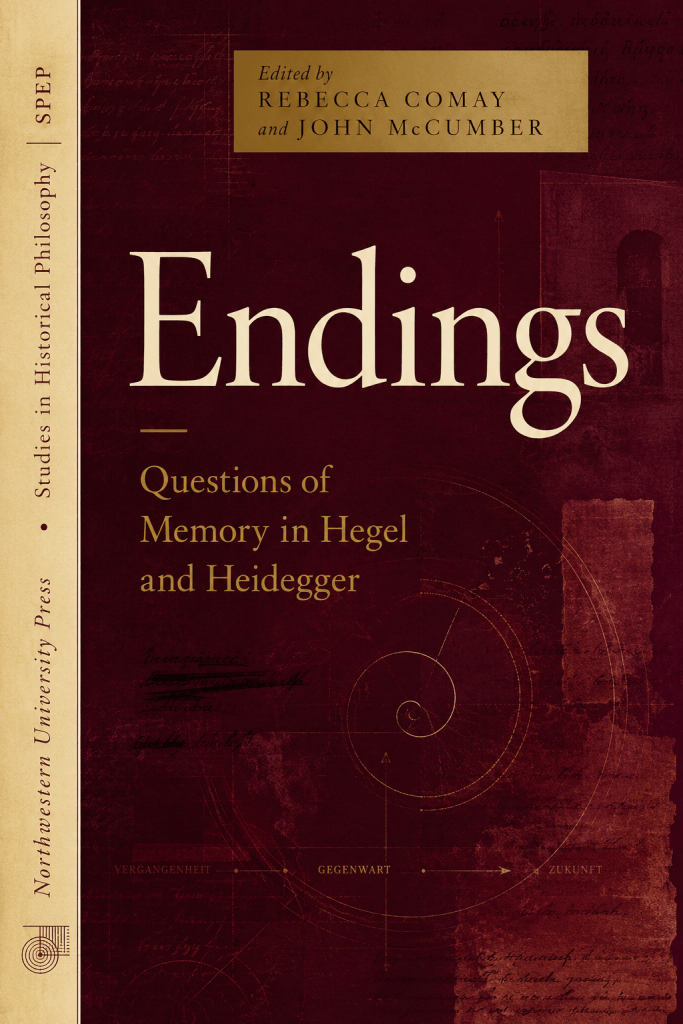
The volume Endings: Questions of Memory in Hegel and Heidegger, edited by Rebecca Comay and John McCumber and published by SUNY Press in 1999, gathers a constellation of essays that together stage one of the most demanding conversations in twentieth-century continental thought The book does not propose a survey of where Hegel and Heidegger agree and where they part company, nor does it adjudicate between them in the manner of textbook comparative philosophy. Rather it lays out a field in which the two names function less as proper names of historical individuals than as figures of the very dilemma the volume is trying to articulate: the dilemma of how thought confronts its own history, how it gathers its inheritance into a present that is at once the realization of that inheritance and its dissolution, and how the question of memory becomes inseparable from the question of finitude.
The book proceeds, that is, on the premise that Hegel and Heidegger together demarcate the contours of philosophical modernity in something like the way Plato and Aristotle demarcated the contours of antiquity, and that the strange, often non-symmetrical relation between them constitutes a kind of irreducible tension within which serious philosophy in our own time must operate. To read Hegel after Heidegger, and even more pressingly to read Heidegger as someone who has himself read Hegel deeply but selectively, partially and yet decisively, is to be drawn into an exchange that has structural features absent from any purely doxographic encounter. That exchange is the subject of these essays, and the volume’s title — Endings — gestures simultaneously toward the Hegelian sense of completion, in which thought finally rejoins itself in the medium of absolute knowing, and toward the Heideggerian sense of the end of philosophy as metaphysics, where what comes to a close is precisely the sequence of ways in which Being has been thought through the figure of beings. To bring those two endings into dialogue is already to refuse to assimilate either to the other, and that refusal is what gives the volume its distinctive intellectual texture.
The editorial choices behind the collection deserve attention before any specific argument is examined. Rebecca Comay’s larger scholarly project, both in her earlier essays of the 1990s and in the later monographs she would publish — Mourning Sickness on Hegel and the French Revolution, and the work she has done with Frank Ruda on the missed and the late — is centered on questions of historical untimeliness, of mourning that fails to mourn, of repetition as the structure within which trauma both binds and undoes the subject. Her sense of Hegel is not the conciliatory Hegel of the standard Anglophone reception, the Hegel of mutual recognition and the rational state, but the Hegel for whom Spirit is constitutively belated, for whom every accomplishment is a missed encounter with what it was supposed to accomplish, for whom Aufhebung names not the untroubled passage from one moment to its synthesis but the wounding by which the moment becomes itself only by failing to coincide with itself. To put it differently, Comay’s Hegel is not opposed to Heidegger’s diagnosis of metaphysics; he is, in a certain way, its first articulator, the thinker who already knew that the closure of the system was inseparable from a constitutive non-closure. John McCumber, for his part, has worked across decades on the relation between time, narrative, and metaphysics, and his book The Company of Words — which precedes this volume — had already laid out a way of reading Hegel that emphasized the dynamic, processual, self-transforming character of the categories rather than their alleged static eternity. McCumber, like Comay, is therefore not interested in defending Hegel against Heidegger by recovering some pre-critical, pre-Heideggerian Hegel; rather, he is interested in showing how Hegel is already engaged in the kind of historical thinking that Heidegger will, in another idiom, claim to inaugurate. The editorial pairing thus produces a volume in which Heidegger’s claim to have surpassed Hegel is itself put under interrogation, without any retreat into a complacent Hegelian triumphalism.
McCumber’s introduction, which the original analysis describes as a “story of things,” is in fact a programmatic narrative about the metaphysical fate of the substantive — about what happens to the thing, the res, the Ding, the ousia, when philosophy ceases to think these as static, self-identical entities and begins to think them as dynamic, processual, internally articulated, historically constituted. To tell the story of the thing in this way is to retrace the entire trajectory from Aristotelian ousia through medieval substantia, through Cartesian res cogitans and res extensa, through Leibnizian monad, through Kantian thing-in-itself, through Hegelian concept and Heideggerian thing — das Ding in the late essay of that title — as a sequence in which the thing progressively loses its self-evidence and is recovered, if at all, only as the site of a more originary event. The point of telling this story is not antiquarian. It is, rather, to mark the threshold at which philosophy can no longer assume that what there is presents itself as a collection of independent items susceptible to inventory, and must instead think being as the unfolding of relations, transitions, mediations, sendings. McCumber’s claim — and it is a claim shared, in different idioms, by all the contributors — is that this transformation, the transformation by which logos is “recaptured by time,” is the threshold at which Hegel and Heidegger stand together, however differently they negotiate it. Hegel recaptures logos by time when he insists that the concept is not a timeless form but the self-articulating, self-mediating motion in which Spirit comes to itself through history; Heidegger recaptures logos by time when he insists that thinking is bound to the epochal sendings of Being, that no concept stands outside the history within which it has come to be intelligible. The introduction therefore sets up a way of reading the rest of the volume: the essays that follow are not so many illustrations of the McCumber thesis, but variations within a problem-space he has marked out, each variation showing a different dimension of what happens when thought becomes its own history.
What is distinctive about the volume’s organizing concept of memory is that it does not function as a topic among others — alongside, say, freedom, or history, or art — but as the modality in which thought engages its own historicality. Memory in this sense is not psychological, not a faculty by which a subject retains representations of past experiences, but ontological: it is the way in which what has been continues to inflect what is, the way in which the past enters into the present not as something completed but as something still working in the present, still soliciting, still demanding. Hegel has at his disposal the rich resources of the German distinction between Erinnerung, the inwardizing of what has been into the substance of consciousness, and Gedächtnis, the more mechanical retention of signs and names that nevertheless makes possible the labor of conceptual thought. The famous closing pages of the Phenomenology of Spirit invoke this complex of terms with extraordinary density: Spirit must externalize itself, must allow its own substance to take the form of an other that confronts it, and must then take that other back into itself as the inwardized truth of what it has been; the calendar of historical shapes, the gallery of forms of consciousness, the long pilgrimage of the Phenomenology itself, is recapitulated at the close as a remembering, an Erinnerung, that is simultaneously a recollection and an interiorization, the inscribing of what has happened on the substance of the Notion. Heidegger, for his part, refuses the trajectory of Erinnerung when it appears to him to amount to the absorption of the past into a present that has overcome it, but he develops his own counter-figure of memory in the term Andenken, thoughtful remembrance, the meditative bringing-near of what has withdrawn. Andenken is not Erinnerung because it does not take the past back into the substance of the present; it holds the past at a distance from which it can continue to call upon thought, to provoke thought to a kind of listening that does not seek to comprehend in the Hegelian sense — does not seek to grasp together — but rather to attend, to abide with what has been sent. Between Erinnerung and Andenken, between inwardizing recollection and thoughtful retention of the withdrawn, the volume locates one of the central oppositions in the Hegel-Heidegger encounter, and many of its essays return obsessively to this opposition, sometimes to sharpen it, sometimes to complicate it, sometimes to suggest that the two figures of memory are less opposed than mutually presupposed.
The encounter between Hegel and Heidegger is, of course, historically asymmetrical. Heidegger reads Hegel; Hegel does not, cannot, read Heidegger. Heidegger lectures on Hegel; he writes the long essay “Hegel’s Concept of Experience” that traces the “Introduction” to the Phenomenology through a Heideggerian lens; he gives the seminar on Hegel’s Logic in 1957 — Identität und Differenz, the lecture “Der Satz der Identität” and the surrounding texts — that announces the onto-theological constitution of metaphysics; he returns again and again to Hegel in the later texts, sometimes naming him, sometimes refusing him without naming, sometimes setting him up as the consummate metaphysical thinker against whose closure the thinking of Being must now begin. Hegel is, in Heidegger’s diagnosis, the figure in whom metaphysics most fully accomplishes itself; the absolute Idea is the ultimate articulation of the onto-theological structure in which a supreme being grounds the totality of beings while itself remaining a being. To read Heidegger reading Hegel is therefore to confront a moment of philosophical violence: Heidegger appropriates Hegel as the index of what must be left behind, and at the same time he cannot cease to engage Hegel because Hegel has thought, more rigorously than anyone before him, the historical character of thinking itself. Janicaud’s contribution to this volume, which the original analysis describes as staging an “impossible dialogue,” seems to take up precisely this asymmetry as its productive provocation. The dialogue is impossible not only because Hegel cannot answer back but because the two thinkers’ commitments are arranged in such a way that what counts as an objection on one side does not translate, on the other side, into what would have been recognized as an objection at all. To say that Hegelian Aufhebung remains within the metaphysics of presence is not, for a Hegelian, to have made an objection; it is to have restated, in different words, the very claim of dialectic. Janicaud’s essay, on the strength of his earlier work in La métaphysique à la limite and his interventions in the debates around the so-called “theological turn” in French phenomenology, would have been alert to the way in which the dialogue between Hegel and Heidegger always risks becoming a non-dialogue, a juxtaposition of incommensurate vocabularies. His contribution presumably attempts, against this risk, to reconstruct the dialogue as a mutual interrogation rather than a unilateral overcoming, and in doing so to recover what is genuinely at stake on both sides — what each thinker actually claims, what each thinker actually requires the other to concede, where the genuine point of non-translation falls.
Michel Haar’s essay on epochality is one of the volume’s most pointed engagements with the structural opposition between dialectic and sending. Haar, whose book La fracture de l’histoire and whose work on Heidegger over decades had given him a finely tuned sense of how the Heideggerian conception of the history of Being departs from any teleological model, would have approached the relation between Hegelian Spirit and Heideggerian Geschick as a relation of point-for-point inversion. Hegel’s history is the history of Spirit’s coming-to-itself, the gradual self-realization of freedom in which each moment is at once a partial expression of the whole and a moment to be sublated, lifted up into the next, with the movement as a whole tending toward the absolute self-presence of Spirit in which it knows itself as the totality of the process. Heidegger’s history is structured wholly otherwise. There is no telos, no convergence, no final coming-to-itself; there are, rather, the epochs of Being, the successive holdings-back, the sendings of Being in which Being gives itself only by withdrawing, in which the fundamental traits of an age — the Greek, the Roman, the medieval, the modern — are not stages on the way to a higher reconciliation but distinct configurations of disclosedness, each one finite, each one bearing within it its own specific concealment. The “forgetting of Being” — Seinsvergessenheit — is not a contingent failure that a future age might overcome by remembering more; it is a structural feature of the way Being gives itself through beings, a withdrawal that is constitutive of disclosure, such that to think Being at all is to think it through and against the forgetting that is its mode of giving. Haar’s analysis, then, would have shown that the Heideggerian critique of Hegel is not merely the substitution of one historical scheme for another but a more fundamental shift in what counts as historical thinking. To think historically, on Heidegger’s account, is precisely not to gather history into the unity of a self-realizing subject but to attend to the irreducibility of each epoch’s mode of giving, to refuse the comfort of the synthetic narrative. This refusal is what Haar would have called, with precision, the Heideggerian inversion of Hegel: not a different conclusion drawn within a shared frame, but a different frame altogether, in which the Hegelian categories — Aufhebung, mediation, the negation of negation — appear as the consummate metaphysical formulations against which thinking now has to struggle.
Yet to leave the matter there would be to grant Heidegger his self-presentation, and the volume is too sophisticated to do so. Several of the essays — and Comay’s own work outside this volume bears witness to the larger movement — register the way in which Heidegger’s account of the history of Being, for all its rejection of teleology, retains a kind of secret narrative shape. The very gesture of identifying epochs, of naming a Greek beginning, a Roman translation, a modern subjectivism, a technological end-of-philosophy, of distinguishing between an inceptive thinking and a metaphysical thinking that has covered it over, of locating ourselves at a threshold where another beginning becomes possible — this gesture is not innocent of the dialectical inheritance it disavows. Heidegger may not be Hegel, but he is also not free of Hegel; the structure of his historical thought owes more to the German tradition of philosophical history-writing — to Hegel and Schelling and the Romantic philosophy of history — than his polemical self-presentation would suggest. To recognize this is not to reduce Heidegger to a Hegelian in spite of himself; it is, rather, to see that the encounter between the two thinkers takes place not at the level of explicit doctrine but at the level of the inheritance that both of them are attempting to articulate. Both inherit the post-Kantian situation in which thought is no longer guaranteed by any pre-given metaphysical or theological frame; both inherit the Romantic problem of how to think historically without thinking developmentally; both inherit the German preoccupation with the relation between art, philosophy, and politics; both inherit the linguistic specificity of German philosophical vocabulary, the resources of a language in which the speculative is, to a degree unmatched in other modern languages, sedimented into ordinary expression. To read Hegel and Heidegger together, then, is in part to read them as joint heirs of a common situation, even where they configure that inheritance against one another.
The essays on aesthetics and art history form one of the volume’s densest clusters, and not by accident: art is for both Hegel and Heidegger a privileged site at which the questions of memory, history, and truth converge. Hegel’s Lectures on Aesthetics, which Donougho would have approached with the philological care he has brought to his Hegel scholarship over decades, advance the famous and famously misunderstood “end of art” thesis. The thesis is not, as it has sometimes been read, that art has historically come to an end and will be produced no more; it is, rather, that art has reached the end of its capacity to be the highest mode in which Spirit articulates its truth. In the Greek world, Hegel argues, the divine could be thought adequately only in the medium of sensuous form; the gods were, ineluctably, statues, and the Hellenic intuition of the divine was inseparable from the marble that incarnated it. With the advent of Christianity, the divine becomes inward, and the truth of Spirit can no longer be adequately presented in a sensuous medium; the medium of truth shifts from art to religion, and finally from religion to philosophy, in which Spirit knows itself in the medium proper to it, the medium of the concept. Art does not vanish; it continues to be produced, and in modern art Hegel sees a kind of liberated, reflexive activity in which the artist is no longer bound to the substantial content of a particular religious or ethical world. But art is no longer the arena in which the question of truth is decided. The “end of art” is therefore not a death certificate but a transposition, a rearrangement of the relation between sensuous form and conceptual content. Heidegger’s “The Origin of the Work of Art,” composed in the 1930s and revised in the years that followed, takes a position that is at once a response to Hegel and an attempt to step outside the framework Hegel had established. The work of art, for Heidegger, is not simply the sensuous presentation of an idea, not the dressing-up of a content in a form, but the originary site at which truth happens, in which world is opened and earth is brought forth, in which the strife between disclosure and concealment is set to work. Heidegger explicitly discusses Hegel’s verdict on art in this essay and in the Addendum he later attached to it; he registers the verdict, he refuses to accept that the verdict has been final, and he opens up the possibility that the work of art might be, again, a site of truth in a way that exceeds the Hegelian dispensation. Donougho and Haar would have approached this conjunction from complementary angles, Donougho with a sharper attention to the nuances of Hegel’s actual aesthetic doctrines (which are far less univocal than the slogan of the “end of art” suggests), Haar with a sharper attention to the way in which Heidegger’s apparent recovery of art for truth is itself bound up with his epochal account of the history of Being. The exchange between their essays, as the original analysis suggests, would have established art as the site at which collective memory takes shape — for Hegel, the Greek statue is the form in which a people remembers, ritually and palpably, what its gods are; for Heidegger, the Greek temple is the work in which a people first comes into the world it inhabits, and the work of art generally is the site at which a historical people gathers and is gathered into its sending.
Jacques Taminiaux’s contribution would have brought to bear on this constellation the resources of a long career devoted precisely to the relations between poiesis, theoria, and praxis in the German tradition. His earlier book La nostalgie de la Grèce à l’aube de l’idéalisme allemand had already mapped the Greek inheritance of Hegel and Hölderlin with unusual care, and his later work on Arendt, Heidegger, and the question of action in the Aristotelian tradition gave him an unmatched sense of how the philosophical engagement with Greek poiesis and Greek theoria informs the modern German problematics. Taminiaux’s argument, as the original analysis indicates, would have engaged Heidegger’s periodicity of art history — the schematism by which Heidegger distinguishes Greek temple, medieval cathedral, modern aestheticized object, and so on — as a “transformative yet inconsistent appropriation of Hegelian themes.” The point is significant. Heidegger’s history of art is not simply a counter-history to Hegel’s; it borrows the very gesture of stratifying art into successive epochal configurations, of making each configuration the site of a specific disclosure of truth, while denying the developmental telos that Hegel’s stratification rests on. The result is, as Taminiaux would have shown, a periodicity that is in important respects parasitic on Hegel even as it claims to dislodge him. To see this clearly is to understand that the Heideggerian critique of Hegelian art history is not a clean break but a complicated overwriting, in which Hegelian shapes return as Heideggerian sendings without the compensating mediation that, in Hegel, made each shape’s finitude bearable. The Heideggerian temple stands in a desolate epochal landscape that the Hegelian statue, for all its Greek finitude, did not occupy; the Hegelian statue was always already on the way to being remembered, taken up into the ongoing self-articulation of Spirit, while the Heideggerian temple risks being left, monumentally, alone, exposed to a forgetting that has no horizon of redemption. Whether this exposure is the strength or the weakness of Heidegger’s position is one of the genuinely open questions the volume keeps in play.
Kathleen Wright’s treatment of gender in Heidegger’s readings of Antigone marks one of the volume’s most politically incisive moments. Antigone, of course, is the figure who haunts both Hegel and Heidegger, and the differences in their respective readings open onto fundamental differences in how each thinks ethical life. For Hegel, in the celebrated chapter of the Phenomenology on “The Ethical Order,” Antigone is the figure of the family, of the divine law, of the unwritten and immemorial obligations of kinship that stand over against the human law of the polis represented by Creon. The collision between Antigone and Creon is not, for Hegel, a simple opposition of right and wrong; both are right within their respective spheres, and the tragedy of Sophocles’ play lies precisely in the necessity of the collision, in the way each ethical power, in asserting itself, brings about the destruction of the other and ultimately of itself, leaving the way open for a higher mediation that the Greek world could not yet attain. In Hegel’s reading, Antigone is also indelibly marked as feminine — she is, he writes, the eternal irony of the community, the moment of the ethical that cannot be fully integrated into the masculine self-conscious order of the political community. Hegel’s reading thereby inscribes a determinate gendering of the ethical, in which the feminine is at once foundational — the family is the substantial soil from which ethical life grows — and irreducibly subordinate, the moment that must be surpassed if the universal is to be realized. Heidegger’s readings of Antigone, particularly in the lecture course on Hölderlin’s “Der Ister” and in the Introduction to Metaphysics, take up the figure differently. For Heidegger, Antigone is the most uncanny — deinotaton — of the uncanny beings of the famous choral ode, the human being who in venturing into the homely makes the homely unhomely, who in the very act of inhabiting an ethos exposes the constitutive uncanniness of human dwelling. Heidegger’s Antigone is therefore not primarily a figure of the family, of kinship, of the feminine; she is a figure of the relation between the homely and the unhomely, of the polis as the site at which historical Dasein takes its stand. Wright’s intervention, on the strength of her broader work on hermeneutics and ethics, would have insisted that this Heideggerian de-gendering of Antigone is not the politically neutral move it presents itself to be. The very erasure of Antigone’s femininity — the lifting of her into a generic figure of the human relation to the unhomely — repeats, at a higher register, the metaphysical operation by which the masculine universal effaces the particular it depends upon. To read Antigone with Heidegger and to read Antigone with Hegel are therefore not two equally innocent options; both readings are politically inflected, both are entangled in a long history of masculine philosophical appropriation of female tragic figures, and both have to be read against themselves if the political stakes of memory are to be made visible.
David Farrell Krell’s reflections on Hölderlin extend this constellation in another direction. Krell, whose books Lunar Voices and Daimon Life and the studies of Hölderlin he has produced over many years have made him one of the most sensitive contemporary readers of the late hymns, would have approached the conjunction of Hegel, Heidegger, and Hölderlin from a vantage that refuses to let either philosophical reading exhaust the poetic. Hölderlin is the figure who stood at the threshold of German Idealism — schoolmate of Hegel and Schelling at the Tübingen Stift, formulator of crucial early arguments about being and judgment, author of the philosophical fragment “Urteil und Sein” that has been read as anticipating decisive moves in Schelling and Hegel — and who, in the long descent into mental illness that occupied the second half of his life, produced a body of poetry that Heidegger would later treat as the indispensable resource for any thinking that hopes to step beyond metaphysics. The Hegelian and Heideggerian receptions of Hölderlin are, however, sharply different. For Hegel, who was Hölderlin’s intimate friend and who, in the early Frankfurt period, shared with him a project of philosophical and theological renewal, Hölderlin remained a presence whose subsequent silence was a wound but whose poetic accomplishments were, from the standpoint of the mature dialectic, surpassed by the conceptual labor of philosophy. For Heidegger, Hölderlin became something quite different: the poet of the poet, the one in whose hymns the very essence of poetry is brought to language, the one whose meditations on Greek and German destiny, on the gods who have fled and the gods who are to come, on the holy and the homecoming, opened a path that no philosophical concept could open. Heidegger’s lectures on Hölderlin — on “Andenken,” on “Der Ister,” on “Germanien,” on “Wie wenn am Feiertage” — are among the most sustained engagements he produced, and they show him working through Hölderlin in a register that mixes philological attention with speculative violence. Krell’s essay in this volume, on the strength of his other work, would have engaged the Heideggerian appropriation of Hölderlin with a salutary suspicion, refusing to grant that Heidegger’s reading exhausts the poet, attentive to the moments at which Heidegger’s interpretive moves serve a thinking that lies, at best, parallel to and not within the poetic gesture itself. At the same time, Krell’s reading would have respected the genuine insight of the Heideggerian reception — that Hölderlin’s poetic thinking does open onto a mode of memory, of Andenken, that resists assimilation to the Hegelian Erinnerung, and that the late hymns articulate a relation between the destinal and the homely, between the holy and the historical, that has no precise equivalent elsewhere in the German tradition. The Hegel-Heidegger encounter, as Krell would have shown, is also a Hölderlin-Hegel-Heidegger triangulation, and the figure of the poet stands within this triangulation as both the resource each thinker draws on and the limit beyond which neither can fully reach.
Robert Bernasconi’s essay on Eurocentrism in Hegel and Heidegger represents the volume’s most pointed political intervention. Bernasconi has been, over the course of his career, one of the most rigorous readers of the racialized and Eurocentric dimensions of canonical German philosophy, and his work on Kant’s writings on race, on Hegel’s Lectures on the Philosophy of History and the Africa chapter therein, on Heidegger’s National Socialism and on the broader question of how the philosophical canon has constructed its own self-image as European, has set the terms for a serious engagement with these matters that goes well beyond either denunciation or apologia. Hegel’s Lectures on the Philosophy of History, especially in the introductory portions and in the treatment of Africa as the land allegedly outside history proper, contain some of the most egregious passages of racialized exclusion in the philosophical canon; the assignment of world-historical significance to a sequence of cultures that begins in the Orient, passes through Greece and Rome, and culminates in the Germanic world, is not an incidental architecture but a structural commitment of Hegel’s philosophy of world-history. Heidegger’s situation is different but not, in Bernasconi’s reading, less troubled. Heidegger’s privileging of the Greek-German axis, his insistence that only Greek and German are languages of philosophical thinking, his repeated gestures of confining the destinal sending of Being to the European trajectory, his hostility to “world civilization” and to the leveling effects of planetary technology, are all moments at which his philosophical commitments and his political and cultural commitments converge. Bernasconi would have insisted, against any complacent reading, that the Eurocentrism is not external to the philosophical content but internal to the way that content is articulated. To take seriously the question of memory in Hegel and Heidegger is therefore to ask: whose memory? whose history? what is forgotten when the history of Spirit or the history of Being is told in this Greek-to-German way? Bernasconi’s essay would have raised these questions with the force of someone who refuses both the reduction of philosophy to politics and the absolution of philosophy from its political commitments. The challenge his essay poses to the volume — and to the Hegel-Heidegger encounter generally — is whether the rich resources of dialectical and post-dialectical thinking can be used to interrogate the Eurocentric inheritance from within, or whether that inheritance is so deeply structural that the only honest response is to begin elsewhere, with thinkers and traditions that have been excluded from the canonical narrative.
John Sallis’s essay on stone offers a quite different mode of intervention. Sallis is the philosopher who, more than any other in the contemporary American scene, has taken seriously the question of materiality, of the elemental, of the place where thought encounters what resists being subsumed into the concept. His books Stone, Force of Imagination, Topographies, and the long sequence of works on the elemental and the imaginal have traced the way in which materials — stone, water, light, air — are not the inert substrate of philosophical reflection but the very sites at which philosophical reflection finds itself addressed, called upon, transformed. To take stone as the focal point of an essay in this volume is to perform a remarkable interpretive operation: it is to bring the Hegel-Heidegger encounter down to a level where it must engage with the stuff of which monuments and temples and cathedrals are made, the substance that endures across epochs, that is shaped by historical hands and that, in turn, shapes the historical sensibility of those who encounter what has been built in it. The Gothic cathedral, which Hegel discusses with extraordinary attention in the Aesthetics, is for Hegel the architectural form in which the inwardness of Christian Spirit reaches its most adequate sensuous expression — the soaring vertical lines, the dissolution of the wall into stained glass, the way the building draws the eye upward toward the transcendent — and the cathedral is therefore a moment in the historical pilgrimage of art toward its dissolution into religion and philosophy. The temple at Paestum, on the other hand, is the structure that Heidegger does not himself name but whose archetype haunts “The Origin of the Work of Art”: the Greek temple that opens a world for a historical people and brings forth the earth in the very thrust of its columns into the light. Sallis’s essay, on the strength of his broader project, would have shown that the materiality of stone is not the same in these two cases. The cathedral’s stone aspires beyond itself, is reached through and as it were rendered translucent in the verticality of the structure; the temple’s stone stands in the strife of disclosure and concealment, neither dissolving into spirit nor receding into mere matter. The Hegelian and Heideggerian readings of stone are therefore not just different aesthetic theories; they articulate different ontologies of the material itself, different senses of what it means for a thing to be the dwelling-place of memory. Stone, in Sallis’s hands, becomes the site at which the question of memory ceases to be a question merely about consciousness or thinking and becomes a question about how the material world holds and transmits historical sense.
The volume also addresses what the original analysis calls the “crisis of science,” and this is a topic on which Hegel and Heidegger meet with particular intensity. Hegel’s Science of Logic and his Encyclopedia of the Philosophical Sciences claim to articulate the entire system of philosophical science, the speculative unfolding of the categories of thought in their necessary interconnection. Hegel did not believe that philosophy was opposed to the empirical sciences or that it could be carried out without engagement with their results; on the contrary, the Encyclopedia contains extensive engagement with the natural sciences of Hegel’s day, with mathematics, with physiology, with chemistry, and the philosophical task is to think through the speculative content of the categories that the empirical sciences operate with but do not, qua empirical sciences, articulate as such. Hegel’s confidence in this project is grounded in his conviction that thought and being, when properly understood, are not externally related but internally identical — that the structure of the concept is the structure of what is, and that the speculative philosopher articulates this identity in the medium of conceptual self-mediation. Heidegger’s relation to science is, by contrast, marked by a deep ambivalence. From the early lectures on the metaphysical foundations of the modern scientific project, through the analysis of “Die Frage nach der Technik” and “Wissenschaft und Besinnung,” through the late meditations on the planetary, technological situation, Heidegger consistently maintains that modern science is not a neutral epistemic enterprise but the realization of a particular metaphysical configuration — a configuration in which beings are pre-disposed to be apprehended as standing-reserve, as calculable, as available for ordering. The “crisis of science” in the sense Heidegger ascribes to it — a crisis that he saw articulated already in Husserl’s Crisis of European Sciences — is not a crisis of bad science to be remedied by better science; it is the crisis of a mode of disclosure that has become so pervasive that it threatens to occlude every other mode. The volume’s essays on this question would have explored how the Hegelian and Heideggerian responses to science, despite their different vocabularies, share a common refusal to grant that science is the privileged or even adequate mode of thinking, while differing radically on what philosophy is supposed to do in response. For Hegel, philosophy carries science to its speculative completion; for Heidegger, philosophy must step back from science altogether, into a thinking that is neither scientific nor anti-scientific but simply other than scientific. Whether either response is adequate to our contemporary situation — in which the planetary technological order has only deepened, in which the sciences have proliferated and specialized to a degree neither thinker could have anticipated, in which the very distinction between human and technological agency has become uncertain — is one of the questions the volume leaves to its readers.
Several of the essays return, in different keys, to the question of what it means to think historically without thinking developmentally. This is, in some ways, the central problem the volume grapples with. The Hegelian dialectic offers one model: history is the self-articulating motion of Spirit, in which each moment is at once partial and necessary, in which the negation of one moment by the next is not destruction but determinate negation, the lifting up of what has been negated into a higher configuration that preserves what was true in it. To think historically on this model is to think the necessity of the sequence, the inner connection of the moments, the way in which what comes later is implicit in what came earlier and what came earlier is preserved in what comes later. The Heideggerian counter-model offers something quite different: history is the sequence of epochal sendings, the successive holdings-back in which Being gives itself, and the relation between epochs is not one of dialectical mediation but of caesura, of the radical otherness of each epoch’s mode of disclosure. To think historically on this model is to think the irreducibility of each epoch to the others, to refuse the synthetic operation by which the dialectical thinker gathers the past into the present, and to attend instead to what each epoch sends as the specific limit and possibility of its own thinking. The volume’s essays do not simply oppose these two models; they trace the complex ways in which each model presupposes elements of the other, the ways in which Hegel’s dialectic harbors moments of caesura — of the failed sublation, of the wound that does not heal — that exceed its self-presentation, and the ways in which Heidegger’s epochal account harbors moments of continuity — of the persistence of metaphysics, of the sedimentation of inceptive thinking in subsequent epochs — that exceed its own self-presentation as a thought of caesura. To think historically, the volume suggests, is to operate in the space between these two models, to refuse the closure of either, to hold open the question of what it means for the past to be both gathered and ungathered, both inherited and irreducible.
This way of holding the question open is, in many respects, what Comay’s larger work has been about, and her presence as editor of this volume is felt not only in the choice of contributors but in the orientation the volume as a whole adopts. The Hegel that emerges across these essays is not the Hegel of the standard caricature — the panlogist for whom everything is sublimated into the absolute, the philosopher of completion who leaves nothing untouched by his synthetic ambition — but a Hegel for whom the system is always shadowed by what it cannot incorporate, for whom Aufhebung is also a kind of mourning, for whom the labor of the negative leaves marks that no subsequent affirmation entirely erases. This Hegel is closer to the Hegel of Nancy and of Žižek than to the Hegel of the textbooks, though neither of those readings is identical to Comay’s. The Heidegger that emerges is also not the Heidegger of caricature — neither the prophetic seer of the destinal sendings nor the simple antagonist of all things metaphysical — but a Heidegger whose own thinking is more deeply marked by Hegelian inheritances than his polemics admit, and whose engagement with Hegel is more philosophically productive than either his self-presentation or his Anglophone reception has tended to suggest. To put it briefly, the volume restores both thinkers to their genuine difficulty, refusing the simplifications that have made their encounter look like either a clear opposition or a manageable convergence.
The figure of the end, around which the volume is organized, deserves a more sustained reflection than the original analysis affords it. To speak of “endings” in the plural is already to refuse the singular finality that either thinker, in his polemical moments, might have wanted to claim. There is no one ending but several, and the relations between them are intricate. Hegel’s Absolute Knowing is an ending in the sense that it is the moment at which Spirit has run through the gallery of its forms and arrived at the comprehension of itself as the totality of those forms; but it is not an ending in the sense of a stopping, since Absolute Knowing is itself the medium in which the philosophical sciences of the Encyclopedia unfold, and in which the world-historical labor of Spirit continues to articulate itself in the various forms of art, religion, and philosophy. Heidegger’s “end of philosophy as metaphysics” is an ending in the sense that the sequence of metaphysical configurations has reached, in the planetary technological order, a kind of consummation, a maximal extension that brings to completion the sequence of forgettings that constitute the history of Being; but it is not an ending in the sense of a stopping, since the end of philosophy opens onto the possibility of another beginning of thinking, a beginning that is not the resumption of philosophy but the inauguration of something else, something whose name Heidegger struggles to find — Andenken, Besinnung, das andere Denken, a thinking that is no longer ours to specify in advance. To bring these two figures of ending into dialogue is therefore to discover that ending is not opposed to continuation, that the gesture of marking an end is itself part of what is going on as the present unfolds, that we live, as the volume suggests, in the long duration of an ending that is not a terminus but a transformation. The question is whether we recognize ourselves in this duration, whether we take up the inheritance it imposes, or whether we merely mark time within an end that we have ceased to think.
The political stakes of this question are not minor. Both Hegel and Heidegger thought of philosophy in terms that connected it to the public, historical life of a people, and both attempted to articulate a vision of the political that would correspond to the philosophical situation they diagnosed. Hegel’s Philosophy of Right lays out the rational structure of the modern state, with its differentiated spheres of family, civil society, and political institutions, and it does so in the conviction that this structure is the institutional realization of the freedom that Spirit has achieved through its long historical labor. Heidegger’s political thought is, notoriously, far more contested. His engagement with National Socialism in the early 1930s, the rectoral address, the lectures of the period, the so-called Black Notebooks now made public, have given rise to debates about the depth of his political commitments, the extent of their philosophical entanglement, and the question of whether his post-war refusal to apologize publicly is itself a philosophical position or a personal failure. The volume does not, of course, attempt to settle these debates, but it cannot avoid them either. Bernasconi’s essay raises them directly; other essays raise them obliquely. To think Hegel and Heidegger together at the end of the twentieth century, when the political experiments their philosophies authorized or were taken to authorize had largely collapsed or revealed their costs, is to think them under the shadow of those collapses. The volume’s seriousness about politics, like its seriousness about gender and about Eurocentrism, is part of what gives it its distinctive intellectual texture; it does not engage Hegel and Heidegger as if these questions had already been settled, nor does it allow the questions to substitute for philosophical engagement.
It is also worth pausing over the way the volume insists on the institutional and pedagogical situation in which the encounter between Hegel and Heidegger now takes place. Both thinkers have, over the course of the twentieth century, become canonical in academic philosophy and in the broader humanities, and their canonization has been carried out in ways that often obscure rather than reveal the genuine difficulty of their work. To read Hegel through the secondary literature is, all too often, to encounter a Hegel reduced to a few formulas — thesis-antithesis-synthesis, the cunning of reason, the end of history, master and slave — that have become detached from the dense conceptual texture of the Phenomenology and the Logic. To read Heidegger through the secondary literature is to encounter a Heidegger reduced to a similar set of slogans — Being and time, the forgetting of Being, the danger and the saving power, the call of conscience, language as the house of being — that have become detached from the painstaking phenomenological work that gave them their original force. The volume, in its sustained engagement with the texts and with the questions, refuses both reductions; it insists that the encounter between Hegel and Heidegger is not exhausted by, and is in some respects resistant to, the canonical reduction. To return to Hegel and Heidegger at the level the volume sustains is therefore also a pedagogical and institutional act, an act of reclaiming a complexity that the institutional pressures of academic philosophy have tended to obscure.
What emerges from a sustained engagement with the volume is, finally, a complicated picture of memory itself as the modality in which thought confronts its history. Memory in this volume is not nostalgic; it is not the longing for a past that has been lost and might be recovered. Nor is it triumphalist; it is not the gathering of the past into a present that has overcome it. It is, rather, something stranger and more demanding: the holding open of the past as a space within which the present must continue to find itself, the refusal both to leave the past behind and to make the past coincide with the present. This holding open is what Hegel, in his most acute moments, calls the labor of the negative; it is what Heidegger, in his most acute moments, calls the thinking that is more rigorous than the philosophical concept. To think memory in this register is to think that the past works in us not as a content we possess but as a demand we owe, not as something we have but as something we are still becoming through. The volume’s title, Endings, signals this clearly: the endings it announces are not closures but transitions, not termini but the threshold at which the relation between past and present, between memory and futurity, becomes once again a question.
It is possible, in this connection, to read the volume as itself an act of mourning — mourning for the figures of Hegel and Heidegger, mourning for the version of philosophy that took them as its dominant references, mourning for the political and cultural worlds that were shaped, for better and for worse, by their philosophies. But it is mourning of the kind that Hegel theorized in his discussions of the death of Christ and that Comay would later treat at length: a mourning that does not consist in the gradual dissolution of the lost object into the substance of the mourner but in the prolonged, ungraspable holding of the loss as constitutive of the mourner herself. To read Hegel and Heidegger at the end of the twentieth century is, in this sense, to mourn them while still engaging them, to hold open the encounter with them as the encounter with a tradition that has not, for all its supposed exhaustion, ceased to make demands. The contributors to this volume seem to know this, and the essays they have produced reflect the strange combination of distance and engagement, of critique and inheritance, that this kind of mourning requires.
A further dimension that the volume opens, though it cannot be exhaustively pursued in any single essay, is the question of how this Hegel-Heidegger encounter relates to the broader landscape of twentieth-century continental thought. The figures whose work has been most decisive in keeping the encounter alive — Derrida, Nancy, Lyotard, Levinas, Blanchot, Adorno, Lacan, and the many others who in different idioms have read both Hegel and Heidegger as constitutive of their own intellectual situations — appear at the edges of the volume’s discussions, sometimes named, often unnamed, but always implicitly present as the third parties to the dialogue. Derrida’s reading of Hegel in Glas and his sustained engagement with Heidegger in essays like “Ousia and Gramme” and “The Ends of Man” provide one of the major conduits through which both thinkers have entered contemporary thought, and the very phrase “the ends of man” registers an attentiveness to the multiple senses of fin — purpose, conclusion, telos, terminus — that resonates with the volume’s title. Nancy’s The Speculative Remark and Hegel: The Restlessness of the Negative offer a reading of Hegel that, like Comay’s, refuses to assimilate Hegel to the consummate metaphysical thinker that Heidegger’s polemic constructs, while acknowledging that there is nonetheless a genuine philosophical issue between the two. Adorno’s Negative Dialectics and his Three Studies on Hegel, while polemically opposed to Heidegger, share with him a refusal of the unproblematic Hegelian sublation, an insistence on the non-identical that resists conceptual gathering. The volume’s essays do not generally engage these later interlocutors at length, but their presence is felt as the broader intellectual context within which the Hegel-Heidegger encounter has acquired its contemporary urgency. To read the volume is, implicitly, to read it within and against this larger landscape, and the volume’s restraint about that landscape — its concentration on the two thinkers themselves rather than on the secondary literature on the relation — is, on reflection, one of its strengths.
The question of language deserves separate consideration, because it is in language that the Hegel-Heidegger encounter perhaps most concretely takes place. Both thinkers wrote in German, and both wrote in a German that was unique to themselves — Hegel’s at once dense and architectonic, with its long syntactic spans, its substantivized verbs, its punning use of the speculative idioms of the German philosophical tradition; Heidegger’s by turns elliptical and almost incantatory, with its hyphenations, its etymological recoveries, its insistence on the way that German itself, in its kinship with Greek, holds open possibilities of thinking that other languages have lost. To read either thinker in translation is to lose much, and to read both in conjunction is to encounter the problem of translation as a philosophical problem. The German Erinnerung — literally an “in-ward-ing” — does not translate cleanly into the English “recollection” or “remembrance” or “memory”; the German Andenken — literally “thinking-toward” or “thinking-of” — has a different valence again, more meditative, more directional, more bound up with what is held in regard. The German Aufhebung — at once “lifting up,” “preserving,” and “canceling” — has been the subject of decades of translation debates and remains, perhaps, the philosophical word most resistant to a single-word equivalent in any other language. The German Geschick — at once “sending” and “destiny” and “skill” — is similarly multivalent. To engage Hegel and Heidegger is therefore also to engage the German philosophical lexicon, with its peculiar density and resistance, and to ask what it means for thinking to be bound to a language in this way. The volume, in its translations and in its scholarly apparatus, is alert to these questions, and the cumulative effect of reading it is to deepen one’s sense of how language, far from being the transparent medium of philosophical reflection, is itself part of what is at stake in the encounter the volume stages.
It would be a mistake to leave this reflection without registering the way in which the volume, despite its considerable seriousness, also leaves much unfinished. The essays open more questions than they answer, and the answers they offer are themselves provisional, calibrated to the specific angle of approach each contributor takes. This unfinishedness is not a defect; it is, on the volume’s own terms, the only honest response to the questions of memory, history, and ending that the volume asks. To finish the conversation would be to betray it; to claim a final synthesis would be to fall back into the very dialectical closure that the volume, after Heidegger, refuses; to refuse all synthesis would be to fall back into the very epochal isolationism that the volume, after Hegel, refuses. What the volume offers is the ongoing labor of holding the question open, of refusing both closures, of attending to what each thinker says and to what each thinker leaves unsaid, of taking seriously both the dialectical and the post-dialectical inheritances. That the labor is ongoing is itself the point: thinking, on the volume’s own showing, is not the gathering of conclusions but the persistence of the question, and the persistence of the question is itself a form of memory.
There is, finally, the question of what such a volume can mean for readers in our own time, more than two decades after its publication. The intellectual landscape has shifted in ways that the volume could not entirely anticipate. The broader institutional pressures on continental philosophy have increased; the reception of Heidegger has been further complicated by the publication of the Black Notebooks and the renewed attention to his political commitments; the Anglophone reception of Hegel has, paradoxically, both deepened (through the work of Robert Pippin, Terry Pinkard, Stephen Houlgate, Robert Brandom, and others) and become entangled in debates about the proper relation between the analytic and continental traditions; the questions of race, colonialism, and Eurocentrism have become more central in the philosophical canon than they were when the volume was first compiled, and a philosophy of memory that does not fully reckon with the memory of the colonized, the enslaved, the displaced, looks today more partial than it did. To read the volume now is therefore also to read it against its own moment, to ask what it would have looked like if it had been able to incorporate fully the perspectives that have since become canonical, and to register the ways in which the encounter between Hegel and Heidegger — as important as that encounter remains — is no longer the only or perhaps even the central scene at which the questions of memory and historical thinking are being negotiated. This is not a criticism of the volume but a reflection on its situatedness, and indeed the volume itself, with its insistence on the historicality of all thinking, would seem to invite such a reflection.
For all that, the volume retains an urgency and a depth that few recent works of continental philosophy can match. The reason is not nostalgia for the period of high theory in which Hegel and Heidegger were the unavoidable references; it is rather that the questions the volume articulates — about how thought confronts its own past, about whether the past can be recovered without being reduced, about what it means for a tradition to come to an end and yet to continue — are questions that any serious engagement with our current intellectual situation must address. To dismiss Hegel as the figure of metaphysical totality, to dismiss Heidegger as the figure of compromised ontological piety, is too easy, and the easiness of these dismissals is precisely what the volume refuses. To engage them, instead, in the careful, demanding, sometimes frustrating, but ultimately rewarding way that the volume’s essays exemplify, is to participate in the kind of self-transforming thought that both Hegel and Heidegger, in their different ways, took to be the only thought worth pursuing. The volume’s title, then, is also a gesture of inauguration: in the endings it traces, it opens the space within which thinking must continue, and it leaves to its readers the task of taking up that opening, of carrying the conversation forward into a future neither thinker could have foreseen.
To think, after Hegel and Heidegger, is to think with the awareness that thinking has a history, that this history is not innocent, that the questions thinking asks are themselves historically constituted, that the future of thinking is not a matter of pure invention but of inheritance, transformation, and the careful, demanding labor of memory. Endings: Questions of Memory in Hegel and Heidegger is, in this respect, not a book about two figures from the philosophical past but a book about the conditions under which philosophical thought, in our own time, can still be undertaken. That it is also a book that engages Hegel and Heidegger with rare scholarly seriousness, that it brings together contributors of the calibre of Comay, McCumber, Donougho, Haar, Taminiaux, Wright, Krell, Janicaud, Bernasconi, and Sallis, that it sustains across its essays a coherent meditation on memory and history without imposing a uniform thesis, makes it a model of what a collection of philosophical essays can achieve when its editors take seriously both the difficulty of the material and the responsibility of editorial judgment. The book, like the encounter it stages, does not end in the sense of being concluded; it ends in the sense of opening onto what is still to come, and in this way it instantiates, in its very form, the kind of historical thinking it sets out to articulate.
To reread the volume now, in the second half of the 2020s, is to be reminded of how much remains to be thought between the two thinkers it foregrounds. The exchange between dialectic and the thinking of Being is not exhausted; the question of memory, of how the past makes its claim on the present, has, if anything, become more urgent in an age of accelerated forgetting and instrumentalized recall. The political upheavals of the past quarter-century, the technological transformations that have reshaped the very texture of memory and attention, the collapse of certain narratives of historical progress and the persistence of others in mutated forms, the emergence of new political subjects whose memories had been excluded from the canonical narratives — all of these have given the questions the volume raises an inflection that none of its contributors could fully have anticipated. The volume is therefore not a finished monument but a living provocation, and the kind of reading it solicits is one that takes up its provocations rather than merely registering its arguments. To read it well is to be drawn into the questions it asks, to find oneself unable to settle them, to recognize that the unsettlement is itself a form of philosophical seriousness, and to be willing to continue in that unsettlement as the only honest mode of inheritance.
It remains, in closing this expanded engagement, to underline that the volume is not a unified treatise but a collection, and that its strength lies precisely in the variety of voices it gathers. To read it is to enter a conversation, not to receive a doctrine, and the conversation is one in which disagreements among contributors are part of what is on offer. Donougho’s Hegel is not Comay’s Hegel; Haar’s Heidegger is not Krell’s Heidegger; Bernasconi’s questions about Eurocentrism cut across the explicit positions of several of the other contributors; Sallis’s meditation on stone takes the discussion in a direction that the more strictly textual essays do not. To read the volume is therefore to participate in the very mode of historical thinking it describes — to inhabit a plural inheritance without forcing it into unity, to attend to differences without dismissing them as mere disagreements, to allow the conversation to remain a conversation rather than collapsing it into a position. This is, perhaps, the deepest lesson the volume offers: that the encounter between Hegel and Heidegger is not the property of any single reading, that no contributor and no editor and no reader can claim final possession of it, and that what we call thinking is, at bottom, the practice of holding open such encounters against the pressure to close them down. In this practice, the volume is exemplary, and its exemplarity is what makes it, more than two decades after its publication, still indispensable for anyone who wishes to take seriously the questions of memory, history, and ending that constitute the unfinished inheritance of philosophical modernity.
The continued resonance of the central problematic — what it means for thinking to take its own history as its theme without dissolving that history into a story it tells about itself — reaches, finally, into questions that exceed the strictly philosophical. The arts have always been more sensitive than the academic disciplines to the demands of memory understood not as inventory but as labor, and the long traditions of music, of poetry, of visual and architectural art, of cinema, of the theatre, have over the course of modernity articulated their own ways of engaging the past as something living rather than something stored. The volume’s recurrent attention to art — through Donougho and Haar on aesthetics, through Sallis on stone, through Krell on Hölderlin, through the various essays’ implicit invocation of the literary and the architectural — is not a marginal gesture but a recognition that the philosophical reflection on memory is ineluctably bound up with the practices in which memory is concretely sustained. In this respect the volume offers something that goes beyond its strictly philosophical content: a sustained suggestion that the future of thinking, after Hegel and Heidegger, will be a future in which philosophy continues to learn from the arts, and in which the arts continue to be capable of articulating, in their own modes, the kinds of historical sense that philosophy alone cannot fully render. Whether and how this suggestion can be taken up in our own moment — when the institutional separation between philosophy and the arts has, in some respects, hardened, while in other respects the integration has been pushed by technological and cultural pressures into new and unexpected forms — is itself a question that the volume invites without claiming to answer. The honesty of this invitation, the refusal to substitute an answer for the open question, is one more measure of the volume’s seriousness, and one more reason that Endings, despite the apparent finality of its title, remains a book of beginnings as well as endings, a book that opens out onto a thinking still to come.
Central to the collection is the notion of historical thinking as a self-transformative act. Hegel’s conception of history as the dialectical unfolding of Spirit contrasts with Heidegger’s idea of history as the epochal sending (Geschick) of Being. Yet, as these essays reveal, both thinkers grapple with the interplay between presence and absence, memory and forgetting, and the implications of these dynamics for the constitution of meaning. Memory, in particular, emerges as a pivotal concept: for Hegel, as the sublation (Aufhebung) of Spirit’s self-alienation into self-consciousness, and for Heidegger, as a more originary An-denken, a thoughtful recollection of Being that resists closure. Art, science, and politics are seen as crucial intermediaries through which Hegel and Heidegger articulate the transformative potential of thought. John Sallis’s exploration of stone—from the Gothic cathedral to the temple at Paestum—illustrates how materiality itself becomes a site of memory and transformation, bridging the natural and the historical. Similarly, the volume addresses the “crisis of science” and its implications for truth, demonstrating how both Hegel and Heidegger wrestle with the tension between stability and transformation in scientific inquiry. Endings positions Hegel and Heidegger as the pivotal figures in a new era of philosophical thought. By placing their philosophies in dialogue, this volume not only illuminates their respective contributions but also opens new pathways for thinking in our own time. It is a work of remarkable depth and rigor, demanding that its readers actively participate in the transformative processes it seeks to describe. Through its essays, Endings achieves what it sets out to do: to engage in the “self-transforming thought” that both Hegel and Heidegger envisioned, offering a reflection on the questions of memory, history, and the future of philosophy.


Leave a comment