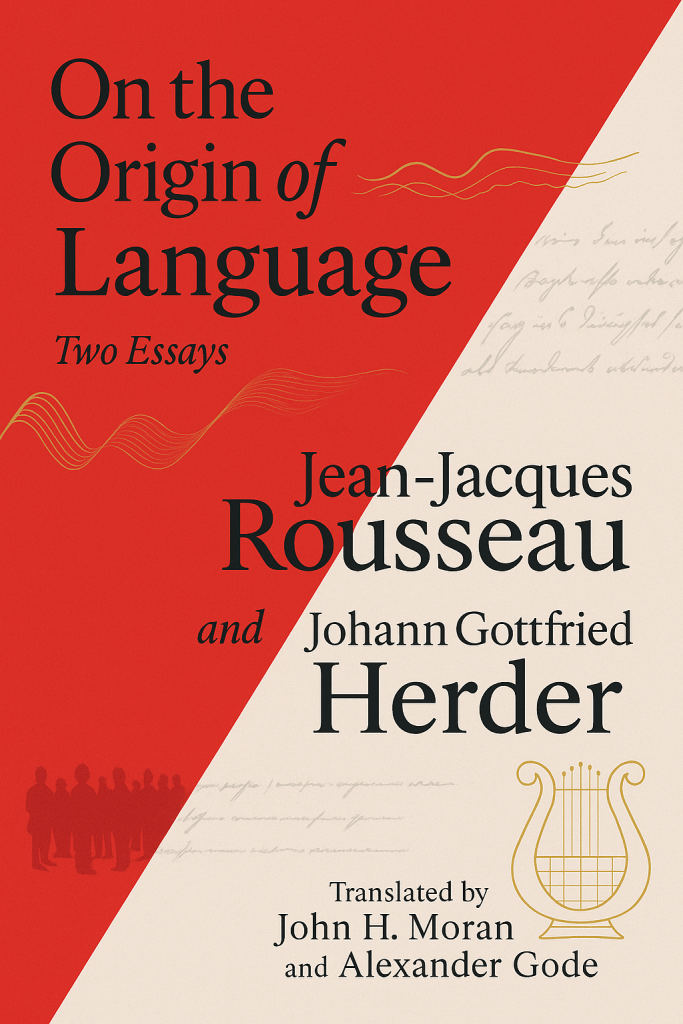
Language’s beginning cannot be asked innocently, and this volume makes that difficulty audible. By bringing into deliberate proximity Rousseau’s Essay on the Origin of Languages and Herder’s Treatise on the Origin of Language, it stages an encounter between a phenomenology of emergence—voice, accent, melody, climate, polity—and a transcendental anthropology of sign-making—reflection, designation, Besonnenheit (deliberative awareness), the institution of a mark. The result is a shaped field of problems rather than a harmonized doctrine. Rousseau shows how speech condenses a people’s form of life into timbre and syntax, and how writing reorders that combination. Herder secures the human power that makes any such a duality possible: the capacity to step back, to set a Merkmal (distinguishing feature) and hold it in common. Read together, these essays disclose a double origin—historical and reflective—and the unstable seam where they join.
The book’s outer frame presents itself with a quiet scholarly tact. An editorial introduction provides the intellectual coordinates within which each essay first moved: a literature abreast of conjectures about first tongues, disputes about the priority of music or articulation, and quarrels over whether speech should be derived from need, imitation, or a peculiar human power. A bibliographic note clarifies the textual base and the choices that govern the English rendering; it also threads the reader through the older debates that contemporary taste has half-forgotten but whose sediment remains audible in both authors. The translation aims at clarity without flattening grain. Rousseau’s play of lyrical utterance and conceptual incision is allowed to retain its ambivalence; Herder’s cadence of argument—at once analytic and genealogical—keeps its deliberate rhythm. Afterwords return to each essay from a reflective distance and gather their consequences without enclosing them. The composition thus turns the two essays into an articulated conversation with anterooms and codas, a design that teaches the reader how to listen: first to an origin narrated in the tonality of climate and custom, then to an origin analyzed in the key of human reflection.
Rousseau’s questioning proceeds from the sensuous density of voice. He begins from the claim that the earliest speech was inseparable from the life that bore it: before there were discrete names, there were modulations of address; before there were stable classifications, there were assaults and seductions of tone; before there was law, there were calls and responses whose contours were shaped by distance, temperature, and habit. The voice is not an instrument that delivers already composed meanings; it is the material in which a people first learns itself as a people. Vowels open or close with climate; consonants harden or soften with terrain and proximity; accent rises and falls with the cadence of assemblies and the density of the marketplace. In such a setting, passion is not an ornament draped over information; it is the very means of orientation and binding. The voice shows before it says. The gestural body doubles the voice, and together they weave a primitive rhetoric in which presence is still palpable.
A decisive structural movement then carries the argument into a second register. As needs diversify, distances increase, and political institutions thicken, articulation grows at the expense of accent. The movement is philosophical, not merely anecdotal: Rousseau correlates phonetic texture with the differentiation of social functions. Where the circle of interlocutors remains tight, vowels flourish and syllables luxuriate; where the circle widens and administration demands precision over warmth, articulation sharpens, syllabic grain thins, and a tendency toward measure imposes itself upon melody. This is neither a nostalgic fable of fall nor a mechanical evolutionism. It is, rather, a diagnostic mapping of co-variation: a theory of how voice, life-form, and polity move together without reducing one to the other. He reworks the old problem of utility by placing it within the metabolism of social forms: usefulness is not an external criterion but a pressure within the life of speech that reconfigures accent and syntax as communities transform their affairs.
At this juncture a problem emerges that the essay does not evade: the appearance of writing. Writing is not introduced as a neutral copying of speech; it signifies a reorganization of presence and authority. The community that can settle its affairs within the radius of the voice, within the orbit of assemblies and face-to-face address, has little need for fixed marks. Writing becomes indispensable as soon as distance is institutionalized and permanence is required beyond the memory of living bodies. The transfer of memory to external traces carries a double effect: it subtracts the warmth through which address binds interlocutors, and it secures durability by which law projects itself across space and time. Rousseau’s analytic power lies in holding these two effects together. The new regime of the mark discloses what the “origin” already contained as a possibility: exteriorization. The sign that seems to betray the scene of living presence preserves it by carrying it beyond the scene; permanence fixes and disseminates at once. The figure of supplementarity thereby takes on more than polemical force; it becomes a structural index that describes how any origin capable of history harbors its own displacement.
The excursus on music deepens the analytic line. If the first tongues were sung rather than measured, then the history of music and the history of speech shadow one another. Melody precedes harmony in that both early song and early speech operate through contour and accent, through lines that track affect and gesture. As social life complexifies and administration insists on regularity, the grid intrudes—meter in place of impulse, harmony in place of free line, calculation in place of immediate address. The term “degeneration” here functions with a technical ambivalence: it names the loss of immediacy and the acquisition of a new layer of formal capacity. The mapping of climates and constitutions is not an idle taxonomy; it collects evidence that audible habitus expresses political life and that musical taste is not separable from civil practice. Where public life condenses into assembly and oath, the voice remains powerful; where public life disperses into offices and documents, the voice must be carried by records and rules. Rousseau’s prose modulates between analysis and tableau to show how phonetic change and political change become mutually legible.
A strand of the essay collects these movements into a reflection on law. The grain of a people’s tongue indicates the mode by which it binds itself. Lexical stability follows legal stability, yet the causal line refuses simplification. Speech cools to enter the archive, and the archive, in turn, governs speech. In this reciprocity, the voice no longer guarantees the unity of the body politic; the mark takes up the burden of continuity. The conceptual stake is not a quarrel between speech and writing; it is a theory of mediation: any form of communal life that aims to survive its own moments must transmute presence into trace. Rhetoric—originally the choreography of bodies and voices—becomes a discipline of records, and the political virtues realign around the ability to navigate procedures rather than to sway assemblies. The philosophically decisive claim is that this realignment becomes audible in phonetics and prosody. The voice says the polity even when the words do not announce it.
Herder’s treatise alters the scale of inquiry. Where Rousseau follows the co-variation of phonetics and form of life, Herder asks by what capacity any such co-variation can become a history of meaningful signs at all. The human distinction, he argues, lies neither in an expanded inventory of cries nor in a miraculous infusion of words, but in a reflective power that fixes a feature from the flux of sensation and intends it as a sign. This act—an act of Besonnenheit, a gathering and holding-in-mind—converts immediacy into availability. The cry of the animal responds to a present excitation and fades with it; the human word remains because it is chosen and instituted. The infant scene—indexical exclamations becoming shared signs—does not demonstrate a leap from silence to speech; it displays an internal reorganization of sensibility under the rule of reflection. The mark separates the salient from the indistinct, and the convention of a community stabilizes that separation for use and teaching.
Herder therefore resists two reductions at once: derivations of language from need alone, and derivations from imitation alone. Need lacks the internal distance required to posit a sign; imitation yields only resemblance unless guided by selection and intention. To say that onomatopoeia participates in the earliest naming is only to say that the human leverages the striking and the familiar to conquer the new. The logical priority belongs to the power of distinction itself, to the capacity to store a feature as a handle for future recognition. This priority has consequences for the structure of meaning. The fundamental energy of naming is metaphorical in the exact sense that it carries a determinate aspect across contexts and abstracts it into a rule of recognition. That movement—a transfer under guidance—is not a deviation from literalness; it is how literalness is historically won. The earliest words are dense, sensuously saturated, inseparable from a matrix of use; their subsequent thinning into more general predicates is not a betrayal but an achievement of scope. The gain of scope then requires a compensating pedagogy to keep the word fastened to life.
The sociality of speech follows. A solitary being might fix a sign for itself, but a language appears only where a community institutes and transmits marks. The practice of naming presupposes teaching; the growth of vocabulary tracks the growth of crafts and institutions; syntax thickens where the economy of thought demands more joints to articulate its burdens. The treatise moves through emblematic scenes less to narrate a fable than to show the necessary transitions: from impressed sensation to retained feature; from retained feature to designated sound; from designated sound to shared convention; from convention to grammatical relation. At each step, Herder insists that what appears as a linguistic form encodes a form of attention. This insistence grounds a subtle anthropology: words are repositories of habits of noticing; grammar is a crystallized policy of comparison and connection; the lexicon is the map of a people’s world. Language is thus natural in the sense that it grows from the structure of our faculties, and cultural in the sense that it persists only as a common discipline.
A decisive section distinguishes human signals from animal signs. Animals do communicate states, and they do so effectively; what they do not do is intend a mark as a mark and thus make it available for arbitrary recombination under rules. The human can detach the sign from the state and then reattach it under new relations; in that power lies both the freedom and the danger of speech. The freedom consists in the ability to construct worlds of shared recognition that exceed immediate stimulus; the danger consists in the distance words can take from life unless continually refreshed by reference and use. Herder accordingly builds a double demand into the theory: a requirement that meaning remain anchored in experience and an acknowledgement that abstraction is the condition of cultural enlargement. The very movement that yields science, law, and art demands compensating practices by which words return to their sources and do not drift into sterile formalism.
Placed in sequence, the essays illuminate each other by disclosing the presuppositions each cannot quite pronounce. Rousseau’s cartography of climates, accents, and polities assumes a power by which the voice can become a vehicle of shared meaning; Herder’s analysis of the act of designation leaves open the question of the social topography within which that act becomes audible as a world. The volume’s arrangement keeps these lines in play without collapsing them. Rousseau teaches the reader to hear the political metaphysics of phonetics; Herder teaches the reader to discern the anthropology in every syllable. A double historicity thereby emerges. On the one hand, language bears the history of institutions, climates, and forms of association; on the other, language bears the inward history of the mind that learns to distinguish, to compare, to remember, and to teach. The two historicities interpenetrate. A people teaches its children how to attend; those children, in speaking, reproduce and subtly alter the attention of the people. The circle is not vicious; it is the living mechanism by which linguistic worlds maintain themselves and change.
The movement of Rousseau’s essay makes this interpenetration visible in several carefully plotted transitions. The early account of sung origins, which begins in the intimacy of call and response, gradually yields to analyses of melody and harmony that register the community’s shift from immediate address to measured coordination. This musical detour returns with philosophical force when writing enters as the medium that makes the measured world transportable. The analysis of law is therefore the displaced culmination of the analysis of music, which itself was the displaced culmination of the account of voice and climate. What began as a phenomenology of presence ends as a theory of institutions. The composition deliberately allows each layer to displace the preceding one without erasing its trace: the music of the origins persists as a residual claim within the measured polity; the warmth of accent continues to haunt articulation; the call for assemblies returns whenever the archive’s rule becomes too cold. The reader learns to hear these survivals and to take their persistence as a structural feature rather than an anomaly.
Herder’s treatise exhibits an analogous, if differently organized, sequence. The early polemics against divine donation and mere imitation are less a clearing of obstacles than a way of forcing the question back to the faculties. Once Besonnenheit is in view, the text follows the necessary deployments of that power into naming, metaphor, memory, pedagogy, and grammar. Each deployment both presupposes and transforms its base. Memory becomes teachable only as the community enacts conventions; metaphor becomes disciplined only as a repertoire of shared features stabilizes; grammar becomes possible only as repeated comparison requires fixed relations. The treatise thus begins with the individual act and ends with communal order; it then returns, by a reflective arc, to the individual to show how the community’s order reorganizes the faculties. The final pages are not a conclusion so much as a relaunch: they send the reader back through the stages with the instruction to observe how each subsequent layer writes itself back into the earlier ones.
The book’s editorial architecture accentuates these displacements without adjudicating them. The introduction situates the essays historically; the afterwords do not close discussion so much as keep the problems mobile. The reader absorbs the apparatus as a pedagogy: to read Rousseau after Herder is to grant that the music of origins stands upon a reflective act; to read Herder after Rousseau is to grant that reflection becomes human only in climates and polities, in voices and assemblies. The translation participates in this pedagogy by refusing to assimilate style. Rousseau arrives in a diction that breathes even when it argues; Herder arrives in a diction that argues even when it breathes. The juxtaposition trains the ear to hear differences of method as differences of object.
A number of stubborn questions gather at the seam between the essays and are sharpened precisely by this editorial staging. The first concerns the temporality of origin. If origin means a singular point before mediation, Rousseau shows that such purity functions as a regulative fiction that communities invoke to orient critique; the earliest song is already socially inflected and thus already mediated. If origin means the first act of reflective designation, Herder shows that origin recurs with each generation’s entrance into language; there is a primitive scene, but it is re-enacted in the pedagogy of every people. The volume thereby gives the reader two temporalities of beginning: one that points back toward an ever-receding horizon where voice and life were still coextensive, another that points forward into the incessant renewal of designation through teaching. These temporalities do not cancel each other. They describe the double demand that governs any living language: fidelity to a felt origin of sense, and fidelity to the discipline by which sense is made repeatable.
A second question concerns the ethical and political complexion of speech. Rousseau’s correlations between phonetic habit and political form risk being read as climatic determinism; the essay prevents this misreading by insisting on a dialectic between voice and institution. Assemblies are made possible by a voice that binds, and voices are modulated by the practices assemblies sustain. Herder’s focus on the act of designation risks transmuting language into a purely mental affair; the treatise prevents this misreading by making pedagogy and convention intrinsic to meaning. Between them a conception of linguistic normativity takes shape: correctness is not the enforcement of a code exterior to life, and neither is it the spontaneous overflow of feeling. It is the practice of a people disciplining its own attention under changing pressures. The editorial frame does not declare this lesson; the essays teach it by example.
A third question pivots on the status of writing. Rousseau’s insistence that writing indexes a transformation in social metabolism can sound like a lament for lost presence. The essay complicates that impression by showing the necessary virtue of exteriorization for any polity that exceeds the radius of the voice. Writing cools, and in cooling it permits law to endure. Herder’s theory of designation makes writing logically possible: once the mark can be intended as a mark, no principle forbids the mark’s embodiment in a medium other than sound. The volume’s sequence invites the reader to feel how a reflective anthropology underwrites the very possibility of Rousseau’s political diagnosis. The supplement is not an accident; it is the fate of a power whose greatness consists in its ability to stand at a distance from itself.
A final question regards method. Rousseau’s manner is comparative and phenomenological; he moves among climates, polities, and musics to extract structures without forcing them into a universal grid. Herder’s manner is transcendental and developmental; he moves from conditions to consequences and returns from consequences to reinforce conditions. Each method finds what it seeks. Rousseau uncovers how audible habits disclose forms of life; Herder uncovers how acts of mind become public norms. The editorial decision to present them without a harmonizing synthesis respects the integrity of both. The reader is asked to inhabit their interval, an interval that modern inquiries into language have never quite left.
The book’s internal cross-references—implicit, enacted in the reader’s memory rather than printed as notes—become the most productive feature of the whole. When Rousseau speaks of the first languages as figurative, the reader equipped with Herder hears a substantive claim about the act of designating through salient features and carrying them over to new domains. When Herder expounds the growth of grammar from the play of predicates and relations, the reader equipped with Rousseau hears how those relations will be colored by climate, instituted by polity, and eventually recorded by writing. The interplay corrects potential excesses on both sides. It rescues Rousseau’s lyricism from nostalgia by giving it a theory of the act that first makes lyric intelligible; it rescues Herder’s rationalism from aridity by giving it a theater in which the rational act becomes audible as world.
This interplay is also visible in the way each essay lets one part be displaced by another part without forfeiting continuity. In Rousseau, the analysis of figurative beginnings becomes an analysis of melody, which then becomes an analysis of harmony and measure, which then, almost without warning, becomes an analysis of law and administration. The displacement is cumulative: early passion persists as color even where measure dominates, and the need for law’s permanence never effaces the memory of assemblies. In Herder, the analysis of reflection’s enabling role becomes an analysis of naming, which becomes an analysis of metaphor, which becomes an analysis of pedagogy and grammar, which finally becomes an analysis of communal order. The displacement is again cumulative: each later layer writes back into each earlier one, reorganizing attention, refining memory, systematizing comparison. The reader learns a compositional lesson: conceptual exposition need not be linear to be exact; it can spiral, augment, and return, provided the returns are principled.
The translation’s fidelity to style enhances this compositional pedagogy. Rousseau’s sentences often hover between image and concept, pressing the reader to hold a double focus; the English rendering sustains that pressure without turning figure into ornament or concept into jargon. Herder’s sentences often build from a quiet premise through a chain of distinctions to a sharp consequence; the English rendering preserves the grip of each transition. The effect is a rare transparency: the reader feels the thinking as much as the theses. The bibliographic apparatus shows its value especially where terminology threatens to float. It anchors Besonnenheit to a practice of reflective gathering rather than to a vague intellectualism, and it keeps Merkmal close to the lived act of picking out a feature rather than to a scholastic formalism. Such anchoring matters because the philosophical stakes depend on the concreteness of these acts: if reflection is an event in attention, and if a mark is a socially stabilized handle for recognition, then the entire edifice of language is built from actions that can be described and taught, not merely posited.
From within the limits the volume sets itself—minimal appeal to speculative histories, minimal reliance on external authorities—the two essays nonetheless project a horizon within which later work can be understood as a series of elaborations. The claim is internal and modest: the reader who follows Rousseau’s correlations and Herder’s conditions acquires a map of the problems that subsequent linguistic, anthropological, and philosophical inquiries repeatedly rediscover. The tension between affective presence and administrative measure reappears whenever the virtues of immediacy are weighed against the demands of scale. The tension between the freedom of designation and the need for anchoring reappears whenever abstraction’s gains are measured against the risk of drifting from life. The tension between climatic particularity and human universality reappears whenever one asks how a language can be at once a people’s own and a medium for thought that travels. The book does not settle these tensions; it furnishes the reader with the concepts and scenes by which to think them well.
A few final clarifications press themselves forward as the argument of the volume comes to rest. First, the talk of origin accrues sense only when hearing is trained to two different tasks. One task concerns the feel of firstness in life—those moments when voice binds, when accent carries more than articulation can say, when presence gathers itself in a line of song. The other task concerns the logic of firstness in thought—the act by which an aspect is lifted from flux, fixed in a sign, and made available to memory and community. Each task fulfills the other. The warmth of firstness supplies the matter through which the act of designation has something to hold; the act of designation supplies the form through which warmth can be shared beyond the moment. Second, the place of writing must be thought without caricature. Its cooling is real, its necessity is real, and its consequences for law and knowledge are constitutive. Treating writing as a mere betrayal misses the way in which the origin prepared itself for exteriority from the start. Third, the ethical demand on speech—its responsibility to experience and to community at once—cannot be discharged in a single gesture. It requires attention to the lived grain of words and attention to the structures that keep words usable. The volume invites the reader to take that double attention as the discipline of thinking about language.
The essays close, and the frame closes with them, not with a doctrine but with a posture: a readiness to hear language as the form of life through which presence and distance, passion and measure, memory and mark, show their necessary entanglement. The scholarly stake of the book is exact: to return two eighteenth-century inquiries to a reader prepared to extract from them neither antiquarian curiosities nor prefabricated theses, but a set of problems that continue to bind our speech to our shape of life. The distinctive contribution is equally exact: to let Rousseau’s phenomenology of emergence and Herder’s anthropology of designation encounter each other under conditions where each reveals the other’s silent premise. In that encounter, the question of origin ceases to demand a single answer and becomes the name for an economy of acts and institutions by which human beings become audible to themselves.
 Simon Gros
Leave a comment