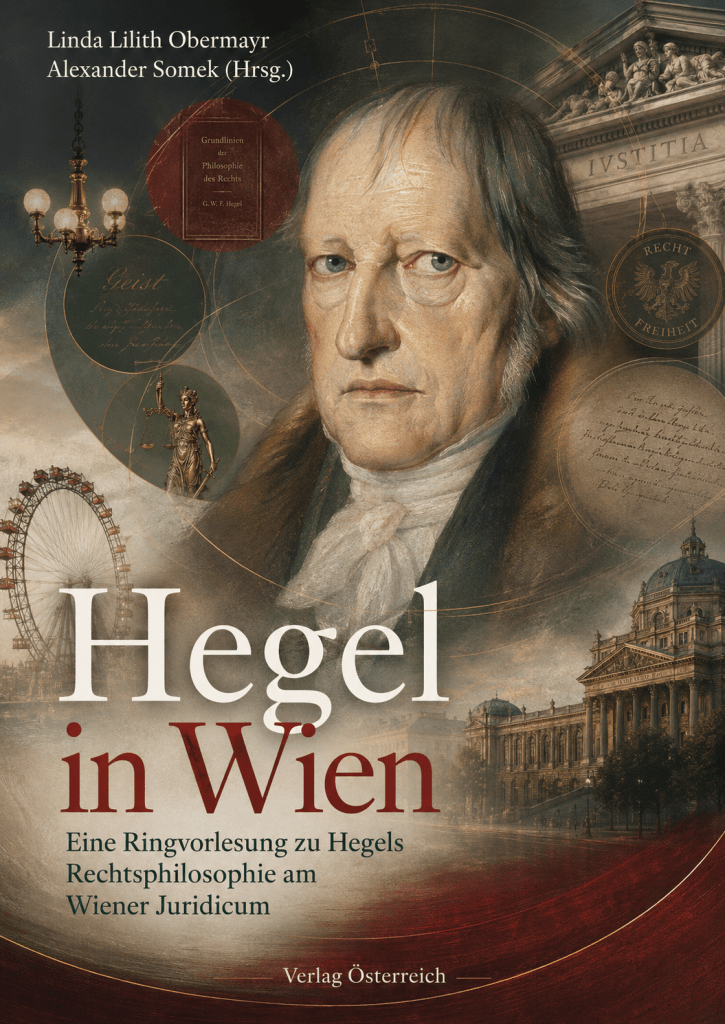
Hegel in Wien: Eine Ringvorlesung zu Hegels Rechtsphilosophie am Wiener Juridicum, Edited by Linda Lilith Obermayr and Alexander Somek (Verlag Österreich, Vienna, 2023) gathers twelve essays drawn from a winter-semester lecture cycle held at the Vienna Faculty of Law in 2021/22, augmented by contributions from a concluding January workshop and one essay on the state added thereafter. Its central question is whether Hegel’s Grundlinien der Philosophie des Rechts can still be read as the immanent self-development of a single concept—the Idea of right as the existence of the free will—rather than as a sequence of doctrines about property, morality, family, civil society, and state. The governing ambition is hermeneutic: to retrace the movement by which each category, taken in its abstractness, generates from itself the next, so that the work’s articulations become recognizable as moments of a single thought rather than as detachable theses. Its distinctive value as an object of study lies in the way an introductory pedagogical aim—offering students of law and philosophy a guide to the Grundlinien—is fused with a sustained interpretive thesis about the inseparability of legal form, willing, and ethical institutions.
The book opens with an editorial overture by Obermayr and Somek that does not so much announce its program as enact it. Under the title Vom Belcanto zur Rechtsphilosophie, the editors stage Hegel’s two-week stay in Vienna in the autumn of 1824, his epistolary effusions about Italian opera, his enthusiasm for Rossini, and the cultural context of the so-called Hegelfieber at the Juridicum, in order to extract from this seemingly biographical episode a properly philosophical claim. Hegel, they argue, finds in bel canto a model of the immanent unfolding of a content—the singer is herself a Compositeur, generating expression and coloratura from within the act of singing—and this same logic of immanente Entwicklung der Sache selbst governs the Grundlinien as a philosophical text. The introductory chapter thereby fixes a methodological wager that returns throughout the volume: that the proper labor of interpretation is to follow how a content develops itself, refusing to bring external standards or Räsonieren to bear on the matter. The Verstand, Hegel’s term for the merely classifying and externally predicating understanding, is identified as the perennial enemy of such immanence; the editors locate its modern symptom in the journalistic practice of dressing musical or philosophical objects with content drawn from outside them, of decorating Rossini with hidden ideological messages, or of reading the Grundlinien through political prejudices supplied in advance.
This first move establishes a tone of deflationary exegesis. The editors make explicit that the philosophical reception of Hegel has been distorted by two notoriously isolated formulations from the preface—the equation of the rational with the actual and the figure of Minerva’s owl flying only at dusk—and they show, by appeal to the second edition of the Enzyklopädie, how these formulations are mistaken when read as endorsements of the existing order. Wirklichkeit in Hegel’s technical sense is not whatever happens to exist, but only what has been comprehended as necessary, a content in which thinking finds itself; and the philosophical retrospect symbolized by the owl is a logical, not a temporal, claim about the relation of the concept to the Sollen. The editors press the point that what philosophy is forbidden to do is precisely what its critics, from Popper to Tugendhat, accuse Hegel of: namely, to instruct the world how it ought to be from a standpoint outside it. Philosophy comes too late not from defect but because the ought, conceived as severed from being, is by its very concept not yet; were it already, it would not need to be ought-to-be. The hermeneutic stake of this opening is therefore that all subsequent contributions must read the Grundlinien as a comprehension of the rational in the actual, not as a normative recipe imposed on it.
The editors then turn to the introductory paragraphs of the Grundlinien themselves and articulate, in what may be read as the volume’s spinal claim, the dialectical structure of the free will. The will, Hegel insists, is not the opposite of thinking but a particular mode of thinking, namely thinking translating itself into existence, the drive to give itself Dasein. The will’s freedom proves to be incompatible with sheer indeterminacy: a will that wills nothing determinate is at first taken to be the freest, since every determination would seem a constraint, but this empty I is only the negation of all content and therefore not anything first. It is itself a result, the negation of every particular willing, and so it is itself determined—determined precisely to abstract from determination. When this determinacy is mistaken for true freedom, the disastrous consequence is the Freiheit der Leere—the freedom of pure emptiness—which acquires reality only by destroying every existing order; the editors invoke Hegel’s own analyses of Indian ascetic withdrawal and the political fanaticism of the French Terror as actualizations of this empty universality. From the inadequacy of the indeterminate will and from the equally one-sided will of mere particular content there emerges the concrete free will, the will that wills its own freedom in every determinate willing, the will that wills the free will. The editors thereby fix from the outset the hermeneutic key that will govern every later contribution: each major figure of objective spirit—abstract right, morality, ethical life—is one historically and conceptually possible form of the universality through which the will lays hold of its own freedom.
Already in this introductory analysis a tension is registered that the rest of the book labors to articulate. The free will requires both Allgemeinheit and Bestimmtheit, both universality and a determinate content, but these two moments seem to drag the will in opposite directions: the more determinate the willing, the less it remains bei sich, with itself, and the more it threatens to become passive, possessed by the determinacy it has acquired; the more universal the willing, the more it threatens to vanish into the indifference of empty self-relation. The whole of the Grundlinien, on the reading the editors set in motion, is the working-out of this tension across three forms of social universality: abstract right, in which the will appears as person and willkürlich chooses without reference to grounds; morality, in which the will reflects upon the goodness of grounds and submits its choices to a universalizing principle; and ethical life, the lived world of institutions in which the universal is encountered as an actual, substantial Sein that confers on the subject a concrete content. These three are at once a logical sequence of moments and a typology of historical and social formations.
This staging is crucial because each of the subsequent chapters can be read as taking up one of these forms and showing both its inner integrity and its inner pressure toward the next. The volume is therefore not a sequence of self-standing studies of distinct topics; it is a layered re-articulation of a single argument, where each later contribution retroactively determines the meaning of the earlier ones. What in the editors’ introduction appears as the mere structural typology of three forms of universality is by the end of the volume—after the chapters on civil society, the state, the act of resolution, international law, and world history—shown to be a graduated stratification of liberty itself, in which the negative freedom of the person, the reflective freedom of the moral subject, and the social freedom of the ethical participant each receive a determinate institutional habitat.
The editors close their introduction with a remarkable methodological reflection on hermeneutics that frames the entire volume’s tone. To interpret Hegel, they insist, is to expose oneself to a movement of Dehnung—a stretching of one’s own horizon—rather than to discover the right doctrine. The hermeneutic encounter is necessarily ironic, because the suspension of the claim to truth is what permits the alien horizon to do its work on the interpreter; what the volume affirms in Hegel is therefore also the volume’s own work, and the editors do not pretend otherwise. Was wir an Hegel bewundern, ist also immer auch unser eigenes Werk. This avowal of interpretive contingency frames the volume’s entire stance: the contributors do not claim to have unlocked the historical Hegel, but to have made Hegel’s text again productive in the act of reading it.
The first substantive contribution, by Tatjana Sheplyakova, advances the volume’s central interpretive thesis at the highest level of conceptual generality. Her question is what it means that Hegel speaks of the Idea of right. The phrase is taken to be a calculated terminological choice that demarcates Hegel’s project from two other long-dominant ways of thinking right, namely classical natural law and modern Vernunftrecht. Sheplyakova reconstructs both polemics with a fine grain. The classical natural-law tradition—Plato, Aristotle—treats law as an order pre-given to the individual by nature, secured by paideia and bringing in the apparatus of courts and written law only when education fails. Hegel’s polemic against this position, already articulated in the early Naturrechtsaufsatz, is that political freedom predicated on a presupposed natural order is structurally complicit with slavery, since the very ground that authorizes freedom for some authorizes unfreedom for others; the abolition of antique slavery required, according to Hegel, the supersession of antique freedom itself.
The modern Vernunftrecht of Kant and Fichte, by contrast, takes its starting point in the freedom of the individual subject, conceived as a property-bearing pre-political being whose external relations to other such beings must be coordinated through the universal form of law. Sheplyakova foregrounds Hegel’s diagnosis that this rational-law construction silently presupposes a particular social model—that of juxtaposed private individuals whose relations are exhaustively regulated by stable legal fixations—and is therefore unable to think the social as a productive medium in which new forms of life arise. Citing Böckenförde, she shows how Kant’s rational law guarantees a state of affairs that is presupposed rather than instituted by law itself; the law on this view secures the social, but does not constitute it. Hegel’s reproach to Kant’s formalism in the Naturrechtsaufsatz is that it reduces the social to abstract reciprocal limitation and thereby produces, paradoxically, a more atomistic image of the polity than the openly individualist antisocialistic doctrines it claims to surpass.
Against both natural law and rational law, Idea in Hegel’s sense names a process: the law that does not stand external to the subject because it has itself become subjective, that is, has become reflexive. Sheplyakova locates the philosophical root of this usage in Hegel’s Logik, where the Idea is no longer a Kantian regulative concept of reason but the vernünftige itself, the logical-real process of reason’s self-determination, in which form and content, ontology and method, are one. To say that right has the form of the Idea is to say that right is unconditioned in the technical sense, that nothing alien stands over against it, that its objectivity is not an external given but a moment of its own self-positing subjectivity. Sheplyakova develops this provocative claim by reading the Logik‘s chapter on the Idea as articulating a complex theory of relation between subjectivity and objectivity, articulated through the figures of Life, Cognition, and the Good, where the absolute Idea emerges only as the unity of theoretical and practical relations to the world.
Here Sheplyakova introduces what is arguably the most original move of her chapter: the claim that the Logik itself leaves an unresolved problem at this very point. The transitions from Cognition to absolute Idea, from the merely theoretical and merely practical relations to their unity, are formally indicated but not concretely thinkable; two false relations are not, of themselves, sufficient to generate a true one. The crucial insight she draws from this is that what the Logik leaves unresolved at the level of pure thought is precisely what the Grundlinien attempts to resolve in its own register: the question of how a content—right—can be thought as having both the form of objective being and the form of self-relating subjectivity. The Idea of right is, on this reading, the Realphilosophie of a problem that is properly logical, and the entire enterprise of the Grundlinien can be understood as the construction of an institutional habitat in which the unity of theoretical and practical, of attitude-independent objectivity and attitude-dependent subjectivity, becomes operationally real.
The diagnostic force of this thesis becomes evident when Sheplyakova turns to the Realphilosophie counterpart of the same problem in the Grundlinien itself. There the difficulty reappears as the problem of the supersession of Moralität in Sittlichkeit and as the crisis of liberal legal consciousness. The dichotomy of enforceable right and non-enforceable morality leaves the order of right looking imperfect from the standpoint of moral demand and morality looking impotent before the order of right. Quoting Lübbe-Wolff, Sheplyakova shows how the bifurcation produces, on the one hand, a real but ethically deficient order of law and, on the other, an empty Sollen without anchorage in actuality. This Verfallsgeschichte—using Theunissen’s term—is the modern self-canceling form of moral consciousness, in which self-legislating moral subjectivity becomes the narcissistic self of the ironic Romantic, oscillating between Selbstschöpfung und Selbstvernichtung, or modulates into the malicious self-stylization of grievance: the Moral als Bosheit of which Somek’s recent book is invoked as the contemporary diagnosis. Hegel’s own marginal note that morality is die Krankheit dieser Zeit, the illness of this time, is presented as the early formulation of a diagnostic that runs from Hegel through Marx to Böckenförde and Christoph Menke.
What Sheplyakova adds to this familiar genealogy is a reading of how the Idea of right is supposed to answer the diagnosis. Her argument proceeds, characteristically, by historical detour. She reconstructs, through Walter Jaeschke and through Max Weber’s analyses of the anschaulicher Formalismus of older legal forms, the path of right from outside to inside, from ritual to procedure. In archaic Roman law, the legis actiones, the strict formulae of the Twelve Tables, the gestural meum esse aio by which property was transferred—all these are forms in which right exists as ritualized externality, as a formula whose proper performance is the legal act. Modern law, by contrast, rests on abstract propositions: norms with the content that under such-and-such condition such-and-such is legally the case. The transition from one to the other is not merely technological but conceptual: it is the becoming-internal of a content that was previously only externally enacted, and the philosophical re-description of this becoming-internal is precisely what Hegel’s category of the Idea names. Sheplyakova thereby ties Hegel’s most abstract logical category to the most concrete historical developments of legal practice, and the Grundlinien emerges from her chapter as the philosophical reconstruction of the way modern law has come to know itself.
The chapter further develops the institutional consequences by attending to Hegel’s treatment of Rechtspflege and the court within civil society. Sheplyakova shows that the modern court, with its publicity, its codification, its rule-bound procedure, and its rejection of merely machinenmäßige application of statutes, is for Hegel the institutional locus where law’s Sich-Wissen—its self-cognition—becomes effective. The judge’s role in adjudicating among colliding rules is not the mere subsumption of cases under norms; it is the moment in which the law makes itself manifest as law, in which the universality of the legal rule reveals its dependence on the situated decision that brings it to actuality. Through this concrete institutional reading, Sheplyakova allows the volume’s overarching claim—that right is the Dasein of the free will—to acquire pedagogical sharpness: the freedom of the will is not given somewhere outside law, to be then secured by law; it is enacted in the procedural self-reflection of legal practice itself.
The chapter by Kristin Y. Albrecht and Folko Zander opens the Grundlinien‘s first major moment, abstract right, and accordingly furnishes the volume with its most basic technical apparatus: an account of Hegel’s dialectical method in just enough detail that subsequent chapters can presuppose it. Albrecht and Zander insist that this apparatus must be presented through the relevant texts themselves rather than through the textbook caricature of the triad thesis–antithesis–synthesis. They locate the structural form of dialectical argument in Hegel’s distinction between the verständig, the dialectical, and the speculative sides of the logical, where abstraction generates apparent purity, but the abstractive exclusion itself reveals the abstraction’s negativity, since what has been excluded must be re-thought as that without which the abstraction has no determinate content. Out of the mutual negation of the abstract concept and its excluded content there emerges the speculative Aufhebung: the concept is preserved (conservare) and lifted (elevare) into a higher, more determinate concept, in whose light the original concept retroactively appears in a new register. This logical schema is then declared to govern the entire architecture of the Grundlinien, from the abstract right through morality to the institutions of ethical life.
The substantive analysis of abstract right that follows is keyed to Hegel’s claim that the Idea of right is freedom, that right is the Dasein of the free will, and that this Dasein must be reconstructed in its abstract first form before its more concrete forms can be intelligible. Albrecht and Zander insist on the technical sense of abstract: not the opposite of form and content, but rather exclusionary, one-sided, considered in isolation from its mediations. The free will, when first considered, appears as the empty I that has negated all its drives and inclinations; this negation, considered in itself, yields a merely abstract universality that, lacking particularization, is in truth not yet universal at all. The dialectical recovery of the will from this empty self-identity proceeds through the recognition that particularity is the necessary instantiation of universality—as fruit as such exists only in apples, oranges, and bananas, not as some additional something alongside them—and through the further recognition that singularity is the unity in which universality and particularity are jointly realized. The person, the protagonist of abstract right, is the will conceived precisely in this abstract self-identity; she is Selbstbewusstsein, but formal, since she abstracts from every determinate content. The very etymology of persona as mask is invoked to make this abstractness conceptually palpable: every person is, in abstract right, indistinguishably a person, mask-like, defined exclusively by the formal attribution of capacities of choice.
From this first determination Albrecht and Zander develop, with considerable economy, the canonical themes of property and contract. Property is the Dasein of the person: the will gives itself external existence by appropriating things and thereby gives its own internal abstraction the form of an external objectivity. The contract is the meeting of two such property-bearing wills who agree to alienate or exchange. Crucially, however, the meeting of two particular wills produces only a Gemeinsamkeit, a contingent commonality, never the genuine Allgemeinheit of right; the contract therefore cannot, on Hegel’s account, ground the state, since whether the joint particular will accords with the will an sich is contingent. This is the central point at which Albrecht and Zander show how the abstract right of contract already contains the seeds of its own supersession: marriage and the state, both of which Hegel explicitly removes from the contractual sphere, are introduced not as exceptions but as illustrations of what contract structurally cannot do. Marriage rests on love, an inwardly subjective ground that no contract can capture; the state rests on the universal free will, from which individual wills are conceptually derived rather than the reverse. Kant’s notorious definition of marriage as a contract for the reciprocal use of sexual organs, ridiculed by Hegel and later by countless commentators, becomes intelligible from within the limits of Kant’s own legal philosophy: having sundered legality from morality and admitted only external, property-mediated relations into legal theory, Kant had no other way of conceptualizing the legal institution of marriage. The pair show how Hegel’s location of marriage in Sittlichkeit and not in abstract right is therefore not a pious traditionalism but a structural consequence of the dialectical method.
The chapter’s most rigorous moment is its treatment of Unrecht—wrong—as the necessary self-exposure of abstract right. Wrong is the negation of right, and its three forms—non-malicious wrong, where the right as such is acknowledged but its concrete subsumption is contested; fraud, where the right as such is acknowledged but the particular right of the other is curtailed; and crime, where the right as such is itself negated—articulate a graduated dialectic in which the abstract right of the person reveals itself as essentially incomplete. Crime in particular shows that the will of the criminal, who negates the right of another and thereby attacks personality as such, attacks his own personality, since the personality of the other is the same universal personality of which his own personality is a moment. The will that negates the will of another is therefore in itself contradictory and null. Strafe—punishment—is the demonstration of this nullity. Albrecht and Zander show how Hegel’s absolute theory of punishment differs both from the archaic jus talionis and from relative theories that justify punishment by its preventive or rehabilitative effects: punishment, on Hegel’s analysis, is not an additional evil added to the original evil but the dialectical exhibition of the criminal act’s own self-cancelation, the zweiter Zwang in which the criminal’s own status as free, rational subject is publicly acknowledged. To punish a person is to take her seriously as one who has acted from purpose—precisely the recognition that the deontological dignity of the criminal demands.
The transition from abstract right to morality is now conceptually warranted. The criminal acted from purpose, and purpose is the central category of morality. With this transition Albrecht and Zander hand the conceptual baton to Linda Lilith Obermayr, whose chapter on the Begriff der Moralität bei Hegel unfolds under the heading Die Krankheit dieser Zeit. Obermayr begins with Hegel’s own marginal note where morality is described as the principal standpoint and the illness of this time, and she takes this diagnostic formula as the lens through which the entire moral chapter of the Grundlinien must be read. Morality, in Hegel’s strict sense, is not the same as the moral life of antiquity or any of the ethical formations to which the term moral is applied colloquially. It names the very specific historical and conceptual configuration in which the subjective will, withdrawn into its own inwardness, claims to derive the standards of action from itself, treating any external ethical content as merely contingent unless validated by its own conscience. The thesis that this configuration is an illness is therefore not a mere polemic; it is a structural diagnosis that morality, understood in this specific way, generates pathologies that morality alone cannot heal.
Obermayr develops the diagnosis with care. She first sets the moral standpoint in relation to abstract right by showing that whereas abstract right takes the will only on the side of its universality—any person under any other—morality takes the will on the side of its particularity, that is, in its capacity to find itself in its action. The action, Hegel’s central category in the moral chapter, is the Äußerung of the subjective will; in acting, the subject externalizes itself and becomes accountable for what it has externalized. Obermayr traces through Vorsatz und Schuld, Absicht und das Wohl, and Das Gute und das Gewissen the progressive determination of this accountability. The right of the subjective will to recognize as its own only what it has consciously intended is the right of knowing; yet the action’s consequences belong to the action, and the moral agent must therefore know not only the singular gesture but the general nature of the action it embeds. To strike the match against a piece of wood is to start the fire that may consume the building; to fire a bullet into a heart is to take the life that the heart sustains. The moral agent must know the universal in the particular she enacts; without such knowledge she lacks responsibility, as is the case with children or those impaired by intoxication or psychiatric illness, in whose cases Hegel speaks of Zurechnungsunfähigkeit.
Obermayr then turns to the Wohl, the welfare or happiness in the satisfaction of which the moral agent has a legitimate right. She shows how Hegel, against Kant’s strict severance of moral worth from inclination, insists that moral interest is interwoven with the concrete needs, drives, and passions of the living subject. The right of the subject to find satisfaction in her action is identified as the modern subjective right—rights to opinion, religion, privacy—and the one-sided fixation of right on this particularity is shown to produce the ideological appearance that the particular stands against the universal. Citing Pippin, Obermayr highlights the radical existentialist undertow of Hegel’s claim that the subject is the series of her actions, with the methodological consequence that the meaning of an intention is determined retrospectively, in light of what the action turned out to be. There is no inner eigentlich sphere of moral truth to which the agent can appeal against her objectified deeds; the Tat is the visible hieroglyph in which intention becomes legible.
The peak of the chapter’s diagnosis is reached in the section on Das Gute und das Gewissen, where Obermayr shows how morality undoes itself. The good, conceived as the substantial universality of the moral standpoint, can only be the duty whose ground is itself; but every concrete duty must determine itself, and the principle of self-determination is the conscience. Conscience claims to know what is right and to be the organ in which the universal becomes effective for the singular subject. Yet, as Hegel argues, conscience is precisely as necessary as it is self-canceling: as the only concrete locus of moral judgment, it is indispensable; but as merely the felt certainty of the subject, it cannot guarantee that what it claims to know really is what is right. The pure inwardness of conscience generates from itself the Zweideutigkeit of conscience—the simultaneous demand that what is right is right because I claim to know it, and that my claim to know it is justified only if what I assert is right. Without an objective principle to fix the content, conscience must look inward for its content, and the self-empowering inwardness of conscience tips, by its own logic, into the self-glorification of the singular will. Hegel’s identification of this configuration with the root of evil, with hypocrisy, and with romantic irony is the rhetorical climax of the moral chapter, and Obermayr renders it with the requisite philosophical sobriety: a morality that ultimately invokes nothing but conscience, whose only ground is felt individual conviction, is malicious—not because the moralist intends evil but because, in the absence of objective grounds, the moralist’s claim to universal validity is itself an act of arbitrary self-empowerment.
The chapter therefore prepares the way for Alexander Somek’s contribution, which takes up the question that Obermayr’s diagnosis leaves urgently open: how is the transition from morality to ethical life to be conceived, given that the very inwardness of conscience generates evil and that no return to mere convention is philosophically respectable? Somek frames his chapter explicitly as a confrontation with what he calls the Rätsel—the riddle—of Hegel’s Rechtsphilosophie. The riddle is precisely the move from morality to Sittlichkeit. Following Theunissen, Somek concedes that one might also locate the core of the Grundlinien in the relation of civil society to the state, and that any reading of Hegel must reckon with the centrality of that relation; but the transition from morality to ethical life encompasses the question of the state, since the state in Hegel is the highest form of ethical life, and the transition is therefore the systematic key. Somek’s reading has the virtue of being unpitying about the difficulty of this transition. He acknowledges that critics from Tugendhat to Popper have read Hegel’s claim that the existing laws have absolute authority and the individual’s conscience must vanish into trust as evidence of conservative apologetic; he does not dismiss the worry but works through it.
The riddle, in Somek’s formulation, is this: the moral consciousness, having self-destructed in the dialectic of conscience and the good, is supposed to find rest in the substantial ethical world, which is described by Hegel as having a power and authority firmer than the being of nature itself. Why should the failure of postconventional morality to produce a determinate moral principle warrant the rehabilitation of conventions? Conventions are notoriously in conflict with one another—the convention that permits self-spending on pleasure conflicts with the convention that demands self-spending on the welfare of the distant poor—and a postconventional principle was needed precisely to resolve such conflicts. If the postconventional level is unattainable, conventions remain in a state of suspended validity, valid as if not, which is hardly the firm authority that Hegel ascribes to ethical substance. Somek presses the point that eine eilfertige Unterwerfung unter das Bestehende—a hasty submission to what exists—does not solve the problem the moral consciousness raised; it merely installs the unsolved problem at a higher institutional level.
The solution Somek constructs from the materials of the Grundlinien hinges on what he identifies as the unspoken theme of the morality-to-ethical-life transition: the form of the relation between subjective recognition and the objective claim to be recognized. Quoting the formulation that the right to acknowledge nothing that one does not see as rational is the highest right of the subject, but through its subjective determination at the same time formal, and against it the right of the rational as the objective stands firm, Somek elucidates the structural feature that subjective insight and objective rationality stand to each other in a relation of mutual Anerkennungsanspruch. The subject claims the right to acknowledge only what she sees as rational; reason claims the right to be acknowledged by subjects, but to be reason it must hold an sich, independently of any particular subject’s acknowledgment. The subject must therefore relate to reason as to something it has not posited but found, to a Sein that is what it is by virtue of its own being. The ethical, accordingly, is the subjective disposition of the an-sich-seienden Recht, a recognition whose content is precisely the content that has not been merely posited by the recognizer.
Somek then performs the volume’s most sustained piece of conceptual labor by working out two interlocking analyses: the first of the objective side, where the substantial good must be articulated as a content that is not arbitrarily constructed; the second of the subjective side, where the subject must participate in the substantial good as its living moment rather than as its passive recipient. He shows, by recourse to Hegel’s own elliptical paragraph on the unity of subjective and objective good, that the bestimmungslose Gute, the indeterminate good, must contain in itself its opposite—the determination by the subject; and equally that the determining subjectivity must contain in itself its opposite—the an-sich-seiende rationality. Each, taken one-sidedly, aufhebt itself and is reduced to a moment of the Begriff, which now appears as their unity. The unity is not constructed by appending one moment to the other but consists in the recognition that each moment, considered for itself, is intelligible only through the other.
To make this logical claim concretely accessible, Somek invokes the communitarian tradition, particularly Charles Taylor’s analysis of strong evaluations. Taylor’s contention that we orient ourselves in our lives by evaluative contrasts—calling some pursuits nobler than others—and that such evaluations require a horizon of values not invented by us but historically inherited, is presented as a contemporary translation of Hegel’s claim that ethical life is the lived medium without which moral judgment is impossible. The ethical horizon is not a sum of rules but a complex tissue of practices, roles, vocabularies, and contrasts, in which alone determinate evaluative meanings can occur. The chapter emphasizes that this horizon does not foreclose criticism or innovation; novel evaluative claims must reach back into the existing horizon for their intelligibility, and even Nietzsche’s Umwertung aller Werte presupposes the values to be revalued.
Somek’s reading then advances a thesis stronger than Taylor’s. Hegel’s claim, he argues, is not merely that evaluative meanings depend on a cultural horizon but that the very form of validity—the form in which a content can show up as claiming validity—requires that the content not be gesetzt, not merely posited, by the recognizing subject. The conscience tries to make itself depend on something that is not its own product; for that something to count as obligating, it must simply be there. The substantial good of ethical life is, on this analysis, the institutional realization of the form of validity itself, the public existence of contents that we encounter as given. In this reading, the “majestic indifference” that Hegel ascribes to ethical substance—ob das Individuum sei, gilt der objektiven Sittlichkeit gleich—is not a totalitarian gesture but the structural feature without which ethical content could not be experienced as binding. The institutional anchoring of normative content in the existing social world is therefore the very condition of moral seriousness.
The chapter culminates in an analysis of how the contents of ethical life must, despite this objectivity, be such that their recognition by the subject does not amount to alienation. The institutions of ethical life must be Wirklichkeit der Freiheit; they must inwardly have the structure of freedom, so that to recognize them is to recognize one’s own freedom in them. Somek redescribes the structure of the free will articulated in the introduction—the will that wills its own free will in every determinate willing—and shows how each of the spheres of ethical life realizes this structure differently. In abstract right, freedom is realized as non-interference; in morality, as the integrity of the role-bearer who refuses to sacrifice the orientation of action to particular advantage; in ethical life proper, as social freedom, the participation in structures of mutual Füreinander-tätig-Sein whose ends interlock with our own. The institutions of marriage, civil society, and the state are the differentiated habitats in which this social freedom takes determinate shape. The chapter ends with a reflection on the figure of the We as Geist—the impersonal collective subject that issues the validity claims to which we, as singular subjects, respond—and on how the transmission of this We through habit, education, and quotidian feedback constitutes the medium of ethical formation. The implication, registered carefully and without polemic, is that postconventional morality survives in ethical life not as an external principle to be applied to institutions but as a critical principle internal to the very institutions that fail to realize the Wirklichkeit der Freiheit.
The chapter on civil society by Alfred J. Noll, titled with a quotation that Hegel might have endorsed—Schlechtes Wetter ist immer noch besser als gar kein Wetter—takes up the next moment in the architectural sequence. Noll opens by distancing his contribution from the academic norm of detachment: he writes as both a philosopher and a practising lawyer, and his reading of Hegel’s bürgerliche Gesellschaft draws unapologetically on the materials of Hegel’s 1819/20 lectures, in the Henrich edition, for their plain-spoken concreteness. The civil society of the Grundlinien is, in his rendering, the sphere in which the subjective will of the individual attains its Selbständigkeit—where each pursues her particular ends through the system of needs—and where this very pursuit, by virtue of universal interdependence, generates a paradoxical universality that is at once its own ground and its own structural deformation.
Noll lingers on the threefold structure of civil society: the system of needs, the administration of justice, and the police-and-corporation. The system of needs is the level at which Hegel makes the most striking diagnostic statements about modernity. Need, in its initial natural form, belongs to the singular individual, but in becoming socially mediated it acquires the form of universality. The subject is not constrained by natural necessity; she relates to a self-made necessity, and in this relation lies ein Fortgang zur Befreiung. Yet this freedom is, as Hegel insists, only formal, since particularity remains the underlying content. Out of this formal freedom Hegel develops one of his most powerful theses: that the indefinite proliferation of needs, means, and gratifications, joined to the differentiation between natural and cultivated need, is structurally tied to a parallel differentiation in productive labor. Noll allows the Grundlinien and the lecture transcripts to make Hegel’s diagnosis of incipient capitalism speak in their own voice: the increase of wealth and the increase of poverty advance in step; the dependence and constraint of those bound to particular labor produce a class structurally incapable of the higher freedoms and spiritual goods of bourgeois society. The famous formulation—the civil society is on the one hand too poor to maintain its poor; this means, on the other side, that the civil society is too rich—is Hegel’s diagnostic of a chronic overproduction crisis whose escape is at once colonial expansion and the consolidation of Pöbel on both ends of the social ladder.
Noll’s most striking exegetical move is his reading of Hegel’s discussion of poverty and its inner Empörung. The poor person stands not before mere natural necessity but before the will of others; her exclusion is the result of Willkür, of human contingency, and her dispossession is therefore experienced as a violation of recognition. The internal indignation that follows is, in Hegel’s analysis, the necessary conceptual precondition for the formation of the Pöbel—a state of consciousness in which freedom no longer has Dasein and the recognition of universal freedom collapses. Noll registers, with critical care, that Hegel extends this Pöbelhaftigkeit not only downward to those impoverished but upward to those whom wealth has rendered shameless and contemptuous. The civil society is the social formation in which two species of Pöbel form symmetrically.
The chapter continues with the administration of justice and the police-corporation as Hegel’s structural responses to the deficits of the system of needs. In Rechtspflege, the universal that has so far operated only as the indifferent mediation of needs becomes determinate as positive law and as the procedural recognition of right. Noll quotes Hegel’s calls for codification—the praise of the Code Napoléon for enshrining property freedom and abolishing feudal residues—and his insistence that the procedure of right be bestimmt, public, knowable. The publicity of the administration of justice is for Hegel a constitutive structural feature of the modern legal order: not because law is administered better when public, but because the right of self-consciousness, the right of the citizen’s own insight, demands that justice be visible, that the citizen know the law and the trial as her own. Yet the administration of justice still leaves the Wohl of the singular subject as something external to right; the welfare of the person is, from the standpoint of right alone, a matter of indifference. Hence the necessity of the Polizei und Korporation: the police, in Hegel’s broad sense of öffentliche Wohlfahrtspflege, takes the welfare of the singular as itself a juridical concern, and the corporation gathers individuals into substantive solidarities whose ethical density compensates for the abstract universality of the legal order. Noll concludes by registering the immense originality of Hegel’s claim that the corporation is the zweite sittliche Wurzel des Staates alongside the family—a claim that prefigures the modern social-democratic intuition that the legitimate state cannot be founded merely on private right but must rest on intermediate associations of social labor.
The shift from civil society to a closer examination of the institutional arrangements of modernity is performed by Andreas Gelhard’s chapter, Staat, Examen. Über die Bürokratisierung der Bildung in Hegels Rechtsphilosophie. Gelhard’s contribution introduces a strikingly contemporary register into the volume by reading Hegel’s analyses of education, examination, and bureaucratic recruitment as the philosophical articulation of a problem that has only intensified in the present day. The chapter begins by reconstructing Hegel’s concept of Bildung through its development from the Phänomenologie des Geistes to the Grundlinien. In the master-slave dialectic, Bildung first appears as the formative labor of the slave on the natural object, the Bilden des Dinges, which only acquires its bildungsphilosophical sense through the recognition that in shaping the thing the laboring subject shapes itself. The discipline of service joined to productive forming converts blind obedience into conscious self-appropriation; Bildung is therefore intelligible only as a particular synthesis of objective work and subjective formation.
Gelhard then turns to the Grundlinien, where the relation of Bildung and labor is explicitly programmatic. Hegel speaks there of an Arbeit der Bildung, an act of liberation, by which the subject works against the immediacy of desire, against the subjectively contingent vanity of feeling, and against the arbitrariness of preference. Citing Christoph Menke, Gelhard shows that this Bildung-as-liberation is the dynamizing of Kant’s concept of autonomy into a process of Autonomisierung: freedom is not given as a property of the subject; it must be acquired through laborious self-formation. In its civil-societal habitat, the Arbeit der Bildung is the labor by which the bourgeois individual rises from her particular subjective motives to the universality of social life. The mechanism of this rise is, structurally, the Entäußerung—the externalization through which the laboring self comes to behold itself in its product and the acting self comes to be seen by other selves in its actions. Entäußerung names the form of appearance in which freedom, which is not an empirical property among others, can show up at all.
The chapter deepens this analysis through a careful reading of the Bildung section of the Phänomenologie and its description of the Welt der Bildung as the world of inversion. The Verkehrung, the inversion of every received certainty, is the negativity through which Bildung unsettles the self-evident standards of everyday life. Following Heidemann and Emundts, Gelhard distinguishes this dialectical Verkehrung from the speculative Umkehrung of consciousness in which a higher standard takes hold; Bildung is the negativistic moment, not yet the speculative resolution. The structural insight Gelhard derives is that Bildungsprozesse are Bewährungsproben—ordeals of testing—in which the subject’s standards of judgment are themselves put on trial. The standards are not mental rules carried in the head and applied to objects; they are complex systems internal to forms of practice, and they change when the practice itself is exposed as inadequate.
Against this conceptual background Gelhard turns to the Grundlinien‘s treatment of the Examen, the institutional examination through which entry into state service is regulated. The state, as Hegel develops it in the third part of ethical life, recruits its officials by Befähigung—qualification—rather than by birth, hereditary right, or contract. Yet Hegel is fully aware that the demand for ascertainable qualification opens the door to a bureaucratization of Bildung, in which the formative labor of self-development is reified into measurable competencies, examined performances, and the reproductions of credentials. Gelhard reads Hegel’s careful insistence that the official’s Pflichterfüllung must be supported by sufficient remuneration and freedom from external dependence as a structural acknowledgment of the danger of the bureaucratized examination: when Bildung is reduced to its examinable surface, the formation of the rational state risks producing officials who are, paradoxically, less gebildet than the program of the modern state demands.
The chapter situates this analysis within Hegel’s broader conception of the state as the institutional realization of Bildung. The state, Gelhard argues, is on Hegel’s account not external to Bildung but internal to it; it is the medium in which formative practices, including the practice of self-presentation under the examining gaze of others, become socially objective. Yet the very institutionalization of Bildung introduces the risk that the formative process degenerates into ritualized performance. Gelhard’s chapter ends by suggesting that the ambivalence Hegel registers between Bildung as liberation and Bildung as bureaucratized examination is not a flaw in his analysis but the philosophical articulation of a permanent tension within modern institutions: the demand that subjects be formed for citizenship and rational service generates institutional procedures that, by their very formality, threaten to substitute the appearance of Bildung for its substance. The chapter thus contributes to the volume’s running tension-sensitivity an analysis of the way the rational state, in seeking to secure its own intelligence, produces examination as both its instrument and its danger.
The two chapters on the state, by Christoph Bezemek and by Thomas Meyer, articulate the architecture of Hegel’s Staatsphilosophie in complementary registers. Bezemek’s Hegels Staat. Ein Umriss offers a sober survey of the state’s threefold structure—fürstliche Gewalt, Regierungsgewalt, and gesetzgebende Gewalt—with attention to how each power articulates the universal, the particular, and the singular moments of the Begriff. Bezemek frames the state as a self-relating organism whose unity is not the aggregation of its parts but the immanent self-production of the whole. The state, as Hegel insists, is the Wirklichkeit der sittlichen Idee, the substantial will that thinks itself, knows itself, and executes what it knows; the state is therefore vernünftige sittliche Substanz in the strict sense developed in Somek’s chapter, the institutional realization of the form of validity. Bezemek’s exposition emphasizes the organic metaphor that pervades Hegel’s account: the state’s powers are not parts but Glieder, members; each member sustains the others by fulfilling its own sphere; the Selbsterhaltung of each is at once the substantive end of the others. Citizens’ patriotism is, on this analysis, not a sentiment to be cultivated by appeal to particular emotion but the Reflexwirkung of institutional functionality. The patriotism of the schweigende Mehrheit—the silent majority—is sustained not by rhetorical appeals but by the daily experience of institutions that work.
Bezemek’s most piercing analyses concern the figure of the monarch and the political constitution. The monarch, in Hegel’s treatment, is the punctual moment of Selbstbestimmung in which the state acquires the singular will that unifies its powers. The monarch herrscht aber nicht regiert; he reigns but does not rule; he merely sets the dot on the I, says yes to the matters that the apparatus of state has prepared. He is, in Bezemek’s apt formulation, ein Monarch ohne Eigenschaften—a monarch without qualities—whose role is precisely to be the formal decider, the necessary contingency through which the state actualizes itself as a singular will. The conceptual function of this formelle Entscheidung parallels Kelsen’s Grundnorm in that both fulfill the role of an unconditioned originating moment that grounds further legal validity without itself being grounded. Bezemek’s restraint in registering this parallel preserves the integrity of Hegel’s argument while signaling its philosophical reach. The chapter thereby places Hegel’s monarch not in the register of ancien-régime apologetics but in the register of constitutional theory, where the question of how political unity is to be institutionally fixed is a perennial problem.
Bezemek further analyzes the Regierungsgewalt—the executive—as the moment of subsumption, the carrying-through of decisions, the maintenance of laws and institutions, including the police and the judiciary. He notes Hegel’s striking inclusion of adjudication within the executive function, a feature that diverges sharply from the contemporary tripartite separation of powers and that prompts a careful reconstruction of why Hegel insists that adjudication is die Geltendmachung of the universal interest in the particular sphere of civil society. The Stände—the bicameral legislative assembly—are introduced as the mediating organ between the executive and the people, with the upper chamber drawn from landed property and the lower from the bewegliche Seite of civil society, especially the Stand des Gewerbes. Bezemek emphasizes that the legislative function is, on Hegel’s account, embedded in the constitution rather than the constitution’s source: the constitution is das schlechthin an und für sich Seiende, that which is to be regarded as the divine and enduring; legislation operates within the constitution and modifies it slowly through ongoing constitutional change. Hegel’s anti-contractualism is here exhibited at its most consequent: the state cannot rest on a contract, the constitution cannot be made, and the political order must be understood as having grown rather than been instituted.
Thomas Meyer’s chapter, Hegels Theorie der Staatsorganisation, supplements Bezemek’s overview by furnishing a closer reconstruction of the explicit arguments by which Hegel justifies his particular constitutional commitments, especially his preference for hereditary monarchy. Meyer formalizes Hegel’s argument for the monarch as the moment of state sovereignty: if a state is sovereign, then it exists as the self-certain subjectivity in which the ultimate decision lies; subjectivity in its truth is only as a subject; therefore state sovereignty exists as a single individual subject, the monarch. Meyer concedes that one could attempt to liberate this argument from its high-Hegelian theoretical scaffolding and ask whether Hegel’s analysis can illuminate modern conceptions of popular sovereignty, in which all state power emanates from the people but is exercised through differentiated organs. The German Basic Law (Grundgesetz) is invoked as a contemporary analogue: even there the federal president is the locus of certain symbolic acts of unity—the signing of treaties, the commitment to devote his strength to the welfare of the German people—that fulfill, in attenuated form, the function Hegel ascribed to the monarch. Meyer’s analysis culminates in a careful distinction between Hegel’s rejection of Volkssouveränität understood as opposition to monarchical sovereignty and Hegel’s acceptance of Volkssouveränität understood as the wholeness of the state itself, which includes the monarch as its differentiated apex. The chapter concludes that Hegel’s defense of hereditary monarchy is grounded not in dynastic apologetics but in the conceptual demand that the moment of singular decision be unentleitbar, immediate, beyond the reach of contractual rationality—a demand that any modern constitutional order must, in its own way, satisfy.
Frank Ruda’s chapter, Sich entschließen, takes up at the highest pitch of philosophical intensity the very category of decision that Bezemek and Meyer have analyzed in its constitutional embodiment. Ruda’s reading is the volume’s most adventurous and its most concentrated. He begins from the Grundlinien‘s introduction and argues that the will, in Hegel’s account, comes into being only through the act of resolving itself—sich entschließen—an act in which the will exits its empty universality and gives itself Dasein by determining itself. Ruda glosses Hegel’s Beimirsein im anderen—the being-with-oneself in the other—as the conceptual signature of the free will: I am a singular will when I am with myself in what is outside me, when I have resolved myself toward and into the Außen, having settled on something that excludes alternatives.
Ruda then mobilizes a strikingly philological reading of Entschließen as a speculative word—a single signifier that fuses contradictory meanings. Sich entschließen contains the negation of schließen, of closing or syllogistic concluding; the Entschluss is by definition not a logical Folgerung, not the inference from prior premises. The act of resolving is therefore not a conclusion but an Urkeim, an originating beginning, that breaks with the principle that every consequent must follow from antecedents. The will begins by deciding, not by deducing; the decision is the leap into the Außen, the opening through which both the deciding subject and the field decided upon come into being. Ruda extends this analysis with a riskier conceptual coinage—Afferenz, Efferenz, and Afforenz (the latter playfully borrowed from Werner Hamacher’s Afformativ)—to indicate that the act of self-resolution is at once an exteriorization and a constitution of the very form in which the act of resolution can take place. The decision is not a movement between two pre-given fields, the inner and the outer, but the simultaneous generation of both fields.
This re-description of the will’s primal act does not remain at the level of subjective psychology. Ruda’s central thesis is that this Sich-Entschließen is the very structure of the objective spirit, that the entire architectonic of the Grundlinien is a sequence of such resolutions taking on increasingly determinate institutional forms. The state, in this reading, is the highest form of Sich-Entschließen, the self-resolution of the free will at the level of an institutional totality. Ruda quotes Hegel’s 1831 lectures: the state is dieß letzte Wollen, dieß sich Entschliessen; but as such, the state must condense its self-resolution into a single individual will, the monarch, which Hegel identifies with the monos. The monarch is therefore not a contingent pre-modern remnant but the structural moment in which the state, as the highest form of self-resolution, gathers itself into the singular act through which it acts as a single will. Following Jean-Luc Nancy, Ruda foregrounds the figure of the one in the monarch, the ein of Vereinigung, and concludes that the monarch is the Verdichtung des Sich-Entschließens—the condensation of the act of resolution—through which the state’s unity is repeatedly enacted.
The chapter does not paper over the well-known philosophical objections to this constitutional ideal: Marcuse’s claim that the monarch is a betrayal of Hegel’s highest philosophical ideas; Knowles’s verdict that the doctrine is a dish so dreadful it discredits the method; the alternative reading by Vieweg according to which the Nichtableitbarkeit of the monarch is Hegel’s coded gesture of disavowal. Ruda navigates these objections with a structural argument: the monarch in Hegel performs a function that any state, qua self-resolving totality, must perform; even the modern republic must locate, in some institutional figure, the punctual self-affirmation through which it asserts itself as a single will. Whether this figure is the constitutional monarch, the elected president, or some other locus, the structural place of Sich-Entschließen in the political body is a permanent feature of the rational state.
The chapter on international law by Jakob Rendl, Zum Begriff des Völkerrechts in den Grundlinien der Philosophie des Rechts, takes up the consequences of this state-centered metaphysics for the relations among states. Rendl frames his analysis through a contrast with Kant: Kant’s Zum ewigen Frieden projects an exit from the international state of nature through the cooperative submission of states to a Völkerbund secured by treaty, whereas Hegel rejects both the strict separation of theoretical and practical philosophy that grounds Kant’s projet and the assumption that international treaties can establish an objective rule binding on states. For Hegel, the state is the absolute Macht auf Erden; international law is äußeres Staatsrecht, an external dimension of state right rather than an autonomous order. Treaties between sovereign states are tied to the contingent particular wills of the parties and bear the form of Sollen, a precarious ought that cannot rise to the firm objectivity of state law.
Rendl reconstructs Hegel’s analysis of war as the structurally decisive form of inter-state relation. Where treaties cannot produce an objective rule binding sovereign states, war becomes the eventually decisive form in which the unsettled relations among states are tested. Hegel does not glorify war as such, but he registers its structural function as the moment in which the absolute power of the state confronts the absolute power of another state, and in which the outcome cannot be subordinated to a higher rule. The structural defect of international law, on Rendl’s reading, is not an accidental feature of Hegel’s analysis but its logical consequence: international law cannot found a higher legal order because the very notion of a state as the absolute power on earth precludes the conceptual coherence of its subordination.
The chapter then turns to a remarkable historical and conceptual move. Rendl shows how the historical practice of states after the Napoleonic wars, especially through the Vienna General Act and the subsequent emergence of multilateral gesetzgebende Vereinbarung or law-making treaty, generated a new form of international cooperation that is no longer captured by Hegel’s analytical apparatus. The law-making treaty establishes an objective regime of rules binding on states, a Gemeinwille that exceeds the sum of particular state wills, and it gives birth to international organizations as new juridical subjects that cannot be reduced to states. By the twentieth century, the individual person has emerged as a subject of international law, and projects like the European Union institutionalize a binding international jurisdiction with a court that issues compulsory judgments. Rendl’s interpretive stance is judicious: these developments, he argues, do not refute Hegel’s analysis but confirm its diagnostic accuracy, since the very deficits Hegel identified are what the post-Hegelian development of international law has labored to remedy. The chapter therefore advances the volume’s tension-sensitive method by showing that an apparent failure of Hegel’s framework, when read closely, becomes a confirmation of its diagnostic precision: Hegel saw the structural reason why classical international law could not function, and history has since labored, through new juridical instruments, to overcome the deficit.
The volume closes with Ștefan Iordănescu’s chapter Die Weltgeschichte, which performs the final structural transition that the Grundlinien itself stages: from the objective spirit, with all its institutional forms, to a horizon that exceeds it, that of world history as the threshold to absolute spirit. Iordănescu first situates the chapter on world history in Hegel’s broader systematic framework. The Enzyklopädie divides the philosophy of spirit into subjective, objective, and absolute spirit; the objective spirit is the medium of verselbstständigter Geist, the institutions and artifacts in which subjective spirit is preserved and transmitted; absolute spirit is the sphere in which inner and outer are reconciled, namely art, religion, and philosophy. The Grundlinien is essentially an elaboration of the second part of the Enzyklopädie; its concluding chapter on world history is the threshold paragraph in which the objective spirit passes over into the absolute. World history is therefore neither wholly within objective spirit nor wholly within absolute spirit; it occupies an in-between space that articulates the transition.
Ivordănescu reads Hegel’s identification of world history with a Gericht, a court or tribunal, as the volume’s most theologically charged metaphor. The court is the medium in which the particular—the Penaten, the civil society, the Völkergeister—appear only as Ideelles, only as moments through which the universal spirit moves; the movement of spirit ist, says Hegel, the staging of these elements. World history is not the mere court of its power; the will, identified with reason, ensures that the unfolding is intelligible and culminates in the realization of rational freedom, freedom as self-determination. Iordănescu carefully reconstructs Hegel’s argument that each stage of world history transitions to the next through the spirit’s making itself the object of its own consciousness, an activity in which the spirit at once gives itself Dasein and grasps itself; the further grasping is itself a transformation of the previously grasped, and the spirit’s progress is thereby an ongoing self-relation that simultaneously transcends and returns to itself.
The chapter then articulates the famous and disturbing thesis that one people, at any given stage of the world spirit’s development, has the absolute right to be the carrier of that stage, against which all other peoples are rechtlos. Iordănescu does not flinch from the difficulties of this claim but reads it carefully against the structural function of world spirit in Hegel’s system. The world spirit, he argues, is in Hegel’s text the conceptual response to a problem that the chapter on the state and international law leaves unresolved: how can the plurality of states be reconciled with the conceptual claim that each state is the absolute power on earth? International law, on Hegel’s analysis, cannot resolve this contradiction; world history offers a different kind of resolution. The world spirit, as ideell, supersedes the conflicts of states by giving the activity of states a transcendent meaning that emerges only at the end of the historical process. The world spirit’s solution is therefore not a higher juridical institution but a higher form of Sinnvermittlung, a way of conferring meaning upon the strivings of finite political units.
Iordănescu’s most original interpretive move is his characterization of the world spirit as a rationale Mythologie—a rational mythology—that performs, on the ideal plane, a global social integration that the real institutional order of objective spirit cannot achieve. The world spirit is not a real institutional power in the manner of the state; it is a philosophical narrative that unifies on the level of meaning what cannot be unified on the level of institutions. This is why, for Iordănescu, the world spirit belongs more to the absolute spirit than to the objective: it is a philosophical account of the meaningfulness of history, an account that shapes how participants in the modern rational state can recognize themselves as participants in a universal Geist without requiring the institutional realization of a universal state.
The chapter then surveys two divergent twentieth-century receptions of Hegel’s world history. The Marxist reception, under the impulse of Die deutsche Ideologie and subsequent developments of historical materialism, dropped Hegel’s distinction between real and ideal and read the world spirit as the real historical process itself, with the consequence that the Versöhnung Hegel had located in the ideal sphere was relocated to the real, generating in turn a more intense and militant idealism. The Ritter School, by contrast, defended the philosophical value of Hegel’s separation of the ideal and real spheres, arguing that the modern Versachlichung of social relations is the very condition for the development of distinctively human spheres of meaning—aesthetics, the Geisteswissenschaften—as compensatory pendants to the disenchanted real. Both receptions, Iordănescu suggests, illuminate different facets of Hegel’s text while distorting its delicate balance. The Marxist reception treats the philosophical Idealisierung as an obfuscation of real conditions; the Ritter School treats the separation between real and ideal as a positive feature to be preserved. Hegel’s own position, Iordănescu argues, is delicately poised: the real and the ideal are distinguished but not severed, and the world spirit’s Versöhnung is properly philosophical, not institutional, while at the same time being the philosophical articulation of a real historical movement that issues in the modern rational state.
The chapter ends, as the volume ends, with a meditation on what is preserved and what is left as residue when the ethical totality of the Grundlinien gives way to world history. The institutions of objective spirit, on Iordănescu’s reading, do not disappear; they remain the actual forms in which life is lived. But their ultimate intelligibility is given by a philosophical narrative—the narrative of the modern rational state as the structurally best possible state—that itself transcends them. World history is therefore the philosophical Selbstbesinnung of the modern, the moment in which modernity contemplates itself as the realized destiny of a long historical process. The volume closes by registering the philosophical defense of the rule of law against both authoritarian and revolutionary encroachments that the Ritter School, on Iordănescu’s reading, drew from Hegel’s separation of the ideal and the real.
Looking back across the twelve essays, one perceives that what at first appeared as a cycle of expositions of the Grundlinien‘s sections has unfolded into a layered argument about the inner dynamics of right itself. The opening chapter staged the will’s three forms of universality—abstract right, morality, ethical life—as a graduated typology. Sheplyakova then reframed this typology as the institutional habitat for a logical problem that the Logik itself had left unresolved, that of the unity of the theoretical and practical relations to objectivity. Albrecht and Zander developed the abstract first form, the will as person and the necessary self-cancellation of right in Unrecht and punishment. Obermayr articulated the moral form, with its inevitable degeneration into the self-empowering inwardness of conscience and the malicious universality of Moral als Bosheit. Somek then reconstructed the transition to ethical life as the Rätsel whose solution required the recognition that institutional substance has the form of validity—the Sein on which the recognizing subject must depend if recognition is to be more than self-positing. Noll developed civil society as the institutional form in which particular needs become universal in their very mediation, generating both rationality and structural pathologies of poverty and Pöbel. Gelhard added the institutional form of Bildung as it crystallizes in examination, foregrounding the tension between formative liberation and bureaucratic reification. Bezemek and Meyer articulated the organic structure of the state, in which freedom finally finds the differentiated habitat in which it can recognize itself. Ruda recast the entire architecture as a sequence of acts of Sich-Entschließen, with the monarch as the culminating condensation of this act in the state. Rendl exhibited the structural deficits of international law and showed how the post-Napoleonic development of gesetzgebende Vereinbarung labored, with partial success, to remedy them. Iordănescu finally placed the entire institutional architecture under the horizon of world history, where it appears as the philosophical narrative of the modern rational state, a rationale Mythologie that confers transcendent meaning on the institutional totality.
The unity of the volume consists, then, not in the agreement of all contributors on a single doctrinal reading of Hegel but in the cumulative articulation of a single interpretive method: that of immanent reconstruction, in which each moment of the Grundlinien is shown to generate its successor by an internal pressure that the moment itself cannot bear. The editors’ insistence in the introduction that Hegel’s text must be allowed to develop itself, die immanente Entwicklung der Sache selbst, is not merely a methodological preference; it is the philosophical commitment that organizes the volume’s twelve contributions into a single argument-like trajectory. The result is a sustained demonstration that the Grundlinien, far from being a sequence of doctrinal theses about property, family, civil society, and state, is the developmental self-articulation of a single concept—right as the Dasein of the free will—and that the apparently disparate institutional forms it discusses are graduated determinations of one and the same form of universality.
This unity, however, is not the unity of a closed system. The volume is conspicuously tension-sensitive in a way that systematic Hegelian commentaries often refuse to be. Sheplyakova foregrounds the unresolved problem in the Logik‘s transition from cognition to absolute idea and reads the Grundlinien as an attempted answer rather than as a guaranteed resolution. Obermayr foregrounds morality as Krankheit, an illness that ethical life cannot simply heal because ethical life is itself the soil on which morality emerges. Somek registers the Rätsel of the transition from morality to ethical life and the suspicion that ethical substance, conceived majestically, might compromise the very subjective freedom it is supposed to save. Noll shows how civil society’s inner mediation of universal and particular generates the structural pathologies of poverty and Pöbel, which the Sittlichkeit cannot fully absorb. Gelhard registers the tension between Bildung as liberation and Bildung as bureaucratized examination. Ruda develops the non-deducibility of the monarch as the structural feature that the monarch must perform but that no rational deduction can ground. Rendl shows how the state’s absoluteness generates the deficit of international law. Iordănescu finally reads the world spirit as a rationale Mythologie, an ideal answer to a real problem rather than a real solution to a real problem.
These are not failures of the volume; they are its philosophical strengths. The book attains a form of unity that consists in the articulated coexistence of these tensions—a unity that Hegel himself would describe as the unity of articulated relations, in which each moment retains its own character even as it participates in a larger whole. The volume’s editorial restraint—its refusal to impose a single doctrinal reading on its contributors—is therefore not a methodological compromise but an enactment of the very interpretive principle the editors articulate in their introduction: the Dehnung of one’s own horizon through engagement with an alien horizon, in which the truth of the engagement is also the work of the interpreter. The volume’s twelve essays, taken together, exhibit how Hegel’s text continues to generate productive philosophical disagreement, and the editors have made of this disagreement not an obstacle but the medium through which the Grundlinien is rendered alive.
The paratextual apparatus of the volume—the editors’ preface, the list of authors and contributors, the Siglenverzeichnis with its standard abbreviations for Hegel’s texts and Kant’s Critique of Pure Reason and the Akademieausgabe—is functional rather than ostentatious. The preface registers the conditions under which the lectures took place: the pandemic, the hybrid format, the eventual lockdown that forced the lectures into pure online streaming. The editors note, with a certain wry poetry, the disjunction between the imagined fullness of the academic lecture-cycle—densely packed lecture halls, oxygen-poor haze, vehement debates—and the actual conditions of streamed lectures and Zoom discussions. They invoke the second editor’s organization of the Iowa City Hegel Fest of 2006, which took place the day after a tornado, and they suggest that the post-disaster atmosphere has its own propitious quality for engagement with the great German thinkers, since it enforces a certain humility before the seriousness of their thought. The decision to publish the lectures as a Sammelband through Verlag Österreich, with its placement at the Vienna Faculty of Law, frames the project explicitly as a contribution to legal-philosophical pedagogy at a particular institution, and the editors’ acknowledgment of the Dean and the publisher’s editor anchors the volume in concrete academic conditions of production rather than in any high-flown gesture of philosophical Aktualität.
The bibliographic protocols of the volume, including its consistent use of the Theorie-Werkausgabe for citation of Hegel’s writings alongside the Gesammelte Werke where that edition’s reading is decisive, allow each contributor to operate within a shared apparatus while remaining free to cite the Grundlinien through the lens of the lecture transcripts—the Henrich edition of the 1819/20 lecture, the Griesheim transcripts of 1824/5, the 1831 transcripts—when those texts illuminate aspects of the printed Grundlinien that the printed text leaves obscure. This editorial decision is itself an interpretive operator: it allows the volume’s contributors to treat the Grundlinien as the published condensation of an ongoing teaching practice, rather than as the doctrinal codification of a finished philosophical position, and it thereby reinforces the volume’s central methodological commitment to immanent reconstruction. The lecture transcripts show Hegel revising his formulations, struggling for precision, reaching for examples; the printed Grundlinien is then read against this background as the published face of an ongoing labor of Begriffsarbeit. The decision to include lecture transcripts as primary materials, even where they push against the printed text, is one of the volume’s most consequential paratextual choices, and it permits each contributor to mobilize Hegel’s own teaching practice as the most authoritative gloss on the philosophical claims of the Grundlinien.
The composition of the volume—its sequence of contributions, its placement of the editorial overture and the Sheplyakova chapter as architectural openings, its assignment of the three sections of objective right to Albrecht/Zander, Obermayr, and Somek, its location of Noll and Gelhard at the institutional core of Sittlichkeit, its placement of Bezemek and Meyer at the apex of the state, and its concluding sequence Ruda–Rendl–Iordănescu—is itself an interpretive decision. The sequence Ruda–Rendl–Iordănescu is particularly telling: by placing Ruda’s analysis of self-resolution before Rendl’s analysis of international law and Iordănescu’s analysis of world history, the editors permit the philosophical concentration of Ruda’s chapter to illuminate what would otherwise be the merely diplomatic-legal questions of Rendl’s chapter and the merely speculative questions of Iordănescu’s. The state’s Sich-Entschließen is the structure that makes intelligible both the prekär status of international law and the rationale Mythologie of world history. The compositional decision thereby retroactively gives Ruda’s analysis the function of a hinge between the institutional totality of the state and the meta-institutional horizons—international law and world history—that close the Grundlinien.
The volume’s overall philosophical posture, finally, is best characterized through its sustained refusal of two equally tempting reductions of Hegel: the apologetic reduction, which reads the Grundlinien as a justification of the existing order, and the revolutionary reduction, which reads it as a covert program for the overcoming of the existing order in favor of a higher historical synthesis. The volume’s contributors, almost without exception, reject both reductions. The apologetic reduction is rejected on the textual grounds that Hegel himself, in the Enzyklopädie and in the preface to the Grundlinien, makes the comprehension of the rational the philosopher’s task and rejects the construction of how things ought to be. The revolutionary reduction is rejected on the structural grounds that the Grundlinien is the philosophical reconstruction of forms of validity that institutional life must take if it is to be the Dasein of the free will, and these forms are not accidental features of any particular historical regime but structural moments of any rational ethical order. The volume’s restraint in resisting both reductions is, again, not a compromise; it is the enactment of the interpretive method announced at the outset.
In its concluding paratextual gesture, the volume’s table of contents and bibliographic apparatus reveal one further interpretive principle: the contributors are drawn from law, philosophy, and pedagogy, and their contributions are arranged so that legal and philosophical analyses alternate and reinforce each other. Sheplyakova’s logical analysis is followed by Albrecht and Zander’s strictly conceptual analysis of abstract right; Obermayr’s diagnostic of moral pathology is followed by Somek’s structural reconstruction of the form of validity; Noll’s lawyerly engagement with civil society is followed by Gelhard’s pedagogical-philosophical analysis of Bildung; Bezemek’s constitutional-legal analysis is followed by Meyer’s analytical reconstruction of the argument for sovereignty; Ruda’s philosophical concentration is followed by Rendl’s juridical-historical analysis; and Iordănescu’s speculative meditation closes the volume. The repeated interleaving of legal and philosophical registers is, again, not a stylistic curiosity; it enacts the volume’s claim that Hegel’s Rechtsphilosophie is irreducibly both, that the philosophical analysis of right can be carried out only through engagement with concrete legal categories, and that the legal analysis of institutions can be philosophically responsible only if it is informed by the speculative architecture of the will and its forms of universality.
The book’s distinctive value lies in this enactment. Hegel in Wien is not a volume that argues for a fixed reading of the Grundlinien; it is a volume that exhibits, through the sustained labor of its twelve contributors, what it looks like to read Hegel’s text as a developing argument rather than as a doctrinal position. The disagreements among the contributors—about whether the world spirit is real or ideal, about whether the monarch is structurally indispensable or merely a contingent residue, about whether ethical life heals or merely contains the moral pathologies of modernity—are not symptoms of editorial laxity but of philosophical seriousness. They are the indication that the Grundlinien itself remains, two centuries after its publication, the kind of text that no amount of scholarly labor can finally close. The volume’s unity, finally, consists in its acknowledgment of this irreducibility: in the recognition that the Idea of right, as Hegel articulates it, names a structure of articulated relations that the work of philosophical reconstruction can clarify but never finally exhaust.
One should add, in fairness to the volume’s compositional achievement, that the editors permit individual contributors a great latitude of voice. Obermayr’s chapter writes itself in the register of theoretical engagement with diagnostic claims; Somek writes in the register of analytical reconstruction with frequent mid-sentence asides about the philosophical literature; Noll writes in the register of a learned practitioner who knows what statutes mean and what they do; Gelhard writes in the register of pedagogical philosophy with attention to the institutional embeddedness of Bildung; Bezemek writes in the register of constitutional-legal scholarship informed by philosophical theory; Meyer writes in the register of analytical reconstruction of philosophical arguments; Ruda writes in the register of high speculative density with neologistic philosophical coinings; Rendl writes in the register of doctrinal-historical international law; Iordănescu writes in the register of philosophical-systematic interpretation with attention to the reception history. These registers are not merely stylistic; they enact the conviction that the Grundlinien is not the property of any one philosophical sub-discipline but is rather a text whose adequate reading requires the contribution of multiple registers. The volume’s pedagogical achievement, in this respect, is to allow a reader to encounter Hegel’s text through twelve different modes of philosophical engagement and to recognize that no one of these modes can do justice to the text alone.
The volume’s concluding effect, after all twelve chapters have done their work, is therefore to leave the reader with a thicker sense of the Grundlinien than she possessed before. The text appears no longer as a sequence of theses but as a layered philosophical architecture in which each level retroactively determines the meaning of those below it and those above it. Abstract right, which appeared at the beginning as the most basic form of right, is by the end seen to be a moment whose intelligibility depends on the entire institutional totality of ethical life and on the historical horizon of world history. Morality, which appeared in the moral chapter as a self-canceling pathology, is by the end seen to be the indispensable subjective moment without which ethical life would degenerate into mere convention. The state, which appeared in the chapters of Bezemek, Meyer, and Ruda as the highest institutional realization of freedom, is by the end seen to be itself a finite institutional form whose absoluteness is mediated by the rationale Mythologie of the world spirit. Each level is, in this way, both itself and a moment of the larger whole; and the larger whole is, in turn, the articulated relation of all its levels. This is the philosophical unity that the volume attains.
What, finally, of the problems that the volume registers but does not resolve? The unresolved transition from cognition to absolute idea in the Logik; the persistent diagnostic of morality as illness; the Rätsel of the transition from morality to ethical life; the structural pathologies of civil society’s poverty and Pöbel; the ambiguity of Bildung between liberation and reification; the non-deducibility of the monarch; the structural deficit of international law; the rationale Mythologie of the world spirit—these tensions remain in place at the end of the volume. They are not papered over by appeals to higher syntheses; they are articulated as the permanent tensions of the institutional realization of freedom in the modern world. The volume’s philosophical maturity consists in its acknowledgment that these tensions are not defects of Hegel’s analysis but the proper philosophical articulation of the actual difficulties of modern ethical life. The reader who comes to the end of Hegel in Wien therefore comes away with a deeper sense of these difficulties, not with a false sense of their resolution.
The form of unity the volume attains is therefore best described as one of layered stratification with controlled antinomy, rather than one of full reconciliation. The strata—abstract right, morality, civil society, the state, world history—are differentiated and articulated; the antinomies within and between them are registered and held in suspension; the methodological commitment to immanent reconstruction is enacted throughout. The volume thereby attains a philosophical unity that is itself an instance of the form of unity Hegel ascribes to ethical totality: a unity of articulated relations, in which each moment retains its own determinate character even as it participates in a larger whole, and in which the unity of the whole consists in the differentiated coexistence of their tensions.
The volume’s editorial decision to begin and end with Obermayr and Somek (in the introduction) and Iordănescu (in the concluding chapter) provides the volume with a frame that mirrors the trajectory of the Grundlinien itself. The introduction stages the question of right as the Dasein of the free will and articulates the three forms of universality—abstract right, morality, ethical life—through which the will lays hold of its own freedom. The concluding chapter on world history situates this entire trajectory within the horizon of philosophical reflection on history, where the modern rational state appears as the realized destiny of a long historical process. The frame thereby enacts the philosophical movement from the abstract anatomy of the will to the concrete historical horizon in which that anatomy receives its meaning. The reader who follows the volume from beginning to end therefore traverses, in a compressed and pedagogically structured form, the philosophical trajectory of the Grundlinien itself.
The volume’s last word, then, is not a doctrine but an enactment: an enactment of the labor of philosophical reconstruction, in which the Grundlinien is allowed to develop itself before the reader’s eyes through the sustained attention of twelve commentators. The pedagogical achievement of the volume, beyond any individual interpretive thesis it advances, is to demonstrate that the labor of reading Hegel is itself a form of Bildung, a Dehnung of the reader’s horizon through engagement with an alien horizon, in which the truth of the engagement is also the work of the reader. The volume thereby invites its reader to participate in the very philosophical practice it documents, and it succeeds by making that participation possible. In this respect, Hegel in Wien is not merely a Festschrift for the bicentennial of the Grundlinien; it is an exemplar of how the labor of philosophical commentary can renew the texts to which it attends. And it is, in the literal and the philosophical sense, an opus in the medium of Bildung: a work, in the strict Hegelian sense of Werk, in which the labor of the spirit’s Sich-Entschließen finds, however briefly, a determinate institutional habitat.
It is worth returning to the volume’s analytic of the will to mark how each subsequent chapter inherits and transforms its terms, since this lateral movement is itself one of the volume’s most significant achievements. The will articulated in the editors’ introduction is, as we noted, the will that wills its own freedom in every determinate willing; this formula recurs across the volume but acquires different weights and burdens at different levels. In Sheplyakova’s chapter, the formula is brought into proximity with the Logik‘s definition of the Idea as the unity of subjective and objective, and the will that wills the free will is identified with the free will that has acquired the structural form of the Idea. In Albrecht and Zander, the same formula is the operating principle behind the dialectical movement from empty universality through particularity to singularity, with the singular person appearing as the immediate first form of this Idea. In Obermayr’s chapter, the formula’s acquisition of moral content is examined as the moment at which the abstract recognition of personality is enriched by the right of the subject to find itself in its objectified action; the formula becomes the principle that the moral subject is what it does, not what it merely intends. In Somek’s chapter, the formula is articulated at the highest level of structural generality as the Wirklichkeit der Freiheit, the actual freedom that requires institutional embodiment in order to be more than the empty self-relation of the moral subject. In Noll’s chapter, the formula is stress-tested against the structural pathologies of civil society, where the will’s pursuit of its own freedom in particular ends produces the structural counterpart of Pöbel and the systemic generation of poverty. In Gelhard’s chapter, the formula is examined in its institutional realization as the Bildung through which the bourgeois individual rises from particular subjective motives to the universality of social life. In Ruda’s chapter, the formula receives its most concentrated philosophical articulation as the Sich-Entschließen through which the will gives itself Dasein and through which, at the level of the state, the institutional totality acquires the singular act of self-affirmation. In Rendl’s chapter, the formula is shown to founder at the limit of the state, where the absoluteness of the will-bearing institutional totality cannot generate the higher institution that international law would require. In Iordănescu’s chapter, the formula is finally placed under the horizon of world history, where it appears as the principle whose institutional realization is what the world spirit’s narrative recounts.
The lateral mobility of the formula across the volume is therefore not merely the repeated invocation of a Hegelian commonplace; it is the demonstration that the same conceptual structure—the will that wills the free will—organizes the entire architecture of objective spirit and that each level of objective spirit is a determinate determination of this structure. The volume’s consistency on this point is one of its most impressive editorial achievements, and it is achieved without any imposition of a uniform terminology on the contributors; each contributor mobilizes the formula in the register appropriate to her own analysis, and the cumulative effect is the demonstration that the formula is the architectonic principle of the Grundlinien. The reader who follows the volume from beginning to end therefore acquires not merely a sequence of expositions of distinct topics but a layered articulation of a single concept across its institutional habitats.
A second axis along which the volume’s inner movement can be traced is the recurring problem of the Verstand—the merely classifying and externally predicating understanding—against which Hegel polemicizes throughout the Grundlinien. The editors’ introduction identifies the Verstand as the perennial enemy of immanent development, the form of cognition that brings external standards to bear on its objects and thereby misses the immanent logic of the matter. This polemic recurs in each of the subsequent chapters under different guises. In Sheplyakova, the Verstand appears as the natural-law and rational-law theorist’s substitution of an external standard—nature, reason—for the immanent self-development of right. In Albrecht and Zander, the Verstand appears as the abstract isolation of the person from the institutional context that gives the person her determinate content. In Obermayr, the Verstand appears as the moral subject’s abstract reflection that fixes the difference and opposition of particular and universal and produces the ideological appearance that morality must persist as a hostile struggle against the agent’s own satisfaction. In Somek, the Verstand appears as the application of external moral principles to the institutions of ethical life. In Noll, the Verstand appears as the externally classifying analysis of civil society that fails to grasp its inner mediation of universal and particular—the Verstandesstaat as Hegel calls civil society itself, where universality is only the external coordination of particular interests. In Gelhard, the Verstand appears as the bureaucratic externalization of Bildung into measurable competencies. In Ruda, the Verstand appears as the demand that the Sich-Entschließen be deduced from prior premises, a demand that the very logic of the act of resolution refuses. In Rendl, the Verstand appears as the application of the categories of state law to the inter-state relation. In Iordănescu, the Verstand appears as the conflation of the ideal Versöhnung of the world spirit with the real Versöhnung of historical institutions.
The persistence of this polemic across the volume is again not the mere repetition of a Hegelian commonplace; it is the demonstration that the Verstand‘s externalizing logic is the perennial threat to the philosophical reconstruction of right. The volume’s contributors are uniformly concerned to show how each moment of the Grundlinien requires immanent rather than external analysis, and the cumulative effect is the demonstration that immanence is not merely a methodological preference but a substantive requirement of the philosophical analysis of right. To read Hegel through external standards is to fail to read him at all; the Grundlinien refuses such readings precisely by its construction.
A third axis along which the volume’s inner movement can be traced is the recurring concern with the relation between the Grundlinien and Hegel’s other works. Sheplyakova’s chapter operates at the highest level of generality by relating the Grundlinien to the Wissenschaft der Logik, with particular attention to the chapter on the Idea. Albrecht and Zander relate the Grundlinien to the Phänomenologie des Geistes, particularly to the analysis of consciousness’s progressive dialectical self-development. Obermayr relates the Grundlinien to Hegel’s late marginal note in the Enzyklopädie on morality as the Krankheit that emerges am Sittlichen itself. Somek relates the Grundlinien to the Phänomenologie‘s treatment of the Lord-Bondsman dialectic and to its analysis of conscience as collective self-deception. Noll relates the Grundlinien to the lecture transcripts of 1819/20 (the Henrich edition), drawing on these for the most direct articulation of Hegel’s diagnostic of incipient capitalism. Gelhard relates the Grundlinien to the Phänomenologie‘s analysis of Bildung as the labor of the slave and to its analysis of the Welt der Bildung as the world of inversion. Bezemek relates the Grundlinien to the Enzyklopädie‘s treatment of the state as a system of three syllogisms. Meyer relates the Grundlinien to its own internal argumentative structure, formalizing the argument for monarchy. Ruda relates the Grundlinien to the lecture transcripts of 1824/5 and 1831, drawing on these for Hegel’s elliptical formulations on Sich-Entschließen. Rendl relates the Grundlinien to the historical practice of post-Napoleonic international law. Iordănescu relates the Grundlinien to the Phänomenologie‘s religion chapter, to the Marxist tradition, and to the Ritter School’s reception of Hegel.
This multiplicity of intertextual reference is again not a methodological scattering but the demonstration that the Grundlinien cannot be read in isolation. The volume’s collective insistence on the embeddedness of the Grundlinien in Hegel’s larger philosophical system, and on the embeddedness of that system in the historical practice of right, is the corollary of the volume’s commitment to immanent reconstruction: immanence requires reading the Grundlinien through its own sources and its own continuations, not as a self-standing doctrine. The volume’s intertextual richness therefore enacts the very methodological commitment that the editors articulate at its beginning.
The thickening of the volume’s analysis by this lateral mobility, this recurring polemic, and this multiplicity of intertextual reference produces an effect that no single chapter could achieve: it produces the sense that Hegel’s Grundlinien is alive, that it remains philosophically productive, that it still has the capacity to organize philosophical reflection on contemporary problems. The volume thereby achieves the editors’ stated aim of moving from Rossini-Fieber to Hegelfieber: from the unrepeatable historical event of Hegel’s Vienna stay in 1824 to the repeatable philosophical event of an engagement with Hegel’s text in which the text itself is allowed to develop its argument before the reader’s eyes.
It will repay the reader to dwell more closely on a particular conceptual locus where the volume’s tensions accumulate: the figure of the monarch. As we have seen, the figure of the monarch is treated by Bezemek in the register of constitutional-legal analysis, by Meyer in the register of analytical reconstruction, and by Ruda in the register of high speculative density. These three treatments are not redundant but cumulative. Bezemek treats the monarch as the Monarch ohne Eigenschaften, the formal decider whose role is to set the dot on the I, the institutional placeholder of the moment of Selbstbestimmung. Meyer treats the monarch as the conceptual answer to the question of how state sovereignty is to be institutionally fixed, with attention to the analytical force of Hegel’s argument that subjectivity in its truth is only as a subject. Ruda treats the monarch as the Verdichtung des Sich-Entschließens, the condensation of the act of self-resolution at the level of the state. The three treatments together articulate the figure of the monarch with a depth that no single treatment could achieve. The reader who has followed all three comes away with a sense of the monarch as a structural feature of the rational state that performs at once a constitutional, an analytical, and a speculative function, and whose adequate philosophical treatment requires all three registers.
The figure of the monarch is also the locus of one of the volume’s most pronounced internal tensions. Bezemek and Meyer treat the monarch with a certain analytical detachment, allowing for the possibility that the modern republic might fulfill the monarch’s structural function through other institutional figures. Ruda treats the monarch with a more concentrated speculative commitment, suggesting that the monarch’s particular form is itself philosophically significant in a way that the modern presidential office may not capture. The two treatments are not necessarily incompatible, but they register different philosophical sensibilities, and the volume’s choice to include both is itself an interpretive decision. The reader is invited to recognize that the figure of the monarch admits of different philosophical interpretations and that the Grundlinien‘s presentation of the monarch is sufficiently elliptical to license such interpretive variety.
Another locus where the volume’s tensions accumulate is the figure of the Pöbel—the rabble—in Noll’s chapter on civil society. Noll treats the Pöbel as a structural product of civil society, generated symmetrically at the lower and upper ends of the social ladder by the structural pathologies of the system of needs. The poor Pöbel is generated by exclusion from the recognition that civil society’s mediation of needs requires; the rich Pöbel is generated by the contemptuous self-empowerment that wealth permits. Both are the product of structural defects in civil society’s constitution, and both signal the limits of civil society as an ethical formation. Noll’s analysis foregrounds the structural fact that civil society generates pathologies that civil society cannot resolve, that the corporation and the police can mitigate but not eliminate, and that the state, in its legitimate function, must therefore reckon with the persistent presence of Pöbel at its margins.
The figure of the Pöbel receives less explicit thematization in the chapters on the state by Bezemek and Meyer, but it remains as a structural background against which their analyses operate. The state, as Hegel articulates it, presupposes the existence of civil society as the social formation in which the system of needs operates; the state must therefore reckon with the Pöbel as the structural shadow of civil society’s mediation. The volume’s compositional decision to follow Noll’s chapter on civil society with Gelhard’s chapter on Bildung and then with the chapters on the state can be read as the institutional response to the persistent pathology of Pöbel: the state’s institutionalization of Bildung through examination, its differentiation of the executive and legislative powers, its monarchical apex—all these are structural responses to the underlying problem that civil society, left to itself, generates pathologies that ethical life must absorb.
This articulation of Pöbel as a structural fact and its absorption by the institutional differentiations of ethical life is one of the volume’s most subtle philosophical moves. The volume does not pretend that civil society’s pathologies can be resolved by appeal to higher syntheses; rather, it articulates how the institutional differentiations of ethical life are responses to these pathologies, responses that cannot fully eliminate the pathologies but can bound them and prevent them from corroding the ethical totality. The volume’s tension-sensitivity is here at its most refined: civil society’s generation of Pöbel is acknowledged as a permanent structural feature of modern social life, and the state’s various institutions are articulated as the differentiated responses to this feature. The unity of ethical life is not the dissolution of these tensions but their institutional containment.
A further locus where the volume’s tensions accumulate is the relation between the Grundlinien‘s diagnostic claims about modernity and its constructive claims about the rational state. The diagnostic claims—that morality is the Krankheit dieser Zeit, that civil society generates Pöbel, that liberal legal consciousness produces the crisis of the moralisch-juridisches Modell, that international law founders on the absoluteness of state sovereignty—are sharp and specific. The constructive claims—that the modern rational state is the institutional realization of freedom, that the world spirit confers transcendent meaning on the institutional totality, that the Idea of right is the Dasein of the free will—are equally sharp but more abstract. The volume’s contributors are careful to articulate the diagnostic and the constructive claims as mutually informing rather than as separable theses. Obermayr’s diagnostic of moral pathology generates the demand for the substantial good of ethical life; Noll’s diagnostic of civil-societal pathology generates the demand for the Polizei and Korporation; Rendl’s diagnostic of international-legal deficit generates the demand for new juridical instruments such as the gesetzgebende Vereinbarung. The constructive claims are therefore not external solutions to diagnosed problems but internal articulations of how problems generate from themselves the conditions of their own response.
This way of articulating the relation of diagnostic and constructive claims is itself a philosophical achievement. The volume avoids the temptation to treat Hegel’s diagnostic claims as anticipations of Marxist or Frankfurt-School critical theory, with the corollary that Hegel’s constructive claims are mere apologetic. The volume avoids equally the temptation to treat Hegel’s constructive claims as the institutional content of the Grundlinien, with the corollary that the diagnostic claims are mere ornaments. Instead, the volume articulates the diagnostic and constructive claims as the inner moments of a single philosophical analysis, in which the diagnosis of pathology is the very means by which the constructive analysis is generated. The result is an interpretive reading of Hegel that is both critical and constructive, both diagnostic and reconstructive, and that does justice to the philosophical depth of the Grundlinien‘s articulation of these moments.
It is also worth dwelling on the volume’s treatment of the polemic against Kant, which runs through the volume in different registers. Sheplyakova’s chapter treats Kant’s Vernunftrecht as the silent presupposition of a particular social model whose limits Hegel exposes. Albrecht and Zander treat Kant’s definition of marriage as a contract for sexual usage as the natural consequence of his severance of legality and morality. Obermayr treats Kant’s exclusion of inclination from moral worth as the basis of the moral subject’s withdrawal into pure inwardness, with all the pathologies that follow. Somek treats Kant’s universalization principle as the principle of indeterminate moral obligation, since the categorical imperative cannot determine what is to be universalized. Rendl treats Kant’s Zum ewigen Frieden as the projection of an institutional response to the international state of nature that Hegel rejects on structural grounds. The polemic against Kant is therefore not the marginal note of any one chapter but a structural feature of the volume’s reading of Hegel.
The volume’s treatment of this polemic is, however, more nuanced than mere anti-Kantianism. Several contributors register the genuine philosophical achievement of Kant and the irreducible pressure that Kant’s analyses put on Hegel. Obermayr’s chapter, for example, registers the way in which Hegel’s analysis of the moral subject preserves Kant’s insight that the moral subject is responsible for the universal in the particular, even as it modifies Kant’s claim about the source of the universal. Somek’s chapter registers the way in which Hegel’s critique of the categorical imperative is internal to the development of postconventional moral consciousness, not external to it. Rendl’s chapter registers the way in which Kant’s projection of an international juridical order, however structurally precarious in Hegel’s terms, has been historically vindicated by the development of post-Napoleonic international law. The volume’s polemic against Kant is therefore the polemic of a careful reader who has registered Kant’s achievements and who articulates Hegel’s response to those achievements in a register that does justice to both philosophers.
Another nuanced feature of the volume is its treatment of the relation between Hegel and Marx. Sheplyakova’s chapter notes Marx’s diagnostic of the crisis of the liberal moralisch-juridisches Modell as a continuation of Hegel’s diagnostic. Noll’s chapter draws on Frank Ruda’s earlier work Hegels Pöbel and on Mesut Bayraktar’s recent book to articulate the relation between Hegel’s analysis of poverty and Marx’s analysis of capitalism. Iordănescu’s chapter treats the Marxist reception of Hegel’s world history with care, articulating both the philosophical force of Marx’s critique—that Hegel’s Versöhnung is located in an ideal sphere disjoined from the real—and the philosophical cost of that critique—that the Versöhnung is then sought in the real with the result of a more militant idealism. The volume’s treatment of the Hegel-Marx relation is therefore neither dismissive nor uncritically affirmative; it articulates the genuine philosophical engagement that the relation requires.
Equally nuanced is the volume’s treatment of the relation between Hegel and the contemporary philosophical literature. Pippin, Honneth, Khurana, Brandom, Menke, Quante, Theunissen, Lübbe-Wolff, Vieweg, Jaeschke, and many others are cited and engaged across the volume. The contributors do not cite these authors merely to anchor their analyses in the literature; they engage with the substance of these authors’ analyses and articulate their own positions in dialogue with them. Pippin’s analysis of action and intention is mobilized in Obermayr’s chapter to articulate the existentialist thrust of Hegel’s analysis; Honneth’s Leiden an Unbestimmtheit is mobilized in Sheplyakova and Somek to articulate the structural feature of moral consciousness; Khurana’s Das Leben der Freiheit is mobilized in the editors’ introduction and in Somek to articulate the three forms of universality; Brandom’s A Spirit of Trust is mobilized in Somek to articulate the attitude-independence of normative content; Menke’s Kritik der Rechte is mobilized in Sheplyakova and Obermayr to articulate the contemporary diagnostic of the empiricism of bourgeois right; Theunissen’s Die verdrängte Intersubjektivität is mobilized in Sheplyakova and Somek to articulate the implicit intersubjective frame of Hegel’s analysis. The volume’s engagement with the contemporary philosophical literature is therefore deep and substantive, and the contributors articulate their positions in active dialogue with the field.
A particular contemporary philosophical interlocutor that recurs across the volume is Christoph Menke. His diagnostic of contemporary subjective rights as the Empirismus des bürgerlichen Rechts, in which the willing of the subject becomes a Tatsache, die gilt, is mobilized by Sheplyakova as a contemporary articulation of the crisis of the liberal model, by Obermayr as the contemporary diagnostic of the moral subject’s withdrawal into pure inwardness, and by Somek as the contemporary diagnostic of the failure of postconventional moral consciousness. Menke’s Autonomie und Befreiung is mobilized by Gelhard as the basis of the dynamizing of Kant’s autonomy into the process of Autonomisierung. The recurrence of Menke as an interlocutor is itself an interpretive decision: it signals the contributors’ shared sense that Menke’s contemporary articulation of the Hegelian critique of liberal right is the interpretive lens through which Hegel’s Grundlinien must be read in the present.
The interpretive decisions registered above—the treatment of the will, the polemic against the Verstand, the multiplicity of intertextual reference, the treatment of the figure of the monarch, the treatment of the figure of the Pöbel, the relation between diagnostic and constructive claims, the polemic against Kant, the relation to Marx, the engagement with contemporary literature—are not isolated features of individual chapters; they are structural features of the volume as a whole. They are the articulation of a philosophical sensibility that runs through the volume and that gives it its distinctive philosophical character. The volume is not a doctrinal commentary on the Grundlinien; it is a philosophical engagement with Hegel that draws on the full resources of contemporary philosophical discussion to articulate Hegel’s text in its inner movement.
Let us return to the volume’s compositional architecture one more time, since this architecture is itself an interpretive operator. The decision to begin with Obermayr and Somek’s introductory chapter on Rossini and the Hegelfieber signals from the outset that the volume is not merely an academic commentary; it is a philosophical engagement informed by an aesthetic-cultural sensibility. The decision to follow this introduction with Sheplyakova’s chapter on the Idea of right signals that the volume is committed to the highest level of philosophical generality at the very start, not as a deferred conclusion. The decision to assign the three sections of the Grundlinien‘s objective right—abstract right, morality, the transition from morality to ethical life—to three different contributors signals the volume’s commitment to letting the Grundlinien‘s sections each receive their proper articulation rather than being subordinated to a single interpretive thesis. The decision to assign civil society to Noll, Bildung to Gelhard, the state to Bezemek and Meyer, Sich-Entschließen to Ruda, international law to Rendl, and world history to Iordănescu signals the volume’s commitment to letting each institutional moment of ethical life receive its proper articulation.
The compositional architecture is also revealing in its omissions. The volume does not include a chapter on the family, the first form of ethical life. This omission is significant: the family is the immediate first form of ethical life and the first social manifestation of the substantial good. The decision to omit a chapter on the family suggests that the volume has chosen to focus on the more conflicted forms of ethical life—civil society and the state—where the structural pathologies of modern social life are most visible, and to leave the family as the implicit first form whose immediate unity is presupposed by the more conflicted forms. This omission is not a defect; it is an interpretive decision that signals where the volume’s philosophical interest lies.
Equally revealing is the volume’s omission of any chapter on the absolute spirit—on art, religion, and philosophy as the forms in which spirit overcomes the alienation of objective spirit. The volume’s concluding chapter on world history takes the reader to the threshold of absolute spirit but does not cross it. This omission too is significant: the volume has chosen to remain within the horizon of the Grundlinien itself, which is the elaboration of objective spirit. The absolute spirit is the larger horizon within which the Grundlinien operates, but the volume’s task is the articulation of the Grundlinien itself, not the further elaboration of the larger horizon.
These compositional decisions—the inclusions and the omissions—are themselves interpretive operators. They signal how the volume understands its task, where its philosophical interest lies, and what kind of unity it aspires to attain. The unity is the unity of the articulated reading of the Grundlinien, with attention to the conflicted forms of ethical life and to the threshold of world history; it is not the unity of a comprehensive reading of Hegel’s entire system. The volume’s modesty about its own scope is one of its philosophical virtues: it does what it can do, and it does so well.
A final feature of the volume that deserves articulation is its relation to the German philosophical-scholarly tradition. The volume operates entirely in German, with all twelve chapters written in the language of Hegel himself. This is not a trivial matter. The German philosophical tradition has, since the time of Hegel, been the primary medium of philosophical engagement with the Grundlinien. The volume’s decision to operate in this medium signals its commitment to the tradition of German philosophical scholarship and its insistence that philosophical engagement with Hegel must take place in the language in which Hegel wrote and in which the Grundlinien‘s technical terminology has its native habitat. The translatability of this terminology into other languages is, of course, not denied; but the primary medium of philosophical analysis remains German, and the volume operates within this medium with confidence and precision.
The technical terminology of the volume—Sittlichkeit, Moralität, bürgerliche Gesellschaft, abstraktes Recht, Idee des Rechts, freier Wille, Sich-Entschließen, Aufhebung, Allgemeinheit, Besonderheit, Einzelheit, Verstand, Vernunft, Geist, Wirklichkeit, Dasein, Anerkennung, Pöbel, Bildung, Korporation, Polizei, Stände, fürstliche Gewalt, Regierungsgewalt, gesetzgebende Gewalt, Völkerrecht, Weltgeschichte, Weltgeist—is consistently and precisely deployed across the volume. The contributors do not feel compelled to translate every German term into a contemporary philosophical idiom; they trust the reader to engage with the German terminology in its own register and to recognize the conceptual articulations that this terminology preserves. This trust in the reader is one of the volume’s pedagogical virtues: it presupposes a reader who is willing to engage with Hegel’s terminology in its German specificity and who is rewarded for this engagement with a conceptual articulation that no translation could fully preserve.
The volume’s relation to the German philosophical-scholarly tradition is therefore a relation of continuation rather than of innovation. The volume continues the tradition of careful philosophical engagement with the Grundlinien that has been the German tradition’s primary mode of philosophical analysis since the publication of the Grundlinien itself. The volume does not seek to revolutionize this tradition or to replace it with a new mode of analysis; it seeks to continue it with the precision and depth that the tradition demands. This continuation is itself a philosophical achievement: it demonstrates that the tradition of careful philosophical engagement with Hegel remains alive and productive, that it can still generate new insights into the Grundlinien, and that it can articulate these insights in the technical terminology that Hegel himself developed.
The volume’s editorial mediation is, in this respect, particularly delicate. The editors, Obermayr and Somek, are philosophical scholars trained in this tradition, and their introduction articulates the methodological commitments of the tradition with precision and depth. They do not impose a uniform interpretive thesis on the contributors; they let the contributors operate within their own philosophical sensibilities. But they also frame the volume’s collective task in a way that gives it coherence: the task is the immanent reconstruction of the Grundlinien from within, with attention to the inner movement of its argument. This framing is not coercive; it is enabling. It permits the contributors to contribute their distinctive analyses while ensuring that the volume as a whole has a recognizable philosophical character.
The editors’ authorial voice in the introduction is itself an interpretive operator. The introduction is not a mere editorial preface; it is a substantive philosophical chapter that articulates the volume’s interpretive method and that mobilizes the resources of philosophical analysis to articulate the Grundlinien‘s opening moves. The introduction therefore functions as both an editorial frame and a philosophical contribution; it both organizes the volume and contributes to its philosophical content. The reader who reads the introduction with attention to this dual function recognizes that the editors are not merely organizing other contributors’ work; they are themselves contributing to the philosophical engagement that the volume documents. The introduction’s authorial voice is therefore the voice of philosophers who are also editors, and the editorial mediation is itself a form of philosophical contribution.
The relation between the editors’ authorial voice and the contributors’ authorial voices is therefore one of complementarity rather than of subordination. The contributors’ chapters develop the analyses that the editors’ introduction frames; the editors’ introduction articulates the methodological commitments that the contributors’ chapters enact. The unity of the volume is the unity of this complementarity, and it is a unity that respects the philosophical autonomy of each contributor while ensuring that the volume as a whole has a recognizable philosophical character.
It will be useful, finally, to articulate the volume’s significance for the contemporary philosophical engagement with Hegel. The Grundlinien has been, since its publication in 1820, the most contested of Hegel’s works. Its political reputation has fluctuated dramatically, from its early reception as an apologetic for the Prussian state, through its re-reading by Marx as a covert critique of bourgeois society, to its rehabilitation in the postwar period by the Frankfurt School and the Ritter School in their respective ways. The contemporary philosophical engagement with the Grundlinien, since the 1990s, has been marked by a new sophistication, with attention to the structural features of Hegel’s argument that earlier interpretations had often passed over. Pippin’s Hegel’s Practical Philosophy, Honneth’s Leiden an Unbestimmtheit, Khurana’s Das Leben der Freiheit, Menke’s Kritik der Rechte, Brandom’s A Spirit of Trust, and many other works have articulated new interpretations of the Grundlinien that draw on the resources of contemporary analytic philosophy, hermeneutics, and critical theory.
The volume Hegel in Wien takes its place within this contemporary engagement. It does not claim to advance a single new interpretation that would supersede the existing literature; it claims, more modestly, to demonstrate what immanent reconstruction looks like in practice. The volume’s contributors draw on the contemporary literature with confidence and precision, and they articulate their analyses in active dialogue with this literature. The volume thereby positions itself as a contribution to the ongoing engagement with the Grundlinien, one that respects the achievements of the existing literature while bringing its own analyses to bear on the text.
The volume’s particular contribution to this ongoing engagement is its sustained demonstration that the Grundlinien can be read as a developing argument across all its sections, with attention to how each section both stands on its own and participates in the larger trajectory. This is a demonstration that few existing commentaries have sustained. Existing commentaries have tended to focus on particular sections of the Grundlinien—abstract right, morality, civil society, the state—and have rarely articulated the inner movement that takes the reader from the introduction’s analysis of the will to the concluding chapter’s analysis of world history. The volume Hegel in Wien offers this articulation in a form that is both pedagogically accessible and philosophically rigorous, and this is its distinctive contribution.
The pedagogical orientation is visible in the volume’s treatment of common misreadings of the Grundlinien. The editors’ introduction articulates the misreading that the Grundlinien is an apologetic for the Prussian state, and it shows why this misreading rests on a mistaken understanding of Wirklichkeit and of the philosophical task. Sheplyakova’s chapter articulates the misreading that the Idea of right is a Platonic ideal that stands above the actual world, and it shows why this misreading rests on a mistaken understanding of the Idea in Hegel’s technical sense. Somek’s chapter articulates the misreading that ethical life is the dissolution of moral subjectivity into uncritical conformity, and it shows why this misreading rests on a mistaken understanding of the form of validity. Bezemek’s chapter articulates the misreading that the monarch is an apologetic for hereditary monarchy, and it shows why this misreading rests on a mistaken understanding of the structural function of the figure of the monarch. The volume’s treatment of these misreadings is itself a pedagogical contribution: it equips the reader to engage with the Grundlinien without falling into the most common errors of reception.
The pedagogical orientation does not, however, compromise its philosophical rigor. The chapters are sufficiently demanding that the reader who works through them will have engaged with the Grundlinien at a level of philosophical depth that few introductory commentaries achieve. The volume is therefore both an introduction and an ongoing engagement; it serves both the first-time reader and the experienced philosophical scholar. This dual function is itself a philosophical achievement, and it is the achievement that gives the volume its distinctive character.
The book’s compositional and editorial achievement is, in sum, considerable. The Grundlinien, that most philosophical and most contested of Hegel’s works, is rendered alive across twelve essays whose collective effect is to demonstrate that the work can still be read as a developing argument and that this developing argument still has the capacity to organize philosophical reflection on contemporary problems. The volume’s contributors are uniformly philosophically capable, and their analyses are consistently rigorous. The editors’ framing of the volume in terms of immanent reconstruction is enabling rather than coercive, and it permits the contributors’ distinctive philosophical sensibilities to find their expression. The volume thereby achieves a form of unity that respects both the integrity of the Grundlinien and the philosophical autonomy of its contributors.
Let us finally articulate, in closing, what the volume leaves as its lasting philosophical impression. The reader who has worked through the twelve chapters comes away with a sense of the Grundlinien as a layered architecture of articulated relations. Right, in Hegel’s strict sense, is the Dasein of the free will, and this Dasein takes determinate institutional form across the levels of abstract right, morality, the family, civil society, and the state. Each level is one form of universality through which the will lays hold of its own freedom, and each level both stands on its own and participates in the larger architecture. The institutions of ethical life—family, civil society, the state—are not external constraints on individual freedom but the differentiated habitats in which freedom acquires concrete content. The state is not the highest expression of right against which the individual’s freedom is to be measured; it is the institutional totality in which the individual’s freedom is realized as social freedom. The world spirit is not a real institutional power that supersedes the state; it is the philosophical narrative through which the state’s historical realization acquires transcendent meaning.
The reader also comes away with a sense of the persistent tensions that the Grundlinien registers but does not resolve. Morality is the Krankheit dieser Zeit, an illness whose symptoms persist within the institutions of ethical life rather than being absorbed by them. Civil society generates Pöbel as a structural feature, and the state’s institutions can mitigate but not eliminate this feature. International law is structurally precarious because the absoluteness of state sovereignty cannot be juridically transcended. The world spirit’s Versöhnung takes place on the ideal plane, while the real plane retains its structural pathologies. These tensions are not defects of the Grundlinien‘s analysis; they are the proper philosophical articulation of the actual difficulties of modern ethical life.
The reader also comes away with a sense of the philosophical task that the Grundlinien sets. The task is the comprehension of what is rational in the actual, and this task requires neither the construction of how things ought to be from a standpoint outside the actual nor the resigned acceptance of the actual as given. The task requires the immanent reconstruction of the institutions of modern life as forms of universality through which the free will lays hold of itself. The task is therefore both diagnostic and constructive, both critical and reconstructive, and it requires the philosopher to engage with concrete institutional forms in their inner logic rather than to apply external standards to them. The volume Hegel in Wien demonstrates what this task looks like in practice, and it thereby contributes to the ongoing engagement with the Grundlinien that Hegel’s text continues to require.
The final word of the volume’s introduction, that what we admire in Hegel is also our own work, is therefore a fitting characterization of the volume itself. The volume is its contributors’ own work as much as it is Hegel’s; its readings are not merely transcriptions of what is in the Grundlinien but are also articulations that the contributors have produced through their engagement with the text. The unity of the volume is therefore the unity of a collective philosophical achievement, one in which the Grundlinien‘s text and the contributors’ analyses are inseparable. The volume is a contribution to the philosophical literature on Hegel, but it is also a documentation of philosophical engagement at a particular institution, the Vienna Faculty of Law, at a particular historical moment, the bicentennial of the Grundlinien‘s first publication. It is a philosophical event that is also a documentary record, and as such it is both a contribution to philosophical scholarship and a witness to the conditions under which that scholarship is produced.
What survives in the volume’s wake is therefore not a doctrinal reading of the Grundlinien but the demonstration of an ongoing philosophical engagement. The Grundlinien remains, two centuries after its publication, the kind of text that no amount of scholarly labor can finally close. The volume Hegel in Wien documents one round of this labor, and in doing so it contributes to the larger philosophical conversation that Hegel’s text continues to require. The volume’s modesty about its own achievements is one of its philosophical virtues: it does what it can do, and it does so with a precision and depth that few contemporary commentaries can match.
It is in this concluding observation that the volume’s distinctive philosophical character becomes most fully visible. The volume does not seek to provide a final reading of the Grundlinien; it seeks to demonstrate what the labor of reading the Grundlinien looks like when carried out with attention to the inner movement of the text. This labor is itself a form of philosophical practice, and the volume documents this practice with such care that the reader is invited to participate in it rather than merely to observe it. The volume thereby achieves something that few academic commentaries achieve: it makes its reader a participant in the philosophical engagement it documents. The reader who works through the twelve chapters comes away with a deepened sense of the Grundlinien and a deepened sense of the labor of philosophical engagement that the Grundlinien requires. This is the volume’s lasting philosophical contribution, and it is a contribution that will repay the attention of any reader who is willing to engage with Hegel’s text in its inner movement.
In its acknowledgments, the editors recall that the cycle was carried through under conditions far less spectacular than nostalgic imagination would prefer—half the students attending online, the speakers transformed into broadcasters, a final lockdown forcing the lectures into purely digital home-streaming—and they invoke Schopenhauer’s quip that to see things in a peep-show is one matter, but to be them is altogether different. This humility is not a stylistic flourish; it sets the tone of the entire volume, which never claims more than the work allows and which always takes care to register the limits of what philosophical exposition can accomplish under any conditions. The dedication of the project to the careful reading of one of the most demanding texts of classical German philosophy under such circumstances is itself an enacted philosophical commitment: the commitment to taking the labor of philosophical thought seriously even when its institutional habitat is fragile, to treating the Grundlinien as worth the labor of immanent reconstruction even when the lecture hall has been replaced by a glowing screen.
This circumstantial humility colors several of the volume’s interpretive choices. It is not accidental, for instance, that the editors’ introduction places such weight on the figure of Hegel reading: the careful, slow, performative engagement with Hegel’s text in which the text is allowed to develop its own argument before the reader’s eye. The volume’s pedagogical orientation, its attention to the interleaving of legal and philosophical registers, its refusal to impose a single doctrinal reading on its contributors, its multiplicity of intertextual reference, its sustained attention to the Verstand‘s perennial threat to immanent reading, its tension-sensitivity, its acknowledgment of the volume’s own status as the contributors’ work as much as Hegel’s—all these features can be read as the philosophical articulation of the editors’ opening sense that the labor of reading Hegel is fragile, important, and irreducible.
The volume’s reception, were one to attempt to predict it, will likely be among scholars and students of legal philosophy, of German classical philosophy, and of political theory. Its accessibility makes it a useful introduction for first-time readers of the Grundlinien, while its philosophical rigor makes it a useful resource for experienced scholars. Its compositional architecture—the editorial frame, the structural articulation of objective spirit, the inclusion of contributions from law, philosophy, and pedagogy—makes it a useful pedagogical model for similar lecture-cycle volumes on classical philosophical texts. Its commitment to the German philosophical-scholarly tradition makes it a useful documentation of the contemporary state of this tradition. Its inclusion of contributions from younger and more established scholars makes it a useful documentation of the contemporary academic field of Hegel scholarship.
The volume is therefore both a documentary record and a philosophical contribution, both a pedagogical resource and a scholarly engagement. Its multiplicity of functions is itself one of its philosophical virtues: it demonstrates that philosophical scholarship can serve multiple ends at once, and that these ends can reinforce rather than compromise each other. The volume’s editorial achievement is to organize its multiplicity of functions into a recognizable philosophical character, and the volume’s philosophical achievement is to demonstrate what this character looks like in practice.
If the reader will permit one final observation, it is that the volume’s title—Hegel in Wien—is itself an interpretive operator. The title locates the volume’s philosophical engagement in a particular place, the Vienna Faculty of Law, at a particular moment, the bicentennial of the Grundlinien‘s publication. This location is not accidental: it inscribes the volume in the long history of European philosophical scholarship at Vienna, in the long history of the Hegelfieber that the editors’ introduction celebrates, and in the long history of the legal-philosophical tradition that Hegel’s Grundlinien helped to inaugurate. The title therefore performs the volume’s commitment to the embeddedness of philosophical engagement in concrete institutional and historical conditions, and it signals the volume’s recognition that the labor of reading Hegel is always carried out somewhere, by someone, at some time. The volume’s modesty about its own location is again one of its virtues: it does not pretend that its readings transcend their conditions of production; it acknowledges that the conditions of production are themselves part of the philosophical engagement.
The volume’s overall achievement, in sum, is a demonstration of what the philosophical engagement with the Grundlinien can still achieve in the present. This demonstration is the volume’s lasting contribution, and it is a contribution that will repay the attention of any reader who is willing to engage with Hegel’s text in its inner movement. The volume’s unity is the unity of an enacted methodology, its tensions are the tensions of articulated relations, its modesty is the modesty of a philosophical engagement that respects the difficulty of its task, and its philosophical achievement is the achievement of careful philosophical scholarship in the German tradition. The volume Hegel in Wien is therefore an exemplar of what this scholarship can still produce, and it is an exemplar that is worth the attention of anyone who is willing to engage with Hegel’s Grundlinien in its inner movement.
What ultimately stabilizes the volume’s many issues is the methodological discipline of immanent reconstruction itself. This discipline does not eliminate the tensions; rather, it locates each tension within the structure of the Grundlinien‘s argument and treats the tension as an articulated feature of that structure. Morality’s Krankheit, civil society’s Pöbel, the monarch’s Nichtableitbarkeit, international law’s structural deficit, and world history’s status as a rationale Mythologie—all these are tensions that the volume locates within Hegel’s articulated structure and treats as essential rather than incidental features of that structure. The tensions are stabilized not by being resolved but by being located, and the location of each tension within the Grundlinien‘s structure is what gives the volume its philosophical coherence.
The form of unity the volume attains is therefore the unity of a layered stratification in which each level retains its determinate character while participating in the larger whole. The levels of objective spirit—abstract right, morality, family, civil society, state—are differentiated and articulated, and the tensions within and between them are registered as essential features of the architecture rather than as obstacles to be overcome. The volume’s unity is the unity of this articulated stratification, and it is a unity that respects both the integrity of each level and the relational structure of the whole. This is the form of unity that the Grundlinien itself attains, on Hegel’s account, and the volume’s enactment of this form of unity is one of its most subtle philosophical achievements.
The volume’s final philosophical message, then, is that the Grundlinien attains its unity not by dissolving its tensions but by articulating them; that the work of philosophical reconstruction is the labor of locating each tension within the articulated structure of the work; and that the form of unity attained through this labor is the unity of layered stratification with controlled antinomy. This message is registered across the twelve chapters with such consistency that the reader cannot fail to perceive it, even though no single chapter articulates it explicitly. The message emerges from the volume’s collective philosophical achievement, and it is the message that gives the volume its distinctive philosophical character.
Hegel in Wien is an exemplar of what the philosophical engagement with Hegel’s Grundlinien can still achieve. It is a documentation of careful philosophical scholarship in the German tradition, a pedagogical resource for first-time readers of the Grundlinien, a contribution to the contemporary literature on Hegel, and a witness to the conditions under which philosophical scholarship is produced. Its multiplicity of functions does not compromise its philosophical character; it demonstrates that philosophical scholarship can serve multiple ends at once when it is carried out with the discipline of immanent reconstruction. The volume’s editorial achievement is to organize this multiplicity of functions into a recognizable philosophical character, and the volume’s philosophical achievement is to demonstrate what this character looks like in practice. The volume is therefore worth the attention of anyone who is willing to engage with Hegel’s Grundlinien in its inner movement, and it is a volume that will reward that attention with a deepened sense of what the Grundlinien still has to offer to philosophical reflection on right, freedom, and the institutional realization of ethical life in the modern world.
A further sustained attention is owed to the volume’s treatment of Wirklichkeit, since this concept governs the Grundlinien from its preface and recurs at every level of the volume’s analysis. The editors’ introduction articulates Wirklichkeit through Hegel’s own gloss in the Enzyklopädie, where it is contrasted with mere existence (Existenz) and identified as that which has been comprehended as necessary, that in which the thinking subject finds herself. Wirklichkeit is therefore not whatever happens to be there; it is the rationally articulable structure of what is. This technical sense of Wirklichkeit is the condition under which Hegel’s notorious formulation in the preface—that the rational is actual and the actual rational—becomes intelligible. The editors’ careful exposition of this concept is one of the volume’s most important pedagogical contributions, since it disarms the most common misreading of the Grundlinien as an apologetic for the existing order.
This careful articulation of Wirklichkeit recurs in several subsequent chapters and is elaborated in different registers. In Sheplyakova’s chapter, Wirklichkeit is articulated through the Logik‘s analysis of the Idea, where it appears as the unity of subjective and objective in the form of a self-relating process. The Idea of right is wirklich in this sense: it is the unity of subjective freedom and objective institutional structure in the form of a self-relating process. In Albrecht and Zander’s chapter, Wirklichkeit is articulated through the dialectical movement of abstract right, where the abstract universality of the person becomes wirklich through its self-canceling encounter with Unrecht and its dialectical recovery in the institutions of ethical life. In Obermayr’s chapter, Wirklichkeit is articulated through the action of the moral subject, where the will’s wirklich existence requires its objectified externalization and the agent’s accountability for what she has externalized. In Somek’s chapter, Wirklichkeit is articulated through the institutional realization of freedom in ethical life, where the abstract freedom of the moral subject becomes wirklich through participation in the social practices of family, civil society, and state. In Noll’s chapter, Wirklichkeit is articulated through the system of needs and the administration of justice, where the abstract universality of right becomes wirklich through its concrete institutional implementation. In Bezemek’s chapter, Wirklichkeit is articulated through the constitution, which is not made but grown, and which acquires its Wirklichkeit through the daily functioning of the state’s institutions. In Ruda’s chapter, Wirklichkeit is articulated through the Sich-Entschließen of the will, where the will gives itself Dasein and thereby acquires Wirklichkeit as singular act. In Iordănescu’s chapter, Wirklichkeit is articulated through the world spirit’s narrative of historical realization, where the institutional structures of objective spirit acquire their transcendent meaning through the philosophical reconstruction of history.
The recurrence of Wirklichkeit across the volume in these different registers is again not the mere repetition of a Hegelian commonplace; it is the demonstration that Wirklichkeit is the operative concept that organizes the entire articulation of right. To say that right is wirklich is to say that it is the rationally articulable structure of the institutional totality through which the free will lays hold of itself. The volume’s collective insistence on this technical sense of Wirklichkeit is one of its most significant philosophical achievements, since it secures the Grundlinien against both apologetic and revolutionary misreadings.
Equally significant is the volume’s treatment of the right of subjective particularity, which Hegel articulates as one of the distinctive features of modernity. The right of the subject to find satisfaction in her action, to determine her own life through her own choices, to be recognized as a person whose particularity is to be respected—this right is registered across the volume as the philosophical articulation of modern subjective freedom. Obermayr’s chapter articulates this right through Hegel’s analysis of the moral subject’s right to find herself in her objectified action; Sheplyakova’s chapter articulates it through Hegel’s analysis of the rights of self-consciousness; Somek’s chapter articulates it through the analysis of the structural form of validity that requires both subjective recognition and objective claim; Noll’s chapter articulates it through the analysis of the system of needs and the right of the citizen to participate in the public welfare; Bezemek’s chapter articulates it through the analysis of the citizen’s right to know the law and to engage with the public administration of justice. The volume’s collective articulation of the right of subjective particularity is one of its most significant contributions, since it demonstrates that Hegel’s analysis of modern subjective freedom is far richer than the conservative-apologetic reading would allow.
This articulation of subjective freedom is, however, always paired with the articulation of the structural pathologies that subjective freedom can generate. Obermayr’s chapter pairs the right of subjective particularity with the diagnosis of moral pathology that emerges when subjective particularity is severed from objective ethical content; Sheplyakova’s chapter pairs the right of self-consciousness with the diagnosis of liberal legal pathology that emerges when subjective rights are reduced to mere instrumentalities; Somek’s chapter pairs the structural form of validity with the diagnosis of the Moral als Bosheit that emerges when the form is severed from its institutional content; Noll’s chapter pairs the right to participate in the public welfare with the diagnosis of the structural pathology of Pöbel that emerges when the public welfare is structurally inaccessible; Bezemek’s chapter pairs the citizen’s right to engage with the law with the diagnosis of the structural pathology of patriotism that emerges when the law is rhetorically appealed to rather than institutionally lived. The volume’s pairing of the right of subjective particularity with its structural pathologies is one of its most subtle philosophical achievements, since it articulates the inner ambivalence of modern subjective freedom in a way that respects both its philosophical achievement and its structural limits.
The reader who has worked through the volume comes away, finally, with a sense of the Grundlinien as the philosophical articulation of this inner ambivalence. Modern subjective freedom is an achievement, and Hegel’s Grundlinien is the philosophical reconstruction of how this achievement is institutionally realized. But modern subjective freedom is also the source of structural pathologies, and Hegel’s Grundlinien is equally the philosophical articulation of these pathologies. The two articulations are not separable; they are the inner moments of a single philosophical analysis, and the unity of the Grundlinien consists in the articulation of this inner ambivalence as the structure of modern ethical life. The volume Hegel in Wien enacts this unity across its twelve chapters, and in doing so it demonstrates that the Grundlinien remains the most philosophically rich articulation of the structure of modern subjective freedom that the German tradition has produced.
The contributors are conscious that this articulation cannot be performed by the application of external standards. The Verstand, in its persistent attempt to bring external standards to bear on the institutional totality, is the perennial threat to the philosophical articulation of modern ethical life, and the volume’s collective polemic against the Verstand is the corollary of its commitment to immanent reconstruction. To articulate modern ethical life from within is to follow the inner movement of its institutions, to register their tensions and pathologies as articulated features of their structure, and to refuse the temptation to evaluate them by standards drawn from outside. The volume’s discipline in this respect is one of its most distinctive philosophical features, and it is a discipline that the contemporary philosophical literature on Hegel often fails to maintain.
The implication of this discipline, as the volume articulates it, is that the philosophical engagement with Hegel’s Grundlinien is itself a form of Bildung. To read the Grundlinien is to undergo the formation that the text demands; it is to allow one’s own conceptual habits to be reshaped by the inner movement of the text; it is to participate in the labor of philosophical reconstruction that the text requires. This is the formative achievement that the volume documents, and it is the achievement that gives the volume its distinctive philosophical character.
The volume’s lasting contribution to the philosophical engagement with Hegel is, in the end, this enactment. The Grundlinien remains a text that requires philosophical Bildung of its readers, and the volume Hegel in Wien documents what this Bildung looks like across twelve chapters whose collective effect is the demonstration of immanent philosophical reading. The reader who has engaged with the volume has herself undergone a form of Bildung: she has had her conceptual habits reshaped by the inner movement of the Grundlinien as articulated by twelve careful philosophical scholars; she has participated in the labor of philosophical reconstruction that the Grundlinien requires; and she has emerged with a deepened sense of what philosophical scholarship in the German tradition can still achieve.
The volume’s editorial mediation in articulating this final achievement is again delicate. The editors do not announce the formative achievement explicitly; they let it emerge from the volume’s collective work. The reader who recognizes this achievement is rewarded with a sense of having participated in a serious philosophical engagement, and the volume’s pedagogical orientation makes this recognition possible without making it inevitable. The volume thereby achieves the rare combination of philosophical seriousness and pedagogical accessibility, and this combination is what gives the volume its distinctive character.
It remains, by way of conclusion, to register the volume’s contribution to the contemporary philosophical engagement with Hegel as an event in the ongoing history of this engagement. The history of Hegel reception is long and contested. From the immediate reception of the Grundlinien in the 1820s through the divergence of the Old and Young Hegelians, the Marxian critique, the late-nineteenth-century neo-Hegelian movements, the early-twentieth-century existentialist appropriations, the postwar Frankfurt School engagement, the Ritter School’s defense, the structuralist and post-structuralist re-readings, and the contemporary analytic engagement, the Grundlinien has been read in multiple registers and has supported multiple interpretive traditions. The volume Hegel in Wien takes its place within this long history as one more documentation of the ongoing engagement.
Its contribution to this history is the demonstration that immanent reconstruction remains a productive interpretive practice, that the Grundlinien can still be read as a developing argument across all its sections, and that this reading can be carried out with the precision and depth that the German philosophical tradition demands. The volume thereby contributes to the continued vitality of this tradition, and it does so without polemicizing against the other interpretive traditions. The volume’s eirenic stance—its willingness to engage with Marxist, Frankfurt-School, and Ritter-School traditions, with analytic and continental philosophy, with classical and contemporary scholarship—is one of its philosophical virtues. It registers the volume’s recognition that the philosophical engagement with Hegel is a collective endeavor across multiple traditions, and that the volume’s contribution is one among many.
The form of unity that the volume attains, finally, is the unity of an enacted methodology that respects the multiplicity of philosophical traditions while articulating a particular interpretive practice. This unity is the unity of a careful contribution to a long-standing collective endeavor, and it is a unity that the volume’s twelve contributors enact through their individual chapters. The volume Hegel in Wien is therefore one round in the ongoing labor of philosophical engagement with Hegel’s Grundlinien, and it is a round that will repay the attention of any reader who is willing to engage with Hegel’s text in its inner movement. This is the volume’s lasting contribution, and it is a contribution that the contemporary philosophical literature on Hegel will be richer for having received.
 Simon Gros
Leave a comment