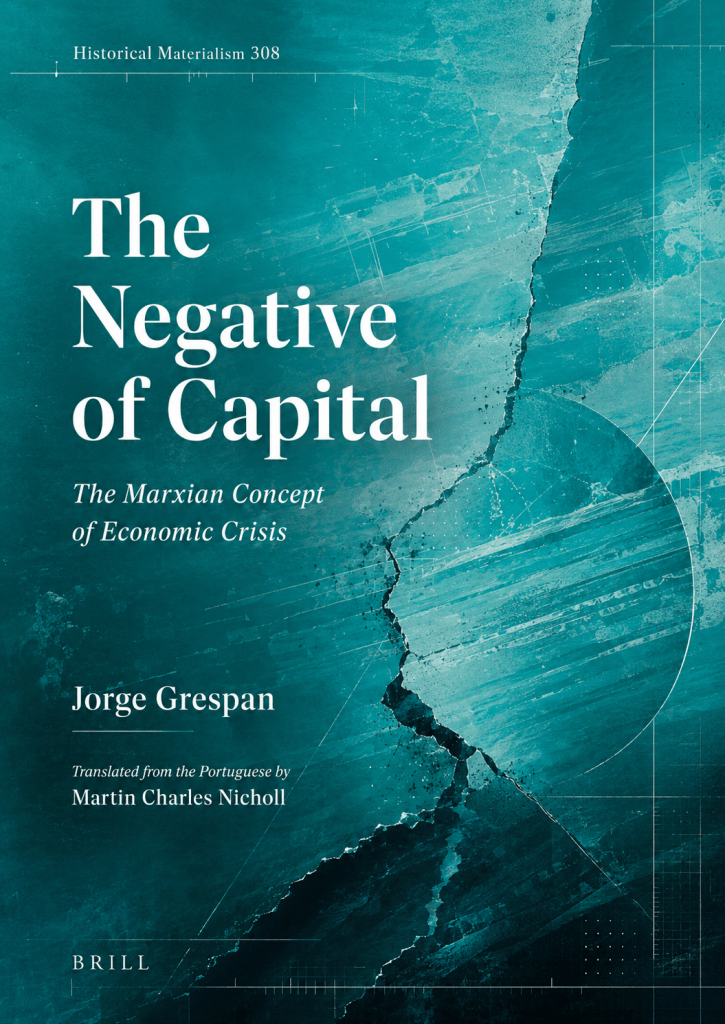
In The Negative of Capital: The Marxian Concept of Economic Crisis, Jorge Grespan undertakes an extraordinary examination of the concept of crisis as developed in Karl Marx’s Capital and its preparatory manuscripts. Rather than treating crises as isolated, incidental phenomena, Grespan reorients the discussion by positing crisis as the very negative of the concept of capital itself. In doing so, he revitalizes longstanding debates surrounding the nature, causation, and inevitability of economic crises, offering a reconstruction of Marx’s dialectical method to illuminate the internal logic by which capital not only reproduces itself but also inexorably generates its own negation.
It asks how Marx’s concept of crisis can be reconstructed when crisis is everywhere present in the exposition of capital yet nowhere isolated as a self-standing doctrine. Its governing ambition is to show that crisis belongs to the same categorial development as capital itself: each determination of capital entails a corresponding negative determination through which capital’s power of self-valorisation becomes exposed to devaluation, mismeasurement, interruption, and modal uncertainty. Its interest lies in the disciplined reconstruction of crisis as an immanent, differentiated, and relatively necessary form of capital’s own objective critique.
Grespan’s thesis is developed through a layered analysis of the dialectical categories that underpin Marx’s critique of political economy. Central to his argument is the assertion that crises manifest as capital’s inability to self-measure—a form of mismeasurement intrinsic to capital’s structure. The notion of ‘self-measurement’ is derived from capital’s need to continuously subordinate labor and extract surplus value in a process of quantifiable, calculable valorization. Yet, as Marx demonstrates, this very process is fraught with contradictions that render self-measurement precarious, inevitably leading to periodic devaluation. Grespan traces how, at each stage of Marx’s exposition—whether in the sphere of commodity production, circulation, or reproduction—the concept of capital unfolds alongside a corresponding conception of crisis. In other words, the negative or self-destructive aspect of capital develops in tandem with its positive or valorizing side.
By parsing Marx’s categories, Grespan shows that crises are not mere accidents or contingent disturbances. They are, rather, “relatively necessary”—a term that captures the dialectical intercourse between possibility and inevitability within the dynamics of capitalist production. This relative necessity emerges from the contradictions inherent in capital’s drive for expansion, contradictions that cannot be resolved without undermining capital itself. For instance, the drive to maximize surplus value through technological innovation and productivity gains ultimately leads to a fall in the rate of profit, an outcome that manifests as crisis. Yet, this tendency is not absolute; counter-tendencies may temporarily stave off collapse, rendering crises postponable but never entirely avoidable.
In Grespan’s reading, the fragmented presentation of crisis across Marx’s writings is not a sign of theoretical incompleteness but a reflection of the systematic nature of Marx’s critique. The concept of crisis cannot be relegated to a single chapter or volume because it is embedded in every determination of capital’s movement. As capital progresses through various stages of development—from the simple exchange of commodities to the complex processes of production and global circulation—the crisis potential inherent in each stage also deepens and diversifies. Thus, the crisis associated with the world of simple commodity producers (the discrepancy between sales and purchases) is fundamentally different in form and content from the crisis that emerges at the level of total social capital, characterized by the over-accumulation and over-valorization of capital.
Moreover, Grespan’s analysis insists on the historical and social specificity of crises. Unlike bourgeois economists who view crises as anomalies or failures of external factors, Grespan affirms Marx’s insight that crises are the “objective form of critique”—a self-criticism enacted by the system’s own contradictions. Capital’s fetishistic nature, wherein social relations appear as relations between things, obscures the structural causes of crises and renders them mystifying to economic agents. Grespan’s rigorous reconstruction of Marx’s dialectical method serves to demystify these crises, revealing them as necessary expressions of capital’s self-negating logic.
The book was created with methodological precision. Grespan demonstrates a deep engagement with Marx’s preparatory manuscripts, including the Grundrisse and the 1861–67 notebooks. His reliance on dialectical categories such as ‘measurelessness’, ‘relative necessity’, and the ‘tendential fall in the rate of profit’ allows him to reconstruct Marx’s unfinished theory of crisis with a level of detail and systematic coherence that few others have achieved. Through this reconstruction, Grespan challenges simplistic interpretations of Marxian crisis theory that reduce crises to single causes such as under-consumption, disproportionality, or falling profit rates. Instead, he argues that all these factors are present in Marx’s analysis, but they are synthesized within a broader conceptual framework that views crisis as an expression of capital’s fundamental contradiction.
Grespan also addresses the contentious issue of whether crises are merely possible or absolutely inevitable. By invoking the category of ‘relative necessity’, he navigates between the extremes of determinism and contingency. Crises are neither purely accidental nor strictly predetermined; they arise from the contradictory nature of capital, whose self-reproduction is always conditional and mediated by opposing tendencies. This nuanced approach provides a powerful antidote to both fatalistic collapse theories and excessively voluntarist interpretations of capitalist resilience.
Grespan’s book is governed by a methodological decision whose consequences extend through every level of its argument: crisis must be reconstructed according to the order of Marx’s presentation of capital, because crisis receives its determinate content only through the determinate content of capital itself. The work begins from a difficulty internal to Marx’s own textual legacy. Marx did not leave a systematic treatise on crisis, and the concept appears dispersed through the critique of political economy, especially in the materials around Capital and its preparatory manuscripts. Grespan treats this dispersion as an interpretive problem requiring categorial reconstruction. The absence of a separate theory of crisis does not license the conclusion that Marx lacked such a theory; it indicates that the theory must be read on the reverse side of the theory of capital. The concept of crisis appears in the negative articulation of the same forms through which capital positively constitutes itself as command over production, circulation, reproduction, competition, profit, and accumulation. This is why the book’s title is philosophically exact: the “negative” of capital is not a mere defect appended to capital from outside; it is the immanent self-negating side of the very process through which capital becomes capital.
The English edition’s preface functions as an interpretive operator rather than a merely documentary threshold. It states that the book originated as Grespan’s doctoral thesis, presented in 1994 at the University of Campinas, first published in Portuguese in 1998, reissued in 2012, and then revised for the English edition with a 2019 postface and an enlarged bibliography reflecting Marxist literature after the 2008 crisis. The preface also clarifies that the English edition has not substantially altered the central ideas of the original thesis; the later financial crisis is read by Grespan as confirming and intensifying them. This paratextual information matters because it distinguishes two temporal strata in the work: the original systematic reconstruction of crisis from Marx’s mature critique of political economy, and the later extension of that reconstruction into commercial and interest-bearing capital. The postface is thus neither an accidental supplement nor a replacement of the earlier argument. It is a controlled addition that tests the book’s categories—mismeasurement, fetishism, relative necessity—within the more fetishised forms of commercial and financial crisis.
The series and publication apparatus also frame the work’s status. Published by Brill in the Historical Materialism book series, volume 308, translated from Portuguese by Martin Charles Nicholl, and identified as an English version of O negativo do capital: o conceito de crise na crítica de Marx à economia política, the book enters Anglophone Marxological debate as both translation and theoretical reconstruction. The translation status is not incidental. Grespan explicitly notes that certain philological decisions matter because his argument depends on differences in Marx’s definitions of crisis, on the ambivalence of terms such as the measureless, and on the reconstruction of a category—relative necessity—that Marx does not simply name as a doctrine. Translation, textual reference, and categorial interpretation therefore become inseparable. The work’s philosophical claims depend on the precision with which Marx’s terms are allowed to retain their place within a structured presentation, rather than being flattened into ordinary economic vocabulary.
The central movement of the book begins with the claim that bourgeois civil society, insofar as it is capitalist society, is subject to crises determined by capital’s contradictory nature. Grespan’s opening problem is that “crisis” has been trivialised by ordinary usage, where it tends to signify disturbance, decline, or disintegration in a vague sense. Marx’s concept requires a stricter determination: crisis is the negativity immanent to capital, the manifestation of its constitutive contradiction. This initial definition already contains the book’s whole task in compressed form. It requires an account of capital capable of explaining why capital’s positive movement of valorisation is inseparable from a negative movement of devaluation; it requires a theory of critique in which critique is objective, because the system criticises itself through its own contradictions; and it requires a modal analysis capable of distinguishing possibility, necessity, inevitability, contingency, and relative necessity without collapsing them into one another.
The concept of critique is therefore displaced from moral denunciation into immanent exposition. Grespan’s Marx is not primarily condemning capitalism from an external standpoint; he is revealing the internal contradictions through which capitalism generates the conditions of its own disruption. Yet this objective self-critique is mediated by forms of concealment. Capitalist relations appear, especially in the sphere of competition, as relations of equality, exchange, equivalence, and lawful reciprocity. The contradictions that generate crisis are therefore not immediately visible to economic agents. They are concealed and transfigured through the same forms in which they operate. Crisis, in this sense, is the point at which the concealed contradiction becomes materially effective, although even then it appears through fetishised forms that can misrepresent its own origin. The book’s concept of critique thus has a double movement: it reconstructs the hidden contradiction, and it explains why that contradiction appears in inverted, objectified, or mystified form.
This is why value theory is structurally indispensable for Grespan. Value is not merely one topic among others in Marx’s economics; it is the categorial form through which the social relations of capitalism acquire the semblance of natural, objective, autonomous economic relations. Marx’s theory of value discloses that what appears as an independent relation among things is a historically determinate relation among producers mediated by labour, exchange, money, and capital. Grespan’s book places crisis within this same field. Crisis is intelligible only where value theory has shown how social relations take on objective economic forms, and how those forms can become contradictory. The negative of capital is therefore also the negative of the value-form’s claim to stable self-measurement. Capital must measure itself through value, must subordinate labour as the source and measure of value, and must continually translate qualitative social relations into quantitative valorisation. Crisis appears where this translation is interrupted, falsified, overstretched, or violently corrected.
The book’s first great problematic concerns the relation between fragmentation and system. Marx’s writings contain multiple crisis determinations: the separation of sale and purchase, the contradiction between commodity and money, the interruption of reproduction, disproportionality among branches, underconsumption, overproduction, overaccumulation, the fall in the rate of profit, credit expansion, commercial collapse, and financial panic. Grespan refuses to reduce this plurality to a single empirical cause. Yet he also refuses to leave the plurality as an unordered list. His reconstruction depends on the claim that each crisis-form corresponds to a specific level of Marx’s categorial presentation. The plurality is systematic because each determination of crisis belongs to a different determination of capital. Crisis in simple circulation is not yet crisis in capitalist production; crisis in reproduction is not yet overaccumulation of total social capital; financial crisis is not an autonomous realm detached from production, even though its fetishised form makes it appear so. The unity of the theory is therefore differential, articulated, and developmental.
This developmental structure is announced in the table of contents. The book moves from “The World of Commodity Producers” through “The Constitution of Capital,” “The Figures of Reproduction,” and “Capital as a Totality,” before arriving at conclusions on the time, actuality, modalities, and fetishistic power of crisis, and finally at a postface on commercial and interest-bearing capital. The sequence is not a simple chapter-by-chapter itinerary; it is a map of determinations. The first level concerns simple circulation, commodity fetishism, abstract labour, money, metamorphosis, and the possibility of crisis. The second concerns the transition to capital, surplus value, appropriation, capital’s subjectivity, accumulation, relative surplus value, and the measureless nature of crisis. The third concerns the circuits of capital, turnover, social reproduction, and disproportionality. The fourth concerns competition, profit, the rate of profit, tendencies, overaccumulation, cyclicality, and necessity. The conclusion and postface then gather these determinations into questions of temporality, modality, fetishism, commercial mediation, and finance.
The initial level, the world of commodity producers, establishes crisis as possibility. The commodity-form already contains a duality: use-value and value, concrete labour and abstract labour, private production and social validation. Commodity-producing agents are formally independent, yet their products receive social validity only through exchange. This means that the social division of labour is mediated by the market, and that the unity of production and consumption, private labour and social labour, commodity and money, must be achieved through a process that can fail. The possibility of crisis is therefore already present before capital has been fully constituted in the presentation. Sale and purchase can separate; the metamorphosis of the commodity can be interrupted; money can become an independent form of value opposed to the commodity seeking realisation. At this level, however, crisis remains formal possibility because the determinate capitalist compulsion to valorise value has not yet been fully unfolded.
The methodological burden of this first level is intricate. Grespan must show that the possibility of crisis is real, since it is grounded in the commodity-form and money-form, while also preventing that possibility from being mistaken for the full Marxian concept of crisis. The book therefore treats simple circulation as both necessary and insufficient. It is necessary because without the separation of commodity and money, and without the possibility that sale and purchase fail to coincide, there would be no elementary form in which crisis could later become actual. It is insufficient because simple circulation by itself does not yet explain why the possibility becomes effective with systemic force. The first crisis-form is thus a formal opening: it discloses the structure through which interruption can occur, while withholding the stronger claim that interruption is generated by capital’s own drive.
Money deepens this possibility by giving value an independent expression. The deduction of the money-form is not only a theory of exchange; it is a theory of how social labour acquires a general equivalent that can stand apart from particular commodities. The fetishism of money intensifies the fetishism of commodities because the social power of value appears concentrated in a thing. Once money becomes the independent form of value, the commodity’s need to become money becomes a site of risk. The metamorphosis of the commodity is therefore intrinsically unstable: commodity must become money, money must become commodity, and the circuit requires successive acts whose unity is not guaranteed by the intentions of the participants. Crisis appears here as the suspended unity of a process that presupposes unity without possessing it immediately. Its modality is possibility because the form permits rupture; it has not yet supplied the necessity of rupture.
The transition from simple circulation to capital reconfigures the meaning of crisis. Capital is not simply money used in exchange; it is value in process, value that preserves and increases itself through the purchase and consumption of labour-power. With this transition, the negative side of capital acquires a new content. The contradiction is no longer only between commodity and money, sale and purchase, or private and social labour. It is now between capital and labour-power, between value’s self-expansion and the living source of value that capital must subordinate yet cannot create out of itself. Capital’s affirmative side consists in commanding labour, extracting surplus value, and incorporating living labour as a moment of its own valorising movement. Its negative side consists in the fact that this command depends on a source of value that remains other than capital, even while capital posits it as its own subordinate moment.
This is the conceptual site of Grespan’s account of capital’s subjectivity. Capital appears as a self-moving subject because it seems to posit its own presuppositions, transform money into productive capital, command labour, produce commodities, realise value, and begin again at a higher level. Yet this subjectivity is structurally dependent. Capital’s claim to self-grounding rests on labour-power, whose activity it appropriates and whose value-creating capacity it must measure, discipline, intensify, and displace. The book’s concept of mismeasurement begins to acquire its sharper philosophical sense here. Capital does not merely calculate badly on occasion. It is driven to measure itself through a social substance—labour—that it must dominate and reduce to its own magnitude, while the very success of this domination alters the conditions of measurement. Capital must make labour the measure of value, yet its development tends to undermine the immediate adequacy of labour-time as measure through productivity, relative surplus value, technological change, and the expansion of accumulation.
The measureless nature of crisis therefore emerges from capital’s infinitude. Accumulation is formally without internal limit: money becomes more money; value seeks expanded value; surplus value becomes capital; accumulation becomes the condition and result of further accumulation. This infinitude, however, is marked by excess. The measureless is ambivalent: it names capital’s vast expansive power and the excess through which that power exceeds its own conditions of adequate self-measurement. The book’s argument depends on preserving this ambivalence. Capital’s positive movement is measureless as expansion; its negative movement is measureless as disproportion, overreach, and collapse of measure. Crisis is not merely the cessation of accumulation. It is the form in which accumulation’s own measureless drive becomes a problem for capital’s self-relation.
Relative surplus value is crucial because it gives this contradiction a dynamic technical and social form. In the pursuit of surplus value, capital revolutionises the labour process, increases productivity, and reduces necessary labour-time. Yet the same process that raises productivity transforms the relation between living labour and the material conditions of production. Capital attempts to increase surplus value by reorganising labour, but it thereby modifies the very basis on which value is measured. Here Grespan’s concept of mismeasurement becomes more than a theory of price discrepancy or market disequilibrium. It designates capital’s difficulty in sustaining its own quantitative self-relation when its qualitative development changes the composition of production. Crisis becomes necessary in the sense of an intrinsic disposition: capital’s production process generates conditions in which its own valorisation encounters the limits created by its own success.
This necessity is still not absolute. Grespan is careful to avoid deriving a fatal collapse directly from the production of surplus value. The negative and affirmative sides of capital coexist. The same mechanisms that intensify contradiction can also renew accumulation; the same productivity increases that reduce the relative role of living labour can increase the mass of surplus value; the same devaluation that destroys capital can restore conditions for future profitability. Crisis therefore acquires necessity without becoming mechanically predictable. It is rooted in capital’s own structure, yet its occurrence, timing, scale, and effects depend on mediations that cannot be deduced as a simple sequence. This is one of the book’s central methodological restraints: to show why crisis is immanent without converting immanence into fatal chronology.
The analysis of reproduction widens the field of crisis from production to the circulation of capital as a social totality. Capital must not only produce surplus value; it must circulate, realise, return, and reproduce the conditions of production. The circuits of capital—money-capital, productive capital, commodity-capital—are not interchangeable empirical descriptions. They are determinate forms of capital’s movement, each disclosing a different aspect of reproduction. The temporality of crisis is thereby complicated. Capital exists only by passing through phases, and each phase can become a barrier to the others. Production without realisation, sale without renewed production, money hoarded rather than advanced, commodities unsold, fixed capital immobilised, turnover delayed: these are not accidental inconveniences; they are determinate interruptions of a movement whose unity must be continuously achieved.
The reproduction schemas introduce another level of mismeasurement. Social capital must reproduce itself through relations between departments, especially those producing means of production and those producing means of consumption. The possibility of disproportion is no longer merely the separation of sale and purchase at the level of individual commodity exchange. It becomes a structural imbalance within the reproduction of total social capital. Expanded reproduction requires specific proportional relations if accumulation is to continue. Yet these proportions are not consciously planned by capital as a social subject; they are mediated by exchange, competition, investment decisions, turnover times, and profit expectations. Crisis as interdepartmental disproportion therefore shows that capital’s self-measurement is social and systemic. The failure of measure can arise from the discordance between branches, departments, and temporal rhythms of reproduction.
At this point the book re-poses the modality problem. Circulation and reproduction may seem to return crisis to possibility, because interruption can appear dependent on contingent mismatches, disproportions, delays, or failures of coordination. Grespan’s argument, however, is subtler. The appearance of mere possibility belongs to the circulation-form itself, where crises emerge as interruptions that could seem externally caused. Yet this appearance is corrected when reproduction is linked back to production and accumulation as a whole. The disproportions of reproduction are not external disturbances imposed on an otherwise harmonious capital. They are forms in which capital’s own fragmented yet totalising reproduction becomes vulnerable to its mode of coordination. The book thus narrows and widens the problem simultaneously: it narrows it by refusing to treat every imbalance as the essence of crisis; it widens it by showing that imbalance belongs to the social form of capital’s reproduction.
The fourth major determination, capital as totality, is the point at which the prior crisis-forms are reorganised. Competition and profit become decisive because capital now appears through the relations among many capitals. Individual capitals pursue profit, equalisation, market share, technological advantage, and expansion, while the total movement produces results not intended by any individual agent. Competition is not an external empirical addition to the pure concept of capital. It is a form of realisation in which the immanent determinations of capital appear as coercive laws imposed on individual capitals. The contradiction between capital and labour, the drive toward productivity, the formation of profit, and the transformation of surplus value into profit all become mediated through competition. The crisis-form therefore shifts again: what was earlier a contradiction of production, circulation, or reproduction now appears in the total movement of profit-seeking capitals.
The tendential fall in the rate of profit receives its place within this totality as a privileged form of mismeasurement. Grespan does not isolate it as the single cause of crisis, even though he grants it a high degree of categorial importance. The falling rate of profit expresses the contradiction between capital’s drive to increase productivity and its dependence on living labour as the source of surplus value. As capital increases the productivity of labour through a rising mass of means of production relative to labour-power, the rate of profit is placed under pressure, even while counteracting tendencies may operate. The falling rate is therefore not a simple empirical regularity; it is a categorial form in which capital’s self-measurement through profit becomes unstable. Profit is capital’s practical measure of successful valorisation, yet the process that raises capital’s productive power can diminish the rate by which capital measures its own expansion.
This is where Grespan’s modal analysis reaches its highest complexity. A tendency is not an absolute law in the sense of a univocal sequence that excludes all contrary determinations. It is necessary because it arises from capital’s own structure; it is relative because its actualisation is mediated by countertendencies, conditions, historical configurations, and the opposing affirmative movement of accumulation. Countertendencies are not external exceptions. They belong to the same totality. The increase in the rate of surplus value, cheapening of elements of constant capital, expansion of markets, devaluation, credit, and other mechanisms can moderate, defer, or transform the manifestation of the tendency. The negative side of capital therefore acts necessarily, while the affirmative side also acts necessarily. Their relation is one of structured opposition rather than simple alternation.
Overaccumulation is the more concrete crisis-form of capital as totality. Capital accumulates beyond the conditions under which it can valorise itself adequately. This does not mean merely that there is “too much” capital in an abstract quantitative sense. It means that capital has expanded in such a way that its own measure of successful valorisation—profitability—can no longer sustain the mass of capital seeking valorisation. Overaccumulation as mismeasurement names the condition in which capital’s expansion becomes excessive relative to its own valorising basis. The same accumulation that confirms capital’s power generates the need for devaluation. Crisis becomes the violent correction of capital’s false self-measurement: values are destroyed, capitals are depreciated, production is interrupted, labour is expelled, and the conditions for renewed accumulation may be reconstituted through destruction.
The cycle, in this context, is interpreted with great caution. Grespan’s discussion of the “bad infinity” of the cycle suggests that capital’s movement can appear as an endless alternation of expansion and crisis, boom and contraction, restoration and renewed excess. Yet the book resists making this alternation into an absolutely necessary rhythm. A cycle may be relatively necessary because the phases of accumulation, overaccumulation, devaluation, and renewed accumulation are internally connected. But their succession cannot be deduced as a rigid law that excludes contingency, political mediation, institutional transformation, world-market conditions, and human action. The cycle therefore has necessity without possessing teleological closure. It is a form of capital’s temporality, not a clockwork guarantee.
The conclusions gather this argument under the problem of time. The “time of crisis” is not simply the empirical moment when markets collapse or production contracts. It is the temporality of capital’s own development, in which presuppositions become results and results become renewed presuppositions. Grespan’s reconstruction of Marx’s “law of motion” requires distinguishing categorial development from historical sequence while also showing their relation. The categories do not reproduce history in chronological order; they reconstruct the articulated relations of modern bourgeois society. Yet these categories are not pure logical inventions. They express a historically constituted object whose real movement supplies the material that the presentation renders intelligible. Crisis belongs to this relation between categorial and effective development. It is conceptually immanent and historically mediated.
The “effective crisis” is therefore not identical with any isolated formal possibility. A crisis becomes effective when the potential contradictions of capital pass into actuality through determinate mediations. This passage from potentiality to actuality is the modal core of the book. Marx’s own vocabulary, as Grespan stresses, repeatedly invokes the movement from potential contradiction to actual contradiction. The question is how such actualisation is to be understood. If crisis is merely possible, then capitalism can in principle evade it indefinitely. If crisis is absolutely necessary, then its occurrence and perhaps even its final form could be predicted as an unavoidable collapse. Grespan’s solution is the category of relative necessity: crisis is rooted in capital’s own determinations, but its actualisation is conditioned by the relation between capital’s affirmative and negative sides and by mediations that cannot be reduced to a single causal mechanism.
Relative necessity is the book’s most important conceptual invention, though Grespan presents it as a reconstruction from Marx rather than as an external doctrine imposed on Marx. It allows him to preserve the immanence of crisis without affirming a fatal automatism. Crises do not happen by chance; they are intrinsic determinations of capitalism. Yet they are not predictable in the strong sense required by collapse theories or rigid cycle theories. They can be postponed, moderated, displaced, or transformed; their violence can vary; their effects can restore accumulation or worsen the conditions of accumulation. Relative necessity thus names a necessity mediated by opposition, dependence, and condition. The negative side of capital cannot be abolished by the affirmative side, while the affirmative side cannot be reduced to the negative. Their conflict is the form of capital’s movement.
This also explains Grespan’s treatment of twentieth- and twenty-first-century Marxist crisis debates. The book does not primarily reconstruct these debates in the main text; it often situates them in notes, while keeping the central exposition focused on Marx’s categories. This compositional choice is theoretically meaningful. Grespan’s aim is not to adjudicate among underconsumptionist, disproportionality, falling-profit-rate, collapse, or cycle theories as competing external interpretations. His aim is to show how each grasps a real element of Marx’s dispersed crisis theory, while becoming one-sided when it elevates that element into the whole. Underconsumption, disproportionality, falling profitability, overaccumulation, and financial disturbance each receive their truth only within the order of categorial development and the modality appropriate to that level. The book’s polemical restraint is therefore part of its method.
The power of fetishism is decisive at the end because it explains why crisis is both revealing and mystifying. Crisis reveals capital’s contradictions by materialising them as devaluation, interruption, collapse of confidence, or destruction of value. Yet the forms through which crisis appears can conceal its roots. Commodity fetishism makes social relations appear as relations among things; money fetishism concentrates social power in the general equivalent; capital fetishism makes value appear self-valorising; interest-bearing capital makes money seem capable of generating more money by its own nature. As fetishism intensifies, crisis can appear either as accidental disturbance or as catastrophic fate. In both appearances, its relative necessity is obscured. The task of critique is to reconstruct the mediations that fetishised consciousness compresses or erases.
The postface extends this logic into commercial capital and interest-bearing capital. Grespan explains in the preface that these forms were omitted from the original version because commercial and interest-bearing capital do not create surplus value; they appropriate portions of surplus value created in production. The later inclusion is prompted by the need to contest the reduction of the 2008 crisis to a merely financial bubble. This addition is carefully framed: because it was written decades after the original thesis, it appears as a postface rather than a new chapter, preserving the compositional integrity of the earlier work. Yet conceptually it belongs to the same system. Commercial and financial crises are not autonomous exceptions to the theory. They are more mediated, more fetishised forms in which mismeasurement and relative necessity become especially difficult to perceive.
Commercial capital introduces a form of separation between buying and selling that is no longer simply the elementary separation of commodity circulation. Commercial capital specialises in circulation, accelerates turnover, mediates realisation, and can expand the appearance of market demand beyond the immediate conditions of productive valorisation. Its crisis-forms therefore involve inventories, sales expectations, circulation delays, credit relations, and the apparent autonomy of commercial movement. Yet because commercial capital appropriates surplus value rather than producing it, its crises must be traced back to the relation between circulation and production. The mismeasurement at this level concerns the apparent measure supplied by commercial success: sales, turnover, market expansion, and realised prices can conceal whether the underlying production of surplus value supports the expanded movement.
Interest-bearing capital intensifies the fetishistic displacement. In interest-bearing capital, money appears to generate more money without the visible mediation of production. The rate of interest becomes a highly fetishised measure, more remote from the production of surplus value than the rate of profit. This is why financial crisis can appear as the collapse of a speculative sphere detached from productive capital. Grespan’s postface contests this appearance. Financial instruments, credit expansion, and interest-bearing claims may develop forms of autonomy, but their crisis cannot be adequately understood if their relation to productive capital is severed. Financial crisis is a privileged terrain of mismeasurement because claims to future value can multiply beyond the conditions under which value can be produced and realised. The eventual correction appears as financial collapse, yet its roots must be sought in the broader contradiction of capital’s self-valorisation.
The 2008 crisis, within this framework, is not treated as an empirical case study replacing the systematic argument. It functions as a historical pressure that reveals the insufficiency of calling a crisis “financial” when that description is allowed to imply causal autonomy. Grespan’s argument is more precise: the financial form is real, and its mechanisms matter, but the fetishism of interest-bearing capital encourages the illusion that finance has created an independent world of self-expanding value. Crisis then appears either as accidental speculation gone wrong or as unavoidable collapse of finance as such. The category of relative necessity resists both simplifications. Financial crises are conditioned forms of capital’s negative movement, rooted in production and valorisation, mediated through credit, interest, expectation, and fetishised claims on future value.
A striking feature of the book is that its key terms migrate across levels while retaining continuity. “Possibility” first names the formal possibility of crisis in commodity circulation; later it becomes inadequate when the production of surplus value gives crisis a necessary disposition; later still it reappears as the appearance of contingency in reproduction and finance. “Necessity” likewise changes role: it begins as the question of whether crisis can be derived from capital’s concept; it becomes intrinsic disposition in production; it reaches complex articulation in tendencies and countertendencies; it is finally stabilised as relative necessity. “Mismeasurement” begins from discrepancies in exchange, becomes capital’s failure to measure itself through labour, becomes disproportionality in reproduction, becomes falling profitability and overaccumulation at the level of total capital, and becomes especially fetishised in interest-bearing capital. The unity of the book is produced by these recurrences with altered valence.
The same is true of “capital.” At the beginning, capital is a presupposition of simple circulation in reality, though not yet fully developed in the presentation. Then it becomes value in process, constituted through the purchase of labour-power and the extraction of surplus value. Then it becomes circulating and reproducing capital, articulated through circuits and departments. Then it becomes total social capital mediated by competition, profit, tendencies, and overaccumulation. In the postface, it appears through derived forms that appropriate surplus value while seeming to detach themselves from production. The concept of crisis follows this movement because it is the negative side of each determination. The book’s systematic claim is therefore not that every crisis-form says the same thing in different language. Each crisis-form says something different because capital itself has acquired a different determination.
This internal development gives the book its philosophical density. It does not proceed by assembling Marx’s remarks into an anthology of crisis passages. It reconstructs a logic of presentation in which the absence of a discrete crisis chapter becomes intelligible. Crisis is everywhere because capital’s negative side is everywhere; crisis has no single location because capital itself is a relation that moves through commodity, money, production, circulation, reproduction, competition, profit, credit, and finance. The book’s wager is that Marx’s fragmentary textual distribution reflects the structure of the object more than the incompletion of a doctrine. This wager remains tension-filled because Marx’s manuscripts do contain real unevenness, editorial mediation, and unfinished plans. Grespan does not erase this difficulty. He works through it by distinguishing the most elaborated form of Marx’s presentation in Capital from earlier manuscripts, while using preparatory texts where their formulations clarify the mature exposition.
The distinction between authorial voice and editorial mediation is especially important in the English edition. Grespan speaks as author of the reconstruction, while Marx’s works enter through editions, translations, manuscripts, and references. Grespan notes the use of MEW references in the original thesis and MEGA² materials in the postface, especially for the 1863–67 and 1868 manuscripts. He also warns that he sometimes modifies English translations where they obscure meanings crucial to his argument. This apparatus establishes the status of the book’s claims: they are not free philosophical extrapolations, because they rest on textual reconstruction; yet they are not mere paraphrases of Marx, because the category of relative necessity, for instance, must be inferred from the interweaving of possible and necessary rather than cited as a ready-made Marxian label.
The work’s relation to Hegel is similarly restrained and determinate. Grespan uses the language of dialectical presentation, contradiction, totality, mediation, and modality, and he explicitly situates relative necessity in a philosophical lineage in which Aristotle and Hegel matter. Yet he does not dissolve Marx into Hegelian logic. The presentation of capital is not a pure deduction of concepts independent of historical material. Marx’s categories refer to historically specific social functions, and the order of presentation is governed by their articulation in modern bourgeois society rather than by chronology or pure thought. This distinction is essential for Grespan’s crisis theory. If the presentation were merely logical, crisis would risk becoming a conceptual inevitability detached from history. If it were merely historical, crisis would risk becoming an empirical recurrence without categorial necessity. Grespan holds the two together through the materialist presentation of a historically constituted object whose immanent law of motion must be reconstructed conceptually.
The book’s treatment of modality is therefore also a theory of scientific responsibility. To say that crisis is possible where Marx has shown only possibility is to remain within the limits of the concept. To say that crisis is necessary where capital’s own production of surplus value and accumulation generate self-negating tendencies is also required. To pronounce possibility as necessity, or relative necessity as absolute necessity, is to exceed the explanatory warrant of the theory. Grespan’s reconstruction is thus directed against dogmatic prognosis as much as against empiricist contingency. The theory of crisis authorises neither the indefinite resilience of capitalism nor the guaranteed prediction of its final collapse. It authorises the claim that capital contains immanent self-negating tendencies that necessarily press toward crisis, while their actualisation depends on historically specific mediations and on the conflict of tendencies and countertendencies.
This restraint has political significance, though the book’s register remains conceptual. Grespan concludes that there are no perfectly sequential cycles or inexorable tendencies in history, and that capital’s fatal automatism is itself a fetish. This formulation is crucial. It means that the critique of fetishism must also be applied to certain Marxist interpretations that transform capital into an automatic subject whose collapse can be deduced without remainder. Capital does possess a totalising power, but this power is contradictory, mediated, and historically conditioned. The opening for praxis arises not from the certainty of collapse, but from the reconstruction of the limits, contradictions, and conditions of capital’s movement. The theory of crisis clarifies what capital cannot master, where its self-measurement fails, and why its reproduction remains dependent on conditions it can neither fully control nor transparently comprehend.
The book’s unity finally takes the form of controlled antinomy rather than reconciliation. Capital is affirmative and negative, self-valorising and self-devaluing, totalising and dependent, measure-seeking and measureless, necessary in its tendencies and conditioned in their actualisation. Grespan does not resolve these tensions by privileging one pole. He stabilises them by assigning each its categorial level and modal force. The formal possibility of crisis in circulation is preserved, then reinterpreted; the necessity of crisis in production is asserted, then qualified; the apparent contingency of disproportionality is situated within reproduction; the tendency toward falling profitability is made necessary, then mediated by countertendencies; overaccumulation becomes the concrete form of mismeasurement, yet its cyclical sequence remains relatively necessary; financial crisis becomes a real crisis-form, yet its fetishised autonomy is criticised. The system holds together because each tension is relocated rather than dissolved.
By the end, The Negative of Capital attains philosophical unity through methodological restraint. It does not produce a single-cause theory of crisis, a collapse doctrine, a cyclical determinism, or a merely pluralist catalogue of crisis mechanisms. It reconstructs crisis as the internally differentiated negative of capital’s own categorial development. Its final position is that crisis is inherent to capitalism, that crises manifest capital’s chronic tendency to devaluation, that mismeasurement names the recurrent failure of capital’s self-measurement through labour, value, profit, reproduction, and credit, and that relative necessity gives the proper modality of this failure. The book’s unity lies in showing that capital’s negative side is neither separable from its affirmative movement nor reducible to an automatic destiny. Crisis is the objective critique capital performs upon itself, but the form, timing, and historical consequence of that critique remain mediated, conflictual, and irreducible to fatal sequence.
In the postface to the English edition, Grespan extends his analysis to the 2008 global financial crisis, contesting the notion that this crisis was purely a “financial” phenomenon. Instead, he argues that the crisis confirmed the systemic contradictions outlined by Marx, particularly those related to interest-bearing capital and the fetishistic nature of financial instruments. The financialization of capital, far from being an anomaly, represents an advanced form of capital’s self-negation, wherein the illusion of autonomous financial growth conceals the underlying contradictions in the sphere of productive capital.
The Negative of Capital is not merely an academic contribution to Marxian scholarship; it is a work of profound theoretical and political significance. By revealing the systematic nature of crisis in Marx’s critique of capital, Grespan opens up new avenues for revolutionary praxis. Understanding crisis as the necessary negative of capital equips readers with the conceptual tools to comprehend the limits and potentialities of capitalism, and to envision forms of social organization beyond it. For anyone seeking a deeper understanding of the Marxian concept of crisis, Grespan’s work is an indispensable resource—a masterful synthesis of theoretical rigor, historical insight, and dialectical reasoning.
 Simon Gros
Leave a comment