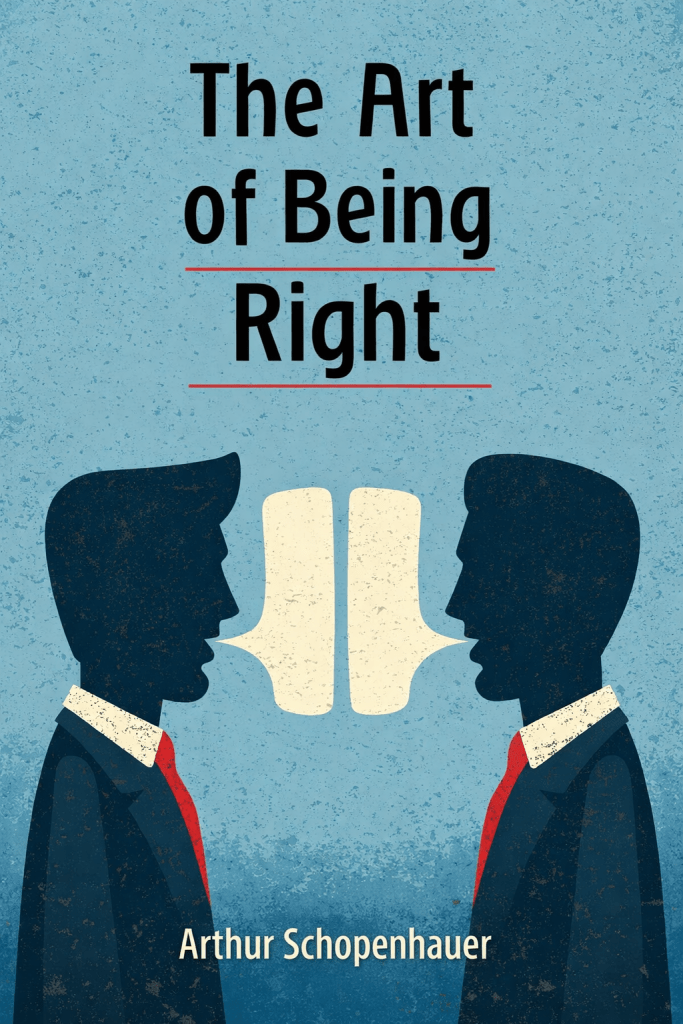
The Art of Being Right organizes itself around a compact and unusually exact question: what, in actual dispute, enables a speaker to maintain a position irrespective of its objective truth, and how may that practical knowledge be rendered explicit without being confused with logic proper. Its governing ambition is taxonomic and diagnostic at once. It seeks to isolate the recurrent procedures by which contentious reason secures assent, deflects defeat, exploits weakness, and converts appearance into provisional victory. Its distinctive value as an object of study lies in the tension it sustains between analytic sobriety and anthropological severity: the text does not merely list tricks, but gradually redefines disputation by separating truth from success, judgment from vanity, formal validity from social efficacy, and rational community from the obstinacy that actual conversation introduces into thought.
The first fact that governs any rigorous reconstruction of this edition is a fact of arrangement. In the uploaded files, the reader encounters the series of stratagems before the conceptual exposition that later names, defines, limits, and justifies them. The title page is followed almost immediately by the catalogue of controversial procedures; only afterwards do the sections labelled Preliminary: Logic and Dialectic, Controversial Dialectic, and The Basis of all Dialectic supply the methodological distinctions that would, in another ordering, have functioned as the text’s threshold. This matters philosophically. The work in this presentation does not begin from a settled concept and proceed to examples. It first places the reader amid the movement of contentious speech itself, among exaggerations, equivocations, feints, emotional provocations, strategic redefinitions, appeals to audience, authority, interest, and insult. Only later does it furnish the conceptual grammar capable of explaining what those procedures have in common. The edition thereby makes the theory retrospective. The reader comes to the concept of dialectic already marked by the experience of its phenomena. The later methodological pages do not simply preface what follows; they reorganize what has already been seen.
This retroactive structure is especially fitting for a text whose own argument repeatedly insists that the essence of controversy cannot be derived from the pure laws of thought alone. Logic, in the later conceptual section, belongs to the order of reason left to itself; dialectic, as the author wishes to delimit it, belongs to the order of reason as disturbed by individuality in intercourse with another rational being. The uploaded edition’s arrangement almost enacts this distinction. It gives first the empirical and tactical surface of dispute, the field in which reason appears under pressure, and only afterwards the reflective account that distinguishes this field from logic. The sequence is editorial, yet it is not philosophically inert. It compels the reader to discover, through delayed clarification, that what at first looked like a handbook of isolated maneuvers is in fact grounded in a general thesis concerning human contentiousness, vanity, weakness of intellect, and the practical non-coincidence between being right and appearing right.
The text’s central conceptual act consists in carving out a domain for what it calls controversial or eristic dialectic. This domain emerges through repeated acts of discrimination. First, logic and dialectic are said to have been historically treated as synonymous; the work acknowledges this usage and traces it through ancient and later authorities. Yet it also registers dissatisfaction with this inheritance. The terms may have been used interchangeably, but the phenomena to be designated by them are not identical. Logic is progressively reserved for the science of the laws of thought, the process of reason considered in abstraction from contingent obstruction. Dialectic, by contrast, names the art of disputation among actual persons. The distinction is neither merely lexical nor merely pedagogical. It concerns the site at which error enters. In logic, thought is considered under the aspect of its lawful form. In dialectic, thought is considered under the aspect of its exposure to contention, self-assertion, concealment, haste, and reciprocal pressure.
A second distinction immediately modifies the first. Dialectic in the relevant sense is not defined as the cooperative search for truth but as the art of disputing in such a way as to hold one’s own, whether one is right or wrong. The formula is stark and recurs as the work’s governing determination. Yet it would be reductive to read it as a simple celebration of dishonesty. The text does not merely say that disputants often lie. It offers a more intricate account. A person may be objectively right and yet appear defeated because the proof first offered for the thesis is successfully attacked, though other grounds in its favor may exist. The difference between proposition and proof, between truth and the occasioned success of its defense, becomes a structural motif. Defeat in debate is therefore not equivalent to falsity, and victory is not equivalent to truth. This dislocation makes a science of contentious procedure both possible and necessary. The practical question is no longer, “What is true?” but, “How is a thesis maintained, how is a thesis made to seem untenable, and what means intervene between objective rightness and social or rhetorical success?”
The work’s anthropology enters precisely here. It proposes that if human beings were thoroughly honorable, every debate would aim at the discovery of truth and would remain indifferent to the ownership of the conclusion. Yet, according to the text, actual disputants are governed by vanity, especially intellectual vanity, and by a reluctance to concede that an initial assertion was mistaken. This vanity is joined to loquacity and dishonesty. What is striking is that the text refuses to keep these traits at the level of moral denunciation. It turns them into explanatory principles. The disputant’s attachment to a thesis is not accidental to debate; it is what transforms debate into the field that dialectic studies. Controversial dialectic is therefore not an optional corruption of an otherwise transparent conversation. It is the positive science of dispute under human conditions.
Even this diagnosis is then complicated. The text grants that persistence in a doubtful or apparently refuted thesis is not merely blameworthy obstinacy. It may arise from the reasonable suspicion that the present refutation has only defeated one proof, not the thesis itself, and that another vindicating argument may later emerge. This is a decisive refinement. It prevents the work from collapsing into a purely cynical psychologism. The same tenacity that appears dishonest may also protect a thesis that is true but provisionally ill-defended. Hence the text attributes the phenomenon of contentious persistence to the mutual support of two conditions: the weakness of the intellect and the perversity of the will. The intellect does not always possess the saving argument at the required moment; the will refuses immediate capitulation. Eristic reason thus arises from a conjunction of cognitive limitation and self-assertive passion. The book’s recurring severity toward human nature is therefore joined to an acknowledgment of the temporal vulnerability of reasoning itself.
This conjunction explains another essential movement in the text: the gradual separation of objective truth from controversial method. The work does not deny objective truth. Indeed, it repeatedly presupposes it. It distinguishes propositions that accord with the nature of things from those that accord only with an opponent’s admissions. It speaks of the false, the true, the valid, the apparent, the undoubted. Yet it insists that in the conduct of actual disputes objective truth cannot serve as the organizing principle of a practical science of controversy, because the disputants commonly do not know with certainty where the truth lies, and because debate as lived proceeds through appearance, concession, timing, and force of impression. The text therefore does not abolish truth; it brackets truth as a methodological center for dialectic. What it seeks is a science of the means by which propositions are defended and attacked under conditions where truth is uncertain in advance and where the participants are not disinterested knowers.
The later section titled The Basis of all Dialectic makes this separation more schematic. Every dispute, it says, concerns a thesis advanced by one side or the other. There are two modes of refutation: one may show that the proposition fails to accord with the nature of things, or one may show that it conflicts with the opponent’s own admissions. The former belongs to absolute or objective truth; the latter to truth as it appears to the opponent. This pairing is not a minor scholastic distinction. It determines the entire architecture of the stratagems. Many of the tricks catalogued earlier work precisely by shifting the burden from one mode to the other, or by exploiting the ambiguity between them. A proposition may survive ad rem and yet be made to fail ad hominem; or it may seem vanquished because the audience cannot distinguish the two orders. The text’s emphasis on appearance, concession, and local conviction gains its conceptual matrix here.
The same basal section introduces a second pair of distinctions: direct and indirect refutation. The direct attack addresses the reasons of the thesis; the indirect attack addresses its consequences. Direct refutation may deny the premises or deny that the conclusion follows. Indirect refutation may proceed through what the text calls diversion, deriving absurd or unacceptable consequences from the opponent’s position, or through the instance, a contrary example that unsettles a universal claim. Again, these distinctions do more than classify formal possibilities. They reveal how the work understands controversial mobility. A disputation moves not only by confronting what is said, but by displacing attention toward implication, compatibility, exemplification, and contradiction. Many of the later stratagems are tactical exploitations of these underlying logical-relational paths. What begins as a seemingly miscellaneous art of quibbling is increasingly shown to rest on a comparatively small number of structural operations.
The text’s relation to Aristotle is constitutive and unstable. References to the Topica and the De Sophisticis Elenchis recur throughout the stratagems and become more explicit in the later notes. Aristotle appears as precursor, source of formal distinctions, and insufficient ancestor. The work repeatedly borrows Aristotelian terms and distinctions, yet complains that Aristotle failed to separate logic sharply enough from dialectic, and dialectic sharply enough from sophistic and eristic, because he retained an overly large relation between dialectic and truth. The author of this work wants a stricter demarcation. Logic is assigned objective truth in its formal aspect; dialectic is confined to the art of gaining one’s point; sophistic and eristic are not kept at a principled distance from dialectic in Aristotle’s manner because, the text argues, the material truth of propositions is too uncertain in advance to ground the distinction. This is one of the work’s most revealing tensions. It draws from the classical tradition while revising the taxonomy on the basis of a harsher view of debate. It seeks legitimacy from the ancient vocabulary and simultaneously reconstructs that vocabulary around the primacy of victory over truth in actual controversy.
This reconstruction becomes vivid in the stratagems themselves. They are not arranged as a ladder of increasing subtlety, nor as a mere heap. They accumulate by families, by recurring operations that acquire altered functions. The opening triad already establishes one of the book’s deepest motifs: the unstable boundary of the proposition under dispute. The first trick, extension, enlarges the opponent’s thesis beyond its natural limits, while allowing one’s own thesis to be contracted into a safer and narrower form. The second, homonymy, exploits lexical sameness across heterogeneous conceptions. The third generalizes a statement made only relatively or in a particular respect. What unites these is not only misrepresentation. Each acts upon the scope of a claim. The thesis is made broader, or less determinate, or transferred from one domain of application to another. The book begins, then, from the idea that controversy often succeeds by modifying what counts as the proposition at issue. This is why the defense in the first trick is said to consist in an accurate statement of the essential question at issue. The integrity of the dispute depends on a labor of delimitation.
That concern with delimitation persists throughout the book. What the first stratagem calls “natural limits” returns under many guises: the distinction between civic honor and knightly honor in the treatment of homonymy; the separation between praising Quietists as men and assessing Hegel as a writer of theories; the need to distinguish practical commendation from theoretical justification; the difference between public worship, piety, superstition, and fanaticism as effects of naming; the later warning that one must stop an opponent from extending one’s statement further than one meant it and insist, “That’s what I said, and no more.” This recurrence suggests that the work’s practical ontology of dispute is founded on the proposition’s vulnerability to displacement. A claim rarely exists in debate as a fixed logical object. It exists as something continually widened, narrowed, translated, re-labeled, and relocated.
From this there follows a second leitmotif: many controversial successes are semantic before they are inferential. The book is highly attentive to naming, metaphor, synonymy, and category assignment. It treats the word not as a transparent vehicle of the concept but as a strategic surface where contests over meaning and affect begin. The discussion of favorable metaphors is especially significant. Terms such as “innovation,” “existing order,” “antiquated prejudice,” “piety,” “bigotry,” “placing in safe custody,” and “throwing into prison” show that the verbal clothing of a matter pre-judges its evaluation. Here the work moves beyond simple fallacy theory. It understands that controversy is often won before explicit argument, because what is to be proved has already entered the definition or designation. This is identified as a subtle form of begging the question. The petitio principii is therefore not limited to formal circularity; it extends into the rhetorical constitution of the object by language.
The text’s treatment of language also shows a persistent movement between explicit classification and empirical exemplification. The work repeatedly states a trick in a compressed formula and then unfolds it through examples drawn from politics, philosophy, biology, social life, or legal and religious naming. These examples are not ornamental. They show that the stratagems are meant to be induced from lived disputation rather than deduced from an a priori scheme. The later methodological section confirms this by stating that dialectic, unlike logic, must for the most part be constructed a posteriori, from experience of the disturbance that pure thought suffers in intercourse between individuals. The examples therefore carry theoretical weight. They are not subordinate illustrations of an already completed science; they are evidence of the empirical origin that the science frankly acknowledges. The work’s ambition is systematic, but its method is observational.
This empirical orientation is part of the text’s methodological self-limitation. It explicitly calls what follows a first attempt and an uncultivated soil. Such remarks are not merely modest. They register that controversial dialectic is not presented as a complete doctrine with demonstrative closure. It is a preliminary tabulation and analysis of recurrent stratagems extracted from experience. Here the work differs from the tone of many of the stratagems, which can sound peremptory or final. The surrounding framework qualifies them. The science is provisional because its object is fluid, instinctive, and indefinitely variable. Yet it is still susceptible to regularization because common elements recur in different forms. This oscillation between incompleteness and schematization is one of the work’s governing tensions. Its unity consists less in an exhaustive architectonic than in a controlled taxonomic practice that knows its field exceeds any single inventory.
Several clusters of stratagems show how the text tracks the migration of argumentative responsibility. One cluster concerns concealment and procedural control: concealing one’s game, using false propositions that the opponent will admit, postulating what has to be proved under another name or by generalization, yielding admissions through a barrage of questions, placing questions in detouring order, taking advantage of systematic negation by asking the converse, and drawing conclusions oneself once the premises have been granted. Across these procedures, the explicit thesis is withheld, fragmented, or deferred. The burden of the argument is spread across admissions before the opponent perceives their destination. What is philosophically notable is that the text treats the order of presentation as constitutive of controversial force. The same inferential content may succeed or fail depending on whether the conclusion is foreseen. Anticipation allows resistance; concealment permits commitment before awareness. The work thus assigns strategic importance to temporal sequencing, not merely to propositional content.
Another cluster concerns the exploitation of affect and temperament. One may make the opponent angry; if he becomes especially angry at a particular argument, this indicates a weak point that should be pressed. One may choose absurd-looking auxiliary propositions so that rejection exposes the opponent to ridicule. One may claim victory despite defeat in a triumphant tone if the opponent is shy or slow and one possesses impudence and a good voice. One may bewilder by bombast, relying on the common assumption that words must mean something. One may end by becoming personal, insulting, rude when the subject is lost. The continuity here is not simply moral degradation. The work is mapping the points at which debate ceases to be governed even by the appearance of neutral reasoning and becomes a struggle over composure, prestige, intimidation, shame, and bodily or social vulnerability. It understands the disputant as an embodied and affectable being, not merely a bearer of propositions.
A third cluster concerns the social third party. The audience enters the text with increasing force. The disputant may generalize from admitted particulars because the audience, remembering the particulars, will suppose the general proposition has been secured. One may employ favorable metaphors because communal linguistic habits already carry valuations. One may persuade the audience rather than the opponent through an objection that experts can see is invalid but laypersons find impressive or amusing. One may appeal to authority rather than reason because most people value authority, and one may use universal opinion as an authority even while exposing, in a later reflective passage, how so-called universal opinion often arises from a chain of untested borrowings. One may exploit interest by working not on the opponent’s intellect but on his will, or on the audience’s shared corporate interest, since what is prejudicial to interest will appear absurd. These moments show that the work’s real scene is often triadic rather than dyadic. Debate is not only a contest between speaker and respondent; it is a performance before witnesses whose cognitive and practical limitations are themselves operative conditions of success.
This social dimension is inseparable from the text’s recurring differentiation between formal correctness and effective plausibility. It does not say that the audience is always irrational. It says that in actual conditions argument frequently works through what is taken, felt, or reputed to be compelling rather than through what is demonstratively valid. Hence the importance of authority, shared prejudice, ridicule, and the semblance of contradiction. The work’s oft-cited severity toward human nature here takes a more distributed form. Vanity, laziness, credulity, sectarian loyalty, and the wish to possess opinions ready-made are not only defects of the opponent. They are conditions of the public sphere in which controversy unfolds. The later long reflection on universal opinion develops this with unusual breadth. “Universal opinion” is decomposed into successive acceptance, trust in putative testers, and the social compulsion to assent to what is already widely assented to. The book thus connects micro-tactics of disputation with a larger account of opinion-formation. Debate is not isolated from social epistemology; it presupposes and exploits it.
Especially revealing is the treatment of ad hominem reasoning. Early in the work, the basis of dialectic distinguishes argument against the matter from argument from the opponent’s own admissions. This relative mode of conviction is then tactically elaborated in numerous stratagems. One may use false propositions that are true for the opponent. One may deploy arguments ex concessis. One may turn the opponent’s prior commitments, sectarian authorities, or practical conduct against him. One may even, when the matter collapses, slide from argumentum ad hominem to argumentum ad personam, abandoning the subject for the person. The work’s conceptual care here is important. It does not treat all personal reference as the same. There is a difference between using the opponent’s own admissions as relative grounds, using his conduct or affiliations for local pressure, and abandoning the topic altogether for insult. That last movement is identified as a terminal tactic, a leap from intellect to animality. The distinction is philosophically serious because it marks degrees of departure from objectivity. Not every appeal to the opponent is equally extraneous to the matter. Some operate within the relative logic of concession; others dissolve disputation into hostility.
One of the work’s most persistent insights lies in its description of how contradiction itself alters the position contradicted. To contradict a person is often to irritate him into exaggeration. The resulting overstatement can then be refuted, with the appearance that the original statement has been destroyed. This observation binds together earlier and later tricks. Extension, false syllogism, generalization of specific statements, forcing dangerous implications, and the management of angry overreaction all presuppose that debate is generative: the proposition under pressure changes form. Controversy does not merely test a fixed claim; it induces transformations in it. The text therefore studies not only arguments but reactive modifications of arguments. Inference and psychology intertwine. A thesis becomes more vulnerable because a person, under contradiction, extends it beyond the limits in which it may have been defensible.
A closely related insight concerns the relation between direct and indirect refutation. The book’s indirect tactics often derive their force from the public or practical unacceptability of consequences rather than from the thesis’s immediate falsity. A paradoxical proposition may be attacked through consequences that look absurd; an odious category may be assigned to a thesis in order to burden it with inherited discredit; a theoretical proposition may be dismissed by claiming that it does not apply in practice; an exception may be inserted to break a universal. What matters is that the text knows these are not all of one kind. Some are formally respectable modes of testing a proposition through implication or instance. Others are plainly sophistical or emotive distortions. Yet the work catalogues them together because controversial success depends on the indistinct border between legitimate testing and strategic exploitation. This is one of the places where the text’s methodological suspension of objective truth proves necessary. The same general relation—consequence, incompatibility, counter-instance—can serve honest critique or dishonest victory.
The discussion of authority continues the ambiguity.While appeal to authority is presented as a common and often effective substitute for reasons, especially since people are readier to believe than to judge, the work notes with precision that authority functions variably according to knowledge, prejudice, and the opponent’s background; one chooses experts, ancient languages, and inaccessible references in order to impress or silence. Yet, the long reflection on “universal opinion” undermines any naive confidence in the authority of common consent. This exposes the genealogy of public opinion as derivative, repetitive, and often intellectually second-hand, although it does not conclude that authority should never be used. In dispute with ordinary people, it says, one may and perhaps must use this weapon too. This is typical of the work. It combines demystification with tactical concession. It reveals the weakness of authority as an epistemic ground while preserving its efficacy as a controversial instrument. The resulting position is internally strained but deliberately so. The book does not seek to purify debate; it seeks to understand and arm oneself within its actual conditions.
Once the reader reaches the later conceptual sections after passing through these stratagems, the whole inventory is re-coded. The opening historical remarks on logic and dialectic no longer appear as neutral philology. They clarify why the work has had to labor so hard over its own object. Because the terms were historically unstable, the author cannot simply inherit a settled nomenclature. The dissatisfaction with Kant’s negative use of “dialectic” and the wish to reserve logic for laws of thought while assigning dialectic to disputation show that terminological reform is itself part of the book’s philosophical labor. It is trying to secure a name adequate to a domain that ordinary philosophy either subsumes under logic or morally degrades into sophistry. The eventual choice to call the subject controversial or eristical dialectic, while acknowledging that “eristic” would be more suitable, reveals methodological restraint. The book does not indulge in the pure invention of vocabulary. It works within inherited language while attempting to sharpen it.
The passage comparing two rational beings to two clocks that would agree if they kept exactly the same time offers, in compressed form, the work’s deepest speculative image. Rational beings, considered merely as rational, ought to agree. Dispute arises from the individuality that diverts them from that ideal synchronization. The metaphor is revealing because it does not say that reason itself is essentially agonistic. It says that agon emerges from the empirical conditions under which reason is borne by individuals. Controversial dialectic is therefore neither a transcendental structure of thought nor a mere accidental pathology. It is the regular science of reason as inflected by individuality, vanity, will, and experiential circumstance. This conception allows the work to preserve a place for logic and objective truth without mistaking them for the immediate law of lived discussion.
Though the book does not sentimentalize this distinction. Its main repeated claim that human beings are naturally obstinate, and that the branch of knowledge in question treats of this natural obstinacy, gives dialectic a darker anthropological foundation. Thought in common does not spontaneously correct itself. The first reflex is not self-revision but the assumption that the error lies in the other. This is one of the work’s load-bearing propositions. It justifies the need for the science, explains the ubiquity of the tricks, and underwrites the shift from truth-seeking dialogue to agonistic disputation. Yet the claim also places pressure on the status of the book’s own recommendations. If obstinacy is natural, then the reader’s appropriation of dialectical knowledge will itself be susceptible to dialectical misuse. The science cannot stand outside the condition it analyzes. This reflexive pressure is never explicitly thematized, but it is strongly implied by the work’s own anthropology.
A further pressure arises from the relation between innocence and expertise. The text observes that many controversial tricks are used instinctively. At the same time, it seeks to give them names and classifications so that they can be identified and reproached. Naming is here a practical form of demystification. A trick is easier to resist when recognized as such. Yet naming also refines the user’s arsenal. The same short, appropriate name that lets one accuse another of homonymy, extension, diversion, or petitio principii also increases one’s own tactical awareness. The work therefore transforms instinctive contentiousness into reflective contentiousness. This is a genuine increase in knowledge, but one with ambivalent moral direction. In this respect the book resembles its own treatment of language: the act that clarifies also equips, and the act that diagnoses also enables repetition at a higher level.
The distinction between objective and relative conviction remains the text’s master-key. Objective refutation concerns the thing itself; ad hominem refutation concerns only what follows from the opponent’s prior commitments. Much of the book’s sharpest intelligence lies in showing how easily these can be confused in practice. Audiences often take a relative defeat to be an objective defeat. A person cornered by his own admissions appears simply refuted. A successful joke at the expense of an expert can create the impression that science itself has been overturned. The text’s repeated concern with the appearance of contradiction, apparent rather than real inconsistency, and the difference between contradiction in seeming and contradiction in fact all derive from this central bifurcation. The book is not only a catalogue of tricks; it is a study of how the space between objective truth and socially persuasive seeming is navigated, widened, and weaponized.
In that sense, the phrase “art of being right” is itself under internal revision across the book. Early on, it may seem to mean the art of making oneself appear correct. Later, through the distinction between objective rightness and controversial victory, the phrase acquires a doubled sense. One may be right objectively and fail controversially; one may be wrong objectively and win the day. The book seeks knowledge that can operate in both conditions. It wants to understand how rightness is displayed, defended, simulated, or stolen in dispute. The title thereby gathers together the work’s chief ambiguity. “Being right” names both truth and the successful holding of one’s ground. The book never fuses these senses, but neither does it allow them to separate without remainder. Its entire movement occupies the unstable interval between them.
Towards the end, the work attains a distinct kind of unity, though not one of reconciliation. It does not harmonize truth and victory, logic and dialectic, reason and individuality, fairness and stratagem. Nor does it leave them in sheer disorder. What it achieves is a layered stratification. At the deepest level stands the distinction between logic as the science of thought and dialectic as the art of dispute under empirical conditions. Upon this rests the anthropological thesis of obstinacy, vanity, and the instability introduced by individuality. Upon that basis the book constructs the formal skeleton of refutation: ad rem and ad hominem, direct and indirect, denial of premises and denial of consequence, diversion and instance. Upon that skeleton it arrays a series of recurrent tactical operations that show how actual disputants manipulate scope, naming, sequence, implication, affect, audience, authority, and interest. Around all this it places a light but consequential paratextual frame of translator credit, source declaration, notes, and editorial ordering that makes the theoretical sections arrive retroactively and hence render the whole text as a delayed self-explanation.
The result is therefore not synthetic in the strong sense. It is a controlled antinomy held in methodological suspension. The work stabilizes its tensions by assigning them to different levels rather than by dissolving them. Objective truth remains real but methodologically secondary for dialectic. Logic remains pure but practically insufficient for controversy. Human vanity is condemnable yet partially excused by the temporal weakness of proof. Stratagems are dishonest yet often necessary for defense in an untrustworthy field. Authority is epistemically fragile yet practically effective. The book’s order in the uploaded edition intensifies this layered unity because the reader first experiences the disorderly intelligence of the stratagems and only later receives the conceptual divisions that make them intelligible as one science. The work thus ends with neither moral purification nor skepticism, but with a disciplined delimitation of a province of reason under combat conditions. That delimitation is the book’s real accomplishment: it gives contentious discourse a form of intelligibility without pretending that the form abolishes the conflict from which it was drawn.
 Simon Gros
Leave a comment