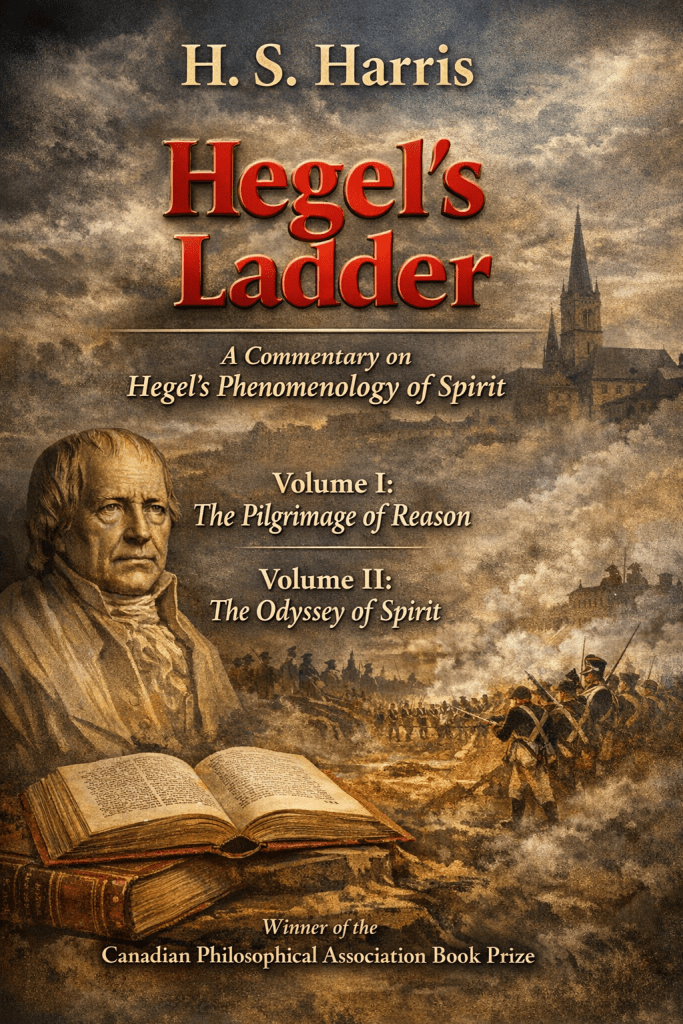
Harris’s Hegel’s Ladder presents itself less as an attempt to accompany Hegel’s Phenomenology of Spirit at the level of its own claim to be a science of experience. Its central question is whether the Phenomenology can be read as a continuous and intelligible chain of argument rather than as a brilliant but discontinuous assemblage of themes, images, and partial insights. Its governing ambition, stated with unusual explicitness in the prefatory matter and then enacted across the two volumes, is to provide a commentary that is at once analytically exact and discursively expansive, rigorous enough to follow the paragraphal articulation of Hegel’s text and supple enough to explain why that articulation takes the form it does. The distinctive value of the book lies in the way it treats commentary itself as a philosophical labor of reconstruction, recollection, and disciplined mediation.
The book’s own preface supplies the methodological key. Harris does not describe his enterprise as a general interpretation, a thematic companion, or a speculative rewriting. He calls it, in aspiration, a “literal commentary,” and the force of that phrase governs everything that follows. The term does not mean verbal paraphrase in the narrow sense, nor a merely lexical fidelity. It designates a task of argumentative accountability. The commentator proposes to discover whether an “acceptably continuous chain of argument, paragraph by paragraph,” is actually present in Hegel’s text. That proposal already contains several determinations. It presupposes that the Phenomenology is to be read as bearing a burden of proof rather than as exhibiting a sequence of memorable spiritual tableaux. It presupposes that apparent discontinuities are to be interrogated before they are normalized as defects or dissolved into literary suggestiveness. It presupposes, further, that commentary cannot remain at the level of isolated local glosses, because the continuity to be established is not merely sentence-to-sentence but architectonic. One must show how earlier premises become legible as later results, how what first appears as a thematic excursion later discloses its methodological necessity, and how the text’s own recurrent formulae alter their valence as the exposition advances.
The preface also makes clear that Harris understands this task as a double labor. An “analysis” that lays out the argument in sequence is necessary, yet insufficient. He remarks that attempts at analysis easily replace Hegel’s reasoning with more accessible reasonings of the analyst’s own. The closer analysis comes to Hegel’s own mode of expression, the less immediately helpful it may appear. This difficulty generates the second labor, the freer commentary that supplies explanation, illustration, and contextual clarification without surrendering the discipline imposed by the text. The distinction is not ornamental. It structures the whole work. What the book seeks is neither bare structural mapping nor unbounded discursive expansion, but a mediated form in which rigorous tracking of argumentative progression and ample explanatory discussion correct one another. The aspiration to combine “short commentary” and “long commentary,” explicitly invoked through the analogy with the Arabic Aristotelian tradition, becomes here a principle of composition. The work wants to remain close enough to the text that interpretive invention is constrained, and broad enough that the text’s compressed transitions acquire intelligible articulation.
This methodological self-consciousness is inseparable from the book’s polemical but still carefully delimited thesis about the Phenomenology itself. Harris declares that the prevailing habit of commentary has been governed by the assumption that Hegel’s book is not, whatever else it may be, the logical science that Hegel claims it to be. Against that consensus, Hegel’s Ladder attempts to show that the project of the book is indeed capable of being traced as a scientific progression. Yet Harris’s manner of proceeding is instructive: he does not ground this claim in preliminary proclamation or external apologetic. He turns it into a methodical obligation. If the Phenomenology is genuinely a science, then a continuous chain of argument should be recoverable. If such continuity cannot be shown, the claim fails. The commentary is thus organized as a test internal to the object it studies. It does not stand above the text as an arbiter armed with an independent doctrine of system. It enters the text under a hypothesis, then repeatedly measures that hypothesis against the work’s own transitions, recurrences, and declared aims.
The paratextual materials deepen this orientation. The apologetic preface is not merely biographical throat-clearing. It frames the entire commentary as the terminus of a decades-long struggle with Hegel and as the completion of a program already implicit in Harris’s earlier historical studies. Yet the tone is strikingly resistant to triumph. The preface repeatedly insists on limitation, on fallibility, on the unfinished character of commentary as such. Harris does not claim finality for his reading. He hopes rather that the work will prove “good enough to provoke a better one.” This statement is neither modest ornament nor rhetorical insurance. It belongs to the commentary’s concept of itself. Because the Phenomenology is approached as a logical science whose continuity must be reconstructed from within, commentary cannot be conceived as exhaustive possession. It remains an experiment in faithful explicitation under conditions of historical and conceptual finitude. Even the aspiration to literality is therefore tempered by an acknowledgment that no commentator simply inhabits Hegel’s own thought-world. Harris declares that he will interpret the text with as much relevant empirical knowledge of Hegel’s world as he can muster, but in terms of his own different cultural background. The commentary’s relation to its object is thus neither antiquarian reenactment nor presentist appropriation. It is a disciplined attempt to test whether Hegel’s “science of experience” can work across a historical difference that cannot be abolished.
The note on conventions and abbreviations, though apparently technical, also functions as an interpretive operator. It reveals how Harris situates his work with respect to the textual body of Hegel scholarship and how he expects the reader to move through the commentary. The emphasis on paragraph numbering is especially important. By incorporating a running analysis keyed to the structure of Hegel’s text, Harris turns the commentary into a parallel apparatus of orientation. The reader is not invited merely to consult the commentary after reading Hegel. One is meant to inhabit a doubled movement: the original text and the analytic recollection of its sequence. This organizational decision has philosophical consequences. It embodies the conviction that understanding the Phenomenology requires more than thematic familiarity; it requires a trained memory of where one stands in an unfolding process. The commentary’s own architecture therefore imitates, in a subordinate register, the labor of recollection that Hegel attributes to science.
The two-volume division gives this architectural imitation a more determinate form. The subtitles, The Pilgrimage of Reason and The Odyssey of Spirit, are not decorative labels affixed to arbitrary halves of a long book. They register Harris’s judgment about a major internal articulation in the Phenomenology and about the changing burden borne by its central terms. The first volume carries the exposition through the initial shapes of consciousness, self-consciousness, and reason up to what Harris calls a concluding intermezzo. The second begins with a prelude and proceeds through spirit, religion, and absolute knowing to a closing ritornello. These musical and dramatic designations matter. They indicate that Harris does not think the book’s unity is a straight line of homogeneous derivation. It advances by returns, recapitulations, reprises, and retrospective reorganizations. A later stage does not merely add new material. It often forces a revaluation of what earlier stages had been taken to show. The commentary is organized so that the reader repeatedly experiences this retroactive determination.
This retroactive structure is visible already in the introduction. Harris begins with “the genesis” and “the project” of the Phenomenology, but these introductory discussions are not extrinsic preliminaries. They establish the terms in which the work’s internal movement must be followed. The initial problem concerns the relation between the title “Phenomenology of Spirit” and the earlier designation “Science of the Experience of Consciousness.” Harris’s resolution is characteristic. He does not erase the difference. He proposes a reconciliation in which the formulation of the science of experience is the culmination of the historical appearing of spirit. The book becomes the final act of the drama it recounts. This is already a decisive hermeneutic wager: the text is at once record and completion, recollection and event, scientific exposition and culmination of historical self-manifestation. The consequence is that the reader must attend not only to what the text says about its objects but also to the peculiar status of the text’s own act of saying. The commentary therefore returns again and again to the relation between experience as undergone, experience as recollected, and science as the form in which recollection attains conceptual necessity.
From this point onward Harris reconstructs the Phenomenology as an experiment born from a long transformation in Hegel’s own thinking. The crucial feature of this genealogical reconstruction is that it does not treat Hegel’s earlier positions as mere antecedents surpassed by simple abandonment. Harris tracks how motifs from the early theological writings, the reflection on positivity, the problem of reconciliation, the role of fate, the notion of life, the aesthetic ideal, the relation to Kant, Fichte, and Schelling, and the concept later named Aufhebung are all reworked under new constraints. The commentary’s governing logic here is not causal explanation but conceptual sedimentation. An earlier distinction reappears later, not as unchanged residue, but as a more stringent determination. A tension first lived in theological or historical form may return as a methodological requirement of science. Harris’s account of how sublation acquires its complex sense, and how sequences of experience in the Frankfurt writings prefigure later sequences of determinate negation, exemplifies this procedure. The value of the introductory reconstruction lies precisely in this: it trains the reader to see the Phenomenology not as a book of abrupt inventions but as a site where inherited problems are forced into a new form of explicitness.
Yet Harris also insists that the eventual project is not simply the maturation of a preexisting idea. He repeatedly marks revolutionary inversions. The “System Programme,” for example, is connected to the later Phenomenology, but the relation is not continuity in the weak sense of thematic resemblance. Harris stresses that a decisive reversal has occurred in the intervening decade. The commentary thereby refuses an easy developmentalism. Earlier materials illuminate the later book only insofar as they help specify what had to change for the Phenomenology to become possible. This is one of the work’s most important methodological commitments. Historical genesis is relevant because it clarifies the form of the final project, not because it licenses reduction of that project to embryonic origins. The Phenomenology must be understood as a novel organization of inherited materials, one in which prior concerns acquire a scientific form they did not previously possess.
The treatment of Hegel’s preface and introduction shows how Harris’s commentary operates when it moves from large framing hypotheses to close interpretive labor. He understands the preface as both indispensable and problematic. On the one hand, it furnishes Hegel’s own general picture of the enterprise, his conception of truth as scientific system, his opposition to formalism, his account of speculative proposition, and his reflections on recollection, method, and the advent of science. On the other hand, precisely because the preface stands outside the order of demonstrative development proper, it risks being misread either as a detachable manifesto or as a transparent synopsis of what follows. Harris’s repeated question is therefore how one should regard the preface. He seeks neither to subordinate the whole book to prefatory declarations nor to isolate those declarations from the immanent movement of the text. The preface becomes an anticipatory discourse whose formulations are vindicated, corrected, or concretized only through the subsequent progression. A phrase such as “truth is properly a scientific system” is not taken as a doctrinal axiom simply to be admired or rejected. It is treated as a promissory formulation whose content must be generated by the very labor it announces.
This handling of the preface exemplifies Harris’s broader conception of philosophical language in the Phenomenology. Terms do not arrive fully determined. They acquire determinacy through use, displacement, and recollection. “Spirit,” “science,” “experience,” “recollection,” “reason,” “substance,” and “subject” are not stable labels attached to fixed objects. They are nodes in a developing inferential field. Harris is especially attentive to moments where a term first appears in a broad or elevated form and only later receives the constraints that make it genuinely operative. This attention to delayed determination is one of the commentary’s strongest features. It allows Harris to avoid both premature stabilization and interpretive vagueness. When he follows the phrase “science of experience” through preface, introduction, early consciousness, self-consciousness, and later religion and absolute knowing, he shows that the phrase changes its role as the conditions of its intelligibility change. What first names the project from outside becomes legible from within only through the process of the book itself.
The commentary’s treatment of “experience” is especially revealing. Harris does not leave the term at the level of ordinary empirical undergoing. The introduction’s analyses of the dialectic of doubt, the Bildung of consciousness, the method of speculative observation, and the table of contents are read as efforts to specify what must count as experience if the book is to be a science. Experience becomes the name for a process in which a shape of consciousness encounters the inadequacy of its own criterion and is driven toward a new object and a new criterion. Yet Harris is careful to distinguish his reconstruction from any merely formal schema. He repeatedly asks what, in concrete cases, makes a transition necessary, what exactly is lost, what is preserved, and what new burden the result must bear. The commentary therefore works against any temptation to reduce the Phenomenology to an abstract dialectical template. Experience is always structured, but its structure is lived through determinate objects, institutions, historical formations, and interpretive commitments. Harris’s analytic patience lies in showing how the formal movement and the concrete content are internally dependent.
This helps explain why the first volume moves through the worlds of everyday life, philosophical common sense, and intellectual theory with such insistence on the specificity of each “world.” Harris does not treat the opening shapes of consciousness as toy examples. He reconstructs them as articulated truth-worlds, each with its own criterion of objectivity and its own conception of what it means to know. The transition from sense-certainty to perception to understanding is accordingly not just a sequence in elementary epistemology. It is the progressive exposure of what a criterion of truth commits one to, and of how those commitments destabilize themselves. Harris’s language of “world” is important here. A shape of consciousness is not merely a proposition or theory. It is a lived horizon in which objects, relations, and forms of assurance hang together. This permits the commentary to give philosophical density to stages often reduced to pedagogical preliminaries. At the same time, it allows Harris to stage later returns. The reader is meant to recognize that patterns first displayed here recur later under altered conditions.
The concept of recurrence with altered valence is indeed one of the work’s deepest organizing principles. Harris repeatedly shows that the Phenomenology does not simply move on from earlier shapes. It repeats them at higher levels, where what was once an immediate world reappears as a mediated relation within a more complex whole. This is why recollection matters so much. A later stage is not simply later in time. It is richer because it contains the remembered logic of earlier failures. The commentary’s own recapitulative moments, especially the intermezzo and the ritornello, make this explicit. These sections do not merely summarize what has already been said. They gather the movement into a new conceptual arrangement, displaying the pattern of transformations that ordinary forward reading may not have fully grasped. Harris’s book thus embodies in its very structure the thesis that philosophical understanding is cumulative through recollection.
The transition to self-consciousness is handled in exactly these terms. Harris refuses to treat the famous section on desire, recognition, lordship, and bondage as an isolated masterpiece detachable from its context. He insists that the concept of self-consciousness emerges from the prior dialectic of consciousness and remains intelligible only through that inheritance. Desire is not introduced as a sheer anthropological datum. It appears as the transformed relation of consciousness to objectivity once the truth of the previous criterion has inverted. Likewise recognition is not simply a normative supplement added from outside. It is the form in which self-consciousness discovers that its truth requires another self. Here again Harris is attentive to internal pressure. The need for another self is not moral recommendation; it is a structural requirement generated by the inadequacy of solitary certainty. This requirement then ramifies across the stages of lordship and bondage, stoicism, skepticism, and the unhappy consciousness, each of which tests a possible relation between individuality, freedom, thought, and objectivity.
What distinguishes Harris’s handling of these sections is the fine-grained tracking of conceptual role-shifts. Freedom, for example, begins as a claim of independence, becomes a formal retreat into thought, turns into skeptical suspension, and then acquires religious form in the divided consciousness that knows itself as cut off from the true. At each stage the same term is operative under new conditions. Harris’s commentary excels at showing why this is not equivocation but development. A concept is being educated by its own failure. The commentary accordingly gives unusual weight to the unhappy consciousness. It is not a picturesque religious episode wedged between classical and modern material. It is a decisive mediation in which thought, finitude, transcendence, and historical religion are brought into a relation that later stages of reason, spirit, and religion will repeatedly transform. Harris’s analyses of “Historic Good Friday,” Sunday consciousness, the working week, penitence, and absolution already indicate how much of the later book is latent here in divided form.
The first volume’s later movement toward reason is especially instructive for understanding Harris’s general procedure. Reason is introduced as the certainty of being all reality, but Harris refuses to let this formulation remain grandiose or abstract. He follows its decomposition into observing reason, instinctive reason, and rational observation of the self, showing how the claim to universality becomes entangled with naturalism, psychology, biography, physiognomy, and phrenology. The commentary’s patience in these sections has a clear philosophical function. Harris wants to show that reason cannot simply assert its universality; it must discover what happens when it tries to know itself as an object. The grotesque and often comic extremities of these analyses are therefore not marginal curiosities. They expose the limits of a standpoint that still seeks itself in objectified forms. When reason attempts to read its own truth in natural embodiment or empirical characterology, it encounters the impossibility of grasping freedom as a thing among things. The apparent detour through dubious sciences becomes an immanent critique of objectifying self-knowledge.
The concluding intermezzo renders this point explicit. Harris identifies the collapse of observational reason as a total inversion. The active self that emerges knows that no reading of individuality is possible while the individual is still a living project of self-making. This result is not merely negative. It produces the divided category that will govern the remainder of the book. Reason now knows itself as at odds with itself, as a universal that is self-opposed. The rest of Hegel’s work, Harris says in effect, is the story of this self-opposition within reason. This is a decisive interpretive claim, because it reorganizes what follows. Spirit, law, morality, religion, and absolute knowing are no longer to be read as fresh thematic domains externally appended after reason. They are the forms in which the self-opposition of reason becomes socially, historically, and conceptually explicit. The first volume thus closes by converting a series of failures in self-observation into the opening of a new field in which the relation between singular agency and communal substance can no longer be deferred.
This conversion also reveals Harris’s way of handling structural tensions in the Phenomenology. He is acutely aware that Hegel’s own table of contents, sectional markers, and title-pages are interpretively significant. He remarks that the beginning of spirit is not the only or even necessarily the most decisive division, because the organization of chapter V and the broader grouping under reason complicate any simple break. The commentary is therefore tension-sensitive not only at the level of doctrinal claims but at the level of compositional architecture. A structural marker in the text may indicate one articulation, yet the logic of development may require another emphasis. Harris does not cancel either. He treats the tension between formal division and logical movement as itself informative. This is exemplary of the book’s broader discipline: whenever a text offers competing cues, Harris tries to preserve them until their relation becomes more determinate.
The second volume opens under the sign of this new determination. The prelude is brief but decisive. It announces that what follows concerns the actualization of rational self-consciousness through itself and then its passage into the life of spirit, culture, morality, religion, and knowledge. Harris’s organization here makes clear that the “odyssey” of spirit is not simply an external history of civilizations or ideas. It is the route by which the self-opposed category of reason discovers the substance it already was, estranges itself from that substance, and returns to it under the form of a more explicit self-comprehension. The language of odyssey is apt because the movement is one of homecoming through alienation. Yet Harris’s use of that figure remains carefully controlled. The home to which spirit returns is not a pre-existing immediacy simply recovered. It is constituted only through the route of estrangement, conflict, and recollection.
The early chapters of the second volume show this with particular clarity. Harris treats pleasure and necessity, the law of the heart, virtue and the way of the world, the spiritual animal kingdom, the Sache selbst, law-giving and law-testing reason as successive attempts by rational individuality to realize itself. What ties these analyses together is not merely the moral drama of failed projects. It is the gradual exposure of the inadequacy of thinking individuality apart from the social substance in which it already moves. The commentary’s recurring insistence on the difference between the apparent world of social nature and the supposed true world of subjective reason allows Harris to show how the contradiction shifts. At one moment the conflict appears as tragedy between desire and necessity. At another it appears as madness of self-conceit. Then again it appears as the vacuity of virtue or the duplicity of the spiritual animal kingdom. In each case a distinctive form of subjectivity discovers that the world it opposes is already its own objectivity in alienated or unrecognized form.
This gradual displacement of argumentative responsibility is one of the most illuminating features of Harris’s description of the move into spirit proper. The problem initially seems to belong to the singular agent: how can the individual actualize rational freedom? But as the analyses accumulate, the burden shifts toward the social and institutional medium itself. The truth of individuality cannot be determined apart from ethical substance. Harris’s exposition of ethical life therefore does not present the ethical world as a static ideal order. He follows the way in which substance, law, family, sexed division, action, guilt, and destiny become internally unstable. “Ethical ignorance,” “destined downfall,” and the condition of right are not successive historical curiosities; they are the forms in which ethical immediacy reveals its own insufficiency. What begins as the promise of unity in ethical substance yields a differentiated field in which knowledge and action, divine and human law, kinship and polity, natural feeling and universal order no longer coincide without remainder.
Harris is careful here to avoid the sentimentalization of Greek ethical life as well as the simplistic moralizing of its collapse. The “garden” imagery of Eden and expulsion, used in the contents and chapter titles, might invite a narrative of innocence lost. The commentary resists that temptation by insisting on the logical work performed by conflict. Ethical life contains within itself the tensions that necessitate its transformation. The family, the city, the sexes, guilt, and fate are not symbols placed upon a prior harmony from outside. They are the determinations through which the harmony itself proves finite. Harris’s reading thus treats the movement from ethical life to legality, culture, enlightenment, and morality as immanent. The later world does not simply destroy the earlier one; it releases contradictions already inherent in it.
The sections on culture, faith, and enlightenment display Harris’s gift for tracking the migration of key terms across very different contexts. Estrangement, for example, no longer means the divided soul of the unhappy consciousness. It becomes socialized and linguistic. Values, service, speech, wealth, contempt, and the disintegration of cultural worlds transform selfhood into a theater of mediation where language itself becomes a decisive medium of spirit. Harris’s repeated attention to speech acts in these chapters is significant. He shows that the life of spirit cannot be understood by looking only at institutions or beliefs in abstraction. The ways subjects surrender themselves through speech, judge one another, universalize or corrode values, and inhabit the rhetoric of culture belong to the process by which spirit estranges and recollects itself. The commentary’s own discursiveness here mirrors its object: it must register the subtle ways in which spirit becomes articulate to itself through linguistic forms that both reveal and deform communal substance.
The confrontation of faith and pure insight, and then the course of enlightenment, is handled with equal care. Harris does not flatten the opposition into a modern triumph of reason over superstition or a nostalgic defense of faith against reduction. He reconstructs the opposition as a conflict between two shapes of spirit, each bearing a partial truth and each generated by the development of the same communal life. Faith preserves a relation to universality under estranged representation; insight seeks to dissolve that estrangement by identifying the rational structure of the world. The struggle is therefore not between reason and unreason in a crude sense. It is a conflict over the proper medium of truth. When enlightenment triumphs, the resulting “mundane religion of pure insight” and the transition to absolute freedom and terror reveal that the victory of universality can become abstract and destructive if not mediated through determinate institutions and reconciliatory forms. Harris’s reading of these sections is especially attentive to how the claim of universality acquires political force and then discovers its own violence.
The movement into morality and conscience is where Harris’s tension-sensitive method becomes most exacting. He traces how the moral world-view, postulation, duty, displacement, conscience, beautiful soul, evil, and forgiveness do not form a sequence of isolated doctrines but articulate the crisis of a standpoint that wants absolute inward freedom and universal validity together. The commentary repeatedly returns to the impossibility of a divine judge in moral life and to the necessity of forgiveness as the only rational completion of conscience’s divided world. Here the book’s earlier concerns are drawn together with notable precision. The divided consciousness, the law of the heart, the limits of legality, the insufficiency of abstract universality, and the need for reciprocal recognition all converge. Harris reads forgiveness not as sentimental closure but as the concept through which agent and observer, singularity and universality, can be reconciled without the reintroduction of an alien sovereign authority. The “law of the heart” receives its rational form only as a universalizable disposition of reconciliation.
This is one of the places where the commentary’s own commitments visibly inform its interpretive emphasis. Harris is deeply concerned with judgment, punishment, mercy, and the communicative conditions of rational community. Yet he grounds these concerns in the text’s own progression. Forgiveness becomes philosophically central because it alone resolves a series of tensions that the previous stages have intensified: the gap between action and observation, the instability of inward certainty, the violence of abstract law, the impossibility of a morally rational divine judge, and the communal need to restore broken channels of recognition. The commentary’s persistent return to forgiveness across later recapitulations is therefore not extraneous moral preference. It is the sign that Harris sees in this concept one of the decisive hinges of the Phenomenology’s own logic.
Religion, as reconstructed in the final third of the second volume, is not treated by Harris as a detachable appendage for pious readers. It is where the truth-concept of the community receives representational content. The movement through natural religion, art-religion, and manifest religion is read as a phenomenology of how the community figures its own absolute relation to itself and its world. Harris emphasizes that religion recapitulates earlier shapes in transformed form. Light-essence, plant and animal, master-craftsman, cult, work of art, epic, tragedy, comedy, incarnation, revelation, community: these are not merely historical types of religion. They are the representational modes in which consciousness and spirit become visible to themselves under the sign of the absolute. The commentary’s strength here lies in showing how earlier conceptual distinctions return under imagistic, ritual, poetic, and communal forms. Religion is therefore neither reducible to concept nor external to concept. It is the field in which concept receives intuitive and imaginative embodiment before philosophy recollects that embodiment as its own truth.
Harris is especially alert to the relation between divine substance, divine intuition, and divine self-concept. These chapter titles already indicate that religion undergoes an internal education. The absolute is first grasped as substantial essence, then as intuitional or artistic life, then as explicit self-concept. Yet even this sequence is not simply linear. The commentary repeatedly underscores that every religion contains many moments together and that it is “invidious” to reduce any religion to a uniquely determinate truth-concept. This remark is methodologically important. It displays a restraint that governs the commentary at a crucial point. Because religion as lived incorporates multiple strata of experience, one cannot simply classify it by a single logical function without violence. Harris therefore preserves a tension between phenomenological ordering and the internal abundance of religious life. This restraint gives the treatment of religion an unusual seriousness. The chapters are neither doctrinal reductions nor historical panoramas. They are disciplined attempts to show how representational consciousness bears, in condensed and overlapping ways, the movement of spirit toward self-comprehension.
When the commentary reaches absolute knowing, it does so by refusing any abrupt rupture. The “republic of the learned” is not an esoteric community detached from life. It is the shape in which the community of rational appreciation becomes conscious of itself as science. Harris’s reading of the final problem, recapitulation, science as self-comprehension, and the circle of experience makes clear that absolute knowing is not omniscience, not a final inventory of all facts, and not a transcendent departure from experience. It is the comprehension of experience as the movement in which spirit’s shapes have generated and displaced their own criteria. Science is self-comprehension because the object has turned out to be nothing other than the self-developing conceptual life of spirit. Yet this is precisely why recollection remains central. Absolute knowing is not immediate possession of the whole. It is the labor of remembering the whole in its necessity.
The ritornello then performs one final and extremely important operation. It circles back across the book and asks explicitly whether the science of experience is a proper science. This question, present from the beginning, returns only after the whole progression has been traversed. The delay is decisive. One cannot answer at the outset because the meaning of “science,” “experience,” and “proper” has itself changed through the journey. Harris’s treatment of this final question is notable for its measured character. He does not offer a triumphalist confirmation. He acknowledges the tension between the Phenomenology as introduction and the possibility of further science. He considers the relation between common sense, language, despair, skepticism, religion, and philosophical freedom. He grants that no one is compelled to be “logical in the Hegelian way,” and he repeatedly emphasizes that philosophy cannot tell anyone how to be authentic. What the science can do is lay out the conditions for understanding and reconciliation. The final dignity of the work lies not in coercive proof that abolishes ordinary life, but in a clarified comprehension of why conflict persists and how conceptual reconciliation remains possible.
This final moderation is important for understanding the type of unity Harris attributes to both Hegel’s book and his own commentary. The unity attained is neither simple reconciliation nor unresolved fragmentation. It is a layered stratification held together by recollective method. Earlier tensions are not annulled in the sense of becoming nonexistent. They are reordered, given their place, and rendered intelligible as moments within a larger movement. Harris’s own vocabulary of circle, reprise, recollection, and self-enjoyment indicates that the completed unity is reflexive and retrospective rather than merely progressive. The book arrives at a standpoint from which the path can be remembered as necessary, but that standpoint does not dissolve the finitude of the shapes that had to be traversed. Even at the end, there remains a disciplined awareness of contingency, extensibility, and interpretive incompletion. The commentary therefore stabilizes its guiding tensions by converting them into methodological consciousness. It does not promise a frictionless finality.
As a book-review-as-description, one can say that Hegel’s Ladder is distinctive because it treats commentary as a form of philosophical participation in the very recollective labor it attributes to Hegelian science. Its prefaces, notes, conventions, volume divisions, intermezzo, prelude, and ritornello are all enlisted as active guides to reading. Its guiding thesis, that the Phenomenology can be followed as a continuous chain of argument, is never simply asserted; it is repeatedly put at risk and re-earned through local reconstruction. Its language remains close to the text’s own burdens while allowing itself enough explanatory breadth to register historical, conceptual, and rhetorical mediations. The result is a work whose philosophical continuity lies not in monotonous sameness of method but in a sustained practice of returning to the same problems under altered determinations. Substance and subject, experience and science, individuality and community, law and forgiveness, representation and concept, tragedy and comedy, despair and recollection: these oppositions do not disappear, yet by the end they stand within a comprehended order. The form of unity attained is therefore that of a controlled and recollected totality, one that knows itself only by carrying its own fractures as remembered moments of its self-understanding.
 Simon Gros
Leave a comment