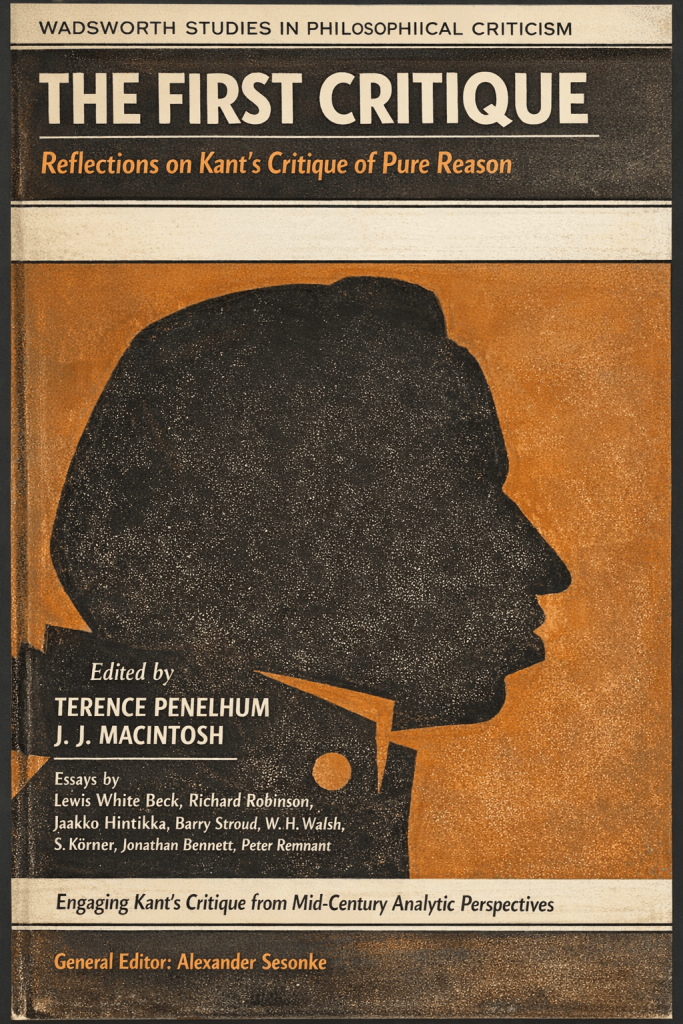
The First Critique: Reflections on Kant’s Critique of Pure Reason, edited by Terence Penelhum and J. J. MacIntosh and published in 1969 as a volume of the Wadsworth Studies in Philosophical Criticism under the general editorship of Alexander Sesonke, assembles eleven essays that interrogate the central doctrines of Kant’s first Critique from the standpoints of mid-twentieth-century analytic philosophy. The volume’s governing question is whether Kant’s architectonic — his theory of synthetic a priori judgments, his transcendental apparatus of intuitions and categories, and his critique of speculative reason — can survive scrutiny by thinkers trained in logical analysis, philosophy of science, and the linguistic turn, while the volume’s distinctive value lies in its refusal to treat the Critique as a finished monument, preferring instead to reopen its arguments at their points of greatest internal pressure.
The series to which this volume belongs defines its own pedagogical and intellectual ambitions in a general foreword that functions as something more than bibliographic metadata. The Wadsworth Studies in Philosophical Criticism were conceived in response to what the foreword identifies as a structural problem in American university education: the growth of class sizes and the consequent retreat of philosophical dialogue from the classroom. Each volume in the series was designed to supply a plurality of critical voices that might, when read alongside the classical text in question, recreate within a large lecture hall or solitary study something of the productive friction characteristic of small seminars. The editorial principle governing the selection of materials was explicitly pedagogical rather than definitive; the editors sought writings that would provoke serious engagement and present a variety of philosophical styles, rather than writings that would settle interpretive controversies. This commitment to provocation over settlement has consequences for the philosophical character of the collection, for it means that the volume is deliberately structured as an open field of contestation rather than as a convergent interpretation. Penelhum and MacIntosh note in their own introduction that the collection is not intended to compete with standard expository commentaries or to augment the already abundant exegetical controversies within them, though they concede that the volume contains more discussion of Kant’s idiom than the series ordinarily requires. This concession is itself revealing: it registers the editors’ awareness that the Critique of Pure Reason, to a degree unmatched by other canonical texts in the series, poses interpretive difficulties that are inseparable from its philosophical substance. One cannot debate Kant’s doctrines without first establishing what those doctrines say, and one cannot establish what they say without confronting the extraordinary terminological difficulty and compositional unevenness of the text itself.
The introduction by Penelhum and MacIntosh provides a compressed yet significant overview of the volume’s contents, grouping the essays into thematic clusters that correspond, loosely but recognizably, to the major divisions of the Critique. The first two essays, by Lewis White Beck and Richard Robinson, are said to deal with the way in which Kant conceived his task. The essays by T. D. Weldon and Jaakko Hintikka address the Transcendental Aesthetic, specifically Kant’s perceptual vocabulary and his concept of intuition. Barry Stroud’s essay examines the form of proof employed in the Transcendental Deduction and its contemporary analogues. W. H. Walsh and Lewis White Beck (in a second contribution) take up the Analogies of Experience, while S. Körner addresses the broader question of Kant’s foundation for science and mathematics in light of post-Kantian developments. Jonathan Bennett’s essay treats the second Paralogism from the Dialectic, and the final two essays, by Jerome Shaffer and Peter Remnant, engage with Kant’s criticisms of the Ontological and Cosmological proofs for the existence of God. The editors observe that the Dialectic has received less attention than the Analytic in the philosophical literature, speculating that this may reflect contemporary philosophers’ greater urgency in refuting the skeptic than the speculative metaphysician, or the questionable assumption that the Dialectic is philosophically easier, or the fact that many of its anti-speculative arguments are not strictly dependent on the epistemology that precedes them. This last observation, as the editors note, is itself a source of the destructive power of Kant’s criticisms: he does not rest content with general reasons for expecting speculative metaphysics to be confused, but exposes and analyzes the specific confusions that his epistemology enables him to predict.
The volume opens, after the introduction, with Lewis White Beck’s essay on Kant’s strategy, and it is with this essay that the collection’s philosophical argument properly begins. Beck’s essay is a masterpiece of synoptic reconstruction that frames the entirety of the Critique as the execution of a single strategic insight. The governing metaphor is military: Kant is presented as a general fighting a two-front war against two opposing philosophical coalitions, and his genius consists in finding an argument that can be deployed against both enemies simultaneously, so that a victory on either front is simultaneously a victory on the other. The two coalitions are identified through Kant’s own tripartite division of philosophical positions, given in the chapter entitled “The History of Pure Reason” at the very end of the Critique: the division between intellectualists and sensualists regarding the object of knowledge, between empiricists and rationalists regarding the origin of knowledge, and between naturalists and systematic philosophers regarding the method of knowledge. Although these divisions are logically independent, Beck observes that in historical fact certain family affiliations have obtained among them: the great intellectualists have generally been rationalists and dogmatists, while the great sensualists have been empiricists and either naturalists or skeptics. There are thus two great coalitions, recurring since Socrates and the Sophists, and Kant is to be imagined as standing isolated between them, looking for future allies in both camps.
Beck characterizes the empiricist coalition — the entente founded in modern times by Locke — as comprising three allied powers united by the thesis that all knowledge derives from experience: skepticism in metaphysics, naturalism in ethics, and what Beck calls, for lack of a better name, skepticism tempered with naturalism in the theory of knowledge. Hume is the exemplar of all three positions. Kant believed that a consistently developed empiricism would lead to skepticism not merely in metaphysics, as far as he thought Hume had pushed it, but in natural and mathematical knowledge as well. The saving feature of Hume’s position, in Kant’s estimation, was a fortunate error in the estimation of mathematical knowledge and the compensating force of good sense and natural temperament. The rationalist coalition, on the other side, comprised dogmatism in metaphysics, the Leibnizian epistemology that explained even simple empirical facts through arguments proceeding from the obscure to the more obscure, and in ethics a voluntarist theory making the good dependent upon God. Kant’s relationship to both coalitions was complex: he had once been a member of the rationalist alliance, had in the 1760s seemed to many historians to have changed sides, and yet as the mature philosopher was never entirely uncritical of the rationalists nor fully committed to a skepticism grounded in empiricism.
The strategic question Beck poses is precise: how could Kant maintain skepticism in metaphysics without falling victim to eudaemonism in ethics and to a jejune appeal to common sense in the conduct of life and science? How could he oppose Hume without joining the uninspiring company of Reid, Beattie, and Oswald? How could he give up supernatural metaphysics without making a metaphysics out of naturalism? On the other side: having turned his back on rationalist dogmatism after 1770, how could he save an ethical theory requiring a metaphysical foundation? How could he give up metaphysics because it was not empirical while defending knowledge of nature through a theory of synthetic a priori judgments, given that metaphysics appeared to consist of nothing but such judgments? Had Kant’s strategy been merely eclectic — drawing a bit from each side — his philosophy would have been a coalition system of the kind he explicitly condemned, and he would be as forgotten as other compromisers.
Beck’s crucial interpretive move is to identify the strategic principle underlying Kant’s solution through what he calls Ramsey’s Maxim: in cases where two opposed arguments seem internally sound but yield incompatible conclusions, the truth lies not in either disputed view but in some third possibility discoverable by rejecting something assumed as obvious by both disputants. Two theories, X and non-X, may both contain a common false element A; upon analysis, X may be found to be A plus Y and non-X to be A plus non-Y, and when A is shown to be false, the contradiction between Y and non-Y ceases to matter because both were interesting only as apparent corollaries of A. Beck illustrates this maxim first through Kant’s treatment of the dispute about mathematics. Hume and Leibniz agreed — using Kant’s terminology — that mathematical judgments are analytic and logically necessary, but disagreed about whether mathematics has necessary objective reference: Leibniz affirmed it, Hume denied it. Kant’s revolutionary move, formulated as early as 1768, was to reject the shared premise: mathematical knowledge is not analytic and logically necessary but synthetic, necessarily applying to our experience of spatial objects while not applying even approximately to anything beyond experience. Beck also illustrates the strategy through the first antinomy of space: rationalists said space was finite, empiricists said it was infinite, and the common false premise was that space is the real form of intrinsically existing objects. If that premise is rejected, the dispute about finitude and infinitude collapses because it concerns something that does not exist in the assumed sense at all.
The common principle that Kant identified as false in both coalitions is, according to Beck’s reconstruction, the thesis that there is but one ultimate source or faculty of knowledge. The rationalists and empiricists disagreed about which single faculty this was — intellect or sense — but agreed that there could be only one. Leibniz intellectualized appearances: increasing the distinctness of a representation raises it from sensation to thought, and empirical knowledge is a poor substitute for rational knowledge of necessary connections. Locke, meanwhile, sensualized intellectual concepts: precisely because mathematical knowledge is knowledge of the relation of ideas and thus does not fall under the empiricist rule that knowledge comes from experience, Hume saw that mathematics has no existential import. By completely intellectualizing mathematical knowledge, Hume severed its connection with existing things; the intellect that could yield genuine knowledge had to be an intellect that had been sensualized. This sensualized intellect produced the skepticism inherent in empiricism, just as Leibniz’s intellectualized senses could produce only dogmatism.
Kant’s counter-thesis, as Beck formulates it with deliberate understatement, can be stated in a single proposition: whatever is given to the senses is given with the form of sensibility, and whatever is thought is thought through the pure concepts of the understanding. Beck hesitates to call this the sum and substance of Kant’s philosophy, but he observes how much of the Critique depends on it, how much is its elaboration and defense, and how many of Kant’s polemics are directed against those who implicitly deny it. The essay concludes with a salutary warning against pressing Kant into any single mold — whether logistic, metaphysical, positivistic, existential, psychologistic, or axiological. Each such interpretation brings to the foreground what is at most background in the others, and Kant has been variously regarded as a founder of positivism and its opponent, the destroyer of metaphysics and the philosopher who made it scientific, the chief critic of psychologism and the man who ruined epistemology by making it psychologistic. The strategic reading Beck proposes is explicitly classical — it is, he notes, the picture already found in Hegel — but its value lies in its capacity to make the entire Critique intelligible as a single argumentative plan.
Beck’s essay performs a framing function for the volume as a whole that exceeds its explicit content. By establishing the Critique as a two-front war requiring a single weapon capable of deployment on both fronts, Beck provides the other essayists with a template for evaluating particular Kantian arguments: each can be asked whether it successfully carries out the strategic plan, whether the tactical execution matches the strategic ambition, and whether failures in specific arguments are failures of strategy or merely of tactics. The military metaphor also introduces a productive ambiguity: a general who loses may lose not because his strategy was wrong but because particular tactical moves failed, and similarly Kant’s specific arguments may fail while his overarching insight remains sound. This distinction between strategy and tactics recurs implicitly throughout the volume, as essay after essay finds fault with particular Kantian arguments while preserving, or at least not dismissing, the larger philosophical vision they were intended to serve.
The second essay, by Richard Robinson, shifts the level of analysis from the synoptic to the granular. Where Beck asked what Kant was trying to accomplish, Robinson asks what Kant means by one of his most fundamental terms: “necessary proposition.” Robinson’s essay is a sustained exercise in conceptual disambiguation, proceeding with the meticulous care of an analytical philosopher determined to expose the confusions latent in apparently transparent philosophical vocabulary. The essay’s central contention is that the concept of a necessary proposition, as it functions in the Critique of Pure Reason, is not a single clear concept but a confusion of four distinct concepts, and that this confusion, which Robinson attributes to Kant himself, has had lasting deleterious effects on subsequent philosophical thought.
Robinson identifies four clear senses of “necessary proposition” that were available in the philosophical tradition Kant inherited. The first is what Robinson calls the compulsory-belief sense: a proposition is necessary if we are compelled to believe it, whether because it has not occurred to us to doubt it, or because it seems obviously true, or because something compels us to believe it. The second is the Aristotelian or apodeictic sense, derived from Aristotle’s use of the expression in the Prior Analytics: a proposition is necessary if it contains the word “must” or “necessarily” or an equivalent, asserting that something necessarily belongs or does not belong to a subject. The third is the Leibnizian or analytic sense: a truth is necessary when the denial of it implies contradiction, which is to say that either the proposition itself or its contradictory is self-contradictory. The fourth is what Robinson calls the universal sense: a proposition is necessary if it asserts a universal connection with unrestricted generality, as in “absolutely any A is B.” Robinson emphasizes that these four senses are logically independent of one another: an Aristotelian necessary proposition may or may not be compulsory to believe, may or may not be self-contradictory in its denial, and may or may not be unrestrictedly universal. What sense, then, did Kant intend?
Robinson’s investigation yields a negative result for each of the four candidates. Kant did not mean the compulsory-belief sense, for his conclusion that we are compelled to believe certain propositions rests on the prior premise that those propositions are necessary in some other sense. He did not mean the Aristotelian sense, for he gives examples of necessary propositions lacking any modal operator. He did not mean the Leibnizian sense, for it is one of his most important premises that there exist propositions that are necessary but not analytic. He did not mean the universal sense, for he explicitly distinguishes necessity from universality and declares them two distinct attributes of a priori propositions. Robinson concludes that Kant must have intended a fifth sense distinct from all four, but that he never defined this sense and that it cannot be reliably reconstructed from his usage. On the contrary, Robinson finds that Kant’s concept of a necessary proposition is nothing definite but rather a confusion of the four clear concepts he has distinguished. When Kant says that a statement “contains” necessity, he means in part that it asserts necessity (the Aristotelian sense); when he speaks of necessity and universality as belonging together inseparably, he fails to realize that they belong together because in many cases they are one and the same thing (the universal sense); and throughout he conflates the feeling of compulsion to believe with the various logical properties a proposition might have.
Robinson’s analysis extends to Kant’s analytic-synthetic distinction, which he finds similarly muddled by the coexistence of two non-equivalent criteria: the contradiction-criterion (a judgment is analytic if its denial leads to contradiction) and the containment-criterion (a judgment is analytic if the predicate is contained in the concept of the subject). Robinson notes that Kant sometimes implies these are equivalent but also implies that the distinction is his own discovery, which it could not be if it were identical with Leibniz’s distinction between truths of reason and truths of fact. Robinson suggests, as a speculative hypothesis, that Kant adopted the containment-criterion because he could not show in detail by Leibniz’s criterion that mathematics is synthetic: the passage in the Critique where Kant discusses the example “7 + 5 = 12” exhibits what Robinson calls a “remarkable slide” from vaguely implying that the denial does not lead to contradiction to arguing via the containment-criterion that the concept of the sum of seven and five does not contain the concept of twelve. Robinson concedes that Kant was likely right that mathematics, or a large part of it, is synthetic — the existence of self-consistent non-Euclidean geometries demonstrates that Euclidean geometry is synthetic — but insists that more was lost than gained by the introduction of the containment-criterion, which confused the notion of necessity and introduced a new notion of analyticity that has given rise to much bewilderment.
The essay concludes with a set of constructive proposals. Robinson argues that what is needed is a division of all propositions, not merely true ones, into analytic and synthetic; that the division should proceed on a single principle rather than two; and that the best principle is one close to Leibniz’s original formulation: a proposition is analytic if either its assertion or its denial is self-contradictory. On this criterion, practical propositions — statements about what ought to be the case — are generally synthetic, since they can be both asserted and denied without self-contradiction, while their truth-value is nevertheless not determined by the course of events in the same way as that of historical propositions. Robinson further argues that the two sets of terminology, “necessary-contingent” and “analytic-synthetic,” do not mark two distinct distinctions but only one, and he expresses a preference for Leibniz’s words over Kant’s, partly because Leibniz gave a clear distinction in the first place and Kant did not.
Robinson’s essay functions within the volume as a sustained challenge to the conceptual foundations of the Critique. If the concept of a necessary proposition is genuinely muddled, then the entire enterprise of explaining how synthetic a priori knowledge is possible — the question that, on Beck’s reading, defines Kant’s strategic mission — rests on a confused formulation. The essay’s pressure is directed not at the plausibility of Kant’s answers but at the clarity of his questions, and it thereby opens a space of philosophical concern that the subsequent essays variously inhabit: can the Kantian project be carried out even if its foundational terminology is reformed, or does the reform of the terminology dissolve the project altogether?
The third contribution, an extract from T. D. Weldon’s study of Kant, addresses the interpretive obstacles posed by Kant’s perceptual vocabulary. Weldon’s essay is comparatively brief and primarily diagnostic in character, but it raises questions of considerable importance for any attempt to reconstruct Kant’s arguments from the text of the Critique. The central concern is the inadequacy of Kant’s terminology for expressing the distinctions he needs to draw within the concept of perceiving. Weldon begins by sketching the general framework of Kant’s theory: our minds receive impressions that are in themselves neither spatially nor temporally ordered, and in addition to being receptive of these impressions, our minds possess a form-imposing structure of their own. This framework, Weldon suggests, is probably best understood through the analogy of colored spectacles, though perhaps the camera would be still more suitable: Kant examines the spectacles in the Aesthetic to determine how they work and what they do, but he cannot examine the pre-spectacular data, the raw materials, before the machine has formed them. He can inspect the images and the camera, but not the images before those have been developed.
The critical observation Weldon makes is that Kant’s perceptual vocabulary, in its German original, does not in fact commit him to any particular metaphysical position — it is too vague for that. The Kemp Smith translations into English, however, are considerably more committal, tending to push Kant toward the phenomenalist camp of the 1930s. The real criticism of Kant’s epistemological vocabulary, according to Weldon, is that it is far too simple to perform the work Kant requires of it. Kant does not possess enough words with which to draw the distinctions within “perceiving” that he must draw in order to expound his concept of the “object of perception.” The term Erscheinung, in particular, is used indifferently to cover at least four distinct phenomena: things as they look to a normal observer under normal conditions, things as they look to a specially equipped observer under controlled conditions, perceptions occurring to normal observers under abnormal conditions (such as Gestalt tricks or mirages), and perceptions occurring to abnormal observers under normal conditions (such as hallucinations). The first two are properly Erscheinung, while the latter two are supposed to be called Schein, but Kant does not always observe this distinction. Weldon’s point is that the English reader, working through Kemp Smith’s translations, runs risks of misinterpretation that are not present to the same degree in the German original, and that any serious engagement with Kant’s perceptual theory must reckon with the poverty of his terminological resources.
Weldon’s essay, though modest in scope, performs an important critical function within the volume’s architecture. It serves as a transitional moment between the broad strategic and conceptual analyses of Beck and Robinson and the more technically focused investigations that follow. By drawing attention to the gap between what Kant needs his vocabulary to do and what it can actually accomplish, Weldon alerts the reader to a difficulty that affects every subsequent discussion of the Aesthetic and Analytic: the philosophical substance of Kant’s arguments is not always transparently available in his formulations, and interpretive work is required to extract the argument from the terminology in which it is wrapped.
Jaakko Hintikka’s essay on Kant’s notion of intuition (Anschauung) is the longest and most technically ambitious contribution to the first half of the volume, and it constitutes a sustained reinterpretation of one of the most fundamental concepts in Kant’s philosophy. Hintikka’s thesis is that the standard interpretation of Kantian intuition — according to which an intuition is something like a mental picture or image, intimately connected to sensibility from the outset — is historically and philosophically mistaken, and that a correct understanding of the concept requires distinguishing between two levels of Kant’s theory, which Hintikka calls the “preliminary” and the “full” theories.
Hintikka takes his point of departure from a remark by Frege in the Foundations of Arithmetic: on different occasions Kant uses the word Anschauung in seemingly different senses, and in particular the relation of this notion to sensibility (Sinnlichkeit) varies. As the term is defined in Kant’s logic, there is no mention of any connection with sensibility, which is however included in the notion of intuition in the Transcendental Aesthetic. Hintikka sets out to explain this discrepancy by tracing the philosophical genealogy of the term. Against the common assumption that the meaning of Anschauung is controlled by its ordinary German etymology — the connection with the verb schauen, to view, suggesting a mental picture — Hintikka demonstrates that Kant took the term from the philosophical jargon current in eighteenth-century Germany, where it had been introduced, probably by Christian Wolff, as a translation of the medieval Latin intuitus. Wolff’s successors, including Baumgarten (whose Metaphysica Kant used as a textbook), were aware of this intended synonymy. In the Critique itself, Kant resorts to the term intuitus when explaining his sense of Anschauung, and in the 1770 Dissertation, composed in Latin, intuitus is used in precisely the same way as Anschauung is used in comparable parts of the critical writings.
This genealogical observation has far-reaching consequences. For in the writings of Descartes, Spinoza, Leibniz, and other seventeenth- and eighteenth-century philosophers, there was no inseparable connection between the notion of intuition and sensibility. Descartes could contrast intuition to the fluctuating testimony of the senses as well as to the blundering constructions of imagination; for him, intuition was a form of intellectual activity. Spinoza reserved the attribute intuitiva for a mode of scientia entirely different from sensible observation. Leibniz contrasted intuitive knowledge not to non-sensible knowledge but to symbolic knowledge: knowledge of a concept is intuitive if we have in mind all the marks that enter its definition, and symbolic if we use words or symbols whose meaning we remember but do not have explicitly present. This distinction has nothing to do with the distinction between perception-derived and perception-independent truths; intuitive knowledge could for Leibniz be of truths of reason as well as of factual truths.
What the term Anschauung primarily conveyed for Kant, Hintikka argues, was the immediacy of its relation to an object, and more specifically the singularity or individuality of the representation: an intuition relates immediately to the object and is single, whereas a concept refers to it mediately by a feature that several things may have in common. This is borne out by the way Kant actually argues for the subjectivity of space and time in the Metaphysical Exposition. The argument proceeds in three steps: first, Kant tries to show that space is a necessary idea a priori; then he argues that space is an intuition; and from these facts he concludes that space is subjective in origin. The crucial middle step — the claim that space is an intuition — is established by arguing that we can represent only one space, that speaking of different spaces means speaking of different parts of one and the same space, and that space is essentially one. This is still clearer in the 1770 Dissertation, where Kant writes that the idea of time is singular, not general, and therefore an intuition. What is at work here is the purely logical sense of intuition — singularity — and not the psychological sense implying a connection with sensibility. The connection between intuitions and sensibility is not one of the premises of Kant’s arguments in the Aesthetic but one of their conclusions: the possibility of a necessary intuition a priori can only be understood, Kant claims, by assuming it to be subjective in origin, due to the structure of our sensibility.
This interpretive result has great implications for the reading of the Critique. It means that one must not presuppose any connection between intuitions and sensibility when interpreting those parts of the first Critique that precede the Transcendental Aesthetic or that are presupposed in the arguments given there. In particular, the section of the introduction in which Kant explains his distinction between synthetic and analytic judgments makes use of the notion of intuition, and if Hintikka is correct, the notion must here be taken in the purely logical sense — as referring to particular ideas in contradistinction to general concepts — and not in the psychological sense implying a connection with sensibility.
Hintikka further argues that there is a part of the first Critique that, although it does not precede the Transcendental Aesthetic in the order of exposition, should precede it in the logical order of Kant’s argument: the discussion of mathematics in the first part of the Transcendental Doctrine of Method, where Kant explains the nature of mathematical reasoning in terms of construction. Hintikka offers four reasons for this priority claim. First, the argument for the subjectivity of space called the Transcendental Exposition presupposes the doctrine of mathematics explained in the Methodology; if the results of the Aesthetic were presupposed in the Methodology, the Transcendental Exposition would be a petitio principii. Second, this dependence is made explicit in the Prolegomena, which refers to the Methodology’s discussion of mathematics both in explaining the synthetic nature of mathematical judgments and in the argument corresponding to the Transcendental Exposition. Third, there are passages in the Methodology that are hardly intelligible if “intuitions” means “mental pictures” — in particular, Kant’s explanation of algebra in terms of intuitions, which, as C. D. Broad observed, could equally well have been said by Leibniz and could with the same right be said of symbolic logic. Fourth, the theory of mathematics in the Methodology is, as E. W. Beth showed, already to be found in Kant’s pre-critical works and is hence historically prior to the critical doctrines of the Aesthetic.
Hintikka therefore distinguishes two levels of Kant’s philosophy of mathematics. The preliminary theory, drawn primarily from the Methodology and pre-critical writings, operates with a purely logical concept of intuition (singularity, immediacy) and makes no assumption about the connection between intuitions and sensibility; constructions in this theory may be purely symbolic, in the sense of producing a particular object to stand for a number of objects with some common characteristic. The full theory, developed in the Transcendental Aesthetic, attempts to narrow constructions down to instantial ones — the production of actual instances — by arguing that all our intuitions are subjective in origin and due to the structure of our sensibility. The preliminary theory poses problems; the full theory proposes to solve them. The crucial transition is that the singularity of space and time, established in the preliminary theory as a purely logical feature, generates philosophical difficulties that Kant believes can only be resolved by assuming the subjectivity of space and time — their dependence on the form of our sensibility.
Hintikka’s essay is among the most consequential in the volume, for it challenges a deeply entrenched reading of Kant’s theoretical philosophy and offers in its place an interpretation that relocates the nerve of Kant’s argument. If intuitions are primarily characterized by singularity rather than by sensory content, then the question of mathematical knowledge changes its character: it becomes a question about why mathematical reasoning requires the introduction of singular terms and individual constructions rather than a question about why mathematicians need to draw pictures. The essay also has significant implications for the assessment of Kant’s philosophy of mathematics in light of subsequent developments — implications that Hintikka gestures toward but does not fully develop, and that Körner’s later essay in the volume addresses from a different direction.
Barry Stroud’s essay on transcendental arguments marks a shift in the volume’s focus from the specific doctrines of the Aesthetic to the general form of argument employed in the Analytic. Stroud’s question is precise and far-reaching: what exactly can a transcendental argument accomplish, and do recent attempts to deploy such arguments against philosophical skepticism succeed in refuting the skeptic or merely in establishing something weaker? The essay begins by characterizing the skeptical challenge in its most radical form. The skeptic does not doubt particular empirical claims but challenges the entire structure of practices and beliefs on the basis of which empirical hypotheses are ordinarily supported. As long as we have a public objective world of material objects in space and time to rely on, particular questions about knowledge can be settled; but whether there is such a world at all is precisely what the skeptic challenges us to show. Transcendental arguments are supposed to demonstrate the impossibility or illegitimacy of this challenge by proving that certain concepts are necessary conditions of thought or experience.
Stroud considers and rejects two preliminary approaches to the skeptic. The first is Carnap’s conventionalism, which distinguishes between “internal” questions raised within a framework of concepts and “external” questions about the framework as a whole, treating the latter not as theoretical questions with objective answers but as practical questions about whether to adopt a certain way of thinking and talking. If a sound transcendental argument can be produced showing that certain concepts are necessary for thought or experience, conventionalism of this sort is refuted, for it would then be false that we could dispense with our present concepts and still find experience intelligible. The second approach is the paradigm-case argument, which attempts to show that from the fact that certain words have the meaning they do, it follows that there must be things to which they truly apply. Stroud shows that this argument depends on a highly doubtful theory of meaning and that even if it succeeds in establishing conditionals of the form “if this isn’t a case of knowledge then nothing is,” it does not succeed in showing that there are cases of knowledge.
The gist of Stroud’s analysis is his examination of Strawson’s arguments in Individuals. Strawson starts from the claim that we think of the world as containing objective particulars in a single spatiotemporal system and seeks to discover the necessary conditions of our thinking in this way. Stroud reconstructs Strawson’s argument as a chain of necessary conditionals: if we think of the world as containing objective particulars, then we must be able to identify and reidentify particulars; and if we can reidentify particulars, we must have satisfiable criteria for reidentification. Stroud argues that this chain of conditionals does not by itself establish that objects continue to exist unperceived — the most that has been shown is that if the skeptic’s statement makes sense, then we must have satisfiable criteria for reidentification. To get from this to the actual continued existence of objects, Stroud argues, an additional principle is required: if we know that the best criteria for reidentification have been satisfied, then we know that objects continue to exist unperceived. Stroud calls this the verification principle and argues that Strawson’s argument either tacitly depends on it or requires it as a suppressed premise. If the verification principle is true, the skeptic is directly and conclusively refuted, and the transcendental argument is superfluous; if it is not true, the transcendental argument fails.
Stroud extends this analysis to a general assessment of transcendental arguments. He introduces the concept of a “privileged class” of propositions: those whose truth is necessary for there being any language at all, and which consequently cannot be denied truly by anyone. If it could be shown that the propositions the skeptic questions belong to this class, then from the mere fact that the skeptic’s challenge makes sense, it would follow that those propositions are true. This would be a powerful anti-skeptical result, but Stroud is pessimistic about the prospects for establishing it. The fundamental difficulty is that for any candidate proposition S, the skeptic can always plausibly insist that what is required for language to be possible is merely that we believe S to be true, or that things appear as if S is true, rather than that S actually be true. The skeptic distinguishes between the conditions necessary for a paradigmatic use of an expression and the conditions under which it is true. Any opposition to skepticism on this point would have to establish that it is not possible for anything to make sense unless it is possible for us to establish whether S is true — which is, again, a version of the verification principle. Stroud concludes that even when we deal in general with the necessary conditions of language, the use of a transcendental argument to demonstrate the self-defeating character of skepticism amounts to nothing more or less than an application of the verification principle, and if this is what a transcendental argument is, then there is nothing special, unique, or new about this way of attacking skepticism. What we need to know is whether some version of the verification principle is true, and those who look with favor on the much-heralded Kantian turn in recent philosophy must address this question directly. It could be, Stroud wryly observes, that we are not as far from Vienna in the 1920s as we might think.
Stroud’s essay occupies a pivotal position in the volume. By subjecting the general form of transcendental argument to scrutiny and finding it wanting — at least in its contemporary deployments — Stroud casts a retrospective shadow over the specific transcendental arguments that Kant employs in the Analytic, suggesting that their anti-skeptical force may depend on assumptions that have not been and perhaps cannot be made good. The essay’s conclusion — that the most a transcendental argument can establish is that we must believe certain things rather than that those things are true — is a result of considerable philosophical significance, for it implies that Kant’s ambition to demonstrate the objective validity of the categories, understood as showing that there must actually be a world of objects to which they apply, may be unrealizable by the methods he employs. The essay thus sets up a productive tension with the subsequent essays on the Analogies, which take Kant’s specific arguments seriously and attempt to evaluate them on their own terms, while the question Stroud raises about the general form of those arguments remains unresolved in the background.
W. H. Walsh’s essay on Kant and the perception of time is the longest and most sustained engagement with the Analogies of Experience in the volume, and it represents the collection’s most serious attempt to reconstruct and evaluate the positive doctrines of the Analytic of Principles. Walsh’s governing idea is that the Analogies can be understood as attempts to establish the conditions under which temporal judgments — judgments about the duration, succession, and coexistence of things and events — are possible. Each Analogy addresses a different mode or aspect of time and argues that we can make temporal judgments of the relevant kind only if a corresponding structural feature of the experienced world obtains: permanence of substance for duration, causal connection for succession, and reciprocal interaction for coexistence.
Walsh begins with a careful exposition of the claim, common to all three Analogies, that time itself cannot be perceived. Time is the form of all experience, but it is not itself given in experience as an object; therefore, the temporal features of our experience must be represented by something in the objects of perception. This is the basic principle underlying the Analogies: since time cannot be directly observed, its unity, continuity, and determinateness must have their counterpart in the world of experienced objects. Walsh notes that this principle already contains an important philosophical commitment — that temporality is not a feature of things in themselves but of appearances, and that the temporal order of experience must be secured by discoverable features of the experienced world rather than by direct acquaintance with time itself.
The first Analogy argues that the perception of duration, and more generally the unity and continuity of time, requires the permanence of substance. Walsh reconstructs the argument by considering what would happen if the principle did not hold. Suppose a new substance could come into existence: its history would be entirely separate from that of the rest of the experienced world, we could not say whether its events were happening before, after, or simultaneously with any other events, and we would find ourselves with two wholly unrelatable time-series. We could not date the emergence of the new substance because, by hypothesis, other happenings would have no connection with this supposed event. The first appearance of a new substance would be preceded by nothing but empty time, which, as Kant says, is not a possible object of perception. Similar difficulties arise for the annihilation of substance: such an event would have predecessors but no successors, could not be said to belong to the history of anything, and would be followed by nothing but empty time. Substance must therefore be taken as permanent because neither the creation nor the annihilation of substance can be experienced. It follows that everything that happens must belong to a single history, the history of eternal phenomenal substance; were this not so, we should be presented with a series of distinct histories that could be brought into no relationship with one another.
Walsh emphasizes that the substance for which Kant argues is not metaphysical substance. He is not talking about things in general but about the world of experience; the characteristics of substantia phaenomenon can accordingly be quite different from those of substance in the traditional metaphysical sense. Phenomenal substance manifests itself in time, which would certainly not be true of Leibniz’s monads. It resembles metaphysical substance in being empirically inaccessible, but its inaccessibility has a different source: metaphysical substance transcends experience altogether, whereas phenomenal substance is not the sort of thing that could be confronted in itself, being rather an organizing concept concerned with relating different items in experience. Walsh confesses to two serious misgivings about this part of Kant’s case: the unjustified transition from substance in the singular (the one permanent substratum) to substances in the plural (the objects discussed in the third Analogy), and the challenge posed by the cosmological theory of continuous creation of matter, which seems to go directly counter to Kant’s conclusions.
The second Analogy, as Walsh presents it, argues that we can say one event really precedes another only if there are necessary connections in the experienced world — specifically, that when an event occurs, there must be some preceding event upon which it follows according to a rule. Kant’s claim is that the temporal order, far from being full of contingencies, is determinate down to the last detail, and that without this determinacy we could never distinguish objective succession from merely subjective succession. Walsh connects this argument to the first-edition Transcendental Deduction’s claim that association presupposes affinity: the categories are not merely highly general concepts empirically arrived at, and Hume’s attempt to ground causation in the psychological machinery of association cannot work because the very existence of association presupposes an objective order of connections in the experienced world.
Walsh reconstructs the argument of the second Analogy through a careful analysis of the distinction between the perception of a house (where the order of perceptions is reversible and does not correspond to any objective succession among the parts of the house) and the perception of a ship moving downstream (where the order of perceptions is irreversible and does correspond to an objective succession of positions). Kant argues that this distinction — between reversible and irreversible perceptual series — cannot itself be drawn without appeal to causal connection, for the reversibility or irreversibility of the perceptual order is a sign of objective coexistence or succession, and the concept of an objective temporal order requires that events be connected according to rules. Walsh is careful to note that the connections Kant demands are not the intelligible connections sought by rationalist philosophers like Descartes; Kant is claiming only that when an event occurs, there must be some preceding event upon which it follows according to a rule, and the workings of nature remain in one sense as secret on Kant’s view as on Hume’s. In another sense, however, Kant’s experienced world is altogether different from Hume’s, for while in the latter all events are loose and separate, in Kant’s world events are tightly linked together.
Walsh then considers the most common objection to Kant’s argument: the suggestion that we could get along with a moderately disorderly world in which most sequences are regular but occasional breaches of causal law can be tolerated. Walsh’s response to this objection is one of the most philosophically interesting passages in the volume. The difficulty, as Walsh sees it, is that once the possibility of exceptions has been admitted, there is no principled way to limit their number. Even if it is true that exceptions have been few up to now, nothing prevents their occurring with far greater frequency in the future. And what of those exceptional events themselves — events with no antecedents, events with no consequences, happenings that come about for no reason? What distinguishes these peculiar phenomena from total illusion? If a hard-headed scientist pronounces them entirely unreal, what means exist for answering him? To take this line is to subscribe to Kant’s principle that only what is connectible according to law is empirically real. Alternatively, one might attempt to hold on to the reality of the anomalous phenomena whatever the consequences, but the effect of this would be to cast doubt on what had hitherto been taken as the system of realities. We cannot do justice simultaneously to happenings that conform to rule and happenings that do not; it is a matter of choosing one or the other. Walsh’s judgment is that those who think we could get along with a moderately disorderly world have not thought through the consequences of their hypothesis, and that one merit of Kant’s discussion is that it makes these consequences clear.
The third Analogy, as Walsh presents it, extends the argument from succession to coexistence: two things can be judged to coexist only if they stand in mutual causal interaction. The reasoning follows the same pattern as the first two Analogies: if different temporal series were causally self-contained — if, for example, the life-histories of the earth and the moon were each determined by causal law but were entirely without influence on one another — we would have separate temporal orders with no means of bringing them into relationship. The fact that we take our temporal system to be unitary commits us to the category of reciprocity as well as to those of substance and causality. Walsh notes that the third Analogy’s demand for mutual interaction need not be as extravagant as it initially seems: Kant says only that each substance must contain in itself the causality of certain determinations in the other, and the influence need not be significant provided it is real — as it is, at least minimally, for any two physical bodies related by gravitational force.
Walsh concludes his essay with a defense of the Analogies against what he takes to be the two most common grounds for dismissing them: the empiricist prejudice against synthetic a priori principles, and the belief that Kant is making a fuss about nothing. Against the first objection, Walsh argues that whatever account we give of the principles Kant advocates, they can scarcely count as ordinary truths of fact miraculously known apart from experience. Against the second, Walsh has already argued that the consequences of admitting exceptions to Kant’s principles are more severe than is commonly supposed. His final judgment is that the argument of the Analogies deserves attention on its own terms and that its conclusions cannot be set aside for any general reason; if they are to be refuted at all, they must be refuted on their own ground, and the critics must explain how the problems about continuity, succession, and coexistence that Kant raises are to be solved, if not along Kantian lines.
Lewis White Beck’s second contribution to the volume, on the second Analogy and the principle of indeterminacy, addresses a specific and historically significant challenge to Kant’s causal principle: the claim that quantum mechanics refutes the second Analogy by establishing that there are events not causally determined by preceding events. Beck’s strategy is to argue that, far from refuting the second Analogy, quantum mechanics in fact presupposes it, and that our knowledge of indeterminacy is parasitic upon our knowledge of causal determinacy.
Beck’s argument proceeds through a careful analysis of the epistemic situation in subatomic physics. The fundamental point is that subatomic events are not directly observed; they are inferred from observations of middle-sized objects such as clocks and scintillation counters. When we observe a flash of light at time t₁ (as measured by a clock) and another flash at time t₂, and when we interpret these flashes as evidence for subatomic events E₁ and E₂, we deny that E₁ is the cause of E₂ because the correlation between them is not perfect — it is an empirical fact that we do not always observe a second flash when the clock reads t₂. The question Beck raises is: in the light of the second Analogy, what entitles us to call E₁ and E₂ events at all? The flashes of light are like Kant’s representations — they must be successive if they occur at all. For the subatomic states of affairs to count as events, they must have a determinate temporal order, and by the second Analogy this requires causal connections. The clock, as a middle-sized object, must have a fixed order in its readings, and this fixed order is secured by the causal determinacy asserted in the second Analogy. The decision that the subatomic states of affairs are events not causally related to each other thus depends on a prior decision that the clock-states are causally related.
Beck further argues that an additional principle — what he calls a synchronization postulate — is needed to correlate the unobserved subatomic events with the observed flashes of light. This postulate asserts that the temporal relation between the clock event and the subatomic event giving rise to a report at that clock reading is the same across different measurements. Without this postulate, the sequence of observations cannot serve as evidence for a sequence of subatomic events. Beck shows that this postulate is analogous to the one needed to correct for the difference in transmission times of light and sound (as in the example of seeing a cannon fire and hearing the explosion), and that its complete generalization in the special theory of relativity is accepted as a decision made for the sake of giving an order to the event-series independent of the position and movement of observers. The conclusion is that the second Analogy must do its work in setting up a temporal order among middle-sized observable events before the principle of indeterminacy can even be formulated for subatomic events. Kant thought that all events were causally determined, and this is now denied on good empirical grounds; but the denial is possible only after the second Analogy has secured the causal determinacy of the observational apparatus.
Beck concludes with a suggestive analogy between Kant’s transcendental apparatus and the physical apparatus used in scientific laboratories. Just as clocks and rulers are constructed to process raw observational data into scientifically usable form, so forms of intuition and categories process the contents of sensibility into experience. Scientific instruments perform operations on data that are structurally similar to what Kant’s forms and categories do to the manifold of sensation. Beck suggests that by shifting from a phenomenalistic protocol language to a physicalistic one, the rules, forms, and concepts that Kant located in the “mind” can be relocated into “instruments” and rules for their use, thereby becoming more readily inspectable and corrigible. A full exploration of this possibility, Beck modestly concludes, would be the lifework of another Kant.
S. Körner’s essay on the Kantian foundation of science and mathematics undertakes a systematic assessment of Kant’s transcendental method in the light of post-Kantian developments in both disciplines. Körner’s procedure is the same in both cases: he first shows that Kant’s assumptions about the possibility of the sciences in question are incompatible with their present state, then traces this incompatibility to an unjustified presupposition, and finally identifies what remains valid in Kant’s approach after the necessary corrections have been made.
Körner begins with a difficulty in Kant’s notion of transcendental knowledge itself. A transcendental judgment is, according to Kant, a synthetic a priori judgment about another synthetic a priori judgment — a judgment by which we know that and how certain representations can be employed purely a priori. Körner points out a dilemma: if a transcendental judgment were analytic, it could establish what can be deduced from our philosophical presuppositions but could never justify those presuppositions. If it were synthetic a priori, it would itself require justification, leading to an infinite regress. Although Kant distinguishes between transcendental and other a priori judgments, he does not address this difficulty. Körner notes that Fries and Nelson attempted to resolve the dilemma by treating the justifying judgments as a posteriori — as belonging to an empirical introspective psychology whose object is synthetic a priori knowledge — but sets this approach aside.
Turning to mathematics, Körner argues that Kant’s assumption that mathematics determines spatiotemporal experience synthetically, a priori, and uniquely is incompatible with the existence of alternative geometries. Kant could not have contemplated the possibility of a bifurcation and consequent diversity of mathematical theories — historically, this is understandable — but the existence of self-consistent non-Euclidean geometries means that the mathematical principles Kant took to be uniquely valid descriptions of spatial experience are in fact merely one option among several. Mathematical propositions, Körner argues, do not describe sense experience but rather idealize it. The application of a mathematical proposition to an empirical observation is not the discovery of a pre-existing structural fact but the identification, in a given context and for a given purpose, of a mathematical proposition (such as a proposition about a Euclidean triangle) with an empirical proposition (such as a proposition about a triangle formed by light-beams). When two non-equivalent mathematical theories can be “co-identified” with the same empirical propositions — when, for example, the geometry of a circle and the geometry of a regular polygon with very many sides yield the same observational predictions — their partial agreement is explained by this co-identifiability rather than by their common description of a single underlying reality.
The parallel argument for the sciences focuses on the second Analogy and the principle of causality. Körner argues that quantum mechanics demonstrates the syntheticity of the causal principle: that it is synthetic follows from the fact that it is denied in quantum mechanics without contradiction, and that it is a priori is not in question. The revision of Kantian philosophy that this requires does not, however, imply that the principle of causality is false. Recalling Kant’s own distinction between regulative and constitutive principles, Körner proposes that the causal principle be understood as a regulative principle for the construction of physical theories — a norm followed by Newton and the classical physicists but not by Heisenberg, Born, and Pauli. Such a norm is tied to experience more loosely than the theories constructed according to it, for what is confirmed or refuted by experiment is the theory itself, not the norm according to which it was constructed. It follows that heterodox physicists like Einstein and Schrödinger, who sought to replace statistical quantum mechanics with a causal theory, cannot be accused of irrationality, since a causal theory might one day prove more adequate to experience than the currently accepted statistical ones.
Körner draws similar conclusions for the first Analogy: the principle of the conservation of material substance is synthetic (because the principle of the conservation of mass can be replaced without contradiction by the principle of the conservation of mass-energy) and, despite Kant’s opinion, dispensable. It is either false or a regulative principle. The general result of Körner’s analysis is that the quaestio facti — the inventory of the conceptual possessions of mathematics and the sciences — has changed so fundamentally since Kant’s time that the quaestio juris as Kant posed it no longer arises. The philosophy of mathematics and the philosophy of science are forced not so much to reject Kant’s solution as to alter the problem itself. What remains valid is the weaker thesis that some categories and synthetic a priori principles are indispensable for science, even if these are not the specific ones Kant identified. The axioms of mathematics are not analytic, as Hume and Leibniz thought; science cannot do without theoretical concepts and theoretical propositions. The possibility of a transcendental deduction of categories and principles is, however, suspect, since such a deduction must presuppose the unchangeability of the concepts it seeks to justify — a presupposition that retrospective examination of the history of science does not support.
Körner’s essay engages with Beck’s strategic reading at a deeper level than might initially appear. If Kant’s strategy was to find a single argument effective against both rationalists and empiricists, and if that argument depended on showing that specific synthetic a priori principles are necessary conditions of experience, then Körner’s demonstration that those specific principles are neither necessary nor unique undermines the strategy at the tactical level while potentially leaving the strategic insight intact. The thesis that experience requires some synthetic a priori principles — even if not the ones Kant identified — preserves the core of Kant’s position against both the empiricist denial that any such principles exist and the rationalist claim that they can be established by pure reason alone. Körner’s essay thus effects a kind of controlled retreat: the territory held by the Kantian position is reduced but not abandoned, and the fundamental insight that knowledge has both an empirical and an a priori component survives the specific failures of the transcendental deduction.
Jonathan Bennett’s essay on the simplicity of the soul represents the volume’s principal engagement with the Dialectic, specifically with the second Paralogism, in which Kant examines and rejects the rationalist claim that the soul is simple — that is, non-composite, incapable of division. Bennett’s essay is notable for its combination of close textual engagement with a willingness to develop Kant’s arguments in directions Kant himself did not pursue, testing them against thought experiments of considerable ingenuity.
Bennett begins by locating the philosophical core of the second Paralogism. The rationalist thesis S — that the soul is simple — is understood by Bennett as the claim that a mind is a single thing and could not split into two minds. Bennett gives this thesis a Kantian basis that differs from the Cartesian basis typically attributed to it. For Descartes, the simplicity of the soul follows from the nature of mental substance, which is essentially non-spatial and therefore incapable of spatial division. For Kant, the appearance of simplicity arises from the structural features of self-consciousness: when I think, I cannot observe myself as a composite of interacting parts in the way I can observe external objects. The “I think” that accompanies all my representations presents itself as a unity that cannot be further analyzed into components. Kant’s insight, as Bennett reconstructs it, is that this unity is a feature of the form of self-consciousness rather than a substantive discovery about the nature of the soul.
Bennett tests this insight against what he calls the Smith phenomenon: a thought experiment in which Smith’s body is halved, each half regenerates into a complete body, each new body qualifies as the body of a person, and there is overwhelming evidence that two distinct persons are involved, each of whom possesses maximum evidence of mental continuity with the original Smith. Bennett argues that Descartes would have to insist that only one of the post-fission persons could be genuinely continuous with Smith, while the other must be an impostor or a newly created mind. But this insistence, Bennett argues, cannot be cashed out with any content: if both Smith₁ and Smith₂ report full continuity with Smith, produce Smith’s memories, complete Smith’s sentences, and in every observable respect qualify as Smith, the Cartesian claim that only one of them is “really” Smith lacks any empirical or conceptual support. Descartes’s position is sustained only by the trivial fact that I cannot intelligibly suppose myself to be two people at once — but this is precisely what Kant’s analysis predicts, for it is a consequence of the form of self-consciousness and says nothing about the metaphysical nature of the soul.
Bennett develops this point through the concept of methodological solipsism, which he attributes to Kant: the philosophical program recommended by the near-tautologies that any theoretical problem must present itself as my problem, that solving it requires deciding what I am justified in believing, and that in justifying my beliefs I can appeal only to data I have. Kant’s respect for the first-person test — the insistence on testing claims about the nature of mind by asking whether one could know oneself to be such a creature — explains his initial sympathy with the second Paralogism. The Kantian basis for the thesis of simplicity is precisely the fact that from the first-person perspective, one’s own mind cannot appear as composite. Bennett’s crucial move is to show that Kant was right to reject the Paralogism despite his sympathy with its motivating insight: the fact that my mind cannot appear composite to me does not entail that it is non-composite, for the appearance of simplicity is a consequence of the structure of self-consciousness rather than evidence of the metaphysical simplicity of the soul.
Bennett goes on to discuss the implications of Kant’s methodological solipsism for the problem of other minds, arguing that while Kant was remarkably inattentive to the question of how we make specific, contingent judgments about the mental states of others, his methodological approach does not in principle preclude a satisfactory account. Bennett distinguishes between first-person judgments, test-passing third-person judgments (those whose content could be expressed in first-person terms), and test-failing third-person judgments (those whose content could not), and argues that Kant’s claim that test-failing judgments are not about minds in the same sense as first-person judgments does not commit him to denying that such judgments can be meaningful or true. Bennett tentatively suggests that a behavioristic account may be adequate for distinguishing between different mental states even if it is not adequate for capturing what it is to be in a mental state at all, proposing that the unsolved problem of other minds may be decomposable into a unitary problem about the nature of consciousness as such and a more tractable problem about the differentiation of conscious states that can be handled behavioristically.
Jerome Shaffer’s essay on existence, predication, and the Ontological Argument takes up Kant’s most famous contribution to the philosophy of religion: the thesis that existence is not a real predicate, and the consequent rejection of the Ontological Proof for the existence of God. Shaffer’s essay is remarkable for the clarity with which it separates the issues and for its willingness to defend the formal validity of the Ontological Argument while simultaneously showing that it cannot accomplish what the religious hope it will accomplish.
Shaffer begins by presenting the Ontological Argument in its simplest form: let “God” be defined as “an almighty being who exists and is eternal”; then “God is an almighty being who exists and is eternal” is true by definition, and this entails “God exists.” Shaffer disposes of five quick objections — that the argument begs the question by using a proper name, that “God exists” does not imply “there is a God,” that tautologies tell us only about language, that similar definitions could prove the existence of things we know do not exist, and that the argument involves a non sequitur from words to things — and then turns to the traditional Kantian critique: the claim that “exists” is not a real predicate and therefore cannot be part of a definition.
Shaffer subjects Kant’s argument to searching criticism. Kant defines a “real” predicate as something that is added to the concept of the subject and enlarges it, and then argues that “exists” cannot be such a predicate because if it were, asserting that something exists would alter our concept of the thing and we would end up with a different concept from the one we started with. Shaffer observes that this argument, if sound, would show that nothing could be a real predicate: if saying that something is red adds to the concept of the thing, then I cannot say that “the exact object of my concept” is red, for the same reason. The difficulty lies in Kant’s overly narrow account of predication, which recognizes only two possibilities: extracting a predicate from the concept of the subject (analytic judgment) or revising the concept by adding a new predicate to it (synthetic judgment). But to say that something is such-and-such is sometimes neither to analyze nor to revise the concept of the subject but to say something about the object conceived. This use of language is not peculiar to existential propositions — it is equally characteristic of saying that crows are black.
Shaffer also examines and rejects Malcolm’s restatement of Kant’s argument (that any person satisfying a description of a perfect chancellor without the attribute of existence would also satisfy the same description with that attribute), the claim that subject-predicate statements are equivalent to hypotheticals (which fails because many subject-predicate statements have subjects that do not refer to existing things), and the view that “exists” is a universal predicate predicable of everything conceivable (which, as Shaffer shows through a detailed analysis of Hume’s texts, leads to the self-contradictory conclusion that whatever we conceive, we conceive to be existent, while simultaneously maintaining that whatever we conceive, we can conceive as non-existent).
Having found all standard criticisms of the Ontological Argument unsuccessful, Shaffer turns in the second part of his essay to show that the argument, though formally correct, cannot accomplish what the religious need. The key distinction is between intensional and extensional claims. The Ontological Argument establishes a tautological existential statement — “God exists” in the sense that the concept of God includes the attribute of existence — but it does not and cannot establish that the concept of God has extension, that is, that there actually exists something answering to the concept. Shaffer illustrates this by noting that “fictitious objects do not exist” is a tautology, but “there are no fictitious objects” is false — there are many fictitious objects, including Alice’s looking glass and Jack’s beanstalk. Similarly, “God necessarily exists, but there is no God” is not self-contradictory: the first clause is an intensional statement about the concept of God, while the second is an extensional statement about whether anything in reality answers to that concept. The Ontological Argument establishes at most an intensional object with the attribute of existence as an intensional feature; to show that the concept has extension requires additional, a posteriori argument.
Shaffer’s analysis converges with a deep philosophical point about the limits of conceptual analysis. Concepts are like nets, Shaffer writes in his concluding image: what they catch depends in part on how we construct them and in part on what is outside the net. We can produce a net designed to catch fish one-millionth of an inch long, and we can truthfully say that such a net catches fish of that size, but whether we shall ever find such fish in our net remains an open question. For those who hunger for such fish, the existence of the net does not show that what they hunger for shall be given unto them.
The final essay in the volume, by Peter Remnant, defends Kant’s argument that the Cosmological Proof for the existence of God presupposes the Ontological Proof — an argument that has been dismissed by several writers as a simple logical howler. Remnant’s essay is compact and sharp, consisting primarily in a careful restatement of Kant’s reasoning and a demonstration that the objections raised against it rest on misunderstandings.
Kant represents the cosmological argument as comprising two parts: first, the argument that since something exists, a necessary being exists; and second, the argument that if anything is a necessary being, it must be an infinitely perfect being, that is, God. Kant does not attempt to reduce the cosmological argument to the ontological argument; what he argues is that the second part of the cosmological argument presupposes the ontological argument. The reasoning is as follows: we wish to prove that any necessary being must be an ens realissimum. Converting this proposition per accidens, we obtain: some entia realissima are necessary beings. Since one ens realissimum is in no respect different from another, what is true of some under this concept is true of all. Therefore every ens realissimum must be a necessary being, which means that the mere concept of the ens realissimum carries with it the absolute necessity of that being — and this is precisely what the ontological proof asserts.
Remnant shows that the objections of Johnston and Smart both rest on the same error: the assumption that Kant has forgotten that the first part of the cosmological argument has already established the existence of a necessary being. But Kant has not forgotten this at all. His point is that even granting the existence of a necessary being, the question remains how to prove that this being is supremely perfect. To prove that a necessary being must be a perfect being amounts to proving that a perfect being must be a necessary being — and this latter proposition is precisely the conclusion of the ontological argument. It is irrelevant that we already know there is a necessary being; the ontological argument is not designed to prove simpliciter that there is a necessary being, and it is not assisted in reaching its own conclusion by the knowledge that such a being exists. The cosmological argument thus depends, for its crucial final step, on a principle that only the ontological argument has ever attempted to establish, and if the ontological argument fails, this principle is left without support.
Remnant’s essay is brief but philosophically powerful, and it serves an important architectonic function within the volume. By vindicating Kant’s critique of the cosmological argument, Remnant confirms the depth of Kant’s analysis of the dialectical illusions generated by speculative reason. The Dialectic’s exposure of the failures of rational theology is shown to be not a collection of ad hoc objections but a systematic analysis in which the failures of different arguments are internally connected: the cosmological proof fails in part because it depends on the ontological proof, and the ontological proof fails for the reasons Kant articulates (even if, as Shaffer has shown, the standard formulation of those reasons requires correction).
Taken as a whole, the volume achieves a form of philosophical unity that is distinctive among collections of this kind. The unity is not that of a single sustained argument — the essays are by different authors working with different methods and arriving at different conclusions — but rather that of a structured investigation in which the same set of problems is approached from multiple directions, with each approach illuminating aspects that the others leave in shadow. The progression from Beck’s strategic overview through Robinson’s analysis of foundational terminology, Weldon’s diagnosis of terminological poverty, Hintikka’s reinterpretation of the concept of intuition, Stroud’s assessment of transcendental arguments, Walsh’s reconstruction of the Analogies, Beck’s defense of the second Analogy against quantum-mechanical objections, Körner’s evaluation of the transcendental method in the light of post-Kantian science, Bennett’s analysis of the Paralogisms, and Shaffer’s and Remnant’s treatments of rational theology traces a path through the Critique that, while not exhaustive, covers its major philosophical pressure points.
Several recurring themes emerge across the essays and give the volume its characteristic philosophical texture. The first is the question of the relationship between Kant’s arguments and his terminology: Robinson, Weldon, and Hintikka all demonstrate, in different ways, that Kant’s philosophical vocabulary is inadequate to his purposes and that interpretive reconstruction is necessary before the arguments can be properly evaluated. The second is the question of the scope and limits of transcendental arguments: Stroud provides the most direct treatment, but the question recurs in Walsh’s defense of the Analogies, Beck’s application of the second Analogy to quantum mechanics, and Körner’s assessment of the transcendental method’s viability after changes in mathematics and physics. The third theme is the relationship between Kant’s specific arguments and the broader philosophical program they are meant to serve: Beck’s strategic reading provides the framework, and the subsequent essays can be understood as assessments of whether the specific tactics Kant employs are adequate to the strategic ambition he has set for himself.
The volume’s internal tensions are themselves philosophically productive. Robinson’s critique of Kant’s concept of necessity, taken to its logical conclusion, threatens to undermine the very questions the other essays seek to answer, for if the concept of a necessary proposition is genuinely muddled, then the question “how are synthetic a priori judgments possible?” may be ill-formed. Stroud’s skepticism about transcendental arguments casts doubt on the anti-skeptical force of the arguments Walsh and Beck defend in the Analogies. Körner’s demonstration that Kant’s specific a priori principles are dispensable challenges Walsh’s sympathetic reconstruction of the Analogies, which assumes that Kant’s principles, or something very like them, are genuinely necessary conditions of temporal experience. Hintikka’s separation of the logical and psychological senses of intuition complicates the standard reading of the Aesthetic that other essays presuppose. These tensions are not resolved by the volume; they are, by design, left open as invitations to further philosophical work.
The editors’ selection of essays reflects a deliberate decision to emphasize the Analytic over the Dialectic, a decision they explicitly acknowledge and partially justify. The Dialectic is represented only by Bennett’s treatment of the second Paralogism and by Shaffer’s and Remnant’s treatments of the theological arguments; the Antinomies, which Kant himself regarded as among the most important parts of the Critique (calling them “the most fortunate perplexity into which pure reason has ever fallen”), receive no dedicated treatment except for Beck’s brief discussion in the context of his strategic analysis. This imbalance is itself a datum about the state of Kant scholarship in the mid-1960s, reflecting what the editors describe as the prevailing greater urgency to refute the skeptic than the speculative metaphysician. Whether this prioritization is philosophically justified is a question the volume raises without answering: the editors note that the common belief that the Dialectic is philosophically easier than the Analytic is questionable, and that the independence of the Dialectic’s anti-speculative arguments from the preceding epistemology is itself a source of their destructive power. A fuller treatment of the Dialectic might have altered the volume’s philosophical center of gravity, revealing connections between the critical and anti-speculative dimensions of the Critique that the present selection leaves largely implicit.
The paratextual apparatus of the volume — the series foreword, the editors’ introduction, the suggested further readings — performs a function that goes beyond mere bibliographic service. The series foreword establishes the pedagogical context in which the essays are to be read: they are not substitutes for the Critique but supplements to it, designed to bring to bear on the problems Kant raises a diversity of voices and viewpoints. The editors’ introduction provides interpretive guidance by grouping the essays thematically and indicating how each relates to the structure of the Critique, while also offering capsule assessments that orient the reader’s expectations without foreclosing independent judgment. The suggested further readings — including Bennett’s Kant’s Analytic, Bird’s Kant’s Theory of Knowledge, Paton’s Kant’s Metaphysic of Experience, Kemp Smith’s Commentary, and Strawson’s The Bounds of Sense — situate the volume within the broader landscape of Kant scholarship and signal the editors’ awareness that the essays they have collected represent a particular moment in an ongoing conversation. The inclusion of Strawson’s The Bounds of Sense, published just three years before the volume, is particularly significant in light of Stroud’s sustained critique of Strawson’s transcendental arguments: the volume thus positions itself not merely as a contribution to the interpretation of a historical text but as a participant in a live philosophical debate about the viability of Kantian strategies in contemporary philosophy.
The philosophical register of the volume’s essays varies considerably, from Beck’s broad historical canvas to Robinson’s minute conceptual analysis, from Hintikka’s learned philological excavation to Walsh’s patient argumentative reconstruction, from Stroud’s incisive logical dissection to Bennett’s imaginative thought experiments. This diversity of styles is itself a philosophical datum, illustrating the editors’ claim that the Critique can be productively engaged from multiple directions and that no single methodological approach is adequate to its complexity. The volume does not attempt to reconcile these different approaches; it presents them as complementary and sometimes competing perspectives on a text that continues to resist definitive interpretation.
What emerges from the volume as a whole is a picture of the Critique of Pure Reason as a work whose philosophical ambitions are clearer than its specific arguments, whose strategic vision exceeds its tactical execution, and whose terminological apparatus is at once indispensable and deeply problematic. Beck’s strategic reading provides the most sympathetic overall framework: Kant’s attempt to find a single argument effective against both dogmatism and skepticism by rejecting the common assumption that there is only one source of knowledge is a philosophical achievement of the first order, regardless of whether the specific arguments of the Aesthetic, Analytic, and Dialectic succeed in carrying it out. Robinson’s and Hintikka’s analyses show that the foundational concepts on which these arguments rest — necessity, analyticity, intuition — require more careful handling than Kant gave them, and that philosophical progress can be made by disambiguating and reconstructing these concepts rather than simply accepting or rejecting them as Kant formulated them. Stroud’s analysis raises the deepest question about the Critique‘s anti-skeptical program: whether any argument of the transcendental form can accomplish what Kant intended, or whether the most it can establish is the necessity of certain beliefs rather than the truth of the propositions believed. Walsh’s and Beck’s defenses of the Analogies show that specific Kantian arguments, when carefully reconstructed, possess a force and sophistication that casual dismissal obscures. Körner’s assessment demonstrates that the Kantian project can survive the revision of its specific content provided the underlying insight — that experience requires both empirical and a priori contributions — is preserved. Bennett’s treatment of the Paralogisms exemplifies the possibility of extending Kantian arguments into territories Kant himself did not explore. And Shaffer’s and Remnant’s treatments of the theological arguments confirm that Kant’s critique of speculative metaphysics, though requiring correction at the level of specific formulations, achieves its essential aim of showing that the existence of God cannot be established by purely conceptual means.
The volume’s deliberate refusal to provide a unified interpretation of the Critique is itself a philosophical statement. By presenting the Critique as a work that generates productive disagreement among philosophically sophisticated readers, the editors implicitly endorse a view of philosophical understanding as dialogical rather than monological. The Critique is not a monument to be contemplated but a provocation to be answered, and the diversity of answers it has received — within this volume and far beyond it — is evidence not of its failure but of its continuing philosophical vitality. The form of unity the volume achieves is accordingly not that of reconciliation or systematic integration but that of articulated difference: the essays illuminate different aspects of the same complex object, and their points of agreement and disagreement jointly constitute a richer understanding of the Critique than any single essay could provide.
This articulated difference extends to the volume’s implicit assessment of Kant’s philosophical legacy. On one reading, the volume’s collective verdict is sobering: Kant’s foundational concepts are confused (Robinson), his terminology is inadequate (Weldon), his arguments may presuppose what they seek to prove (Stroud), his specific a priori principles are dispensable (Körner), and his critique of the Ontological Argument, though essentially correct in its conclusion, is flawed in its formulation (Shaffer). On another reading, the verdict is considerably more favorable: Kant’s strategic insight is brilliant and enduring (Beck), his concept of intuition is more sophisticated than the standard interpretation suggests (Hintikka), his arguments in the Analogies deserve serious philosophical engagement (Walsh), his second Analogy survives the challenge of quantum mechanics (Beck), his critique of speculative metaphysics is systematically sound (Shaffer, Remnant), and his underlying thesis that experience requires both empirical and a priori contributions remains defensible (Körner). The volume contains both readings without resolving the tension between them, and this irresolution is philosophically appropriate: it reflects the genuine state of the question as it stood in the late 1960s and, in many respects, as it continues to stand.
The volume’s relationship to the broader trajectory of Kant scholarship deserves brief consideration. Published in 1969, the collection reflects the high-water mark of analytic engagement with the Critique. The essays draw extensively on the resources of logical analysis, philosophy of science, and ordinary language philosophy, while remaining committed to serious textual engagement with Kant’s actual arguments. The inclusion of Hintikka’s essay on intuition, with its careful philological reconstruction of the concept’s history, shows that the volume is not exclusively analytic in orientation; and the presence of Walsh’s sympathetic defense of the Analogies suggests that not all contributors share the prevalent analytic assumption that Kant’s specific arguments must ultimately fail. The volume thus captures a moment of productive intersection between the analytic tradition’s methodological resources and the historical richness of the Kantian text — a moment that would be followed, in the 1970s and beyond, by increasingly sophisticated attempts to read the Critique in ways that do justice to both its systematic ambitions and the specific details of its execution.
The suggested further readings at the end of the volume map the contemporary landscape of Kant scholarship with economy and precision. The list includes both traditional commentaries (Paton, Kemp Smith) and more recent interpretive works (Bennett, Strawson, Bird), representing a range of approaches from close textual exegesis to systematic philosophical reconstruction. The editors note the availability of M. J. Scott-Taggart’s survey of recent work on the philosophy of Kant, published in the American Philosophical Quarterly in 1966, which would provide the student with a comprehensive overview of the scholarly context within which the volume’s essays were produced. These bibliographic indications are not merely practical aids but intellectual signals: they indicate the editors’ assessment of which works are most relevant to the philosophical conversation in which the volume participates, and they implicitly define the interpretive community to which the volume addresses itself.
The volume achieves a controlled balance between criticism and appreciation, between the exposure of Kant’s failures and the recognition of his achievements. The individual essays vary in the weight they assign to each side of this balance, but the collection as a whole neither celebrates Kant uncritically nor dismisses him as a philosophical curiosity. The Critique of Pure Reason emerges from the volume as a work whose importance lies not in the definitive correctness of its specific arguments but in the depth and precision with which it formulates philosophical problems that remain unsolved. The question of how synthetic a priori knowledge is possible, whether or not it is formulated in precisely those terms, continues to define one of the central problems of epistemology; the question of whether transcendental arguments can refute the skeptic continues to divide philosophers; the question of the relationship between mathematical structures and empirical reality continues to engage philosophers of science; and the question of the limits of speculative reason continues to shape the agenda of metaphysics. By returning to the Critique with the analytical resources of mid-twentieth-century philosophy, the essays in this volume demonstrate that Kant’s work remains not merely historically interesting but philosophically indispensable — a source of problems, insights, and arguments that no serious philosopher can afford to ignore.
The vmethodological wager — that a collection of independent critical essays, read alongside the primary text, can generate philosophical understanding more effectively than a single unified commentary — is vindicated by the results. The diversity of perspectives, far from producing mere confusion, generates a kind of stereoscopic vision: each essay illuminates the Critique from a different angle, and the composite image that emerges is both richer and more nuanced than any single perspective could provide. The tensions between the essays — Robinson’s critique of Kant’s concept of necessity and Beck’s sympathetic reconstruction of Kant’s strategy, Stroud’s skepticism about transcendental arguments and Walsh’s defense of the Analogies, Hintikka’s separation of intuition from sensibility and the standard reading that other essays presuppose — are not defects but philosophical achievements, for they faithfully represent the genuine complexity of the interpretive situation. The Critique of Pure Reason is a work that resists unification, and a volume that acknowledged this resistance while providing the materials for productive engagement with the work’s central problems would have accomplished its editorial purpose. The First Critique: Reflections on Kant’s Critique of Pure Reason accomplishes that purpose with distinction.
DOWNLOAD: (.pdf)
 Simon Gros
Leave a comment